

Ranking the Nation's Top 20 Power Forwards for 2014-15 NCAA Basketball Season
The power forward has become one of the most important (and productive) positions on the offensive end in college basketball.
For one, the position has produced some of the most dominant players in recent years. Four of the last eight Naismith Award winners played the 4, including last year's winner, Doug McDermott.
A player in the mold of a McDermott is an impossible matchup. He could act as a stretch 4, which has become the trendy type of 4 man to recruit, or he could score from the blocks with his back to the basket. Many of the guys on this list can do both as well.
For all you traditionalists who like an old-school 4 who puts the "power" in power forward, make sure to navigate your way to the end of this list. The best power forward in the country is a throwback in that sense, and it's his defense, rebounding and the ability to outwork and outmuscle opponents that make him just—if not more—valuable than the versatile scorers.
Just missed the cut: Ryan Spangler, Oklahoma; Dorian Finney-Smith, Florida; Justin Sears, Yale; Jordan Loveridge, Utah; Kevon Looney, UCLA; Jacob Parker, Stephen F. Austin; David Kravish, California; Seth Tuttle, Northern Iowa; John Brown, High Point; Rico Gathers, Baylor; Jarell Martin, LSU
This is the fourth installment in B/R's positional ranking series in the lead-up to the 2014-15 season. In case you missed it, here are the top 20 point guards, the top 20 shooting guards and the top 20 small forwards. Check back on Monday for centers. The series will culminate on November 12 with our ranking of the top 100 players in college basketball.
20. Austin Nichols, Memphis
1 of 20
Class: Sophomore
2013-14 Stats: 9.3 PPG, 4.3 RPG, 1.2 BPG
Young big men with great fundamentals are few and far between these days. Austin Nichols is one of the rarities. Nichols has great footwork and really good feel with his back to the basket. He can score over either shoulder and knock down the jump hook with both hands.
More of the Memphis offense should run through the bigs this year. Nichols deserves the touches after what he did as a freshman. He scored 90 points on 82 post-ups, good for 1.098 points per possession, per Synergy Sports (subscription required). Those are good numbers, especially for a freshman.
19. Trey Lyles, Kentucky
2 of 20
Class: Freshman
2013-14 Stats (High school): 23.7 PPG, 12.9 RPG, 3.5 APG
Trey Lyles is part of a beyond-loaded frontcourt, and it's still too early to say how it's going to shake out. Lyles, at this point, is probably a favorite to start because of the versatility he brings. He can shoot and is more comfortable on the perimeter than UK's other bigs.
Lyles is extremely skilled. Everything he does is smooth, and he makes it look easy. He has great hands, great feet and a nice touch. He is a good dark-horse pick to lead the Wildcats in scoring.
18. Bobby Portis, Arkansas
3 of 20
Class: Sophomore
2013-14 Stats: 12.3 PPG, 6.8 RPG, 1.5 APG, 1.0 SPG, 1.6 BPG
The last NBA-caliber power forward who Mike Anderson had in his system was DeMarre Carroll. Here were Carroll's numbers in his first year at Missouri (as a junior):
- 13.0 PPG, 6.7 RPG, 1.3 APG, 1.1 SPG, 0.7 BPG
Look familiar? Portis had a very similar first year at Arkansas. Now here were Carroll's numbers in his second year:
- 16.6 PPG, 7.2 RPG, 1.6 SPG, 0.7 BPG
It's also worth noting that Missouri was a .500 team in Carroll's junior year in 2007-08 and made the Elite Eight his senior season. Arkansas fans should expect similar progress from Portis, who is arguably the best talent Anderson has coached since Carroll.
As for an Elite Eight? Hey, the Razorbacks were better last year than 2008 Mizzou, and they return their three leading scorers. At the very least, an NCAA tourney bid wouldn't be surprising.
17. Nigel Hayes, Wisconsin
4 of 20
Class: Sophomore
2013-14 Stats: 7.7 PPG, 2.8 RPG
Nigel Hayes was terrific off the bench last year for Wisconsin and has the potential to be a great scorer down the road in Bo Ryan's swing offense. He can score facing up or with his back to the basket, and he gets to the line often—he drew 7.3 fouls per 40 minutes as a freshman, according to KenPom.com (subscription required).
Hayes will be an important piece on this year's team, which will be a national title contender, but whether he gets starter minutes could depend on whether Sam Dekker can play the 3. A lineup with Hayes will definitely be the most talented one, so that should be the hope for the Badgers.
16. Kyle Wiltjer, Gonzaga
5 of 20
Class: Junior
2012-13 Stats (at Kentucky): 10.2 PPG, 4.2 RPG, 1.5 APG
Kentucky is a great place to play college basketball. Kyle Wiltjer would have been a contributor last year on the team that went to the national title game. But for Wiltjer, the player, the move to Gonzaga makes a lot of sense for his game.
Some guys are better in a certain system, and Wiltjer's game is suited for the Zags. Mark Few likes to play a big man around the top of the key and utilizes stretch 4s. It's hard to find a 4-man who can shoot it better than Wiltjer.
He should get to show off more of his game too. He didn't get many iso opportunities in UK's offense, but when he did, he showed an ability to put the ball on the floor. Wiltjer is extremely skilled, just not the kind of caliber athlete that John Calipari prefers.
But Few loves skill, and the two should be a great fit. It's also worth mentioning the last talented big man to sit out a year at Gonzaga was Kelly Olynyk, and he ended up being an All-American.
15. Brice Johnson, North Carolina
6 of 20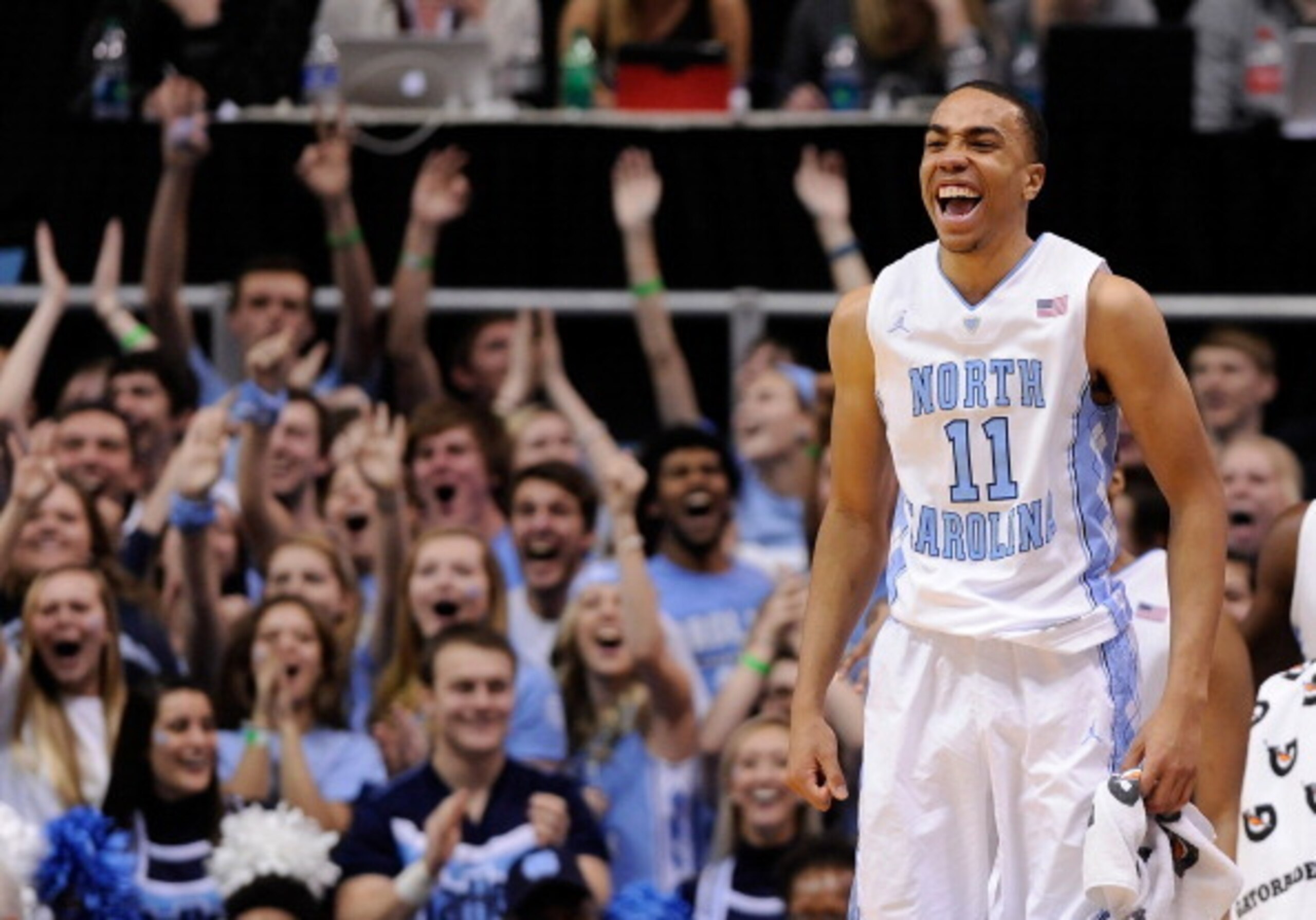
Class: Junior
2013-14 Stats: 10.3 PPG, 6.1 RPG, 1.3 BPG
The ceiling for Brice Johnson is really high. He's one of the best athletes in college basketball who gets off his feet extremely quickly. He runs the floor well, which makes him a good fit in UNC's offense. And he can knock down a face-up jumper.
Considering all that ability and the production he put up last season, it was tough to explain why he played only 19.4 minutes per game. The Tar Heels were deep inside, so I guess that explains it. Now that James Michael McAdoo is gone, there's really no reason why Johnson shouldn't slide into his starting role and play more minutes.
14. Shaq Goodwin, Memphis
7 of 20
Class: Junior
2013-14 Stats: 11.5 PPG, 6.5 RPG, 1.8 APG, 1.3 SPG, 1.8 BPG
Last season all anyone could talk about when it came to Memphis going into the year was the guard play. That changed some because of how good Shaq Goodwin was, and now all the talk around Memphis going into this season should be about the bigs: Goodwin and Austin Nichols.
Goodwin made a big leap from his freshman year. He shot 58.4 percent after shooting 46.6 percent as a freshman, and he had a better idea of how to use his great strength and quickness to his advantage.
Goodwin and Nichols were good working the high-low together, and that combination should only get better this season. It'll need to be if the Tigers—inexperienced everywhere else—want to make the tournament for a fifth straight season.
13. Markus Kennedy, SMU
8 of 20
Class: Junior
2013-14 Stats: 12.4 PPG, 7.1 RPG, 1.5 SPG, 1.2 BPG
Markus Kennedy has three attributes that make him really tough to cover on the blocks. He's a lefty, he has a big backside and he's patient.
So far in Larry Brown's two years back in college, he has preferred that his team score inside the arc, and Kennedy was the go-to guy last year, particularly in March. He averaged 14.4 points per game in the Mustangs' final nine games, helping the team advance all the way to the NIT Championship Game.
12. Branden Dawson, Michigan State
9 of 20
Class: Senior
2013-14 Stats: 11.2 PPG, 8.3 RPG, 1.6 APG
There are some guys who just know who they are and know how to get the most out of that. Branden Dawson has developed into one of those guys.
Dawson plays with terrific energy and has figured out how to be a productive scorer without much of a jumper. He's a really good finisher around the rim and can out-athlete just about anyone in the country.
On a loaded team last year, he averaged 17.5 points per game in Michigan State's six games leading up to the UConn loss. The Spartans lose stars Adreian Payne, Keith Appling and Gary Harris, but that six-game stretch from Dawson has to give them hope heading into this season.
11. Larry Nance Jr., Wyoming
10 of 20
Class: Senior
2013-14 Stats: 15.4 PPG, 8.6 RPG, 1.6 APG, 1.4 SPG, 2.1 BPG
Larry Nance Jr. was blessed with his dad's athletic ability and hops, and his pops taught him some footwork along the way as well.
Nance is a treat to watch operate from the blocks. He's really good at getting an angle, and that makes him an easy target for an easy bucket when the ball is delivered. He's also extremely quick with his moves inside. His 1.202 points per possession on post-ups ranked fourth in the nation last year (minimum 50 possessions), per Synergy.
Nance isn't a great shooter, but he's so good inside of four feet that it doesn't matter. He shot 81.3 percent at the rim last year, according to Hoop-Math.com. And to really see his value, look at what Wyoming did with him last season (17-9 overall, 8-5 in the Mountain West) and without him (1-6).
10. JayVaughn Pinkston, Villanova
11 of 20
Class: Senior
2013-14 Stats: 14.1 PPG, 6.1 RPG, 1.4 APG
Jay Wright has never had a Villanova team shoot a higher percentage of its attempts from outside the three-point line than last year's squad. The Wildcats shot a three on 44.8 percent of their attempts.
Yet with the guards firing all those long balls, JayVaughn Pinkston still got his numbers. And it was Pinkston— or at least the threat of Pinkston—who played a part in opening things up for the shooters. Pinkston is solid scoring from the blocks, and he can also attack off the dribble and get to the rim. He's always been consistent because he's always gotten to the line and is a solid free-throw shooter (74.4 percent).
It seems like he's been at Villanova forever. That's usually the case for a guy who has been as productive as he has.
9. Jonathan Holmes, Texas
12 of 20
Class: Senior
2013-14 Stats: 12.8 PPG, 7.2 RPG, 1.3 BPG
What started as a talented class of six at Texas was down to one by last season. Jonathan Holmes was the lone junior for Texas, as he watched his five other classmates either transfer or go pro the previous two years.
Thanks to all the departures, not much was expected out of the Longhorns. Holmes was not considered the most talented of that group, yet his leadership and versatility turned the Longhorns into an NCAA tournament club.
Holmes also showed he is a pretty talented player. He's an efficient scorer who can bang inside or knock down a pick-and-pop jumper, and he played solid defense and was a good rebounder. As the lone senior on this team, he'll play a similar role, although he may have to take on the added responsibility of playing a second position.
Rick Barnes plans to experiment with Holmes at the 3 to get both Cameron Ridley and freshman Myles Turner in the starting lineup. Holmes is a good enough shooter to play that spot, but will he be able to defend that position? How he fares there and how Barnes divvies up those minutes will be interesting to watch.
8. Cliff Alexander, Kansas
13 of 20
Class: Freshman
2013-14 Stats (High school): 25.0 PPG, 16.0 RPG, 6.0 BPG
Right away Cliff Alexander could overwhelm college players with his strength and effort. That's rare for a freshman, but getting Alexander to play hard should not be difficult for Bill Self. He projects as a Kenneth Faried type.
Alexander is a bit raw when it comes to fundamentals and footwork, but he picked the right program to get better in that capacity. Self's high-low offense has been great for developing big men and will put Alexander in spots to score. And not since Thomas Robinson has Self had a big man who played with such tenacity.
Like Robinson, Alexander figures to be a double-double machine. The Jayhawks will just be banking on it happening faster than it did for Robinson, because for this team to live up to expectations, Alexander is going to have to be good on both ends.
7. Brandon Ashley, Arizona
14 of 20
Class: Junior
2013-14 Stats: 11.5 PPG, 5.8 RPG, 1.0 APG
Arizona was 21-0 last season when Brandon Ashley got hurt against California in a game that turned out to be Arizona's first loss.
The 'Cats still managed to have a great season, but Ashley was missed because his absence made the team easier to guard. Ashley helps space the floor because of his shooting ability as a stretch 4. He made 37.9 percent of his threes last season and is a great pick-and-pop guy. He was scoring 1.294 points per possession on pick-and-rolls, according to Synergy, many of those paired with T.J. McConnell.
This team is similarly built—full of athletes, short on shooters—and Ashley's ability to make outside shots should once again be an extremely valuable asset.
6. Jordan Mickey, LSU
15 of 20
Class: Sophomore
2013-14 Stats: 12.7 PPG, 7.9 RPG, 3.1 BPG
Jordan Mickey is a great athlete with a chance to be a great player. His athleticism alone made a big impact as a freshman for the Tigers. Defensively, he was great shot-blocker without fouling. On the offensive end, he was a good finisher at the rim because of his ability to just jump over everyone else.
To become a really great scorer, Mickey needs to improve as a shooter. The good news is he has good form. He should also benefit this year from playing more inside. The Tigers would start games huge last year with Mickey at the 3 alongside the inside duo of Jarell Martin and Johnny O'Bryant. O'Bryant's leaving was not a good thing, but it at least makes it so Johnny Jones shouldn't have to play Mickey out of position as much.
5. Aaron White, Iowa
16 of 20
Class: Senior
2013-14 Stats: 12.8 PPG, 6.7 RPG, 1.8 APG, 1.0 SPG
Aaron White was made for Fran McCaffery's run-and-gun system. White is probably the quickest power forward in the country. He's also very skilled. He's so athletic and so skilled, in fact, that he often leaves you wanting more.
Wouldn't you want a guy who made 63.1 percent of his twos and 80.7 percent of his free throws to take more shots? For as talented as White is, it's really hard to grasp how he took only 17.9 percent of the shots last season when he was on the floor, according to KenPom.com.
White needs to be more assertive, especially with Roy Devyn Marble gone. Marble was undeniably the leader of last year's team. That might not be in White's personality, but for the Hawkeyes to get back to the tournament, he's going to need to be more involved in the offense.
4. Perry Ellis, Kansas
17 of 20
Class: Junior
2013-14 Stats: 13.5 PPG, 6.7 RPG, 1.0 APG
Andrew Wiggins got all the hype, but when Kansas needed a bucket in crunch time last season, Perry Ellis was the man Bill Self trusted.
Ellis is an extremely versatile scorer in the mold of Marcus Morris, who was an All-American as a junior at Kansas. Ellis can hit the spot-up jumper, play with his back to the basket and he got more comfortable last season attacking off the dribble as the game slowed down for him.
If there's one word to describe his offensive game, it'd be slippery. He has a great spin move and can score over either shoulder. He scored 30 or points twice last season, and he has the ability to average 16-18 points per game. The Jayhawks have other talented scorers coming in, but once again, Ellis is likely the man Self will trust more than any other.
3. Sam Dekker, Wisconsin
18 of 20
Class: Junior
2013-14 Stats: 12.4 PPG, 6.1 RPG, 1.4 APG
Look at those numbers. Sam Dekker was a starter on a Final Four team. That's a pretty darn good season, but for Dekker...
"I wasn't necessarily happy with how things ended up for me as a player," Dekker told my colleague Jason King this summer. "I don't think I lived up to my expectations of myself."
Dekker was expected to be the man for the Badgers last year, and Frank Kaminsky ended up coming out of nowhere to be the star. Dekker was solid all-around, but he didn't shoot as well from deep (32.6 percent) as he expected. He shot 39.1 percent as a freshman.
King said he was the standout among college players at the LeBron James Skills Academy that included some of the best talent in the country. He also reported that Dekker grew two inches—from 6'7" to 6'9".
The Wisconsin system does a great job of exploiting mismatches, and at 6'9", he's an even tougher cover for 3s. And his ability to shoot from deep or put the ball on the floor as a stretch 4 makes life tough on bigs.
Dekker will play both positions for the Badgers with Nigel Hayes expected to get more minutes at power forward. Sophomore Dekker was a tough cover. Add two inches, another year of experience in Ryan's system and some motivation...
Good luck, Big Ten.
2. Georges Niang, Iowa State
19 of 20
Class: Junior
2013-14 Stats: 16.7 PPG, 4.5 RPG, 3.6 APG
Georges Niang was one of the most difficult matchups in college basketball last season, and that was pudgy Niang. This summer Niang got skinny.
The argument could be made he was already the most dangerous weapon Fred Hoiberg has ever had. Royce White was bigger and more athletic, but he couldn't shoot. Niang can handle the ball and initiate the offense just like White but with the added threat of scoring the ball. That puts any big guarding him in an awkward spot.
Hoiberg is creative in how he uses his best scorers, but all he needs to do with Niang is give him the ball and have everyone get out of the way. Niang was only one of two post players who ranked in the top 30 in points per possessions on isolation plays (minimum of 50 possessions) last season, according to Synergy.
Everyone says he has an old-man game. That's because he has great footwork, great feel and he's slow. Add a little more quickness in because of the weight loss, and he's going to be even more difficult to check.
1. Montrezl Harrell, Louisville
20 of 20
Class: Junior
2013-14 Stats: 14.0 PPG, 8.4 RPG, 1.3 BPG
When Louisville lost to Kentucky in the NCAA tournament, Rick Pitino called it the "end of an era." All of his best players were graduating or likely off to the NBA. That included Montrezl Harrell.
Harrell surprised many by coming back to school, and his return means Louisville is once again a Final Four threat. He's one of the strongest bigs in the country, runs the floor, is a strong finisher at the rim and he's an excellent defender. Last season, his man scored only 71 points—a measly 0.587 points per possession—when he was defending, according to Synergy's numbers.
Harrell does have areas where he could improve and make Louisville's offense more diverse. He's never been great with his back to the basket, and he's depended on others to create for him. Often that was Russ Smith. He could also improve on his 46.4 percent shooting at the line last year. That's really just nitpicking though, because what Harrell does well, he does better than arguably any big in the country.
C.J. Moore covers college basketball for Bleacher Report. You can follow him on Twitter @CJMooreBR.
.jpg?w=2560 "Colts Chiefs Football")

.jpg?w=2560 "Porter Blasts Steelers 😳")
.jpg?w=2560 "Browns Improve to 3-1 After TNF Win 📈")