
Early College Basketball Player of the Year Rankings for 2014-15
The start of the 2014-15 college basketball season has been nothing short of scintillating and sensational, leaving no shortage of options for the Player of the Year rankings after less than a month.
As expected during the preseason, Jahlil Okafor and Frank Kaminsky sit atop the list and Montrezl Harrell isn't all that far behind in the top 10.
However, a lot has changed in a short amount of time.
North Carolina's Marcus Paige was arguably supposed to be the best player in the country, but he isn't even in the conversation at the moment. Virginia's Justin Anderson was completely overlooked by all the preseason top 100 lists, but he's knocking on the door of the top 10. Notre Dame's Jerian Grant is playing nothing like a guy who missed 20 games last season.
And those are only the biggest movers from the ACC. Through just three-and-a-half weeks, we've already got some major shifting all around the country.
We'll explain the criteria considered on the next slide before hitting on a plethora of honorable mentions.
Statistics on the following slides courtesy of Sports-Reference.com, ESPN.com and KenPom.com (subscription required) and are current through the start of play on Tuesday, December 9.
Criteria Considered
1 of 23
Much like the process of early-season bracketology, ranking these top 20 players was a painstaking combination of data-driven findings and anecdotal thoughts.
I wanted a baseline of 50 players, so the first stop was obviously the 50 preseason Wooden Award candidates.
However, some guys on that list have been injured (Dez Wells, Isaiah Taylor, Sam Dekker), some have underperformed (Kelly Oubre, Treveon Graham, Marcus Paige) and others are playing for teams that don't deserve a POY candidate (Michael Frazier II, Olivier Hanlan, Nic Moore). As such, about 15 players were removed from the list and replaced with others by perusing top teams and stat leaders.
(How was Alan Williams not one of the 50 preseason candidates for the Wooden Award?)
Once I had my 50 preliminary candidates, it was time to input data: minutes, points, rebounds, assists, steals, blocks and win shares per 40 minutes (as calculated by Sports-Reference.com).
Right away, I deleted anyone without at least 0.25 win shares per 40 minutes. The last four Wooden Award candidates had a mark at least that high, and if you aren't already at least at 0.25 against nonconference foes, you're probably not finishing the season above 0.2.
That got the list down to 32, at which point I was unwilling to continue deleting players, hence the 12 honorable mentions on the following slide.
With each of those 32 players, I considered per-game and per-40 minute statistics while also thinking about what he is worth to his team in terms of "wins above replacement." In other words, it's more than just how good the player has been. We're also considering how much it would negatively impact his team's tournament or title odds if he was suddenly injured or ruled ineligible.
There will be arguments. Try to keep them civil.
Honorable Mentions
2 of 23
Tyus Jones and Quinn Cook, Duke
Jahlil Okafor obviously made the cut, but it didn't feel quite right having three Duke players in the top 20. However, good luck distinguishing between Quinn Cook and Tyus Jones enough right now to say that one belongs in the top 20 and the other doesn't.
Rather than having one at 20 and one as an honorable mention, we're keeping them both on the outside until one distinguishes himself from the other.
Dakari Johnson, Kentucky
Again, it didn't feel right to have three players from the same team in the top 20, and we split enough hairs to decide that Willie Cauley-Stein and Karl-Anthony Towns were more deserving of a spot on the list than Dakari Johnson.
Johnson does have the highest win shares per 40 minutes mark in the country (0.38), though I'm not entirely sure why. In almost the exact same number of minutes, Johnson has five more points than Towns, but trails him by 15 blocks, four rebounds and an assist.
Brad Waldow, Saint Mary's
We had a player from Saint Mary's (Emmett Naar) as an honorable mention in Monday's ranking of the top 10 freshmen, so it only makes sense to have a Gael just miss this list as well.
Care to guess how many players are currently averaging at least 20 points and 10 rebounds per game? If you guessed one, then congratulations on identifying the leading question.
Brad Waldow is averaging 22.8 points and 10.0 rebounds per game, ranking sixth in the nation in scoring average and 18th in rebounding average. And while Saint Mary's hasn't yet played a ranked opponent, the Gaels have played some quality teams in Boise State, New Mexico State, UC Irvine and Denver. We'll keep watching Waldow as the season progresses.
D'Vauntes Smith-Rivera, Georgetown
Great as the Big East has been thus far, it's been much more team effort than individual stalwarts. Only five players in the entire conference have at least 0.25 win shares per 40 minutes, and D'Vauntes Smith-Rivera was the only one in our preliminary 50 candidates. (D'Angelo Harrison also made the top 50, but has "only" 0.242 win shares per 40 minutes.)
Smith-Rivera got out to a slow start in the first two games, but he's turning things around for a Georgetown team on the cusp of the Top 25.
Phil Forte, Oklahoma State
We're impressed with Phil Forte's newfound ability to play defense, but we're still waiting on Oklahoma State to face a quality opponent.
R.J. Hunter, Georgia State
R.J. Hunter's national status depends on how many more games Georgia State plans on losing. If the Panthers go 31-3 and he's still averaging 23.3 PPG, 3.6 RPG, 3.5 APG and 2.5 SPG, it's going to be hard not to argue for him as a potential Player of the Year.
Rakeem Christmas, Syracuse, and Travis Trice, Michigan State
Three cheers for two seniors who came out of practically nowhere to rank among the most efficient players in the country, but we're still wary of believing in a few weeks after what we saw for the past few years. Also, both Michigan State and Syracuse have already suffered three losses and aren't playing anywhere near as well as usual.
Larry Nance Jr., Wyoming
Larry Nance's per-game numbers are never going to blow you away, given the snail-like pace at which Wyoming plays, but he's a five-category guy playing nothing like someone who tore his ACL in February.
Fred VanVleet, Wichita State
It's an unwritten rule of writing about college basketball that you love Fred VanVleet, but his assist rate is down from last season and his three-point shooting (20.8 percent) is pretty dreadful.
Seth Tuttle, Northern Iowa
The Missouri Valley has some serious Wooden Award candidates, but we're holding off on putting Seth Tuttle (16.4 PPG, 7.9 RPG) in the top 20 until we see what he can do against Iowa and VCU later this month.
Super Honorable Mention: Georges Niang, Iowa State
3 of 23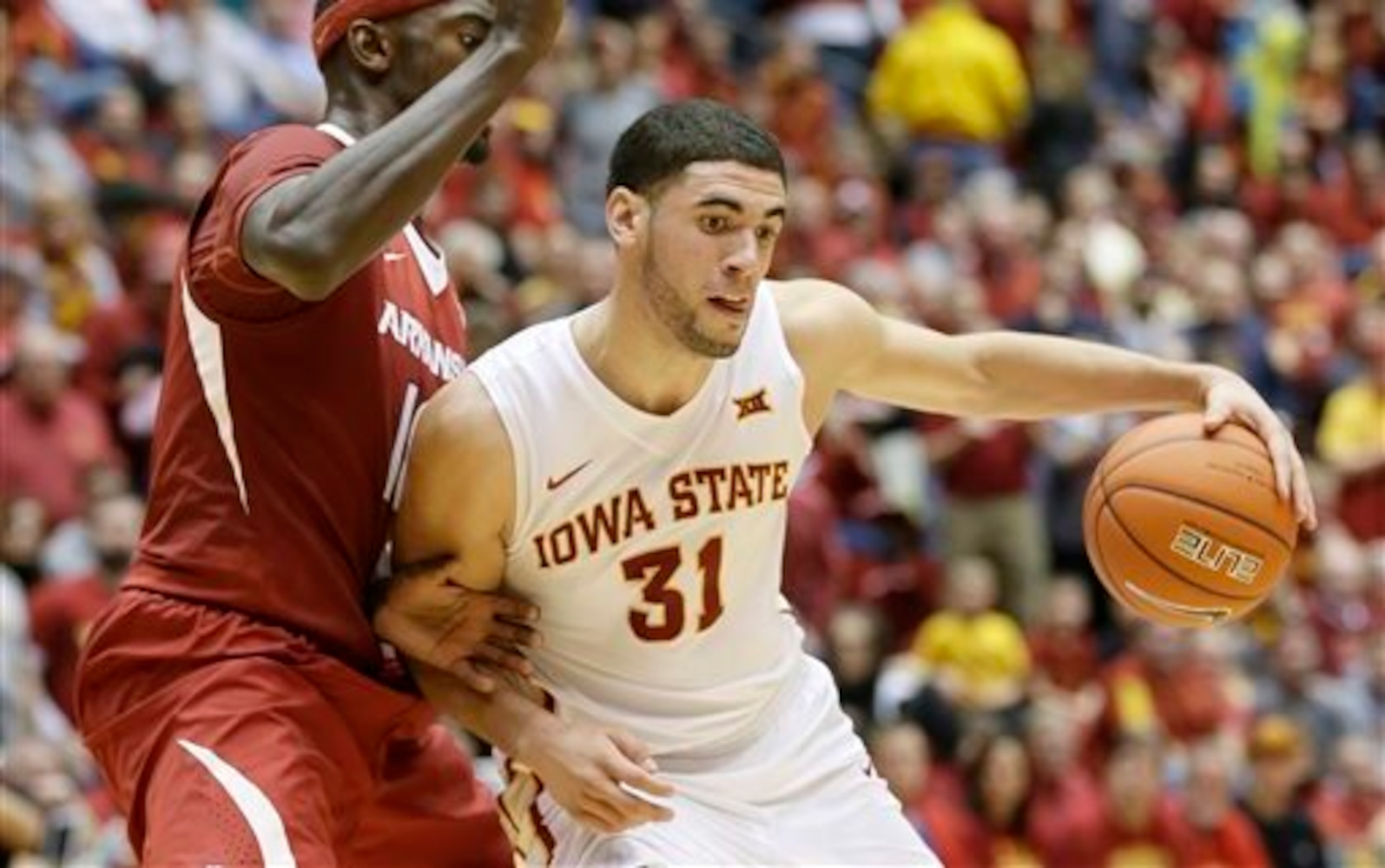
By the Numbers: 19.5 PPG, 6.5 RPG, 3.8 APG, 0.238 WS/40
Best Game: 26 points, eight assists, six rebounds vs. Arkansas
Why He's Here
A lot of very good players fell by the wayside because of the win shares criteria, but Georges Niang was by far the toughest to let go.
The big man is leading the Big 12 in points per game and ranks seventh in assists and 15th in rebounding. He was a top-10 guy on most everyone's preseason watch list, and it would be crime if he didn't get mentioned here because of a fraction of a fraction of a win share.
Other quality guys who were cut because of that metric but absolutely warrant watching throughout the year (in no particular order):
Marcus Paige, North Carolina (0.175 WS/40)
Perry Ellis, Kansas (0.227 WS/40)
Ryan Boatright, Connecticut (0.198 WS/40)
Malcolm Brogdon, Virginia (0.238 WS/40)
Melvin Johnson, VCU (0.216 WS/40)
D'Angelo Harrison, St. John's (0.242 WS/40)
D.J. Newbill, Penn State (0.242 WS/40)
Kevon Looney, UCLA (0.236 WS/40)
Joseph Young, Oregon (0.211 WS/40)
Stanley Johnson, Arizona (0.208 WS/40)

.jpg?w=2560)
20. Rondae Hollis-Jefferson, Arizona
4 of 23
By the Numbers: 12.8 PPG, 6.3 RPG, 2.0 APG, 1.3 BPG, 0.9 SPG, 0.275 WS/40
Best Game: 14 points, six rebounds, three blocks, two assists, one steal vs. San Diego State
Why He's Here
The only non-starter in the top 20, Rondae Hollis-Jefferson would be a lock for national sixth man of the year if such a thing was awarded.
The sophomore small forward leads Arizona in blocked shots and is second on the team in both scoring and rebounding behind Stanley Johnson. Here's a little-known factoid about Hollis-Jefferson: Among Wildcats who have attempted at least three free throws this season, he is making them most frequently at 77.5 percent.
He has been a Swiss army knife this season for Sean Miller, capable of playing anywhere from 2-4 while doing some damage in all five major categories.
The longer Arizona remains ranked in the top five, the more inevitable it becomes that the Wildcats have a serious candidate for National Player of the Year. Maybe it ends up being Johnson, but the early money is on Hollis-Jefferson.
19. Kevin Pangos, Gonzaga
5 of 23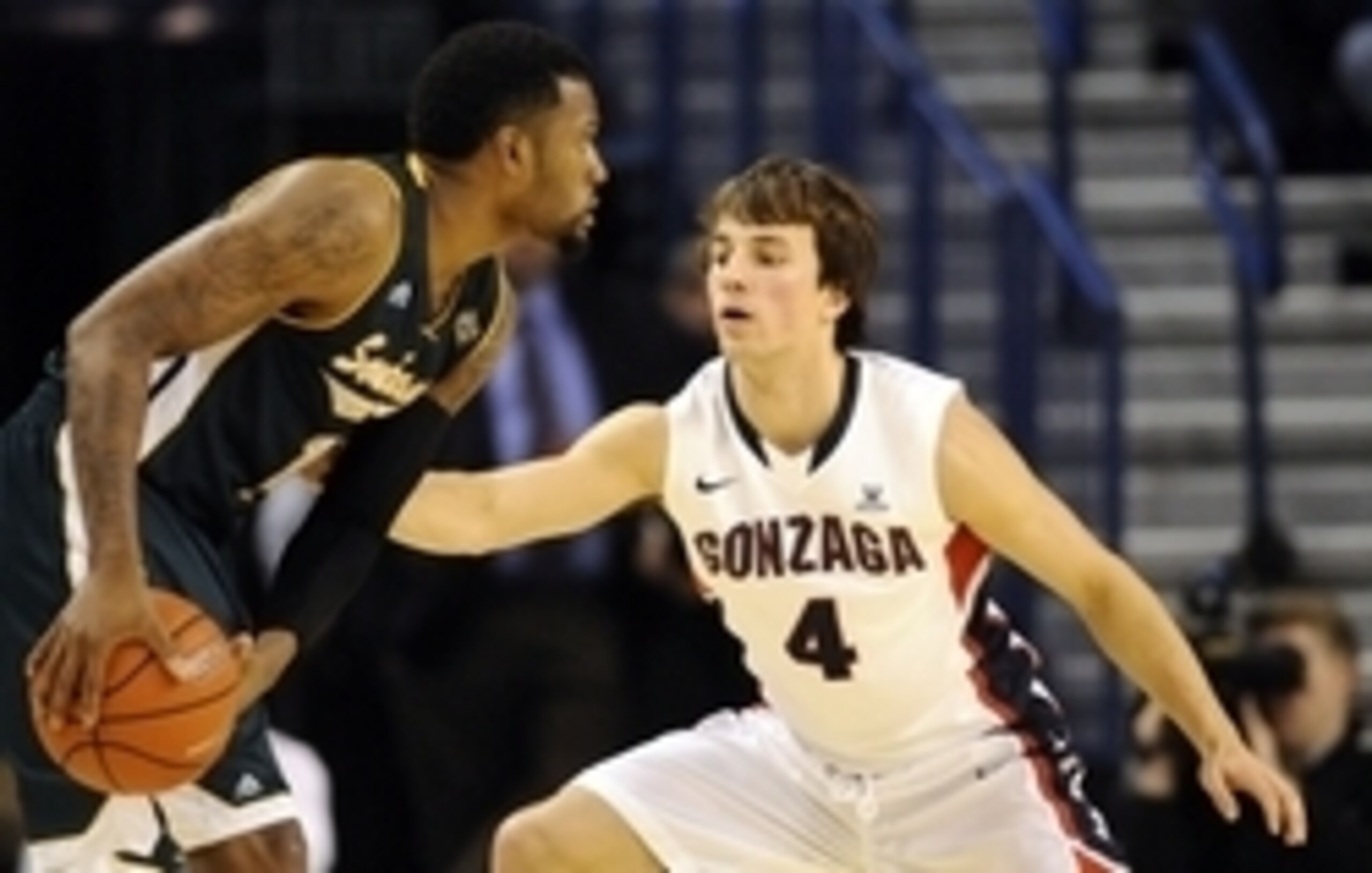
By the Numbers: 11.8 PPG, 5.9 APG, 2.9 RPG, 1.5 SPG, 0.299 WS/40
Best Game: 17 points, seven assists, five rebounds, three steal, zero turnovers vs. SMU
Why He's Here
Anyone can end up looking bad against Arizona's defense, but I'd be lying if I said Kevin Pangos' eight-point, four-turnover game against the best in the west didn't knock him down about 10 spots in these rankings.
Prior to that game, Pangos was one of the most sure-handed point guards in the country. In 209 minutes of action, he had 41 assists against just five turnovers.
In his first three seasons, he was a shooter who sometimes set up his teammates. This year, though, he's doing a pretty good John Stockton impression, increasing his assist average by more than 60 percent and increasing his shooting percentage by nearly 100 points but scoring fewer points per game.
Of course, in previous years, he didn't have toys like Kyle Wiltjer, Byron Wesley and Domantas Sabonis to play with.
Pangos is doing a fantastic job of leading one of the best offenses in the nation. He should gradually work his way back into the top 10 as the season progresses and we distance ourselves from that Arizona game.
18. Aaron White, Iowa
6 of 23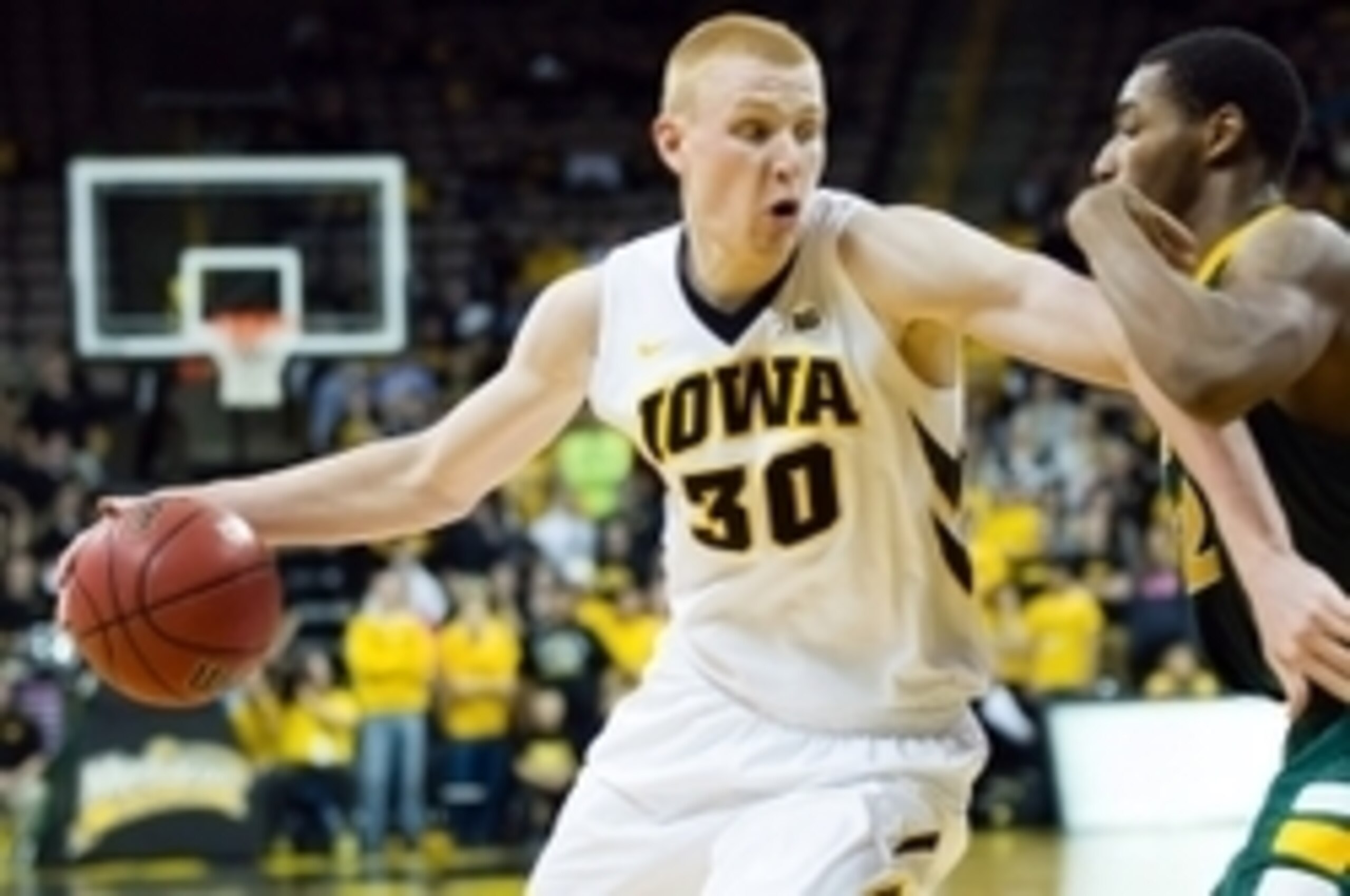
By the Numbers: 15.7 PPG, 7.3 RPG, 2.3 APG, 1.8 SPG, 0.34 WS/40
Best Game: 23 points, eight rebounds, two steals, one assist vs. Texas
Why He's Here
Iowa could have imploded this year (and still may) without Roy Devyn Marble, but Aaron White has really stepped up his game to become a more assertive piece of the Hawkeyes puzzle.
White has always been efficient, but he hasn't always been aggressive. He shot 58.4 percent from the field last season, yet scored only 12.8 points per game.
This year, he has increased his scoring output by more than 20 percent while simultaneously doing more in the rebound, assist and steal departments than ever before.
Basically, the team is relying on him to carry the load, and he's answering the call.
In by far their biggest win of the season, he didn't make a single field goal, but he was 10-of-10 from the line, finishing the night with 10 points, eight rebounds and three assists while frustrating the bejesus out of the entire front line of the Tar Heels.
One way or another, White is going to give Iowa about 15 points and seven rebounds on a nightly basis. That could go a long way.
17. Ron Baker, Wichita State
7 of 23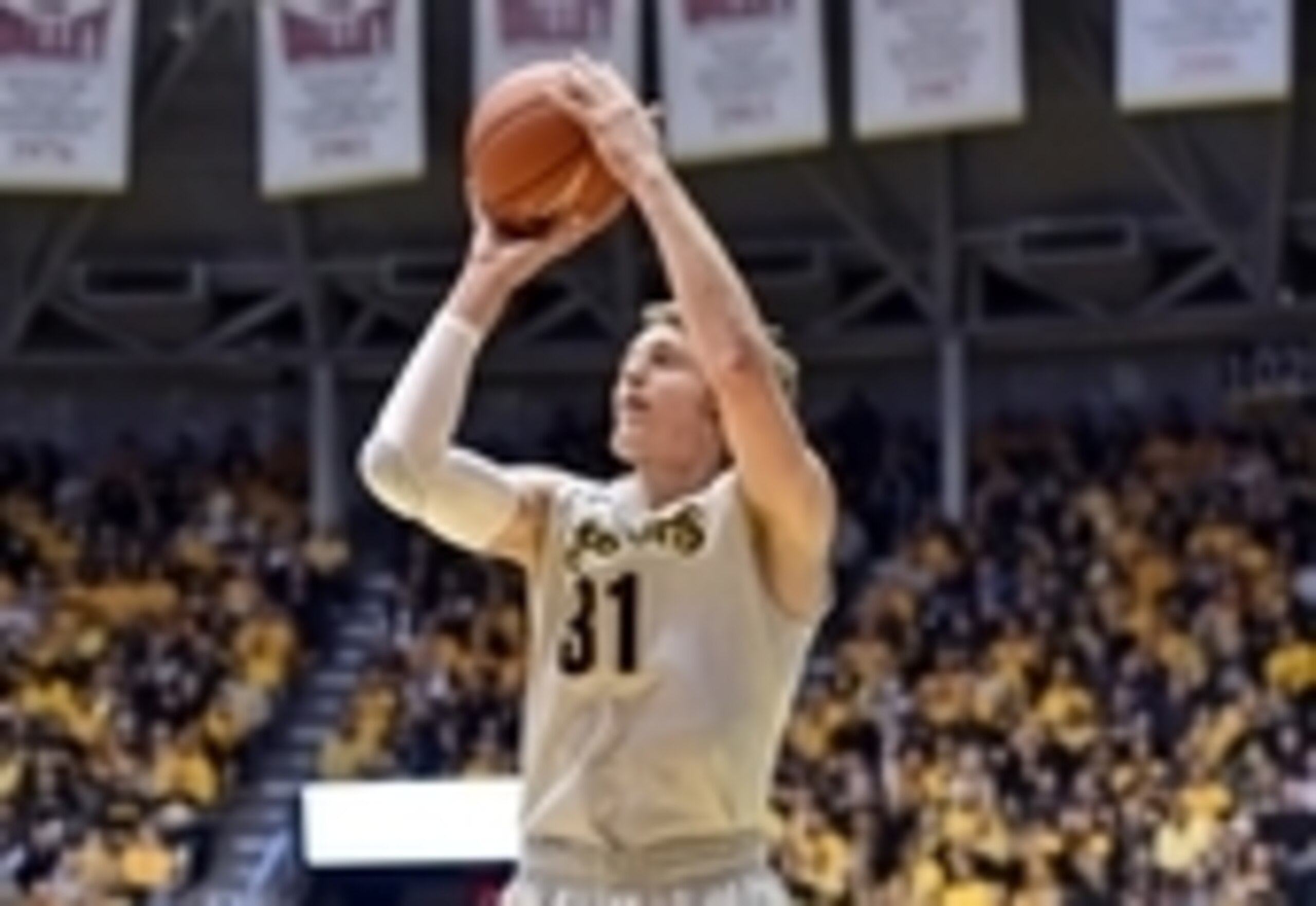
By the Numbers: 17.8 PPG, 4.2 RPG, 2.2 APG, 1.3 SPG, 0.322 WS/40
Best Game: 21 points, six assists, five rebounds, two steals, one block vs. Memphis
Why He's Here
Fred VanVleet didn't make the cut, but Ron Baker does.
Coming into the season, the big question with Baker was whether he could actually become an elite three-point shooter. We remember him catching fire during Wichita State's run to the 2013 Final Four, but he actually made just 37.3 percent of his three-point attempts in his first two seasons.
That's a solid percentage, but the Shockers needed more in the absence of Cleanthony Early.
Will 50 percent suffice?
Baker is 18-of-36 from downtown, drastically increasing his percentage while also attempting more triples per game.
Throw in his ability to grab some rebounds and force some turnovers and he has been one of the most valuable shooting guards in the country.
And unlike others on the list who are inevitably going to experience a decline in numbers once conference play begins, Baker might actually be capable of maintaining his win shares ratio in the Missouri Valley. If he's still shooting at least 43 percent from three-point range at the end of the season, he'll be high up on a lot of Wooden Award ballots.
16. Delon Wright, Utah
8 of 23
By the Numbers: 15.0 PPG, 5.1 APG, 4.7 RPG, 1.7 SPG, 1.1 BPG, 0.34 WS/40
Best Game: 24 points, seven rebounds, six assists, two blocks, one steal vs. Alabama State
Why He's Here
We all fell in love with Delon Wright over the summer because of his ability to stuff the stat sheets.
He's still putting up strong numbers, but each and every one of those per-game averages is a little bit lower than last season.
There's one major difference working in his favor, though.
People are actually watching this time.
Utah gained a little bit of traction at the end of last year in the part of the college basketball community that pays attention to things like BPI and Sagarin rankings, but the Utes were no more than an afterthought for the first few months of the season. I'd even venture to suggest that 95 percent of casual fans had never even heard of Wright until after the season ended.
Now, however, Utah is a serious force in the Pac-12, jumping up to No. 13 in the latest AP Top 25 after knocking off Wichita State.
That Wichita State game, though, was an 11 p.m. tipoff on a Wednesday night, meaning the only Utah game that a good number of people have watched this season was the one against San Diego State in which Wright had one of the worst stat lines of his career.
We'll see if he can win some people over this Saturday against Kansas.
15. Rayvonte Rice, Illinois
9 of 23
By the Numbers: 17.4 PPG, 7.3 RPG, 2.1 SPG, 1.8 APG, 0.359 WS/40
Best Game: 21 points, seven rebounds, five steals, one assist, one block vs. Indiana State
Why He's Here
Where Delon Wright has gotten a little bit worse while Utah gets a lot more attention, Rayvonte Rice has improved his game considerably while Illinois works its way back to national relevance.
Rice put up good numbers last season, but he has been better in all five per-game categories while actually playing 4.9 fewer minutes per game.
The difference in efficiency between current Rice and 2013-14 Rice is roughly the difference in efficiency between a drive-thru with one lane and a drive-thru with two.
There are already a lot of numbers up above, but humor me here.
Rice has increased his field-goal percentage by 100 points, his three-point percentage by 172 points and his free-throw percentage by 56 points. He has increased his scoring by 1.5 PPG and his rebounding by 1.3 RPG and has decreased his turnovers from 1.6 per game to 1.0.
All that despite a 1-of-7 shooting night with just two rebounds in his most recent game against American.
Tough to decide whether we should believe in this new version of Rice, but 39 points, 19 rebounds and zero turnovers during a two-game stretch against Baylor and Miami is even tougher to ignore.
There are a lot of quality players in the Big Ten—the conference represents 25 percent of these top 20 players—but Rice is going to at least get a lot of Big Ten Player of the Year votes if he keeps this up.
14. Kennedy Meeks, North Carolina
10 of 23
By the Numbers: 13.8 PPG, 10.1 RPG, 1.9 BPG, 1.4 APG, 0.9 SPG, 0.32 WS/40
Best Game: 18 points, 13 rebounds, two blocks, one assist, one steal vs. Florida
Why He's Here
Marcus Paige has been good, but nowhere near as good as we expected when crowning him a preseason first-team All-American.
Brice Johnson—and North Carolina in general—has been woefully inconsistent.
Justin Jackson and Theo Pinson have yet to look anything like McDonald's All-Americans.
But, hey, at least Kennedy Meeks is a monster?
Meeks has at least 11 points and 11 rebounds in five of North Carolina's eight games. In both the loss to Butler and the loss to Iowa, Meeks was the lone bright spot, combining for 22 points, 22 rebounds, seven blocked shots and four assists in those games.
Though he is much slimmer than last season, minutes played may still plague his overall standing. Extrapolate his numbers to 40 minutes and he's good for 23.9 points and 17.6 rebounds, but he is averaging only 23.0 minutes per night thus far.
However, if we're going to have two Kentucky players in the top 12, it only seems fair to rank Meeks, seeing as how he's still averaging a double-double despite the limited playing time.
13. Tyler Haws, Brigham Young
11 of 23
By the Numbers: 24.4 PPG, 3.9 RPG, 2.2 APG, 0.9 SPG, 0.288 WS/40
Best Game: 35 points, six rebounds, two assists, one steal vs. Utah State
Why He's Here
We can already hear you guys: "BYU played two games against D-II schools! Boo! Hiss!"
In actuality, those were the two least productive games of the season for Tyler Haws.
Against D-I competition, Haws is averaging 26.9 PPG and shooting 42.9 percent from three-point range. Had BYU used those games to pad his stats instead of giving playing time to reserves, he'd be leading the nation in scoring right now.
So, yeah, his win shares ratio isn't that great and he doesn't do a whole lot other than score a ton of points.
If he would just fight for another two or three rebounds per game, though, Haws would have numbers nearly identical to the ones Doug McDermott posted last season.
You remember McDermott, right? The guy who won every award known to mankind in 2013-14?
That's a pretty good dude to be favorably compared to.
12. Karl-Anthony Towns, Kentucky
12 of 23
By the Numbers: 9.4 PPG, 7.1 RPG, 2.8 BPG, 1.4 APG, 0.373 WS/40
Best Game: 19 points, nine rebounds, four blocks, two assists, one steal vs. Eastern Kentucky
Why He's Here
Karl-Anthony Towns is a gem of a player, but we have to wonder whether per-40 minutes stats will carry as much weight with the Wooden Award voting committee as their per-game counterparts.
For instance, Towns has a block percentage of 17.2 that ranks fifth in the nation, according to KenPom.com (subscription required), but he's merely in 27th place nationally in blocks per game.
His rate of win shares per 40 minutes is the fourth-highest among players considered, but he doesn't even appear on the national leaderboard in that category because he plays fewer than 20 minutes per night.
Eventually, I believe Towns joins the Harrison twins, Devin Booker, Alex Poythress, Dakari Johnson and Willie Cauley-Stein in Kentucky's primary seven-man rotation, playing enough minutes and putting up enough numbers to warrant consideration from per-game and per-possession statheads alike.
That's far from a guarantee, but let's just say there's a reason our resident NBA draft expert (Jonathan Wasserman) is asking whether Towns or Jahlil Okafor is the better prospect. Hard to believe the Wooden Award voters are going to disregard a consensus top-five draft pick just because he isn't playing 30 minutes per game.
11. Justin Anderson, Virginia
13 of 23
By the Numbers: 15.8 PPG, 4.9 RPG, 1.7 APG, 0.357 WS/40
Best Game: 21 points, eight rebounds, one block, one assist vs. VCU
Why He's Here
Of all the players on the list, Justin Anderson has been the biggest surprise by leaps and bounds.
The other 19 players were each expected to play huge roles for their team. Go find preseason projections for their respective all-conference teams and they were, at worst, second-team players.
But Virginia's studs were supposed to be Malcolm Brogdon and London Perrantes with honorable mentions for Anthony Gill and Mike Tobey. None of us really knew what to expect out of Anderson—the Cavaliers' sixth man who started all of five games last season and averaged 7.7 points per game over the previous two years combined.
Thus far, he has been downright amazing.
So amazing, in fact, that he was named the National Player of the Week by the U.S. Basketball Writers Association.
A 29.8 percent three-point shooter in his first two seasons, Anderson evidently forgot how to miss and is shooting 58.8 percent from beyond the arc. He's leading Virginia in scoring and has also been a serviceable defensive rebounder.
Anderson obviously won't stay this hot all season, but he has established himself as the team's replacement for Joe Harris. As long as he doesn't completely revert to being a 30 percent shooter, he should continue to be one of the leaders for one of the nation's best teams.
10. D'Angelo Russell, Ohio State
14 of 23
By the Numbers: 18.0 PPG, 5.4 APG, 4.3 RPG, 1.9 SPG, 0.294 WS/40
Best Game: 32 points, nine rebounds, five assists, one steal vs. Sacred Heart
Why He's Here
Please forgive me for comparing a Buckeye to a Wolverine, but it's impossible not to see the similarities between D'Angelo Russell and Trey Burke.
During his sophomore year at Michigan, Burke averaged 18.6 PPG, 6.7 APG, 3.2 RPG, 1.6 SPG and shot 38.4 percent from the three-point line. He wasn't particularly efficient, needing 14.3 field-goal attempts per game to score his points, but there was no one you'd rather have with the ball in his hands and the game on the line.
That's Russell to a T.
Russell isn't averaging quite as many assists as Burke did, but that's partially because Shannon Scott (8.1 APG) is racking up so many dimes and partially because he doesn't have guys like Tim Hardaway, Nik Stauskas and Glenn Robinson III to capitalize as frequently on his looks to open teammates.
However, we want to see more from Russell against quality opponents before moving him any higher into the top 10. He played very well in the second half against Louisville, but that's Ohio State's only game against a top 100 team to date.
If he's still averaging these numbers against Big Ten teams, it'll be fun to watch him skyrocket into the top five of the Player of the Year and NBA draft discussions.
9. Montrezl Harrell, Louisville
15 of 23
By the Numbers: 16.1 PPG, 9.4 RPG, 1.3 APG, 1.0 BPG, 0.324 WS/40
Best Game: 30 points, seven rebounds, two steals vs. Minnesota
Why He's Here
After that opening night game against Minnesota, it looked like Montrezl Harrell was ready to blaze through this season like a video gamer playing on the easiest difficulty level in order to break all the records.
Since that 30-point outing, though, he has yet to score more than 15 points in a game.
Moreover, since hitting those three three-pointers against the Golden Gophers, Harrell is 0-of-9 from behind the arc and is shooting just 52.5 percent from the free-throw line.
Basically, that first game was a mirage and we're instead getting the same version of Harrell that we saw over the final two months of last season.
That's hardly a criticism, considering we were all astonished that Harrell came back for his junior season after spending those two months establishing himself as a potential first-round pick.
Like D'Angelo Russell, though, the jury is still out on Harrell until Louisville's level of competition improves.
By the end of January, he'll have played against Duke, Kentucky and twice against North Carolina. It won't be long before we have enough data points to definitively determine if he's the best big man in the country.
8. Caris LeVert, Michigan
16 of 23
By the Numbers: 18.6 PPG, 5.6 RPG, 4.4 APG, 2.3 SPG, 0.268 WS/40
Best Game: 32 points, six rebounds, four steals, one assist vs. NJIT
Why He's Here
The loss to NJIT was probably the worst that any team will suffer this season, but it will have been a good thing if it serves as the kick in the pants that Caris LeVert needed.
He certainly wasn't playing poorly or tentatively before the NJIT game. He has attempted at least 11 total field goals and at least three three-point field goals in every game. He was averaging 16.7 points per game.
Yet, it really felt like he had a sixth gear that he didn't discover until the second half against the Highlanders.
While the rest of the Wolverines seemed content with suffering a horrible loss, LeVert scored 25 of the team's 38 second-half points, putting the team on his back as much as humanly possible.
After a players-only meeting led by LeVert and Spike Albrecht following the loss to NJIT, Brendan Quinn of MLive.com quoted LeVert as saying, "It's not about the (NJIT) game. It's how you respond to it."
With an interior game made up of Mark Donnal and Ricky Doyle, they'll need more games like that from LeVert in order to survive the season. He isn't the one-man show that Joseph Young needs to be at Oregon, but LeVert is the Batman to Zak Irvin's Robin.
He might lead the Big Ten in scoring, and with peripheral numbers like the ones above it might be LeVert instead of D'Angelo Russell getting the comparisons to Trey Burke.
7. Alan Williams, UC Santa Barbara
17 of 23
By the Numbers: 18.0 PPG, 12.6 RPG, 2.9 BPG, 1.9 APG, 1.1 SPG, 0.281 WS/40
Best Game: 22 points, 20 rebounds, six blocks, one assist, one steal vs. Mercer
Why He's Here
Despite a poor showing against SMU on Monday—poor by our "Alan Williams is a basketball god" standards, as he still recorded nine points, eight rebounds, three blocks and two steals before fouling out—Williams has to be considered one of the primary candidates for National Player of the Year.
If you're not familiar with Williams' work, shame on you, but he is a 6'7" center who simply exists to score and rebound.
Last season, he finished eight games with what I like to call 1.5 double-doubles (at least 15 points and 15 rebounds) and already has two of them this season.
He's the only person to record at least 20 rebounds in a game against a D-I opponent this season, and we'd bet dollars to doughnuts he has at least one more 20-point, 20-rebound game in his bag of tricks before the season (and his college career) ends.
If you haven't gotten a chance to see Williams yet this season, he still has two games on the Pac-12 Network against Oregon on Dec. 22 and against Oregon State on Dec. 30.
Considering Oregon doesn't regularly play anyone taller than 6'7", we'd advise you tune in for the first of those two options and enjoy the show.
The real key to his candidacy: Can UCSB stop losing games? The Gauchos are already 4-4 and have blown every chance at a quality win. No matter how ridiculous his stats are, Williams won't be winning any awards if his team misses the NCAA tournament.
6. Josh Scott, Colorado
18 of 23
By the Numbers: 16.6 PPG, 8.6 RPG, 2.0 BPG, 1.6 APG, 0.365 WS/40
Best Game: 29 points, 13 rebounds, five assists, three blocks vs. Lipscomb
Why He's Here
Can someone please explain why Josh Scott still isn't showing up on any draft boards?
Since when does the NBA not like 6'10", 245-pound power forwards who shoot nearly 90 percent from the free-throw line, routinely record double-doubles and block a couple shots per game?
Let's not sugarcoat it: Scott already is what Cliff Alexander is supposed to be.
His start to the season isn't a fluke, either. He recorded 13 double-doubles last season while shooting 81.0 percent from the free-throw line.
I can almost appreciate college basketball fans not giving him the respect he deserves because Colorado hasn't appeared in the Top 25 yet this season, but are scouts really this oblivious to Scott's play?
5. Willie Cauley-Stein, Kentucky
19 of 23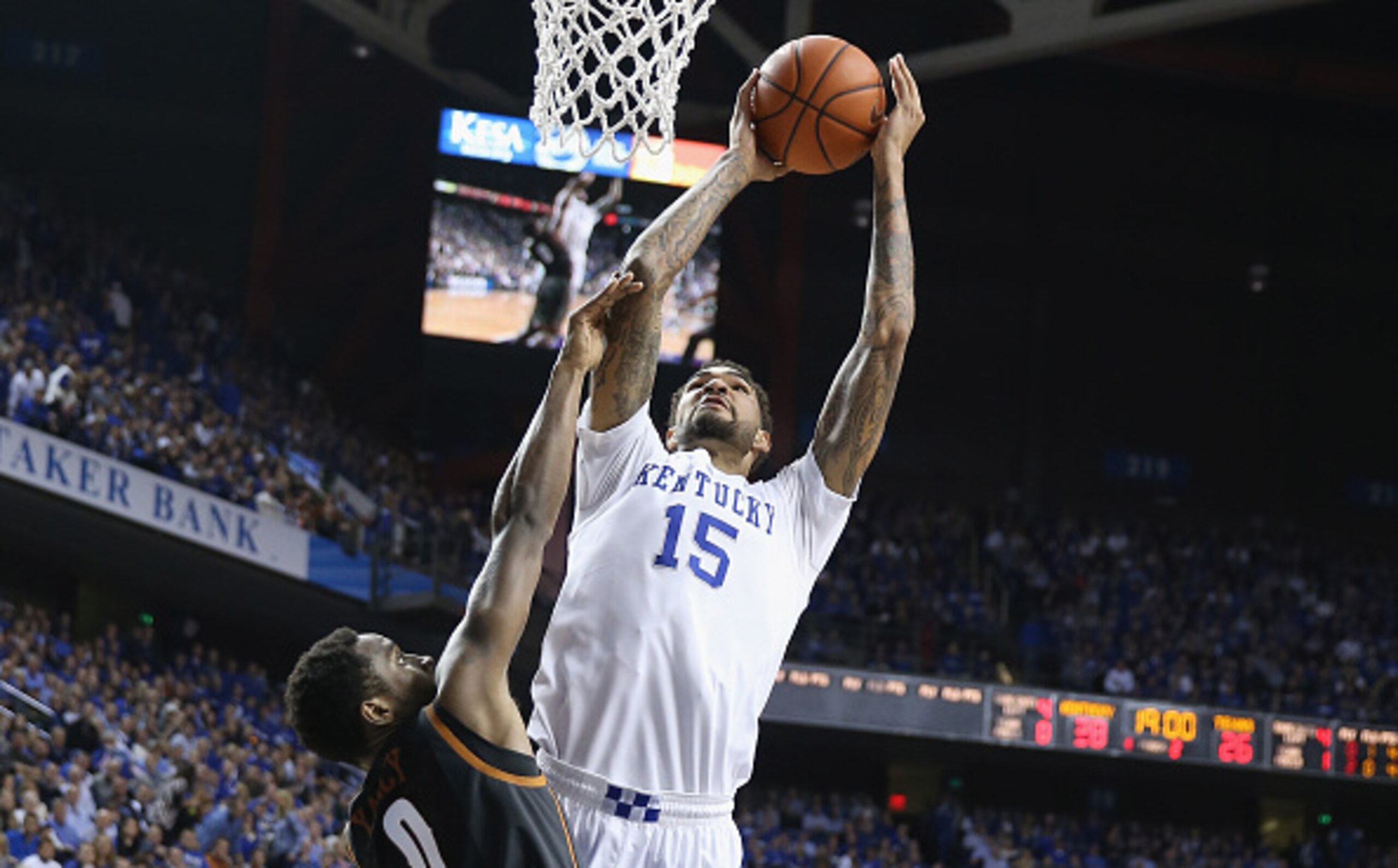
By the Numbers: 10.3 PPG, 6.6 RPG, 1.7 SPG, 1.7 BPG, 1.1 APG, 0.375 WS/40
Best Game: 21 points, 12 rebounds, five steals, three blocks vs. Texas
Why He's Here
As was the case with Karl-Anthony Towns, it's tough to say what sort of negative impact the platoon system will have on Willie Cauley-Stein's POY status.
He already had his statement game last weekend against Texas, pretty much single-handedly willing the Wildcats to victory by stuffing the box score like a Thanksgiving turkey.
What's curious is that he's playing almost the exact same number of minutes per game as the last two seasons, but he's improved in some categories and not so much in others.
Once regarded as a block machine, Cauley-Stein is averaging just 2.8 blocks per 40 minutes after posting a ratio of 4.8 last year. But his scoring is way up from 6.8 points per game last season and he has been marginally better in rebounds, assists and steals.
The most important increase, though: free-throw shooting.
Hack-a-Cauley-Stein was a perfectly valid strategy over the last two seasons as he shot 42.6 percent from the line, but he's sitting at a 63.0 percent clip this season. That still isn't great, but it isn't "Don't let that liability on the court in the final five minutes with a single-digit lead" either.
Regardless of minutes, at least one player from Kentucky is inevitably going to be a serious contender for Player of the Year. For now, we like Cauley-Stein as the top dog for the 'Cats.
4. Wesley Saunders, Harvard
20 of 23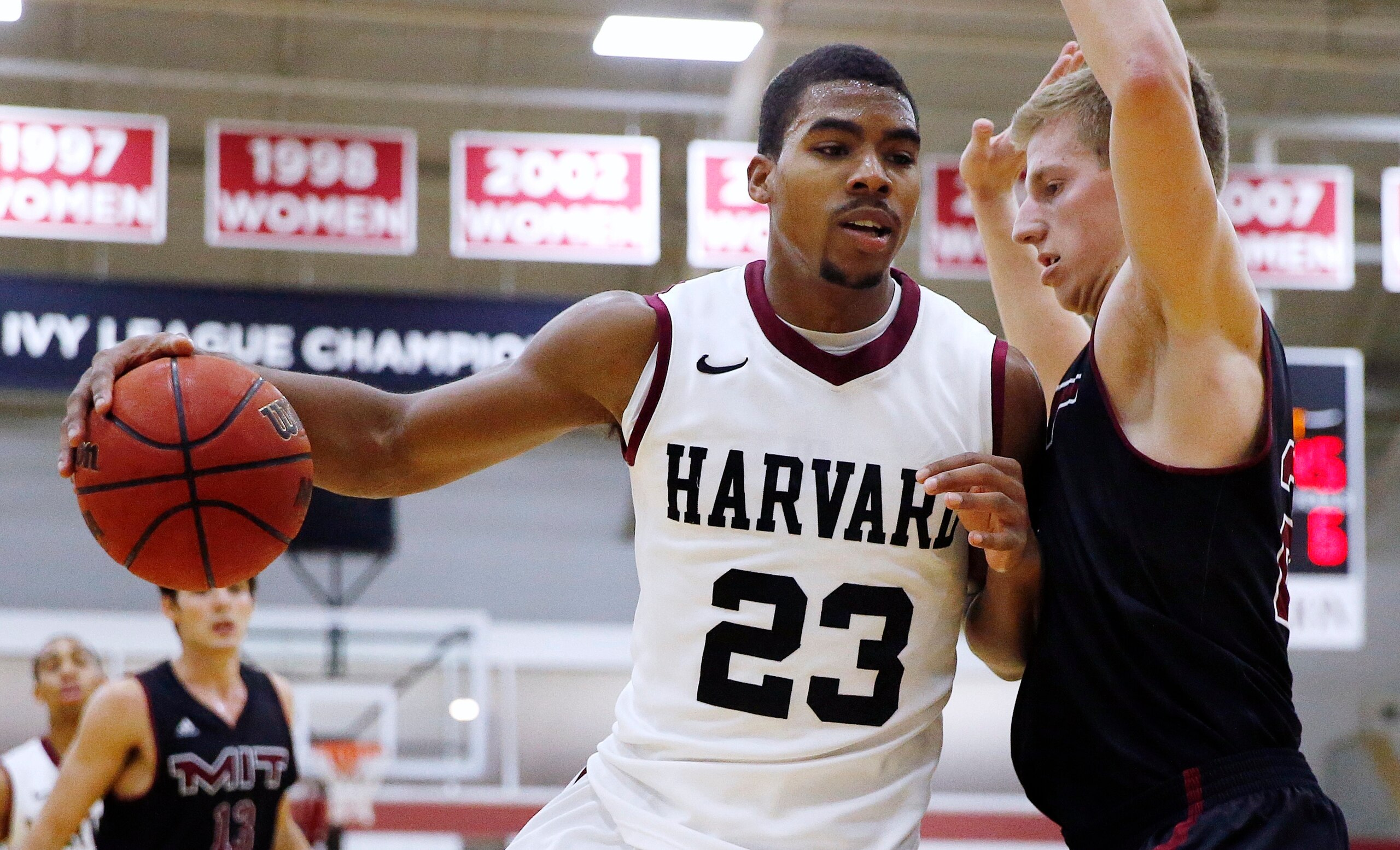
By the Numbers: 20.1 PPG, 7.0 RPG, 4.5 APG, 2.8 SPG, 0.337 WS/40
Best Game: 24 points, 12 rebounds, four steals, three assists, three blocks vs. Holy Cross
Why He's Here
You may have forgotten about Harvard since that one-point loss to Holy Cross—the AP certainly has, as the one-loss Crimson didn't receive a single vote this week even though Yale did—but Wesley Saunders has been quietly setting the world on fire.
Even in the Holy Cross loss, he was unstoppable. If Siyani Chambers hadn't had the worst game of his life on that night, Harvard would still be undefeated and probably ranked in the top 15.
C'est la vie.
Eventually, Saunders is going to mess around and record a triple-double. His season high in each category: 27 points, 12 rebounds, eight assists, seven steals. If he ever puts it all together in one game, it'll be the best individual performance of the entire season.
As was the case mentioned earlier with Ron Baker, we're not too concerned about Saunders experiencing the type of drop-off in production that these other guys will once they start playing their power conference schedules.
The Ivy League isn't completely terrible, but it certainly isn't the Big Ten or the ACC.
The next two games will likely dictate whether Saunders gets any respect in the voting at the end of the season. It'll bode well if he can perform well in road games against Virginia and Arizona State.
3. Jerian Grant, Notre Dame
21 of 23
By the Numbers: 19.0 PPG, 6.4 APG, 3.6 RPG, 1.7 SPG, 0.376 WS/40
Best Game: 27 points, six assists, four rebounds, three steals, one block vs. Michigan State
Why He's Here
Do you think Notre Dame might have missed this guy in the second semester last year?
Jerian Grant picked up almost exactly where he left off when being ruled academically ineligible 12 months ago. Back then, he was averaging 19.0 PPG and 6.2 APG.
Grant has scored at least 13 points in every game the Irish have played this season and has reached at least 20 points four different times. Better yet, he has at least five assists in eight of the nine games.
Everything about this team's offense runs through him. The Irish currently rank seventh in adjusted offensive efficiency, according to KenPom.com (subscription required).
Despite losing two of last year's three leading scorers in Garrick Sherman and Eric Atkins, this is probably the best Notre Dame team that we've seen since the 2010-11 season.
And it's all thanks to the return of Grant.
As Rob Dauster of NBC Sports noted in his recent Player of the Year rankings (where Grant is also No. 3), "The Irish lost nine games by single digits after Grant was suspended last season, and that would have changed seeing as he’s the guy they go to down the stretch of games."
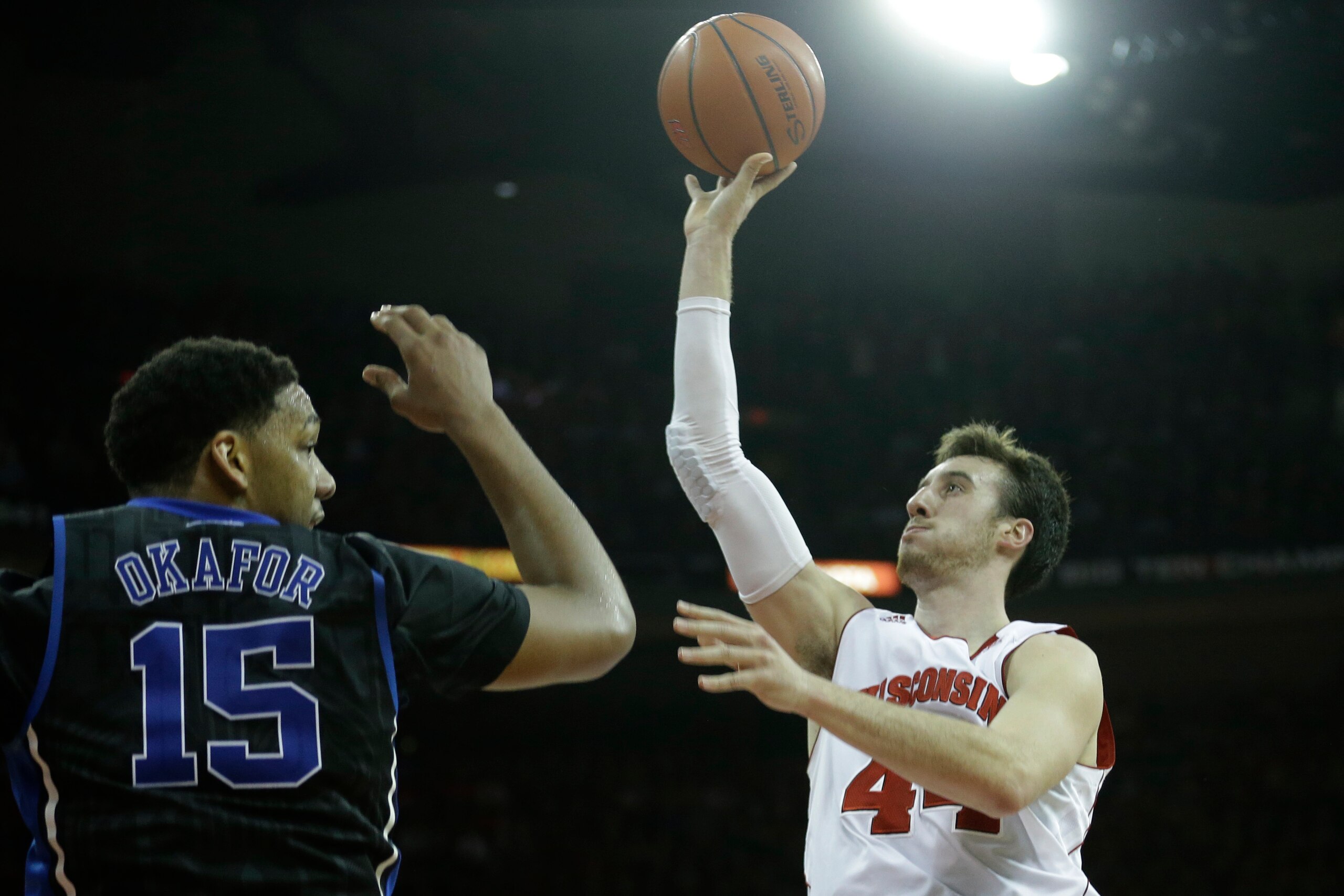
2. Frank Kaminsky, Wisconsin
22 of 23
By the Numbers: 16.4 PPG, 8.9 RPG, 2.2 BPG, 2.2 APG, 1.3 SPG, 0.324 WS/40
Best Game: 20 points, 15 rebounds, seven blocks, two assists, one steal vs. Green Bay
Why He's Here
This was an extremely difficult call, but I believe the head-to-head victory puts Jahlil Okafor ahead of Frank Kaminsky for the time being.
However, this battle is playing out much like the battle between Duke and Kentucky in most power rankings: They're clearly the top two, and you can make a valid case for either one at No. 1.
Kaminsky came into the season as a preseason first-team All-American and has gotten better in every single category except for turnovers and free-throw shooting.
He's shooting more three-pointers and making a higher percentage of them. His rebounding rate is up from 9.3 per 40 minutes to 11.4. He's distributing the ball more than ever before and has beefed up his defense in regards to blocks and steals.
There's really nothing not to like about Kaminsky. If Wisconsin cuts through the Big Ten like a hot knife through butter, he should be named National Player of the Year no matter what Okafor does.
1. Jahlil Okafor, Duke
23 of 23
By the Numbers: 17.1 PPG, 7.6 RPG, 1.6 APG, 1.5 BPG, 0.9 SPG, 0.294 WS/40
Best Game: 24 points, seven rebounds, three assists, two blocks vs. Furman
Why He's Here
In the past decade, we've had two freshmen (Kevin Durant and Anthony Davis) win National Player of the Year awards as freshmen.
Jahlil Okafor is fixing to make it three.
It's crazy to think that Duke lost Jabari Parker and Rodney Hood and actually got a lot better, but Okafor's presence has made it possible.
On offense, not only is he leading the team in scoring, but the need to provide help defense on him in the paint has led to a ridiculous number of open three-pointers for a team that has been notoriously abusing the three-point line since it was painted on the courts.
On defense, he has been something of a safety net, allowing the guards to go for more steals while also improving the team's defensive rebounding and two-point field-goal defense.
(Amile Jefferson has actually been Duke's unsung hero on the glass, but he has had a much easier go of things this season because his running mate in the paint is Okafor instead of Parker.)
The Blue Devils might not win it all this season, but with Okafor in tow they certainly won't be eliminated in the first round by some team shooting 62.5 percent from two-point range.
Kerry Miller covers college basketball for Bleacher Report. You can follow him on Twitter @kerrancejames.


.jpg?w=2560 "Nabers' Recent IG Post 👀")