Kansas vs. Oklahoma II: What to Expect as an Encore to CBB's Game of the Year
On Jan. 4, Kansas and Oklahoma waged war in one of the most exhilarating college basketball duels in recent memory.
That game had everything.
For just the fourth time in the past 10 years, it was a regular-season battle between No. 1 and No. 2 in the AP Top 25. It featured two of the primary candidates for the Wooden Award (Wayne Selden and Buddy Hield). It came on the first Monday without an NFL game in nearly four months and just two days after college football's bowl season had all but wrapped up, resulting in substantially more national intrigue than if it had been played one week earlier.
.jpg?w=2560 "Cardinals 49ers Football")
And then the game even exceeded the insane amount of hype it received by going to three overtimes. On a scale from 1-10, Round 1 of Kansas vs. Oklahoma was a 46, which is the ridiculous number of points Hield scored in the 109-106 losing effort.
"Like most sportswriters, I've racked my brain and can't come up with a more electric regular-season game in college basketball," wrote Shannon Ryan for the Chicago Tribune.
With Oklahoma now ranked No. 3 and Kansas still sitting pretty at No. 6, can the sequel possibly live up to the original?
The Jayhawks and Sooners have each played 10 games since last facing each other, and we dove into that data to get a grasp on what has changed about these two teams in the past five weeks and what we should expect as a result.
And the eyes were immediately drawn to the decrease in scoring by both teams.
| Team and Time Frame | Points / Game | Poss. / Game | Points / Poss. |
| Kansas through Jan. 4 | 89.8 | 74.4 | 1.21 |
| Kansas since Jan. 4 | 73.4 | 69.0 | 1.06 |
| Oklahoma through Jan. 4 | 88.4 | 76.4 | 1.16 |
| Oklahoma since Jan. 4 | 78.4 | 70.3 | 1.12 |
Oklahoma and Kansas were two of the five highest-scoring teams in the country at the conclusion of their last meeting. And while they still respectively rank 11th and 16th in the nation in points per game, it's evident that the drastic increase in level of competition has taken quite the toll on their scoring.
Kansas' scoring, in particular, is way down. After dropping 102 on Baylor and 109 on Oklahoma, the Jayhawks were averaging 89.8 points per game through 14 contests, but they haven't even topped 77 against a Big 12 opponent since then.
Even Oklahoma's high-powered, three-point oriented offense has now been held to fewer than 70 points in back-to-back games—though, that can be heavily attributed to Jordan Woodard scoring a combined three points in those games after averaging 14.4 through the first 21 games of the season.
And don't forget that these teams were tied at 77 at the end of regulation back in January. They needed all three of those extra five-minute periods to hit the century mark.
Hopefully they won't give us a rock fight, but expecting to see a game played in the mid-80s or low-90s seems more than a little foolish.
On Oklahoma's side of things, a decrease in pace of play is largely to blame for the decrease in points. The Sooners shot 47.3 percent from the field in their first 13 games and have shot 47.2 percent since then, but averaging 6.1 fewer possessions per game has limited their ability to light up the scoreboard.
There are two other culprits, though.
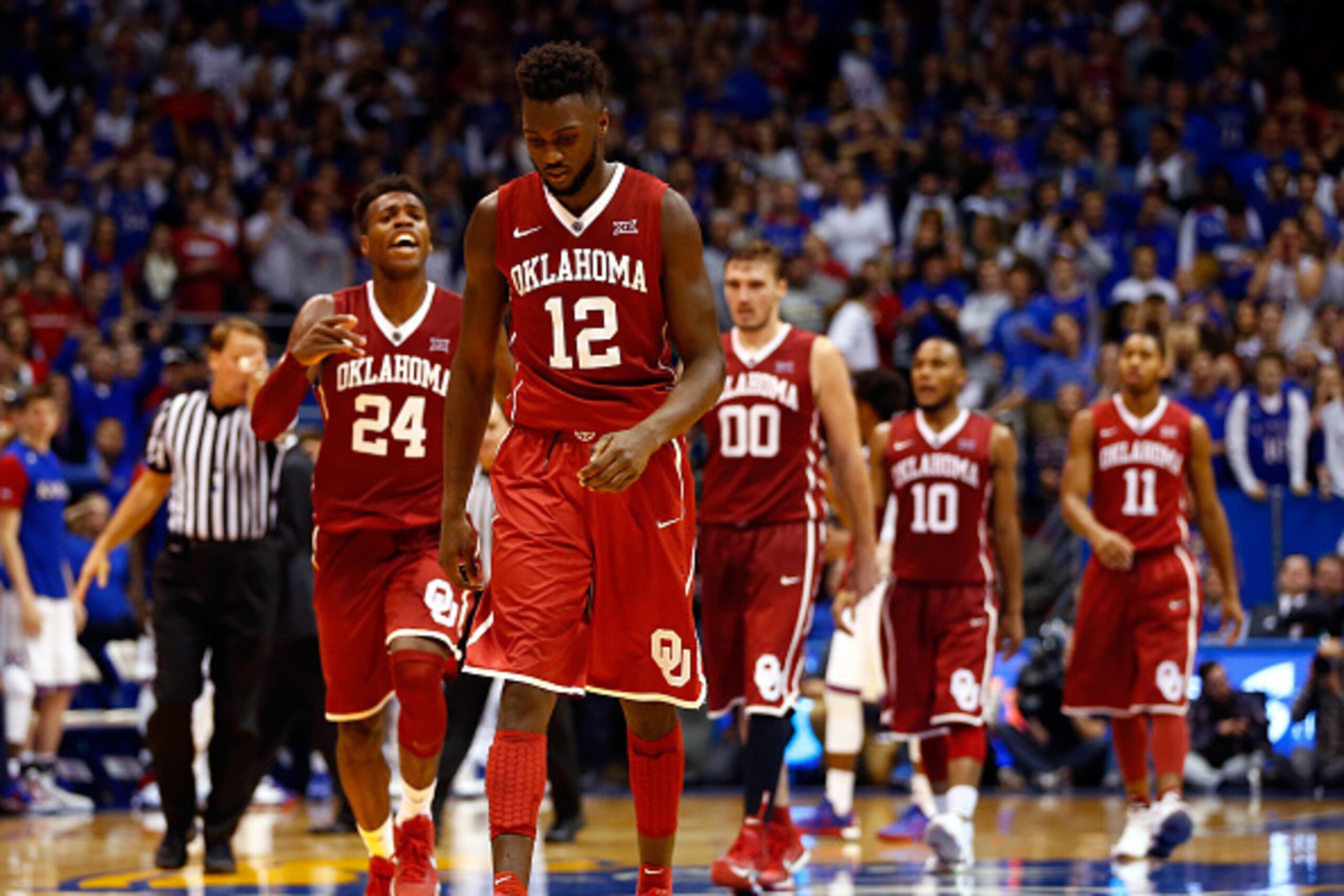
Oklahoma had an average rebounding margin of plus-8.2 per game but is averaging minus-0.8 over its last 10 games. Ryan Spangler is still doing work on the glass, but Khadeem Lattin has vanished. After averaging 12.3 rebounds per 40 minutes through his first 16 games, Lattin has been good for just 6.7 rebounds per 40 minutes over his last seven games.
And not only is Lattin less effective with his minutes, he's receiving fewer of them. Dante Buford has gotten a substantial boost in playing time over the past few weeks, but the 6'7" forward is much more of a wing than a bruiser in the post, corralling three rebounds or less in every Big 12 game.
An increase in turnovers is also to blame for Oklahoma's decreased scoring. Despite 6.1 fewer possessions per game, the Sooners are giving the ball away 1.1 more times per contest.
Fortunately for them, that shouldn't be a problem on Saturday, because Kansas' defense is way less aggressive than it used to be.
| Time Frame | Assists/G | Steals/G | Turnovers/G (Committed) | Turnovers/G (Forced) | Assist Rate | Assist/TO |
| Through Jan. 4 | 18.5 | 8.5 | 11.0 | 14.9 | 57.7% | 1.68 |
| Since Jan. 4 | 13.3 | 5.1 | 13.8 | 10.7 | 52.8% | 0.96 |
No one was ever confusing the Jayhawks with West Virginia or VCU, but they had one of the better turnover-forcing defenses, recording at least six steals in each of their first 14 games. But now, they're just barely averaging five per night for a decrease of 40 percent in steals per game.
Worse yet, the Jayhawks are also giving the ball away far more often. Granted, two of their last 10 games were against West Virginia—a team that leads the nation in steal percentage—so a moderate uptick in turnovers was to be expected. However, their average turnover margin has gone from plus-3.9 per game to minus-3.1.
Coupled with an assists-per-game average that dropped by about 28 percent, Kansas' assist-to-turnover ratio over the last 10 games is 0.96. Compared to the 1.68 ratio posted through the first 14 games, that's a pretty damning indication of how "well" these guards have been protecting and distributing the ball as of late.
| Time Frame | FG% | 3P% |
| Through Jan. 4 | 50.6 | 46.3 |
| Since Jan. 4 | 46.3 | 36.5 |
Of course, it's hard to get assists when guys aren't making baskets.
Selden is by far the biggest culprit for those numbers. He was absolutely on fire through the first eight weeks of the season, but outside of a big game against Kentucky, he has been ice cold for more than a month.
At the conclusion of the first game, Selden was shooting 55.2 percent from the field and 54.2 percent from three-point range. Since then, he's 41.9 percent from the field and 29.6 percent from beyond the arc.
Displaying his struggles in a different metric, Selden's average O-rating through 14 games was 132.8, but it's 91.2 since then.
If the Jayhawks are to have any chance of winning this road game against arguably the best team in the country, getting Selden back on the right track has to be No. 1 on their to-do list.
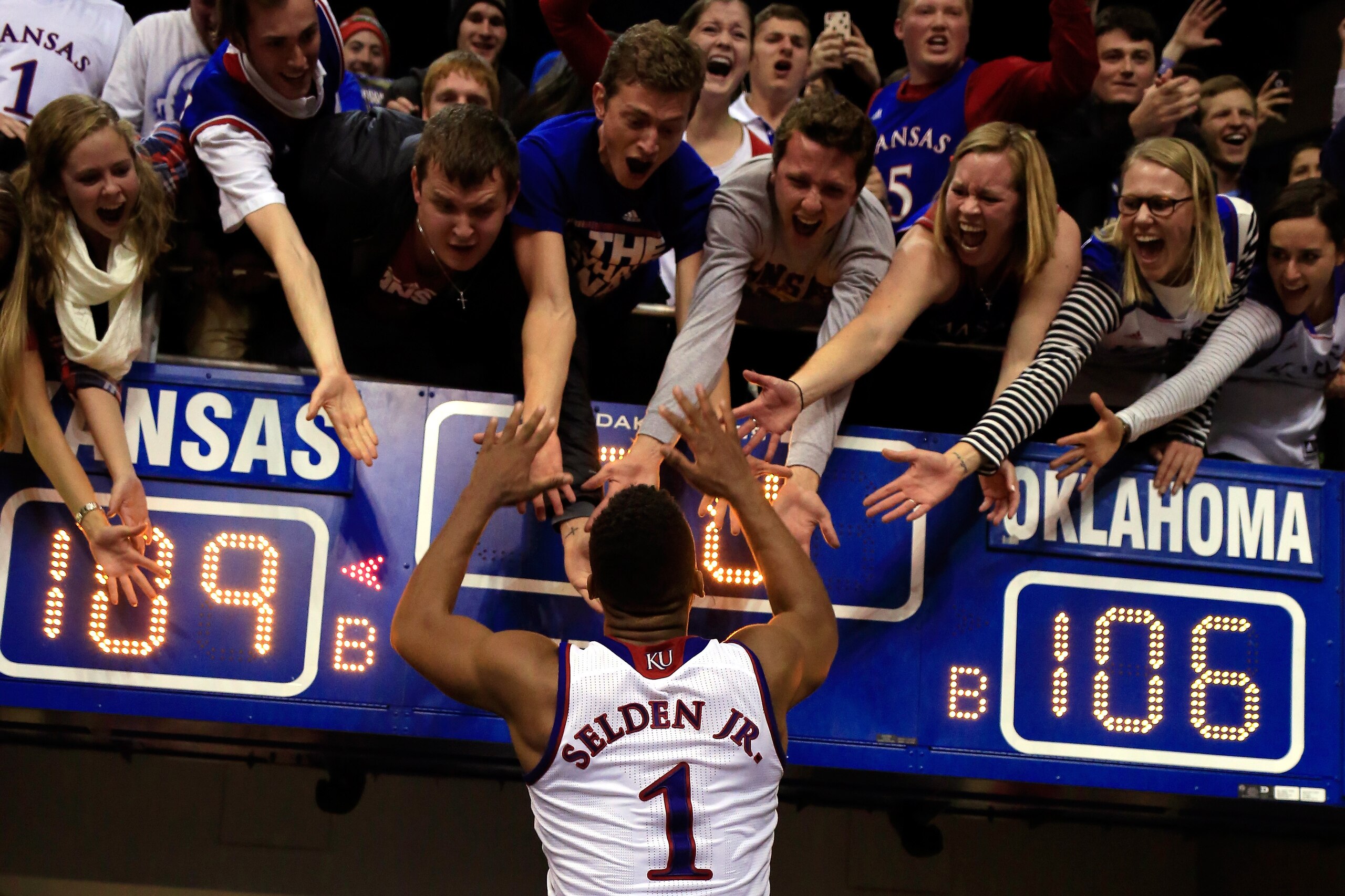
Frank Mason and Perry Ellis are great, Devonte' Graham has been shooting well all season long, and Landen Lucas has been a pretty valuable asset at power forward since being inserted into the starting lineup six games ago. Selden's supporting cast has done enough to keep this team afloat while he tries to rediscover his shooting stroke.
However, you simply don't beat elite teams without getting good production from your elite players. His 33 points against Kentucky are why the Jayhawks won that game, and his less-than-lackluster performances away from home against West Virginia, Iowa State, Oklahoma State and Michigan State are largely to blame for those losses.
And it's not like Kansas can exactly hope for a bad night from Hield. Sure, he scored 46 in their first meeting, but that was hardly a one-hit wonder for the overwhelming favorite to win the 2016 Wooden Award. He has averaged 24.9 points per game over his last 10, 27.4 over his last 17 and has made at least three three-pointers in 17 of his last 18 games.
One of the only things that we have been able to count on in this topsy-turvy season is that Hield will score in bunches. So even if Woodard's two-game cold spell extends to a third poor scoring night, Oklahoma should prevail on its home court if Selden is unable to keep pace with his Sooner counterpart.
Advanced statistics courtesy of KenPom.com and Sports-Reference.com.
Kerry Miller covers college basketball for Bleacher Report. You can follow him on Twitter @kerrancejames.

.jpg?w=2560 "Browns Come Back to Stun Panthers")