

Melvin Johnson: VCU's 3-Point Marksman with Secret Service Agent Aspirations
Melvin Johnson daydreams about being in the United States Secret Service someday. Then again, he’s pretty high on the idea of becoming a special agent with the Bureau of Alcohol, Tobacco, Firearms and Explosives, known more familiarly as the ATF. On the other hand, wouldn’t an NBA career be awfully nice?
Just maybe he’ll have a chance at all of the above. There’s certainly time; Johnson is only 22, a sharp-shooting senior guard at VCU who’s averaging 18.3 points and crushing it from beyond the arc with 3.6 threes per game, eighth-most in the country. And judging by his trajectories as a player and as a student—he graduated in three-and-a-half years with a degree in criminal justice and has taken on a second major in homeland security—there’s no reason to doubt the guy.

.jpg?w=2560 "Commanders Eagles Football")
College basketball has its fill of student-athletes who bite deep into the bone of the college experience and feed on the marrow of opportunity both on and off the court. It also has its fill of players who rise and fall on the court without embodying much of anything meaningful off it. Johnson might’ve been an example of the latter; in his early time at VCU, he was. But he changed.
He changed as a student. Not coincidentally, he grew as a player. In VCU’s program, he went from a self-centered athlete to a pillar of team-first positivity.
Faking It and Not Making It

Johnson spent his freshman year being chased by the man. That man had a name: Will Wade, an assistant under Shaka Smart who’d soon leave to become head coach at Chattanooga. Johnson couldn’t be trusted to show up to classes, let alone sit through them from start to finish. So Wade, himself only 30 at the time, was deputized to be Johnson’s—shall we say, parole officer? The term seems to fit.
“He didn’t really like me much,” said Wade, 33, who returned to VCU as head coach this season after Smart left for Texas. “I followed him to class, made sure he was where he was supposed to be. He was slippery. He’d pump-fake you and go in another direction. He might stay for the first five minutes and bolt out.”
Johnson was like a loose bolt on a swinging gate: happy to be there, in theory, but not truly comfortable or all that against popping free and heading back to the Bronx, his hometown New York borough. The one thing he locked into was the fame that came with being a basketball player at a basketball school.
“When I look back on it,” he said, “I needed a lot more than Coach Wade following me around. It was just different, honestly. There’s no football at VCU. I don’t like saying it, but as a basketball player, you kind of get catered to. People are there for you. Everyone knows who you are. You can get caught up in that, and I definitely did.”
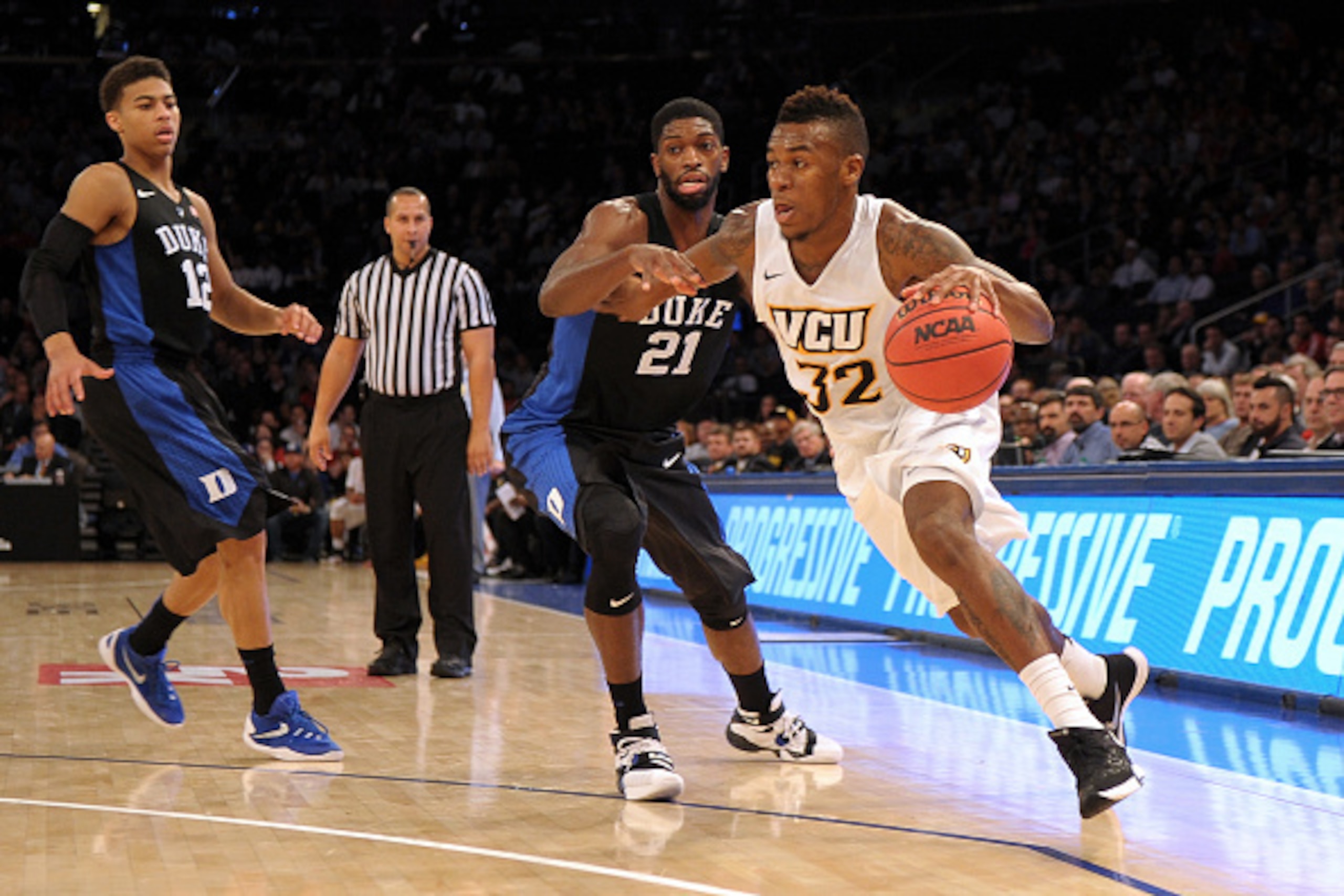
He was caught up in a different sort of irresponsibility as a player. Johnson had been a 4-star recruit out of St. Benedict’s Preparatory School in Newark, New Jersey, and was bound for Miami before that relationship fractured, for reasons Johnson prefers not to discuss. At VCU, he expected to be a standout, yet he didn’t start as a freshman. Coming off the bench, he was the Rams’ fifth-leading scorer. Really, all Johnson cared about that season were his stats.
“I just cared about me and what I was doing, how many points I scored,” he said. “If I played bad but we won, I was still in my feelings, just really selfish.”
The academic engagement would kick in first. The star player would follow.
Putting in the Work
Growing up in the Grant Houses projects in Harlem, Johnson was something of an anomaly—he liked cops. He admired and trusted them. Boyishly, he imagined himself working among them someday.
“They were cool,” he said. “I was in the projects, so they couldn’t be too cool. They always had their guards up. But it wasn’t bad. I was probably one of the few guys where, if there was trouble, I’m looking for an officer rather than an uncle or a cousin, you know what I mean? I had great encounters with everyone.”
When he entered the criminal justice program at VCU, he figured he might get to wear a badge someday. In truth, he was clueless in regard to the expanse of criminal justice. A forensic sciences course opened his eyes.
“I was fascinated by how technology is really involved in criminal cases nowadays,” he said. “Chasing guys is not the new thing. You follow their social media and things of that nature. I loved that class. I really worked hard after that.”
Honor rolls and internships followed, including one in the trafficking division of tobacco company Altria in Richmond, Virginia, where Johnson learned firsthand about the illegal distribution of cigarettes. Along with teammate Mo Alie-Cox, Johnson is interning this semester at the state’s general assembly, hoping to form relationships with politicians who might grease the wheels with a recommendation or two. They won’t be about basketball.
Yet, at the same time, Johnson has—belatedly—become deadly serious about his basketball future. He was a starter and a double-figure scorer at VCU as a sophomore (started 7 games) and a junior, but he still didn’t quite get it. Pursuing an early degree helped light the bulb.
Over the summer, Johnson overhauled his diet and took full advantage of what Wade calls “sweatshop gym”—donning a sweat suit for workouts in a gym with the thermostat cranked to just short of nuclear. Twenty-two pounds of excess weight eventually came off.
He carried an off-the-charts shooting regimen into his senior season, taking game-speed shots for an hour before every team practice, and returning to the gym once and sometimes twice a day for similar individual exercises.
Wade often has to tell Rams graduate assistants to restrict Johnson to free throws, the worry being that he’ll cash in his legs before the critical home stretch of a campaign in which VCU has an excellent shot to reach its sixth straight NCAA tournament.
But Johnson can be—what’s that word again?—slippery? If his first class is at 9:30 a.m., he’ll be in the gym before 8 putting up jump shots. Following practice and dinner with the team, he’ll be right back on the outskirts of the three-point line, firing into the night. Free throws, OK, sure. But Johnson knows the long ball is the ticket to a future in basketball.
“I just feel like work ethic eliminates fear,” he said. “Those are my two biggest things right now: eliminating fear and staying polished. I’m really optimistic about the NBA, but I know I have a lot of work to do. I feel like the biggest thing for me to have a chance is having an NBA skill. Probably my only chance is to perfect my craft shooting the three.”
A Better Present and a Brighter Future

But don’t think Johnson’s point of view can be summed up as NBA-or-bust. He’s intrigued by the possibility of playing pro ball elsewhere, and he remains fascinated by the doors that could open to him within the realm of criminal justice.
More than anything else, he is invested in VCU’s season. Johnson—who’s drilling 42.5 percent of his three-point attempts, up from 36.3 as a junior—has flourished into a leader both by example and by vocally imploring teammates to reach higher. He lives with sophomores Justin Tillman, Michael Gilmore and Jonathan Williams, and dares them by the day to join him for some non-mandatory work at the team’s practice facility.
“I tell guys, ‘You guys want to shoot like him and score like him? I wish you’d work like him,’” Wade said.
Gone are the days when Johnson put his own success over the Rams’. In an early-season comeback victory at Middle Tennessee, Johnson missed six of his first eight three-point attempts. But he finished with one of his best overall floor games—five assists, four boards and a steal to go with 19 hard-earned points—in a 62-56 victory.
“That couldn’t have happened even a year ago,” he said. “I would’ve been in a complete shell, would’ve gotten quiet. It would’ve affected every other area of my game. Even my facial expressions.”
Johnson’s best shooting stretch came during the first five games of VCU’s current 10-game winning streak—he averaged 21.4 points and drained 22 of 44 three-point attempts—but he ran into a speed bump in a victory at Saint Louis, getting in early foul trouble and playing only five minutes of the first half.

His team was besieged by foul trouble in that half, with 18 whistles on the Rams. With Wade running walk-ons into the game to stem the tide, Johnson planted himself next to the coaches on the bench and seemed to become one with them, loudly exhorting teammates and standing to cheer even the simplest hustle plays.
“He’s changed so much over the years,” Alie-Cox said. "When he first got here, he had that New York attitude about him. He didn’t want to listen. He thought he knew everything. Now he’s the leader of our team and the hardest-working person in our program. He’s the example for everybody.”
A parole officer? Please. Johnson is the last guy who needs that. As VCU heads for February unbeaten in conference play atop the Atlantic 10, Johnson is the No. 1 reason bigger-league teams should be wary of the Rams.
Meanwhile, there’s no secret to his service to his team, his school and himself. He is fully seizing this moment in his life. Better present, brighter future. Isn’t that the whole idea?
Steve Greenberg has covered college sports for nearly 20 years, namely for the Sporting News and the Chicago Sun-Times. Recruiting info provided by 247Sports.
.jpg?w=2560 "Raiders Camp Football")
.jpg?w=2560 "Best Spots for Diggs & Tyreek 🤔")
.jpg?w=2560 "Ranking Top Available Free Agents 📊")
.jpg?w=2560 "Panthers WR Out for Season")