Why Blake Bortles Could Be NFL's Most Improved Quarterback in 2015
Sometimes lost in the ebbs and flows of the NFL season is the development of young players. There’s a natural inclination to believe that talent should sprout in a linear manner, but all doesn’t go to plan for many athletes. For Jacksonville Jaguars’ second-year quarterback Blake Bortles, the flashes he showed in 2014 must become more consistent.
The NFL’s quarterback deprivation issue is a major problem for about half of the franchises in the league. There is no greater need for any team than to find a cornerstone quarterback, which is why we routinely see top collegiate signal-callers selected high in the NFL draft.
.jpg?w=2560 "Cowboys Rams Camp Football")
.jpg?w=2560 "Patriots Moves Football")

Bortles, the Jaguars’ No. 3 overall pick in 2014, was one of five rookie quarterbacks to earn significant playing time last season. Four of the rookies, including Bortles, had many head-scratching moments that rookies are quite prone to making. The only rookie who consistently showed star qualities was Minnesota Vikings’ quarterback Teddy Bridgewater.
When I went back through the film after the season concluded, I was taken aback by how many good moments Bortles had. He had played better than I had remembered during the season. This isn’t to say that he was great, but there are reasons to believe that Bortles can take a major step in his development as soon as 2015.
Breaking down games helps give a fraction of the picture, with statistics there to fill in the gaps. Using both as indicators for Bortles’ talent, there are three major reasons why he can be the NFL’s most improved quarterback in 2015.
Allowing Bortles to Create
Even for the few elite quarterbacks in the NFL, playing to your strengths is imperative. Look at future Hall of Famers Tom Brady, Peyton Manning and Drew Brees. Each has cut down on his deep ball attempts over the past few seasons in favor of a more efficient intermediate game.
This isn’t necessarily a change across the NFL. Rather, these quarterbacks have lost arm strength and found their effectiveness going deep is no longer the same. They’ve adjusted to focus on what they do best, which is what every offense much do.
It sounds obvious, but it rarely happens in the NFL. The Jacksonville Jaguars fell in that boat in 2014 under offensive coordinator Jedd Fisch. One of Fisch’s biggest failures was his dedication to the zone-blocking system, which has had tremendous success creating running lanes for mediocre backs for two-plus decades.
Fisch is now gone, and former Oakland Raiders’ offensive coordinator Greg Olson has taken over. Olson wasn’t very impressive with a limited cast in Oakland last season, but he’ll be working with more talent in Jacksonville than what he had previously.
For Olson to have a successful tenure with Bortles, he must allow Bortles to create. Even back at Central Florida in 2013, Bortles brought memories of Ben Roethlisberger with his ability to extend plays and attack downfield matchups. Yet we barely saw Bortles given that opportunity as a rookie.
Using Pro Football Focus’ signature stats, it’s easy to see that Fisch’s offensive attack did not fit his personnel. Bortles attempted 98 passes at or behind the line of scrimmage, but this only created 502 yards and no touchdowns. Compare this to only 50 passing attempts past 20 yards, and it’s safe to say Bortles was a square peg into Fisch’s offense.

When given the opportunity to hit a leaking receiver, Bortles has shown great improvisational skill. This requires good pocket presence, confidence and throwing talent. One of my favorite plays from Bortles’ tape is below.
There’s a lot to digest in this one play. Bortles, in the shotgun, is facing a 3rd-and-4 situation in the second quarter. This should be four-down territory, so he can afford to work through his progressions for the right play.
Upon reaching the top of his dropback, San Diego Chargers’ edge rusher Dwight Freeney has beaten left tackle Luke Joeckel with an inside move. Bortles reads this and correctly escapes the pocket and moves the launch point. There is not another defender close to him after he gets outside of the pocket.
Once Bortles avoids Freeney’s rush, he’s eyeing receiver Allen Hurns on a double move deep. Chargers’ safety Eric Weddle bites hard on the inside fake by Hurns, and Bortles simultaneously reads his man coming open. Bortles anticipates Hurns coming open when even with Weddle and quickly throws an accurate ball for the completion.
This is the type of play in which Bortles flashed so much potential with last season. He reads leverage at a solid rate already, which is required because NFL cornerbacks can close gaps quickly. The key to reading the leverage happens in a split second; he must read whether the cornerback’s feet are flat and which way his momentum is.
Later in the season, in Bortles’ best game of the season, he made a brilliant read. The Cincinnati Bengals feature multiple standout defensive backs who always seem to be in proper position to make a play on the ball.

On 1st-and-10, the Jaguars are running a three-step drop that will allow Bortles to get rid of the ball quickly. He has to read the cornerback at the top of the screen. His top receiver will run upfield, while the slot will run a quick out route.
In Cover 2, the cornerback must stay with his man long enough to allow the safety to come down. Then, the cornerback slides down into the flat to get the underneath receiver. Against a three-step drop, this all happens in a blink of an eye.
Bortles reads and reacts with extreme precision. Although the slot receiver looks to be open, the top cornerback is working to get off his man, when Bortles takes his left hand off the ball. At this point, Bortles knows he must go to his outside receiver.
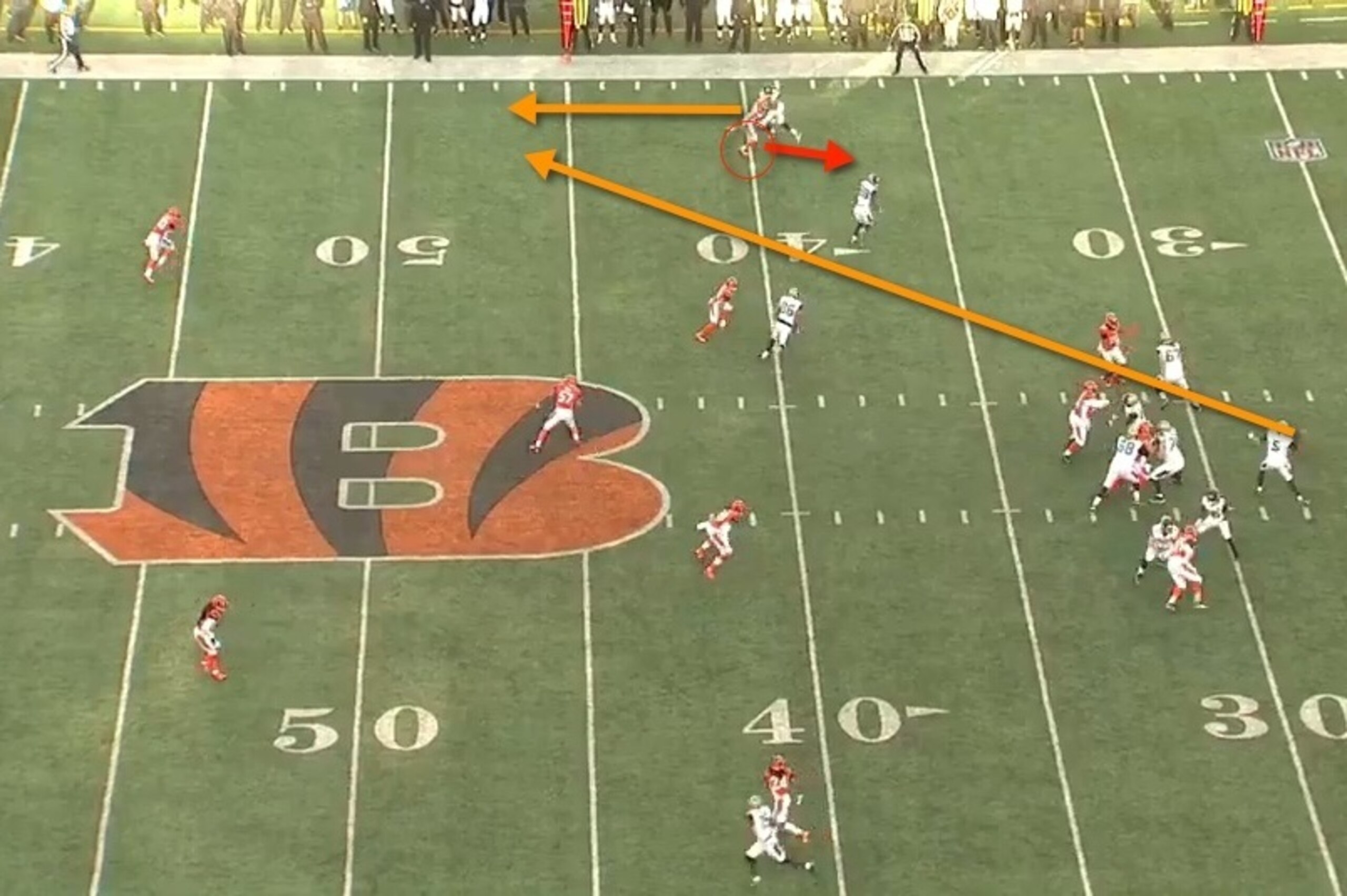
With the safety late to react, Bortles hits his man in stride, creating an extra four yards. If Cecil Shorts could make a slight move on the safety, he could take the reception to the house for a touchdown.
Instead of checking down for the easier throw, Bortles correctly read the leverage of the cornerback to make the correct throw. These are just samples we’re using, but this wasn’t the first or last example of Bortles' making tough plays happen.
Reducing Variance
There are two types of quarterbacks in the NFL, and then varying degrees of talent within each archetype. Some quarterbacks play with variance, providing big plays but also opening themselves up to major mistakes. Jay Cutler, Roethlisberger and Philip Rivers are some who fit this mold.
On the other side are the efficient quarterbacks who execute at a high level but usually with less explosive moments. Matt Ryan, Alex Smith and Joe Flacco are examples. Both types have successful quarterbacks in their respective category.
Bortles fits the first mold, as he doesn’t mind to take risks for the big play. His issue last year was his number of interceptions, finishing with 17. He also had just 11 touchdowns, so the amount of risk was too high with his play last season.
For Bortles to put out more consistent performances, the Jaguars tried to upgrade the situation around him. Olson at offensive coordinator is one individual who can help. So can new tight end Julius Thomas and running back T.J. Yeldon.
One factor that can lower variance in play is the performance of others around Bortles. He suffered from the fourth-highest drop percentage in the NFL last season, per Pro Football Focus, as 6.5 percent of his passes fell to the ground. Although drops are normal, Bortles dealt with an abnormally high number.
That’s something Thomas should help with. Losing Shorts to free agency hurts, but rookie receiver Rashad Greene can instantly slide into the slot position and provide a formidable pair of hands. Jacksonville must hope that second-year receivers Hurns, Marqise Lee and Allen Robinson can be more reliable at the catch point.
For Olson to be successful, he’ll have to help Bortles out more than Fisch did. The Jaguars’ running game averaged the sixth-best yards-per-carry rate at 4.5 but only ran the ball 360 times last season. That’s the 28th-most rushing attempts in the NFL. A recipe like that is exactly why the Jaguars changed offensive coordinators.
Oakland ran the ball the lowest number of times in the league last year, but it was also averaging 3.7 yards a carry. Its offensive line was not nearly as good as what the Jaguars have now. Olson must not repeat Fisch’s mistake.
With a good running game that can be a threat on every down, Bortles should have less pressure on him. Also adding a better supporting cast, in Yeldon as the starting running back and Thomas at tight end, will help. All of a sudden, the Jaguars have actual playmakers around their second-year quarterback.
Playing Under Pressure
Simply put, the Jaguars allowed a ridiculous amount of pressure in 2014. The team finished last in the league with sacks allowed with 71. This likely played a part in the Jaguars’ re-investment into the offensive line this offseason.
Jacksonville drafted stud left guard A.J. Cann in the third-round of the NFL draft, as well as signing right tackle Jermey Parnell in free agency. These moves will help supplement a porous group last year, and should be much better in pass protection without sacrificing anything in the run game.
It’s crucial that this new line performs better than last year. Per PFF, Bortles was the 35th-ranked quarterback in the NFL when pressured last season. He threw eight interceptions and zero touchdowns with a defender applying pressure. This should improve as Bortles now has more experience, but we cannot assume he’ll massively grow in the area.
Jacksonville can help Bortles limit his exposure to pressure more this season. One good thing Fisch did was put Bortles into play action passes on 22.5 percent of his throws. Bortles responded by improving his passer rating by 14 points off play action passes, per PFF.
Olson called a similar game with Derek Carr in Oakland. Carr threw 21.4 percent of his passes in 2014 with a less effective threat of a run game. This is promising for what will happen in 2015, as Bortles should be more protected by the run game and an effective play action game.
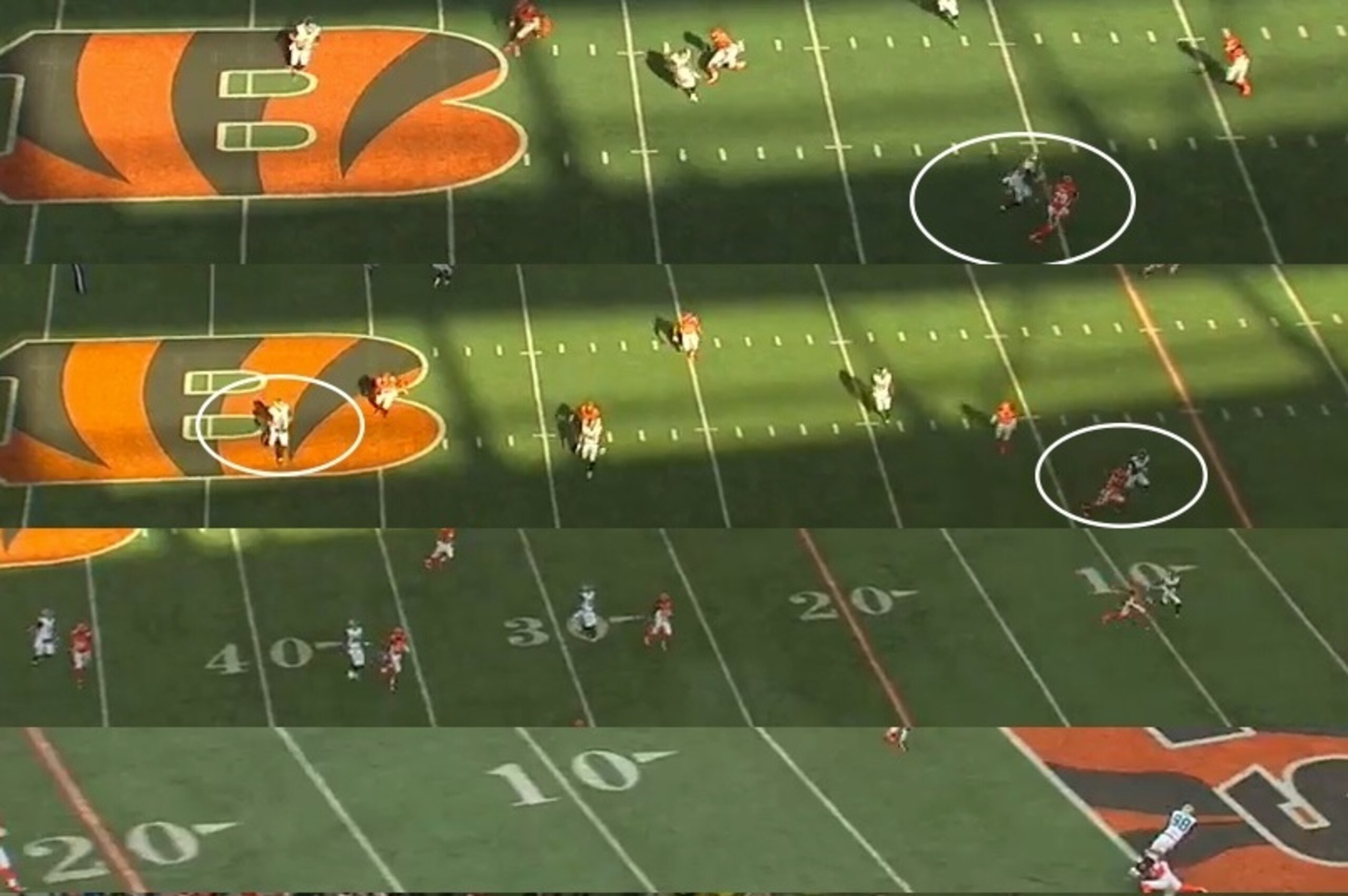
Considering Bortles’ athleticism, using him in rollouts would be wise. This shrinks the field for Bortles to read and allows him to get out into space to operate. One of Bortles’ biggest throws of the season came on a rollout against the Bengals.
Above is a series of pictures that shows the progression of the 40-yard touchdown pass from Bortles to Hurns. Off a play action, Bortles rolls to his right, with three receivers in his direct view. The one of note is Hurns, who is running a go route.
The second pane is where Hurns gains a little separation from the cornerback, and we see Bortles begin his throwing motion. He wasn’t afraid to thread the needle, which again shows his confidence and arm talent. His delivery to Hurns is good enough to allow Hurns the chance to go get the ball, and he secures the pass for a touchdown.
It’s these types of throws that separate quarterbacks from their peers. This is a very difficult throw against a talented defender, but it protected Bortles from direct pressure.

Finally, Bortles has shown a willingness to take what is given. If his receiver group is fully healthy this year, then he should be looking vertical more often. But it’s very important the Jaguars give him an outlet underneath.
Bortles’ creativity and ability to buy more time is what really illustrates his potential to grow into a great player. Above, we can see Bortles climbing the pocket, and then hitting his streaking receiver in stride. This is key, as Hurns extends the drive with his post-catch effort.
As a playmaker, Bortles has shown these glimpses of brilliance that sell his upside. Young quarterbacks often struggle early in their careers, and Bortles was no different. His accuracy and consistency must improve.
But there are too many good plays and flashes from his rookie campaign to ignore. Bortles will have more help around him this season, and this group looks much more formidable than what was rolled out in 2014. As the game slows and the scheme improves, Bortles has a great opportunity to improve his play this season.
All stats used are from sports-reference.com.
Ian Wharton is an NFL Draft Featured Columnist for Bleacher Report.
.jpg?w=2560 "Falcons Patriots Football")
.jpg?w=2560 "Browns Camp Football")