

Can the Dallas Mavericks' Record-Setting Offense Last All Season?
Ever wonder what happens when the NBA's most unstoppable force meets its most moveable object?
Well, wonder no more. The Dallas Mavericks put that predictable hypothetical to rest Friday, steamrolling the defenseless Los Angeles Lakers at American Airlines Center 140-106.
TOP NEWS
Silver Wants Team in Portland 📍
NBA Vegas expansion bids nearing $10B

Mock draft for Vegas, Seattle expansion teams
Granted, it's not exactly breaking news when these Lakers allow a team to blow past the 100-point plateau and into the scoring stratosphere. Their defense has pretty much been dead-last in the league since the 2014-15 season's opening tip. L.A. had held its opponent under 100 points just three times in its previous 12 games, allowing five of the other nine to pile up 110 or more.
The Mavs, though, hit that latter mark in just three quarters.
Let me repeat: 110 points. Three quarters. Against an (ostensible) NBA squad.
This was far from Dallas' only impressive offensive performance of the young campaign, though. The Mavs hit the century mark in three frames against the Minnesota Timberwolves before finishing with 131 points. That came just two days after tallying 123 points at the winless Philadelphia 76ers' expense.
OK, so maybe astronomical point totals against the dregs of the NBA don't indicate much. But what about the fact that the Mavs are one of just three teams to score 100 points against the San Antonio Spurs this season? Or that they've failed to cross that threshold just twice so far, losing to the Portland Trail Blazers and Miami Heat?
Or, how about this: If the Mavs maintain their blazing scoring pace from now until mid-April, their offense will go down as the most productive on a per-possession basis in NBA history.
Some Context
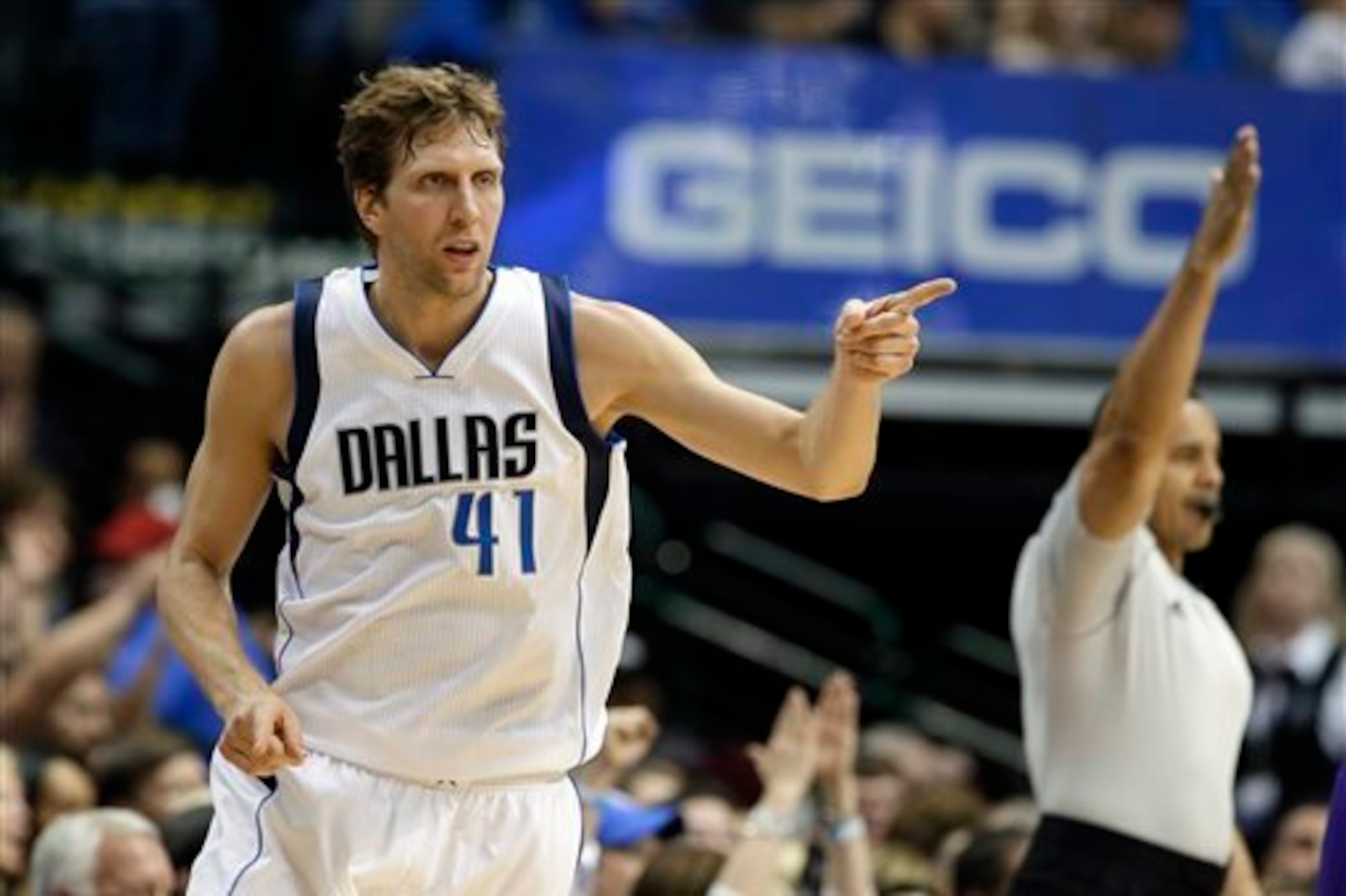
More prolific than Magic Johnson's Showtime Lakers ever were. More efficient than Michael Jordan's Chicago Bulls. More lethal than Larry Bird's Boston Celtics or Steve Nash's Phoenix Suns ever managed to be.
But can Dirk Nowitzki's Mavs keep it up?
To be clear, Dallas isn't likely to so much as sniff the all-time record for points per game over a full campaign. Prior to their sixth consecutive win, the Mavs had been scoring nearly 109 points per game.
That's a magnificent mark in today's slower, more methodical league, but it can't hold a candle to some of the ridiculous numbers posted by the Sixers, Celtics and Lakers (among others) between the late 1950s and early 1970s, back when the game was faster, players weren't nearly as athletic as they are today and the three-point shot was but a twinkle in Herman Sayger's eye.
Wilt Chamberlain's 1966-67 Philly team averaged 125.2 points per contest on the way to winning 68 games and claiming the Big Dipper's first championship. That record still stands to this day, nearly a half-century later.
But those Sixers got to that number by piling up 122.9 possessions per game. That's nearly 30 possessions more than the Mavs' 95.3—the 12th fewest in the Association this season.
Give this Dallas team as many possessions as Chamberlain's Sixers had, and the Mavs would average an eye-popping 144.5 points per game, or just a handful more than they managed at the Lakers' expense.
How They've Done It
It certainly helps that the Mavs have the three-point shot that those Sixers never did, and that was only scantly used when Johnson, Jordan and Bird were at their respective peaks.
Dallas has made great use of that now-all-important feature, too, launching the third-most treys (31.4) and knocking them down at the eighth-highest clip (37.2 percent). All told, Dallas has scored more than a quarter of its total points (26.5 percent, to be exact) from beyond the arc—the sixth-highest mark in the league.
As with any team that boasts as extensive an analytics department as theirs, the Mavs have also taken care of business in the paint, converting an outstanding 66.4 percent of their shots within five feet of the cup. Along those same lines, they've done an excellent job of limiting their mid-range looks, with just 8.5 percent of their attempts coming between 10 and 16 feet from the rim.
But unlike the Houston Rockets—for whom threes, bunnies and freebies are the only offensive currency—the Mavs don't get to the free-throw line all that frequently. In fact, they've racked up .265 free-throw attempts per field-goal attempt (i.e., about one free throw for every four field goals), which places them 22nd in the league.
What they have done, though, is knock down the foul shots they've earned. A strong 79.4 percent of Dallas' dalliances at the stripe have ended in success.
And it's not as though the Mavs are getting their shots in any particularly fancy way. They're patently middle-of-the-pack in most ball-movement-related statistical categories, though they do rank fifth in assists (23.9) and fourth in points per game created by assist (57.5).
Of greater intrigue is how Dallas is racking up its points and assists: namely, by attacking the basket, often off the pick-and-roll. The Mavs lead the league with 37.2 points per game on their 29.9 drives, the third most in the NBA.
And when Dallas isn't driving in for layups and dunks, its players are kicking the ball out to open shooters on the perimeter. Nearly 83 percent of the Mavs' threes have been assisted, and they rank among the top 10 in catch-and-shoot makes and attempts per game, both overall and from downtown.
Better yet, they've kept the rock zipping around without throwing it away. They've notched turnovers on a league-low 11.5 percent of their possessions.
"We just moved the ball," Chandler Parsons told reporters after the Mavs mauled the Lakers. "People had good shots. If someone had a better shot, we moved the ball."
Who They've Done it With
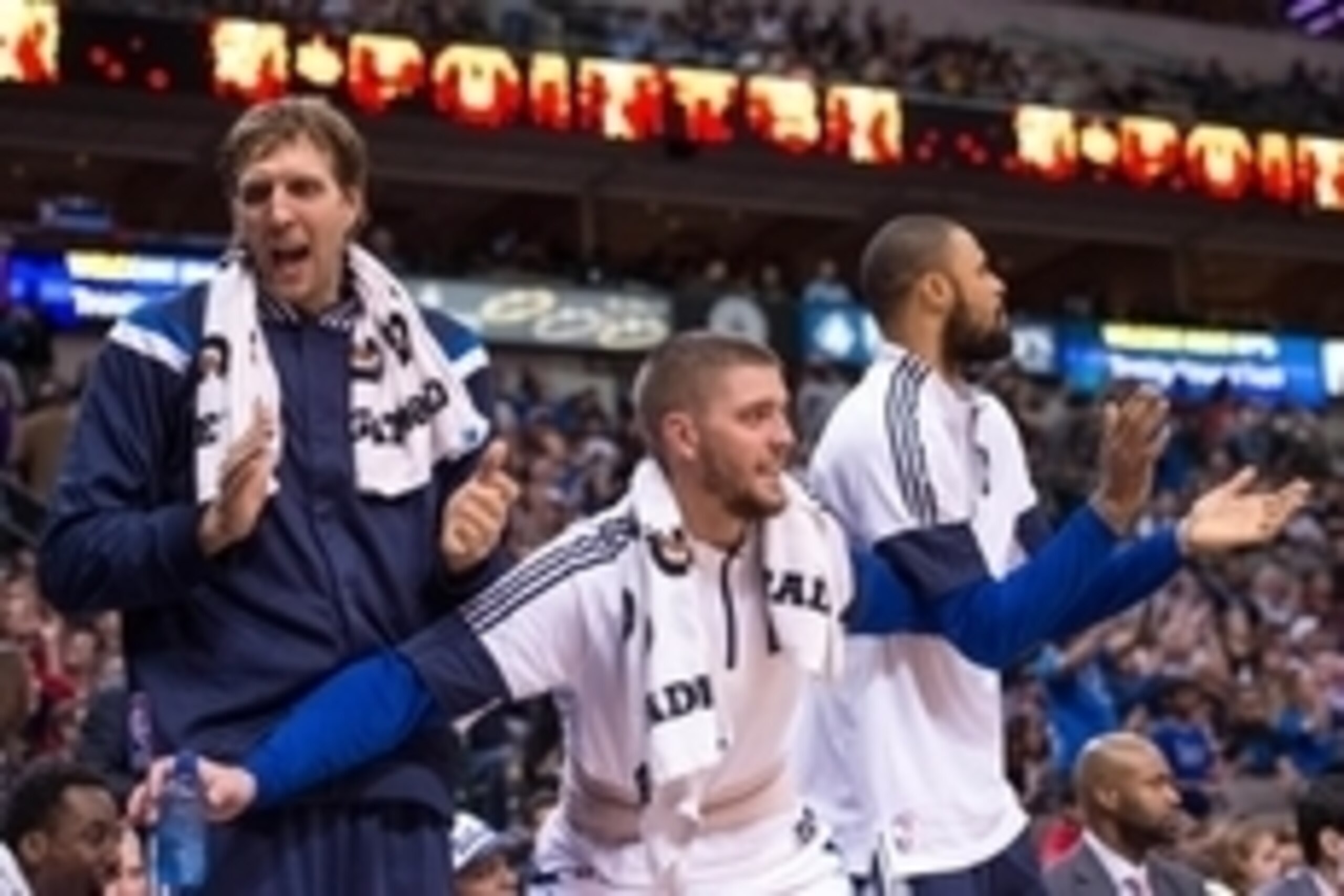
Parsons could've just as easily been referring to Dallas' season-long methodology. Sure, the Mavs run some clever plays here and there, but mostly they've just done a great job of bending defenses via the dribble and the pass to create great looks for their multitudes of offensive talent.
It all starts with Nowitzki. The 12-time All-Star is off to another scorching-hot start, knocking down 54.7 percent of his field goals, including 49 percent of his threes.
Mavs coach Rick Carlisle has once again constructed an offense that takes full advantage of not only Nowitzki's historic skill, but also (and, perhaps, more importantly) the extent to which opposing defenses tend to focus on the giant German.
All of their guards—from Monta Ellis and Jameer Nelson in the starting backcourt to J.J. Barea and Devin Harris off the bench—are capable pick-and-roll operators, with little fear of driving into the lane. Ellis, in particular, has put his prodigious first step to good use, driving to the cup almost 10 times per game.
The Mavs, though, aren't entirely reliant on their guards to make plays off the bounce. Parsons and Jae Crowder can make magic with the orange in their hands. Richard Jefferson and Charlie Villanueva have both enjoyed seasons as prolific scorers in the past. Nowitzki's been known to put the ball on the deck from time to time, as well.
That being said, it helps that Ellis and the rest of Dallas' smaller ball-handlers (i.e., Nelson, Barea and Harris) have all shot 35 percent or better from three-point range. As such, defenses have to take them seriously as scoring threats in two-man sets with Nowitzki.
Nowitzki, though, is far from the only top-notch pick-and-roll partner playing in Big D. Tyson Chandler has long been one of the NBA's best screen-setters and at-rim finishers. He led the league in field-goal percentage in 2011-12, when he converted 67.9 percent of his attempts while with the New York Knicks, and he is actually on pace to shatter that mark at his current clip (69.6 percent).
Believe it or not, Chandler isn't even the Mavs' most efficient finisher. That title belongs to the bouncy Brandan Wright, who's put through a league-best 77.8 percent of his tries to date.
Can They Keep it Up?

Even with all that offensive talent, Dallas could have some difficulty keeping its historic roll alive, if only because this team is so reliant on the three-point shot. Should the Mavs go cold for any extended stretch, they'd risk falling back into merely the upper crust of historic offenses, rather than leading the pack.
But, by the same token, it's the three-point shot, and its importance in the modern NBA offense, that's put the Mavs in this position and could keep them there over the long haul. In fact, Dallas has averaged more threes per game than the next three best offenses in league history combined.
As it happens, the Mavs' proficiency from three-point range could easily improve as the season progresses. Parsons, for one, has hit 34.7 percent of his treys, below his career rate of 36.8 percent. Nelson's done well from beyond the arc (36.7 percent) but has barely sniffed a 30 percent success rate from everywhere else.
As ESPNDallas.com's Tim MacMahon put it:
"This was an elite offensive team last season that made significant upgrades at two spots in the starting lineup. It’s not a surprise that the Mavs are by far the league’s most efficient offense so far this season. It is a bit surprising that the Mavs have been so explosive with Chandler Parsons and Jameer Nelson off to slow starts. Those two will get better, so we might not have seen the Mavs hit their offensive peak yet.
"
If anything's going to drag down the Mavericks offense, it's injuries. Nelson and Tyson Chandler have both battled their own bodies in recent years. Nowitzki, at 36, will always be at risk of breaking down. Harris is already on the shelf for a spell.
But if this team can stay healthy, stick to its principles and keep firing away from deep, there's no reason to think the 2014-15 Mavs won't go down as the most efficient offensive machine the NBA has yet seen.
And if Dallas' defense holds up its end of the bargain, Nowitzki and Co. might just have a Larry O'Brien Trophy to show for their incredible efforts.
Josh Martin covers the NBA for Bleacher Report. Follow him on Twitter.

.jpg?w=2560 "Report: Darnold Could Miss 3-6 Weeks")
.jpg?w=2560 "Week 2 Start 'Em, Sit 'Em Decisions")
.jpg?w=2560 "Best NFL Free Agent Fits 📝")