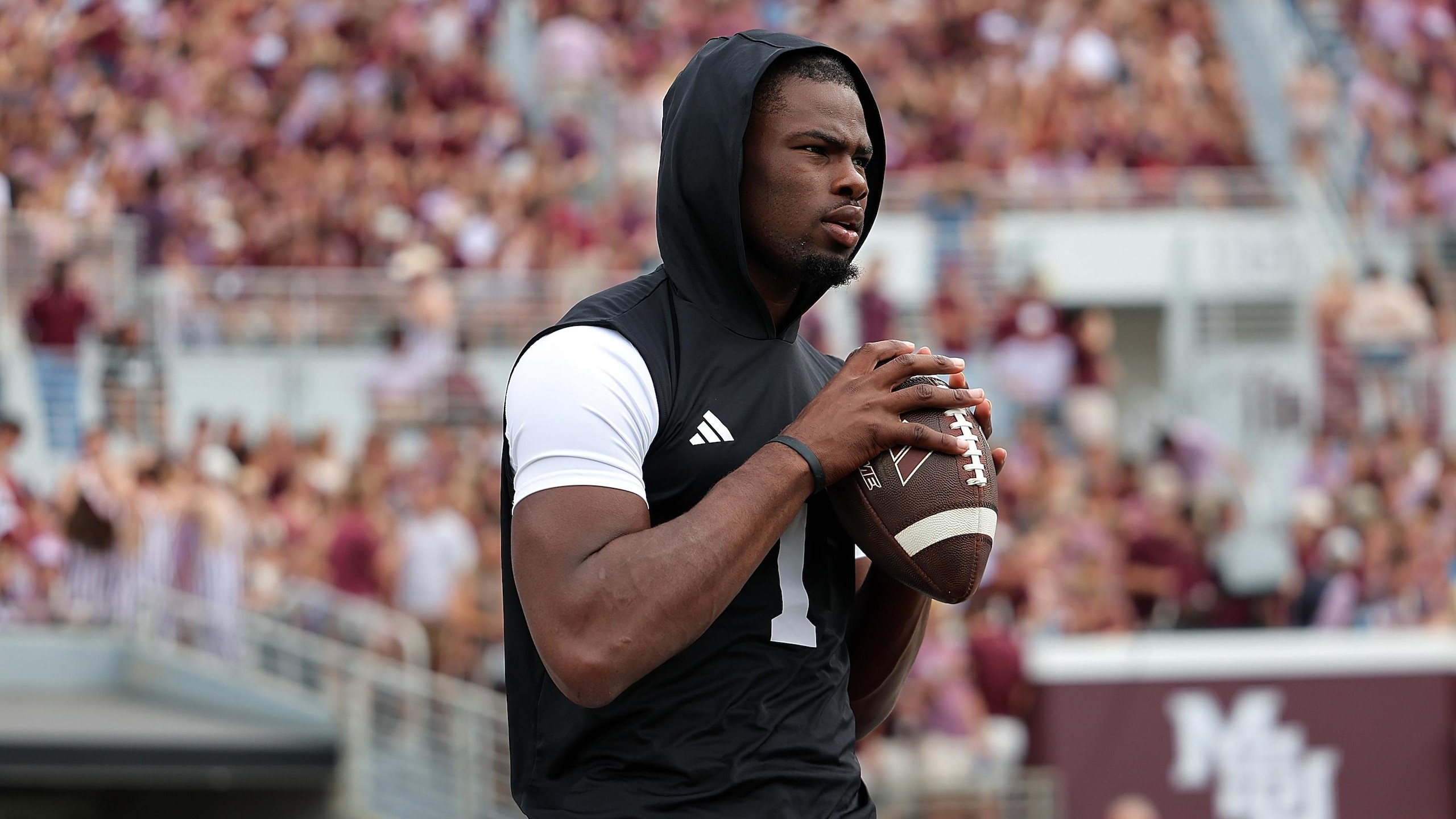
If you haven't seen footage of the Steelers' James Harrison giving Browns quarterback Colt McCoy a concussion with a vicious helmet-to-helmet hit this past Thursday, watch this video before reading ahead.
If you've seen the hit, and you've read Harrison's justification for the hit—"From what I understand, once the quarterback leaves the pocket, he's considered a runner. All the defenseless(ness) and liberties that a quarterback has in the pocket are gone and you can tackle him just as he's a running back"—only one question should come to mind.
Why, in God's name, is the NFL still allowing anyone to deliver helmet-to-helmet hits to another player?
TOP NEWS

New NFL Power Rankings 📊
Seahawks trade for Colts' All-Pro OL
Predicting Five Potential Shocking Trades 😲
If you're not a believer in football's concussion crisis at this point, there's likely little I can do to convince you.
But don't let me speak for it; instead, let NFL commissioner Roger Goodell do the talking.
In 2009, Goodell appeared before a Congressional panel and denied any connection between head injuries in football and long-term brain disease.
Two years later, former Chicago Bears star Dave Duerson shot himself in the chest instead of the head to preserve his brain for scientific research. Doctors discovered chronic traumatic encephalopathy in his brain—a neurodegenerative disease that's now been found in over 20 deceased NFL players. CTE is linked to depression, memory loss and dementia, according to the New York Times.
Lo and behold, Goodell and the NFL did a complete 180 in that two-year time frame.
These days, the league is threatening suspensions for egregious hits, issuing ominous posters that warn of the dangers of concussions, and campaigning for every U.S. state to adopt a youth-concussion law, "sooner, rather than later."
Could the league really make all of those changes for the sake of player safety, including banning the wedge formation on kickoffs, and still allow certain players to receive helmet-to-helmet hits with no penalty? I went to the NFL Rulebook to find out.
The Current Rules
Players are banned from using any part of their helmet or face mask to "butt, spear or ram an opponent violently or unnecessarily," according to Rule 12, Section 2, Article 8 of the NFL Rulebook, except when going against a runner who isn't considered a defenseless player.
While there's potentially a gray area in the rules that Harrison can exploit because McCoy switched from runner to passer at the last second, the NFL's explanation of the hit suggests Harrison should expect some form of discipline next week, according to ProFootballTalk.
The Browns also may be in trouble with the NFL after allowing the concussed McCoy to return to the game after sustaining the hit from Harrison. A league spokesman told CBSSports.com that it "would review [the decision] with the team."
Browns coach Pat Shurmur told reporters Friday that the team followed protocol in assessing whether or not McCoy was fit to return to the game following the hit, but McCoy's father, Brad, told the Cleveland Plain Dealer that his son had no business returning to the game after that shot to the head.
"He was basically out (cold) after the hit," Brad McCoy told the paper. "You could tell by the rigidity of his body as he was laying there. There were a lot of easy symptoms that should've told them he had a concussion. He was nauseated and he didn't know who he was."
Moving Forward
This isn't just about McCoy and Harrison. Instead, let's refocus on the big picture.
Why would the NFL allow any helmet-to-helmet hits, ever?
Count Deion Sanders as one opposed to that theory. In the video at the top of this article, Sanders mocks NFL Network co-commentator Rich Eisen for suggesting that Harrison shouldn't have led with his head while tackling McCoy.
"If [Harrison's] head is up and he's seeing it, wouldn't he be able to dodge it?" Eisen asked.
"Who hits like that?" Sanders responded. "Rich, who hits like that? Nobody hits with their face...You can't hit with your face. Your head goes down sooner or later. That's how you're taught."
No offense to Deion Sanders here, but doing something "because that's the way we're taught to do it" has to be some of the most painfully idiotic justification imaginable. People were once taught that the Earth was flat, too.
When scientists make new discoveries—say, like a study that finds even one mild brain injury (such as a concussion) has the potential to do long-term, permanent damage—isn't it the responsibility of the world to adapt to that new reality?
The Spread of CTE
On the same day as the McCoy-Harrison incident, the Associated Press reported that former NFL player Lew Carpenter, who never suffered a concussion during his NFL career (according to his family), had an advanced form of CTE when he died at age 78.
Dr. Robert Cantu, who works at the Boston University Center for the Study of Traumatic Encephalopathy (where Carpenter's brain was examined), told the AP that "concussions aren't necessary for CTE to exist."
"It's the total brain trauma. Tens of thousands of subconcussive blows all add up," Dr. Cantu said. "You can't draw a line between number of concussions and risk for CTE. You have to factor in the subconcussive trauma. It's equally—if not more—important."
Dr. Cantu is not the only medical professional with this theory about subconcussive hits. Back in 2009, Dr. Kevin Guskiewicz from the University of North Carolina told Malcolm Gladwell of the New Yorker that cumulative exposure to hits to the head can be as dangerous as the high-impact, jaw-shattering hits, like the one Harrison laid on McCoy.
Assuming that these researchers continue finding evidence linking subconcussive hits to long-term brain damage in football players, this once more begs the question: Why isn't the NFL doing everything in its power to reduce the number of hits to the head that its players take on a yearly basis?
And why, in this concussion-crisis era, would the NFL leave running backs or wide receivers susceptible to legal helmet-to-helmet hits, so long as their forward progress hasn't been halted?
As far as the NFL has come in terms of concussions these past few years—and it's worth noting that they're far ahead of their professional sports brethren in the NHL—there's still plenty of work left to be done.
The McCoy-Harrison incident was a stark reminder of a larger problem with the NFL's current player safety rules.