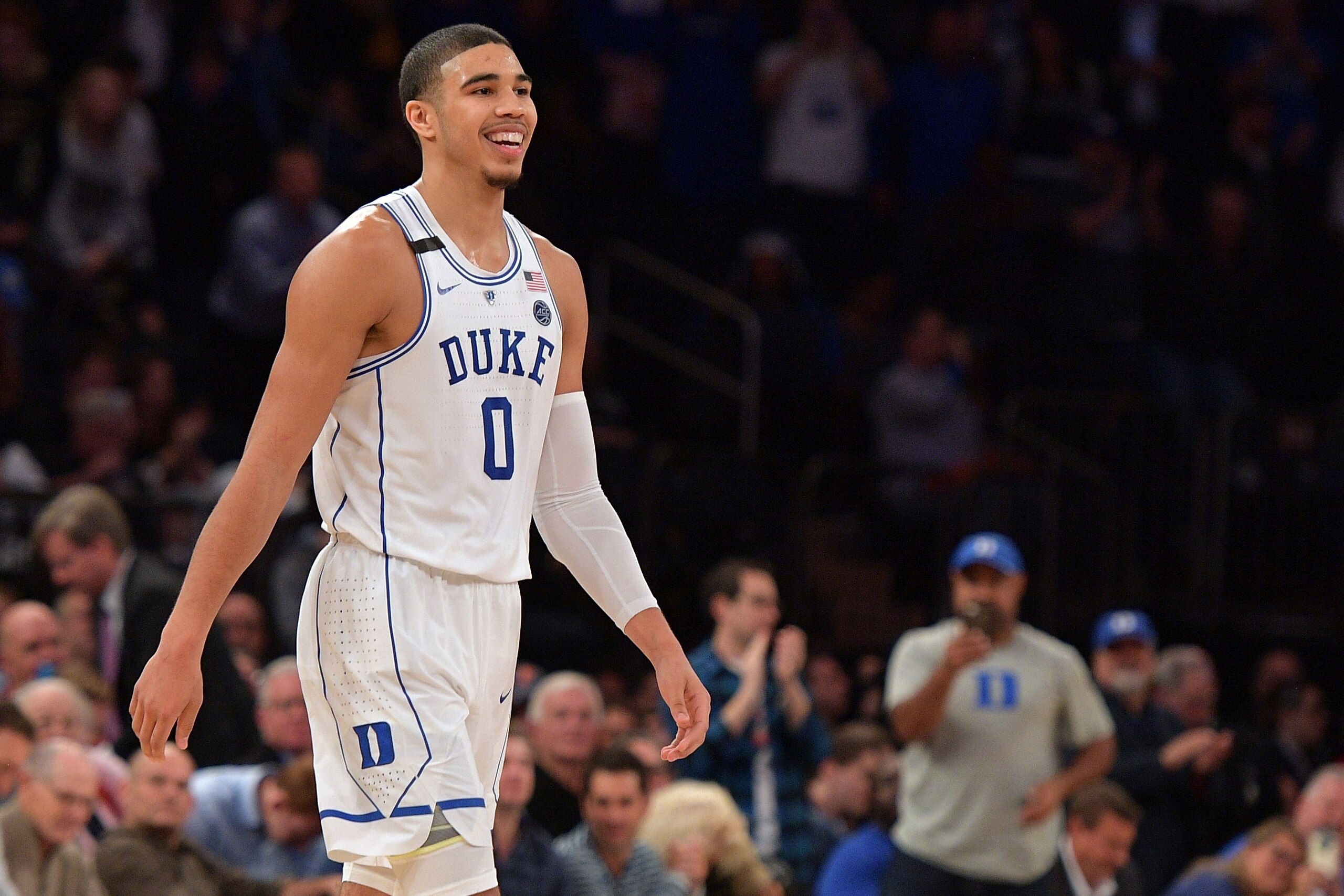

2017 NBA Draft Big Board: Jonathan Wasserman's Updated Top 50
The 2017 NBA draft class is looking stronger by the week.
Duke's Jayson Tatum made his debut after missing the first eight games with a foot injury. UCLA's Lonzo Ball has established himself as one of the most distinctive point guards in recent memory. And Kansas' Josh Jackson, Florida State's Jonathan Isaac and Arizona's Lauri Markkanen have all consistently produced big numbers early on.
Injuries have become a disappointing talking point, though. Indiana's OG Anunoby and Michigan State's Miles Bridges are the latest to join Duke's Harry Giles on the shelf.
Still, based on the first month of the college basketball season, NBA evaluators and projected lottery teams should feel great about their chances of landing a core piece in June's draft.
No. 50-No. 48
1 of 30
50. V.J. Beachem (Notre Dame, SF, 6'8", Senior)
Beachem has emerged as Notre Dame's No. 1 option, averaging 16.8 points on 2.3 three-point makes per game. He looks the part with 6'8" size and athleticism, while his jumper has always been money.
But Beachem lacks toughness and isn't a good defender or playmaker. Dating back to last year, he's totaled a troubling 37 assists through 45 games.
49. Monte Morris (Iowa State, PG, 6'3", Senior)
Morris' numbers haven't changed much since his sophomore season. He's still making his mark as a facilitator and decision-maker, averaging over five assists and fewer than two turnovers for the third straight year.
But without much athleticism or strength—and a jumper that hasn't improved—there are too many questions about his transition from college to pro. He's a backup point guard at best, though one who won't offer scoring firepower.
48. Josh Hart (Villanova, SG, 6'5", Senior)
Hart is having his best year, both as a shooter and playmaker, making two three-pointers per game (43.9 percent) and averaging a career-high 3.8 assists. He lacks athleticism and size, but his defense, jumper and passing make him worthy of second-round consideration.
No. 47-No. 45
2 of 30
47. Sviatoslav Mykhailiuk (Kansas, SG/SF, 6'8", Junior)
It's easy to forget Mykhailiuk is still a teenager: This is his third season at Kansas, and he's underachieved through the first two. But he looks more confident so far in a much bigger role, nailing 2.2 threes per game and shooting above 40 percent from deep. His jumper and stock are both heating up.
46. Mikal Bridges (Villanova, SF, 6'7", Sophomore)
Bridges has taken a step forward in his bigger sophomore role. He's already made 11 of his first 27 three-point attempts after shooting 29.9 percent from deep as a freshman. And he's more than doubled his assist percentage to 16.5 percent, per Sports-Reference.com.
Between his defense, passing and ability to score off the ball as a slasher and shot-maker, his role-player potential is intriguing.
45. Jonathan Jeanne (France, PF, 7'2", 1997)
Jeanne is now with Le Mans' senior team, but he isn't seeing many minutes. Giant 7'2" size, absurd length and shooting touch previously helped him earn NBA attention. There is obviously a ton of intrigue tied to his potential as a rim protector who can also stretch the floor. But it's tough to imagine him drawing first-round interest until he shows he can physically compete at a high level.
No. 44-No. 42
3 of 30
44. Edmond Sumner (Xavier, PG, 6'5", Sophomore)
Size and athleticism still fuel enticing upside for Sumner, but no progress with his jumper is unsettling. Per 40 minutes, his scoring (16.9 points), assists (5.0) and rebounds (5.0) are each down, per Sports-Reference.com.
Physical tools, explosiveness and quick hands/feet on defense will keep him afloat in the late first-round discussion, for now.
43. Grayson Allen (Duke, SG, 6'5", Junior)
The addition of Frank Jackson and emergence of Luke Kennard has made it tough for Allen to find a rhythm. He's only shooting 35.7 percent and 32.2 percent from three. But his jumper isn't a major issue; He's still hitting 2.3 triples per game while becoming Duke's top playmaker, averaging 4.1 assists.
The concern stems from Allen's lack of strength and length, which hurts him as a finisher in traffic and as a defender. He's still worth taking a chance on as an energizer and shot-maker to bring off the bench.
42. Jawun Evans (Oklahoma State, PG, 6'1", Sophomore)
Evans struggled to separate into clean looks against Maryland on Dec. 3. It exposed his lack of size and explosiveness. But having hit the 30-point mark three times already, Evans can light it up, a tribute to his difficult-shot-making ability inside the arc.
He's made a habit of converting tough runners, floaters and layups in the lane. And when his confidence starts to pump, his jumper heats up. Scouts aren't sold he's a first-round pick; but despite lacking traditional NBA athleticism and tools, he's put himself in the draft conversation.

No. 41-No. 39
4 of 30
41. Luke Kennard (Duke, SG, 6'6", Sophomore)
Nobody has been able to guard Kennard, who's averaging 28 points over Duke's last three games. His confidence has skyrocketed, and you get the impression every jumper he takes is going to fall.
Making 2.5 threes a game at a 41 percent clip, Kennard has burned defenses with spot-up shooting and also pull-ups inside the arc. He plays with great balance and rarely takes a shot that isn't straight up and down off two feet. With 6'6" size, lethal shot-making ability, handles and vision, the big question is whether a lack of athleticism will nullify his offensive strengths and skills.
40. Thomas Bryant (Indiana, PF, 6'10", Sophomore)
Bryant's numbers haven't changed much from last year. He's scoring three fewer points per 40 minutes (18) and has the same rebounding percentage (15.3), per Sports-Reference.com.
But he's already made six three-pointers (made five last year) and has his free-throw mark up to 76.2 percent. Bryant isn't explosive around the basket, which makes the development of his jumper extra important. His 19.2 percent turnover percentage is still way too high as well.
Bryant has NBA tools and admirable energy, but at this stage, he doesn't do enough things great to lock him inside the first round.
39. Lagerald Vick (Kansas, SG, 6'5", Sophomore)
Vick has found a rhythm, though his sales pitch starts on defense—where he's had success locking up around the perimeter, thanks to his length and quickness. Vick has also hit 10 of 12 three-pointers over Kansas' last four games. And with defensive upside and athletic slashing ability, the jumper puts him in the conversation as a potential three-and-D off-guard.
With Frank Mason III graduating and Devonte' Graham a candidate to declare early, returning as a junior could be the move for Vick, who'll have a better chance to fully break out in 2017-18.
No. 38-No. 36
5 of 30
38. Cameron Oliver (Nevada, PF, 6'8", Sophomore)
Averaging 15.8 points and two three-point makes per game, Oliver's scoring and shooting both look sharper. The improved jumper could be a big development, given his lack of size for a traditional NBA 4.
With showtime athleticism, long arms and a nose for the ball, he's still blocking shots at a terrific rate (4.4 per 40 minutes, according to Sports-Reference.com) as well. His rebounding numbers are down early, though between his physical tools, liveliness and last year's 12.3 boards per 40 minutes, it's not a concern worth getting worked up over.
37. Arnoldas Kulboka (Lithuania, SF, 6'9", 1998)
Kulboka is producing at 18 years old in Germany's top league, averaging 13.8 points and 2.2 three-point makes per game. A standout from last year's Basketball Without Borders Global Camp, the skinny Lithuanian turned heads with his ball-handling and shooting. He won't be physically ready for the NBA, but at 6'9", his skills and production will earn him looks as a draft-and-stash option should he declare.
36. Zach Collins (Gonzaga, C, 7'0", Freshman)
Collins has been incredibly active, averaging 25.2 points and 13.5 rebounds per 40 minutes. He's only missed 14 shots through nine games.
At 7'0", Collins isn't explosive, but he's flashed a jumper and the ability to put the ball on the floor. He doesn't offer great defensive upside either, which hurts his value as a big, but Collins is a hard worker under the boards with an expanding offensive game. He could be a fringe first-rounder in 2017 or—if he continues to improve—a late lottery pick in 2018.
No. 35-No. 33
6 of 30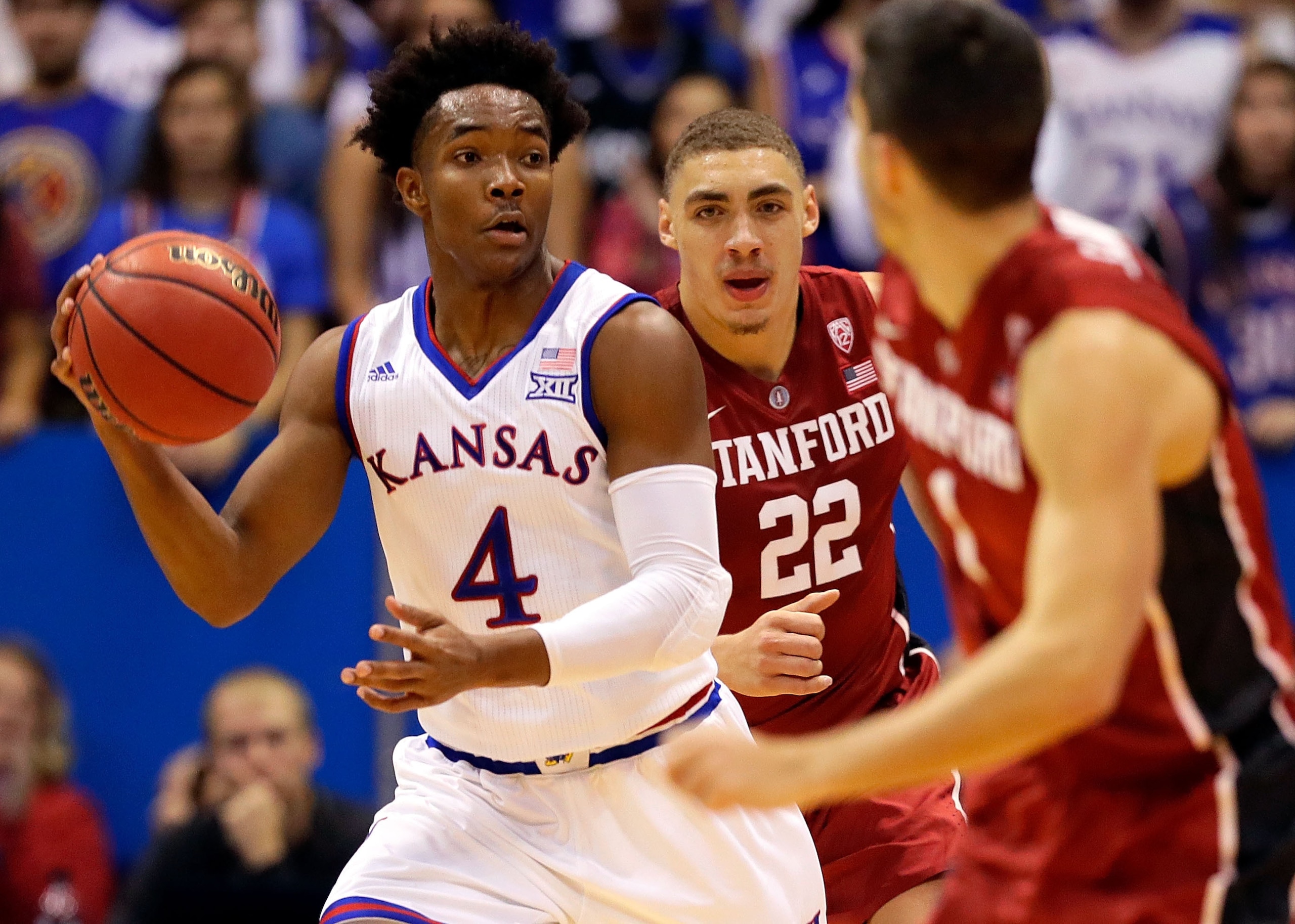
35. Dwayne Bacon (Florida State, SG/SF, 6'7", Sophomore)
As a non-playmaker and suspect defender, Bacon's margin for error is small; He'll need to become a complete scorer to carve out an NBA career. He's off to a good start this season, though. Bacon has been consistent and looks improved in the most important area: shooting. He's making 1.8 threes per game at a 40.9 percent clip—a key development, considering he projects as an NBA 2-guard or wing.
34. Jaron Blossomgame (Clemson, SF/PF, 6'7", Senior)
Blossomgame is averaging 17.4 points, and that's without making many jump shots. He's just 3-of-21 from downtown after shooting 44.6 percent from deep as a junior.
He'll fall into the second round if his jumper never comes around. But if it does, he could wind up emerging as a routine 20-point weapon for Clemson. Teams will ultimately value his defensive tools and scoring versatility as a face-up driver and post option.
33. Devonte' Graham (Kansas, PG, 6'2", Junior)
Graham's ceiling falls short of NBA starter, but his ball-handling, passing and shooting could help him land a backup gig. Converting at better than 42 percent from deep and 72 percent from the line for the third straight season, his jumper is for real—he gets good elevation and has a quick release. Graham is especially dangerous when he can set his feet, whether it's off a spot-up, screen or pull-up.
He's shown recent improvement in the playmaking department, averaging 5.1 assists this year while sharing the backcourt with a more ball-dominant player in Frank Mason III.
His sharp skills and tough defense should be enough to compensate for physical limitations. Graham could be a second-round bargain if teams feel there isn't enough upside to reach in Round 1.
No. 32-No. 30
7 of 30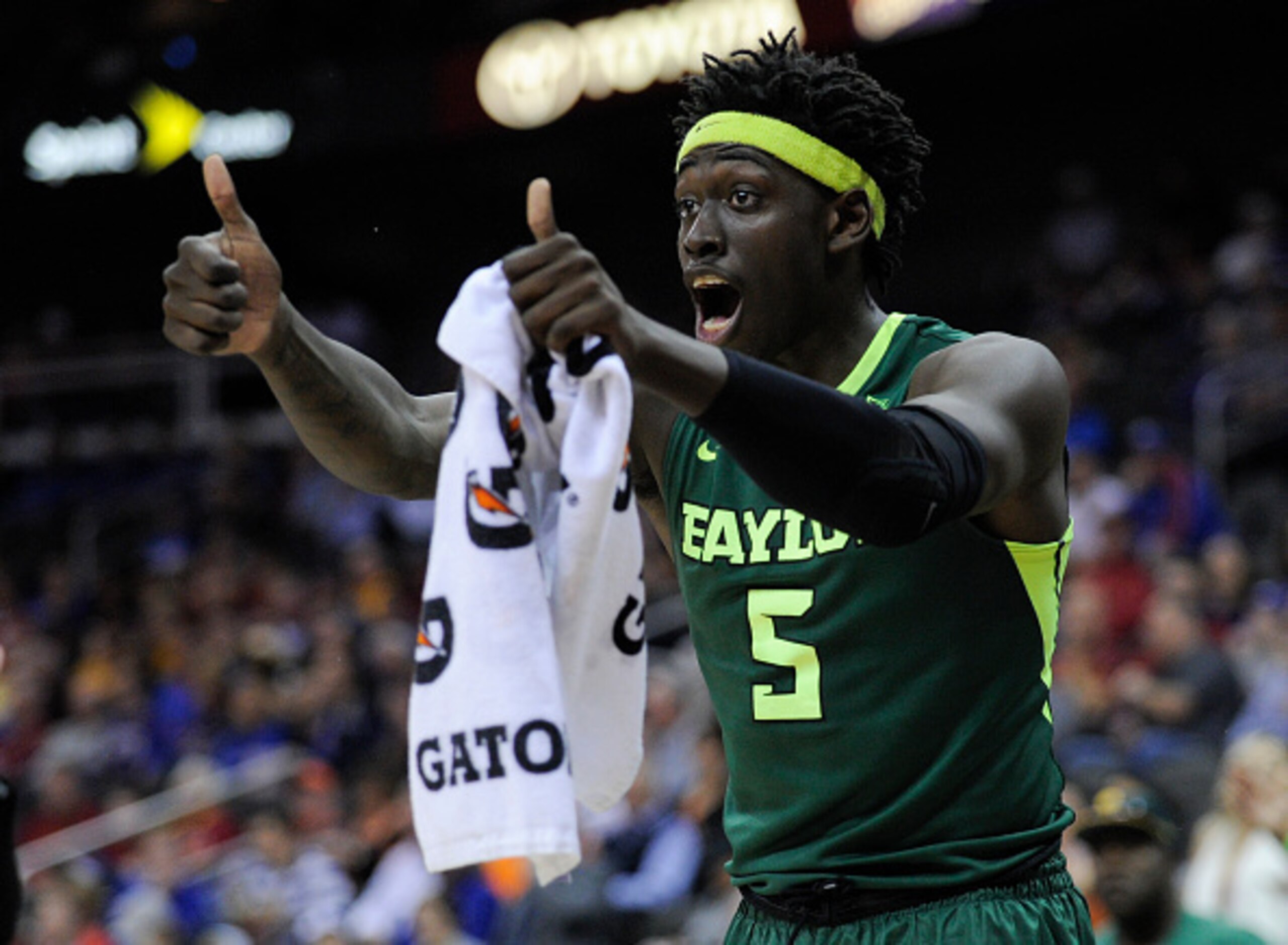
32. Justin Patton (Creighton, C, 7'0", Freshman)
A redshirt freshman, Patton already stood out with 7'0" size and mobility, but the fact he's averaging 12 points on 80.3 percent shooting enhances the intrigue tied to his future. He's missed just 13 shots in 10 games. Patton effortlessly runs the floor and shows soft touch around the basket. He'd be ranked much higher if he were more physical and disruptive defensively.
31. Johnathan Motley (Baylor, PF, 6'10", Junior)
Motley has entered the first-round discussion by adding to and sharpening his offensive game. Averaging 16.3 points, he's become more advanced in the post and threatening in face-up situations, showing the ability to put the ball on the floor and drive. But he's even shooting 77.8 percent from the free-throw line.
With better touch and ball skills, Motley's athleticism, versatility and production should help him earn consideration from teams in the 20-35 range.
30. Alec Peters (Valparaiso, PF, 6'9", Senior)
Peters has now scored at least 20 points during each of Valparaiso's first nine games, including its last one against Kentucky.
He's averaging 25.1 points without his most reliable, coveted weapon working (24.5 percent from three); he shot 46.6 percent from three as a sophomore and 44 percent from deep as a junior. Having improved his two-point scoring—Peters now gets to the free-throw line 8.4 times per game—he's going to become one of college hoops' toughest covers once his jumper starts falling.
No. 29-No. 27
8 of 30
29. Omer Yurtseven (North Carolina State, C, 6'11", Freshman)
Yurtseven's debut is just around the corner with only one game left on his suspension (due to benefits received while overseas). He looks the part of an NBA center with 6'11" size and effortless mobility, and we've seen flashes of back-to-the-basket moves and mid-range jumpers.
He'll want to eliminate concerns over his toughness, however—Yurtseven isn't physical down low and doesn't come off as an intimidating rim protector. He'll go anywhere in the Nos. 20-40 range depending on his interior presence and skill level.
28. Tyler Lydon (Syracuse, PF, 6'9", Sophomore)
Lydon has been disappointing so far—his rebounding numbers are still low (9.3 per 40 minutes), and he hasn't added to his offensive repertoire. Athleticism and three-point shooting will keep first-round interest alive, though. He's effective around the basket and threatening from behind the arc.
But without the ability to create or win the battle under the boards, there is only so much he brings to the table. Lydon will have to show he can impact games when his jumper isn't falling.
27. Shake Milton (SMU, PG, 6'5", Sophomore)
From an NBA standpoint, Milton stands out with 6'5" size and powerful legs. He's become shiftier off the dribble too, which has led to an increase in assists (3.9 per game). And his jumper is back after a slow start—he's connected on nine threes over SMU's last three games.
He isn't the most explosive, which has something to do with the fact he's only shooting 46.3 percent inside the arc. But Milton's physical tools, ball-handling and perimeter scoring pass the eye test. He just might need a third year at SMU to tie everything together and max out his stock.
No. 26-No. 24
9 of 30
26. Frank Jackson (Duke, PG/SG, 6'3", Freshman)
Though he disappeared against Florida (three points), Jackson has been fairly reliable, averaging 14 points per game on 47.8 percent from the floor and 37.5 percent on threes. He's a good-looking shooter, a capable ball-handler and a strong athlete—traits that could carry him to an NBA career.
But he lacks point guard wiggle (1.8 assists per game) and 2-guard size, raising questions concerning his NBA position and his upside.
25. Isaiah Hartenstein (Germany, PF, 6'11", 1998)
Having played fewer than six minutes during five of Zalgiris' last seven games, Hartenstein hasn't been able to build much of a draft case for himself. He's been on the radar for years, though, with 6'11" size, scoring ability and shooting range.
Skilled and versatile, he's also a handful under the boards. But with a strong NCAA field filled with productive freshmen and sophomores, Hartenstein has become vulnerable on the draft board.
24. TJ Leaf (UCLA, PF, 6'10", Freshman)
Leaf validated his hot start last Saturday by taking it to Kentucky, recording 17 points, 13 boards and five assists. He's giving scouts reasons to overlook his lack of athleticism and strength (225 lbs), having made nine of his first 18 three-point attempts and showing he can take bigs off the dribble. He's also been an above-average rebounder and passer, good signs for his NBA role-player potential.
Can he guard and execute offensively against stronger, more explosive NBA bigs? Those questions hold him outside the top 20, but they won't matter as much in the late part of the first round.
No. 23-No. 21
10 of 30
23. Rodions Kurucs (Latvia, SF, 6'8", 1998)
Kurucs returned to Barcelona's junior team after suffering a knee injury earlier in the year. He's only playing 14.7 minutes and shooting 33.3 percent, making it difficult to envision him declaring this June. But there will be NBA interest whenever he does—for a wing, Kurucs has convincing size, athleticism and shooting range.
22. Jarrett Allen (Texas, C, 6'11", Freshman)
Allen passes the eye test with 6'11", 235-pound size, mobile feet and a 7'5 ½" wingspan. And though not known for his offense, he's had some nice moments. Allen has a hook-shot game down low and some touch in the mid-range.
He challenges shots defensively, though limited explosiveness has hurt him as a rebounder (9.4 per 40 minutes) and shot-blocker (1.8 per 40 minutes). Without sharp skills or flashy athleticism, Allen isn't the most exciting prospect, but teams hoping to land a Robin Lopez-like anchor could still target him with a first-round pick.
21. Ike Anigbogu (UCLA, C, 6'10", Freshman)
Anigbogu has played a total of 45 minutes all season and has still made an impression on NBA scouts. Credit his physical profile—at 6'10", 250 pounds with notable strength, length and athleticism, he stands out among inferior college bigs.
But Anigbogu just turned 18, and despite his limited offensive skills and feel for the game, there are bound to be NBA teams intrigued by his tools and his 12.4 boards and 6.2 blocks per 40 minutes.
20. Kostja Mushidi (Germany, SG, 6'5", 1998)
11 of 30Key stats: 9.7 points, 1.9 3PTM
Playing 24.1 minutes per game, Kostja Mushidi is getting legitimate time with Mega Leks. And though he's only shooting 36.7 percent from the floor, he's contributing at both ends.
Mushidi has a strong frame (205 lbs) and some ball-handling skills, which help him create shots from all three levels. His shot selection isn't the cleanest, but he scores in a variety of ways: drives, pull-ups, floaters, spot-up threes.
His defense is another plus—in addition to his strong frame, Mushidi has long arms, quick feet and a competitive edge. When engaged, he's shown he can lock up wings as well as guard multiple positions.
At 18 years, he's visibly raw, something the field-goal percentage and ridiculous 19.4 percent turnover percentage highlight, per RealGM.com. He's a lock for the NBA Development League next year if he chooses to come over right away.
19. Tony Bradley (North Carolina, C, 6'10", Freshman)
12 of 30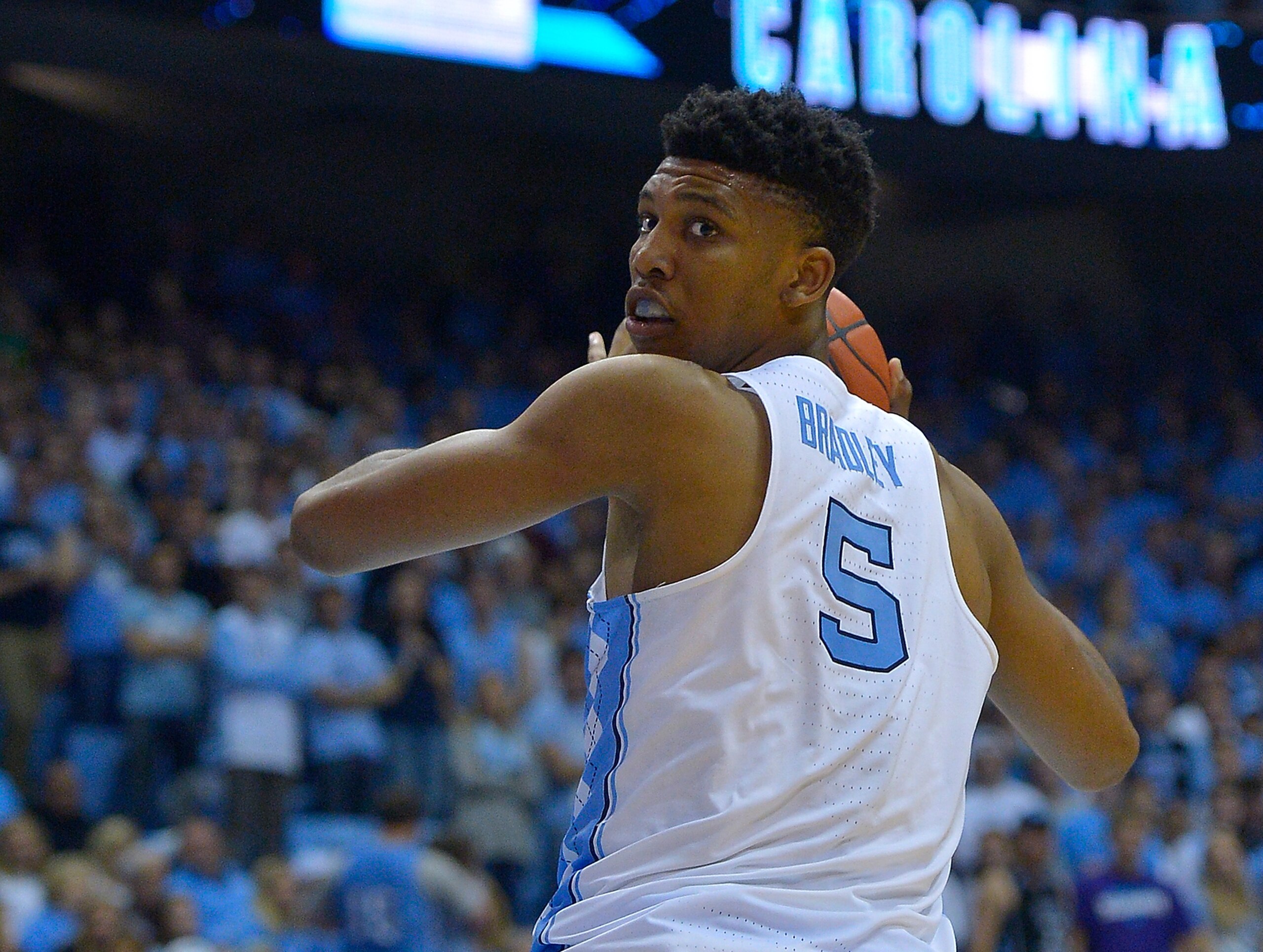
Key stats: 9.2 points, 6.1 rebounds, 60 percent FG
Tony Bradley hasn't needed a giant role to show scouts he's North Carolina's top NBA prospect. Averaging 21.6 points and 14.4 rebounds per 40 minutes, he's consistently made his presence felt around the hoop.
Offensively, he's looked fluid when scoring with his back to the basket or facing up from the short corners. And he continues to put himself in catch-and-finish position at the rim.
Shooting 60 percent from the floor, he takes and makes quality shots.
The biggest number tied to Bradley is the 22.4 percent offensive rebounding percentage, per Sports-Reference.com. He uses his broad shoulders to move bigs and an enormous 7'4" wingspan to reach loose balls above traffic.
With only five blocks in 170 minutes, Bradley hasn't come off as an intimidating rim protector, however. Questionable defensive upside and average athleticism will make it difficult for him to rise into this year's lottery. But between his tools, production and post game, Bradley has emerged as a first-round-caliber big man at just 18 years old.
18. Terrance Ferguson (Adelaide 36ers, SF, 6'7", 1998)
13 of 30
Key stats: 18.4 minutes, 6.3 points, 38.7 percent 3PT
18-year old Terrance Ferguson has earned himself a legitimate role among professionals in Australia's National Basketball League.
He's shooting 41.7 percent—so the transition hasn't been seamless—but his signature strengths out of high school have held up. Co-MVP of the Nike Hoop Summit after knocking down seven three-pointers, he's converting at a 38.7 percent clip from downtown. And at 6'7" with quick feet and explosiveness, the three-and-D potential remains easy to buy.
Eight total assists through 11 games reflect limited playmaking skills. And though he's unselfishly played within the Adelaide 36ers offense, Ferguson isn't a one-on-one shot creator in the half court; He leans heavily on stop-ups, transition and open lanes.
But teams just start looking for rotation players around No. 20 overall. And Ferguson's NBA tools for a wing, jumper and defense should be enough.
17. Robert Williams (Texas A&M, PF, 6'9", Freshman)
14 of 30
Key stats: 9.8 points, 5.6 rebounds, 1.5 assists, 2.6 blocks, 61.5 percent FG
Robert Williams' activity off Texas A&M's bench has created buzz among NBA scouts.
Averaging 11.3 rebounds and 5.3 blocks per 40 minutes, he's doing damage around the basket as a finisher, rebounder and rim protector. A powerful athlete with a huge 7'4" wingspan, Williams' tools have been the driving force behind his production and efficiency.
Dishing out three assists per 40 minutes, he's also flashed surprising passing instincts out of the post.
He isn't overly skilled, though it's been encouraging to see him make 14 of 16 free throws and rarely turn the ball over (seven turnovers in eight games). There is enthralling potential here if he continues to develop his back-to-the-basket game and his jumper.
16. Marques Bolden (Duke, C, 6'11", Freshman)
15 of 30
Marques Bolden saw his first action of the season last Saturday—following a preseason lower-leg injury—though he only played two minutes Tuesday night during Duke's win over Florida at Madison Square Garden.
With the team's guard trio of Frank Jackson, Luke Kennard and Grayson Allen averaging a combined 50.3 points, Jayson Tatum back and Amile Jefferson locked into the lineup, Bolden's role is unclear moving forward.
Limited playing time and touches won't help the 6'11", 245-pounder's development or draft stock either.
But it's tough to argue with Bolden's tools, including his strong frame, massive 7'6" wingspan and nimble feet. An active, high-percentage finisher with a budding back-to-the-basket game and a live motor on the offensive glass, Bolden has the chance to be a handful in the paint.
But scouts will need to see more when determining how far away his skills are and whether he's anything more than just a defensive space-eater down low. His image will take a hit if it turns out he doesn't stretch the floor or protect the rim.
15. Edrice 'Bam' Adebayo (Kentucky, PF/C, 6'10", Freshman)
16 of 30
Key stats: 12.4 points, 8.1 rebounds, 1.8 blocks, 52.2 percent FG
Limited offensive skills haven't stopped Edrice "Bam" Adebayo from averaging 14.5 points over Kentucky's last six games.
Instead of fancy moves or jump shots, he's using his strength, footwork and quickness to gain position, drop-step past defenders or spin by them baseline. Of his 35 made field goals, 29 have come right at the rim, per Hoop-Math.com.
At 6'10", 260 pounds, and with elite athleticism for a big man, he should continue to be difficult around the basket as he moves from college to the pros.
Adebayo's upside kicks in if the occasional hook shots in the lane and mid-range jumpers become every-game weapons.
Along with his post game and touch, his pick-and-roll defense could stand to improve. But at the least, imposing physical tools, explosiveness and motor should help Adebayo earn an energizer role in the NBA.
14. Miles Bridges (Michigan State, SF/PF, 6'7", Freshman)
17 of 30
Key stats: 16.6 points, 8.8 rebounds, 2.0 assists, 1.9 3PTM
An ankle injury will keep Miles Bridges sidelined for at least two weeks; Athleticism and inside-out skills made him one of the more exciting freshmen prior to the injury.
A powerful mix of explosiveness and strength has translated to numerous monster finishes above traffic. He's consistently picked up easy buckets off transition, drives and putbacks. Tremendous leaping ability and motor help him pull down 8.8 rebounds and block 1.5 shots a game as well.
Bridges' jumper isn't the prettiest, but he's flicking in 1.9 threes a game at a 38.5 percent clip. He looks confident from behind the arc while rising and firing one-on-one from the short corners.
On the downside, his 53.8 percent mark from the free-throw stripe suggests his early three-point numbers could be fluky. And despite his strong frame (230 lbs), quickness and hops, he takes just four free throws per 40 minutes.
To play NBA small forward, he'll need to improve his handle and his shot-creating in the half court.
Bridges has also looked wild with his decision-making (3.4 turnovers per game) and is prone to getting flustered when things are going wrong.
He's a clear talent but not an obvious fit. Bridges could be a candidate to fall under the boom-or-bust umbrella by June.
13. OG Anunoby (Indiana, SF, 6'8", Sophomore)
18 of 30
Key stats: 12.5 points, 6.0 rebounds, 1.5 blocks, 38.1 percent 3PT
OG Anunoby went down with an ankle injury, but not before a 16-point effort (on two misses) during a high-profile win over North Carolin on Nov. 30.
His athleticism, length and defensive potential continue to shine, but every so often, he'll make a move or a pass that suggests he's catching on offensively. Baseline spins, rip-throughs into drives, "Eurosteps," three-point shooting—he has major upside if he can eventually tie everything together.
Even if he doesn't, NBA teams will still value his ability to guard four positions, provide transition firepower, make open shots and bring energy.
It creates a high floor and the perception of low risk, big upside.
12. Frank Ntilikina (France, PG, 6'5", 1998)
19 of 30Key stats: 15.8 minutes, 5.7 points, 1.3 assists, 50.6 percent FG, 47.1 percent 3PT
Frank Ntilikina continues to efficiently produce in a 15.8-minute-per-game complementary role in France's top league. He's coming off arguably his best game of the season against Juventus on Wednesday, finishing with 11 points, five assists and three steals.
Ntilikina plays within himself—he rarely gets sped up or out of control, and he makes poised, smart decisions off the dribble. He's shown he can play slow or fast, with the patience and vision to probe and find the open man in the half court while also displaying long strides and athleticism for transition.
He's strengthened his case this year as a shooter as well, having hit 16 of 34 threes.
Ntilikina should battle Kentucky's De'Aaron Fox for the title of top defensive guard in the class. The Frenchman's 6'5" size, long arms, quickness and focus translate to pressure, forced turnovers, steals and versatility.
Given the point guard competition in today's NBA, projecting Ntilikina as a starter could be a reach. But the likelihood of his fitting in wherever he goes is high.
11. Malik Monk (Kentucky, SG, 6'3", Freshman)
20 of 30
Key stats: 19.3 points, 2.2 assists, 2.9 three-pointers, 38.2 percent 3PT, 48.1 percent FG
Elite athleticism and shot-making skills should help scouts overlook Malik Monk's 6'3" size.
For a guard who rarely gets to the basket—he has just four buckets at the rim in the half court, per Hoop-Math.com, and he only averages 2.3 free-throw attempts per game—he's been incredibly productive and efficient.
Monk has already hit the 20-point mark five times while shooting 48.1 percent. He makes 2.9 threes a game, showing deep range, a quick release and the ability to connect off screens, spot-ups, transition and pull-ups.
He's relied heavily on fast breaks and jump-shot opportunities: Of Monk's 24 made field goals at the rim, 20 have come within the first 10 seconds of the shot clock. Two-point jumpers and threes account for 41 of his 65 total made field goals.
It's a tough formula for consistency, but it's worked so far. Monk appears on track toward selling himself as a microwave scorer and explosive open-floor weapon.
10. De'Aaron Fox (Kentucky, PG, 6'3", Freshman)
21 of 30
Key stats: 15.1 points, 7.4 assists, 5.4 rebounds, 1.9 steals
Despite suffering a loss, De'Aaron Fox helped himself against UCLA last Saturday. He gave Lonzo Ball the business on a few nasty moves off the dribble that highlighted shiftiness and breakdown ability.
Fox finished with 20 points and nine assists (two turnovers), having done a great job of selling his playmaking potential. He is excellent at using ball screens and change of speed to get inside the defense.
NBA teams will ultimately value his knack for setting the table over his scoring.
Fox's shooting range needs work—he's only hit three triples all year (15 percent) and has been shaky in the mid-range (29.3 percent on two-point jumpers, per Hoop-Math.com). At this stage, he relies on transition opportunities and open driving lanes to slash through.
Extremely quick, he's unsurprisingly established himself as a suffocating on-ball defender. An unreliable perimeter game hurts his upside as a scorer, but his passing, open-floor offense and defensive pressure should lock him into this year's lottery.
9. Harry Giles (Duke, PF, 6'10", Freshman)
22 of 30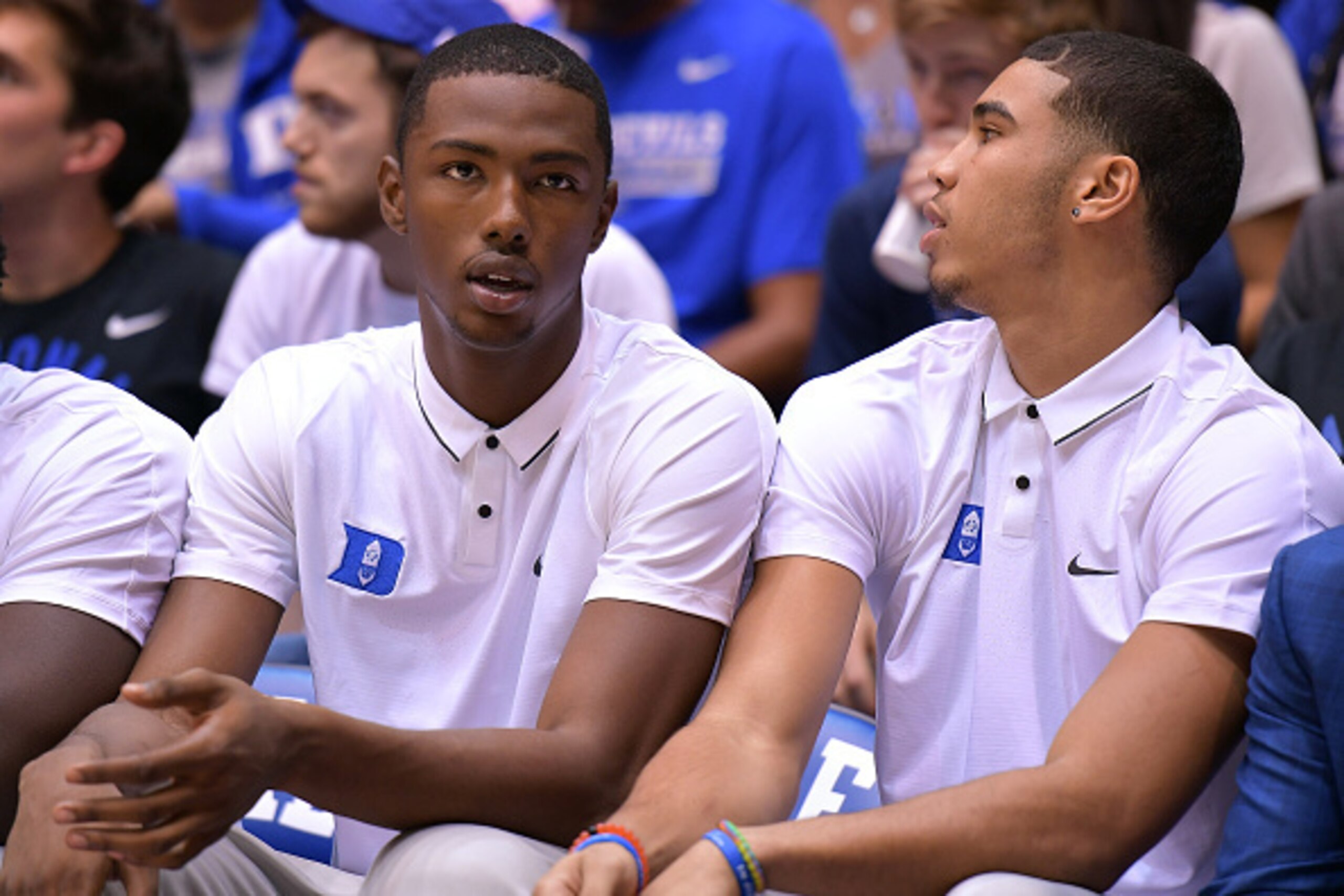
Scouts finally got to see Harry Giles on Tuesday night, though there is only so much to take away from layup lines.
He sat out his 10th consecutive game to start the season because of a preseason knee surgery—his third in three years.
The good news: Head coach Mike Krzyzewski finally shined some positive light on Giles' status:
"Harry's participating," he told CBSSports.com's Matt Norlander. "He hasn't had as much contact yet. We're hoping before Christmas, those two games. But I don't want to put a gun to his head, like, 'You have to do it.' I want to see what he's [able to do] during the same period with a little more contact before we go forward."
Having only played two full seasons since his freshman year of high school, Giles lacked polish to begin with. He is going to need time and reps.
But it's tough to replicate his 6'10" size, 7'3" length, athleticism, motor and skill set, which consists of post moves, ball-handling and some shooting touch.
8. Ivan Rabb (California, PF/C, 6'11", Sophomore)
23 of 30
Key stats: 16.1 points, 10.0 rebounds, 56.8 percent FG
Ivan Rabb fell back to earth this week after combining for 51 points against Louisiana Tech on Nov. 30 and Alcorn State last Saturday. He finished with six points (0-of-6 free throws) against Princeton on Tuesday before scoring just eight during a weak loss to Seton Hall the following night.
But we've seen flashes of sharper, more advanced offense so far mixed with quiet stretches and shaky execution.
Inconsistency could make it difficult for Rabb to climb this year's board, given he's already a sophomore and the field is strong. But by June, scouts will still see an attractive NBA package of physical tools, post skills and rebounding instincts.
Even if he never develops into a reliable go-to option offensively, his finishing ability, nose for the ball and pick-and-roll defense should still hold late-lottery to mid-first-round value.
7. Lauri Markkanen (Arizona, PF, 7'0", Freshman)
24 of 30
Key stats: 17.8 points, 7.2 rebounds, 52 percent FG, 46.3 percent 3PT
Lauri Markkanen is quietly emerging as one of the country's top offensive prospects. He continues to strengthen his track record as a shooter, making 19 of his first 41 three-pointers and showing convincing touch out to NBA range.
More than just a spot-up threat, he's also flashed the versatility to attack closeouts or separate into pull-up and step-back jumpers. He can create his own shot away from the basket, and though he prefers the perimeter, he's flashed the footwork and instincts to improvise and convert in the post.
Highly skilled with enough athleticism, Markkanen has exciting scoring potential. But 8.8 rebounds and one block per 40 minutes are not enough and represent weaknesses that damage his value.
More of a finesse big man that a power one, his lack of physicality and length have been exposed under the boards and in rim protection. Strong, aggressive NBA power forwards could potentially have a field day with Markkanen around the basket.
It's worth noting his worst two games of the season have come against ranked opponents—Markkanen shot 4-of-9 against Michigan State on Nov. 11 and 4-of-14 against Gonzaga last Saturday.
6. Lonzo Ball (UCLA, PG, 6'6", Freshman)
25 of 30
Key stats: 14.6 points, 9.3 assists, 5.0 rebounds, 1.4 steals, 1.0 blocks, 55.4 percent FG
Lonzo Ball was up and down during UCLA's first real test against Kentucky last Saturday, though he still managed 14 points, seven assists and six boards during a road win.
He looked overly casual at both ends with six turnovers and some lackluster defense on De'Aaron Fox. But if a team views Ball's package of strengths as one of a kind, his correctable weaknesses won't stop it from pulling trigger in six months.
He's helped change the Bruins' identity with contagious passing and fast-paced play. It's no coincidence UCLA is shooting a red-hot 55.1 percent from the floor (it shot 45.4 percent last year). Ball is a quick decision-maker with unteachable vision and IQ, and his value stems from his knack for putting teammates in high-percentage scoring opportunities.
The fact he's hitting 2.2 threes per game only strengthens his draft case, though his 43.5 percent clip should fall eventually.
5. Dennis Smith Jr. (North Carolina State, PG, 6'3", Freshman)
26 of 30
Key numbers: 18.3 points, 4.9 assists, 1.4 steals
Dennis Smith Jr. has struggled from the floor (40.9 percent), which is mostly the result of inconsistent shooting and tough shot selection.
Even on off days, it's easy to see why scouts think so highly of him. Smith's an explosive athlete, flashy ball-handler and capable scorer from all three levels. His scoring mentality and his ability to break down defenses with change of speed/direction reminds me of Portland Trail Blazer point guard Damian Lillard.
Smith is shooting 82.5 percent from the line and looks relatively natural pulling up with the jumper; Teams should feel comfortable about his potential to improve from outside.
In the meantime, they'll covet his playmaking, transition game, jets and knack for getting to the hoop.
4. Jonathan Isaac (Florida State, SF, 6'10", Freshman)
27 of 30Key stats: 15.1 points, 7.3 rebounds, 58.8 percent FG, 44.4 percent 3PT
With seven games under his belt, Jonathan Isaac has yet to put up a dud.
A hip flexor injury just recently knocked him out of action, but Isaac has shot at least 45 percent from the field every night and finished with at least 14 points in all but one contest. His 6'10" size, athleticism, face-up ball skills and defense create potential, and he looks poised to back that up with production.
Making 1.7 threes per game at a 44.4 percent clip, he was consistently on fire from outside throughout November. He's also flashed the ball-handling ability and footwork to separate one-on-one, whether it's into a pull-back jumper or a swoop to the rack.
Despite a skinny, 210-pound frame, he's shown the willingness and hands to go after and bring down rebounds in traffic (11.4 per 40 minutes). Plus, he's been noticeably effective defending the perimeter, where he's done an excellent job of switching and containing.
Isaac always oozed upside, particularly after a seven-inch growth spurt in high school. But seeing him execute this early strengthens his case even further.
He could go as high as No. 2 in this draft.
3. Josh Jackson (Kansas, SF, 6'8", Freshman)
28 of 30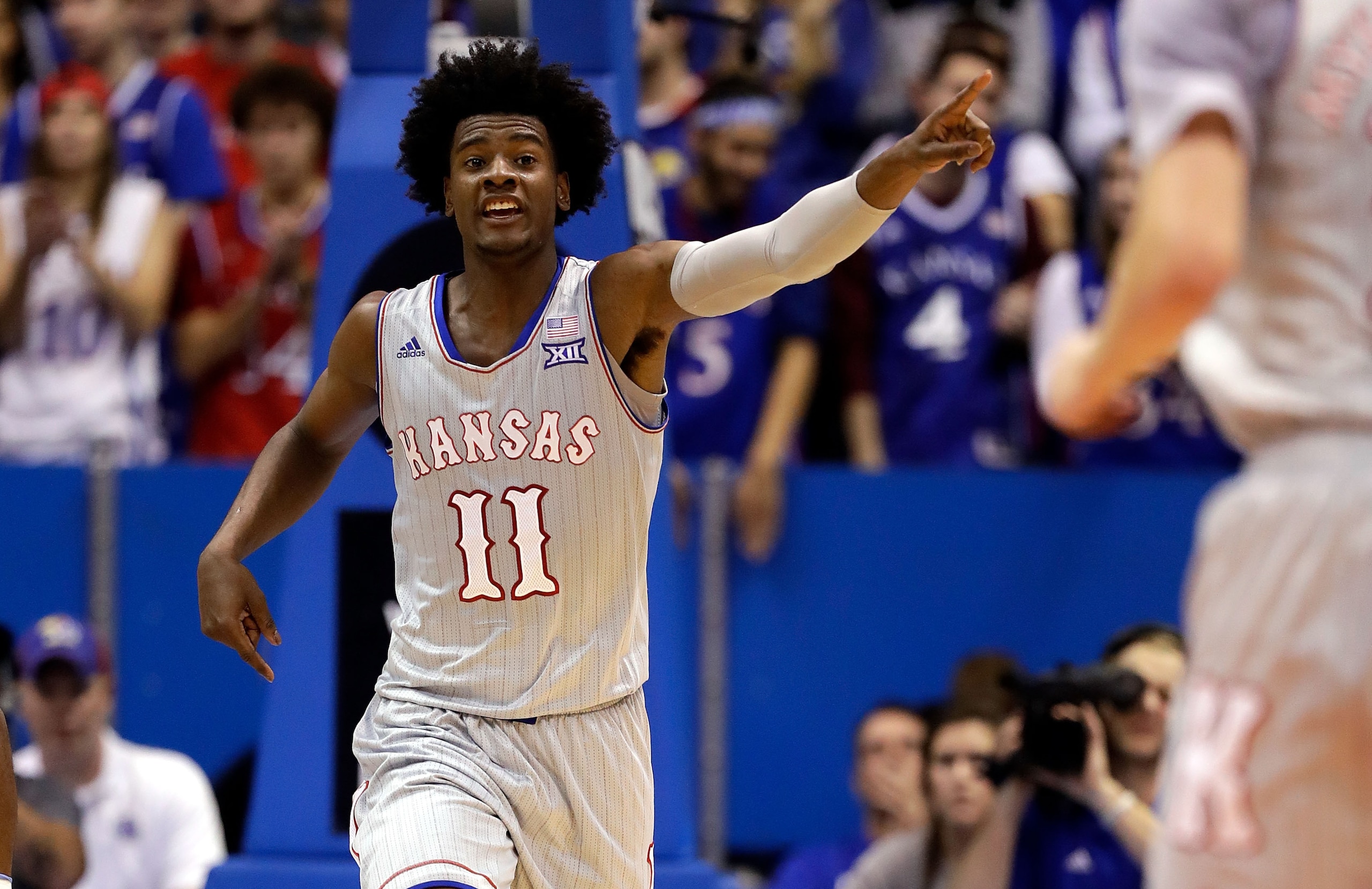
Key stats: 14.6 points, 6.1 rebounds, 3.6 assists, 1.7 steals, 1.1 blocks, 52.6 percent FG
A model of consistency since Kansas' opening game against Indiana, Josh Jackson hasn't given scouts or fans much to criticize.
Averaging 14.6 points per game on 52.6 percent shooting, he's been steady and efficient while flashing versatility the NBA traditionally covets. Along with his scoring and highlight-reel finishes, he's dishing out 3.6 assists per game, demonstrating strong passing IQ and playmaking ability off the dribble.
His defense is another major selling point—Jackson's blazing lateral quickness shows up in isolation and pick-and-roll coverage, where he seamlessly slides side to side to contain penetration. His athleticism translates to 1.7 steals and 1.1 blocks a night.
The only concern now is his jumper and his range, as he's made just five of 19 three-pointers through nine games.
Jackson's mechanics aren't ideal—he has a lot of motion resulting in somewhat of a push shot right in front of his face. But he's been effective pulling up inside the arc, and he covers enough ground to contribute without a reliable three-ball in the arsenal.
2. Jayson Tatum (Duke, SF, 6'8", Freshman)
29 of 30
Key stats: 16.0 points, 8.0 rebounds
It took just two games for Jayson Tatum to validate the preseason hype. Against the Florida Gators on Tuesday night, he had Madison Square Garden rocking with 22 points and advanced moves that many of today's NBA scoring forwards are executing.
Tatum immediately passes the eye test, both physically and fundamentally.
He's going to give college 4s problems with his quickness and ability to separate into balanced jumpers. Tatum hit his man with a couple of sweet mid-range step-backs, a post fallaway and a back-to-the-basket spin move into a layup on Tuesday. His ball-handling, footwork and shot-making skills look top-notch.
He also flashed some defensive potential against Florida with the lateral foot speed and length to make plays on the ball and force turnovers.
Tatum got denied at the rim on multiple occasions, a reflection of his limited explosiveness. And he isn't likely to showcase his skills as a passer or a playmaker much throughout the year.
But between his physical tools and a scoring attack more polished than Josh Jackson's and Jonathan Isaac's, Tatum has a chance to be the first forward called on draft night.
1. Markelle Fultz (Washington, PG, 6'4", Freshman)
30 of 30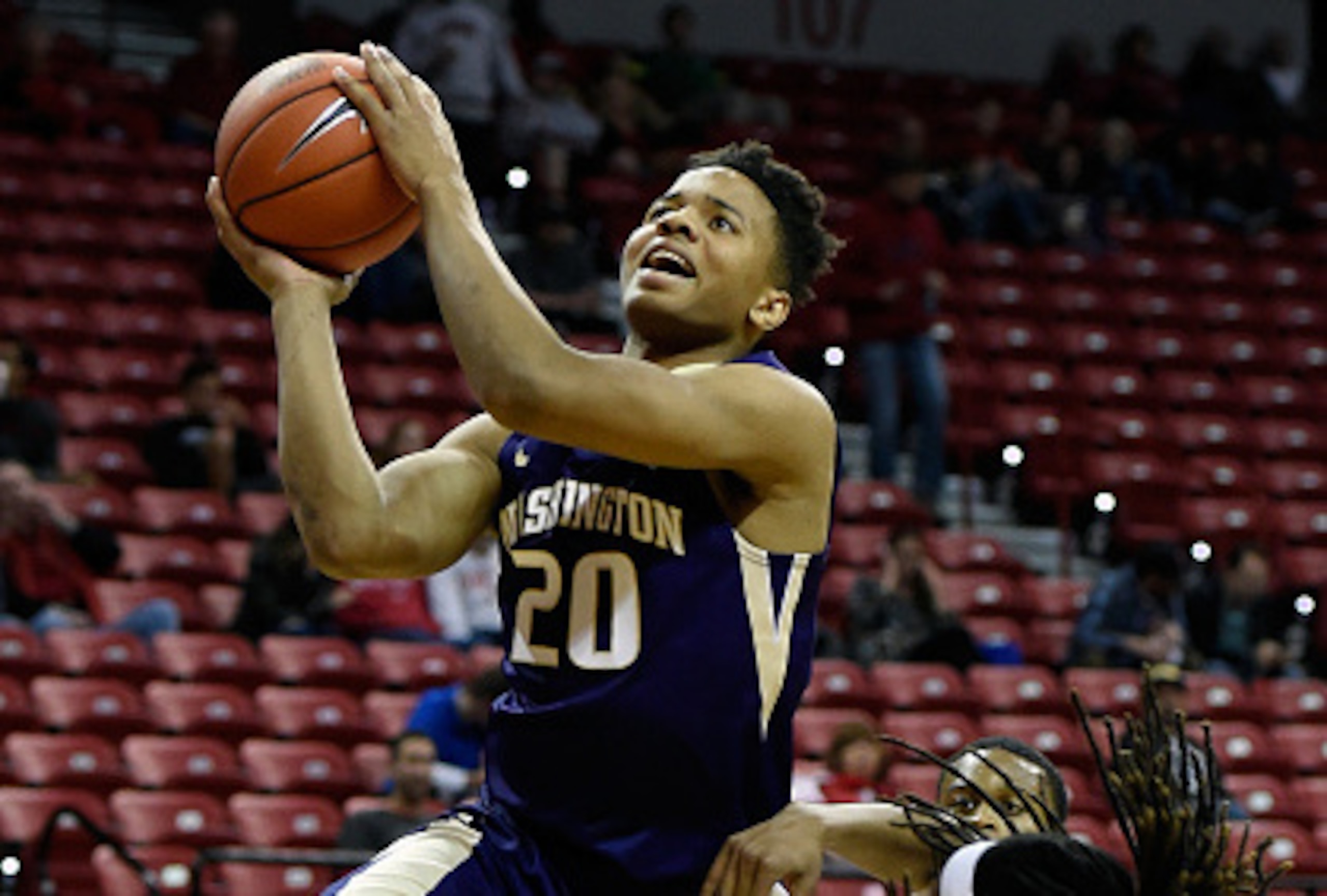
Key stats: 23 points, 7.1 rebounds, 5.9 assists, 2.0 steals, 48.5 percent 3PT
The losses may continue to pile up at Washington, but they won't damage Markelle Fultz's NBA outlook. His team can't get stops, and though Fultz's individual defense needs work, there isn't much more he can be doing offensively.
He's the only player in the country averaging at least 23 points, six rebounds and five assists per game, according to Sports-Reference.com.
With scouts likely tuned into Fultz's Wednesday matchup against Gonzaga, he struggled in the first half. The Bulldogs' blowout of the Huskies started early, though. Fultz was in a tough spot that called for him to force the issue and be overly aggressive, which he did en route to 25 points on 26 shots.
He creates shots for himself with snazzy ball-handling and change of speed, and he's demonstrated the shot-making ability to connect from all three levels, whether it's off a three-point pull-up, mid-range floater or a big finish at the rim.
Fultz has also used his elusiveness off the dribble to set up teammates. And if they were a little more reliable, he'd be averaging more than 5.9 assists per contest.
His defensive effort has flickered, though. And it wouldn't be surprising if his casual approach turned some teams off. But with explosive athleticism, high-level scoring ability and secondary playmaking skills, he's also the ideal fit for the lead guard position in today's NBA.
Advanced stats courtesy of Sports-Reference.com unless noted otherwise.


.jpg?w=2560 "Commanders May Change Logo 👀")

.jpg?w=2560 "Seahawks Have No Plans to Move")
.jpg?w=2560 "Most Tradeable Players on Every Team")