

Jamie Vardy: Is Late-Blooming Leicester City Man Galactico Material?
Unless you’ve been living under a rock for the past three months, you’ll have noticed Jamie Vardy tearing Premier League defences apart on a regular basis. That the Leicester City striker is on the cusp of equalling a legendary goalscoring record is the most remarkable storyline this young campaign has thrown up so far.
He’s been our No. 1-ranked player in the Premier League player form charts for four straight weeks—a longer streak than anyone else has managed this season (David Silva accrued three weeks at the top pre-injury); he’s heading toward Eden Hazard-levels of domination from last season if he keeps this up.
Vardy leads the individual scoring charts with 12 goals, per WhoScored.com, sitting five clear of the next-best challengers Riyad Mahrez, Odion Ighalo and Romelu Lukaku. According to the Mirror, if he scores in his next game, he’ll equal Ruud van Nistelrooy’s long-held record of most consecutive games with a goal (10). The 28-year-old is on nine at the moment, and regardless of whether he finds the net next week, what he’s done can already be considered stunning.
He was awarded the Barclays Player of the Month award for October, sealing his epic start to the season with a dose of legitimacy. He’s not just a hipster’s pick or an unsung hero; he was crowned the best in the league last month, ahead of a host of star names who cost untold amounts of cash. Vardy, a £1 million signing from Fleetwood Town from 2012, is a rather different story to the likes of Alexis Sanchez and Kevin De Bruyne.

So what’s the deal? Is this just an elongated purple patch, fuelled by confidence and consecutive strikes, or is it indicative of something else? Is Vardy, now a four-cap England international who has one foot in France for Euro 2016 under Roy Hodgson, a top-tier striker?
When dicing this argument up, it’s important to acknowledge that Vardy’s miraculous form started back under Nigel Pearson’s reign, leading to a call-up for the summer friendly against the Republic of Ireland, rather than under new man Claudio Ranieri. His form has coincided with a team-wide resurgence at the King Power Stadium, starting with the stunning escape from relegation in 2014-15 and continuing into this season.
The key to unlocking the Foxes’ best back in March was Pearson's cleverly undertaken change in formation. He switched away from a back four and installed a counter-attacking 3-5-2, making the most of some limited resources—and unlocking an extra 10 percent in a talented few.
The defensive organisation improved tenfold, with Robert Huth allowed to play a smasher role as a central centre-back in a three, merely leaping into the air and heading everything clear. It was, for comparison’s sake, the Martin Skrtel role: no-nonsense, combative defending, without the need to worry too much about positioning and tracking.
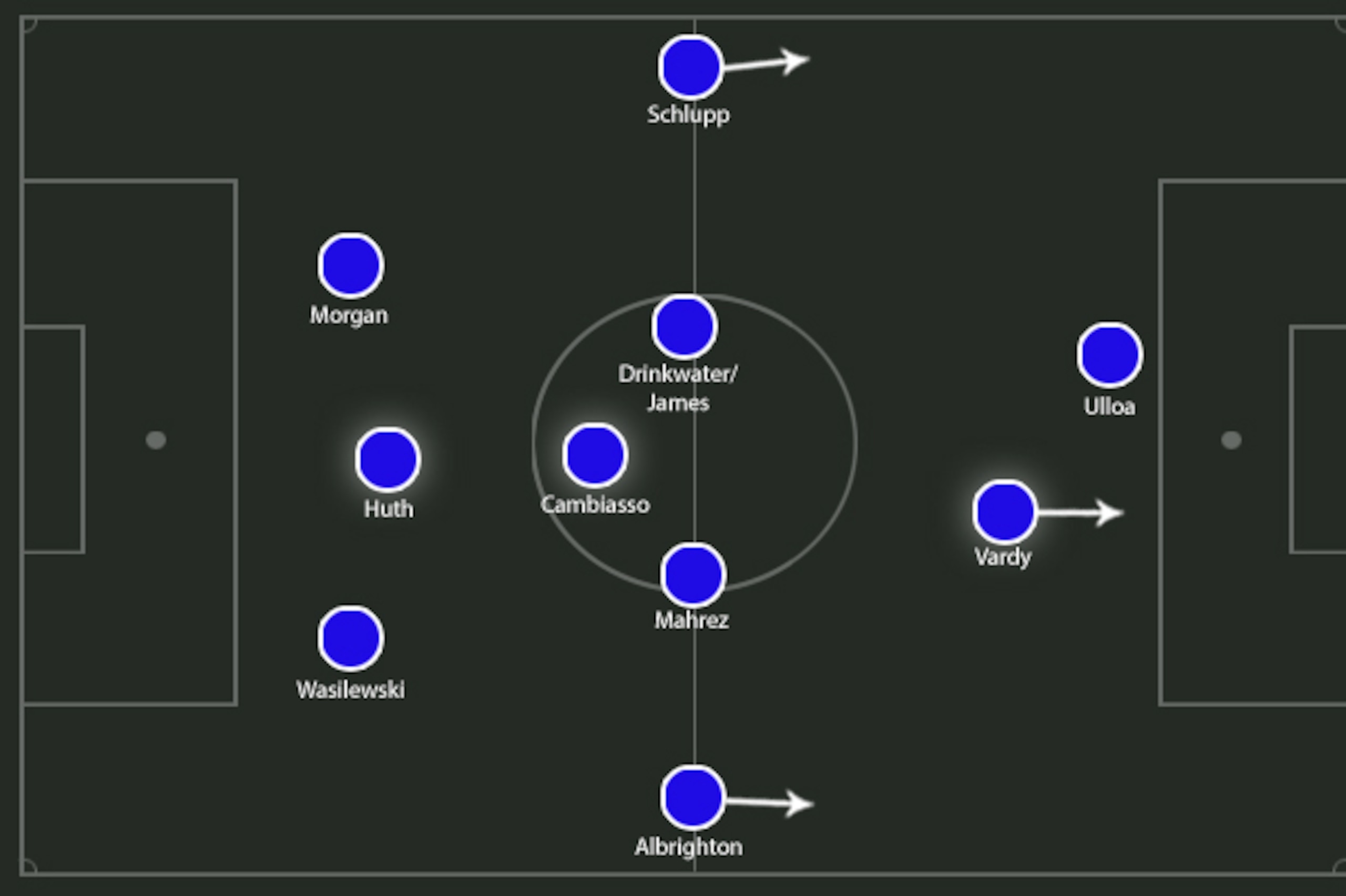
The wing-backs—Jeffrey Schlupp and Marc Albrighton—played a considerably direct, thrusting game with the ball at their feet, allowed to sear forward and attack at every opportunity. The former bruised and barrelled his way down the left to gain territory, while the latter zipped about, crossed with accuracy and weighed in with many important assists during key games.
Esteban Cambiasso’s excellent passing range was utilised from a deep-lying central-midfield role, and he was given two energetic comrades to cover the ground around him thoroughly—not that he was lacking legs himself.
That just left the front two, and in a way, their roles haven’t really changed from Pearson’s reign. The process of unlocking Vardy and Co. as effective attacking implements started under their old manager, and Ranieri has made only mild adjustments to the play, continuing to utilise direct attack patterns and reaping the rewards.
Vardy’s two biggest gifts are his relentless athleticism and work rate; he never stops running, harrying defenders on the ball and sniffing for mistakes. He sets such an energetic tempo that his colleagues can’t help but follow it—again, for comparison’s sake, Diego Costa did this at the beginning of last season, and the Chelsea midfield responded to his urgency. That’s a little lacking at Stamford Bridge at present.
Vardy is quick and fast—quicker and faster than perhaps many realised. In a straight-line race, he’ll beat most players; when discussing football’s human blurs, Vardy is in the conversation with Theo Walcott, Hector Bellerin, Jesus Navas and Co. Combine his athleticism and his mentality, and you’ve got a player defenders despise playing against.
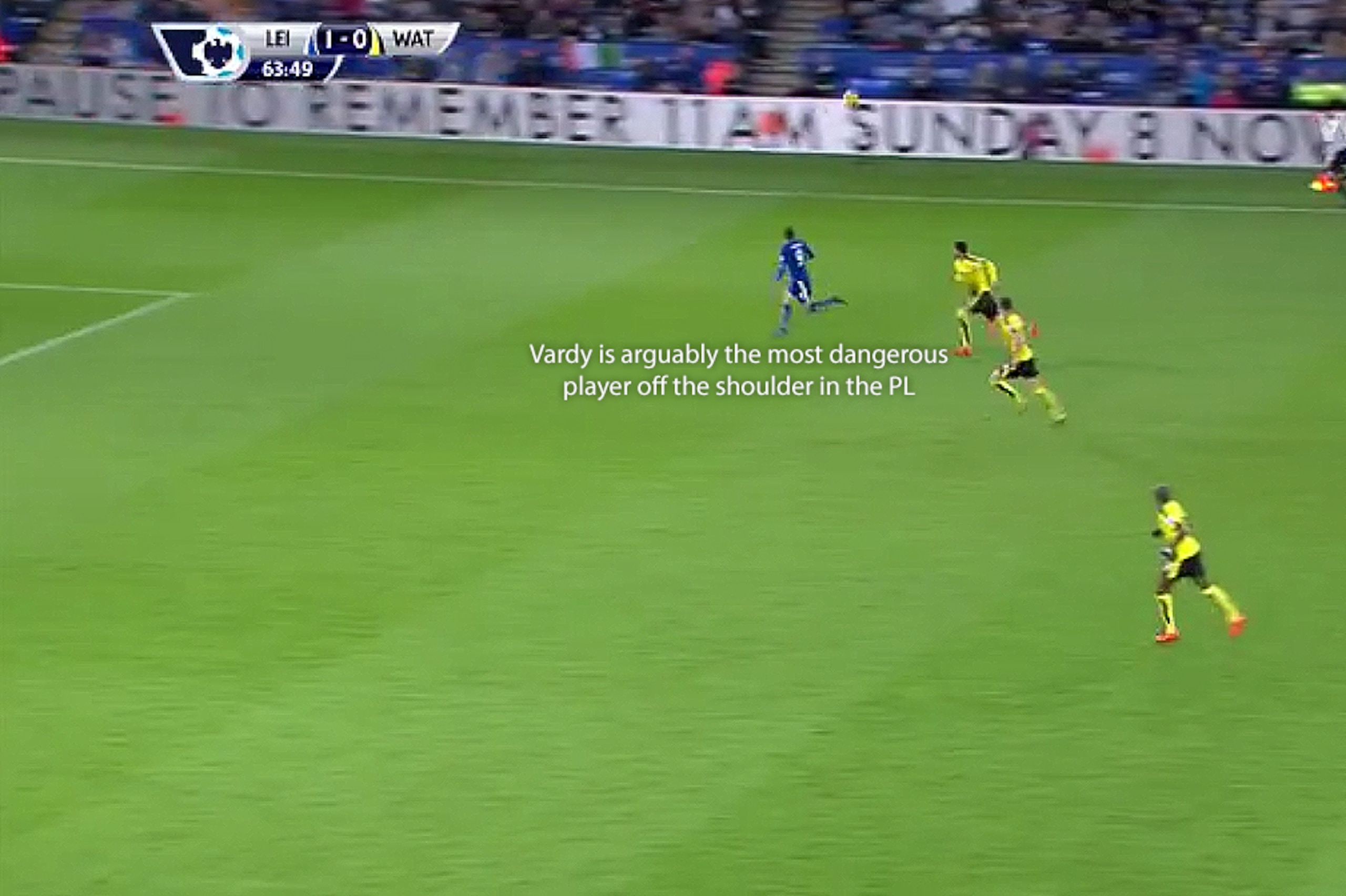
Ranieri has constructed a fairly simplistic 4-4-1-1 at the King Power Stadium and has placed Vardy atop the formation, asking him to run the channels. While Leicester initiate periods of pressure at times, their go-to attacking move is to hit the channel early out of defence with a longer pass. It doesn’t have to be that accurate; it just has to be, at worst, a 50-50 ball, so Vardy can contest it.
This is his bread and butter: combative, scrappy football that he can outfox even the best covering defenders at. Confidence-fuelled finishing means there’s an end product after these loose-ball tussles, and if he’s not sticking it in the back of the net himself, he’s winning penalties by coaxing silly challenges out of desperate defenders.
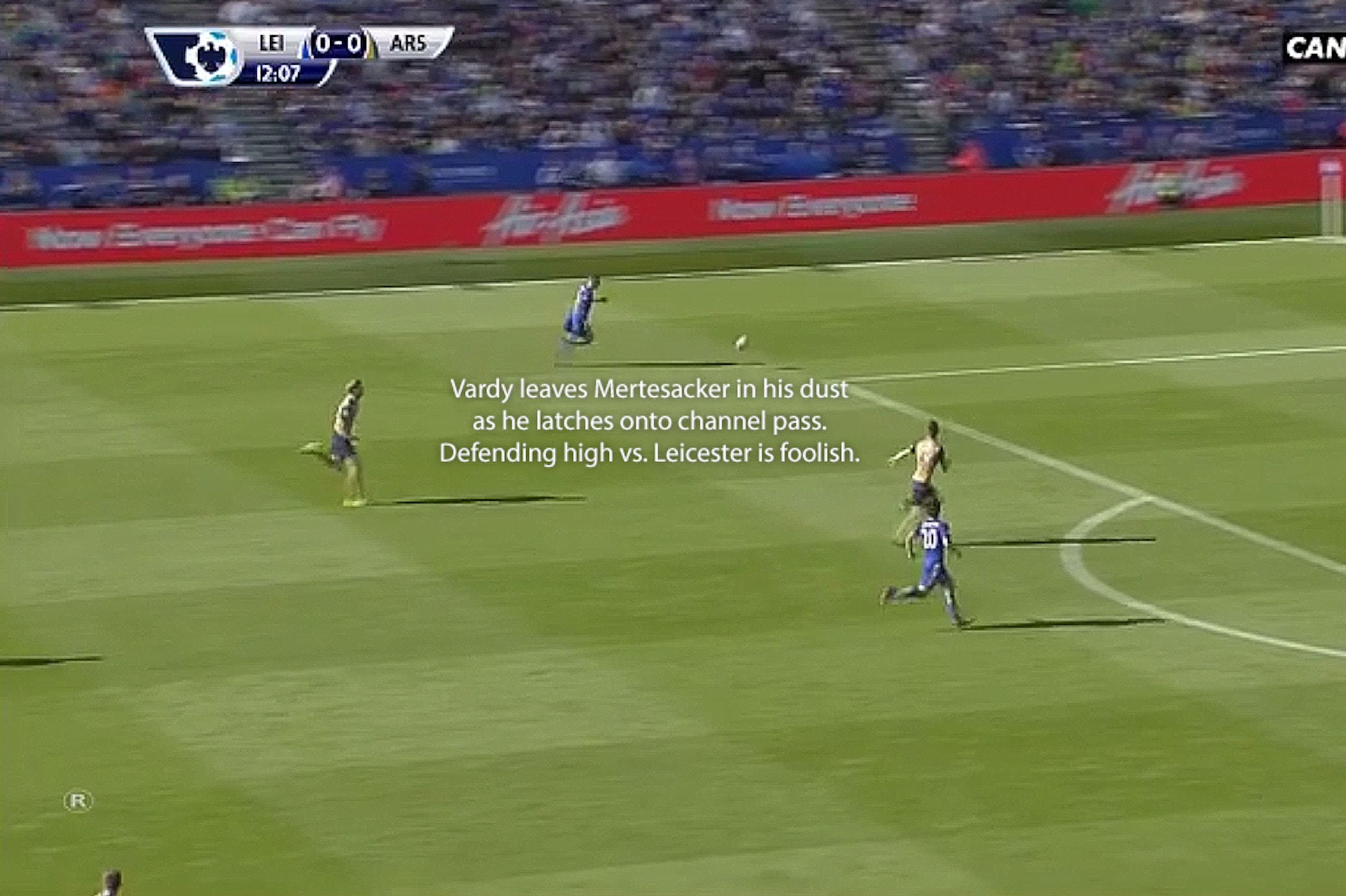
Such a consistent and effective impact in front of goal turns heads, and despite not long graduating from the Championship, there is a debate over whether Vardy is a top-shelf striker.
The production suggests he is, but people are unwilling to be easily fooled by strikers’ purple patches. After all, is Bas Dost an elite player? No, but his brilliant streak last season garnered attention—a streak similar to Robert Lewandowski’s ridiculous run this season, although the Pole is, undoubtedly, one of the finest in the world. Where do you draw the line?
Vardy is the benefactor of a game plan immaculately tailored to fit him. Pearson unlocked his roaming, aggressive best in a direct 3-5-2, and Ranieri has kept that same ethos, merely adapting the shape of the side around him. He’s given him Shinji Okazaki, a clever withdrawn forward to link with, and wing-wonders Albrighton and Mahrez ensure that no team can pay too much attention to any one individual in particular.
The theme for Vardy’s success is directness. Unleash him over the top, in transitions or on the counter, and he’ll kill you. Even his assist for England was on an extremely rare counter opportunity against Estonia.
You have to give him credit for sniffing out these chances and making the correct runs, but he’s quite a fundamental player. He doesn’t do anything eye-poppingly fantastic; he doesn’t stop the world on its axis in anything he does.

Hodgson likes Vardy and, if the striker continues in this vein, he will head to France next summer as England’s fail-safe option off the bench. A quick striker who can cause chaos over the top is the ideal weapon to have at a tournament, and though he won’t trouble the starting XI, he can impact.
That’s the key to Vardy’s rise: The setting for him has been perfect. He’s not a player managers have chosen to build around—that privilege is reserved for the Juan Roman Riquelmes of this world!—but he has benefitted greatly from a system that accentuates his considerable strengths and brushes over his weaknesses.
He’s not an elite-level player. He’s a good striker who has fallen into the ideal tactical system to suit him. Per the Daily Mail, Barcelona and Real Madrid are monitoring him, but then again, Arsenal were once reported to be in for Matthew Lowton, per the Mirror (now at Burnley). These situations tend to spiral out of control a little.
None of this is to discredit the fantastic start Vardy has made, but he is not the next Galactico, nor would he be a particularly good signing for the likes of Liverpool and Tottenham Hotspur. Players who benefit greatly from game plans can shine brightly, and that’s what’s happening for the Englishman.
Would Spurs utilise him in the same way? Would he be the focal point for a bigger club? If he wasn’t the focal point, would he thrive? These are the important questions when it comes to projecting Vardy down the line, and the answer to all three, in all likelihood, is no.




.jpg?w=2560 "Myles Garrett Got Warning 👀")

.jpg?w=2560 "Every Team's Biggest Surprise So Far 😲")