
What It Was Like to Witness Change on the University of Missouri Campus
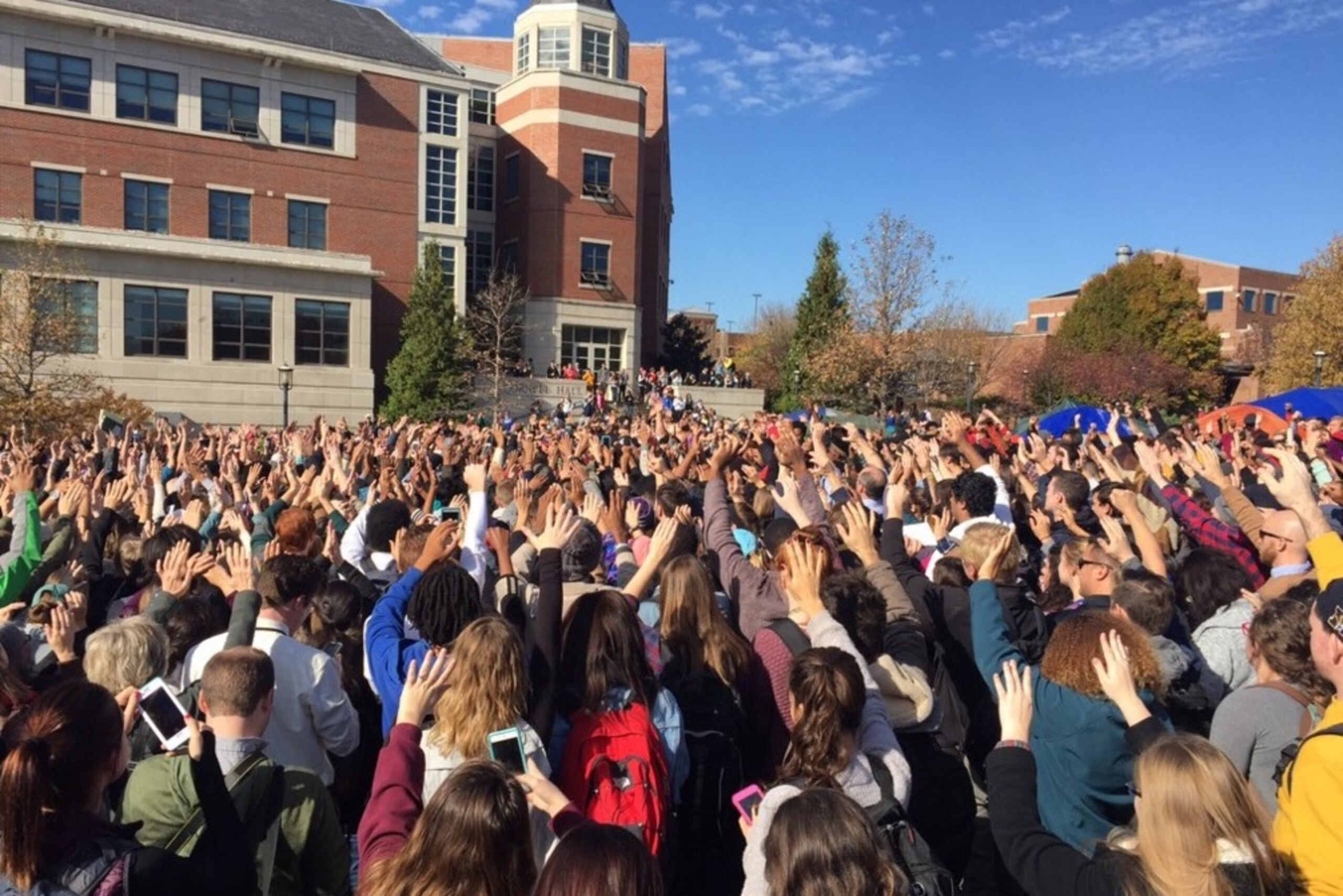
COLUMBIA, Mo. — Mornings are usually pretty quiet on Carnahan Quad, the open field separating the Missouri School of Law and the Trulaske College of Business. Monday morning, the tiger statue at the south end of the quad watched as a crowd of hundreds roared. They wanted action, and answers.
Saturday, players on the Mizzou football team announced via Twitter that they were standing in solidarity with graduate student Jonathan Butler and his hunger strike against UM System President Tim Wolfe. The team would not be participating in any football-related activities until Butler was able to eat again.
Sunday, head coach Gary Pinkel tweeted his support. There would be no more practices for his Tigers. The noise—on the quad and throughout campus—got louder and louder.
TOP NEWS

Grading Top 20 CFB QBs 👨🏫
Week 4 College Football Predictions for Every Game 🔮
Ranking the Most NFL Pro-Ready College Football Athletes 🔢
It was the most tension-filled moment on a campus where tensions have been steadily rising for weeks.
On October 5, the Legion of Black Collegians was rehearsing for a homecoming celebration when a man talking loudly on his phone approached the members and was politely asked to leave. As he was leaving, the group said, he used a racial slur. The group released a letter via its Twitter account, detailing the events and calling for action from the University of Missouri.
On October 21, Concerned Student 1950—named after the year the first African American student was admitted to the University of Missouri—released a list of eight demands for change, per Ruth Serven of the Missourian. Among those demands was a call for a change in the school administration, specifically requesting Wolfe's resignation over feelings of insufficient action on issues of racial equality.
The conflict between MU and Concerned Student 1950 finally reached its apex Monday morning. Shortly before 10 a.m., I was walking along the quad, where members of Concerned Student 1950 had set up their camp. It looked like there were at least 500 students there, chanting, cheering and calling for answers.
Then, all of a sudden, came the announcement that Wolfe was resigning.
Cheers erupted from the crowd that had gathered steadily throughout the morning. I watched as the 11 original leaders of Concerned Student 1950, who were at the center of it all, immediately broke down in tears, entered into prayer and joined together to sing hymns.
Among those 11 original leaders was Butler, the grad student whose hunger strike grabbed national headlines. One week into his hunger strike, he needed people on either side of him to help him stand. He raised his right fist up in the air and mouthed "thank you" to the members of the crowd.
That moment was roaring with emotion. What they had been fighting for had happened. They got their answer.
A feeling of relief seemed to overcome the crowd. They hugged one another and wiped away each other's tears—tears of joy.
Then a chant broke out: "I believe that we will win. I believe that we will win."
Students flocked to the quad from every direction, joining their fellow classmates arm in arm to support the change that is occurring on this campus. It wasn't just African-American students. It was white students, African-American faculty, white faculty, Latinos, Asians.
Current and former Mizzou football players, including Michael Sam, came to join in the celebration on the quad.
Student leaders ran around inside the circle of students who had linked arms around them, singing and dancing.
This was the moment the campus came together in support of the quest for change largely inspired by Butler, Concerned Student 1950 and the players on the Mizzou football team.
MU had been pushing this idea of "One Mizzou" since it mobilized to help victims of the Joplin tornado in 2011. Monday, it felt like it really was one Mizzou in Columbia.
But the reality is Wolfe's resignation is only one step in the march toward change.
There is much more work to be done.
Jason Boatright is a junior at the University of Missouri, majoring in convergence journalism and minoring in political science.

.png?w=2560 "NFL Draft Prospect Rankings 📊")
.jpg?w=2560 "OBJ's Post for Dart 🙏")
.jpg?w=2560 "Report: Bears' Backup QB Has Concussion")
.jpg?w=2560 "Broncos HC Had Beef with Seahawks 😡")
.jpg?w=2560 "Week 3 NFL Trade Candidates 📋")