

Kevin Nash, Diamond Dallas Page, More Reminisce on Sting's Career as a WCW Icon
Diamond Dallas Page’s heart was pounding as he crumpled at ringside after being knocked through the ropes on a 1997 edition of WCW Monday Nitro.
The crowd at Boston’s Fleet Center had been animated and loud since Page—his blond, shoulder-length locks flapping against the collar of his black trenchcoat—stormed the ring to tussle with the New World Order, the most dominant unit in the company at the time. As fans focused on the action, Page managed to peek up at the ceiling, anticipating the surprise that had been planned earlier in the day.
He’d been involved in some big angles before, but this was like nothing he had ever tried.
On television, viewers saw a wide shot of the arena, then Sting rappelling straight down from the rafters, his signature black baseball bat in hand, landing with legs apart over Page’s body. With Hulk Hogan, Randy Savage, Scott Hall and the other NWO members agitating in the ring, Kevin Nash rushed The Stinger and was bashed with the weapon.
Then the mysterious interloper bent over DDP and reached for something under his clothing.
“I had my own harness on that nobody saw,” Page says. “He hooked me up, and we took off.”
Sting was still straddling Page as the two rose above the audience. “I had my eyes closed,” Page recalls. “It was pretty scary. But then I had to open them. I knew I’d never do anything like this again, and I wanted to look.”
The show ended with the pair disappearing into the darkness at the top of the arena. Page remembers being the first one to reach safety, then watching Sting climb up and steady himself on the catwalk. Enveloped by blackness, away from the cameras, Page had something he wanted to say.
“You really are Batman,” he told the performer, both for his ability to successfully play a superhero on television and behave like one off-screen.
Yet despite a celebrated career spanning nearly 30 years, the multiple WCW, NWA and TNA champion has yet to achieve one benchmark.
“I’ve done so many things in the wrestling business,” he told Rob Leigh of the Mirror in July, “but the one thing I’ve never done was wrestle or be part of the WWE family. I didn’t want to hang it all up and retire without having done that in some capacity.”
For much of the past year, the real-life Steve Borden has been involved with a number of WWE projects, notably a WWE Network special about the death of his first tag team partner, The Ultimate Warrior, and a new video game. Nevertheless, fans continue to speculate over whether he’s preparing himself for one last run—or at least a final match at WrestleMania 31.
The 55-year-old legend is reticent about discussing his next move. In fact, he’s selective about even detailing the high points of career, preferring to glorify his Christian faith instead of his in-ring character. But wrestlers and other associates consistently tell the same story about Steve Borden, a tale of tenacity, devotion and principle, unwrapping the mystery of the individual behind the white face paint.
“You evaluate your masculinity not by the size of your biceps,” points out “Million Dollar Man” Ted DiBiase, who’s participated in a number of Christian outreach projects with Borden, “but the size of your integrity. That’s Steve.”
Blade Runner

“Steve is a really, really good guy,” says Rick Bassman, the trainer and entrepreneur who met the future superstar when Borden was a day manager at a San Fernando Valley gym and helped guide him toward the squared circle. “He’s a grounded guy in a world that involves fooling people and convincing them that you’re something you’re not. And it’s allowed him to survive and thrive for so many years.”
Borden had first been spotted at Gold’s Gym by Red Bastien, a 1960s headliner who was working with Bassman to train a quartet of multi-ethnic wrestlers they dubbed Powerteam USA. Steve was supposed to be the blond, Nordic member after the athlete originally slated for the role, Jerry Botbyl, left the group.
“Had Jerry gone on, there never would have been a Sting,” Bassman says. “But his head was on all wrong. Initially, we were calling the group Team America, and after about a week of training,Jerry said, ‘Change all the promotional material. My name is now Jerry America.’ So that wasn’t going to work.”
At first, Borden was chosen simply for the way he looked. “It was almost like Greg Brady becoming Johnny Bravo, because he fit the suit,” Bassman says.
Another bodybuilder, Ed Brock, had been slated to play a Native American. Bassman is convinced that Brock could have been one of the biggest names in the industry.
“He was 6'5", 275-pounds, perfectly symmetrical, maybe the best-looking guy in professional wrestling,” Bassman says. “He could do backflips. But he was from Hawaii and lived on island time. We couldn’t have a guy who was consistently late to practice.”
Brock was replaced by Jim Hellwig, the future Ultimate Warrior.
Hellwig and the other two members, Garland Donoho and Mark Miller, moved into a home together in Reseda. But Borden was married at the time and lived separately—a pattern that would carry into his later career, when Steve isolated himself from his peers’ excessive partying.
“He’d never been in a wrestling ring before,” Bassman says. “But when he started training, you immediately saw his athletic ability.” Asked to compare Borden to John Cena—another star tutored by Bassman—the impresario takes a breath. He’s been asked this question before.
“Sting was a better athlete at that stage. Cena had a great work ethic and possibly more charisma. But Steve had more character.”
Powerteam USA debuted in 1985 with Bassman as the manager, then quickly splintered. Donoho and Miller quit. Despite their lack of experience, Borden and Helwig took off to wrestle in promoter Jerry Jarrett’s Memphis-based territory.
“Helwig was the type to blame the world,” Bassman says. “Steve said, ‘Rick, I really appreciate everything you did for me, but this is something I have to do.’”
The two had high expectations and saw themselves as the next incarnation of The Road Warriors. “In our book, there couldn’t be a better way than going the face-paint route and see if we could get the attention of the public and hopefully get matches against the Road Warriors,” he told UK’s SportsVibe in 2011. “I can’t say it was a mistake from either of us.”
Working as the Freedom Fighters—Borden was Flash, Helwig was Justice—the two were reportedly so green that they didn’t know their own strength and inadvertently hurt opponents. Soon, they moved on to Bill Watts’ Universal Wrestling Federation (UWF), based in Oklahoma.
Watts was impressed with the duo’s look. As The Blade Runners, Borden and Helwig were rechristened Sting and Rock, respectively. But, as a legitimate tough guy with a strong amateur background, Watts expected the pair to prove themselves.
“Initially, they came across as two muscleheads, particularly Helwig,” recounts Bruce Prichard, who worked for Watts at the time and would later become an executive in both WWE and TNA as well as playing televangelist character Brother Love on WWE broadcasts. “But then they started working with really good wrestlers like Ted DiBiase and Steve ‘Dr. Death’ Williams. That’s when the learning process started.
“I don’t mean to speak ill of the dead, but Steve was head-and-shoulders above Helwig. He applied the things people were teaching him. He knew he didn’t know everything. But he wanted to get better.
“Warrior got run off pretty quickly. And Steve stuck it out and started to rise.”
DiBiase remembers Sting “trying to find himself” in the ring.
“The difference between him and the Warrior was attitude. I didn’t understand Warrior then, but after hearing his (2014 WWE Hall of Fame) induction speech, I do now. He had a lot of anger that had to do with being abandoned by his father. Steve was a more personable guy and was able to handle things better. Did I think he’d turn into the star he became? No. No one could have predicted that.”
Leaving the Drama in the Ring
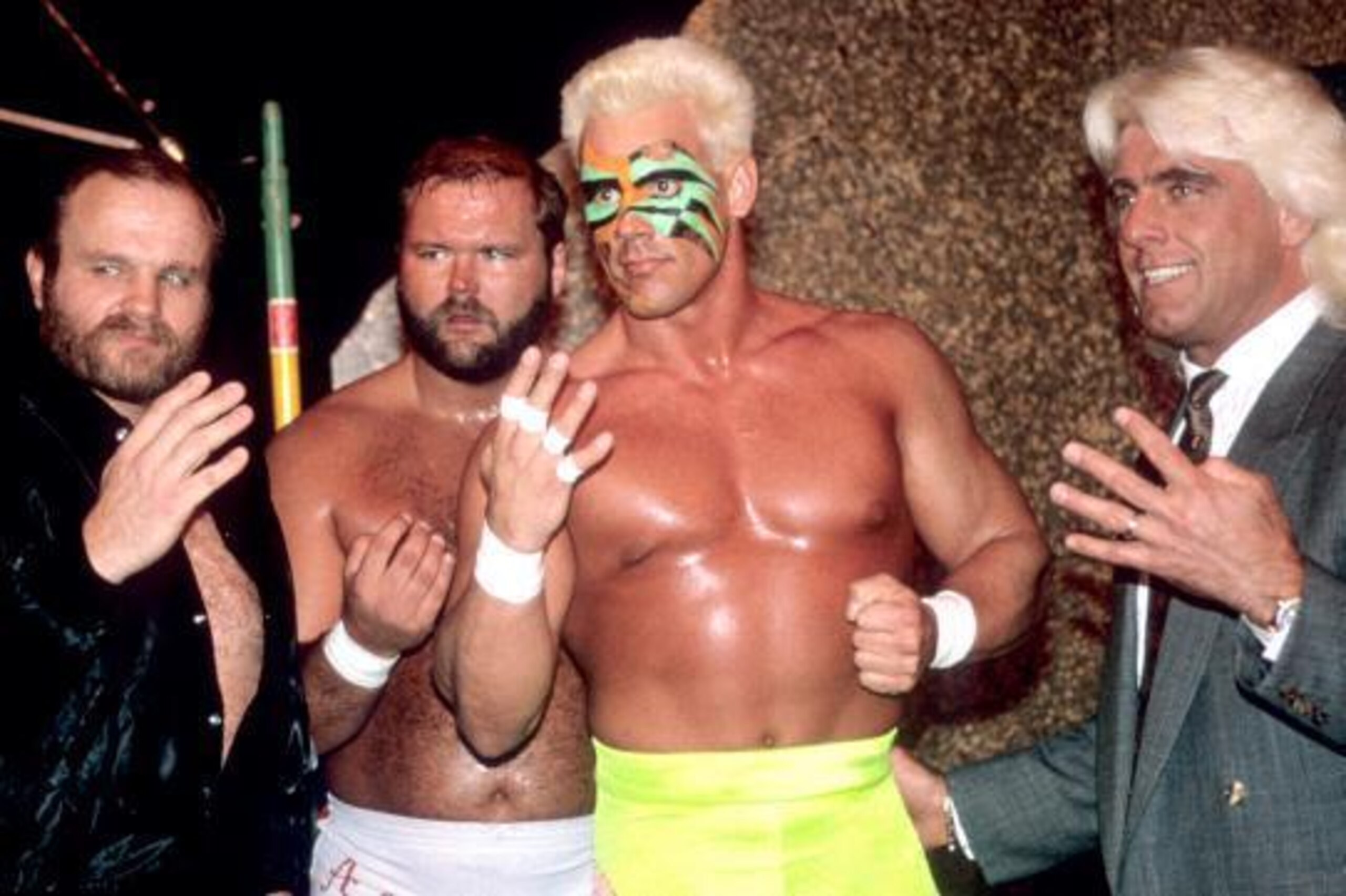
As Vince McMahon began widening WWE’s reach, Watts made an attempt at starting a national promotion.
As one of the sharpest minds in the industry, Watts had built a company that featured creative storylines, frenzied crowds and motivated talent. But a number of things conspired against him.
The oil industry, once the backbone of the UWF’s Oklahoma base, was in decline. And Watts lost his television spot on the TBS Superstation to Charlotte-based promoter Jim Crockett—who was conducting his own expansion and building the promotion that would become WCW. Eventually, the UWF became absorbed into WCW.
Although he was still regarded as a newcomer, Sting’s tenure in the UWF had turned him into a compelling performer. With his spiked, blond hair, Sting had the right look for the era.
“He picked a neon persona as society was going with the anti-hero, and just stayed relevant,” observes Kevin Nash.
While other UWF wrestlers were either forgotten or deliberately buried in WCW, Sting was quickly becoming one of the most popular stars. But it was his 45-minute, time-limit draw with NWA world heavyweight champion “Nature Boy” Ric Flair on a live special on TBS in 1998—opposite WrestleMania IV—that vaulted him into a new stratosphere.
In time, Sting became known as “The Franchise” in WCW. Still, he appeared to keep his growing fame in perspective.
“There was no drama,” says former WCW lighting director Jeff Bornstein. “He always delivered. Backstage, you could relate to him as one professional to the other. He wasn’t distant, but I think it was work to him.”
Within the wrestling fraternity, though, Borden’s small acts of kindness enhanced his reputation. In 1990, the year Sting captured his first major title (the NWA Championship from Flair), Nash was the orange-mohawked Steel in a forgettable tag team called The Master Blasters. There was little reason for a performer of Sting’s magnitude to pay attention to the former University of Tennessee center. But Sting did it anyway.
“If there was an extra bed in his room, he always provided a place for you,” Nash says. “It didn’t matter where you were on the card.”
During Sting’s title run, a mysterious, hooded character dubbed The Black Scorpion began interfering in his matches. The role was supposed to be played by Al Perez. But after a match with Sting as on a TBS Clash of the Champions special, Perez quit the promotion.
Uncertain what to do, the WCW brain trust had Sting wrestle a succession of Black Scorpions until deciding that Flair—the man Sting was wrestling when the Scorpion first appeared—would be exposed as the titlist’s tormentor.
“In typical WCW mode, he wrestled about seven Black Scorpions,” Nash says, “and had to adapt to each guy’s style. There was no consistency. But in spite of everything, he put on a great show every time.”
And just as the Scorpion disappeared when the angle was completed, the industry’s biggest names—Flair, Dusty Rhodes, The Road Warriors, Kerry Von Erich and Jerry “The King” Lawler, among others—began vanishing and re-materializing in WWE.
Sting was the only one who held out.
Prichard was on the WWE payroll by this point and involved in outreach to talent in other promotions. He remembers the company being close to signing Sting in 1989, but unable to reach terms.
“At a certain point, Vince said, ‘Take it or leave it,’” Prichard says. “Whenever his contract (with WCW) would come up, we’d check and see what he was up to. But nothing ever happened.”
In reality, Sting was suspicious of McMahon’s true intentions. “I always believed Vince McMahon wanted me more to undercut WCW than he did me as a talent,” he told SportsVibe.
In retrospect, Prichard theorizes that Sting may have been better off in the No. 2 promotion.
“Part of what makes him still so attractive is that he’s never been in WWE. Had he come in during the ‘80s or ‘90s, fans might have compared him to the Warrior, and he wouldn’t have meant as much. And back then, when someone new would come in, Vince liked to repackage him. And no one knows how that would have turned out.”
Nash marvels at the fact that Sting continued to thrive without WWE’s marketing machine. “It’s like pitching in the major leagues without a fastball,” he says. “You have to learn to throw junk. There weren’t many draws in WCW at that point, but he was one of them.”
The Crow
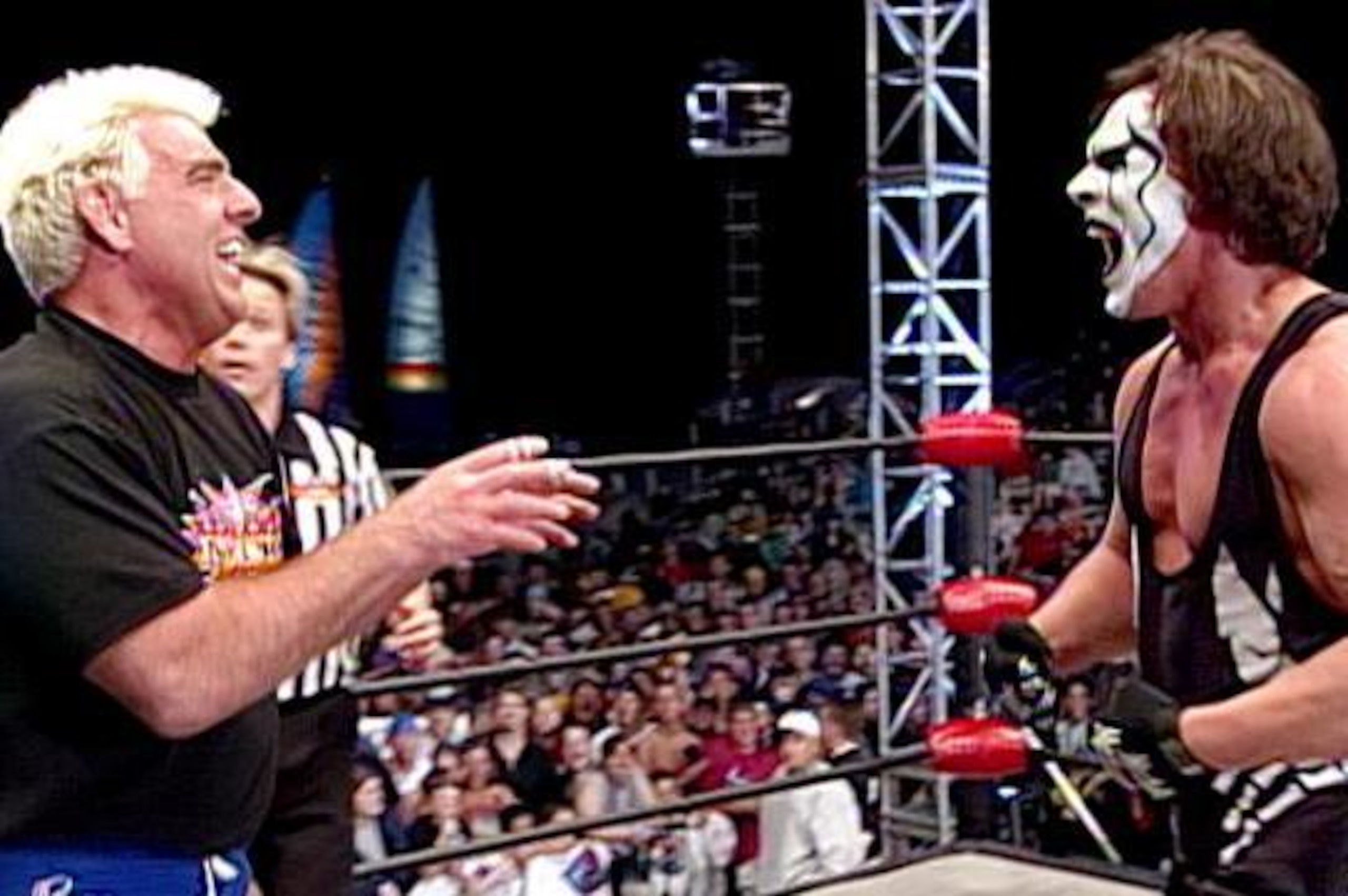
On September 4, 1995, U.S. Champion Sting defeated Flair via disqualification on the premier episode of Nitro. On the same program, Lex Luger stunned the wrestling community by defecting from WWE and issuing a challenge to WCW world heavyweight champion Hulk Hogan.
Luger proclaimed that he was “sick and tired of playing with little boys. ... I want to play with the big boys.”
A new era in professional wrestling had begun.
“The Monday Night Wars were the best years of our lives,” contends Ellis Edwards, WCW’s stunt coordinator from 1995 to 2000.
Even the business-like Sting was caught up in the merriment. “He’d do little, funny things in the ring that the boys saw, but no one else saw,” says Page. “I’d pick him up for a spinning powerbomb, and he’d scratch my head and go, ‘Shampoo?’”
Yet success came with a cost. “I made it to the top, but now my marriage was really starting to fail,” he told the Christian television show The 700 Club. “(His wife) Sue and I were like two ships passing in the night. She had a life. I had a life. And now, we had two boys. ... I was losing control over every part of my life.”
For years, his brother Jeff, pastor of the Rock Community Church in Waxahachie, Texas, had been urging Borden to face his demons and take solace in Christianity.
“In August, 1998, I had a moment of truth with a confession I made to my wife,” he told Matt Tuthill of Muscle & Fitness. “There was drugs (he’s told church groups that he struggled with painkillers), alcohol, adultery, the whole package. And I wound up coming clean and confessing it all.”
The purging had a rejuvenating effect on both the marriage and the rest of Borden’s life. But few WCW staffers realized that there’d ever been anything wrong.
“I don’t ever remember seeing a drink in his hand,” says Bornstein, who began working for the company in 1990. “He didn’t travel the way the other boys traveled. On the road, he was his own man. It wasn’t party time.”
DiBiase related to Sting’s attitude: “If you sit at the bar long enough, you’re going to drink. If you stand on the corner long enough, you’re going to do drugs. There was a reason why Steve separated himself.”
With the industry in flux, Sting updated his look, adorning his features with white face paint and replacing his 1980s platinum locks with longer, dark hair. In 1996, on a recommendation from Scott Hall, he adopted a similar look to Brandon Lee’s character in the 1994 movie The Crow.
He also began appearing in the rafters, mysteriously staring down at the action in the arena.
No one was happier about this turn of events than Diamond Dallas Page.
“When he went into the rafters,” Page says, “it left the door open for someone else to fight the NWO, and that was me. He did me a super solid, and he didn’t even know he was doing it.”
Gliding through the Air
In order to help Sting’s new persona gain traction, Bornstein introduced a number of generator-powered lighting effects. For months, Sting avoided any conflict between the ropes. But he wasn’t convinced that he was doing the right thing.
“I remember him coming into the truck in the white makeup and black duster during that period when he’d just glare from different parts of the arena,” Bornstein says. “And he said, ‘When are they going to do something with this character? Nothing’s happening. The people are going to get bored with this.’”
Additionally, he was concerned about being perceived as a Brandon Lee knockoff. That changed, however, when Sting began rappelling down from the ceiling.
“That was different than anything you had in wrestling,” says Edwards. “What’s your favorite type of superhero when you’re a child? Someone who flies.”
In order to prepare Borden for the role, Edwards took the wrestler rock climbing and rappelling on Rocky Peak, on the border of Los Angeles and Ventura Counties. “When I’ve worked with actors in the movie business,” Edwards points out, “I did the same thing. The idea was to just get him comfortable.”
But at the arena, just finding the ceiling was a formidable task, beginning with taking the elevator to the highest portion of the building. “If you’ve ever sat in the nosebleed section,” Edward says, “and you stand up, it’s pretty steep.” From there, the two would climb a staircase, then a ladder bolted into the wall “like you see on the side of a billboard.” At the top, a trapdoor led to the catwalk.
The first time Borden practiced, “We both went down at the same time, so he could look at me and talk to me in the air. I showed him how if anything went wrong, you could pull the rope and stop it.” The two returned to the catwalk and repeated the exercise. Then Sting went down by himself.
Over the next few weeks, the two developed a routine, rehearsing the drop at about 2 p.m., then going up to the rafters at 5 p.m. and waiting for the portion of the show when Sting was needed to rappel down.
“He usually didn’t do anything until about 10, so we’d be up there five hours,” Edwards says. “We had soft drinks, some video games, a bucket if we had to pee. We’d take naps and talk about everything—kids, working out, motorcycles.”
When it was time for Sting to rappel toward the ring, the two stayed in sync.
“He never, ever went down when I wasn’t looking him in the eye,” Edwards says. “We also knew that the stunt didn’t mean anything if the cameras didn’t catch it. So we let him down off a rappelling rack like a window washer and controlled the speed so the cameras could get him. If the cameras missed, why do all that work?”
Only once did Sting seem uncertain about a jump, at the Houston Astrodome.
“It was so high you could parachute down,” Edwards says. “The catwalk was real narrow, maybe 22 inches. We get up there in the afternoon to test everything out. We go about five feet, and he’s grabbing me and won’t let go. So I went down one time by myself to show him it would be OK. And after that it was a breeze.”
Remembering His Debts
There were other stunts, too.
On a Spring Breakout edition of Nitro in 1997, the ring was floating on a dock in Panama City, Florida, over a pool. “I had to get a special permit to drop him out of a helicopter,” Ellis recalls. “Before the show, we went to an airport in Orlando and flew over to see how it would go. When he jumped out, he got into it so much he wanted to do it again and again.
"He probably went out 17 times. He wasn’t in character. He was smiling from ear to ear. He was having so much fun, I thought we’d run out of gas.”
At another show, Sting was supposed to crash through a table. “We didn’t use special show tables that break away,” Edwards says. “I cut and prepped each one. And on this night, when Sting hit that table, it didn’t break.”
Borden was angry. Despite their friendship, he depended on Edwards to protect him from injury, and it seemed like the stunt coordinator had been delinquent in his task. As they argued, Edwards set up another table in the dressing room, climbed onto a locker and leaped onto the object himself.
“The table broke perfectly,” he says. “I explained to him that you had to hit the right spot or it wouldn’t work. Steve thought about it, and said, ‘I’m sorry.’ He’s a big star, and I’m just a redneck stunt coordinator. So for him to apologize to me says a lot about him.”
By 1999, Sting had held the WCW World Heavyweight Championship on five separate occasions, but he remained aware of the people who’d helped him rise to this position.
Back when he was working with Bassman, Borden had signed a contact agreeing to pay back his sponsors for the time that went into training and promotion. But when Borden and Helwig left for Memphis, the debt apparently disappeared with them. Then, at the peak of his fame in WCW, Sting and Bassman arranged to meet for lunch.
Without prompting, Borden handed over a check for $12,800.
“That kind of thing is rare in this business, but it happens,” Bassman says. “Even if he hadn’t paid me, my view of him would be the same. I know who he is.”
In fact, Bassman emphasizes that when The Ultimate Warrior died, he refrained from returning the dozens of calls from reporters seeking background on Jim Helwig’s early days in the industry. “But I wanted to call you back right away because I always like to say good things about Steve.”
Charisma Never Leaves
WCW was always a tumultuous place with erratic storylines and questionable management. But when WWE finally purchased its primary rival in 2001, one circle neatly closed. Sting wrestled Flair on the final Nitro, like he had on the first broadcast six years earlier.
Parts of the show were simulcast on Raw, including a feature in which Vince McMahon ran down a list of WCW wrestlers and polled his audience on whether WWE should hire them. Sting’s name was met with loud applause. But Borden opted not to join the organization, in part because he reportedly disliked the way some early hires from WCW were utilized in WWE.
“He was the only smart guy who held out—to the point that WWE still wanted him more than 10 years later,” Page claims. “Sting didn’t need the money, so he wasn’t in a rush to go anywhere.
"The main reason I think he’s associated with WWE today is that it’s become kid-friendly. He never would have gone there during the Attitude era. He’s one guy who walks the walk on his Christianity and doesn’t compromise.”
“As far as content goes,” Sting told Kevin Eck of The Baltimore Sun in 2011, “I only involve myself in situations that will not jeopardize my walk (with Christianity) or my witness. You won’t hear vulgar things coming out of my mouth, or sexual innuendo and all that kind of stuff.”
Yet he also lived, and flourished, in a universe where others thought differently. “Jesus himself went in amongst the sinners,” he told the Sun, “the murderers, the adulterers, the idolaters, the drunkards, and so on and so forth. ... I’m not going to put myself in a shell.”
In 2003, Sting signed a deal with TNA, as the company attempted to fill the void created by WCW’s demise. It had been 15 years since Sting’s 45-minute draw with Flair, and everyone knew that he wasn’t the same wrestler.
“At that point of his career, his rotator cuffs were bad, so he didn’t have the same physique,” Nash says. “But he doesn’t age because the white paint doesn’t show age. He had the verbal ability and he had charisma, and charisma never leaves. True with Ric Flair. True with Hulk Hogan. It doesn’t matter how old you are. It’s always there.”
Behind the scenes at TNA, Sting objected to anyone rising from a seat and offering it to him when he entered a room. “He didn’t even like being called ‘Sting,’” says Bornstein, now the lighting director for TNA and Bellator MMA. “He was Steve. When people tried to reminisce about WCW, he wasn’t interested. He was involved in the ministry and didn’t want to live in the past.”
Prichard, who became the company’s senior vice president for programming and talent relations, says that in the ring, Sting was “as good as the guy he was in with. He’s different than a Shawn Michaels—if you put Shawn Michaels in with the timekeeper, Shawn would have made the timekeeper look great. With Steve, if you put him in with someone great, he was going to be great. But he wasn’t going to make talent. I don’t know if that was due to age or due to him.”
But that’s virtually forgotten as items appear on the Internet almost daily, hypothesizing about how Sting will be used in WWE. “People want to see what they haven’t seen,” Prichard says. “And they want to see him in the big pond.”
In numerous interviews, Sting has been unable to contain his excitement about possibly wrestling the Undertaker. But he understands that the fantasy can only be realized if The Phenom feels healthy enough to do battle. “I think, at least I’m hoping, that Undertaker’s going to come back, and that he’s not done,” Borden told the Mirror. “If he’s not done and he would consider doing it, I’d love to work with him one time.”
He’s mentioned other names, too: Cena, Randy Orton and The Rock. Still, even without a future Hall of Famer on the opposite side of the ring, a clash with one of the company’s rising stars could be just as memorable.
“Personally, I’d love to see him against someone like Seth Rollins or Roman Reigns or Bray Wyatt or Dean Ambrose,” Prichard says. “Those are the guys who are going to be on top in five years. With guys of that quality, Sting will rise to the occasion, and even if he has one match, it could be a moment in history.”
Nash prefers remembering the Sting he knew in WCW. Nevertheless, he’s excited by Sting’s association with WWE, particularly his inclusion in the WWE 2K15 video game as both his golden-haired and white-faced characters.
“He’s so valuable to the company as a trademark,” Nash says, “he never has to wrestle again.”
Quotes obtained firsthand unless otherwise noted.
.jpg?w=2560)
.jpg?w=2560 "Skattebo Has 0 Touch Game 😬")
.jpg?w=2560 "Jameis Benched by Giants")
.jpg?w=2560 "Travis Hunter Makes Rare History")
.jpg?w=2560 "49ers FB Slams CJGJ 😳")
.jpeg?w=2560 "Colts DT's Harsh Quote 😨")
.jpg?w=2560 "CJGJ Ejected for Spitting")