Boston Celtics Must Prioritize Finding Long-Term Answer at Center
The Boston Celtics have adopted a fast-paced, exciting brand of basketball, and it’s helped up their Q rating and improve their offensive efficiency. This development is wonderful and necessary, but it ultimately means nothing until they sign, draft or trade for a defensive-minded center.
Second to having a legitimate superstar or two, plugging the paint with a humongous shot-blocker is arguably the most desired component by general managers across the NBA. Stout rim protection is powerful. It’s the most important part of the defense, and the best way to alter what the offense has planned.
It’s almost impossible in today’s NBA to consistently contain speedy ball-handlers on the perimeter, making the last line of defense most important. Anchors who claim the paint as their personal property are now invaluable.
TOP NEWS
Knicks Staff Didn't Get Rings 👀
SGA's Streak Ends In Win vs. Nuggets
LeBron Gives VJ Bloody Nose 🩸
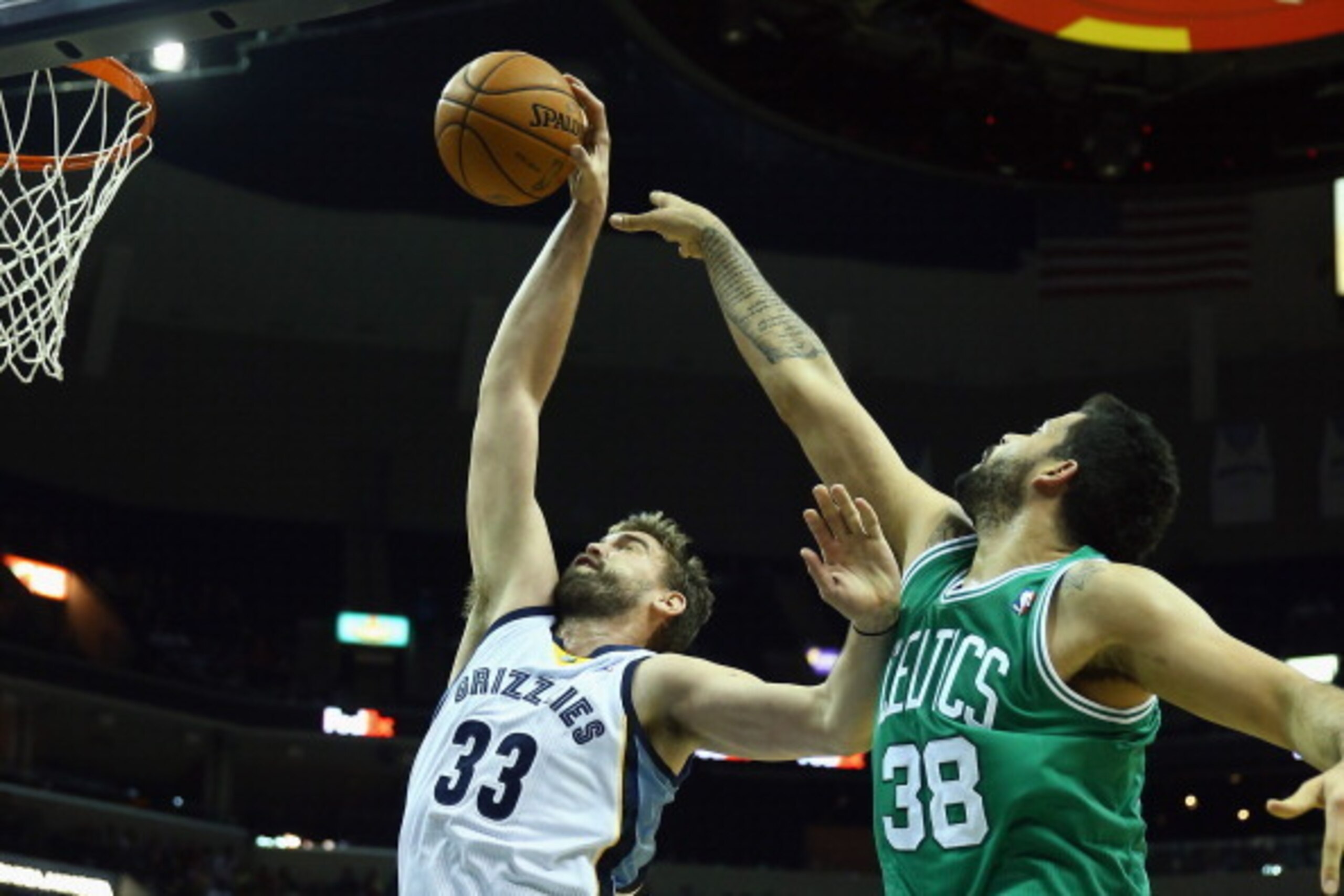
The sturdiest defenses in the league have these players on tap. Roy Hibbert, Dwight Howard, DeAndre Jordan, Serge Ibaka and Marc Gasol are just a few examples who headline the league’s most formidable units. Their mere presence forces inefficiency in the form of mid-range jump shots that then magically turn into layups whenever they need a breather. These guys don’t grow on trees. They’re rare and expensive.
Right now, the Celtics don’t even have a poor man’s version of rim protection. It’s early, but opponents are already shooting 54.2 percent at the rim, which is 10th worst in the league per SportVU. The issue goes all the way back to last season, when Kris Humphries, Jared Sullinger and Kelly Olynyk were the only real options. Here’s Celtics head coach Brad Stevens discussing the problem last March (via ESPNBoston’s Chris Forsberg):
"I think, certainly, in an ideal situation, what you're looking for are certain qualities as a team. A rim protector, whether it's a 7-footer or not, is extremely important in this league. A guy that really protects the rim from the dotted line in. I'd be really curious to know, or to see from a defensive standpoint systematically, plugging one guy in there, what that might do to our numbers, being where we are in a lot of different areas.
"
And nothing has really changed. Today, Boston’s front court consists of the undersized Sullinger (who’s surprisingly mobile on the perimeter and tough on the inside, leading the team with 1.8 blocks per game), Olynyk (a true 7-footer) and Tyler Zeller (ditto). Vitor Faverani is also tall, but he's currently injured and not considered a long-term factor.

Olynyk is not a terrible defensive player, but relying on him to anchor a defense is foolish. Stevens has used the second-year player’s huge physical features to clog up the paint, particularly against pick-and-rolls, but Olynyk’s ultimate strengths reside on offense. He’s a knockdown three-point shooter with the ability to take his man off the dribble. He also has great court vision and the potential to become one of the best passing bigs in the league. Defense, though? Not so much.
The other “option” is Zeller. Opponents are shooting 66.7 percent at the rim with him defending it so far this season. We’re going off a four-game sample size, but that’s deplorable. Last year with the Cleveland Cavaliers, that number was a more respectable 48.3 percent. But even then, Zeller was averaging 15 minutes a game, mostly facing second-unit scorers.
He’s a fine backup center who can do some nice things on both ends of the floor, but the Celtics need someone who can bang against the Howards and Cousins of the world for 30-35 minutes a night, swallow pick-and-rolls and turn sure dunks into wobbly floaters. Zeller isn’t that guy.
How can they get better? This sort of thing normally isn’t easy, but the Celtics have several hopeful avenues to help them bring in a suitable defensive anchor sooner rather than later. They have draft picks, trade assets and expiring contracts at their disposal to support the league's fiercest backcourt (Avery Bradley, Rajon Rondo and Marcus Smart are already incentivizing opposing point guards to save their sick days until it’s time to play Boston).
Option A should be trading for Hibbert, the league’s finest pure rim protector who’s currently drowning in hopelessness on the Indiana Pacers. His team is terrible. They need to start over, and there’s no better way to do so than cashing Hibbert out on the trade market and re-building around Paul George and a few fresh lottery picks.
The Celtics have enough of those to make a deal possible, along with expiring contracts like Brandon Bass, to make the money work. Hibbert has a $15.5 million player option next season, though, so surrendering too many assets for a player who could walk this summer is undesirable. On the other hand, there’s a chance he picks up the option, really loves playing with Rondo and old college teammate Jeff Green and wants to sign on long-term.
If so, the Celtics would almost instantly transform into a formidable playoff out. They wouldn’t be a championship contender yet, but the impact Hibbert could have on their defense, filling their most glaring hole, would be enormous.
From Hibbert, there’s a steep drop down to the next crop of big men who may be attainable before this year’s trade deadline. The Denver Nuggets are rotting trash, and rookie Jusuf Nurkic could use some playing time, so JaVale McGee and/or Timofey Mozgov may be on the market. It's unclear why Boston would give up much for either player—particularly McGee, who’s due $12 million next season—but who knows.
Along those lines, if Alex Len emerges as a legitimate defensive presence for the Phoenix Suns, maybe their general manager, Ryan McDonough (who used to work for Danny Ainge), would be willing to move Miles Plumlee. Probably not, but that’s the type of scenario Boston’s looking for in the trade market. Which is to say, if they can't land Hibbert, another route is needed.

Moving onto free agency, this summer’s class will feature A-listers like Marc Gasol, Tyson Chandler and Omer Asik, B-listers like DeAndre Jordan and Robin Lopez and C-through-F-listers like Kosta Koufous and Kendrick Perkins. Boston needs to flex a bit of magic on its cap sheet to afford whom they really want from this group, though.
Assuming Green opts out of his $9.2 million player option, Rondo’s cap hold puts the team at just under $50 million in guaranteed money, leaving them roughly $16.5 million to play with beneath the 2015-16 season’s presumed $66.5 million salary cap. That’s tight, and these numbers don’t include the money Boston will owe its two first-round picks from the 2015 draft.
What now? The Celtics can finally use the stretch provision on Gerald Wallace, who’s somehow still owed $10.1 million next year. This means that deal would be paid out over the next three years, at a $3.36 million annual rate. The extra $6.7 million in spending money would certainly come in handy, allowing the team to throw max money at both Rondo and Gasol (the only center who deserves it in this year’s class).
And then there’s the draft, with big kids like Myles Turner, Willie Cauley-Stein, Karl Towns and Dakari Johnson all expected to throw their names in the ring. This can be risky, of course. Remember Fab Melo? Of course you do.

The Celtics need someone in the middle. That’s what we know. What we don't know is whom they have their sights on, who's available in a trade or whether there's any real motivation to acquire a center so soon into the rebuilding process.
All of a sudden, the Celtics are a young, exciting basketball team. But they won't find true respect or success until a humongous defensive presence is protecting their basket. It's a question they'll eventually need to answer.
All statistics are courtesy of Basketball-Reference.com or NBA.com unless otherwise noted.
Michael Pina covers the NBA for Bleacher Report, Sports on Earth, FOX Sports and elsewhere. Follow him on Twitter @MichaelVPina.