

B/R NBA's Max 5 Series: Is Draymond Green Really a Maximum Contract Player?
This is the fourth installment in a five-part series where we'll be discussing whether or not five of the NBA's biggest free agents are worth maximum-salary contracts. The first installment covered Chicago Bulls swingman Jimmy Butler. The second discussed San Antonio Spurs forward Kawhi Leonard. The third glanced at Cleveland Cavaliers forward Tristan Thompson. Below, we look into Golden State Warriors forward Draymond Green.
Draymond Green didn't play his best ball in the NBA Finals, but his ascension in role was arguably more important to the Warriors vaulting from mid-rung playoff team to NBA champions than anything outside of Stephen Curry's jump shot. Green replaced David Lee in the starting lineup at the beginning of the season (largely due to an injury Lee suffered during the preseason), and the Dubs never looked back.
TOP NEWS
Only 2 Players Left from Russ' Draft Class
Bob Iger Talks Lakers Purchase

Most Expensive Team Sales Ever 🤑
Green played nearly as many minutes and both took and made more field goals and three-point attempts this year alone than in his first two seasons combined. It was a true breakout year, and in the playoffs, he was even better.
During Golden State's run to a ring, Green averaged 13.7 points, 10.1 rebounds, 5.2 assists, 1.8 steals and 1.2 blocks per game, becoming just the seventh player since 1980 to average at least 13-10-5-1.5-1.0 throughout the playoffs. The other six: Larry Bird, Kevin Garnett, Charles Barkley, Derrick Coleman, LeBron James and Magic Johnson.
The regular season vaulted him into max-contract territory, and the playoffs essentially sealed it. That the NBA issued a memo to teams discouraging them from saying they'll "match any offer" for restricted agents is probably the only reason the Warriors haven't publicly taken that stance.
Klay Thompson's father, Mychal, doesn't work for the team, though, and he was quoted in March saying this, per the Bay Area News Group's Diamond Leung:
"Mychal Thompson: Draymond worth $15 mil/yr. "I've talked to some ppl in GSW org. They said they're going to match whatever..Doesn't matter."
— Diamond Leung (@diamond83) March 17, 2015"
Green is a restricted free agent, so if the Warriors want him back (general manager Bob Myers has said Warriors fans "shouldn't worry" about if he'll be back next year), that's where he'll be. But that doesn't mean he can't go comparison shopping before heading back to Oakland. When he does, these are the offers he'll find available:
| Season | Re-Sign with Warriors | Sign Offer Sheet |
| 2015-16 | $15,856,500 | $15,856,500 |
| 2016-17 | $17,045,738 | $16,570,043 |
| 2017-18 | $18,234,975 | $17,283,585 |
| 2018-19 | $19,424,213 | $17,997,128 |
| 2019-20 | $20,613,450 | |
| Total | $91,174,875 | $67,707,255 |
The question, of course, is this: Is he worth it?
The Hope: Why Green is Worth the Max

Green is one of the NBA's very best defensive players. He was the runner-up to San Antonio's Kawhi Leonard in 2014-15's Defensive Player of the Year voting. He finished the season ranked second in both ESPN's defensive real plus-minus (behind only teammate Andrew Bogut) and defensive win shares, while he also checked in fourth in defensive rating (D-Rtg) and fifth in defensive box plus-minus (BPM).
His combination of strength and agility allows him to capably defend frontcourt players of all stripes—from Kevin Durant and LeBron James to LaMarcus Aldridge and Marc Gasol. His remarkably quick feet also unlocked the Warriors' switch-heavy defensive system that helped catapult them to an NBA championship.
Golden State's ability to trade assignments on the fly was key to keeping ball-handlers out of the paint and shooters from getting open looks, and it can be argued that no player on the team was more important to enabling that tactic than Green. Between his quicks, his smarts and his constantly flapping mouth, he was the backbone of Golden State's No. 1-ranked defense.
While Green certainly improved defensively in his third NBA season, it's not as though his excelling on that end of the floor was anything new. During his second year in the league, he finished 12th overall and first among small forwards in defensive RPM, fifth in D-Rtg and third in defensive BPM. Even before he helped elevate the Dubs to new heights with an increase in playing time and responsibility, Green was making a big defensive impact.
If his value lied only in defense, justifying a maximum contract might prove difficult. But with Green, that's not the case. As ESPN.com's Ethan Sherwood Strauss wrote earlier this season:
"Unlike some other defensive specialists, Green plays enough offense to remain on the floor. His ability to capably hit open 3-pointers means he can play more minutes than Tony Allen or Andre Roberson. He also rebounds, passes, pushes the ball in transition and throws Kevin Love-style outlet passes. About the only thing Green can’t do on a basketball court is create his own shot.
"
Green turning himself into a functional three-point shooter was incredibly important to Golden State's offensive exploits this season. You do have to make the opposing defense pay for blitzing Stephen Curry when he comes around the corner on a pick-and-roll, after all.
But it's not just the shooting that's important. There are plenty of stretch 4s out there that can let it fly from deep, but not all of them have quite the same impact as Green, because he can do so much more than that. He can catch the ball at the nail and dish to a shooter; he can put it on the deck and take it straight to the rim; or he can attack, draw the defense and dump it off to a big man. He is the prototypical "playmaking 4" Zach Lowe wrote about in his recent article at Grantland:
"Shooting is nice, but it’s not enough anymore as defenses get smarter, faster, and more flexible working within the loosened rules. Spot-up guys have to be able to catch the ball, pump-fake a defender rushing out at them, drive into the lane, and make some sort of play. If they can’t manage that, a possession dies with them.
"
That's Green's offensive game in a nutshell, and that hyperversatility has turned him into an incredibly rare player. Though his per-game averages of 11.7 points, 8.2 rebounds and 3.7 assists may not immediately jump off the page, only one other NBA player met or exceeded those thresholds last season: Sacramento Kings All-Star DeMarcus Cousins.
If you add in his defensive contributions in the form of blocks and steals, only 12 other players in the last 30 years have equaled Green's all-around production from this past season: Chris Webber, Hakeem Olajuwon, Barkley, Kevin Garnett, Karl Malone, David Robinson, Bird, Tom Gugliotta, Scottie Pippen, Lionel Simmons, Josh Smith and Cousins.
Pippen was the only one of those 12 to do it while also making at least 100 threes, just as Green did this year. When you and Scottie Pippen are the only two players on a list, that's generally a good list to be on.
And while the depth and breadth—if not necessarily gaudiness—of his per-game stats already paints an impressive picture, advanced statistics love Green even more. He finished the season ranked sixth in wins above replacement, eighth in RPM, ninth in value over replacement player (VORP) and 12th in BPM.
It was a season of crowning achievement on multiple levels, the culmination of the improvements he's made in so many areas since his career began.
Green has used more possessions, increased his shooting efficiency, taken and made more three-point shots, assisted on a greater percentage of his teammates' baskets, turned the ball over less and raised his PER, win shares, BPM and VORP every season he's been in the league. That rapid, steady improvement has put him in position to cash in—in a big way—this summer.
The Doubt: Why Green Might Not Be Worth the Max
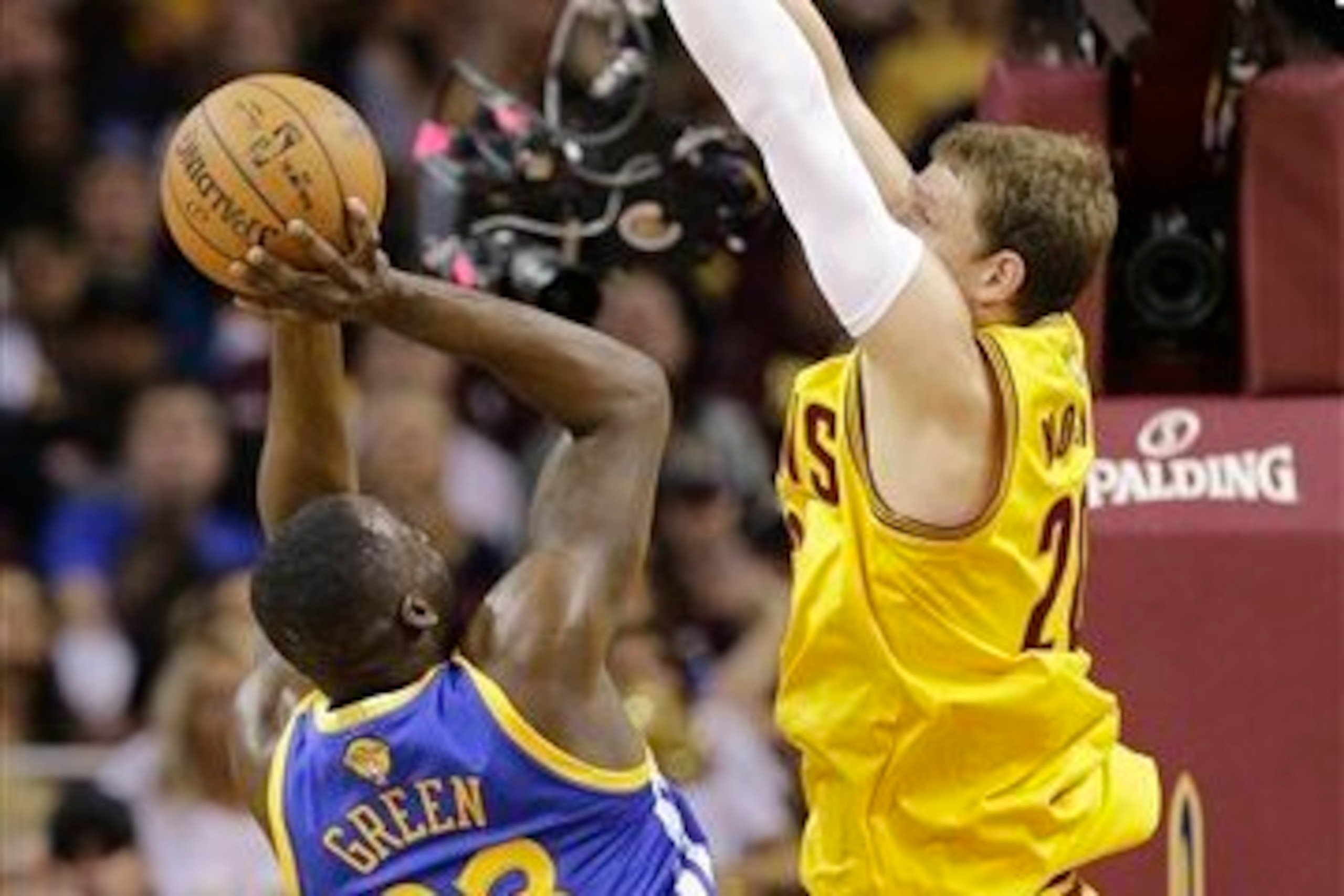
Remember the first few games of the NBA Finals? Where Green got clobbered on the boards by Tristan Thompson, was dared to shoot or pass or drive or do whatever else he wanted to do with the ball by an entirely unafraid Cavaliers defense and looked utterly lost? That's why.
In those first few games, the Cavaliers sent two defenders at Curry every time he came around a screen, forcing him to find Green on the roll or the pop. A typical team in this situation would send help toward Green from elsewhere on the floor; the big man would step up or one of the wings would crash down. Cleveland didn't do that.
They yielded as many open threes as Green wanted to take, and if he turned it down and drove the lane, the Cavs still didn't send help until he got right within five feet of the rim. Their wings stuck with the shooters and the big man stuck with Bogut or Festus Ezeli underneath.
They took away two of Green's options once he put the ball on the floor, and he responded by throwing awful lobs, bricking not-even-close floaters and on more than one occasion, unsuccessfully trying to challenge Timofey Mozgov at the rim.
Much of Green's production appears very much a product of context, and if that context drifts, the results can apparently get pretty ugly. It's that reality that prompted Lowe, who had previously cited Green as his prototype of the new playmaking 4, to write the following:
"The jury is out on whether Green’s salary should shoot up in lockstep with the max, and this is coming from someone who spent the entire season slobbering over the dude. He’s a freaking monster, the prototypical playmaking 4, with the unmatched versatility to jostle with Marc Gasol and stick stride-for-stride with James Harden.
But, as we said, he’s 25 — and a five-year deal would take him through age 30. The thought of Green losing just half a step makes me nervous. That could be the difference between staying in front of Harden and reading the back of Harden’s jersey. If Green can’t switch onto basically any player, he becomes a lot less valuable. As it is, Green can barely open up enough air space on offense to loft contested floaters; what would happen if that window were to shrink a few inches? The fire in Green’s belly comes from proving doubters wrong. Can a max-contract guy still have a chip on his shoulder?
"
If even one of those skills slips as Green ages, it could throw things off more than it would for other elite players.
Take Green out of the Golden State incubator, and would he be the same kind of monster? Without Curry, Thompson, Andre Iguodala and Shaun Livingston around to create his shots (82.3 percent of his baskets were assisted this season) and Andrew Bogut to protect his back, would he be capable of the same feats?
The Market Reality
What do the Warriors think of Green? “The guy just helps you win,” Myers told Lowe. “That’s not a compelling argument for some people, because it doesn’t get into specifics—like his numbers. But it should be the only truism that matters. He helps you win games.”
That does not sound like a man who wants to let his latest breakout player walk out the door. The Warriors will do whatever it takes to bring Green back. And Green himself wants to be back, too. "I'll be here," he told the San Jose Mercury-News' Tim Kawakami. "I love this group of guys."
Barring the two sides coming to an agreement on a discount contract, it seems exceedingly likely that the deal Green signs will be for the maximum salary. The only question will be whether he signs for the full, long-term max, or if he pursues a shorter deal in the form of an offer sheet from another team.
Since Green—unlike Butler, Leonard and Thompson—was a second-round pick, the Warriors don't have the option to extend him a maximum qualifying offer to ensure that any offer sheet he signs contains at least three guaranteed years, not including options. That makes him eligible to sign a Chandler Parsons-style two-year deal with an opt-out clause just in time for the salary-cap explosion of 2017.
All statistics courtesy of NBA.com and Basketball-Reference.com unless otherwise noted. Salary-cap info courtesy of ShamSports.


.jpg?w=2560 "NFL Win-Loss Predictions 🔮")
.jpg?w=2560 "Panthers Signing Darren Waller")
.jpg?w=2560 "Every NFL Team's Biggest 'What If'❓")
_0.jpg?w=2560 "AEW Dynamite Results & Recap 🔠")