Rex Ryan's Flashy Start with Bills Shows He Still Hasn't Learned from Mistakes
Meet the new Rex Ryan…same as the old Rex Ryan.
When the former New York Jets coach took over for Doug Marrone as the head coach of the Buffalo Bills, it seemed almost too good to be true for the Bills' long-struggling fanbase. The loquacious and fiery second-generation NFL head coach had faced the Bills enough over the past six years and fit perfectly with what Buffalo had been building.
Ryan was viewed as one of the top (if not the top) coaching candidates on the market, so this seemed like an offseason win for Buffalo. And it was just icing on the cake that Marrone then struggled to find a job and ended up with the lowly Jacksonville Jaguars as an offensive line coach.
.jpg?w=2560 "Bears Eagles Football")
The Bills went 9-7 last season and finished second in the AFC East. Although they haven't made the playoffs since 1999 and haven't won a playoff game since 1995, they remained in contention through Week 16 last season on the back of a stifling Jim Schwartz-led defense.
Even if Ryan is only good for one or two additional wins, that could be enough in the AFC to end that playoff drought, right? This could be the start to a bright future!
Well…not so fast, my friends.
So far this offseason, Ryan seems hellbent on rebuilding the Bills in the image of his former Jets teams, and while those teams had some success over the half-decade he was there, he left a trash heap of mediocrity at the Meadowlands when he departed.
As of right now, it appears he hasn't learned a thing from his mistakes.
An Inability (Or Disinterest) In Properly Assessing the Quarterback Position

When it comes to the most important position on the field, Ryan has no idea what he's doing.
Last season, in the sixth year of Ryan's mismanagement, the Jets offense finished 32nd—dead last—in passing offense. This lead to total offensive rankings of 22nd (by yards) and 28th (by points) and a record of 4-12.
That sort of place is not where the Bills want to be headed.
Though, as mentioned earlier, it's sort of where the Bills already are.
The Bills offense—thanks to Marrone and former offensive coordinator Nathaniel Hackett—was a lowly 18th in passing yards per game and struggled to do much more than simply exist with Kyle Orton under center in 2014. They were also only 18th in points per game—a mere field goal per game better than Ryan's Jets.
It was safe quarterbacking and game management at its finest.
Expect more of the same.
After the 2014 season, Orton informed the Bills that he would be retiring…again. That gave Ryan uninspiring options at quarterback with only EJ Manuel and Jeff Tuel left on the roster, a poor free-agency crop and no first-round draft pick in April.
After interviewing free agent Josh McCown, who has since signed with the Cleveland Browns, the Bills swung a trade for former Minnesota Vikings quarterback Matt Cassel, per Chris Brown on the Bills' official site. Cassel is still living off the results of one good season (in 2008) with the New England Patriots.
In a column titled, "Be Careful What You Wish For With Rex Ryan," Boston Herald columnist Ron Borges wrote the following about the acquisition of Cassel:
"What Cassel showed in 2008, though, is that he knows how to follow orders and Ryan’s will be explicit: “Don’t get in McCoy’s way and don’t put my defense at risk.” He will not often be asked to win games, assuming he first wins the position from young and reckless EJ Manuel, but merely to manage them. That is seldom enough to beat Brady, but when Ryan has been successful against the Patriots it’s been with that formula—defense, ball possession and a physical running game.
"
Please understand that this isn't just a situation Ryan was thrown into. These are situations he creates for himself. He took the Bills job fully understanding that the quarterback position in Buffalo was just as horrific as the one he left in New York.
| Quarterback | Years | Starts |
| Mike Vick | 2014 | 3 |
| Geno Smith | 2013-2014 | 29 |
| Greg McElroy | 2012 | 1 |
| Kellen Clemens | 2009 | 1 |
| Mark Sanchez | 2009-2014 | 62 |
Ryan doesn't deserve a "pass" for inheriting this QB mess because it looks exactly like he wants it to look.
It's not as if he's simply left the position alone over his career. No, he's drafted four quarterbacks as a head coach, starting with Mark Sanchez in 2009, then Greg McElroy in 2011, Geno Smith in 2013 and Tajh Boyd in 2014.
Today, Sanchez is a free agent no one really wants. Boyd and McElroy are currently not in the NFL, with the former trying to get back in while playing for the "Fall Experimental Football League" and the latter working for the SEC Football Network.
Smith may be the quarterback of the future for the Jets, but that's certainly not a done deal at this point.
The bright side of the Cassel deal is maybe he's just a placeholder for recent first-round pick Manuel. Maybe he's just the latest in a long line of possible mentors for Manuel whom the Bills have tried out, as NFL Media's Ian Rapoport suggests:
Well, that's the thing: Cassel wasn't exactly a very willing mentor to Teddy Bridgewater in Minnesota last year, and Manuel isn't exactly a bright light at the end of the tunnel at this point, either.
Trust in Overpaid, Aging and Declining Running Backs Behind Terrible Offensive Lines
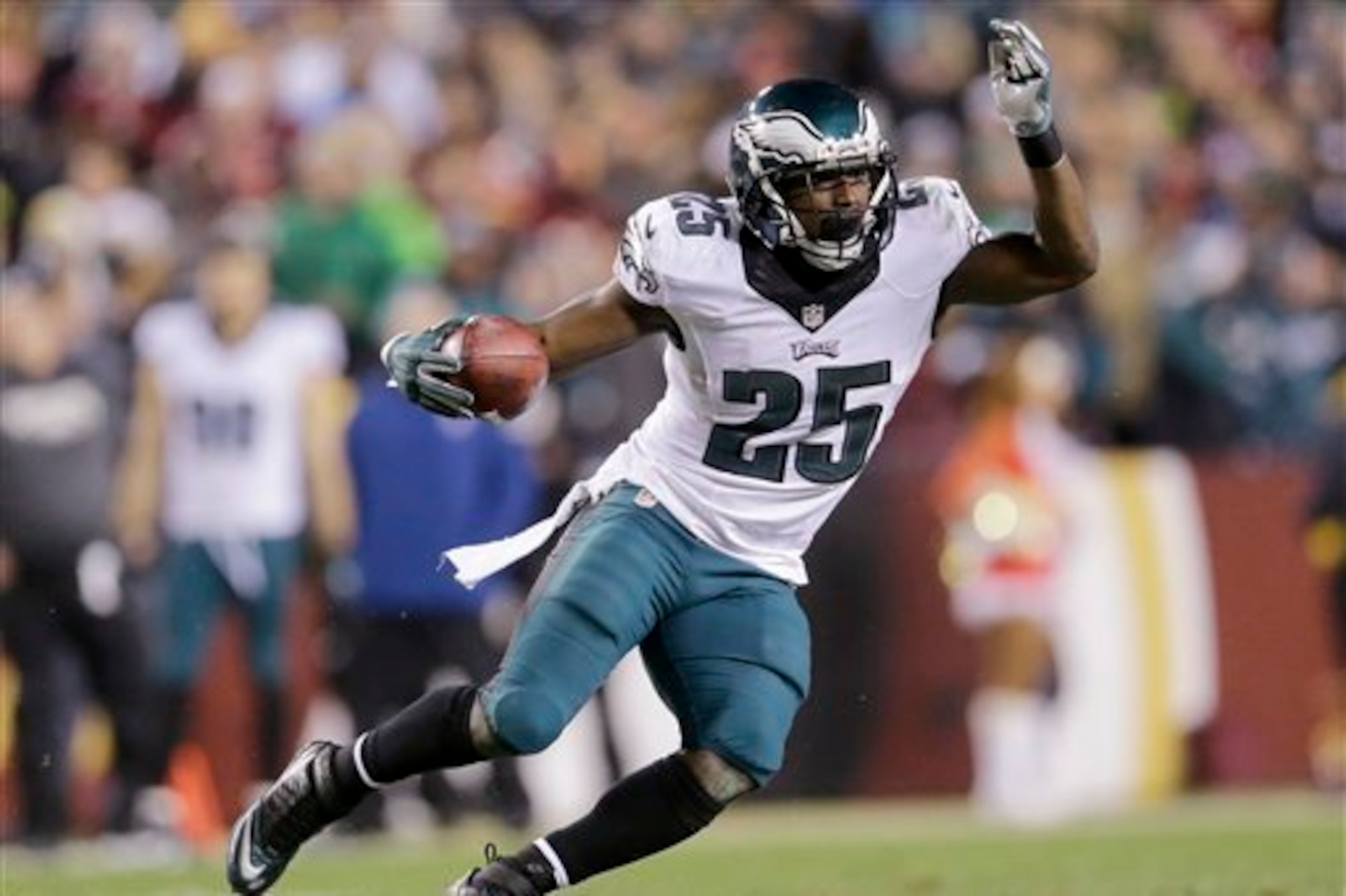
So, if the quarterback can't get the job done, how are we going to score points?
This is the question I assume Ryan has asked himself before every season of his head coaching tenure. It's not a question any coach probably wants to ask—even Ryan—but it's the bed that Ryan keeps making and then lying in every single season.
For most of his career, the answer he's come up with has been an overreliance on overpaid and overrated running backs.
Yes, while just about everyone else in the NFL is devaluing and nearly eliminating the lead running back position, Ryan is putting it on a pedestal. He's one of the lone torchbearers of leaning on the position in the way teams used to in the good ol' days.
Three yards and a cloud of dust may have worked in the NFL at some point, but it doesn't in 2015.
In fact, when one considers how reticent teams like the Dallas Cowboys, San Francisco 49ers and Philadelphia Eagles were in terms of willingness to pay their top backs this offseason, Ryan might be one of the last coaches prepared to pay a running back to be the focal point of the offense.
To fill the void at running back on the Bills' roster with C.J. Spiller headed out the door, the Bills traded for Eagles running back LeSean McCoy in a move first reported by ESPN.com's Adam Schefter and Mike Rodak.
While some may want to make this move about Eagles head coach Chip Kelly reuniting with former Bills and Oregon Ducks linebacker Kiko Alonso, the actual details of the deal make it clear that was more of a happy accident.
No, this was about the Eagles dumping a declining asset instead of paying McCoy more money and the Bills being willing to invest far more in the running back position than the Eagles.
Don't think McCoy is overpaid?
Over the next three seasons, McCoy is owed over $24 million on his current contract. At this time, none of that is guaranteed, but the Bills are expected to offer him a new contract, according to Rapoport. That new deal will likely spread McCoy's 2015 salary over the course of the next few years, giving him both future guaranteed money and incentives to perform.
The last part of that sentence is not as much of a sure thing as McCoy's star status suggests.
That's one of the more maddening things about people who believe the Bills won this deal, as well as Ryan's assessments of the running back position. He's consistently targeting guys like McCoy who have clearly already done their best work.
For the Jets, it was Chris Johnson and LaDainian Tomlinson. Now it's McCoy.
This brings us to the fact that—like those backs when Ryan acquired them—McCoy truly is aging.
Yes, he's only 26 at the moment, but McCoy is anything but young by NFL standards. First off, with a July birthday, McCoy will be 27 before the season begins. Secondly, having entered the NFL at age 20, this will be McCoy's seventh NFL season. That means it's more appropriate to put McCoy in a category with other backs who have had just as many seasons of wear and tear on their bodies as he as: Houston Texans Arian Foster (28), Jets' Shonn Greene (29) and former Miami Dolphins back Knowshon Moreno (27).
That's still not old, you may say.
With running backs, the common parlance has been the "30-year wall," which has been billed as some sort of mysterious hurdle that only the best backs clear. By that standard, McCoy still has three or four years left, right?
Well, no.
Not even close.
Chase Stuart of Football Perspective put together the numbers for something many of us already knew for a long time: In today's NFL, that 30-year wall has been much closer to 27 or 28 than many running backs would like to admit, with a peak performance at age 26.
In fact, it's more of a cliff than a wall.
Just look at some of the running backs drafted in the years around McCoy, who was drafted in 2009.
In the 2008 class, many backs are already out of the NFL, like Kevin Smith and Rashard Mendenhall, and backs like Ray Rice and Darren McFadden are awfully close. Really, only the Kansas City Chiefs' Jamaal Charles and Chicago Bears' Matt Forte are still successful backs from that class, and I would contend that the latter has lost a step much like McCoy.
In 2009, drafted alongside McCoy, we find a host of busts. But even those who were mildly successful, like Moreno and San Diego Chargers back Donald Brown, are clearly on the downside of their careers.
Even 2010—which was not that long ago!—has a bunch of backs in it who peaked with some solid performances and have already seen their careers start to decline in 2014: the Chargers' Ryan Mathews, the Tennessee Titans' Dexter McCluster, the Jacksonville Jaguars' Toby Gerhart and the Jets' Chris Ivory.
Now, some of those backs (and their agents) would disagree that they're on the decline, and even more might disagree on that fact about McCoy, who rushed for 1,319 yards last season.
Yet one must remember that Kelly's fast-paced scheme is fantastic for running backs, and McCoy carried the ball 312 times (second in the league). His yards-per-carry average was only 4.2, which drops him to 21st in the NFL (right above Ivory!) and was almost a full yard per carry worse than 2013.
Let's add to that.
Last season, McCoy lost his role on passing downs to Darren Sproles. That's not saying a whole lot, as Sproles is a singular type of athlete in the NFL and is absolutely perfect for those downs, but it represents important downs on which McCoy sat on the sideline for Kelly and the Eagles.
Then McCoy also lost short-yardage work to Chris Polk.
Between not rushing as effectively per carry and missing out on both passing downs and short-yardage situations, McCoy's touchdown total dropped to only five rushing touchdowns (he did not get a single receiving touchdown)—a clear decline from 11 total touchdowns a year before and his high-water mark of 20 total touchdowns in 2011.
It gets worse.
Pro Football Focus ranked McCoy as the 55th-best back in the NFL last season. That makes him the third-worst. Yes, he got a lot of yardage in the box score, but that had a lot to do with the amount of carries he had and the offense he was in.
This all means that while McCoy may have made a big impact on the box score or even for your fantasy team, he wasn't necessarily helping the Eagles win a lot of football games. Kelly knew that, and therefore wasn't about to pay him the big bucks.
Those big rushing totals also had a lot to do with the Eagles' offensive line, which PFF had as the best run-blocking unit in the league (tempo probably helped that as well). Buffalo's offensive line, meanwhile, was last in that same ranking.
This is the last piece of the puzzle that connects the start of Ryan's Bills' tenure with much of his resume from his time with the Jets. The Bills offensive line is a mess, much like the Jets offensive line (even with a number of solid players on it) has been a mess for a long time.
Placing revolving doors at some positions and turnstiles at others is no way to properly run an offense.
It's mismanagement not only from an on-field perspective, but also in terms of how the roster and the salary cap are delegated. Paying McCoy this much money will have a ripple effect, much like it did for Ryan's Jets teams that invested far too much on running backs who couldn't get it done.
Make no mistake about it: This offensive ineptitude is Ryan's fault. He had three different offensive coordinators in six years with the Jets, and he hired the last two. As a head coach, he can't simply be a defensive mastermind (which, to be fair, he still is), but it's almost as if Ryan has purposefully aimed for the middle on the offensive side of the ball just to show defense can win championships.
This is how Ryan's father, Buddy Ryan, coached as well, and Rex has continued the tradition using the same sort of game-planning, defensive scheme and mindset while getting almost the exact same results. Buddy Ryan, though he had moments of punctuated success, finished his career with a perfectly mediocre 55-55-1 record.
Rex, heading into his seventh season, currently sits at 46-50 (50-52 including playoffs). Eighteen active NFL coaches have a better regular-season win-loss percentage than Ryan, and it's a nice little father-son bonding moment on the all-time list, as they sit near each other with Buddy at 91 and Rex at 105.
If Ryan is still trying to win the same way he's always done it, and it's never really worked for him before, why should we expect anything different?
Unless Ryan and the Bills learn from his previous mistakes, they're doomed to the same fate that got Ryan fired from the Jets. Sure, maybe there will be a bit of success here and there, led by exceptional defensive performances, but that's never proven to be sustainable.
Eventually, down this path, Ryan will run the Bills into the ground.
Michael Schottey is an NFL National Lead Writer for Bleacher Report, a writer for Football Insiders and an award-winning member of the Pro Football Writers of America. Find more of his stuff on his archive page and follow him on Twitter.