

Carmelo Anthony Needs Second Superstar to Fulfill Full Potential
Carmelo Anthony still needs help.
Superstar help.
Phil Jackson can change the New York Knicks' coach. He can change the point guard. He can change the culture and system. He can wax optimistic about all the changes he's made. But there's nothing he can do or has already done that will unlock Anthony's individual potential like superstar assistance.
TOP NEWS
Report: Heat to Sign Klay 🌴
Realistic Blockbuster Trade That Should Happen Before NBA Season
D-Wade Shows Off New Look 🪒
The Absence of Superstar Help
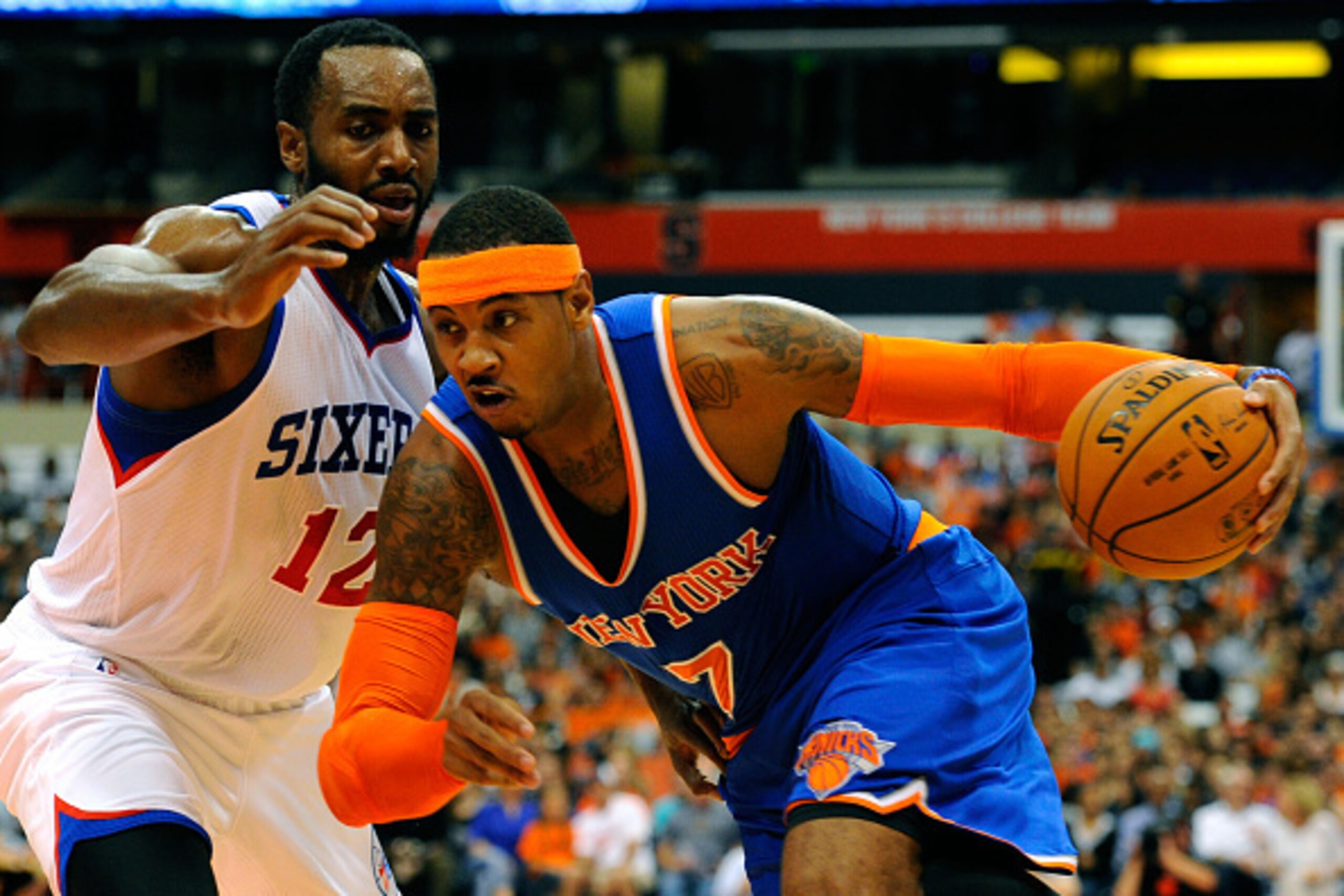
Diminishing the mental and physical weights Anthony constantly freights has been one of Jackson's goals all along. Though he's made it abundantly clear from the beginning no one player—including Anthony—is bigger than the team and its vision, he's placed a premium upon unearthing and acquiring offensive adjuncts who lend helping hands.
"All we talked about in our negotiation was, 'I’d like not to have to feel like I have to carry the load to score every night,'" Jackson told the New York Post's Steve Serby of Melo. "He wants some help."
In search of that help, Jackson traded for point guard Jose Calderon, and new head coach Derek Fisher has started implementing the triangle offense, a motion-crazy reactive attack that isn't supposed to rely on one-man shows.
In conjunction with those tweaks, Jackson has extolled Anthony's value, touting him as a superstar who, per ESPN New York's Ian Begley, "has just touched the surface of his greatness."
Those words represent an interesting juxtaposition. Jackson has, for the most part, been cautiously optimistic about New York's immediate and future prospects. But his expectations for Anthony have been unceasingly buoyant—surprising only because the Knicks haven't done enough to unlock his still-sealed greatness.

Systematic changes aren't going to do it for Anthony alone. As much as Jackson has pinched and poked and prodded and pulled, the Knicks aren't vastly different from last year.
New faces abound, but not one of them represents an ideal No. 2 option. Calderon is easily their second-most valuable player, and he tallied just 6.3 win shares with the Dallas Mavericks in 2013-14. If that's the best help Anthony has, it's close to the least amount of help he's ever enjoyed.
Last year was just the second time (2005-06) in Anthony's career that at least one of his teammates didn't register seven win shares. Not surprisingly, the 2005-06 Denver Nuggets and 2013-14 Knicks are two of the three worst regular-season teams—in terms of winning percentage—Anthony has headlined.
Consider too that Anthony has only ever led his teams in total win shares three times—once in Denver (2005-06) and twice in New York (2012-13 and 2013-14). Just one of those teams (2012-13 Knicks) made it past the first round of the playoffs.
Even when Anthony has been afforded prominent help, it hasn't come from a fellow superstar. Here's the list of past and present teammates who have recorded at least seven win shares alongside him:
- Chauncey Billups (twice)
- Marcus Camby (twice)
- Nene (three times)
- Allen Iverson
- Andre Miller (twice)
- Tyson Chandler (twice)
- Amar'e Stoudemire
This list is less impressive upon noting Anthony split time with the Knicks and Nuggets in 2010-11, which basically removes Stoudemire and one of Nene's three seasons from consideration.
Iverson is the closest thing to a superstar teammate Anthony has ever seen. He was on the wrong side of 30 when he arrived in Denver, but during the lone full season he spent there (2007-08) he provided an offensive punch—26.4 points and 7.1 assists—unlike any of Anthony's other compadres.
That Nuggets team still lost in the first round of the playoffs.

Still, that season was in many ways a personal best for Anthony. He banged in a career-high 49.2 percent of his shots, with nearly 59 percent of his made baskets coming off assists. Not once since then have more than half his converted buckets come off dimes; the closest he came is 2008-09, when 48 percent were the product of assists.
That 2008-09 team offered relief in other ways. Two of Anthony's teammates—Nene and Billups—amassed at least 9.3 win shares each as the Nuggets reached the Western Conference Finals.
The Knicks need to give Anthony that kind of help, and then some. Eventually. Given the way their roster is structured, however, it's not going to be this season. Their projected starting lineup isn't doing Anthony any favors.
Marc Berman of the New York Post says that in addition to Anthony, Calderon, Iman Shumpert and Samuel Dalembert have secured starting spots. Quincy Acy and Jason Smith, meanwhile, have emerged as candidates to start at power forward, per Berman and Begley.
Painfully obvious floor-spacing issues aside, those five-man combinations don't spell offensive relief or prosperity for Anthony. Not one of those players has lifetime scoring averages north of 10.2 points, tethering most of the pressure and potential to the triangle's magic-making abilities.
Even the Triangle Has Its Limits
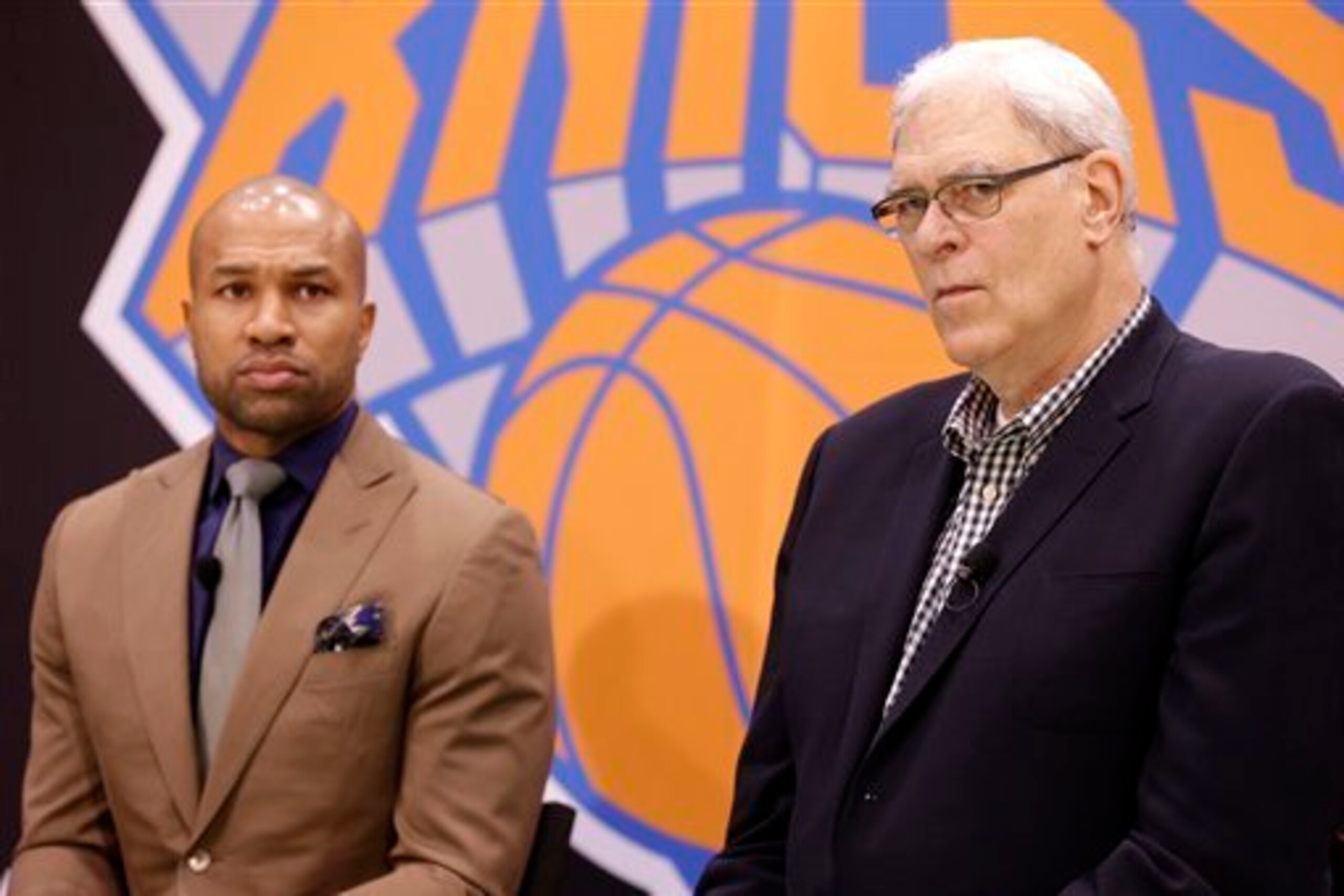
Learning patience is part of the evolution Jackson expects Anthony to undergo.
See, the Knicks aren't merely trying to be the 2007-08 or 2008-09 Nuggets, or any one of Anthony's other teams. None of those teams have been successful enough. Different versions of supporting casts have provided help—some of which, as previously noted, can even be deemed adequate—but to make even more of Anthony's illustrious career, the Knicks must do better.
Rather than model surrounding support after one of Anthony's most successful NBA teams, the Knicks need that second superstar to get the best version of their superstar.
Glimpses of that Anthony can sometimes be seen in New York, when J.R. Smith or Stoudemire get unexpectedly hot and defenses are compelled to split focus. But even more of them have been seen during Olympics play and All-Star Games where a stable of superstars complements Anthony.
"For the needs of USA’s Olympic team, Anthony plays the part of the perfect FIBA forward," Yahoo Sports' Adrian Wojnarowski wrote in 2012. "An impossible matchup on the perimeter for power forwards, the beneficiary of Kobe Bryant and LeBron James to attract defenders and genius point guard talents to deliver passes."
It was Anthony who set the United States' Olympics scoring record in 2012, pumping in 37 points over 14(!) minutes of action. It was Melo who set the record for the most made three-pointers in an All-Star Game (eight) last year.
Drastic as those examples are, that's the Anthony New York needs: the one who thrives within free-flowing systems that relegate him to second-option status for stretches at a time.
Other superstars have sought and found—or always had—such refuge. LeBron James' efficiency has been climbing since 2010, when he first left the Cleveland Cavaliers. It's no coincidence that career-best shooting percentages (56.7 overall) came with 41.6 percent of his made baskets coming off assists, another career high, in 2013-14.
Not even Kevin Durant was forced to create for himself as much as Anthony last season. More than 47 percent of his made shots came off dimes. Less than 39 percent of Anthony's successful attempts were assisted.
Part of that stark contrast can be attributed to Mike Woodson's simplistic, isolation-heavy offensive sets. Anthony had to create for himself more than most superstars because that was his job. The Knicks had neither the clipboard competency nor playmaking talent—ahem: Raymond Felton started 65 games—to render Anthony anything other than a do-it-yourself scorer.
Successfully installing the triangle should remedy much of this, regardless of the talent around Anthony, per Grantland's Kirk Goldsberry:
"That’s where the triangle offense comes in. Jackson and Fisher’s preferred system relies on the exact kind of cooperation that’s been absent in Manhattan for so long. Jackson is arguably the most luminous mind in NBA history, and has an impressive resume of engineering great offenses around superstar centerpieces. He better. It’s gonna take all the Zen in SoHo to design a pass-happy offense around Anthony, the NBA’s crown prince of the unassisted midrange jumper.
"
All the Zen in the world won't change Anthony completely, though. It can't. He needs players he can defer to and who can hit shots. He needs players in whom defenses are willing to invest time to defend.
As much as some like to pretend the triangle is this spellbinding panacea that conjures collective dominance on a whim, it's not. The supporting cast is not rendered irrelevant by association. What it does is lay the blueprint for something special, the results of which, like any system, are much better when the talent is there.
Help First, Transformation Later

None of the Knicks' drawbacks mean that Anthony is tracking toward a disastrous season.
Much of what makes him great is an ability to thrive despite the absence of help. Fifty-eight percent of all field goals were assisted last season, per Goldsberry. Even though Anthony's situation forced him nearly 20 percentage points below the league average, he still topped 27 points and 45 percent shooting.
It's entirely possible that the Knicks as currently constructed offer enough relief within the triangle to make the playoffs and improve Anthony's numbers even further. Until he gets that second superstar, though, it's all gravy and, in all likelihood, inconsequential.
Name the last NBA champions that didn't house at least two stars. The 2010-11 Dallas Mavericks spring to mind, but they employed quality role players—Chandler, Jason Terry, Jason Kidd, Shawn Marion—while the Knicks do not. Besides them, the list of champions for the last three decades reads like a who's who of multi-star powerhouses.
Whether it was Isiah Thomas and Joe Dumars in Detroit, Michael Jordan and Scottie Pippen in Chicago, Kobe Bryant and Shaquille O'Neal or Pau Gasol in Los Angeles, James, Dwyane Wade and Chris Bosh in Miami or Tim Duncan, Tony Parker and Manu Ginobili in San Antonio, the NBA has proved time and again it's a powerhouse-controlled league. Exceptions to the rule—like the Mavericks, or the 2003-04 Detroit Pistons—are anomalies. That's why even now, future free-agency additions weigh heavily in New York.
"Carmelo took less money—even though it seems rather minuscule—but it’s enough for us to have flexibility in the coming year," Jackson said, per Begley, "and then as the years go on the pie’s going to get bigger, things will happen."
Things need to happen. Next summer or the summer after—or both—they need to happen.
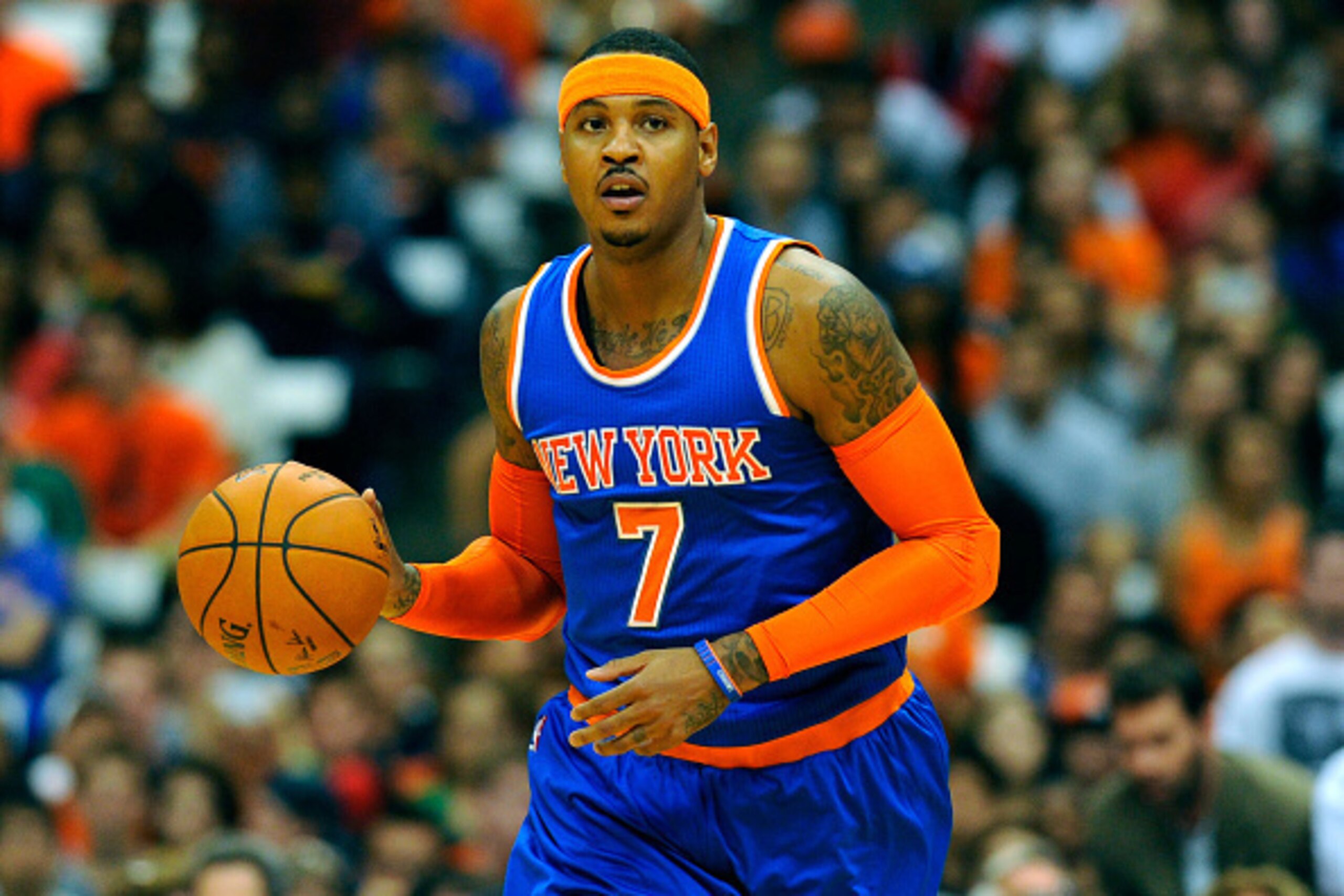
These Knicks shouldn't have to be the latest exception to the rule. Anthony has already carried teams on his own, and it's never enough. Superstar teammates who stick around for more than a second are luxuries he hasn't yet enjoyed. If an unprecedented Anthony is what Jackson and the Knicks are after, they'll need to assemble unprecedented help.
"For this season, right now, we have what we have," Anthony said, per ESPN New York's Ohm Youngmisuk.
Until the Knicks have something different and Anthony isn't the team's only superstar, the extent of his own, true superstar potential will remain one of the NBA's greatest unknowns.
*Stats courtesy of Basketball-Reference.com and NBA.com unless otherwise cited.
.jpg?w=2560 "Report: Saints Trade For 49ers RB")
.jpg?w=2560 "Jeanty Avoids Major Injury")
.png?w=2560 "MLB Playoff Picture Shaping Up")
.jpg?w=2560 "NFL's Biggest Rumors Ahead of Roster Cuts Deadline")