

Meet Al Horford, the NBA's Hidden Superstar
Everyone seems to have different definitions of the term "superstar," at least when used in an NBA context, but allow me to share mine.
It shouldn't have anything to do with widespread recognition. A player doesn't have to wear a name that resonates in most households around the world on the back of his jersey. Flashy dunks, fancy passes, game-winning shots and other highlights aren't necessary.
Instead, it's all about production on the court. The bigger the impact, the better.

By traditional definitions, Al Horford is not a superstar, not by any stretch of the imagination. Fans of opposing teams don't flock to the arena when he's in town, nor do they make sure to tune into their televisions whenever he and the Atlanta Hawks are playing on a national channel.
But they should.
Incredible Impact
One of the reasons Horford has become a "hidden" star is simply that he's been stuck in street clothes on the sidelines for far too long. After he tore his pectoral muscle—somehow for the second time in his career—against the Cleveland Cavaliers one day after Christmas, he wouldn't play again during the 2013-14 season.
And the Hawks went into a corresponding tailspin.
Through the first 29 games of the season, all of which featured Horford on the court for a prolonged portion of the outing, Atlanta stormed out to a 16-13 record, one earned despite a dozen of its contests coming against the much more difficult Western Conference.
At that point in late December, the Hawks were sitting pretty at No. 3 in the East, and it appeared as though it was a spot they could hold on to throughout the entire season.
They couldn't without Horford, though.
Over the rest of the campaign, Atlanta went just 22-31, giving the franchise a winning percentage that was more than 10 percent lower than when the team's star player was healthy and lining up at the 5. That's a huge difference for one player to make, and it's perfectly indicative of just how much value he brought to the lineup.
Without Horford on the floor, the Hawks had to adopt somewhat of a novelty system—passing the ball far more than before because the sets were more limited and also shooting an inordinate number of three-point attempts. That's actually a statistically beneficial strategy, but it wasn't how Atlanta was playing when it was at its best.
Quite simply, the Hawks were just better when Horford played, primarily because he was able to help anchor the defense.
According to Basketball-Reference.com, the team outscored opponents by 3.5 points per 100 possessions when the big man from Florida was playing in 2013-14, and it was 1.5 points worse than the opposition over the same span when he sat, whether in the course of action or due to injury.
This is no aberration either. Throughout Horford's prime, his team has been significantly more adept when he's playing, as you can see below:
He struggled during his first few years of NBA action, but over the last couple seasons, he's had a profoundly positive impact on Atlanta's success.
Why? Above all else because of the very thing that makes him so underrated and allows him to play like a superstar but be categorized as a hidden one.
Two-Way Hub and Overall Versatility

Whether Mike Woodson, Larry Drew or Mike Budenholzer has been calling the shots from the sideline of the Philips Arena, Horford has often been at the center of the plans.
Literally and figuratively.
One of the biggest misconceptions about this former Gator's game is that he's better suited at the 4 than the 5. Nothing could be further from the truth, even if his 6'10" frame does leave him as an undersized option at the biggest position on the court.
When Horford plays center, he brings so much versatility to the Hawks lineup, as he can operate in the post, anchor the paint on defense and step out to the perimeter to space the court with his patented awkward-looking mid-range jumper. Everything flows better, and he's sometimes uncomfortable working against the smaller but more agile players who line up at power forward in today's game.
As 82games.com shows, he's been far better at the 5 than at the 4 on both ends. Last season's data points in the opposite direction, but that's largely because he spent minimal time at power forward and only played in 29 games, thus creating a ridiculously small sample.
But in 2012-13, when Horford played 50 percent of the available minutes at center and 15 percent of them at power forward, the results are more telling:
| PER | 17.9 | 21.9 |
| PER Allowed | 19 | 16.6 |
The narrative that the Hawks need to grab a true center and shift Horford back over to his more "natural" position—whatever that means—is one grounded in fallacy, baseless assumptions and unsubstantiated opinions.
It's easy to look at his size and think the opposite, but there's no statistical support for Atlanta needing to make that move, nor does it make sense conceptually, given Horford's playing style.
After all, it's rare to find a center who can do as many quality things as he does.
According to NBA.com's SportVU data, he averaged 6.5 touches per game on the elbows while he was healthy this past go-round. Only 14 players throughout the entire NBA posted higher numbers in that category, but LaMarcus Aldridge, Pau Gasol, Joakim Noah, Blake Griffin, Kevin Love and Marc Gasol were the only members of the group to average more half-court touches per contest as well.
That's the statistical profile of a big man serving as an offensive hub.
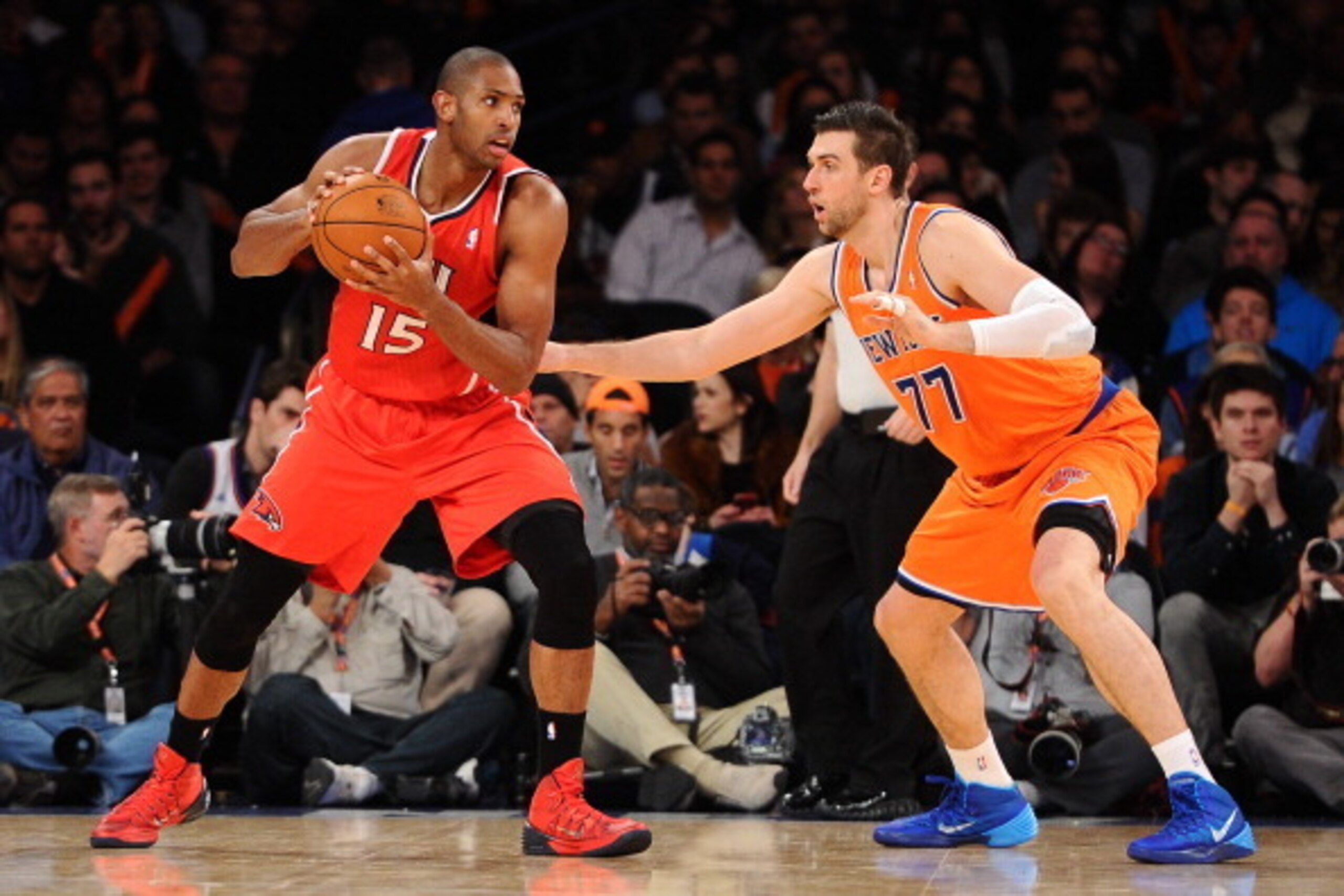
The Hawks offense often flowed through Horford, who was able to hurt defenses from the high and low posts in so many ways. He could score from either spot, but he could also keep the ball moving and create for his teammates. Though Horford doesn't average many assists per game, his job isn't to finish plays but rather to serve as a source of options.
In many ways, I've always viewed Horford in the same vein that I do a tight end running an option route in the NFL. Once he breaks into the secondary, he can either choose to continue with his primary route or he can read the defense and cut to a different spot on the field. He has a choice, and trust is placed in him to make the proper decisions.
It's the same way with Horford. While most players follow designed sets, the Atlanta offense often seems structured so that he can alter the play if he makes a certain read, and few big men are granted that type of creative freedom.

"The two-time NBA All-Star is trying to remain engaged as a leader in preparation for an expanded role within second-year coach Mike Budenholzer's system adopted from San Antonio, one that should enhance Horford's status as one of the league's most versatile big men," wrote ESPN.com's Michael Wallace at the beginning of October.
It's a role he should be perfectly comfortable filling, even if the world at large has yet to accept it as one he can handle.
"I feel we can turn this around and really make something special happen here," the big man told Wallace.
And if he's able to recover fully from the torn pectoral—he was recently cleared to play five-on-five and has experienced no publicized setbacks, per Hawks beat writer Chris Vivlamore—there shouldn't be any doubt he can make that happen and fill in the biggest hole on his resume: team success.
Horford has labored away in relative obscurity for a while now, thriving as one of the NBA's best hidden stars. All it takes is one season leading the Hawks beyond the expected level, and he'll start receiving the nationwide attention he deserves.

.jpg?w=2560 "Sports Leagues Ask for Protections from Bettors' Threats (AP)")

.jpg?w=2560 "Report: Darnold Could Miss 3-6 Weeks")