

Cleveland Cavaliers' Plan to Beat Isaiah Thomas, Boston Celtics Already in Place
Even though the Cleveland Cavaliers didn't find out until Monday night they'd be playing the Boston Celtics in the Eastern Conference Finals, their plan to defeat the No. 1 seed had already been set in motion.
Boston was the only team in the East to finish ahead of Cleveland in the regular-season standings, accumulating 53 wins to the Cavaliers' 51. In the playoffs, however, the Cavs are a perfect 8-0, while the Celtics are just 8-5 overall.
Cleveland will be smelling blood in the water.
TOP NEWS
Jayson Tatum's dad blunt about Celtics roster
Offseason Overreactions for Every Team 🫨
Teams Still Eyeing Kyrie
This is a dream Eastern Finals matchup for the Cavaliers, who just steamrolled the Toronto Raptors and put in place a defensive strategy that should now carry over to stopping Boston.
No team in history has ever swept three straight best-of-seven series to advance to the NBA Finals. If the Cavs continue their recent blitzkrieg of the East, that will soon change.
Lue's Star-Stopping Strategy
Tyronn Lue has kept the same defensive strategy in place since joining the Cavaliers as an associate head coach in 2014. The idea: Find out what the opponent does best, limit that and live with the adjustments.
With the Celtics, it's all about containing All-Star point guard Isaiah Thomas.
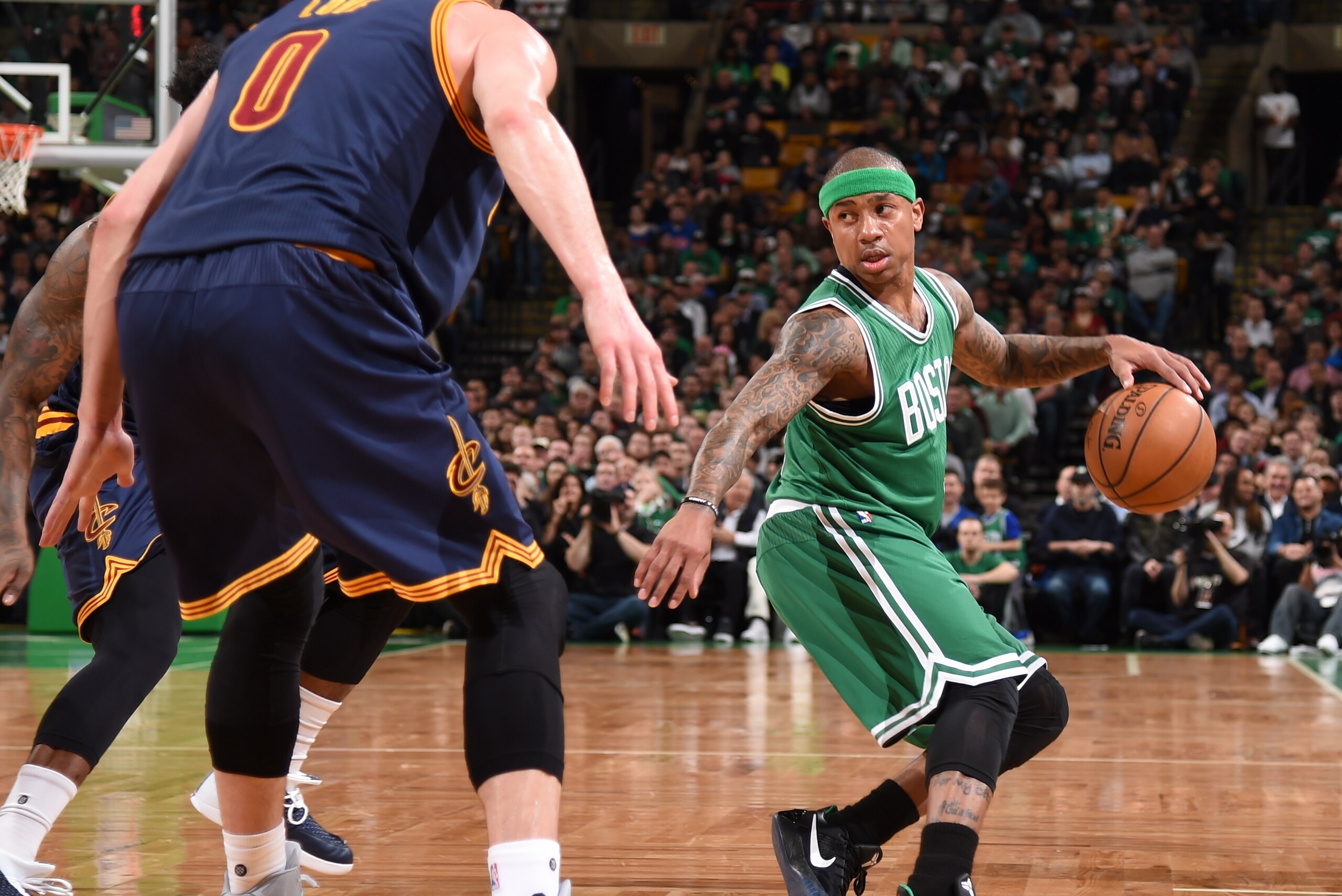
Thomas averaged 28.9 points and 5.9 assists on 46.3 percent shooting during the regular season, lifting the team on his 5'9" frame and taking over fourth quarters on a nightly basis. The Celtics offense increased by 14.4 points per 100 possessions with Thomas on the floor.
Outside of the 28-year-old star, no one on Boston's roster should scare Cleveland. Al Horford, the Celtics' second-leading scorer this postseason (16.1 points), was 0-8 against the Cavs in the playoffs as a member of the Atlanta Hawks the past two years.
While Thomas' overall scoring doesn't vary much between wins and losses (29.3 points compared to 28.2), the Celtics live and die by his efficiency (47.1 and 39.8 percent from the field and three-point range in victories, respectively, to 44.7 and 33.7 in defeats).
This is just the latest challenge for Lue and the Cavaliers, a test they've passed many times already.
Previous Success
Lue is at his best when given sufficient time to game-plan for an opponent.
In last year's Eastern Conference Semifinals against the Hawks, Lue wanted to limit the team's spacing and shooting that current Cavalier Kyle Korver spearheaded.
Korver was an All-Star the year prior, part of the Hawks' starting five that won 60 games and captured the top seed in the East.
Cleveland, led by shooting guard J.R. Smith, smothered Korver and took away his looks, even if it meant easier opportunities for others. The result? Korver averaged just 7.5 points on 5.8 shot attempts per game, even forcing head coach Mike Budenholzer to bench him in Games 3 and 4.
Cleveland won the series 4-0.
More recently, the Cavaliers were hellbent on limiting open looks for Raptors shooting guard DeMar DeRozan, who finished the regular season fifth in scoring at 27.3 points per game.
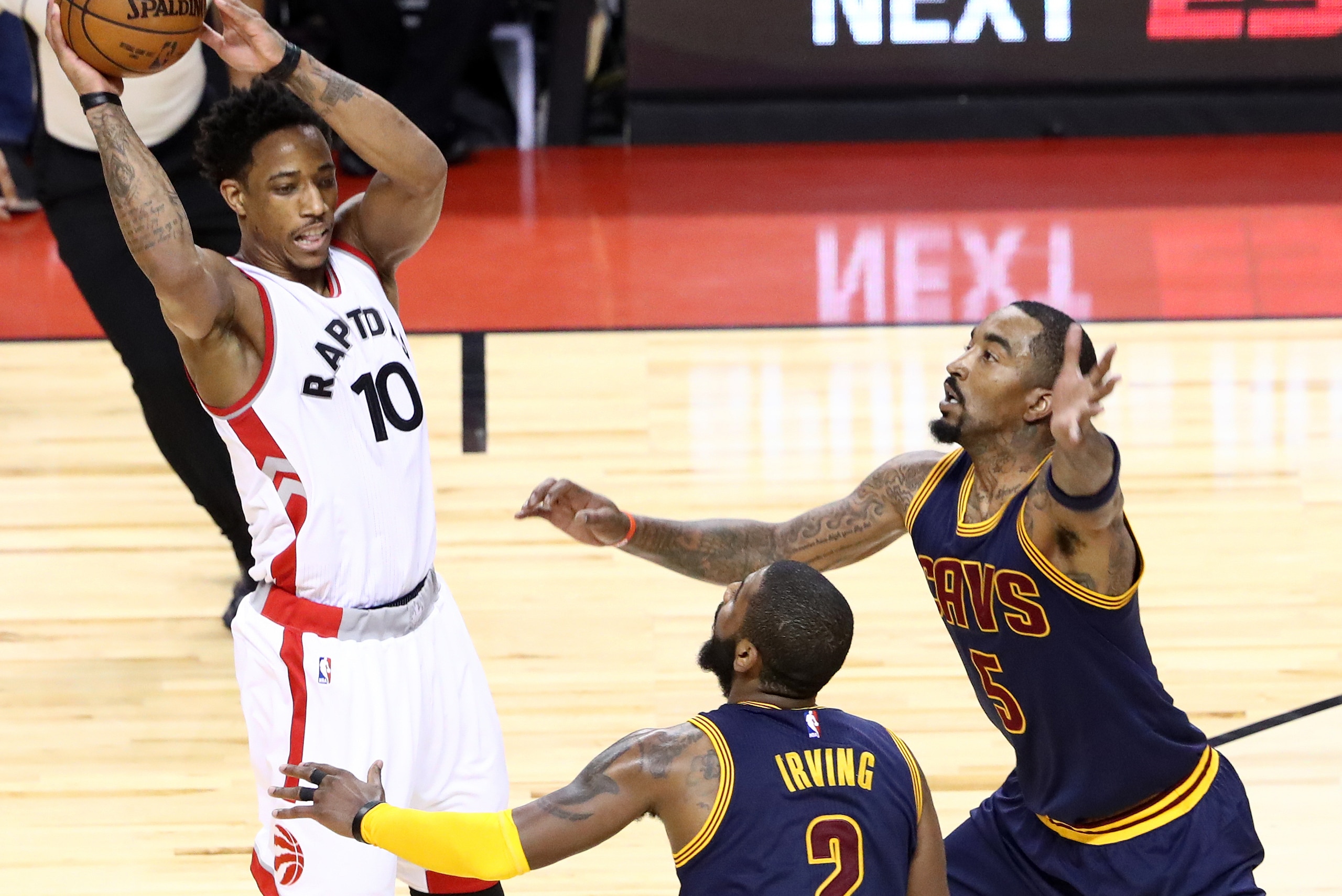
To do this, Cleveland used Smith to open the game with a heavy dose of Iman Shumpert off the bench. Whenever DeRozan touched the ball, a double-team was quick to follow. In four games, the Cavaliers sent an extra defender 116 times, including a whopping 44 in a series-clinching Game 4, per B/R Insights.
This blitzing or trapping strategy doesn't work on just any superstar. Try it on LeBron James, and he's happy to snap a crosscourt pass to an open teammate. Against a score-first star like DeRozan or Thomas? It can work beautifully.
"We're aggressive. One thing you can't do is be passive when you're trapping and blitzing," veteran James Jones told Chris Fedor of Cleveland.com. "In every sport, usually the most aggressive team defensively has the most success. For us, it's about not allowing good players to get a rhythm and feel comfortable."
Despite a brilliant regular season, DeRozan averaged 20.8 points on just 42.6 percent shooting against the Cavaliers. In the two games in Cleveland, those numbers plummeted to 12.0 points on 33.3 percent shooting. In Game 2, the Cavs' blitzing defense was so effective that DeRozan didn't score a field goal until the fourth quarter.
Cleveland's "superstar takeout" method works.
| 61.0 | 29.0 | 43.3 | 28.6 |
"It's just a numbers game. I think it works well for us at this point and time right now because it just activates us and gets us moving, gets us talking and communicating," James said, via Fedor. "Stick with it, and if we put the pressure on for a consistent time over a 48-minute game, then we feel like it works in our favor."
Thomas Stoppers
Before the playoffs started, Lue issued a challenge to J.R. Smith to guard Paul George of the Indiana Pacers and DeRozan, the opponents' two best offensive players.
That won't be the case this time around.
"He won't be on Isaiah [Thomas] to start," Lue said, per Fedor. "He'll get a chance, maybe, but we'll see how it goes."
This means that either Kyrie Irving or James will open the game on Thomas. If it's Irving, that would mean a Smith-Avery Bradley matchup. If it's the 6'8" James on 5'9" Thomas, then Irving would slide down to Bradley, and Smith would take on Jae Crowder.

One has to assume it will be Irving who's asked to do his best, possibly as a warm-up for an eventual bout with Stephen Curry in the Finals. Whoever the Cavaliers stick on the Celtics star, he won't be alone.
Doubling Thomas means forcing him to take contested shots or give the ball up. The last time these teams met April 5, the remaining Boston backcourt rotation of Bradley, Marcus Smart and Jaylen Brown shot a combined 3-of-23 from the field. Cleveland, without starting center Tristan Thompson, won 114-91.
If the Celtics even win a game this series, it will be due to role players coming up big, something the Cavaliers will be happy to live with.
Cleveland's star-stopping strategy has worked for years, with Thomas and the Celtics as the latest target.
Greg Swartz is the Cleveland Cavaliers Lead Writer for Bleacher Report.
.jpg?w=2560 "Source: Freedom, White Not Eligible for WNBA Draft (AP)")
.jpg?w=2560 "LSU Lands 2nd NFL Commit")
.jpg?w=2560 "Players with Shocking Career Earnings 😳")
.jpg?w=2560 "Grading WWE Raw 🔠")
.jpg?w=2560 "Shedeur's Reaction to Browns' QB Decision")