

DeMar DeRozan Is Rewriting the Definition of Superstar Efficiency
DENVER — In the waning moments of an NBA basketball game, with the score tied 102-102, in the year 2016, DeMar DeRozan calmly dribbled the ball down the court, one possession after he'd given his Toronto Raptors the lead on a 20-foot jumper.
The NBA's then-leading scorer used a screen from fellow All-Star Kyle Lowry and forced the Denver Nuggets to switch Emmanuel Mudiay onto him. Backing the point guard down, he used every bit of his 6'7" frame and 6'9" wingspan to loft a turnaround jumper at the buzzer.
The ball rattled in and out, bounced around the rim, kissed off the backboard and fell harmlessly to the hardwood.
TOP NEWS

Pic of LeBron's Helicopter Commute 🚁

Jokić Pops Out at CU Game 🦬

NBA Power Rankings Entering Preseason 🔢
Overtime.
The miss isn't the point. After all, the Raptors escaped with a 113-111 victory during this Nov. 18 affair. It's the idea that a turnaround fadeaway jumper from 18 feet—a play that's anathema to modern NBA analytics—was a sound decision.
"That's a good shot," Lowry said after the game. "I think that's a great possession for us. We get our best player, our best guy, our closer, the league's leading scorer with the ball. An in-and-out fadeaway? I'll take it every time."
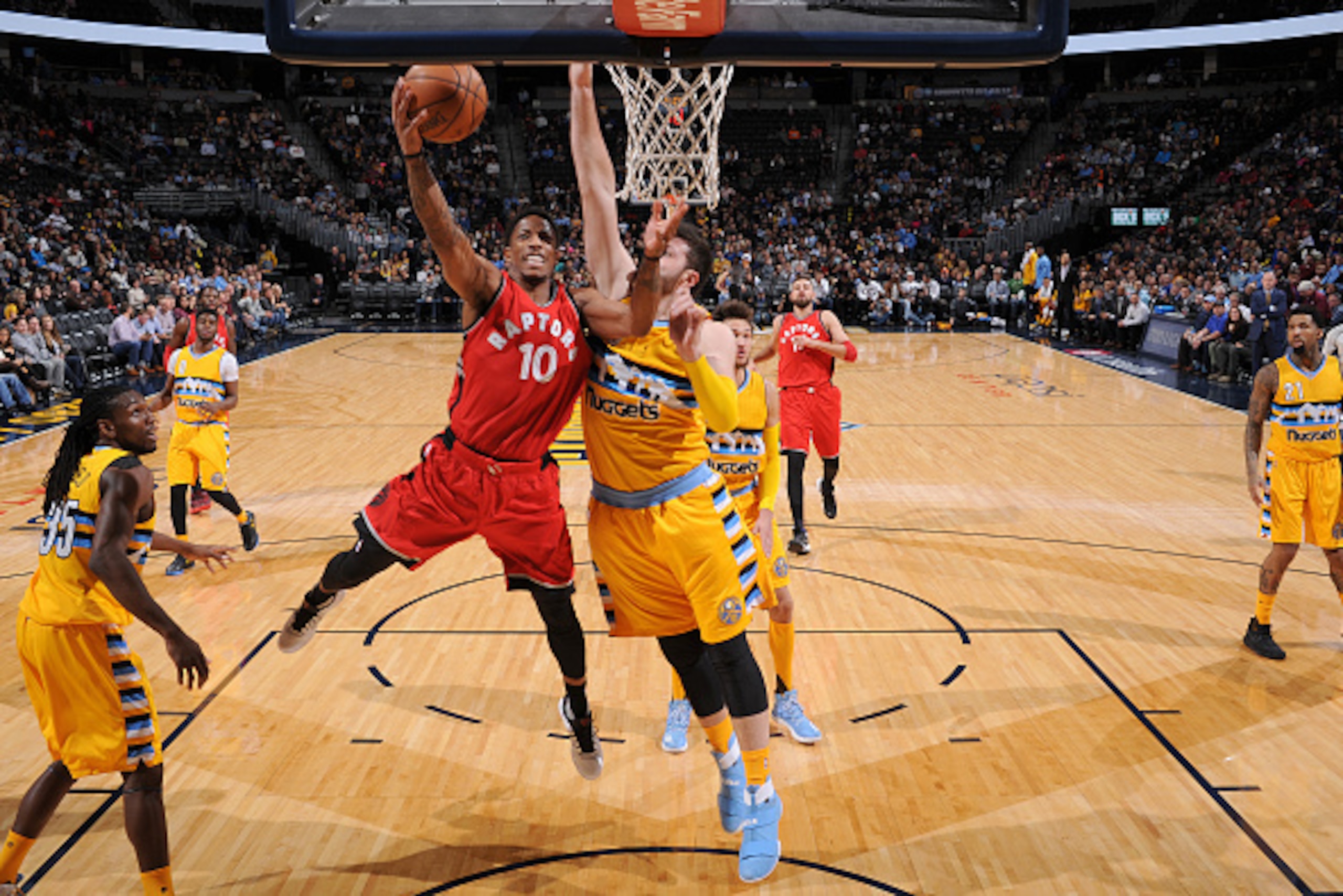
If this was anyone else, the discussion would be different. But while the NBA trends away from mid-range jumpers in favor of increasing three-pointers and a constant assault on the painted area, DeRozan has made his living on those exact shots.
After Toronto's Sunday night loss to the Sacramento Kings, the 2-guard was averaging 31.4 points per game while shooting 48.8 percent from the field and 80.9 percent from the charity stripe. Earning statistical comparisons to historically great scorers such as Michael Jordan, he was on pace to become one of just 17 players in the NBA annals to average at least 30 points with a true shooting percentage north of 57.
"He breaks the analytical mold when it comes to his type of scoring," Toronto head coach Dwane Casey explained before the win in Denver.
During 2015-16, DeRozan was a solid mid-range player who relied on volume to put up gaudy point totals (23.5 ppg). This year, he's emerging as the league's most dangerous player from 10 to 16 feet—the "king of the mid-range," as Nuggets head coach Mike Malone put it.
Plenty goes into an improvement of that magnitude: confidence, improved form and a scheme designed to promote success, for example.
But as Casey told Bleacher Report, an increase in strength has been key.
"I think strength has helped him a lot, being able to take the bumps," Casey said. "Because if you're in that tight space right there, you're going to get hit, touched. So he's playing through that now. He's doing a much better job of playing in that crowd, exploding up, vaulting up, taking the hits, taking the bumps, taking the physicality and completing the play."
All these factors have helped him take a monumental offensive leap on long two-pointers, moving into heretofore undiscovered territory:
The Toronto 2-guard already looks stellar, but context makes his work that much more stunning. The players surrounding him in the high-percentage, high-efficiency quadrant typically don't provide their teams with much scoring—their percentages are high, but their overall volumes low.
Of those who came close to matching DeRozan, only Dirk Nowitzki, who has built his career upon unblockable one-legged jumpers, took a comparable number of long twos. Nowitzki launched 9.4 attempts per game, leaving Myles Turner (5.4), Jason Smith (5.1), Andrea Bargnani (4.1) and Tayshaun Prince (1.9) in the dust.
In 2016-17, DeRozan is taking 12.2 long twos per contest. As Casey said, "If he's open, he has the green light to shoot the basketball."
No player in recent history has blended together such accuracy and volume. That has a compound effect: His ability to capitalize on opponents' fear of his mid-range game gets him to the hoop, making DeRozan an even more dangerous scoring threat.
Malone knows how that can kill a team.
"What really hurt us was early in the [Oct. 31] game, we dropped back and he hurt us," Malone explained, referencing DeRozan's 33-point performance. "We adjusted and got more aggressive. But late game, we started switching a lot, and our switching killed us because we just gave up blow-by after blow-by."
Modern teams aren't used to this style of play. If you don't switch on screens, DeRozan pulls up from areas most players won't. If you do, he has the quickness to jet past a bigger defender and explode toward the hoop. It's the main reason he's taking 10.1 shots per game at the stripe, which boosts his noteworthy efficiency levels to mind-numbing territory.
But DeRozan is also crafty enough to take advantage of mismatches without relying on whistles. Take, for example, this play against the Nuggets, during which he intentionally slows down to ensure Wilson Chandler remains assigned to him before setting up in his sweet spot and blowing by the 6'8" forward for an interior finish:
DeRozan will cool eventually.
His mid-range percentages may be unsustainable. But even if he regresses in some areas, he could still thrive in others. He's not just a one-dimensional player.
In fact, there's a chance he could finish as the NBA's leading scorer, staving off elite competitors such as Anthony Davis (31.7), Russell Westbrook (31.6) and James Harden (28.7).
And if he does so, he'll have rewritten the rules of the offensive superstar even further.
No scoring champion since Shaquille O'Neal in 1999-00 has made fewer than one triple per game, and DeRozan is sitting steady at 0.5. We haven't seen a perimeter player pace the league without using three-point territory since Jordan's last season with the Chicago Bulls (0.4 treys per game in 1997-98):
But don't expect this to serve as any sort of motivation to the mid-range specialist.
"Nothing," he told Bleacher Report when asked what leading the league in scoring means to him. "All I care about is winning."
Behind his efforts, the Raptors sit first place in the Atlantic and have overcome some futile defensive outings with with their high-scoring habits. So long as DeRozan keeps refusing to cave to modern shooting conventions, they should keep winning.
Adam Fromal covers the NBA for Bleacher Report. Follow him on Twitter @fromal09.
Unless otherwise indicated, all stats are from Basketball-Reference.com, NBA.com or NBA Math and are current heading into games on Nov. 21. All quotes obtained firsthand.

.jpg?w=2560 "OBJ Calls Out Giants After Release")

.jpg?w=2560 "Rap: Lions, LaPorta End Contract Talks")


.jpg?w=2560 "Report: Baker May Miss Up to 6 Weeks")