Breaking Down Dashon Goldson's Role in New-Look Washington Redskins Secondary
Dashon Goldson, do you need some help with that? After all, you're carrying on your back the hopes of a Washington Redskins fanbase who want to believe its franchise still deserves good safety play.
It's got to be a heavy burden, even for a 6'2", 200-pound former two-time Pro Bowler.
Yet it's hardly overstating things to to say this is the level of expectation facing a player whose career has, at best, plateaued during the last two seasons. After making consecutive trips to Hawaii as a member of a star-studded San Francisco 49ers secondary in 2011 and 2012, Goldson joined the Tampa Bay Buccaneers.
TOP NEWS
.jpg?w=2560)
New 2027 NFL Mock Draft 🔮
Caleb Changes IG Profile Pic 👀
.jpg?w=2560 "Tyreek Hill Verdict")
Jury Finds Tyreek Hill Liable for 2 Battery Counts (AP)
Since then, his reputation has taken a bigger hit than the ones he used to deliver to unfortunate receivers going across the middle. That's something Goldson is determined to change during his time in D.C., according to ESPN's John Keim: "I want to show I can still play. Nothing has changed about me; my game is still the same."
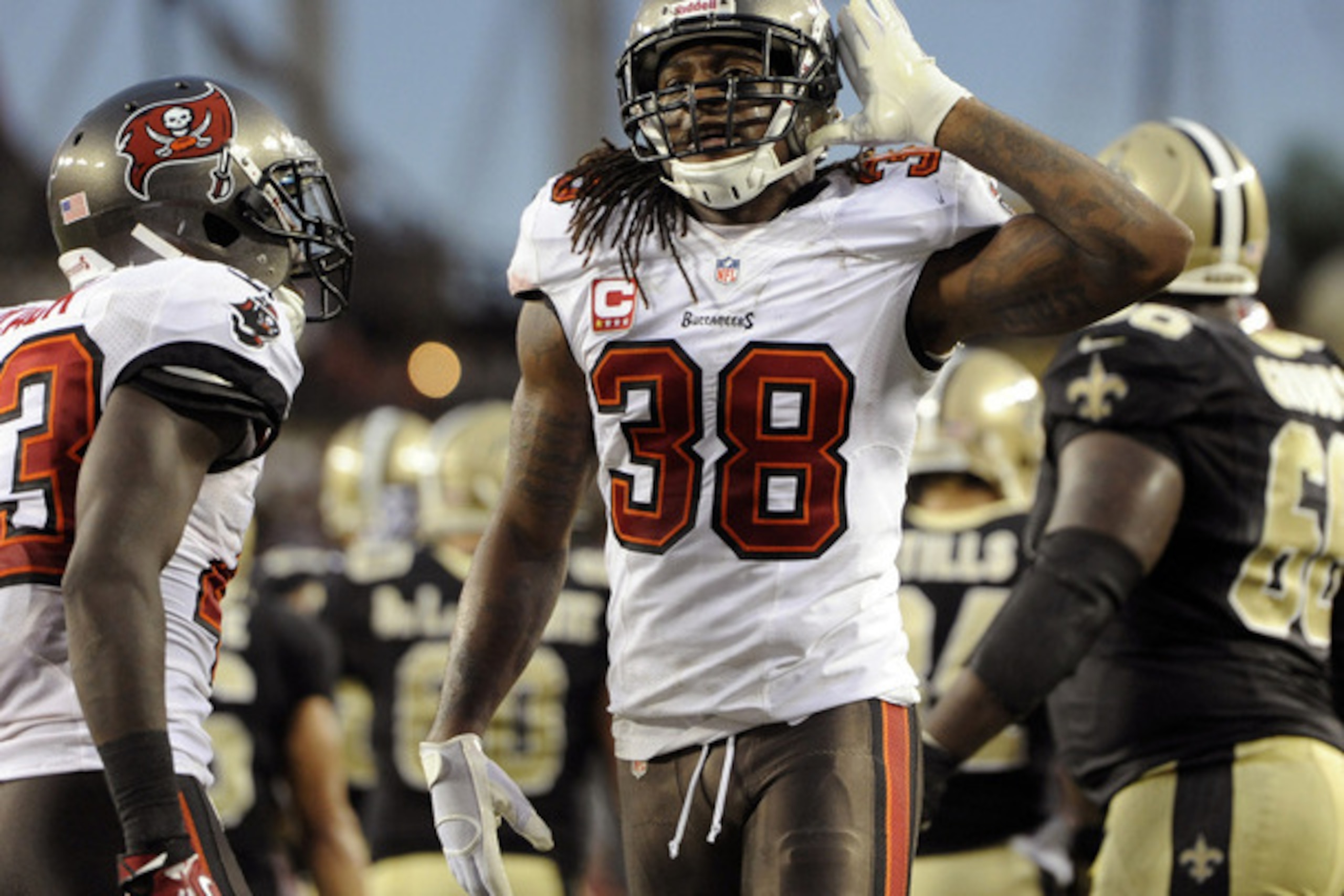
But Goldson's struggles are nothing compared to the ones Washington has experienced at the position. Dire play from the safety spots has been the albatross around the necks of successive defenses since 2009.
During that time, the Burgundy and Gold have indulged a rogue's gallery of inept cover men and reckless tacklers. Last season may have been the nadir moment, as ageing and ineffective duo Ryan Clark and Brandon Meriweather managed to plumb new depths.
So Goldson is the savior, right? Well, that's the theory at least.
To see if he can live up to the billing, here's a look at his coverage play, from his peak with the 49ers in 2012 to the valley he landed in when his form dropped off the map in Tampa Bay:
Being Trusted on an Island
At his very best, Goldson can be trusted on an island. That means a defensive coordinator should have no worries about positioning the safety to pick receivers up deep.
When it has worked, Goldson has looked awfully good. He certainly did on a 2nd-and-16 play in San Francisco's home win over hated rivals the Seattle Seahawks from Week 7 of the 2012 season.
The Niners responded to Seattle stacking two receivers, Sidney Rice and Golden Tate, on the same side by breaking up their two-deep shell and having strong safety Donte Whitner rotate down into man coverage.
Whitner took Robinson in the slot (orange arrow). Meanwhile, Goldson rotated to the deep middle (purple arrow). San Francisco now had a Cover 1 shell, with Goldson as the single-high safety behind underneath man coverage:

Facing a long-yardage situation in the final two minutes of the first half, the Seahawks set up a deep strike to Golden Tate. The sturdy and loquacious flanker was matched up against ex-Redskins starter Carlos Rogers:
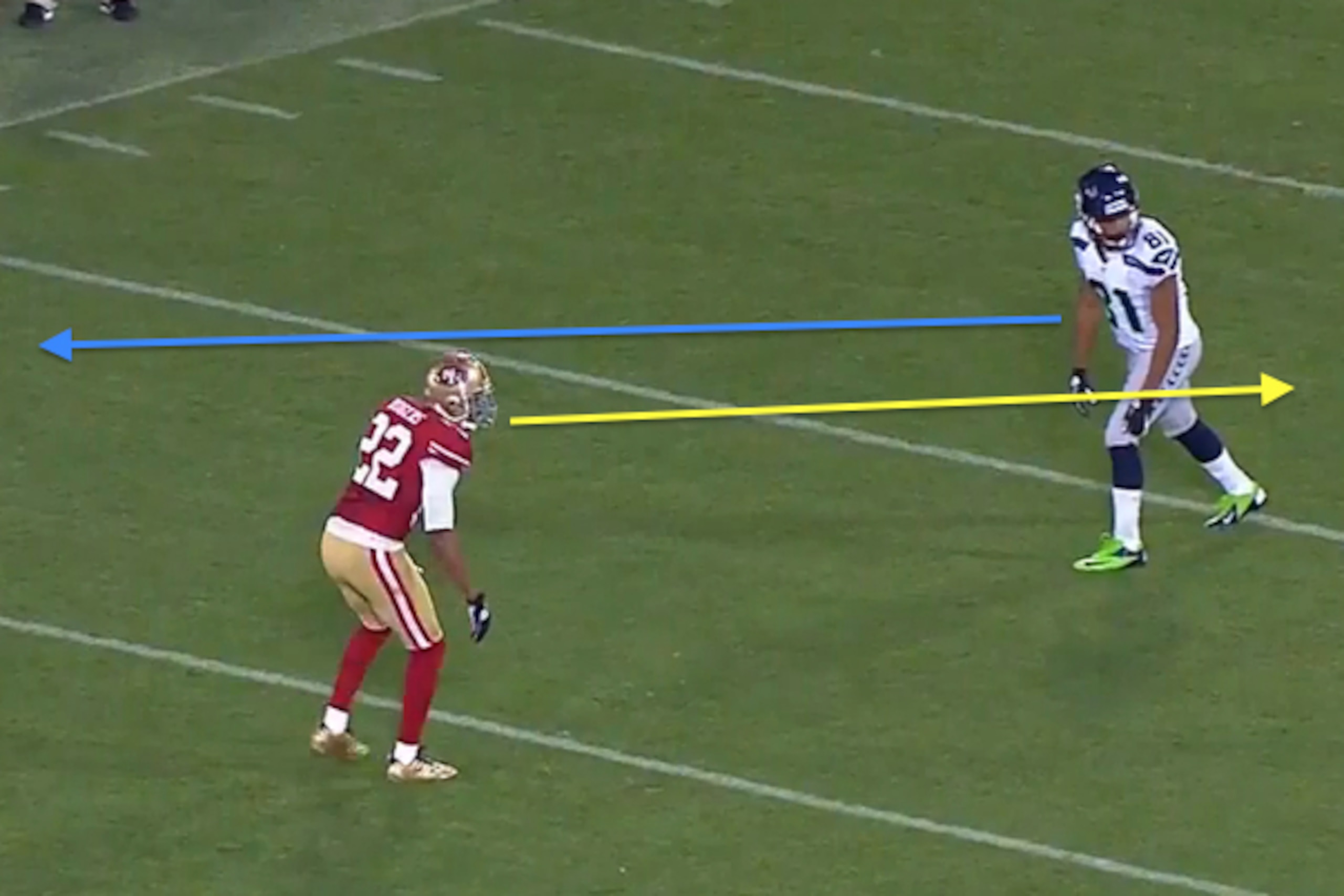
He would be playing zone, as evidenced by how he's peeking into the backfield pre-snap. Tate wouldn't go short or to the flat though. Instead, he intended to breeze past Rogers on a post pattern.
At the snap, Tate made his move, while Rogers maintained his zone eyes on quarterback Russell Wilson:

Sensing a deep pattern, Rogers let Tate go and picked up the underneath receiver, Rice (18), as he should do in zone coverage. But Tate's vertical release made him Goldson's man:
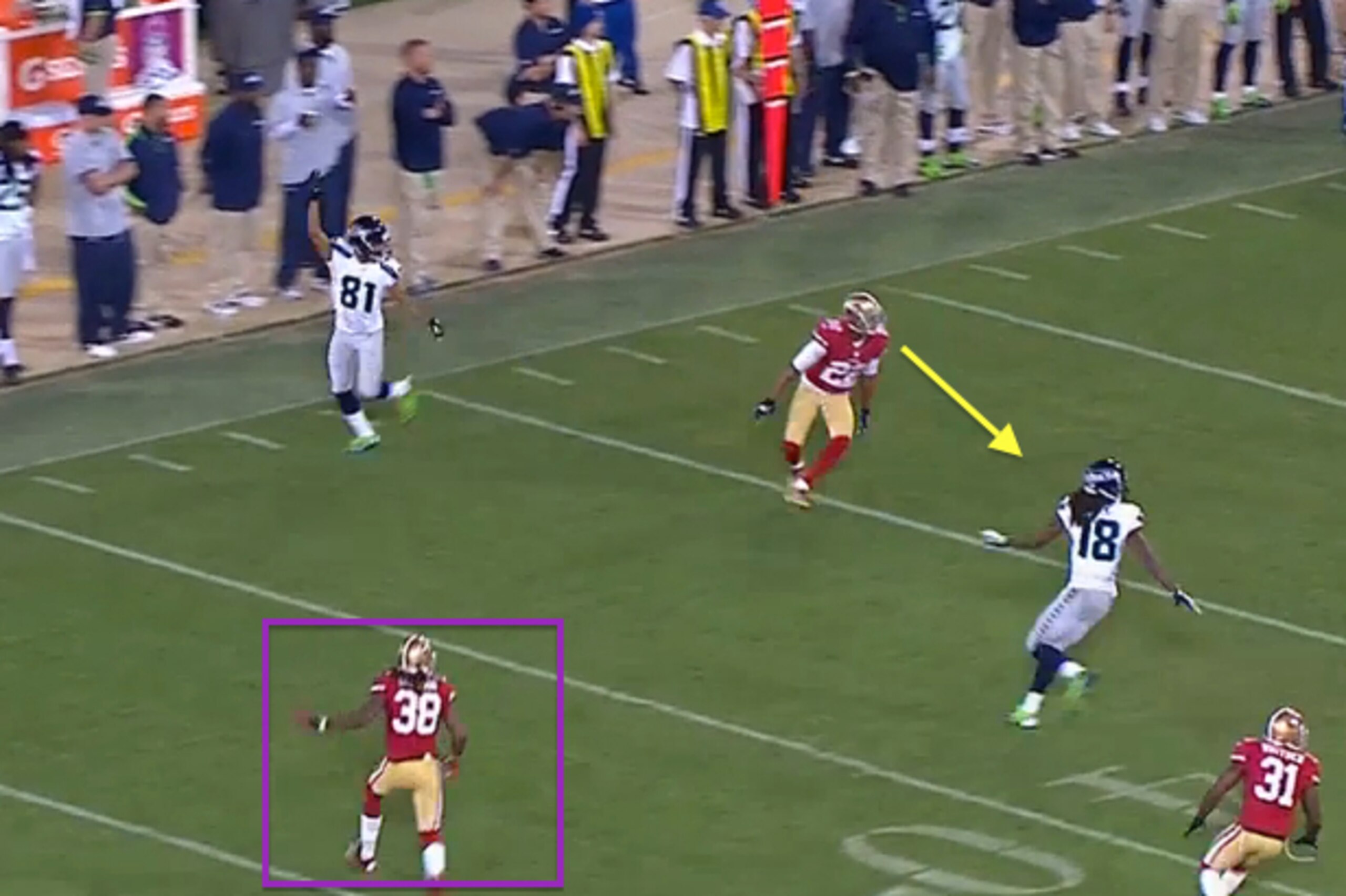
With Tate passed off in the zone, Goldson had to cover ground quickly. He got on his horse and did just that:
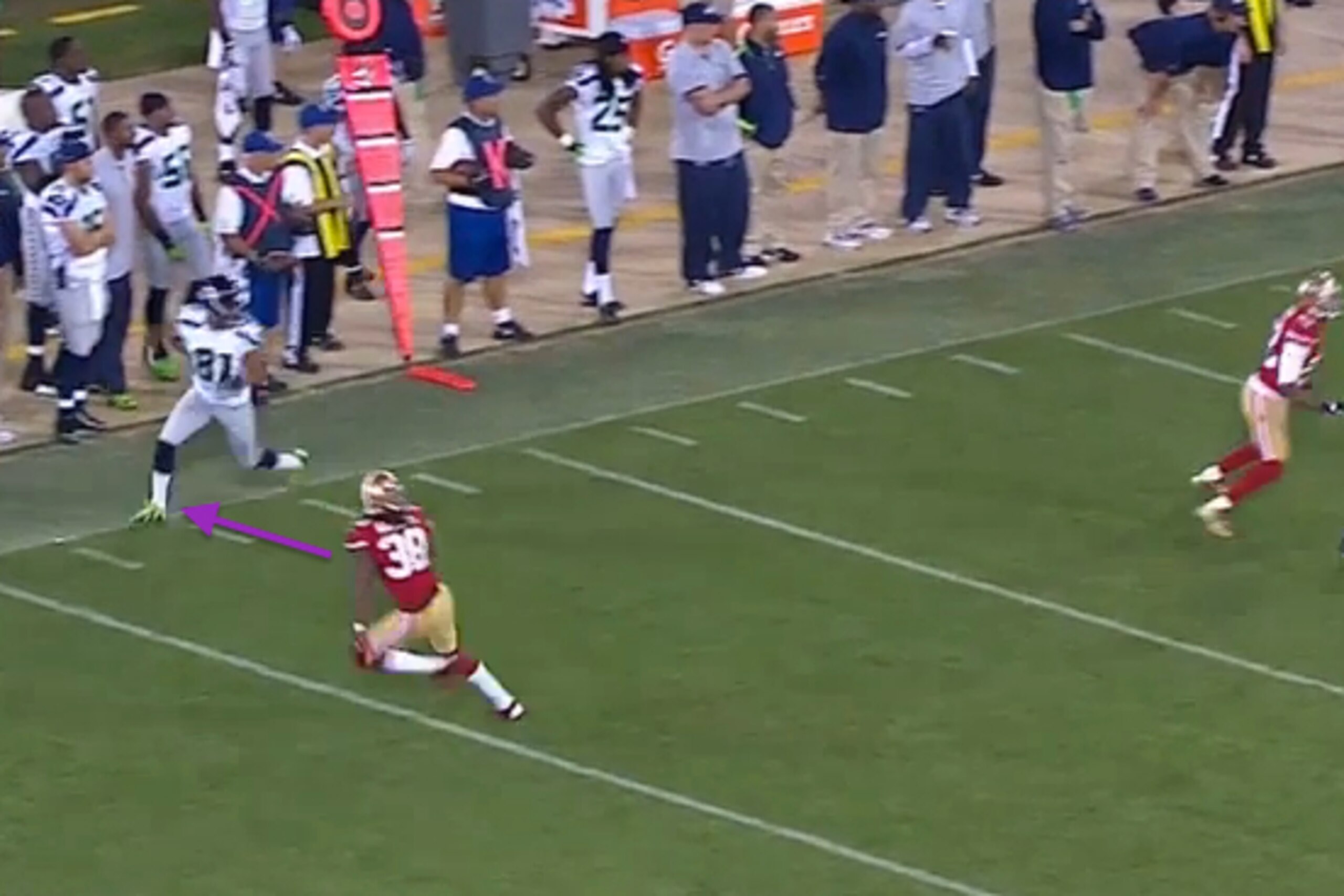
Now Goldson was able to pin Tate to the sideline and get on the inside to face the quarterback in man coverage. This was perfect trail technique:
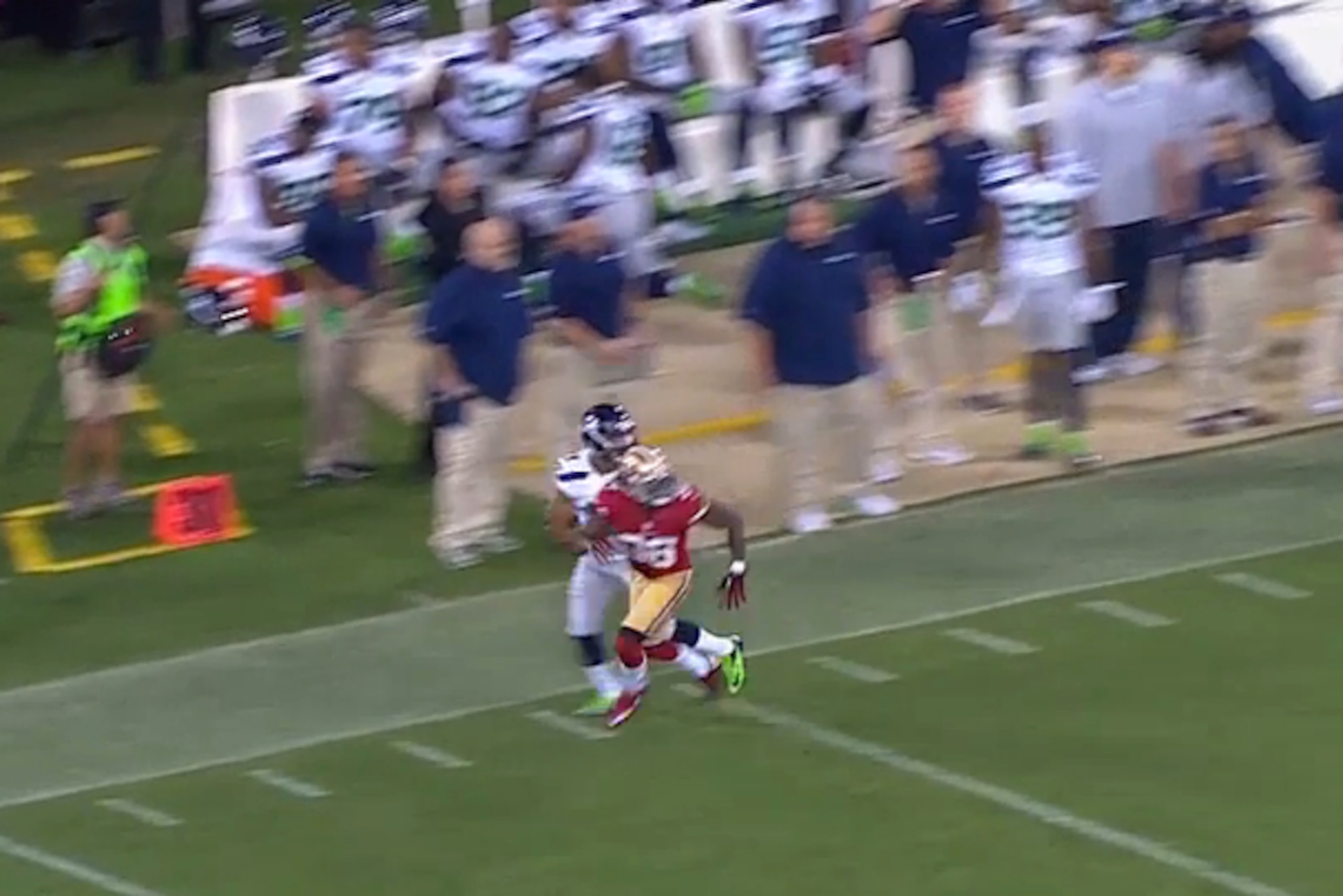
Goldson had now taken away Wilson's throwing window. Instead, the pocket-edition passer was forced to try and drop the ball into a minute spot just inside the field of play.
That's a feat of accuracy even the very best quarterbacks struggle with. Wilson's in that group, but he couldn't get it right here. His bomb to Tate floated out of bounds, with Goldson still giving the wideout no room to breathe:
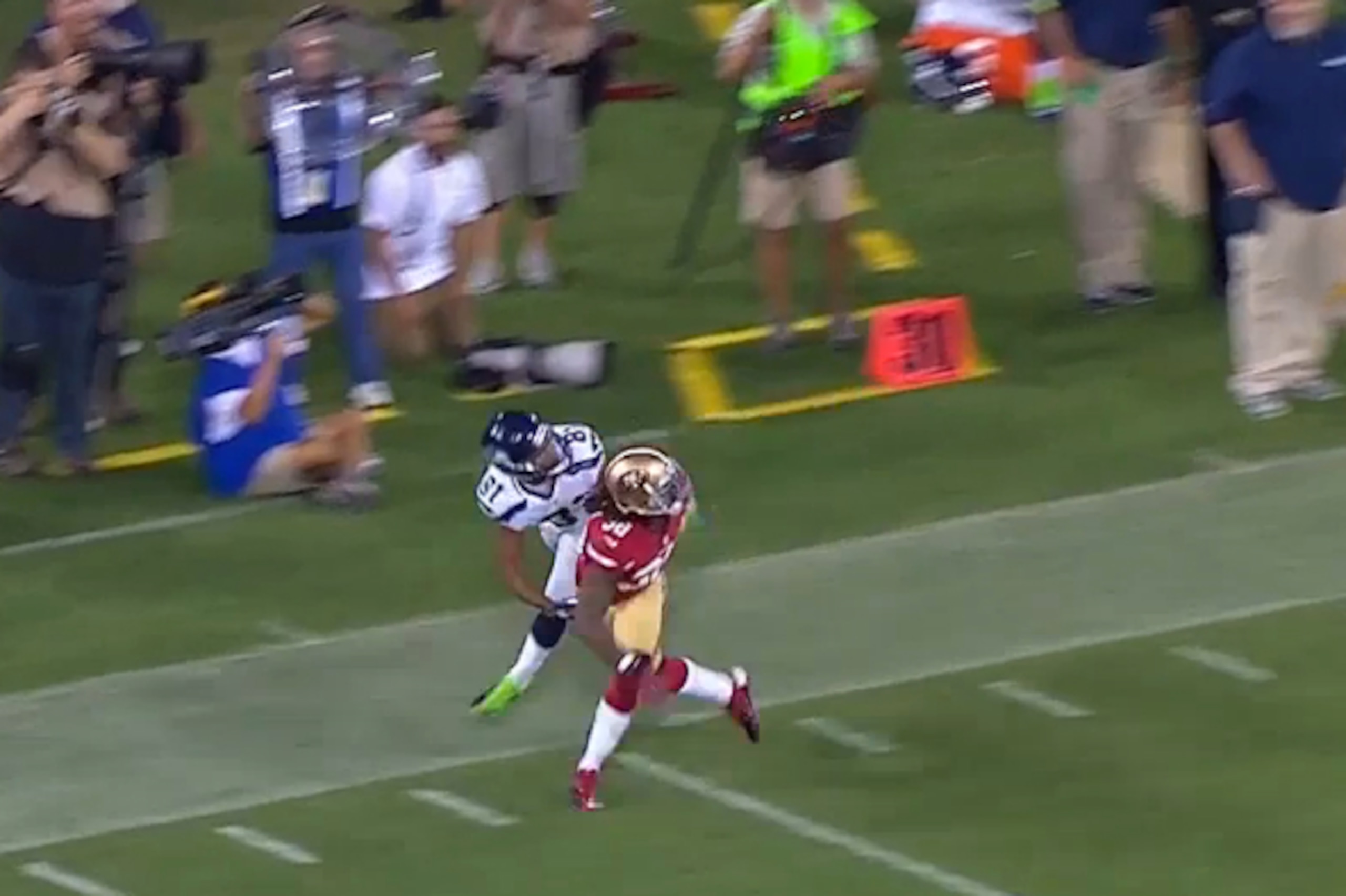
This was a textbook example of how to play deep center fielder. Goldson read the play in an instant and reacted just as swiftly.
He put himself where he needed to be and executed his coverage with discipline and sound technique. If that description sounds odd, it's because it hasn't belonged in an article about a safety who wears Burgundy and Gold for the last six years.
But this is the kind of play or, more specifically, the type of scheme a defense can run when it has a competent player manning the last line. Of course, a truly versatile safety expands the playbook even further.
Goldson gave a good example of those possibilities during Tampa Bay's home defeat to NFC South foe the New Orleans Saints from Week 2 of the 2013 season.
He began a 1st-and-10 play aligned over big-bodied wide receiver Marques Colston in the slot:
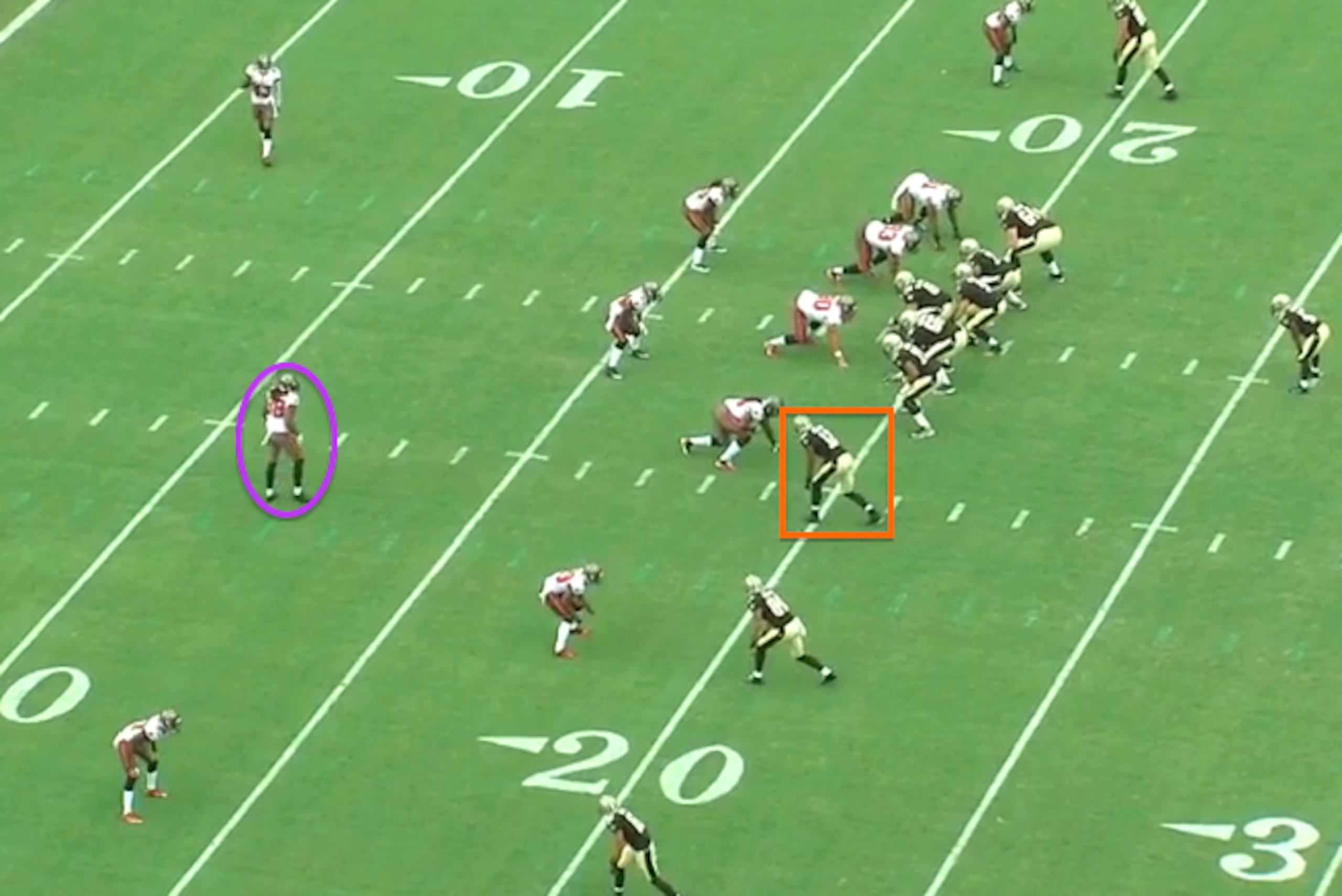
In typical fashion, the Saints planned to have Colston run a quick slant, a route that lets him use his 6'4", 225-pound frame to shield defensive backs from breaking on the ball.
But Goldson played things smart. He let Colston out of his break, wisely resisting a physical battle he may have lost in press coverage.
Instead, Goldson kept his receiver in front of him and began to break on the throw:
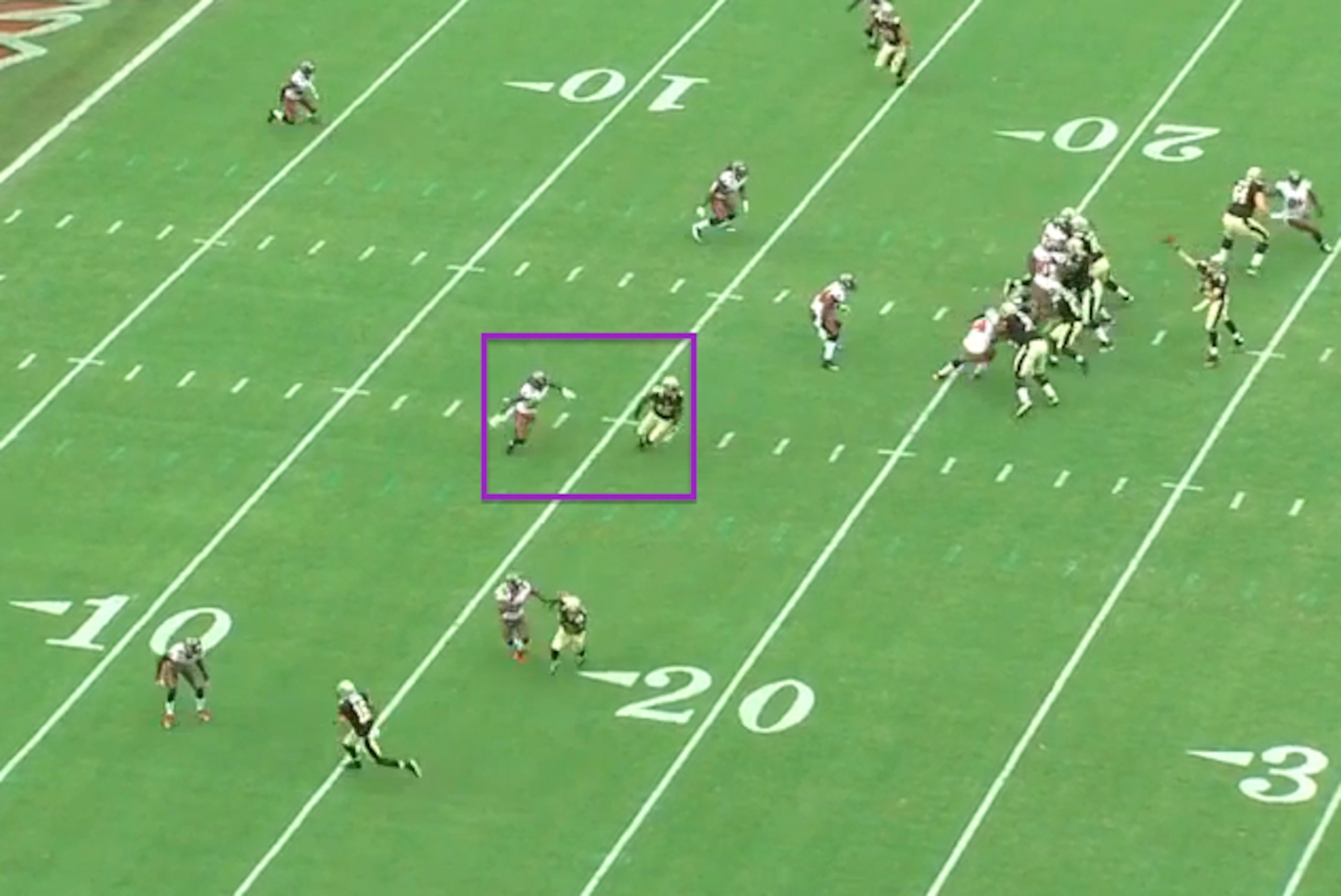
Again, he quickly covered ground and was able to contest the play at the catch point:
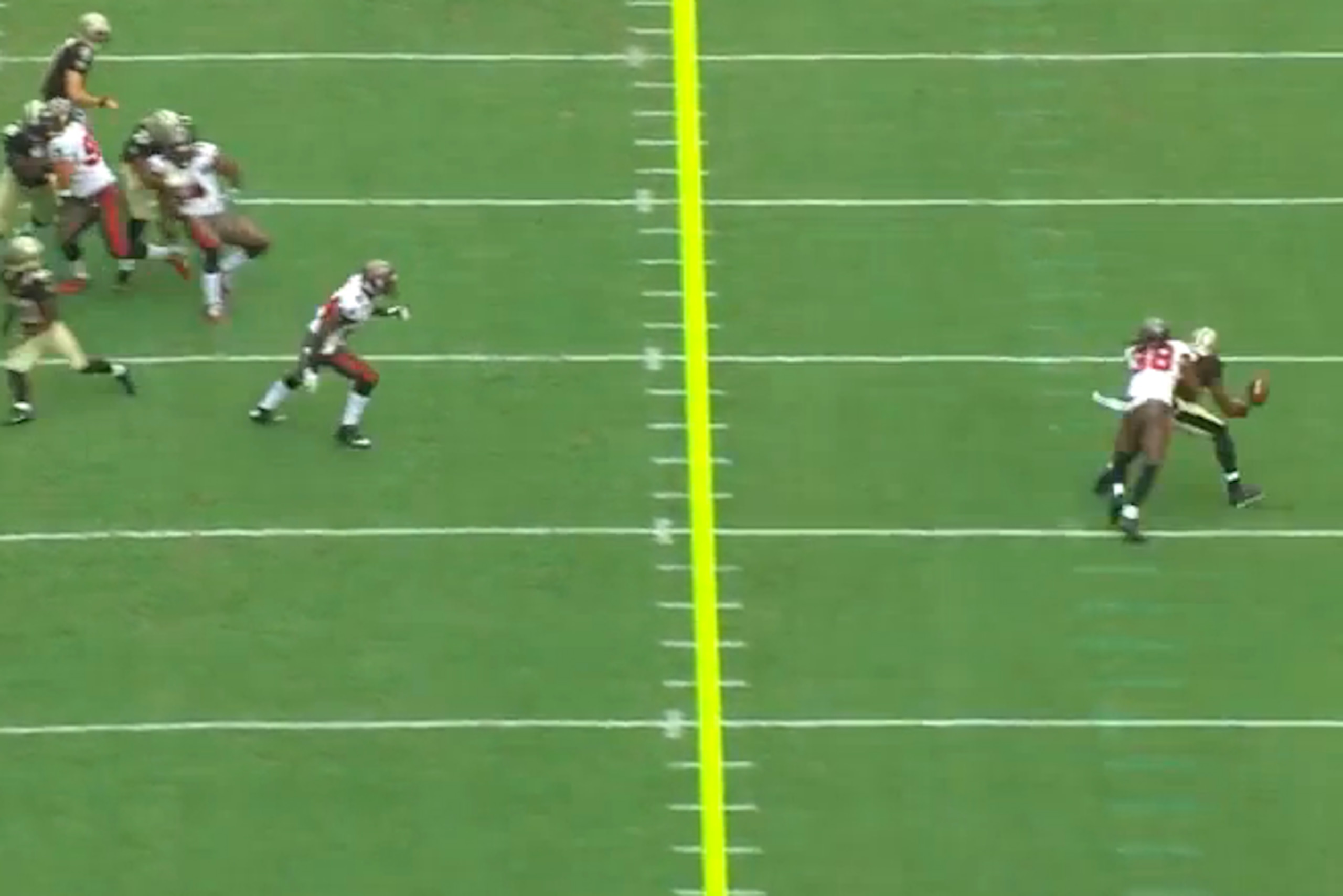
Goldson reached his target and jarred Colston loose from any attempt to reel the ball in, forcing an incomplete pass:
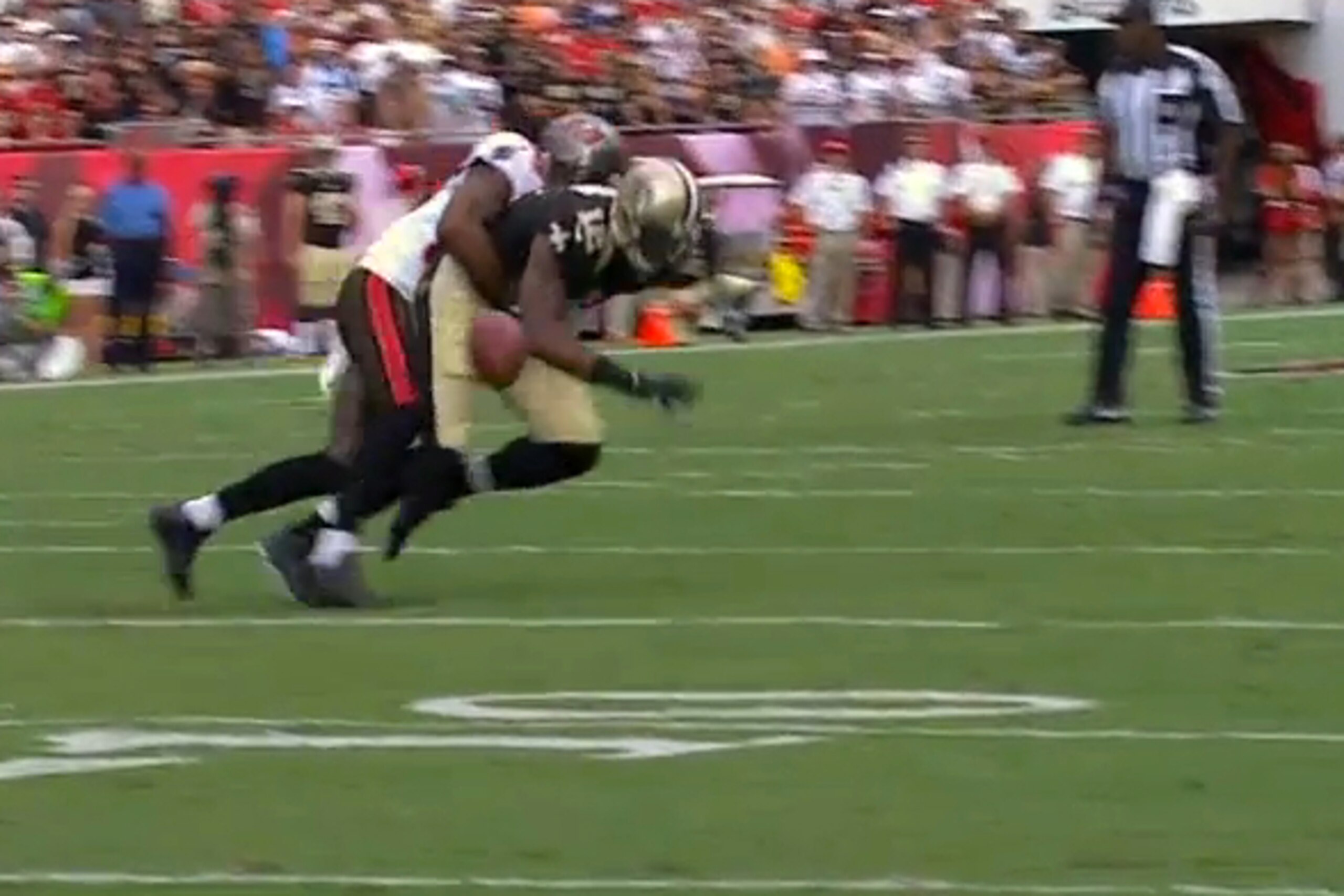
Being able to match up a safety with a receiver underneath and still not get burned for a big play is a major advantage for any defense. It means a unit can adjust easily to offenses that try to spread the field to create mismatches. An in-form Goldson has the skills and range to cure this particular ill.
That's not something last season's safeties could do. Remember how often Washington's linebackers and safeties were burned deep in games against the Buccaneers and Indianapolis Colts?
A lot of those problems were created by the precarious positions 2014's starters were put in by previous coordinator Jim Haslett. Things often worked the opposite way for Goldson in San Francisco.
During those years, it was shrewd schemer Vic Fangio routinely putting safeties like Goldson in positions conducive to success and not a one-way ticket to a spot on a weekly low-light reel.
Goldson's interception against the Chicago Bears from Week 11 of the 2012 season brilliantly illustrates the point. The Bears faced a 3rd-and-3 in the third quarter, and Fangio and the Niners decided to throw some disguise at quarterback Jason Campbell.
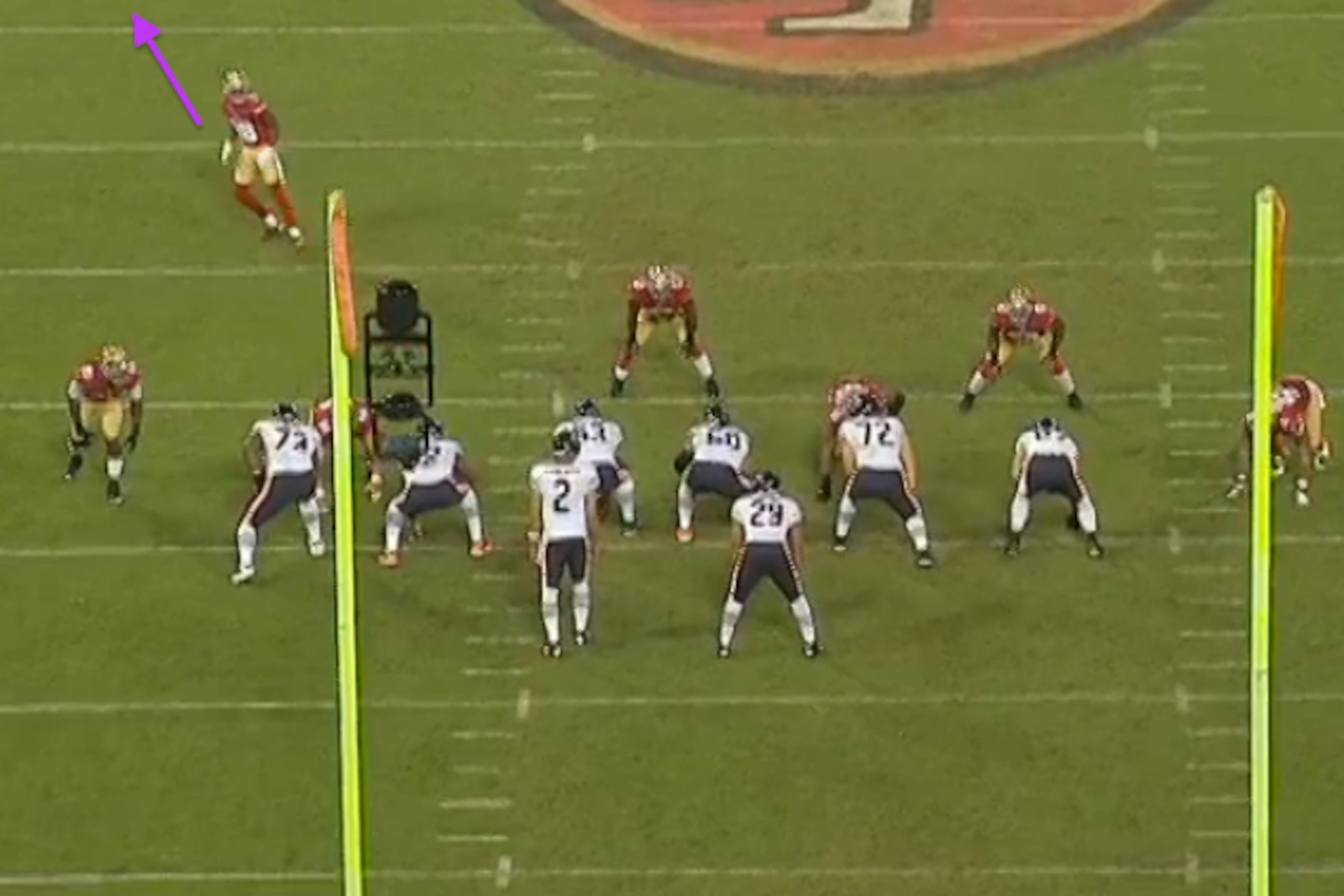
Things began with San Francisco showing what looked like a quarters or Cover 4 structure. Both safeties were rolled up closer to the line, with Goldson near the box (purple square):
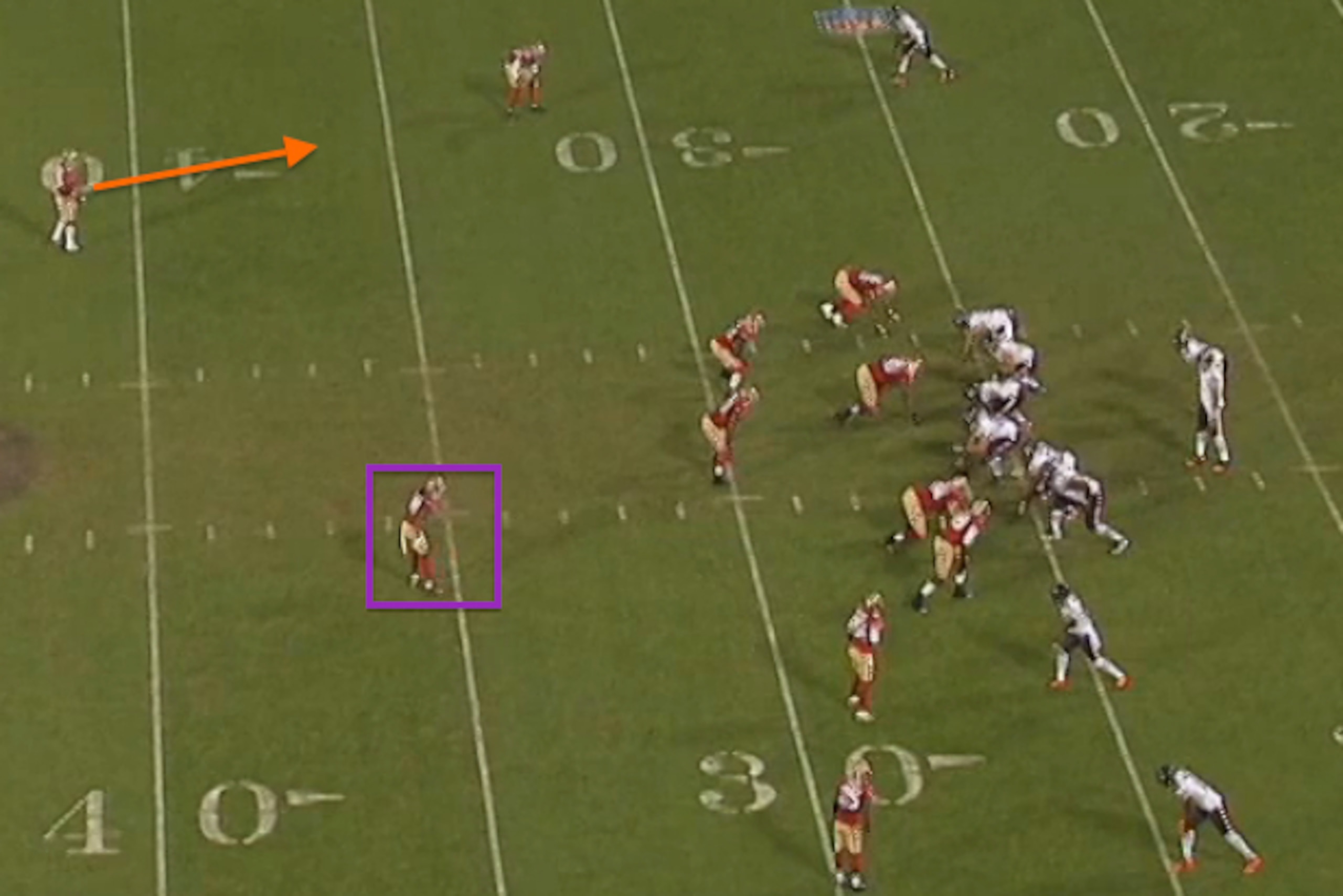
In fact, this looked a lot like quarters on one side, with half-field coverage on the other. Notice how strong safety Whitner was rotating close to Brandon Marshall on the other side of the field. With a corner rolled up underneath and a safety over the top, this was a classic double coverage look.
But it was Goldson's position nearer the line that had Campbell confused. The free safety soon started to rotate deep pre-snap:
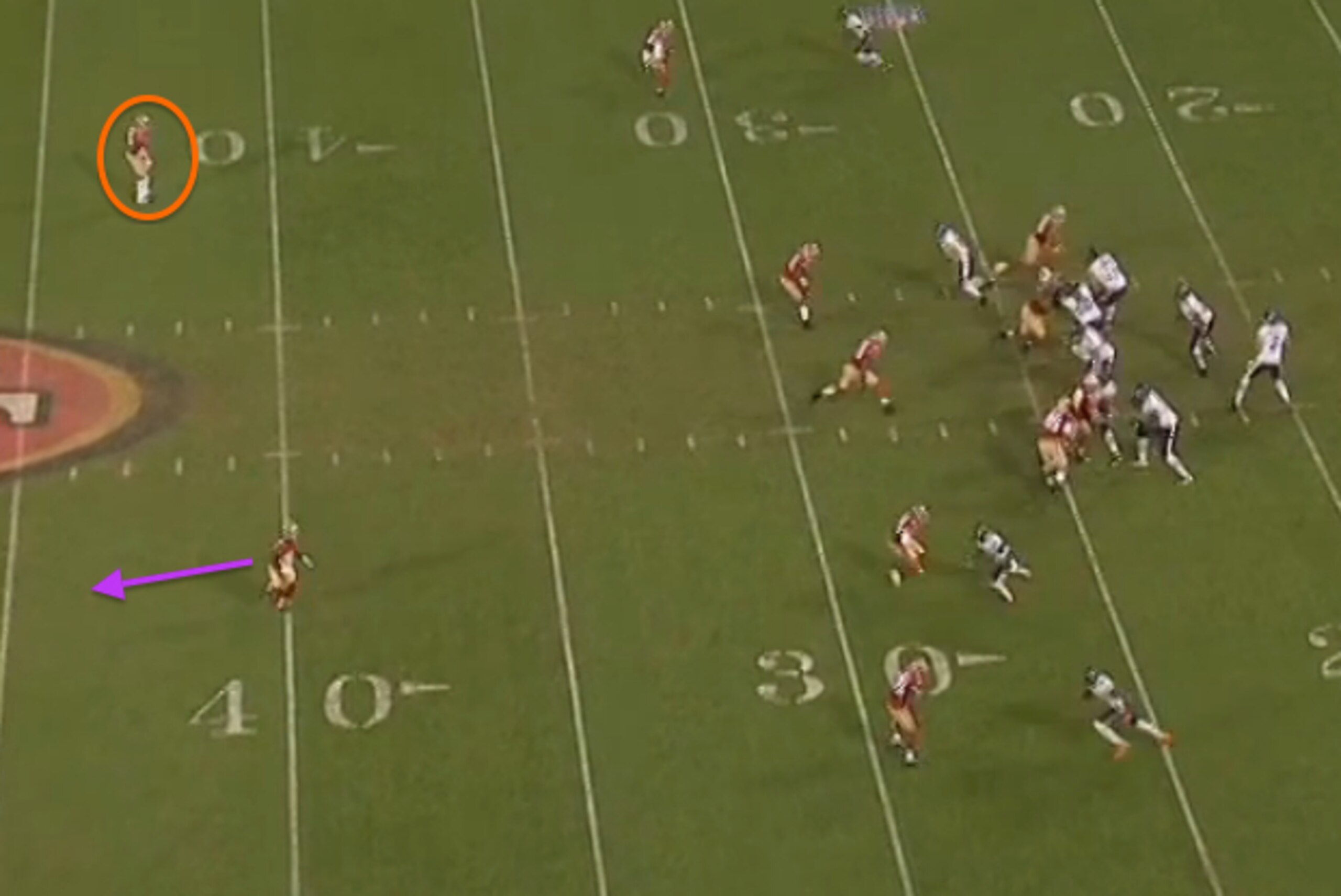
Whitner also seemed to have taken a couple of steps back. The 49ers were changing the shape of their coverage structure.
Here's what the rotation looked like from Campbell's point of view. Initially, he was seeing one safety high and Goldson low:
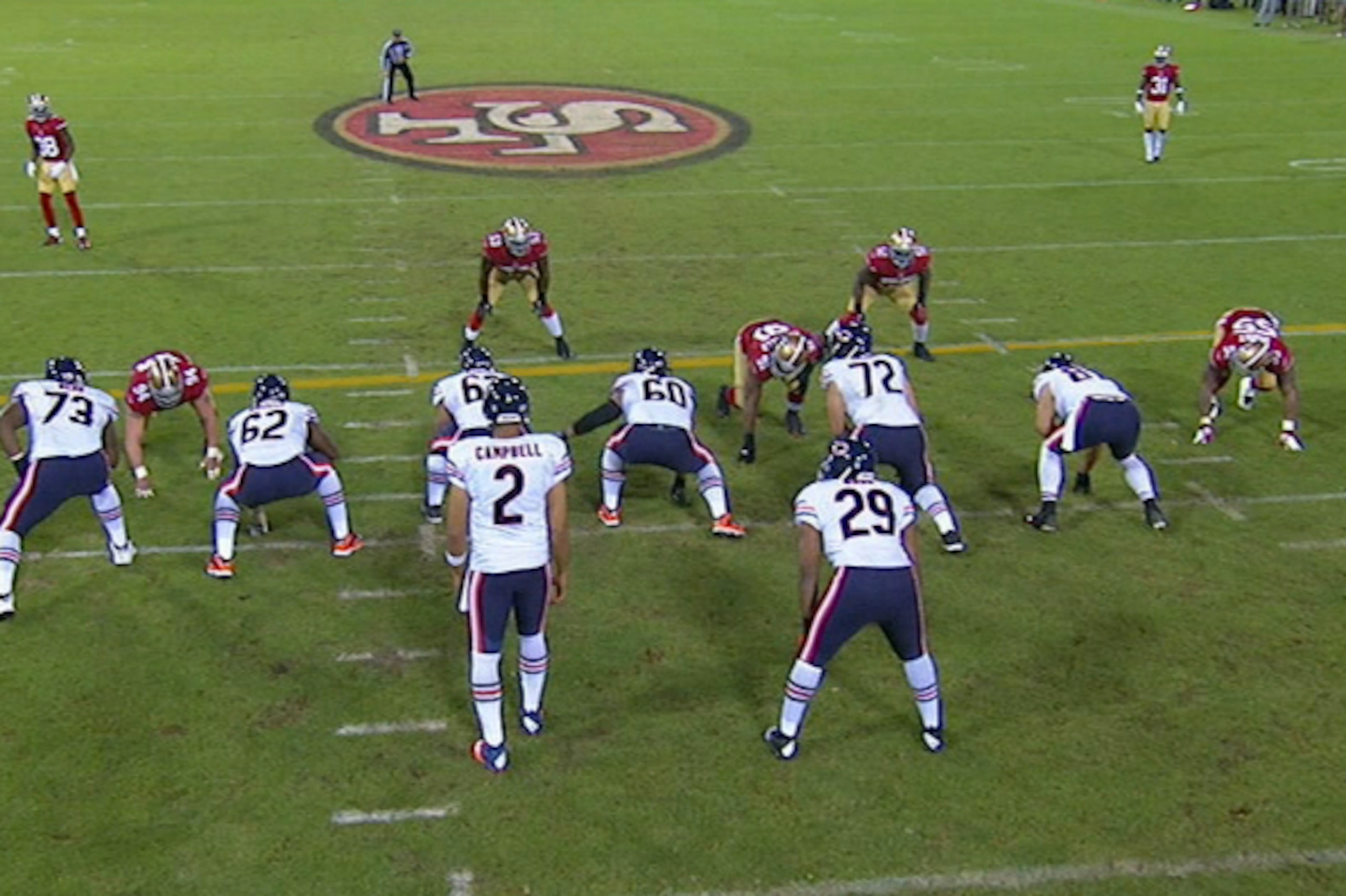
But that soon changed once Goldson made his move and retreated deep:
Now the 49ers had adopted a traditional two-deep safety look:
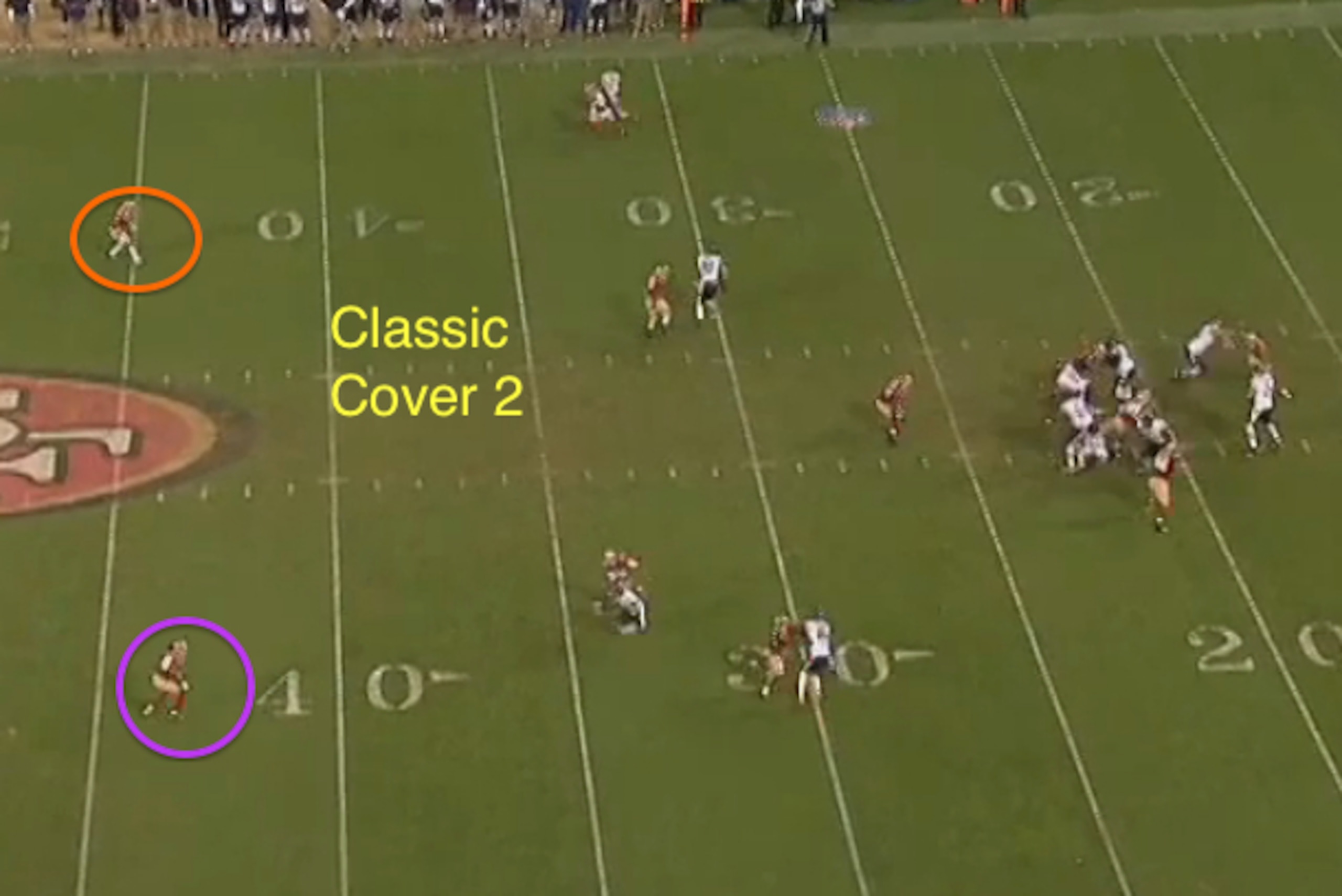
Campbell was trying to target a vertical, out-breaking route run from the slot by Earl Bennett. But he didn't anticipate Goldson would be hovering so deep.
Campbell's throw, delivered under intense pressure, sailed over Bennett, where a grateful Goldson was waiting to snatch the ball:
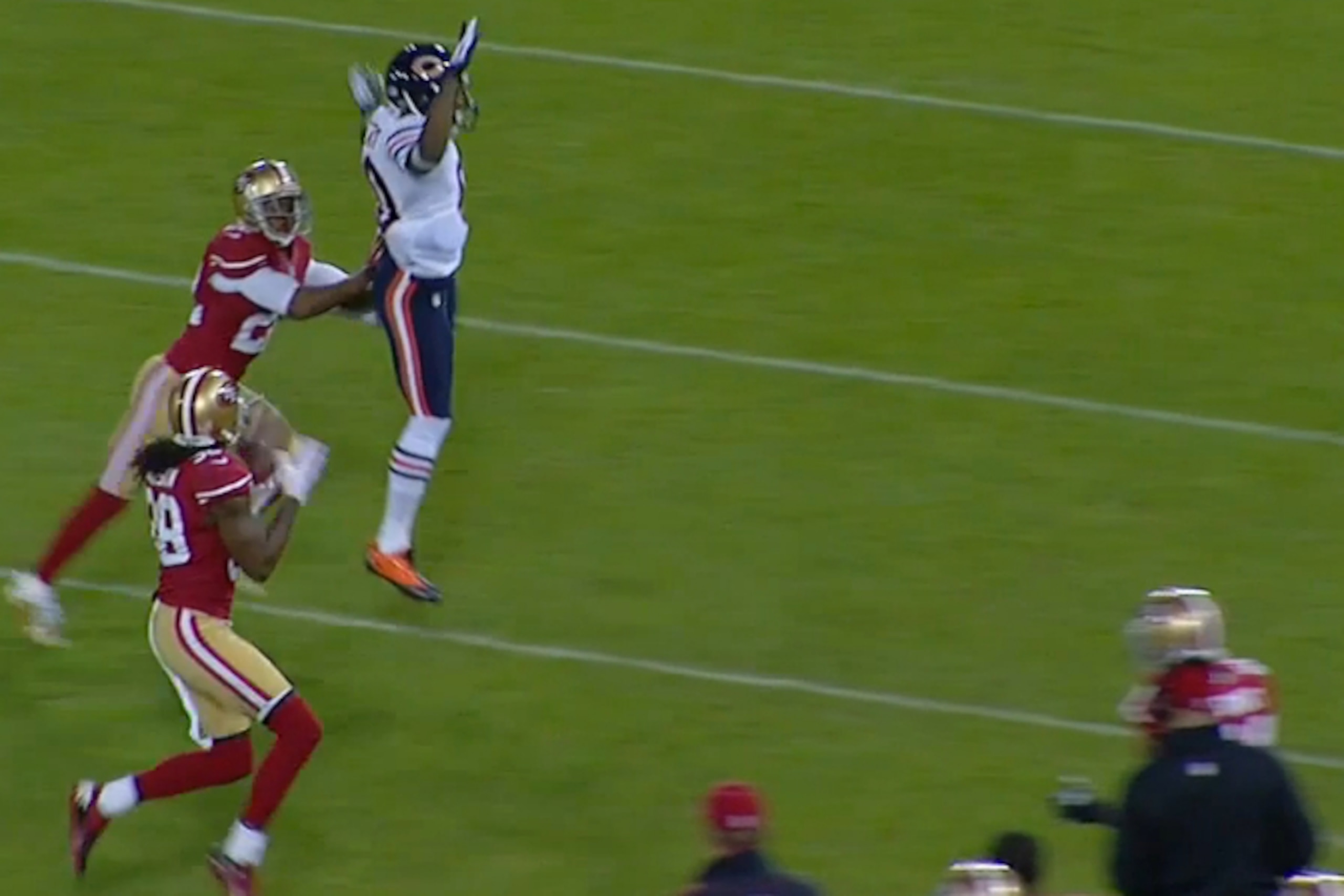
Goldson made a big play partly because of how he was aided by a smart scheme that positioned him to succeed. That's the way Barry must use his new safety in 2015.
He needs him to be a matchup safety at close quarters and a level-headed freelance agent of destruction deep. As a naturally versatile playmaker, Goldson is certainly better suited to that role than either Meriweather or Clark.
Of course, Barry can only give Goldson that much responsibility if the 30-year-old quickly gets back to his best. The flip side to his coverage makes for ugly viewing.
Flying Solo Can Be Dangerous
When he's been on top of his game, Goldson has often been trusted to patrol the deep zones as a lone enforcer. But that's a demanding role for any player.
When things go wrong, a defense is usually vulnerable to big plays. Sadly, Goldson has plenty of experience of what that looks like.
Going back to San Francisco's win over the Seahawks reveals a near miss that should have been six points because of a failure from Goldson. The Niners were in their familiar Cover 1 look run from 4-2-5 nickel personnel. Goldson was the single-high safety:
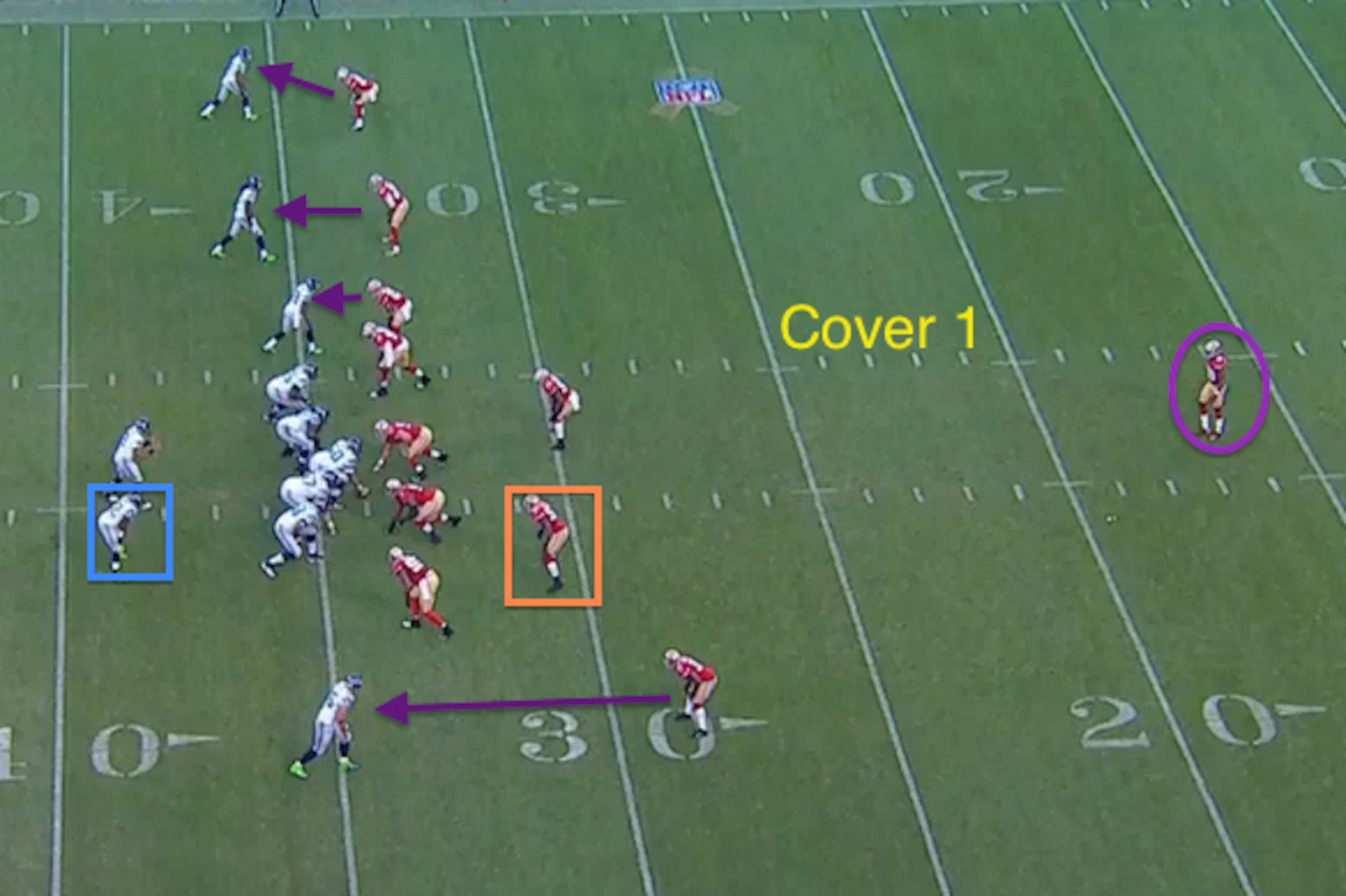
The Seahawks planned to take advantage of the underneath man coverage by isolating middle linebacker Patrick Willis against running back Robert Turbin. A running back against a linebacker in space should be a matchup win for an offense.
Turbin released on a wheel route and prepared to attack vertically along the sideline, taking Willis with him. As the last line of defense, Goldson had to decide which route and receiver he would defend:

Although he had multiple options, Turbin's was the only route that went vertical and thus threatened Goldson's portion of the field. But the safety was late to react.
Goldson took too long getting across to meet the running back at the catch point:
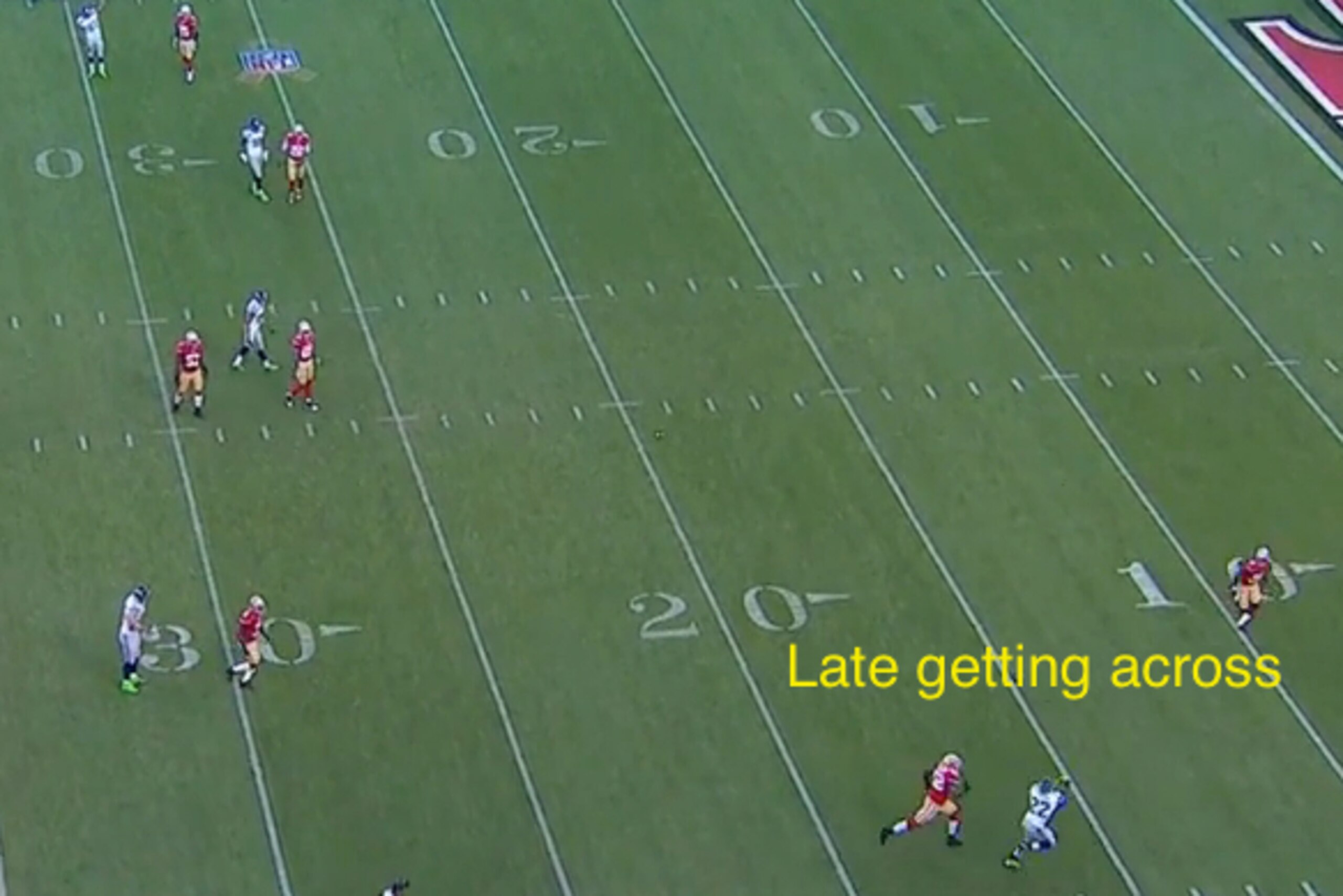
Fortunately, for San Francisco, what should have been a touchdown was dropped by Turbin:
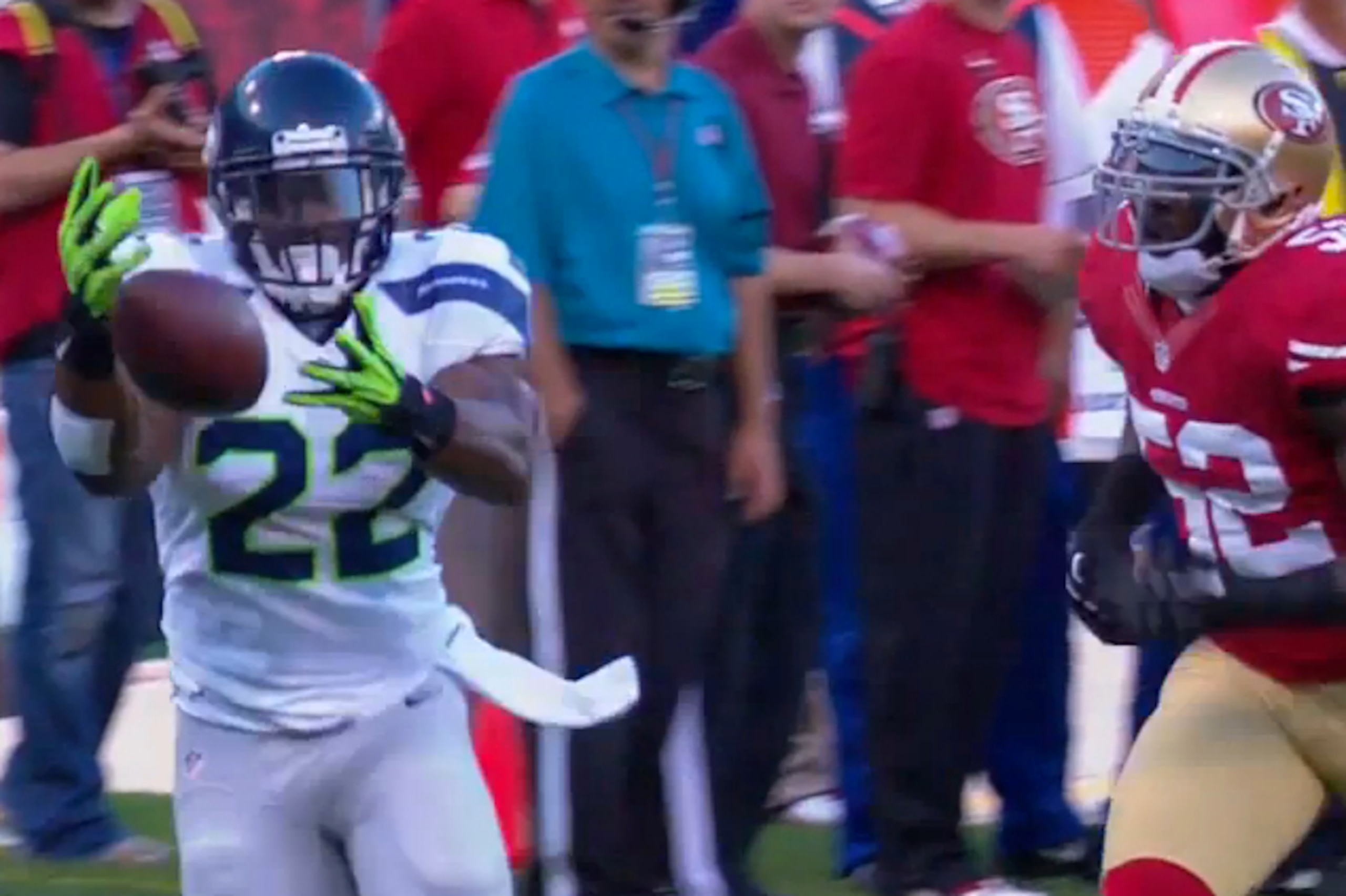
But this was merely a lucky escape. The Niners should have been burned for a big play. Their Cover 1 shell failed because its most important player, Goldson, didn't read and react quickly enough.
Playing Cover 1 is tough for a free safety because every mistake is magnified. There's literally nowhere to hide for the deep rover who errs consistently.
If Goldson needed a reminder, he got one during the Bucs' home defeat to divisional opponent the Atlanta Falcons in Week 10 of the 2014 season.
Tampa's defense initially showed the Falcons a typical Cover 2 look:
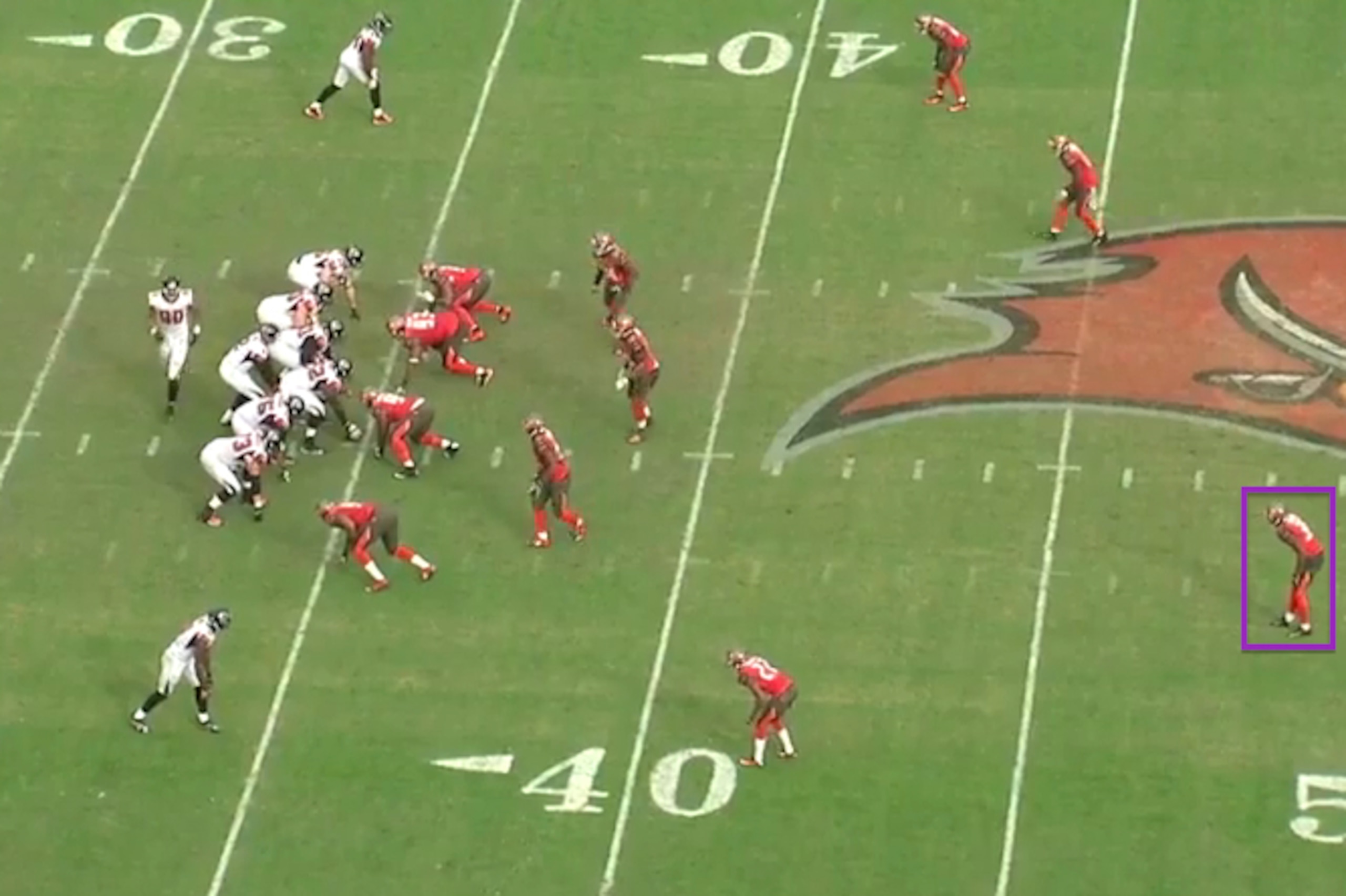
But this soon morphed into another single-high shell that again meant Goldson patrolled the deep zones by his lonesome:
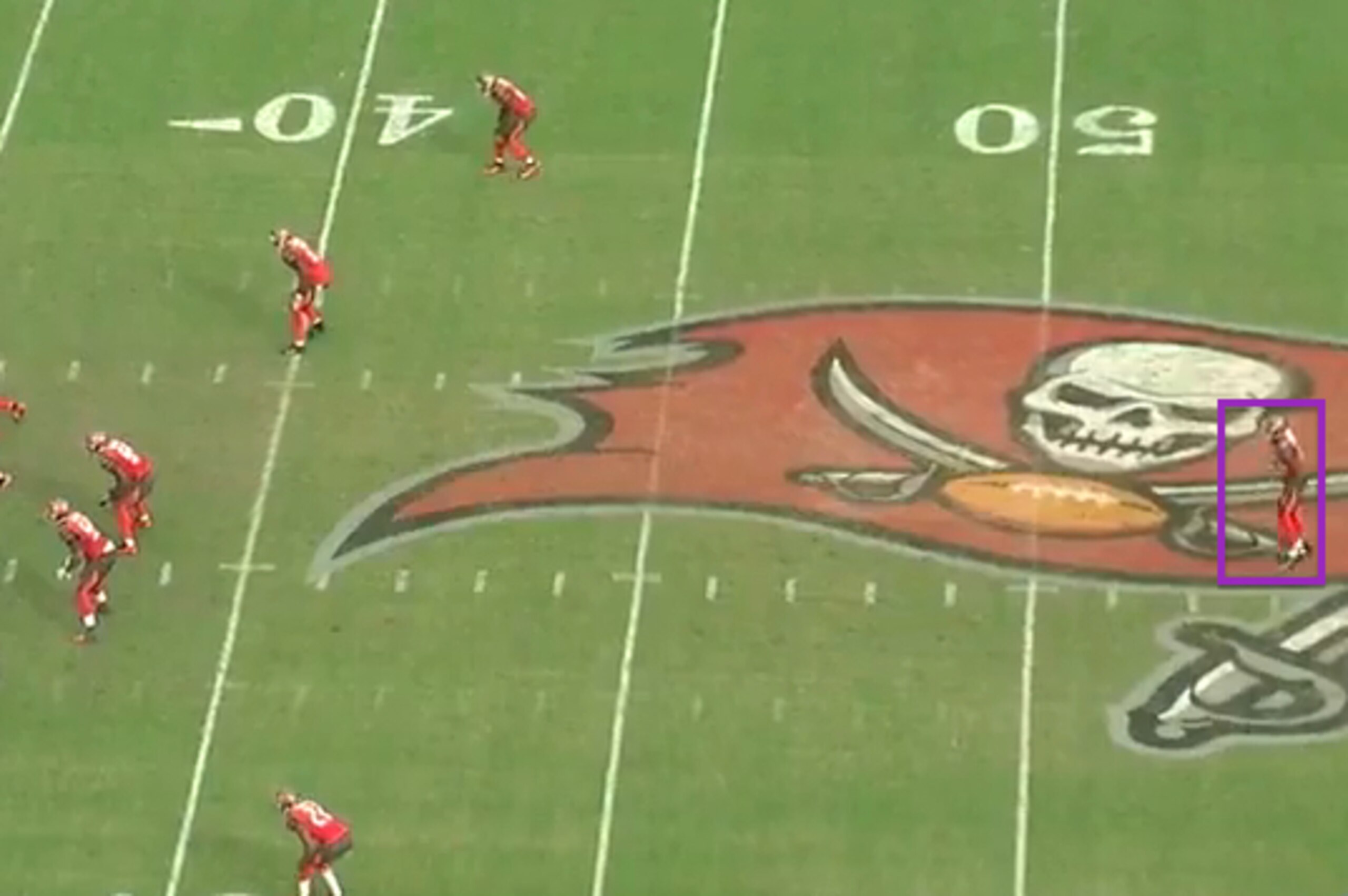
He would soon get a little more help this time though. Notice how the Buccaneers sent their cornerbacks bailing deep with Atlanta's receivers. This essentially made the coverage a single-high Cover 3 shell:

But even with the cornerbacks around, Goldson still had a decision to make. He had to choose which receiver to intercept and double between Julio Jones and Roddy White:
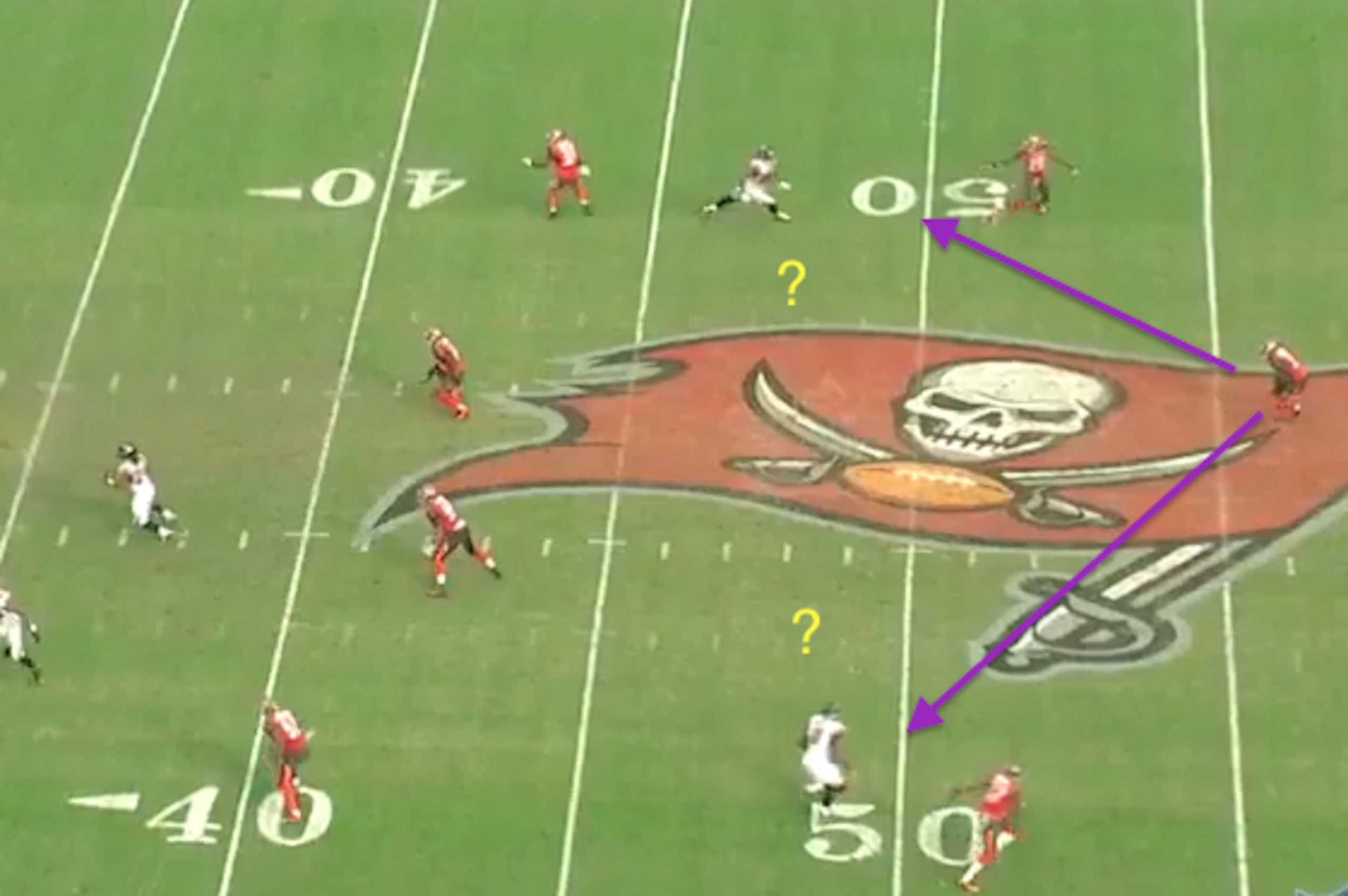
He initially lent White's way, even though Jones (bottom of the picture) was the intended target. So Goldson was late getting across to block Jones' in-breaking route.
The result was 20 easy yards for the Falcons:
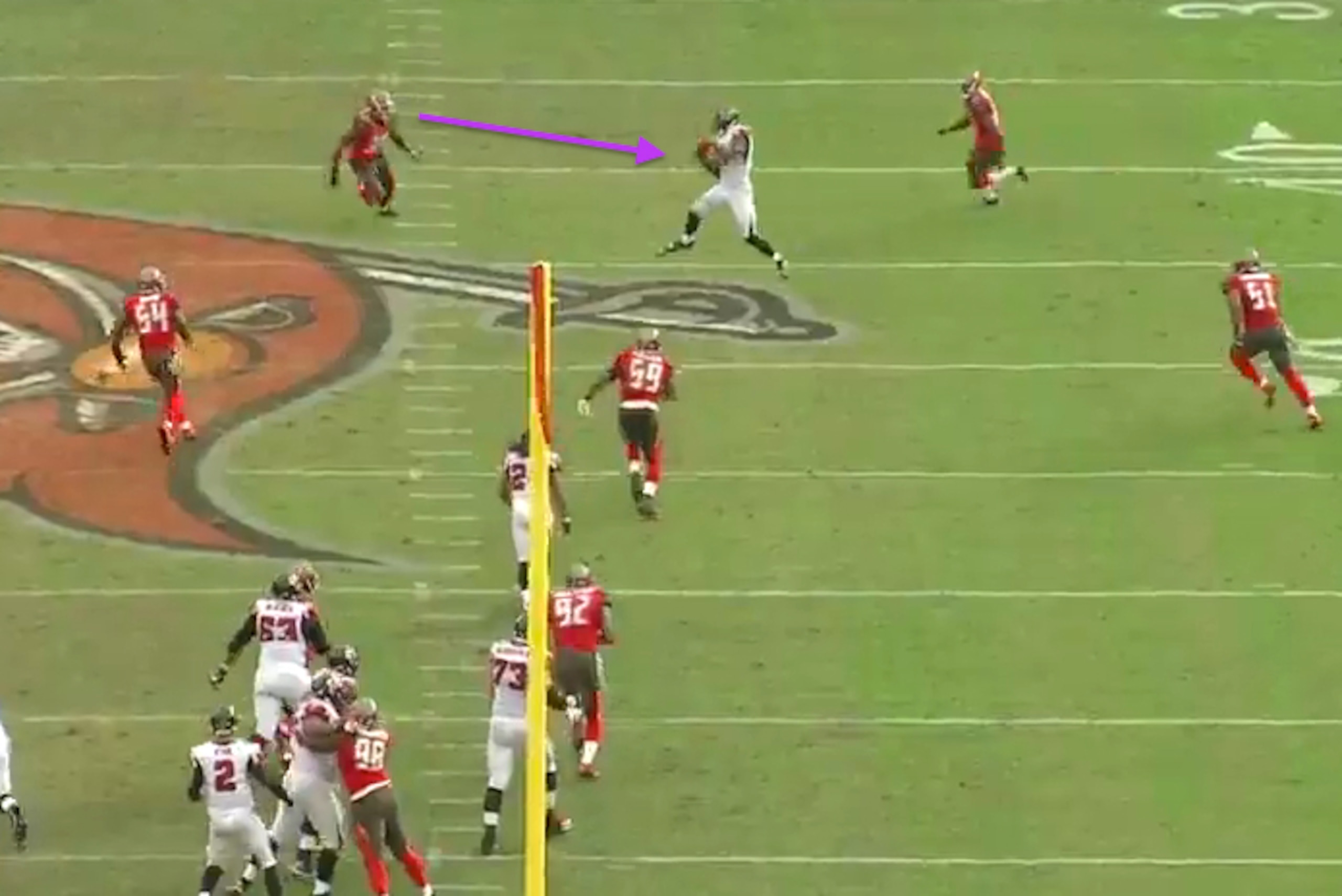
Free safeties have to get these decisions right. Sadly, Goldson has been guessing wrong more often than not during the last two years.
Interestingly, and deeply concerning, is how the player himself puts many of his problems down to the scheme he operated in for Tampa Bay, per Keim:
"Everyone knows I'm an aggressive player. I like to be in the mix, to have gap responsibilities and all that extra stuff. I like to get my hands dirty. I like to be in the mix a little more often than I was in a Tampa 2.
"
That's a curious statement considering many of Goldson's problems have come when he's been left on an island. It also may not bode well for his time in Washington given Barry's background is deeply rooted in the Tampa 2.
But Goldson doesn't see that fit as a problem. In fact, he's already indicated Barry will let him return to a role that suits him best, also per Keim:
"I'm calling out stuff, the way I move. Little things like that. I'm not a robot. [Defensive coordinator Joe Barry] lets me play. He trusts me enough to make the plays I'm calling out. It's just more about my presence back there and making plays and seeing things before it happens.
"
Such a level of trust implies Goldson will be the quarterback of Washington's defensive backfield in 2015. It's a role all talented free safeties can take to, as long as they are in a scheme that protects them.
Goldson is hoping for a system that takes advantage of his core versatility. It's that flexibility to play man, roam deep or lock up late in zones, as well as hit in the box, that has B/R analyst Chris Simms expecting big things from Goldson in Washington:
That's a big claim, but it does speak to the type of season the Redskins need Goldson to have. Diabolical safety play has hamstrung this defense, and the team as a whole, for far too long.
For Goldson to make a difference, it won't be his hitting that counts, although few safeties pack such a formidable thump. Instead, it will be his coverage skills that define his success in D.C.
If he can turn the clock back to his time in the Bay Area, Goldson will be a matchup safety Barry can trust deep and in one-on-one situations. That will add a ton of variety to the coverage looks the Redskins can show quarterbacks in the new season.
Of course, that type of stunning return to form may be too lofty an ambition for his first season. Goldson will need the help of a cornerback rotation that still has question marks, while there's also currently no designated strong safety between Duke Ihenacho and Jeron Johnson.
Goldson's primary role for the Redskins this season may be holding a completely revamped group together. That's a lot of responsibility for a player who's trying to get his own groove back.
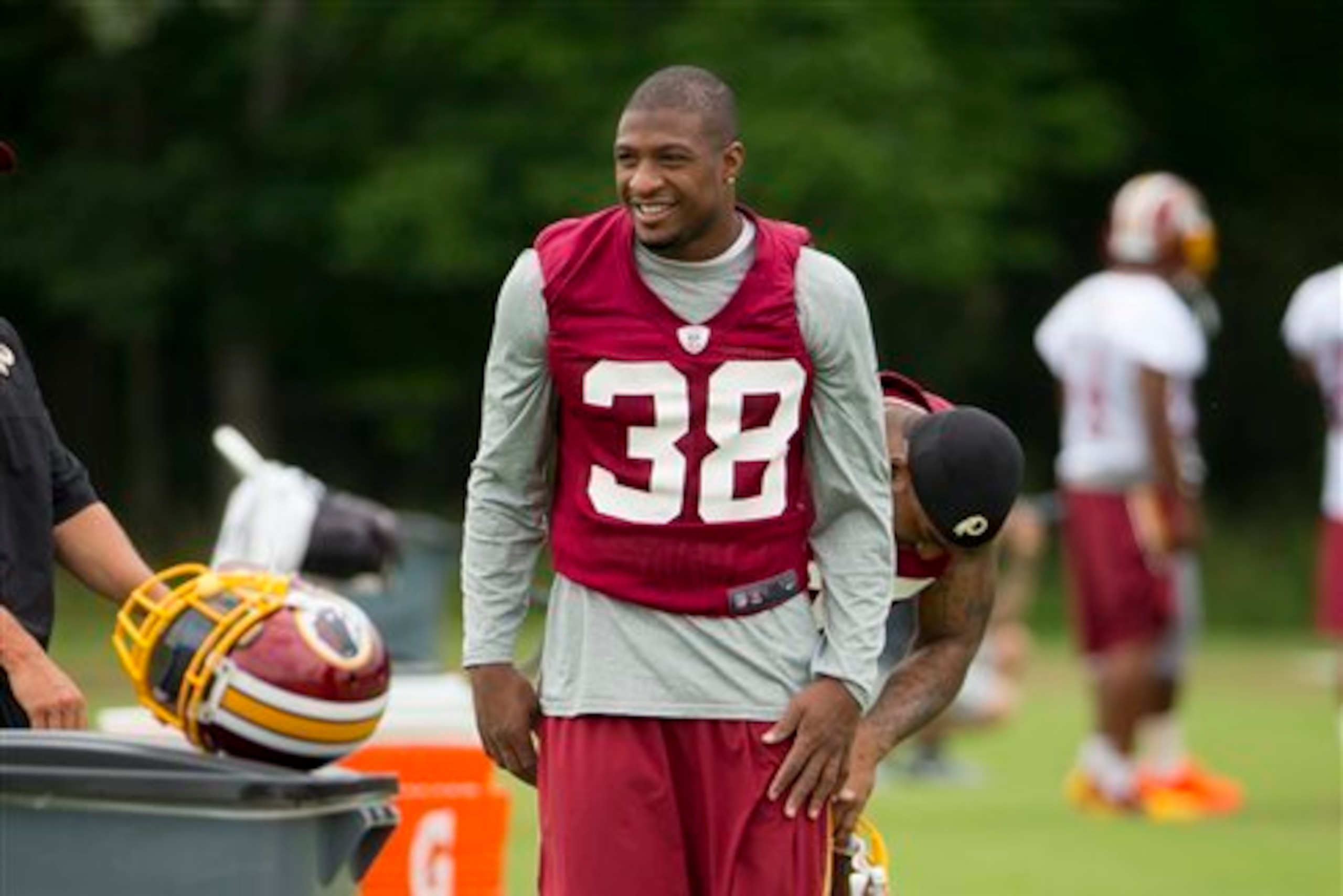
Yet general manager Scot McCloughan is obviously still a believer. He drafted Goldson in San Francisco, and he's traded for him in Washington. McCloughan knows what he's getting.
But it seems more reasonable to temper expectations for Goldson. He's not surrounded by the talent he worked with for the 49ers, neither in the secondary nor up front.
While he's a good bet to key an improvement in Washington's safety play, don't expect the rebirth of Goldson the All-Pro in 2015.
All screen shots via ESPN, Fox Sports, NFL Network and NFL.com Game Pass.
.jpg?w=2560)