Indianapolis Colts: How Pep Hamilton Unleashed Andrew Luck's Deep Ball
In January of 2013, Pep Hamilton was hired by the Indianapolis Colts to replace Bruce Arians as the team's offensive coordinator.
The former offensive coordinator at Stanford University, Hamilton had created a devastatingly powerful attack with quarterback Andrew Luck in college, and the Colts hoped that he could do the same with the young superstar in Indianapolis. Owner Jim Irsay and general manager Ryan Grigson wanted a balanced team with an ability to run the ball.
Hamilton has fit that bill, having worked in a variety of different offensive styles during his time as an assistant coach for the New York Jets, San Francisco 49ers and Chicago Bears from 2003-2009.
TOP NEWS
.jpg?w=2560 "Chiefs Cowboys Football")
🚨 Tony Romo, CBS Sports Part Ways
49ers Owner Jed York Suspended 6 Games (AP)
.jpg?w=2560 "Falcons Steelers Football")
Porter Jr. Set to Play Sunday
From the very beginning, Hamilton preached balance and versatility in Indianapolis, per Michael David Smith of Pro Football Talk:
"We’ll do a great job of mixing in some power runs, mixing in the downfield passing game, maybe even mixing in some wildcat plays, mix in some read-option, pistol-type schemes. Just really try and present once again a lot of conflicts for our opponents.
You start upfront with the offensive line. We’ll continue to work and develop that continuity. I mean that’s where it all starts. I think it’s important that we have balance in our offense. We’re not just a one-dimensional football team. We want to create conflicts for our opponents. We want to have the ability to not only push the ball downfield and hit the big play in the passing game but we’ve got to be able to run the football.
"
This was Hamilton's mantra heading into 2013. While the sentiment was not misguided, it did not fit the Colts personnel well at all.
This wasn't a team with well-rounded personnel, nor one with a quarterback that needed to be hid by an ever-changing scheme. This was a team with Andrew Luck, even if he was entering just his second year in the league.
Because the team had already built an explosive, if erratic passing attack in 2012, Hamilton tried to balance things out by forcing the run early in 2013, especially after the infamous trade for Trent Richardson.
By now, the story is old news for anybody who has covered the NFL.
The Colts were disappointingly inefficient as an offense in 2013, in part because of Reggie Wayne's midseason injury, in part because of the team's refusal to start T.Y. Hilton early on and in part because of the inability to adjust to a pass-heavy game plan after trying to build a power-run game.
But in 2014, the Colts flipped the script completely.
With a pass-heavy offense and some well-timed, efficient running, the Colts put together their most successful offensive season since Peyton Manning was around.
But just increasing the number of passing attempts for Luck wasn't going to cut it for 2014. After all, he still had 570 passing attempts in 2014, 11th-most in the league.
The Colts' identity shift was more than that. The kind of passing attempts that Luck took changed as well.
In 2013, the team's identity was still wrapped up in balance and possessing the ball, leading to a lot of short passes rather than chunk plays down the field. The 2014 Colts, on the other hand, stretched the field on any given play, and orchestrated the offense around such plays.
It's hard to trust a third-year quarterback with that much responsibility in an offense, but Luck isn't an average third-year quarterback. While it may seem obvious that the Colts chose the most profitable strategy, the amount of trust a coach must have in his quarterback for a team to pull this off is tremendous.
The Colts still have work to do, of course, but it started with Hamilton unleashing Luck in his third year.
| 2013 | 60 | 12 | 614 | 18 | 36.7% | 14 |
| 2014 | 88 | 1 | 1,387 | 1 | 47.7% | 1 |
Luck wasn't the most efficient downfield quarterback in 2014, nor the most accurate, but he was the most productive, and it wasn't particularly close.
With 1,387 yards on deep passing plays (aimed 20 yards or more downfield), Luck had nearly 300 more yards than second-placed Peyton Manning's total. Luck's total was the second-most deep passing yards Pro Football Focus had ever tracked, with only Eli Manning's 2011 season finishing with more yards (1,490).
Luck doubled his deep passing yards while adding more than 10 percent to his accuracy percentage down the field, due both to his improvement and Pep Hamilton scheming more open receivers for Luck to find.
Of course, there was also a significant upgrade in the quality of his targets, with Reggie Wayne and Dwayne Allen returning, Hakeem Nicks replacing Darrius Heyward-Bey, T.Y. Hilton becoming a No. 1 threat and Donte Moncrief entering the fold.
Hilton, obviously, is the first name that comes up as a deep threat.
In 2014, Hilton finished eighth in the NFL by catching more than 45 percent of his deep-ball (20 yards or more downfield) targets. He didn't drop a single deep target and tied for third in the league with five touchdowns on such plays, per Pro Football Focus. On those plays, Hilton averaged more than 17 yards per target, the fifth-best mark among qualifying receivers.
Another key in the Colts' deep passing attack was tight end Coby Fleener. He struggles with inconsistencies and has some issues as a possession receiver, but Fleener was a key part to the Colts' downfield dominance.
With his speed, Fleener was able to take advantages of open zones in the defense, racking up the most deep receiving yards of any tight end in the NFL last season, per Pro Football Focus. Fleener's 291 yards on deep passes were more than 100 yards better than the next player, St. Louis' Jared Cook. Fleener also finished second in the league by catching 50 percent of his downfield targets.
A good example of how Fleener took advantage of defensive attention elsewhere came against Washington in Week 13.
Here, Fleener lines up in the slot directly across from an outside linebacker. Right away, the Colts know this is a mismatch:
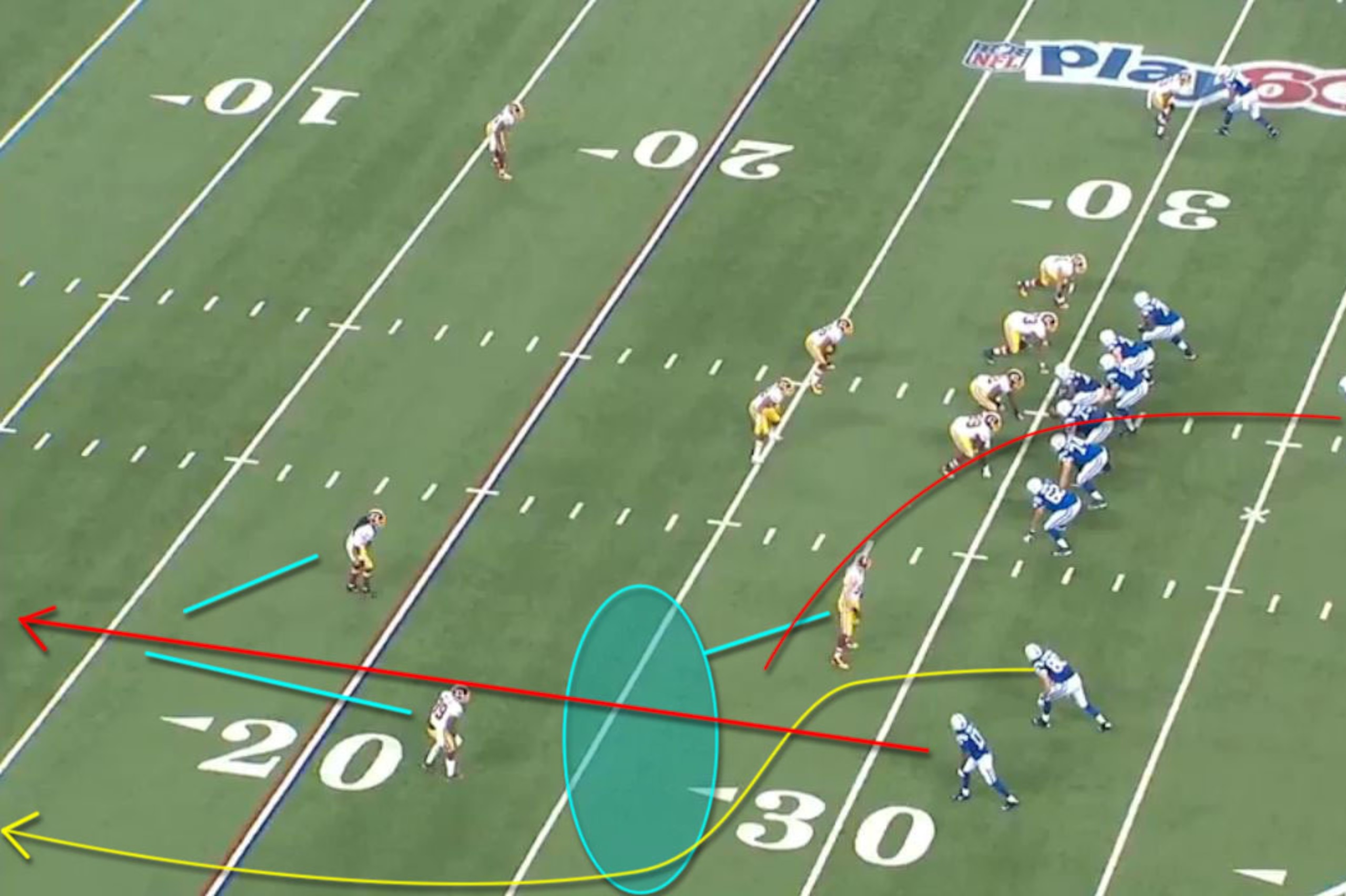
As Hilton runs a nine route down the field, both the safety and cornerback follow him into the end zone, leaving a wide-open zone for Fleener to enter. The linebacker in underneath zone coverage leaves Fleener for Dan Herron coming out of the backfield, and Fleener catches a touchdown without a defender within 10 yards of him:
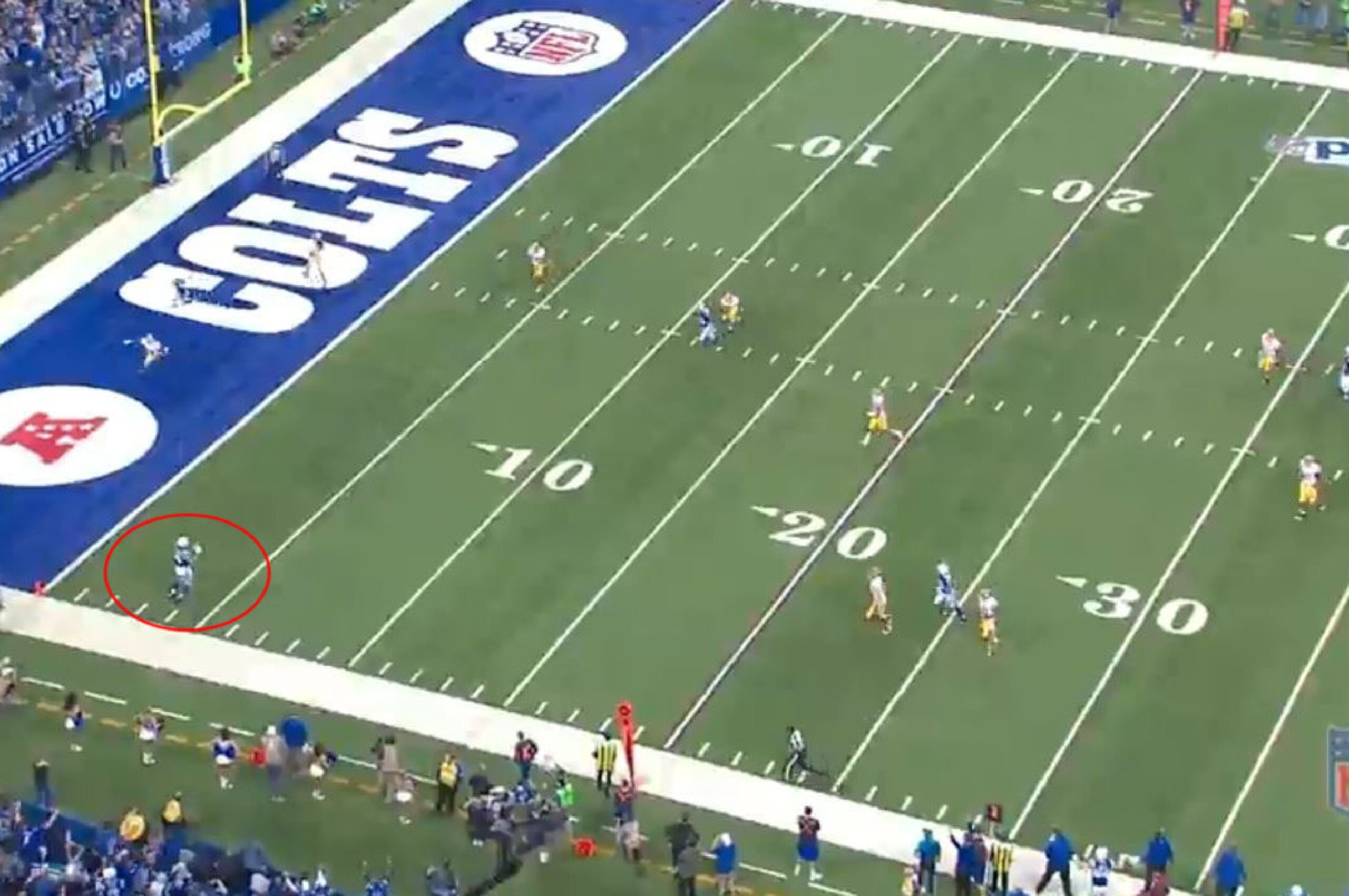
This is what having big-play threats, and a quarterback that can hit them, does to a defense.
Oftentimes those deep threats open up space underneath for receivers as well. Ahmad Bradshaw played roughly half the season in 2014, but finished with the second-best receiving DYAR (defense-adjusted yards above replacement) in the league among running backs, per Football Outsiders.
Dan Herron took advantage of it too, catching 20 passes in the postseason, second-most of any player in the 2014 playoffs.
Now, as we look forward to 2015, the Colts, somewhat remarkably, have a chance to be even better throwing the ball down the field.
Luck's targets have improved more than we can describe. Hilton and Fleener return, as does the ever-improving Donte Moncrief. Phillip Dorsett, drafted in the first round of the 2015 draft, adds another blazing-fast deep threat to the receiving corps.
Andre Johnson should be able to take advantage of open space underneath with all the attention on the Colts' speedsters, as will Dwayne Allen and the running backs.
Dorsett and Moncrief, the young deep threats, might by the ones who take advantage of defensive lapses most often this season. Both players have the ability to play both in the slot and outside, and will move around to get the best matchups on the field. With defenses keying on Hilton and Johnson, the two youngsters will be in play for sneaky-big plays on any given down.
.jpg?w=2560 "Steelers Eagles Football")

.jpg?w=2560 "Grading SmackDown 🔠")