Washington Redskins Offseason State of the Union
It's strange for any team coming off just seven wins in two years to be as optimistic as the 2015 Washington Redskins. Subtle yet significant changes during this offseason have created a rare feel-good factor around a franchise which has been mired in downbeat controversy for too long.
Most of those changes have come from the men at the top. More specifically, they've come from the new man at the top.
General manager Scot McCloughan has given this offseason a sense of direction, purpose and professionalism. His savvy moves in both free agency and the 2015 NFL draft, moves designed to rebuild the team in a time-honored way, have been met with an almost universal seal of approval by the league fraternity.
Admittedly, most of the praise is justified considering McCloughan has helped Washington improve in most of the positions that blighted the team in 2014. Those improvements form the focus of this State of the Union assessment.
That means the spotlight is put on five key areas: the pass rush, secondary, offensive line, running game and the quarterbacks.
There's simply no way the Redskins will leave the foot of the NFC East without significant improvement in each of those areas.
Read on to find out the state of play in all five departments.
Pass Rush
1 of 6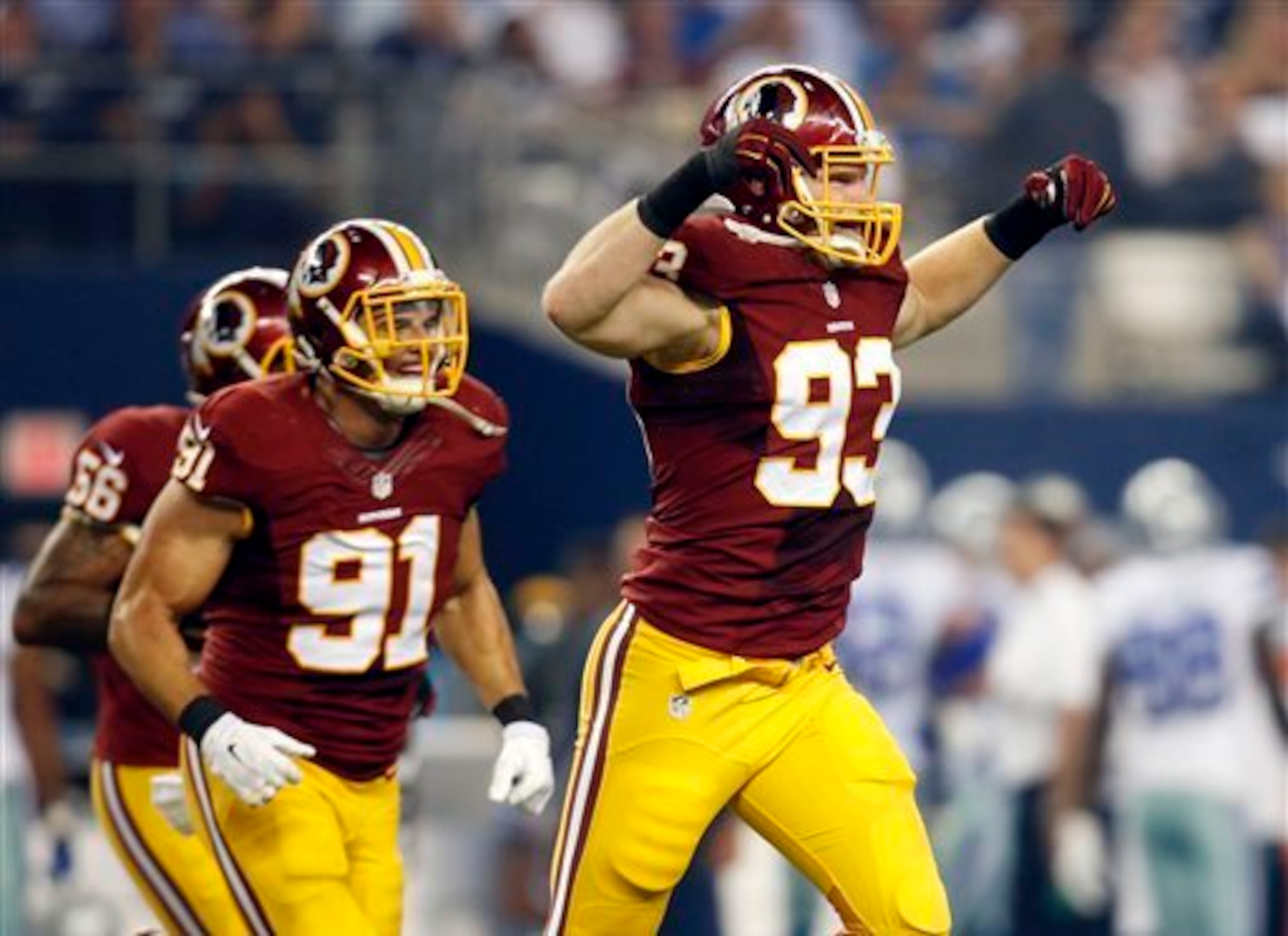
State of the Union reports are generally sales pitches (admittedly very highbrow ones), but sales pitches nonetheless. A new vision is being sold, with the guts of the speech detailing the nuts and bolts that will help create a bright new future.
The first thing the Redskins are selling is a much-improved pass rush for 2015. It was certainly a priority after the defense took down opposing quarterbacks just 36 times last season.
There are two keys to boosting that number. The first is philosophical and involves altering the way Washington runs a 3-4 defense.
Jim Haslett has gone and taken his largely traditional, two-gap base front with him. Joe Barry has been hired to install a more attacking, one-gap system.
Back in January, head coach Jay Gruden offered this vivid description of what the new defense will look like, via Mike Jones of the Washington Post: "There will be some different ideas that we have, as far as it’s not a two-gap 3-4. It might be more of a shoot-the-gap-type of 3-4, a get-up-the-field-and-rush-them 3-4, you know what I mean?"
This is a rare time when it's actually easy to know exactly what Gruden means. One-gap 3-4 fronts have become the vogue in the modern NFL.
They are more aggressive in intent and more hybrid and multiple in appearance. Essentially, single-gap alignments make it easier for defensive linemen to attack the backfield, rather than spending time occupying blockers so the linebackers can have all the fun.
With that in mind, McCloughan's decision to sign veterans Ricky Jean Francois and Stephen Paea is very significant. Both are one-gap linemen, with the latter closer to a classic 3-technique, interior pass-rusher.
The Redskins already have one of those in the form of Jason Hatcher. Now he's being freed in a scheme more suited to his natural talents. That's something that has the ex-Dallas Cowboys Pro Bowler very excited ahead of the new season, according to ESPN.com's John Keim:
"You’re expected to make more plays in this system. You can make more plays in the backfield, make a lot of tackles, as long as you’re in your gap and do what you’re supposed to do it’ll be fun. Just attack. You ain’t holding up blocks no more. You can make a play here and there.
"
Hatcher is also grateful for the attention players such as Paea and Francois will take away from him: "You can’t just focus on one guy and try to stop him, and nothing else happens. We have guys who can come in and rush besides me. That’s great."
The Hatcher-Paea-Francois trio will play a major role in revamping the pass rush. So will house-sized nose guard Terrance Knighton.
While the former Denver Broncos linchpin's main impact will come repelling the run, Knighton's presence will also create one-on-one matchups for Hatcher and Paea. Just as important, Knighton can be a factor in how this defense changes its looks.
Barry will use Paea and Knighton in creative ways, moving both around to play different techniques, according to CSN Washington's JP Finlay: "We are very multiple. We’re going to give you a bunch of different looks."
Such variety will be essential for a defense that became predictable on Haslett's watch. But the multiplicity won't just be limited to the D-line.
McCloughan used a second-round pick on versatile rush end Preston Smith. Snagging a roving SEC pass-rush ace to push 2014 second-rounder Trent Murphy was a smart move.
Both players are vying to replace Brian Orakpo at one outside linebacker spot. More importantly, the duo also increases the combinations Barry can unleash up front.
Smith played all over at Mississippi State, often sliding over center in some sub-package looks. Meanwhile, even Haslett utilized Murphy's flexibility, letting him rush from the inside on occasion as a rookie.
Washington's D now boasts more weapons for pressuring quarterbacks. That means there'll be less of a burden on Ryan Kerrigan, the lone standout of 2014's front seven.
But the increase in the variety and scope of the schemes will be just as significant. Offenses won't find it as easy to identify what the Redskins are doing up front.
Creating that kind of uncertainty in the minds of quarterbacks and O-linemen is a major advantage, one that will lead directly to more game-changing plays from a reloaded pass rush.
Secondary
2 of 6
An improved pass rush feasting on frightened quarterbacks should be a tonic for any secondary. But the Redskins are no longer trusting talent up front to mask deficiencies in the defensive backfield.
McCloughan wisely overhauled a secondary in dire need of help. He added five fresh faces via free agency and the draft, a group from which three new starters should appear.
One will certainly be cornerback Chris Culliver. Coming off a career year during his final season with the San Francisco 49ers, Culliver will bring a change in mentality to Washington's secondary.
In this case, that will mean a more aggressive approach to combating wide receivers. Potential pass-catchers won't find the same freedom out of their breaks as on Haslett's watch.
Culliver will join Bashaud Breeland to give the Redskins a pair of scrappy, press-style, rough-and-rowdy cover men. Just like with every problem position he inherited, McCloughan has made greater size and physicality the blueprint for getting better.
That same blueprint extends to the safety position, where big hitters Jeron Johnson and Dashon Goldson were recruited. The former was a depth player for the famed Legion of Boom secondary McCloughan helped create with the Seattle Seahawks.
It's easy to see that imposing group as the inspiration for what McCloughan is trying to build in D.C. Johnson doesn't mind aiming for the level of success achieved in Seattle but also wants to help Washington forge its own identity, according to Keim.
Interestingly, Keim detailed one schematic difference between what the Seahawks did and how the Redskins will run things:
"For Johnson, it's also a transition to a different style of defense. The Seahawks ran a 4-3 with a single-high safety look most of the time. The Redskins will use their safeties in more of a two-man shell, making them more interchangeable. Run fits can change from scheme to scheme, but Johnson said that's not an issue.
"
A swarming Cover 2 shell is ideal for a defense that expects to get a lot of pressure up front without having to blitz too often. The better athletes McCloughan recruited along the line will be vital for that plan.
It's that kind of symbiosis that is so impressive about the changes in the secondary. Last season, adding Murphy and Hatcher alongside Orakpo and Kerrigan was thought to be enough to make quarterbacks forget about a secondary that still housed Brandon Meriweather and E.J. Biggers.
It was a foolhardy gamble. But this year the Redskins aren't taking those kinds of risks.
Instead, a more physical secondary will punish offenses at one end, while a more athletic line causes havoc at the other. Greater talent at each position group will serve the other well.
It's how well-built teams are supposed to function.
Running Game
3 of 6
It shouldn't be possible to boast a perennial 1,000-yard runner, along with a blocking scheme that's made stars out of a small army of running backs, and still own one of the league's worst rushing attacks.
Yet the Redskins managed to thread that needle in 2014. Despite having Alfred Morris lug the rock behind the zone-blocking that turned him from sixth-rounder to Pro Bowler, Washington ranked 19th running the ball.
Breakdowns along the O-line, combined with play-calling skewed too heavily toward the pass, undermined what should always be a team strength. Those failings have prompted changes at the coaching, playbook and personnel levels this offseason.
The inclusion of more power principles in a ground scheme previously tied almost exclusively to the outside zone will either make or break Morris. As early as midseason, it will be clear if the three-time 1,000-yard rusher can survive outside Mike Shanahan's famed zone-stretch system or not.
Frankly, more power plays should be the necessary tonic for a running game that had become predictable and stale. At 5'10" and 224 pounds with a squat base and broad shoulders, Morris should welcome the chance to put his head down and batter defenders more than he runs around them.
That was his experience at the collegiate level, via Keim: "But, (Morris) said, the power game is what he prefers. Florida Atlantic ran a lot of power with Morris, focusing on runs between the guards. His job: break inside the pulling guard's block and stay downhill."
Morris had better be prepared for the demands of a new scheme. If he isn't, third-round pick Matt Jones will be waiting to take his job.
The former Florida bruiser is in the mold of running backs McCloughan has worked with in the past, smashmouth-style workhorses like Frank Gore and Marshawn Lynch. Jones has generated buzz this offseason and is eager to let Morris know he has a fight to maintain his status as the primary ball-carrier for the Burgundy and Gold, via Jacob Feldman of the Washington Post: “I’m just grinding every day to be the starter. I will put some pressure on Alfred.”
Jones fits the new scheme like a glove, something he made clear to CSN Washington writer JP Finlay: "Being a runner like I am, I love to lower my shoulder."
Jones will push Morris, but that shouldn't be seen as a bad thing. Adding genuine competition at core positions has been one of the hallmarks of this offseason. It's the best way for struggling teams to improve.
What will really benefit Morris, Jones and every member of Washington's backfield rotation is the presence of new offensive line coach Bill Callahan. He is set to take a big role in the how the running game operates during the new season.
Given his stellar track record in this area, Callahan's influence is a good thing for Washington, according to NFL.com's Conor Orr:
"While we're always ready to concede coincidence, Callahan has had a hand in coaching NFL offensive lines for the past six years. In that time, three of those teams finished in the top five in rushing (2009 Jets, 2010 Jets and 2014 Cowboys). The 2008 Jets finished ninth.
"
It makes some sense that Callahan is getting to set the direction for this year's rushing attack. He's already described how variety will be the key to keeping defenses off balance, via Real Redskins' Rich Tandler.
Callahan placed great emphasis on mixing up concepts and designs to include zone plays alongside gap and power principles. Gruden has already stressed how he wants a running game that delivers both, according to another report from Tandler.
Yet how the scheme is designed won't matter as much as how often it's trusted. Simply put, Gruden has to lean on the run more than he did as a first-year sideline general.
Keim spelled it out perfectly: "Also, if the Redskins are as committed to the run as they say, then they should have at least 50 more carries than last season's total of 401."


Offensive Line
4 of 6
Before Callahan delves too deep into what the running game should look like, he'll remain focused on improving one of football's worst offensive lines.
The Redskins yielded 58 sacks last season and turned the running game from a core strength to an inconsistent shambles.
But in keeping with the new vision McCloughan and Gruden are selling, that will all change during 2015. As with most of the key weaknesses on the roster, the chosen remedy is a simple one: getting bigger and better.
The first part has been amply taken care of by the decision to draft Brandon Scherff fifth overall. He joined the team with a reputation as college football's best offensive lineman during 2014.
A former Iowa mainstay, Scherff will add his 6'5", 319-pound frame and appetite for destruction in the running game to the problematic right tackle spot. If he can nail that down, Scherff will solve an issue that's blighted this team since 2009.
Sadly, Scherff has already run into some teething problems with the switch, according to 106.7 The Fan co-host Brian McNally. While a tough learning curve should be expected, Scherff's ability to quickly make the grade once the real action begins will be crucial to the success of a revamped group.
As much as anything else, though, Scherff represents the change in mindset dominant at Redskins Park this offseason. Previous trench warriors who suited up for the Burgundy and Gold have been quick to pinpoint the type of characteristics Scherff adds to the current roster.
Raleigh McKenzie, who won a Super Bowl with Washington after the 1991 season, described Scherff as "the ultimate offensive lineman. He’s a gritty guy. He’s a tough guy,” via Jake Russell of the Washington Post.
Meanwhile, Ed Simmons, another member of the last Redskins team to win a Super Bowl, also played up Scherff's rugged qualities: “He definitely shows a lot of toughness. He’s a big country boy. He likes to rough it. I don’t think there should be any problems.”
That toughness is exactly what Gruden and McCloughan want to define this team from now on. Establishing physical dominance in the offensive trenches is the best way to start.
That's why Scherff was drafted and Callahan was brought on board. It's also why Spencer Long, all 6'5" and 311 pounds of him, was chosen to replace Chris Chester at right guard.
This is now a bigger line tutored to overwhelm defensive fronts rather than finesse them.
Whether the changes actually lead to improvement on the field naturally remains to be seen. But given Callahan's track record, this is a rare time in the last decade when Redskins fans can justify feeling confident about an O-line.
The Quarterbacks
5 of 6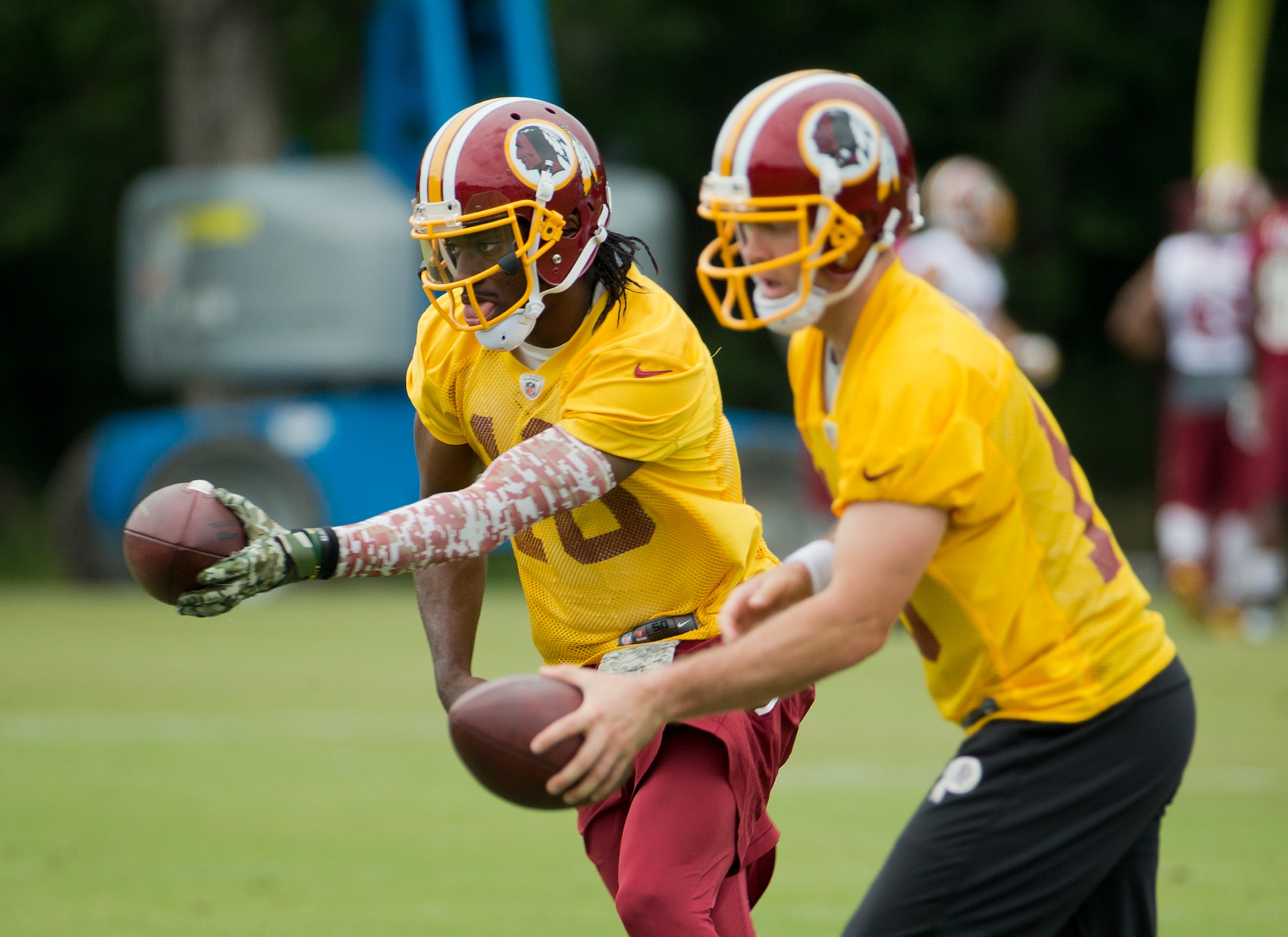
McCloughan will know all his plans can crumble to dust if the men under center still can't get things right. But he isn't just crossing his fingers and hoping Robert Griffin III stays healthy and finally gets it.
That seemed to be the approach during the last two seasons, but not anymore. Things changed the moment Matt Cavanaugh was hired as Griffin's position coach.
It was scarcely believable that the Redskins didn't have a quarterbacks coach in 2014. All that did was leave the head coach as Griffin's direct point of reference. The man who should have been focused on the big picture was instead micro-managing Griffin's development.
This overbearing approach inevitably led to disastrous results.
Cavanaugh's presence ensures things will be different. Specifically, he is helping the team get realistic about what it has at the position.
In Griffin's case, Washington has an athletic phenom, but a highly brittle one tragically unschooled in the nuances of the pro game. Griffin needs a makeover that involves going back to the classroom to get his footwork, throwing motion and ability to read defenses right.
Thankfully, Cavanaugh is pushing those core traits as the foundation of his lesson plan, according to Nora Princiotti of the Washington Times: "No matter what, Cavanaugh expects all three quarterbacks to watch every play. He doesn’t refer to starters or backups when he talks to them and focuses on base and reading defenses, things not particular to any one player."
The fidelity to fundamentals is great news not only for Griffin but also for Kirk Cousins and Colt McCoy. For the former, it means there'll be a greater emphasis on the monotonous but necessary work he needs to refine his game.
Cavanaugh has already noted how Griffin has "become very aware of some of the things that we want him to do a little bit differently,” via CBS D.C.'s Brian McNally. It's a small but essential first step toward progress.
Meanwhile, if McCoy and Cousins are going to provide a more competent fail-safe, they each have fundamental weaknesses to iron out.
Sadly, neither has managed to show the same kind of progress Griffin has this offseason, according to Mike Jones of the Washington Post: "Meanwhile, coaches felt like Colt McCoy and Kirk Cousins did nothing to make them second-guess the decision to go with Griffin as the starter in the offseason and training camp. Both were rather inconsistent and struggled with ball security."
By contrast, Jones detailed how Griffin registered some improvement in stance, timing and pocket patience, three areas where progress is vital ahead of the new season.
There have been many false dawns at this position in recent years. So it's a good idea to temper enthusiasm for Griffin's solid offseason thus far, as well as soften the indictments of Cousins' and McCoy's lack of progress.
McCloughan Has Set the Course, but Can Gruden Steer the Ship?
6 of 6
You don't need to be a Mensa member to decipher the course McCloughan has set the Redskins on this offseason. His navigation chart makes for very simple reading.
McCloughan wants a bigger, tougher and more versatile defense. New faces along the front seven and in the secondary should ensure that.
He also wants a physically dominant O-line to key a punishing, downhill running game that will control the clock and ease the pressure on the team's struggling quarterbacks. Of course, nothing is guaranteed, but the arrival of Callahan and Scherff at least give McCloughan's plan a chance.
A suffocating defense and a physically imposing offense: It's a combination as old as the NFL itself, and one that's produced success for generations.
But there's an elephant in the room, and its name is Jay Gruden. McCloughan has crafted the plan, but now Gruden has to execute it.
That's the same Gruden who wanted to confine a mobile quarterback to the pocket. The same Gruden who thought it was a good idea to keep Haslett around. Now he thinks it's a good idea to let Barry run the defense.
Will he be the same Gruden who let a productive running game gather dust and cobwebs? The same Gruden who publicly takes his quarterback to task after a bad game?
One year removed from inheriting a Shanahan-sized mess, Gruden now has more of what he wants. But patience will be in short supply.
He doesn't have McCloughan's reputation, or Callahan's or Cavanaugh's. They're marquee names here to make his job easier.
If the Redskins still can't win, it will be Gruden who's quickly shoved overboard.

.jpg?w=2560 "LA Premiere of \"Chad Powers\"")