How Tim Duncan Became a 1-Man Dynasty
Celebrating Tim Duncan's longevity has become an annual journalistic tradition, a ritual that—much like Duncan himself—never gets old. His capacity for All-Star-caliber contributions becomes more startling by the year, at least among those who haven't been numbed to the constant barrage of good things we associate with him.
The legendary big man has dispelled any notions that he's running on fumes these days.
Indeed, Duncan is running on something else entirely—a high-octane fuel comprised of proper physical care, ageless skills and a quiet passion for the game. Spurs general manager R.C. Buford and head coach Gregg Popovich have equipped Duncan with the tools to build something special: this generation's closest thing to a one-man dynasty, a dynasty that may well be passed on to another generation.


We typically associate talk of dynasties with franchises—the '60s Celtics, '80s Lakers or '90s Bulls. But not since Michael Jordan himself has such a dynamic been so inextricably linked to one individual. Duncan has been the common and essential denominator in each of San Antonio's five titles, Finals MVP honors be darned.
He'll remain just that this season after signing a new deal with the organization on Thursday. Yahoo Sports' Adrian Wojnarowski reported, "Duncan has signed a two-year, $10 milllion-plus deal to return to the San Antonio Spurs."
The paycut paves the way for the franchise to formally ink prized free-agent acquisition LaMarcus Aldridge, but it's not indicative of Duncan's play.
He turned 39 in April and will be 40 by next season's end. Given the level of play he's sustained in recent campaigns, it's hard to imagine a significant drop-off this time around. Precipitous decline isn't in this man's DNA.
| Season | Games | Min | Pts | FG% | Reb | Ast | Blk |
| '10-11 | 76 | 28.4 | 13.4 | .500 | 8.9 | 2.7 | 1.9 |
| '11-12 | 58 | 28.2 | 15.4 | .492 | 9.0 | 2.3 | 1.5 |
| '12-13 | 69 | 30.1 | 17.8 | .502 | 9.9 | 2.7 | 2.7 |
| '13-14 | 74 | 29.2 | 15.1 | .490 | 9.7 | 3.0 | 1.9 |
| '14-15 | 77 | 28.9 | 13.9 | .512 | 9.1 | 3.0 | 2.0 |
Even in his 18th season, Duncan was among the league's most elite big men and two-way presences. According to Basketball-Reference.com, his 22.6 player efficiency rating ranked 18th in the league, while his .207 win shares per 48 minutes ranked 15th. Beyond the comprehensive metrics, his basic numbers looked pretty good too—especially for a guy averaging just 28.9 minutes per contest.
Duncan averaged 13.9 points, 9.1 rebounds, 3.0 assists and 2.0 blocks per game while making 51.2 percent of his field-goal attempts. He upped that production in San Antonio's opening-round defeat to the Los Angeles Clippers, posting 17.9 points, 11.1 rebounds, 3.3 assists and a highly efficient 58.9 shooting percentage.
He did that damage in 35.7 minutes per game, proving he's still the centerpiece of San Antonio's relentless accomplishment. Time hasn't slowed Duncan by most meaningful metrics. It's only highlighted the extent to which he remains the thread that ties everything else together. The numbers have been pretty conclusive too. One way or another, this has been Duncan's team since 1997.
| Season | USG% | Off. Win Share | Def. Win Share | PER |
| '97-98 | 26.0 | 5.6 | 7.2 | 22.6 |
| '98-99 | 27.2 | 4.0 | 4.7 | 23.2 |
| '99-00 | 28.7 | 6.7 | 6.4 | 24.8 |
| '00-01 | 28.7 | 6.2 | 7.1 | 23.8 |
| '01-02 | 29.0 | 10.7 | 7.1 | 27.0 |
| '02-03 | 28.0 | 9.5 | 6.9 | 26.9 |
| '03-04 | 29.7 | 5.9 | 7.2 | 27.1 |
| '04-05 | 28.9 | 5.5 | 5.7 | 27.0 |
| '05-06 | 27.7 | 3.9 | 6.9 | 23.1 |
| '06-07 | 27.9 | 6.3 | 6.8 | 26.1 |
| '07-08 | 28.2 | 4.9 | 6.2 | 24.4 |
| '08-09 | 28.5 | 5.0 | 5.0 | 24.4 |
| '09-10 | 26.0 | 6.4 | 4.5 | 24.7 |
| '10-11 | 22.9 | 3.7 | 4.0 | 21.9 |
| '11-12 | 26.2 | 3.0 | 2.9 | 22.5 |
| '12-13 | 27.8 | 3.4 | 4.9 | 24.4 |
| '13-14 | 25.2 | 2.8 | 4.6 | 21.3 |
| '14-15 | 22.2 | 4.9 | 4.7 | 22.6 |
As ESPN's Marc Stein noted in June 2014, Buford once famously said, "The truth is we all work for Timmy."
Former Spur and current Spurs television analyst Sean Elliott elaborated on that sentiment.
"We all see it R.C.'s way," he told Stein. "We're not dumb. We all know we wouldn't have any rings without Timmy. Everybody understands that. We all feel like we're working for Timmy.
"We joke about it, but I think the organization feels that way because he's such a special talent. They've been trying to surround him with the right group ever since they got him. They're always working for him."
In turn, Duncan has had to put in some work.
Building a Foundation
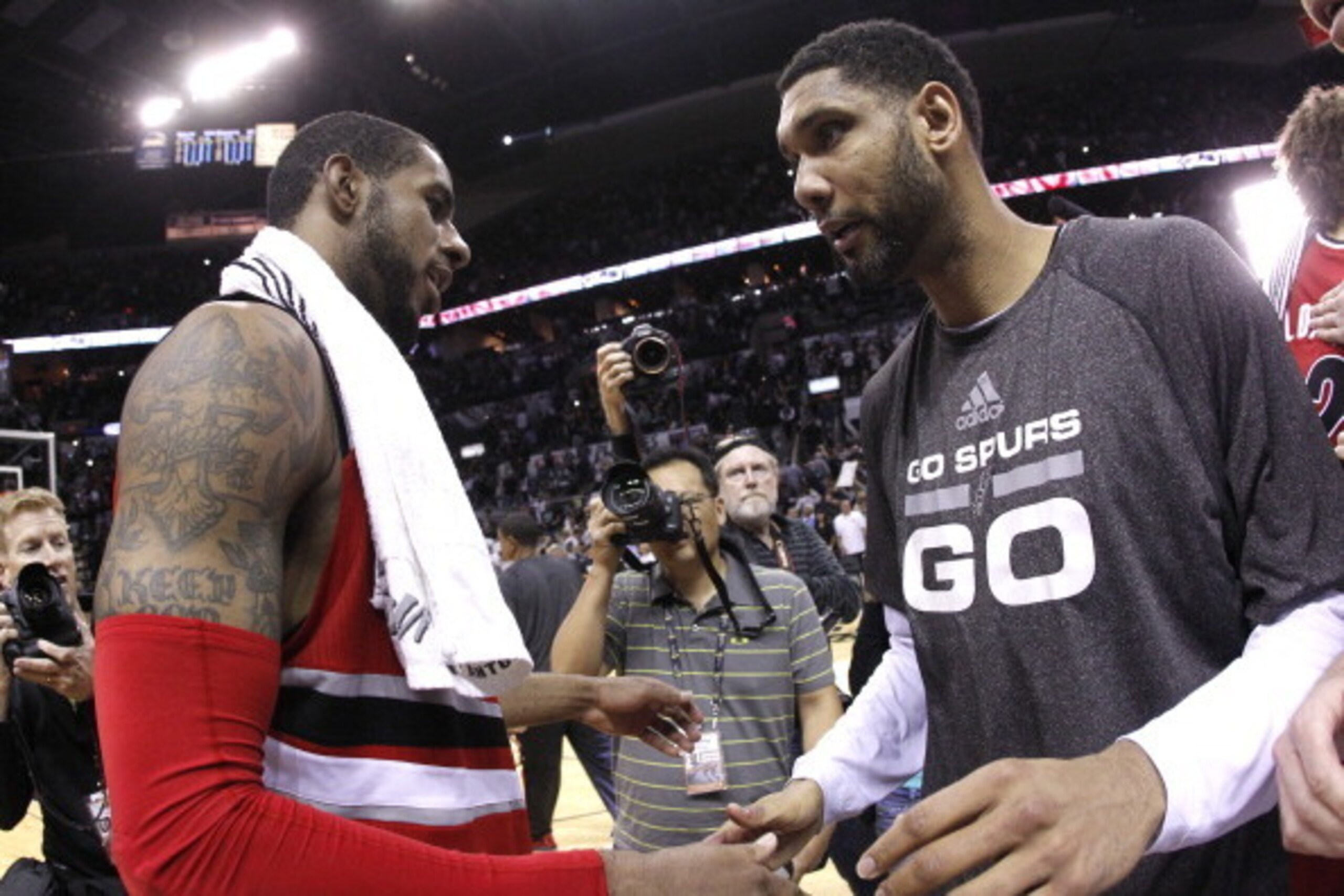
While Duncan had the luxury of leaning on veteran David Robinson during his early years, it quickly became apparent that the Wake Forest product would lead this team on both ends of the floor. That's remained the case, even as Tony Parker, Manu Ginobili and now Kawhi Leonard inherited more prominent roles. In many ways, Duncan will even remain a leader in the wake of San Antonio's most recent premier addition.
Duncan joined San Antonio's team of recruiters in Los Angeles in a bid to land a commitment from Aldridge. That commitment was confirmed by the big man himself via Twitter on July 4, cementing the organization's status as offseason winners and would-be contenders entering the 2015-16 campaign.
In order to make the money work, Duncan accepted yet another paycut—his latest sacrifice in a career that's had its share.
On face, things have worked out pretty well for Duncan. His franchise will be remembered as a model, and his contributions may well rank him as the best power forward ever—certainly among the very best big men the league has witnessed.
But he's given up a few things. Duncan could have joined a superstar core in Orlando back in 2000 but remained with the Spurs instead. He could have made at least $15 million last season but played for closer to 10. And his most recent contract was small enough to accommodate a max-level deal for Aldridge.
These are the gestures that build a culture, and it's a culture guys such as Aldridge have every reason to join. It's also a culture that will show up on the floor—both in Duncan and those around him. He's voluntarily given up his role as the team's primary scorer in order to give guys such as Parker and Leonard an opportunity to shine, a particularly wise move in an increasingly perimeter-oriented league.
It should come as no surprise that San Antonio is one of the league's most unselfish teams, regularly ranking among the best assist producers in the business. This team followed Duncan's quiet leadership and has mastered the art of passing up good shots in order to find great ones.
No one should be surprised Ginobili and David West accepted below-market contracts in order to play for the Spurs. They know what Duncan knows: Sacrifice can be essential to winning a championship.
Aldridge will see that too if he hasn't already. His numbers may drop in San Antonio's ensemble system, but his game may reach heretofore unknown levels in the process.
In turn, Duncan will pass his torch soon enough. If only he could pass along the secret to a career that will span at least 19 seasons.
The Body of Work
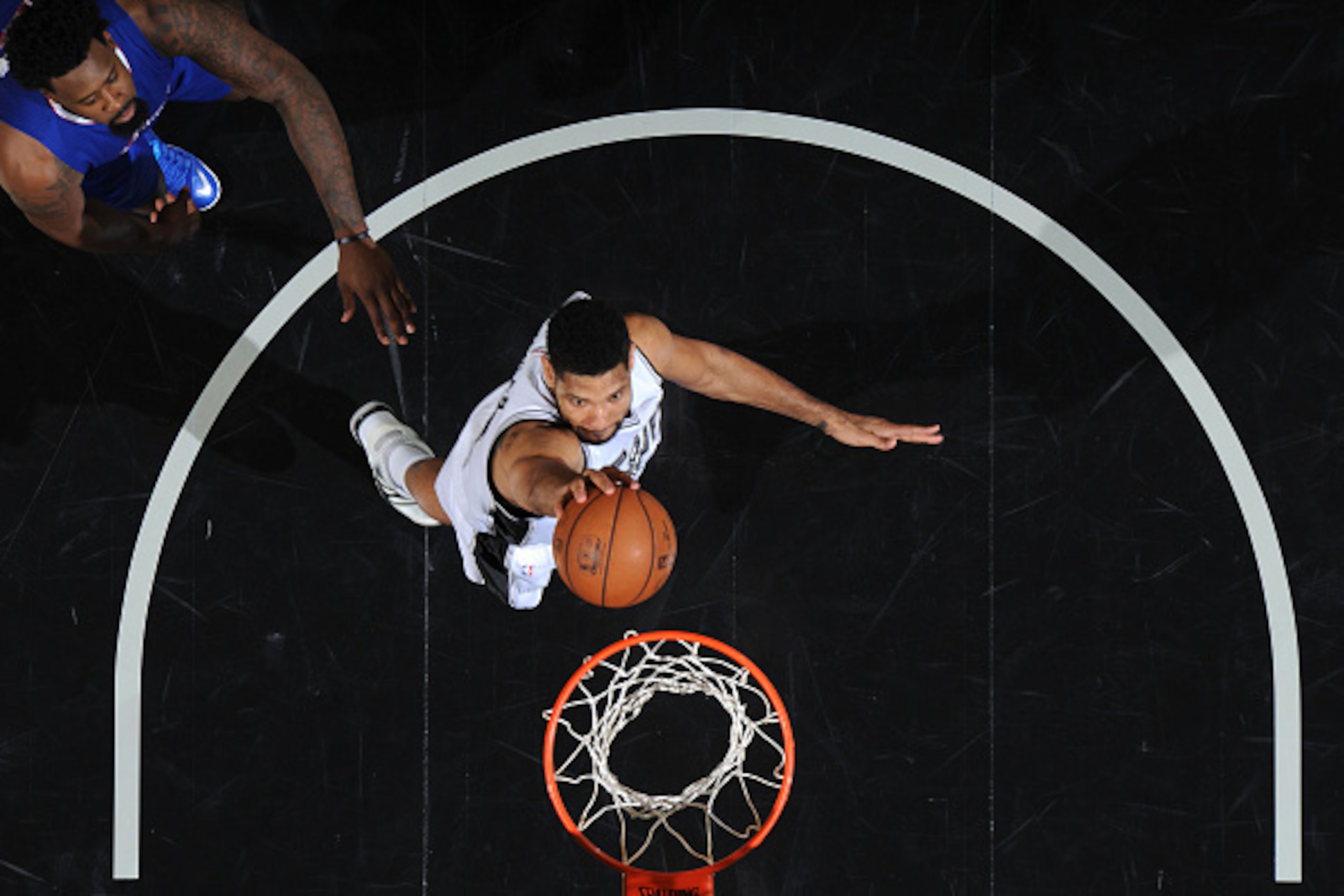
Nearing the end of the 2012-13 season, when San Antonio famously lost in a classic seven-game NBA Finals, Duncan offered a curious insight when USA Today's Sam Amick asked what continues to drive him.
"It's a lot of different stuff, but honestly I just feel healthy right now." he said at the time. "I feel like I have my legs underneath me for the first time in a while. My knee pain is way down, and I just feel good on the floor."
It was one of the first clues that Duncan had some kind of Benjamin Button thing going on. His body was feeling better as it aged, even at the brink of 37.
A couple months into the 2013-14 campaign, Popovich marveled at that continued physical prowess.
"[Duncan] is out there with one leg, and he keeps on playing beautiful basketball," the head coach told reporters in December 2013. "Makes everybody around him better with the decisions he makes, with the way he plays so unselfishly. He's still the base of everything that we do."
Duncan underwent a partial lateral meniscectomy on his left knee in 2000 after tearing some cartilage. What could have been the beginning of the end has subsequently proved to be a fairly minor setback, even if it has compromised his athleticism to some unmeasurable extent over time.
Athleticism deficit aside, Duncan remains a mobile and lively contributor on both ends of the floor, covering ground in pick-and-roll situations, recovering to protect the basket and bodying up against big men in the post. Even among all-time greats, that kind of physical activity generally takes its toll.
But Duncan has weathered that slow-moving storm in stride. And it hasn't been by coincidence.
"Everybody likes to think that maybe there's something behind the scenes that's special, something going on, but there's no real big secret," teammate Danny Green told Amick in 2013. "He takes care of his body. He does a great job with what he eats, his sleeping habits, stretching, working-out habits in the summertime. ... He stays in great shape."
He also gets in the boxing ring.
San Antonio Express-News scribe Buck Harvey recently spoke with Duncan's boxing trainer, James Leija, who explained the icon's impressive health by saying, "Most guys get hurt because they are out of shape and trying to get it back. Tim never gets out of shape."
When Duncan isn't boxing, he's likely tending to his martial arts regimen with trainer Jason Echols.
Echols told Harvey, "[The training] increases your hand-eye coordination, literally connecting your brain to your body. And when you put it in the hands of someone like Tim Duncan, it can turn into magic."
There's nothing at all magical about Duncan's long-lasting effectiveness. It's the product of a carefully crafted diet and workout routine—and a nonstop commitment to both.
The Fundamentals
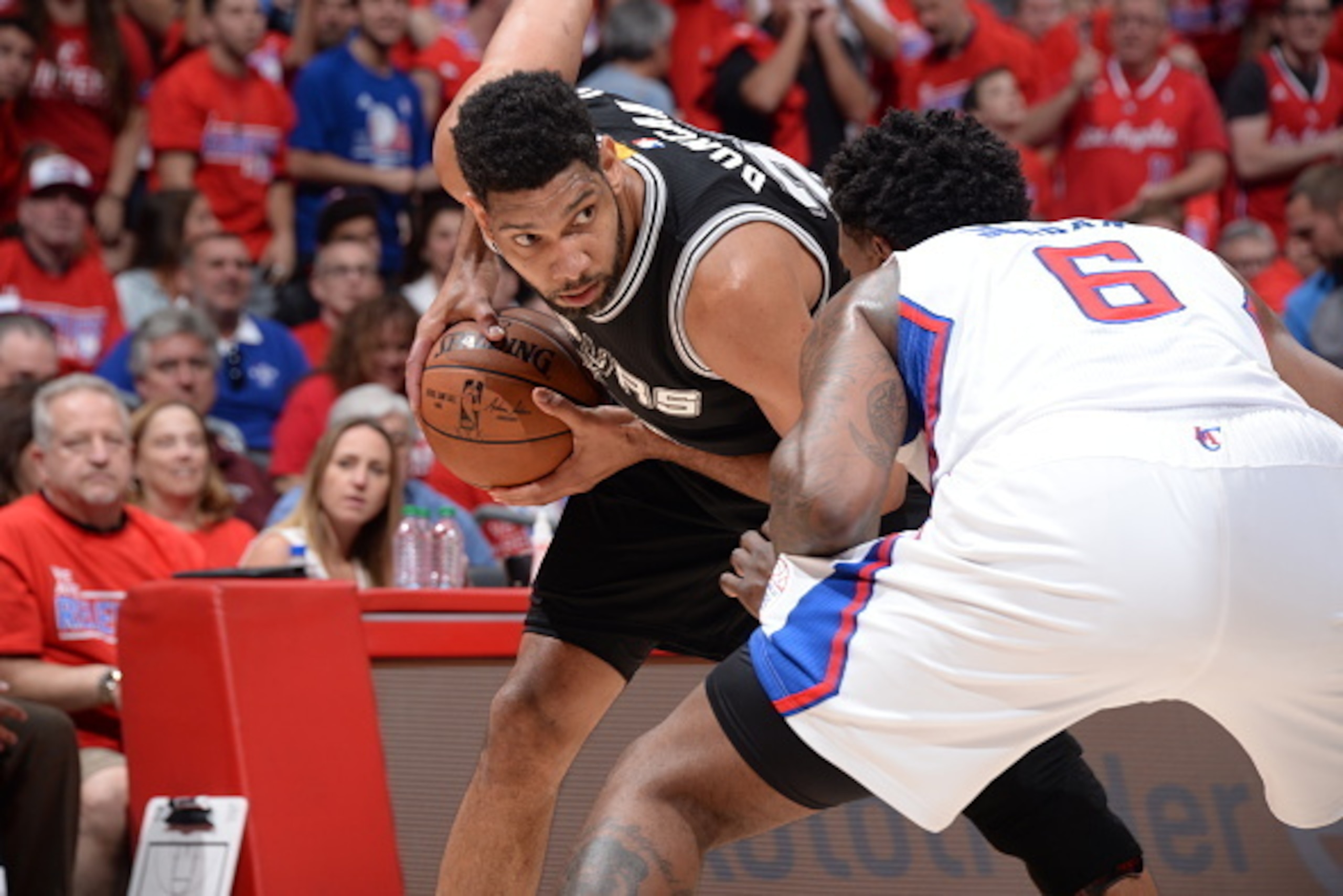
Whereas contemporaries such as Kobe Bryant and Kevin Garnett built their brands with the help of elite athleticism, Duncan was always different. His buckets came via footwork, a soft touch and intelligence—qualities that don't erode over time.
| NBA Champion | 5 times ('99, '03, '05, '07, '14) |
| MVP | 2 times ('02, '03) |
| NBA All-Star | 15 times ('98, 2000-11, '13, '15) |
| NBA Finals MVP | 3 times ('99, '03, '05) |
| All-NBA First Team | 10 times (1998–2005, '07, '13) |
| All-Defensive First Team | 8 times (1999–2003, '05, 2007–'08) |
| Career Points | 25,974 (14th) |
| Career Rebounds | 14,644 (8th) |
| Career Blocks | 2,942 (6th) |
| Win Shares | 201.2 (6th) |
And as physical assets go, Duncan's aren't especially time-sensitive. As one general manager told Bleacher Report's Ric Bucher in April 2014, "It's his length and his hands. It doesn't matter if his knees slow him down. It's his hands, more than anything. As long as he doesn't get arthritis in those, he can play at a high level."
That combination of length and touch makes Duncan an easy target for passers and an adept finisher from anywhere near the painted area. His mid-range accuracy has ebbed over the years, but he has a significant edge over many his size. He's also a sound distributor who's averaged 3.1 assists over the course of his career.
Put it all together, and one can only describe Duncan's repertoire as ageless—a fine-wine-like conglomeration of learned skills and innate talent. Time may bring sky-high verticals back down to earth, but it has little impact on basketball basics.
Just as San Antonio has become a model for other franchises, Duncan is an exemplary testament to the value of hard work and a constantly growing game IQ. The evidence is in the numbers and his remarkably sustained success.
Others have played essential roles in the winning, but Duncan's individual accomplishments are the stuff of which NBA legends are made.
The Psyche
There's at least one distinguishing and commonly held characteristic among such legends: They have a rare passion for the game itself.
The appearances are particularly deceiving with the stoic Duncan. Excepting the occasional pump of the fist, he's perhaps the least demonstrative superstar in recent memory. One could easily mistake his even-keeled demeanor for indifference, but that perception couldn't be more wrong.
"As far as basketball and his love for the game, that hasn't changed in the 17 years I've known him," former teammate Stephen Jackson told Bucher. "As soon as the season is over, I guarantee you there aren't three guys in the league who will be in the gym before him."
Forget the nonchalant exterior. Remember the work ethic, the hustle and the ability to deliver in the clutch.
"He's a different one because it's this internal fire," said Spurs former assistant coach and current assistant general manager Sean Marks, per Bucher. "He'd never say it, but I think he wants to be remembered as one of the best ever—best power forward, top five all time. You'll never hear that come from his mouth, but somewhere it's deep down in there."
That fire was on full display during the title-winning 2013-14 season. On the heels of 2013's stinging Finals defeat, Duncan was on a mission, citing a "bad taste" in San Antonio's mouth. This is an emotional venture for Duncan, a personal one.
Therefore, perhaps we shouldn't be surprised that his story will continue—this time with more help than he's ever had before.

.jpg?w=2560 "Bills Fans RIP New Stadium")