

Is Rajon Rondo a Bad Fit with the Dallas Mavericks?
Not much has gone right for the Dallas Mavericks since the acquisition of Rajon Rondo from the Boston Celtics.
The Mavs are a mediocre 23-17 since the blockbuster deal, a far cry from the 19-8 start that propelled them to the upper echelon of the Western Conference.
On paper, the deal made a lot of sense. Dallas had a huge hole at the point guard position, and Rondo's aptitude for defense (when he's locked in), coupled with his pass-first mentality, fit in with the team's style of play. That they only had to give up three lesser rotation players and two draft picks made it even more worthwhile.
TOP NEWS
Lakers Minority Owner Won't Sell
.png?w=2560 "Cleveland Cavaliers v New York Knicks - Game One")
🚨 CAVS TO PAY HARDEN $97M

Predicting Every Team's Best Player in 2029 🔮
Things just have not panned out as expected, though. The 40-game stretch since the trade is not an ideal sample size, but it's enough to at least draw some initial conclusions about how he's meshing with the Mavericks. And for Rondo, this is all the time he'll have to impress the Mavericks or other potential free-agent suitors for a big contract in the offseason.
In terms of net rating, Rondo's plus-2.4, according to NBA.com, barely moves the needle. The 100.8 defensive rating he sports while on the floor is second-best on the team among significant contributors, but it's his 103.2 offensive rating that is dragging down his impact.
His on/off court numbers don't help his case, either. The team slightly falls off to a plus-2.3 when he's off the floor.
Among the league's best players on winning teams, this type of addition by subtraction is rarely the case. And compared to his teammates, Rondo is the lone wolf struggling to find the means by which he can positively contribute.
The Mavs fall off by minus-4.2 when Tyson Chandler sits. Without Chandler Parsons, Dallas is 3.3 points per 100 possessions worse. Efficiency remains about the same when Dirk gets a rest, but even his absence hurts the team slightly with a minus-0.4.
So what exactly is going on?
By the eye test, Rondo is playing similarly to how he always has: probing on pick-and-rolls while resisting mid-range jumpers and three-pointers unless he's given 10 feet of space. He's only attempting 20.3 percent of Dallas' field goals when he's running the point, a rate that places him ninth on the team.
That's hardly different from his Boston days (15.5 percent), when his teammates were significantly worse and there was a greater pressure for him to shoot the ball. Rondo has been, and always will be, an unselfish player.
But the heart of the problem has nothing to do with Rondo's tendencies with the basketball in his hands; it's about his ineffectiveness playing off the ball.
When Rondo was first emerging in Boston with the Big Three of Kevin Garnett, Paul Pierce and Ray Allen, there were three proven alpha dogs to whom he had to distribute.
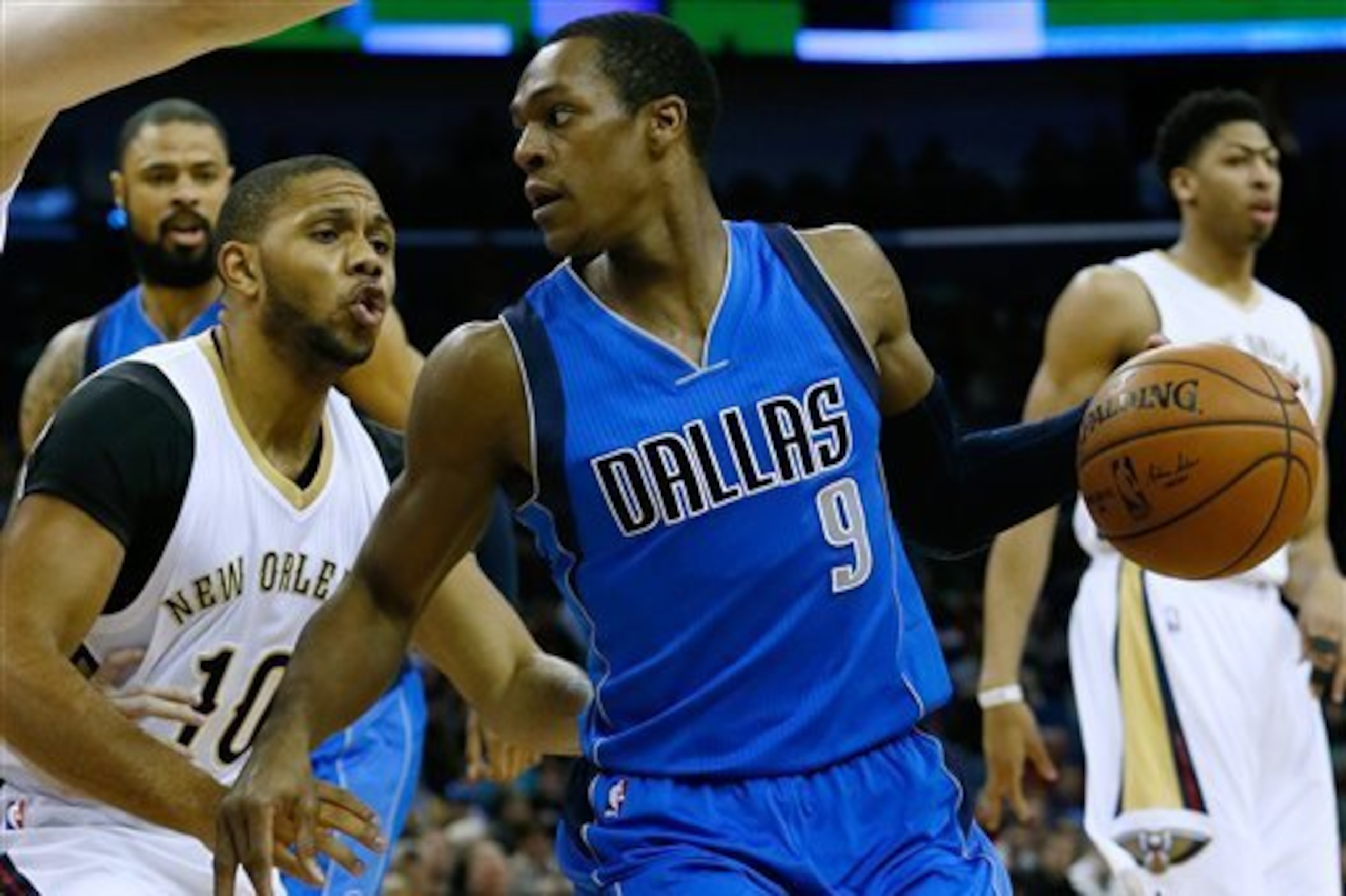
Pierce, great scorer that he is, lost a step and the subsequent ability to generate shots for teammates. Garnett (at least in his later years) wasn't a passing big through whom an offense could flow cohesively, and Allen morphed into purely a spot-up shooter.
That left the ball in Rondo's hands, and at times, he was brilliant. Much of the reason why that Boston team wasn't dismantled sooner was due to Rondo's play, as his individual dominance prolonged the effectiveness of his aging teammates.
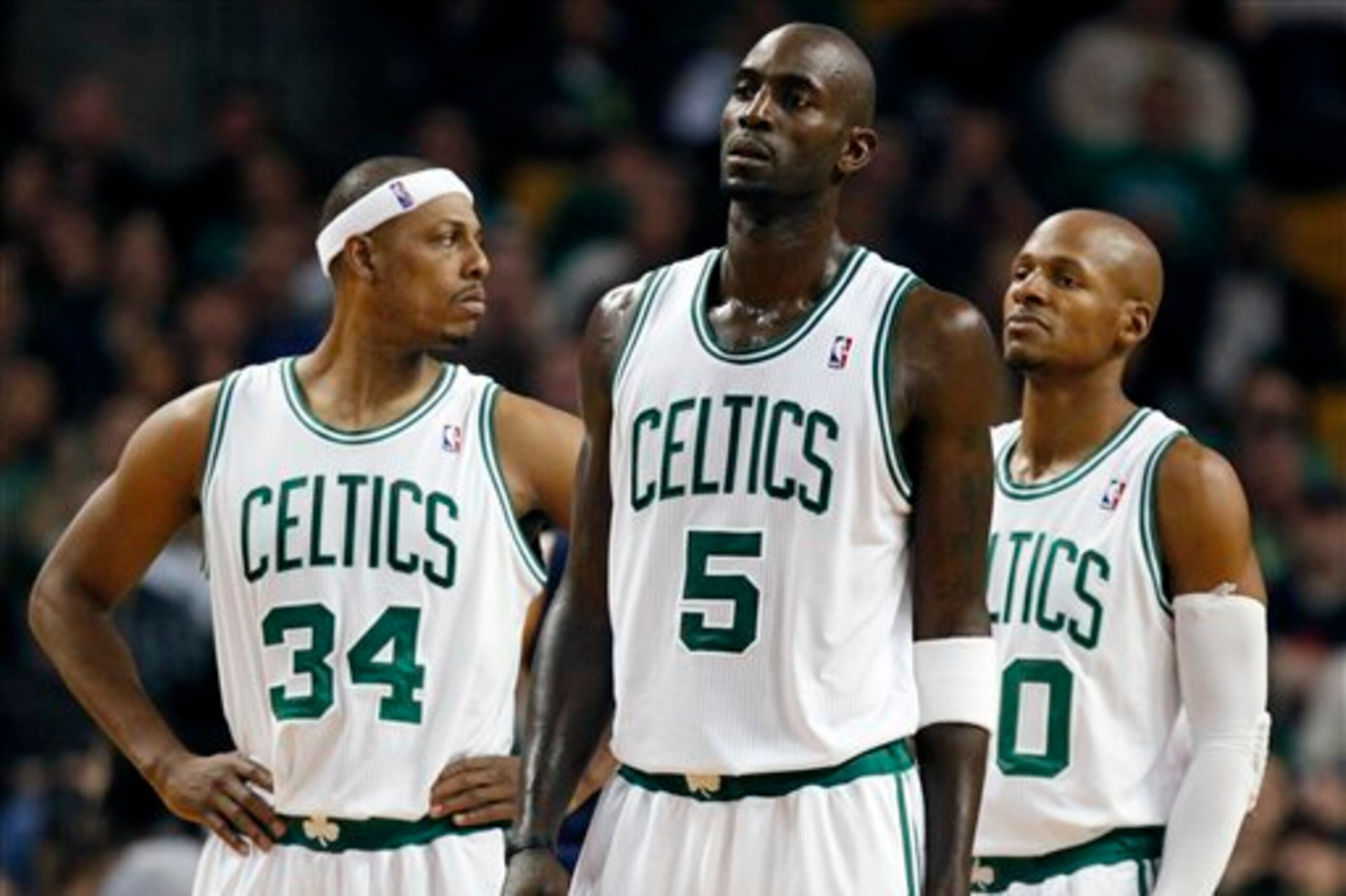
In Dallas, Rondo simply doesn't have the ball quite so often. According to NBA.com's player tracking data, Rondo's touches per game have dropped from 93.5 in Boston to 75.1 with the Mavs.
We can attribute this change both to a shift in system and personnel. As a Celtic, Rondo simply didn't have another featured player to whom he could consistently give the ball. He had to play the role of both main scorer and distributor, and his near league-leading touches reflected as much.
In Dallas, head coach Rick Carlisle favors a system that encourages changing sides of the floor and throwing out of pick-and-rolls early. Similar to the Miami Heat's "Pace and Space" system, the ball doesn't stick. The idea is that ball movement—even simplistic side-to-side passing—leads to shifting defenses, and shifting defenses leads to gaps.
It's much easier to attack a gap when a defender is rotating, as he has to stop his momentum and slide his feet against the grain. This is what Dallas does particularly well.
And then there's Dirk. Although he's at the tail end of his career, he's still one of the league's most efficient scorers. A handful of touches for Dirk, some plays for Parsons and Monta Ellis, and the overarching theme of passing equals 20 fewer instances on the ball for Rondo.
As a Celtic, Rondo could play cat-and-mouse games with his big in pick-and-rolls until a driving lane appeared. Many possessions looked like the one below, in which one pick-and-roll led to a throwback, a dribble handoff or a re-screen.
This is what he had to do to counteract teams going underneath screens against him. You might have noticed that Kirk Hinrich of the Chicago Bulls went almost to the free-throw line instead of pursuing over the top. He has absolutely no respect for Rondo's jumper and continually fights underneath to get between Rondo and the basket.
The running hook shot that Rondo takes, therefore, is very difficult.
In Dallas, he's asked to move the ball as other players—Parsons and Ellis in particular—can have a go at it in pick-and-roll as well. By default, therefore, Rondo finds himself in the role of spot-up shooter, which is clearly not one of his strengths.
Smart defenders know this and completely sag off Rondo once he gives the ball up. This in turn mucks it up for his teammates. Not only is the lane now clogged with an extra defender, but the ball-handler cannot punish that disrespect by kicking it to Rondo for a catch-and-shoot opportunity.
What this means is that advantages are being created by Dallas players, but Rondo is negating them with his inability to shoot jumpers.
Here's a quick look at his less than impressive shot chart:
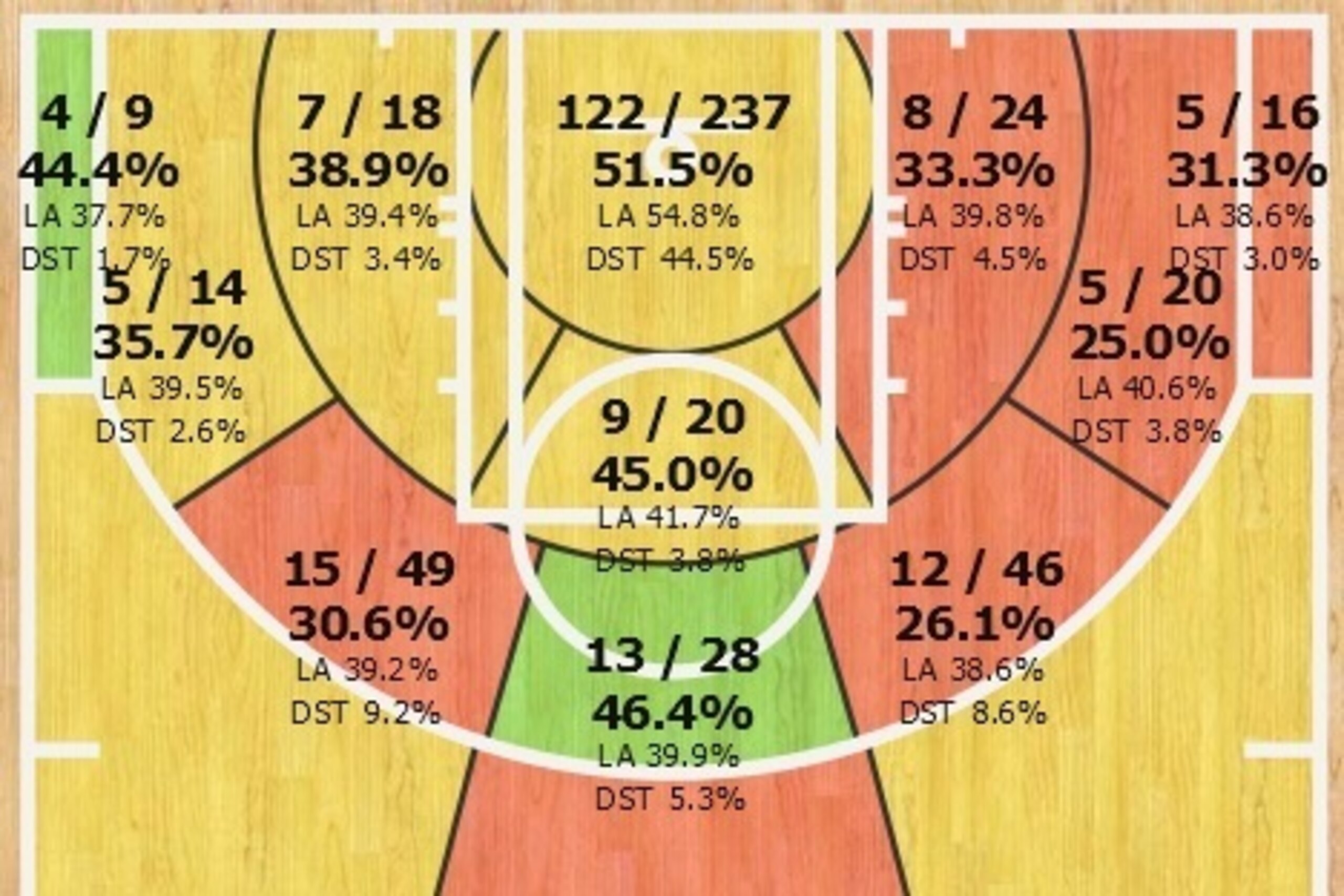
In Dallas' half-court sets, opponents completely ignore him on the perimeter.
On this Dirk post-up from a game against the Memphis Grizzlies, Vince Carter cuts through after making the initial entry pass.
The purpose of such a cut is to clear out space and give the offensive player room to operate. With defenders now on the weak side, it's more difficult to initiate a double-team without the post-up player noticing.
Here, Beno Udrih doesn't seem to care. He pushes over toward the ball on the catch, completely ignoring Rondo and encouraging Dirk to give the ball up.
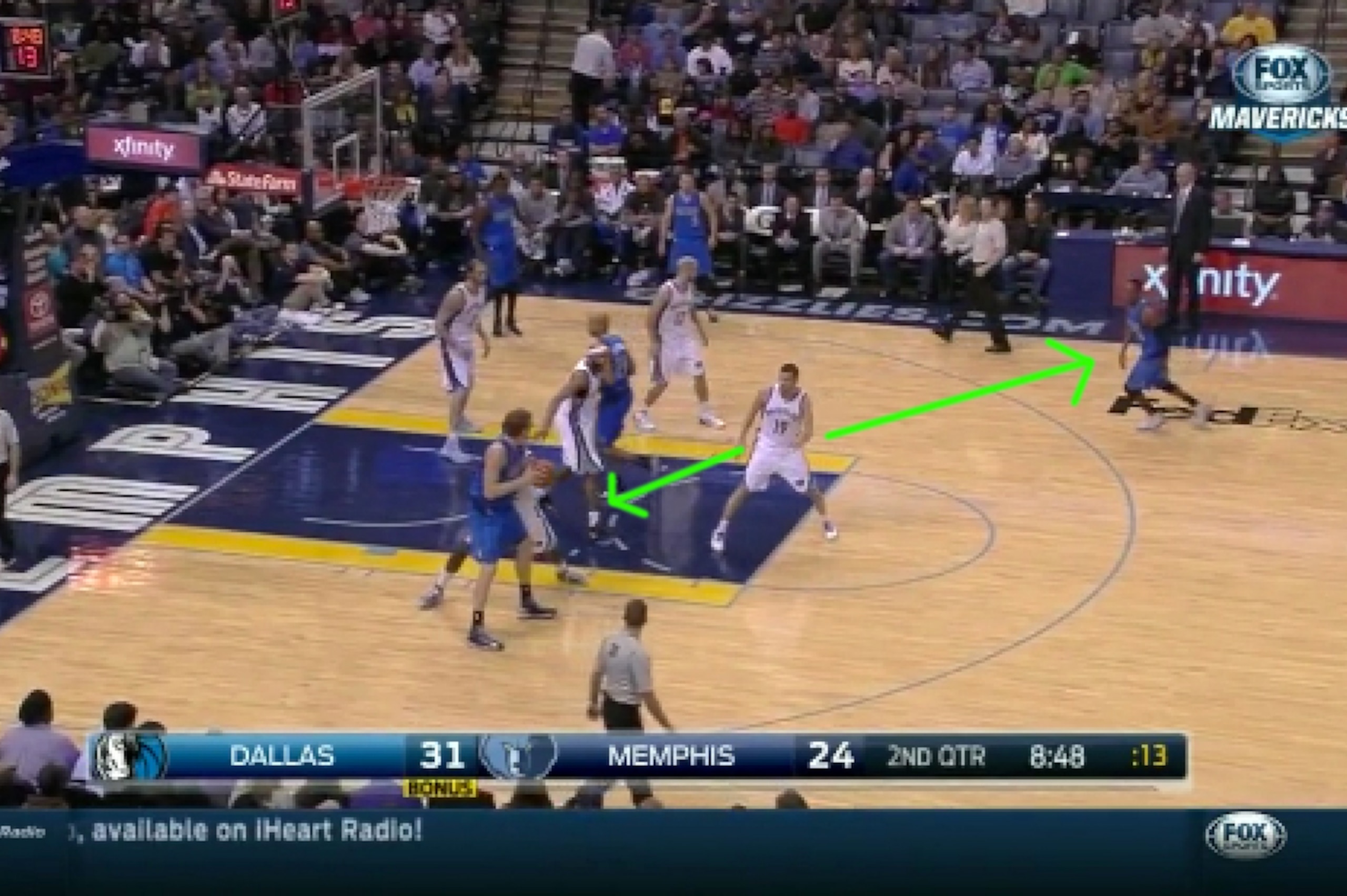
Rondo makes an appropriate backdoor cut since Udrih's head is turned, but the natural tendency of the defense to load up into the paint on a post touch mitigates the threat. Rondo is forced to pull the ball out once he makes the catch in a dangerous position.
As the ball swings to the top of the key and J.J. Barea drives, Carter leaves Rondo in the corner to swipe at the ball.

Per normal defensive rules, this is a no-no. Defenders are only supposed to stunt—jump out at the ball briefly before quickly recovering to the player's original assignment—out of the strong-side corner but never actually leave the shooter. This is because the time it takes to help, pivot and recover is too long. Clever drivers will read this rotation and kick it to the corner for an open three.
Carter appears to commit this cardinal sin here, but it's likely by design. He knows that Rondo is a non-shooter, so he has no qualms over abandoning him. Barea, therefore, has to take a tough shot over two players instead of one.
To assign blame to Rondo for Dallas' struggles is entirely too narrow a perspective. It's still a playoff team, and Rondo is finding his groove. Even though Dallas has played 40 games with Rondo at the point, there is hardly any time for practice or adjustments during the hectic NBA schedule.
From purely a talent standpoint, Dallas has enough pieces to win the Western Conference. Whether or not they can put it all together on a consistent basis is another question, and they don't have much time left to iron out the details.
Whatever does end up happening, Rondo's ability to mesh with the Mavericks will be a crucial component.

.jpg?w=2560 "Buzz: Texans May Explore WR Trade")
.png?w=2560 "Ja'Marr's Quote on Scuffle 😅")
.jpg?w=2560 "NFL Probing Cowboys-Saints Fight")
.jpg?w=2560 "Saquon Rips Joint Practices")