

Why Sam Bradford Can Excel in Chip Kelly's Offense
Quarterback-for-quarterback trades in the NFL are very rare. Trades that involve starting quarterbacks are even less common. Unsurprisingly, Chip Kelly isn't scared of blazing a trail.
Now with personnel control of the Philadelphia Eagles, Kelly acquired former first overall draft pick Sam Bradford from the St. Louis Rams for Nick Foles, per ESPN's Adam Schefter. Foles entered the 2014 season as the Eagles' starting quarterback, but the offer of Bradford and a "swap of picks," per NFL.com's Albert Breer, proved to be too much.
A huge amount of speculation has surrounded Kelly and his quarterback position this offseason. Most of that has been focused on Marcus Mariota, the Oregon prospect who is expected to go in the top 10 of the upcoming draft.
.jpg?w=2560 "Saints Giants Football")
.jpg?w=2560 "Titans Elliott Football")
It's still possible that Kelly is chasing after his former college quarterback. Bradford and the second-round pick reported by ESPN.com's Phil Sheridan could simply be added to the team's arsenal of assets for a potential trade up into the top five with the Tennessee Titans, Jacksonville Jaguars, Oakland Raiders or Washington.
While that's still a possibility, Bradford could also be the quarterback whom Kelly intends to start in 2015.
As this article discusses in depth, Bradford's situation in St. Louis has dramatically hurt his statistical production. The 27-year-old missed a lot of time on the field through injury, including two torn ACLs over the past two seasons, but when he was on the field, he didn't have a consistent running game or pass protection while his receivers struggled to get open and catch the ball.
Furthermore, Bradford was playing in Brian Schottenheimer's offense. Schottenheimer is widely disdained for his lack of creativity and overall ability as a coordinator.
It's blatantly obvious that Bradford will get better support if he stays in Philadelphia. Even though the Eagles lost Frank Gore, as the Colts announced his acquisition Tuesday, traded LeSean McCoy and couldn't re-sign Jeremy Maclin, they still have Kelly's scheme and enough talent to be more than just an average unit with good quarterback play.
Good quarterback play is what Bradford can give the Eagles offense. In a vacuum, Bradford has always been a good NFL quarterback. It's not widely accepted because to come to this conclusion, you need to be able to isolate his performances from the offense in which he has played.
Bradford's greatest strength is his accuracy.

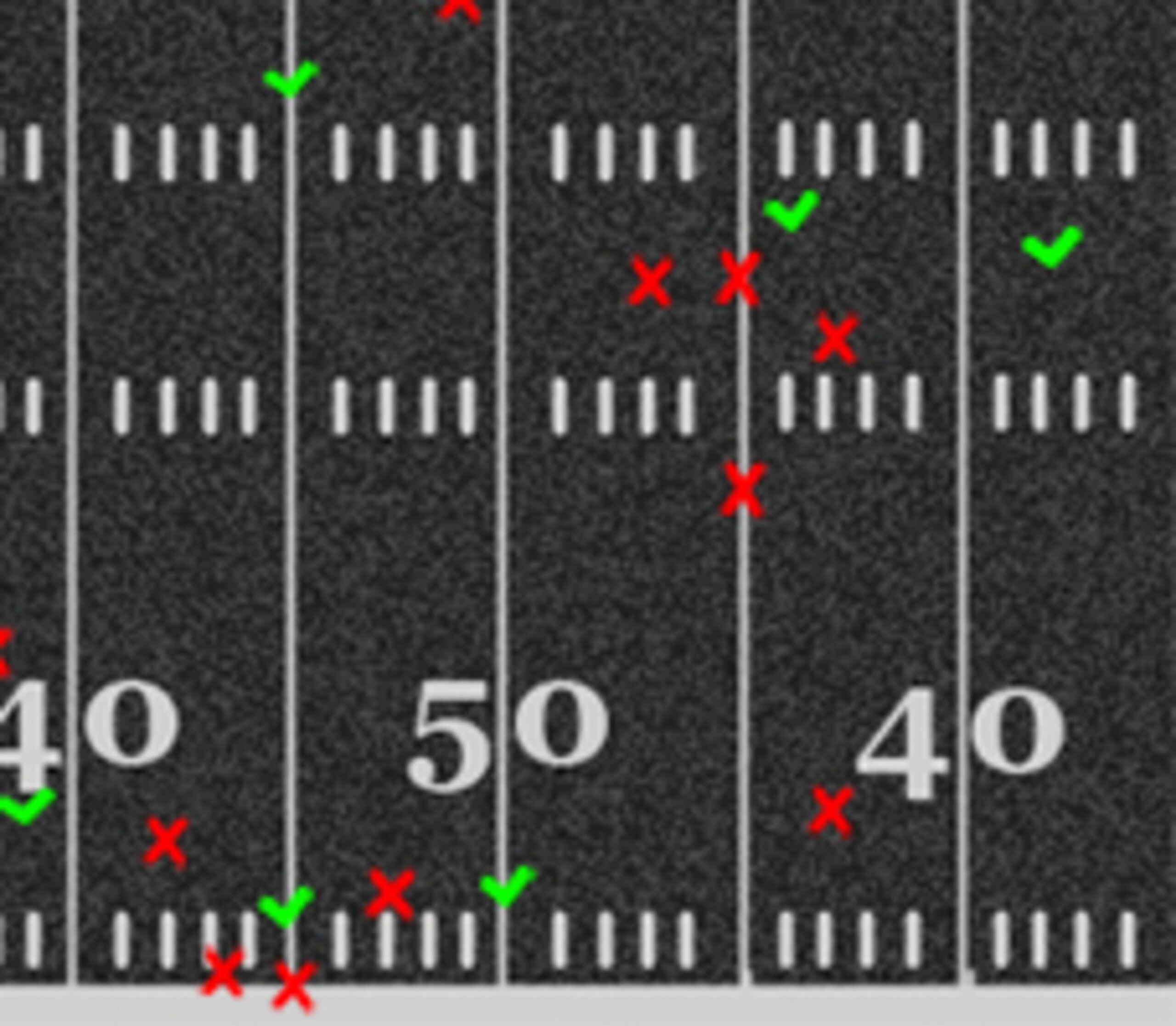
The above chart tracks Bradford's accurate and inaccurate passes from the 2013 season. He missed all of the 2014 season after tearing his ACL during the preseason, so this was the last time that he was on the field during the regular season.
It's clear that Bradford is an exceptionally accurate passer when throwing the ball fewer than 10 yards downfield. His deep accuracy looks worse because the ratio of accurate-to-inaccurate throws broadens, but that is to be expected when throwing the ball farther downfield.
To get an idea of how impressive Bradford's accuracy is overall, we must compare his chart to that of other quarterbacks. For an Eagles perspective, the best quarterback to compare him to is Foles.
As this chart highlights, a vast number of Foles' targets during the 2013 season were behind the line of scrimmage. That year was Foles' best with Philadelphia. Foles' accuracy on these throws was mostly effective, but that should be expected of quarterbacks at this level.
His flaws became more apparent when he was asked to push the ball deeper downfield.
Foles was at his best throwing to intermediate routes directed toward the sideline. He was able to consistently give his receivers opportunities to catch the ball in those areas. However, his shorter accuracy often strained receivers unnecessarily, and his deep accuracy was simply bad.
In Kelly's offense, Foles was regularly throwing deep passes into sizable windows. This helped his raw accuracy statistics, as he was able to simply float the ball downfield for his open receivers to run underneath.
Bradford didn't have that advantage in St. Louis. Instead, he had the opposite.
Therefore, Bradford's ability to throw the deep ball should be considered much more advanced than that of Foles. More specifically, Bradford's ability to throw the deep ball should go a long way toward helping Kelly maximize the potential of his offense as a whole.
On this play against the Jacksonville Jaguars in 2013, Bradford shows off his impressive arm talent:

As they have so often done under Gus Bradley, the Jaguars come out showing a Cover 3 look before the snap. Bradford is under center with an offset fullback and one receiver outside of the numbers to each side of the field.
The receiver to his right, Austin Pettis, is whom Bradford is going to throw the ball to.

Pettis was initially lined up to the wide side of the field. His positioning against the Cover 3 that the defense was hinting at and his route that would take him down the sideline meant that he was always going to be Bradford's best option on this play.
After carrying out the play fake and holding the deep safety to the near side of the field with his eyes, Bradford begins his throwing motion.
At this point, Pettis has created no separation against the defensive back. He is not even level with the defender as he accelerates into his route. Pettis is primarily a possession receiver who lacks size and doesn't have long speed to be an adequate deep threat in this situation.
Therefore, Bradford must throw him open.

With exceptional arm strength and the perfect trajectory and placement, Bradford is able to lead Pettis to space behind the defensive back. Bradford puts the ball outside, away from the defensive back in a spot where only his wide receiver can catch the ball.
Covering that much ground through the air could lead you to think that he was simply lucky with the positioning of the ball, but that doesn't jibe with the rest of Bradford's tape.
He was consistently able to throw his receivers open in St. Louis, but those receivers weren't consistently able to take advantage of the opportunities he provided. That kind of accuracy is what Kelly's offense has been lacking with Michael Vick, Foles and Mark Sanchez in recent years.
With the accuracy in place, Bradford also needs to demonstrate his intelligence in terms of reading defenses consistently and making the types of plays that Kelly asks his quarterback to make.
During his time with the Rams, Bradford defaulted to caution. He typically appeared to be too cautious on the broadcast game tape, but the All-22 often revealed that he was being cautious because he had no options downfield. Being cautious was usually the smarter alternative.
He is a pocket passer with decent athleticism. That athleticism may be diminished now after two ACL tears, but it's not the foundation of his success.

Back in Week 1 of the 2013 season, Rams tight end Jared Cook and rookie Arizona Cardinals safety Tyrann Mathieu combined for one of the more memorable plays of the year. Mathieu caught Cook from behind to punch the ball away as he was running into the end zone.
That was notable because of what Mathieu and Cook did, but Bradford made it happen by executing a very Kelly-like play.

From the shotgun, Bradford carries out a play fake with the running back who initially lined up to his right. This wasn't the full extent of the play fake, though, as the Rams also pulled the right guard across the formation to sell the run as much as possible.
On the back end, the coverage has been left with man assignments underneath and one deep safety to the left of the offense.

Because the play fake was so effective, the Cardinals had two linebackers caught in no-man's land underneath. As they attempted to recover their positions, Bradford was sitting deep in a completely clean pocket, watching the deep safety down the seam.
Bradford has to hold on to the ball to allow his routes to develop before making his decision based on what the deep safety does.
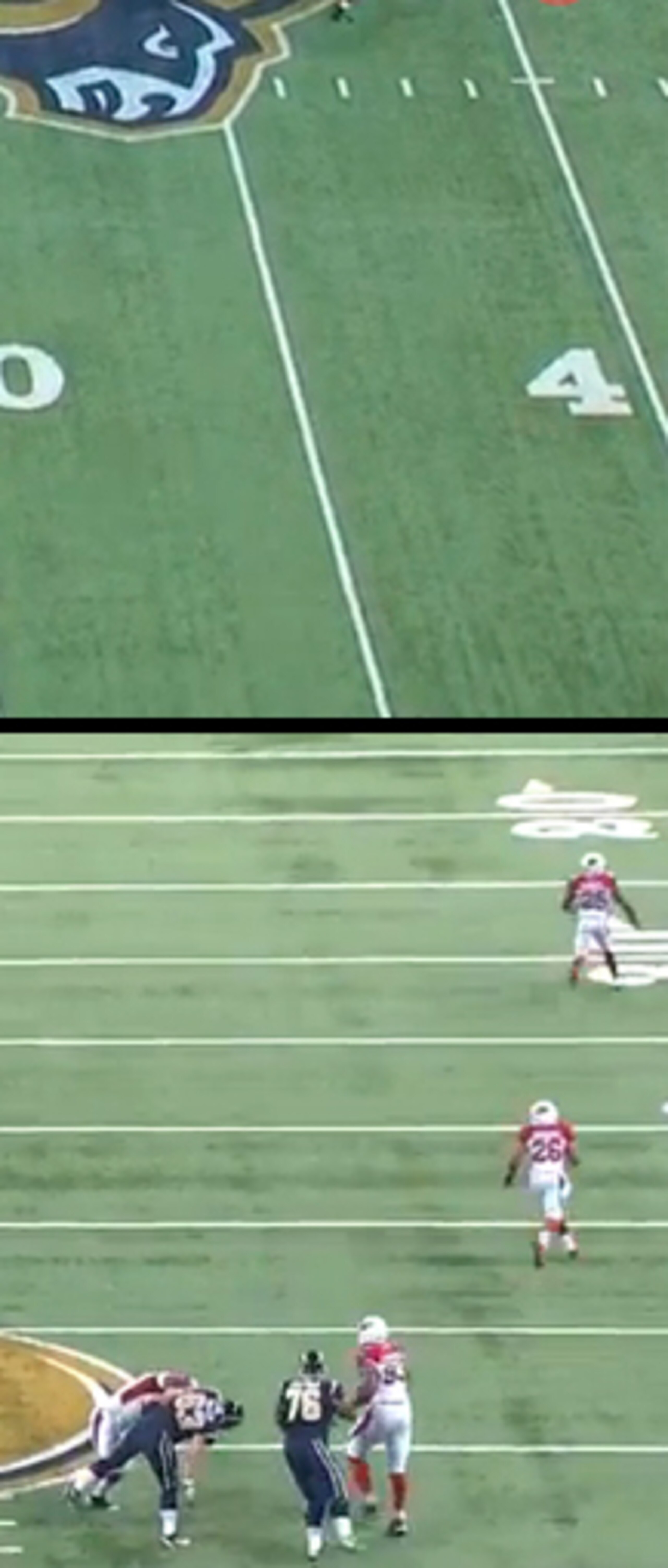
At the perfect time, Bradford decides to throw the ball to his closer seam route, which Cook is running. Cook squeezes in behind the defender covering him, but he hasn't created significant separation downfield.
Bradford could attempt to float the ball down the field for him to run underneath, but there are defenders in position to come across and disrupt his tight end at the catch point if he does. Instead, he is able to alter the trajectory of his pass to fit it around the cornerback and hit Cook in stride.
Cook doesn't have to slow down at any point, and the cornerback never has a chance to prevent the completion. This was a perfect play from the quarterback.
In recent times, Kelly has used similar principles to these in order to attack the defense deep down the field. The design and overall quality of his offense has often led to wide-open receivers, though, so even this play is more difficult than the average one Bradford would need to make in the Eagles offense.
The Rams didn't trade Bradford to the Eagles because he doesn't have the potential to be a very good player. They traded him because of his injury history and salary.
Bradford is a significantly better player than Foles despite the Rams' willingness to jettison him.
.jpg?w=2560 "Colts Chiefs Football")

.jpg?w=2560 "Porziņģis Trade Packages 📦")
