Kobe Bryant and Los Angeles Lakers Entering Uncharted Crossroads Together
Kobe Bryant and the Los Angeles Lakers have been joined at the hip for 19 years. But the legendary superstar and his team are now in an uncertain crossroads, and nobody really knows what comes next.
Bryant recently underwent season-ending surgery to repair a torn rotator cuff and is expected to return in time for training camp in the fall.
And the only thing we can predict with any real confidence? The need for important pieces to be added to the puzzle for any chance of future success.
TOP NEWS
Knicks Staff Didn't Get Rings 👀
SGA's Streak Ends In Win vs. Nuggets
LeBron Gives VJ Bloody Nose 🩸
Speaking to the press after Bryant’s successful procedure, Lakers general manager Mitch Kupchak recited the stock litany of reassurances.
“He’s in great spirits,” said Kupchak, via the Lakers official site. “The surgery went really well, and he’s excited about the prognosis, which is to be ready for training camp. So that’s a good thing, but we’ve lost a great, great player for the rest of the year.”
When asked about the keys for getting the veteran guard through his 20th season in terms of fatigue and avoiding further injury, Kupchak spoke about the need to improve the team, adding:
"As you get older and you experience injuries in this league—and he will have played for 20 years—it’s difficult to play when you’re going to lose three or four games, or five games. When you’re winning games it’s a lot easier to get ready to play, and play through aches and pains. So to me, a big part of Kobe’s contribution next season is if we can improve the team.
"
This isn’t a new speech, however—Lakers management has been promising improvement for years. And while regeneration hasn’t manifested itself in wins as of late, it’s not for a lack of trying.
Kupchak will never telegraph major moves in public. But he is known for swinging for the fences every few years in order to acquire centerpiece players. Sometimes the bold moves work, and sometimes they don’t. That's the gamble.
In 2008, the Lakers acquired Pau Gasol from the Memphis Grizzlies, a move that led to three Finals appearances and two championship trophies.
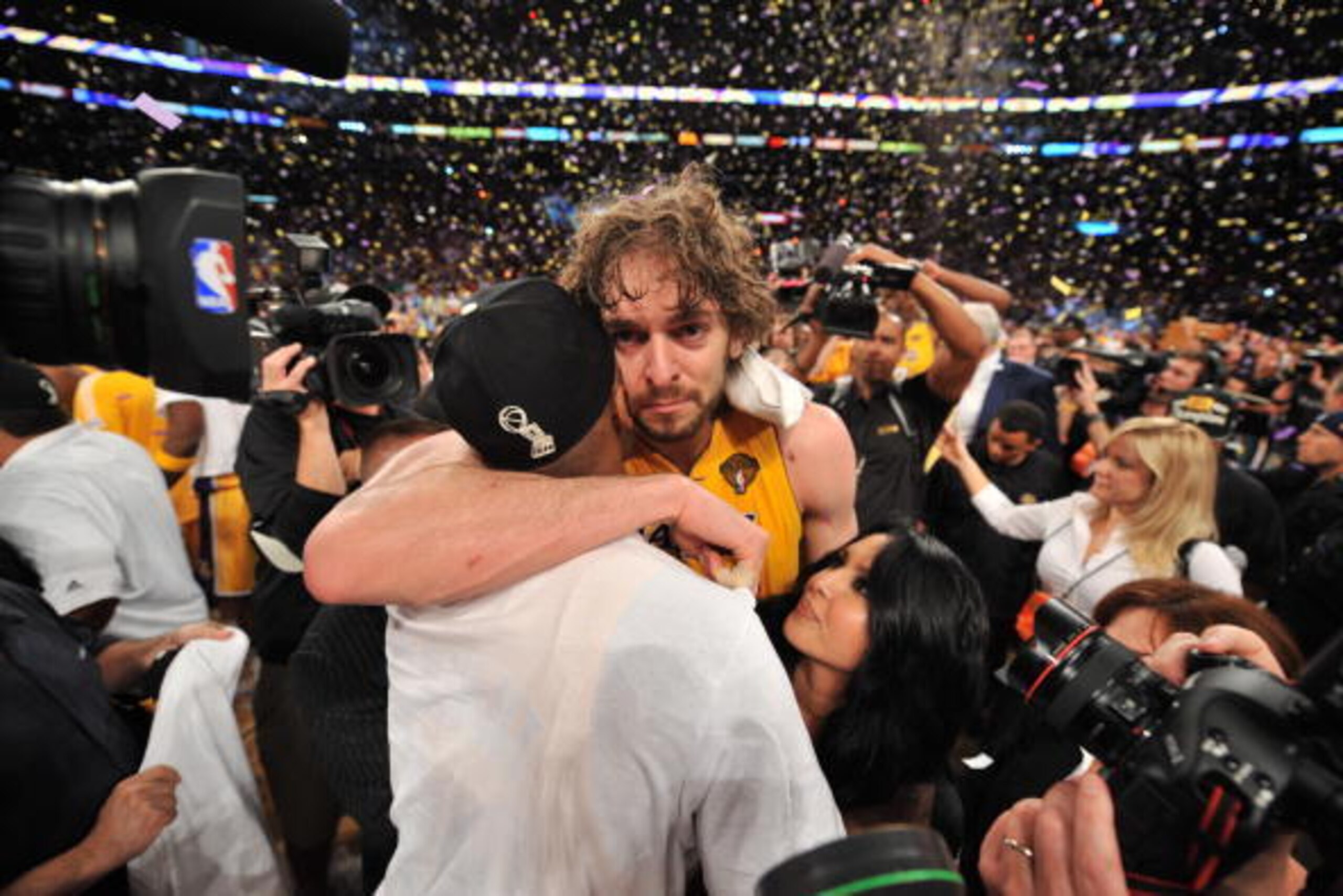
Four years later, on the eve of the lockout-shortened season, management engineered a blockbuster deal that would have sent Gasol to the Houston Rockets and Lamar Odom to the New Orleans Hornets (then under temporary ownership by the league) in return for Chris Paul.
At the time, NBA commissioner David Stern assured Hornets general manager Dell Demps autonomy to make the best deal possible for a star point guard planning on becoming a free agent. But an email from Cleveland Cavaliers owner Dan Gilbert to Stern protesting the “travesty” was widely seen as having a negative effect on the three-team trade.
The commissioner subsequently voided the transaction in a stunning decision that sent shock waves through an industry already bitterly divided in the wake of a lengthy labor dispute.
The following summer, however, L.A. rebounded by acquiring two elite players in Dwight Howard and Steve Nash via separate transactions.
But Howard, who was coming off back surgery, was never a good fit in Mike D’Antoni’s system, nor was he a good match with task-master Bryant. The All-Star center walked away at the end of the season as a free agent and joined the Rockets.
As for Nash, a fractured leg suffered in his second game with the Lakers led to a chain reaction of nerve-root and back issues that eventually kept him off the court for good.
Regardless of successes or lack thereof, these were all bold steps, often coming seemingly out of the blue and during periods when Bryant needed fresh ammunition to make another run.
The crossroads the Lakers currently find themselves in seems uncharted. Indeed, Bryant is in the end game of his long tenure with the team, while the core roster seems more unsettled than at any time in recent memory.
Still, there is a method to the madness. Management has systematically whittled away the team payroll since the league’s new collective bargaining agreement went into effect in 2011. And now, they are developing the nucleus of a young, low-cost talent base to build around.
Rookies like Julius Randle (out for the season with a broken leg), Jordan Clarkson and Tarik Black can potentially provide long-term value and production. Sophomore forward Ryan Kelly shows promise and the ability to be a useful floor-stretching role player.
And Nick Young—currently mired in an epic shooting slump—is the only Laker whose salary is guaranteed past next season. The (not unreasonable) hope is that Young will soon get his swag back and resume lighting up the scoreboard while delighting the purple and gold fanbase.
That leaves the what-comes-next phase—partaking in the next draft is certain. But even more importantly, making the type of splashy, bold acquisitions that have always typified the Lakers’ roster builds, from the Showtime era to the here-and-now.
In other words, expect some major fireworks in the very near future.
As Bleacher Report’s Kevin Ding recently wrote, the team has both the money and the desire to spend for the post-Bryant era: "The Lakers are in position to offer more than $20 million to free agents this summer—although what they commit in 2015 affects how much they'd be able to offer free agents in 2016, when Bryant's league-leading $25 million salary comes off the books and they expect to enjoy a real shopping spree."
And Bryant himself has complete faith in Kupchak’s ability to pull the trigger, referencing the aborted CP3 gambit, via Ding: "It's phenomenal, so much so that the league had to protest a trade that he made. He pulled that off and saved money? What other GM could pull that off? You've kind of got to lean on the track record of the front office and the decisions that they make."
The current crossroads is not unlike the revitalization of an urban neighborhood—old buildings are torn down, new developments are constructed, and in the case of Bryant, a historic centerpiece is being restored—hopefully to something resembling its former glory.
But in this scenario, that particular glory will be both temporary and fleeting. When Bryant does come back, it will be for a comparatively brief stand—the final season on his current contract, if his body holds up even that long.
Because it should be abundantly clear by now that 19 years of wear and tear have significantly degraded Bryant’s body. His most recent surgery doesn’t come as the result of a freak accident. It is likely due to the accumulative stress on a long-balky right shoulder that was first surgically repaired in 2003.
The 36-year-old guard can never be expected to shoulder the team’s heavy lifting again. The new generation of developing talent won’t be ready in time to provide a dependable platform for Bryant’s playoff aspirations during his swan song.
The Lakers need to swing for the fences, even while in the midst of uncharted territory. The slow rebuild simply isn’t enough.
"Let's make some trades now, Mitch Kupchak.
— Dexter Fishmore (@dexterfishmore) January 30, 2015"
And if there is any doubt of the urgency, or the thought that big moves can wait until after Bryant’s ship has finally sailed off into the sunset, just remember that Jim Buss—the current head of basketball operations—pledged last season to step down if the franchise isn’t contending in a few years.
The clock is ticking loudly, and very publicly.
The amelioration that Kupchak recently alluded to so generically may come sooner than anyone expects.
And if it doesn’t? Then batten down the hatches for a very, very bumpy ride.