Luke Willson Can Be the Seattle Seahawks' Super Bowl X-Factor
In a different life Luke Willson isn’t a Seattle Seahawks tight end. He’s not a warm safety blanket for his quarterback, Russell Wilson, and he’s not preparing to play in Super Bowl XLIX against the New England Patriots.
No, in this alternate universe Willson isn’t even a football player. He’s getting ready for spring training right now.
Before he was an emerging talent in the Seahawks offense and before he was a unique blend of muscle and fast-moving body mass in the NFL, Willson swung a mean stick of a different kind. This one was literal: In 2011 he was signed by the Toronto Blue Jays.
TOP NEWS
.jpg?w=2560 "Titans Giants Football")
OBJ Calls Out Giants After Release

Live Live: Updates from every NFL game
Lamar Exits with Injury
The football-baseball bridge is well-worn, but Willson wasn’t just finding a pursuit for his offseason downtime. He hit cleanup on the Canadian Junior National Team, and he was even the subject of old-timey baseball speak when a Blue Jays scout told Bob Elliott of the Toronto Sun “the boy has tremendous makeup.”
The Seahawks are happy to have him catching balls now, not hitting them.
"Somehow Russell is able to make the throw and Luke Willson makes the catch https://t.co/IOa9Y2hahq
— Jose Rivera (@Jose8BS) January 18, 2015"
Willson was an afterthought just a short time ago while buried on the depth chart and a role player searching for a role. He's still not featured prominently, but that doesn't matter anymore. Once he was given the slightest opportunity numbers piled, and Willson has done a whole lot with little.
His combination of speed and bulk could be a difference-making force as the Seahawks try to secure another set of shiny Super Bowl rings.
Willson has forced nine missed tackles this season, per Pro Football Focus, including four during a divisional-round win over the Carolina Panthers. He’s not too far behind his Super Bowl counterpart Rob Gronkowski in that category. Throughout the regular season and playoffs Gronkowski averaged a missed tackle once every 4.4 receptions, while Willson created a whiff once every 3.1 catches.
Of course, Willson approaches his forward-marching and after-the-catch gains a little differently. Whereas Gronkowski and many others enter full smash mode in the open field, Willson’s special power is speed—and by extension the element of surprise.
Willson wasn’t invited to the scouting combine or Senior Bowl during his draft year in 2013. He had only one chance at Rice University’s pro day to make eyes widen and drool puddle. That mission was accomplished when he posted 40-yard dash times of 4.57 and 4.46.
Both of those times make Willson a blur in the open field, though the latter is most impressive when compared to his draft peers. No tight end at the 2013 NFL Scouting Combine ran the 40-yard dash in under 4.5 seconds.
We instinctively associate speed with a person who’s smaller in stature because common logic says carrying fewer pounds around means better acceleration. But Willson isn’t a small human at 6’5” and weighing 252 pounds. When that size is combined with his quickness, tackling angles are eliminated, and yards compile in the open field.
For example, here’s Willson after catching a quick slant against the Panthers. The ball arrived five yards downfield, and at this point he had secured the pass, spun around and taken about four steps.
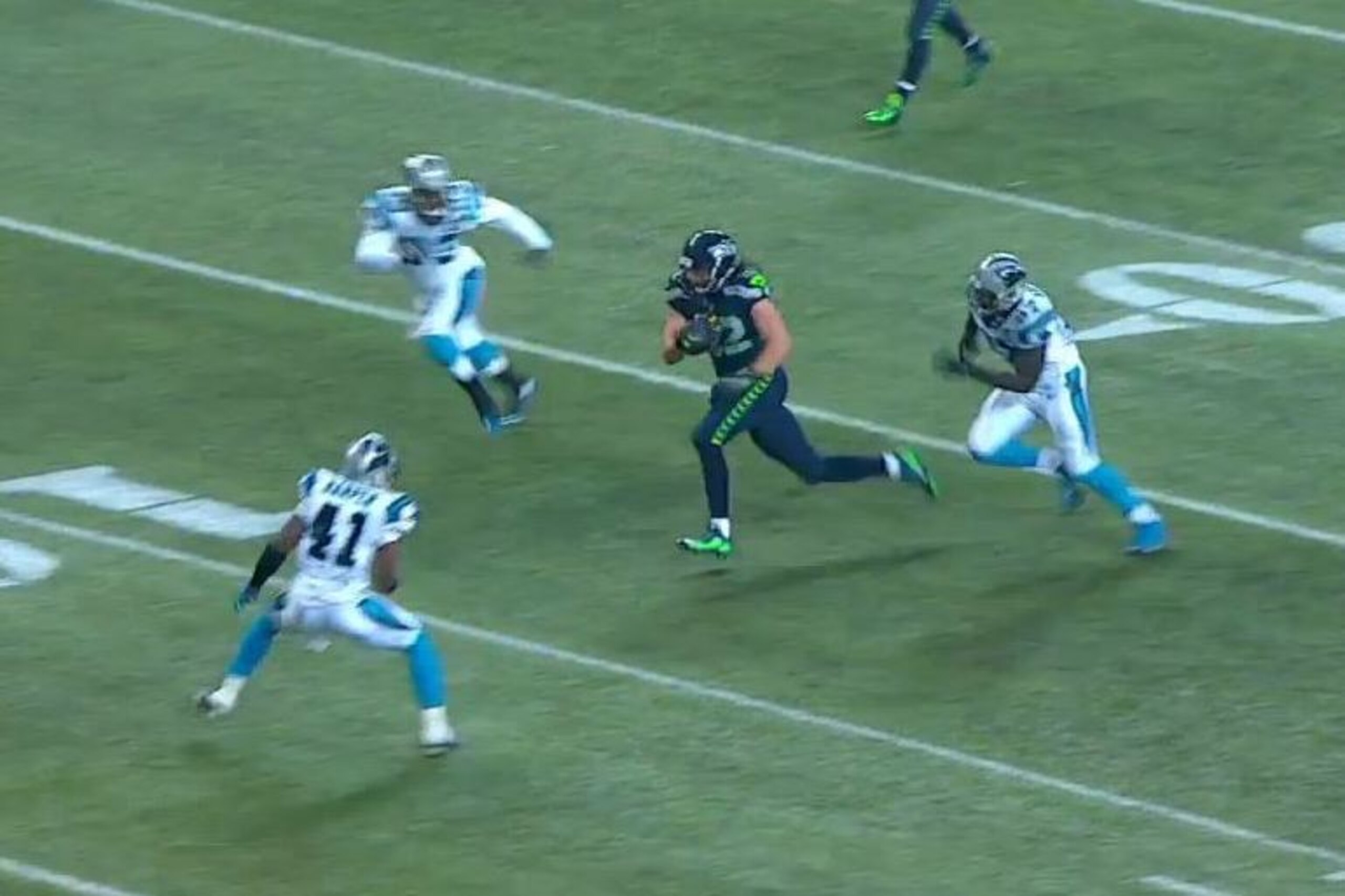
The play should have reached a clashing conclusion there after an 11-yard gain.
Sure, Willson had already accelerated to reach max speed in just a few steps, and he found a favorable angle to advance further. But note the three Panthers defenders still closing in to erase said angle: one to his right, one trailing just behind and safety Roman Harper directly in front to force Willson wide.
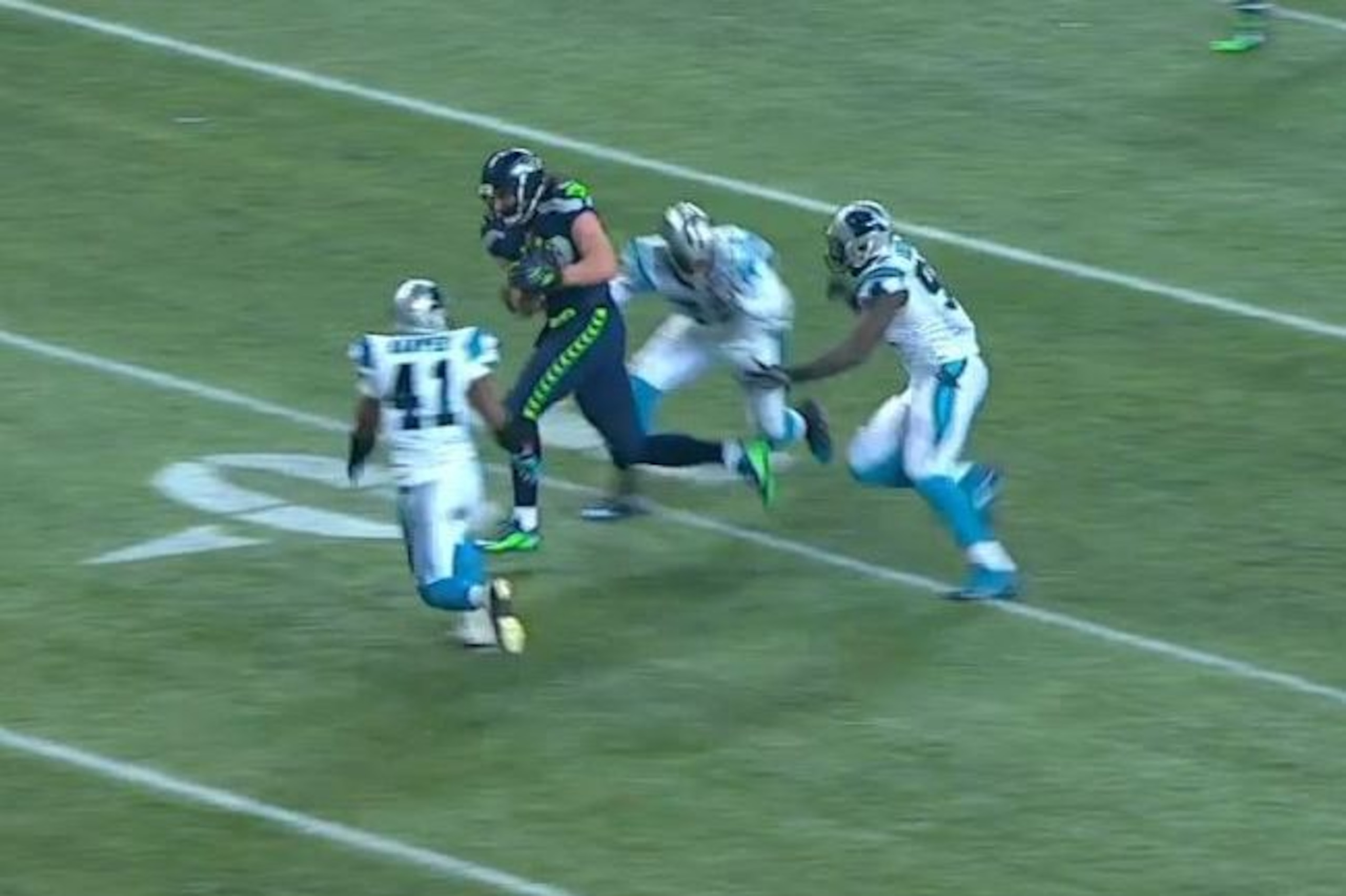
But when Willson's aforementioned size and speed are used in harmony, beautiful touchdown music is created. In this case, speed gave Willson a scoring opportunity, and size finished.
He easily absorbed an arm-tackle attempt by cornerback Melvin White while still maintaining his speed and angle on Harper to score a 25-yard touchdown.
The Seahawks offense thrives on open-field speed from any source, whether it’s running back Marshawn Lynch once he reaches the second level or Wilson when he keeps the ball on read-option plays.
But with Golden Tate and Percy Harvin long gone there’s been an offensive shift away from leaning on receivers to generate those yards after the catch, especially as they continue to struggle with separation. That’s made Willson’s growing presence and speed up the middle so vital as an avenue to create mismatches.
Willson was given a somewhat larger role once Zach Miller was placed on injured reserve, and fellow tight ends Cooper Helfet and Tony Moeaki struggled through injuries of their own.
Yet despite being on the field for only 59.6 percent of Seattle’s offensive snaps, per PFF, and finishing the regular season with a mere 22 receptions, Willson's yards after the catch compares favorably to other top tight ends who all saw significantly more snaps and balls in their direction.
| Greg Olsen | 1,091 | 84 | 381 | 4.5 |
| Jimmy Graham | 790 | 85 | 292 | 3.4 |
| Coby Fleener | 812 | 51 | 276 | 5.4 |
| Luke Willson | 579 | 22 | 216 | 9.8 |
The three other tight ends there each finished among the top 10 in regular-season receiving yards at their position, and they were all featured for at minimum 211 more snaps than Willson (Panthers tight end Greg Olsen received the second-highest usage among tight ends, seeing 512 more snaps than Willson). Yet Willson is easily on their YAC level considering his lack of playing time.
Willson’s YAC ranked 17th at his position, per PFF, and he was one of only two tight ends in the top 20 who received fewer than 600 snaps. Over the Seahawks’ past four games he has 250 receiving yards, which means he’s been on the other end for 23.7 percent of his quarterback's total passing production during that time.
From most tight ends that percentage would barely warrant an eyebrow raise. But Willson is in an offense that finished dead last in pass attempts throughout the regular season, and he had 191 receiving yards to his name entering Week 16.
That’s when Willson flicked a switch and then broke it right off.
| Before Week 16 | 17 | 191 | 11.2 |
| Since Week 16 | 11 | 250 | 22.7 |
Willson’s boom started during a Week 16 win over the Arizona Cardinals when he accumulated 139 yards in style: on receptions for 80, 39 and 20 yards. In that game alone he logged 75 yards after the catch, most of them on one read-option play.
That play now serves as a prime example of how the Seahawks’ power running and Willson’s speed up the middle go together like the Super Bowl and a giant inflatable jar of salsa.
In the second quarter the Seahawks were on their own 20-yard line. A short Lynch run had started their fourth drive of the game, which was already Seattle’s 11th rush attempt. The Cardinals were then bracing for even more running and were on high alert against both power and deception when they faced an overloaded formation to the left side on second down.
The Seahawks put three receivers to Wilson’s left, and his tight end lined up on the right side. At the snap Wilson extended the ball toward Lynch, reading the defensive end as he so often does. But this time there was a third option for Wilson when the defensive end crashed inward toward Lynch and Arizona’s entire front drifted in the opposite direction, leaving plenty of space downfield.
Actually, there were third and fourth options.

Wilson still had a chance to run and plenty of glistening green available. But the play designed and called by offensive coordinator Darrell Bevell presented a multipronged attack. Wide receiver Doug Baldwin offered a bailout option directly in front of Wilson. The true focus of the play, however, was chugging deep.
Willson had reached his top gear and was now placed in an ideal situation. He was isolated one-on-one against a safety who had to come across the field after the play fake led him just a step or two in the wrong direction.
That is all Willson needed to complete his assigned mission with ease, putting two full strides of space between himself and Cardinals safety Rashad Johnson before the ball was even airborne.

The resulting 80-yard touchdown was the longest reception of Willson’s career. It was also one of his seven catches for 20-plus yards during the regular season, a mark that tied him with the likes of the Denver Broncos' Julius Thomas and Dallas Cowboys’ Jason Witten.
Willson’s burst presents a unique challenge for any defense and a potentially daunting one for the Patriots after they allowed an average of 65.6 receiving yards per game to tight ends this season, according to Football Outsiders. That was tied for the league’s second-worst average.
The Patriots’ tight end weakness is one concern defensively, and a lack of exposure to mobile quarterbacks is another.
As ProFootballTalk’s Michael David Smith noted Tuesday, defending the read-option and a mobile quarterback of Wilson’s caliber isn’t something the 2014-15 Patriots have been asked to do often. Wilson rushed for 849 yards during the regular season, and Miami Dolphins quarterback Ryan Tannehill’s 311 rushing yards was the highest total from any quarterback New England faced.
As the Cardinals and others have discovered, Seattle’s use of the read-option can bring both of those threats—an athletic tight end and an athletic quarterback—into play at the same time. Defending one is difficult enough, but introducing Willson at a precise moment after establishing the run could easily lead to a key gain from an unexpected source.
Winning Sunday might only require one such play if a tight defensive slugfest develops.
.jpg?w=2560 "Saints Lions Football")
.jpg?w=2560 "Vikings Buccaneers Football")