Can Seahawks Receivers Get Separation vs. Patriots Secondary?
It’s easy to be confused at first when we talk about the Seattle Seahawks wide receivers and separation. It’s easy to look at the many deep connections with quarterback Russell Wilson and wonder where, exactly, the problem lies.
Wilson has indeed placed plenty of sailing balls this season into the waiting arms of receivers Jermaine Kearse and Doug Baldwin. But a narrow throwing peephole is often all he’s been provided, leaving the margin for error thin.
Without his receivers creating space, Wilson is about to feel downright claustrophobic as a passer during Super Bowl XLIX. When New England Patriots cornerback Darrelle Revis is lurking, thin margins tend to become batted balls.
TOP NEWS
.jpg?w=2560 "Titans Giants Football")
OBJ Calls Out Giants After Release
Lamar Jackson Day-to-Day

Live Live: Updates from every NFL game
Or worse, Revis will shut down an entire half of the field, just like his Seahawks counterpart.
When you think about the Seahawks offensively, you think about running.
You think about running back Marshawn Lynch powering, hurdling and high-stepping his way toward 4.7 yards per carry during the regular season, and a franchise postseason record of 157 rushing yards during the NFC Championship Game. You think about Wilson and his read-option scampering for 849 rushing yards, the fifth-highest single-season total among quarterbacks since the merger.
That heavy reliance on running is a starting point for something larger: aggression from the opposing defense and, eventually, separation downfield.
The Patriots defense has succeeded through eliminating the run. New England gave up the fewest chunk plays on the ground for 20-plus yards during the regular season (just two) and only six rushing touchdowns. They also have five starters with at least 30 defensive stops, according to Pro Football Focus.
Offensively for the Seahawks, it’s not difficult to envision a near future when passing is a necessity and viewed as more than an annoyance. Today in information that shocks no one: Seattle ranked dead last this season with 454 pass attempts.
Now we go from not remotely shocking to information that’s curious, or even strange.
| Seahawks | 454 | 54 | 7.7 |
| Patriots | 609 | 46 | 7.0 |
Let’s repeat this with feeling: The Seahawks run, they’re a running team and they run because they’re a running team. Yet despite a whopping 155 fewer pass attempts than the Patriots, they still recorded eight more completions for 20-plus yards.
For the Seahawks, passing and the quest for separation deep is always linked to running. That's how space is created, along with gains after the catch.
Both Kearse and Baldwin churn out yardage after the catch, and so does Lynch. The two receivers have combined for 674 yards after hauling in a reception this season (including playoffs), while Lynch has contributed 428. In total, Wilson’s passes have led to 1,872 yards after the catch.
Looked at from another far more revealing angle: Only 46.1 percent of Wilson’s passing yards have come through the air, per PFF. He ranks 36th among quarterbacks who took at least 25 percent of their team’s dropbacks this season, and he's in the company of Blake Bortles and Kirk Cousins.
That percentage isn’t anything new, and it doesn’t necessarily speak to a problem either. No, instead it potentially outlines a solution.
Less is more with the Seahawks and their sometimes chaotic relationship with passing. Sometimes they don’t even call passing back after a nice evening. Other times, the Seahawks splurge and take passing out to Applebee’s.
Their passing yardage is primarily gained through slants, crossing routes and screens, all of which offer the opportunity for those lengthy runs after the catch. That approach decreases the need for separation and creates a passing game rooted in timing.
The space needed for a successful quick-strike passing game is generated through play action. Wilson logged the third-most throws off of play action during the regular season (143), per PFF, averaging 8.4 yards per attempt.
| Alex Smith | 157 | 69.4 | 1,265 |
| Tom Brady | 151 | 66.9 | 1,366 |
| Russell Wilson | 143 | 63.6 | 1,207 |
Of Wilson’s 20 touchdown passes this season, six came off play action, and he has a higher passer rating after a play fake (98.4) when compared to his rating on a standard dropback or rollout (93.3).
The entire Seahawks offense is structured around the run, whether it's power from Lynch or deception from Wilson. That includes the passing game, as both Lynch and Wilson are respected threats.
When the Seahawks fall behind, that threat begins to fade. When separation then inevitably becomes difficult, those throwing windows tighten and Wilson has to be nearly perfect.
Wilson’s NFC Championship Game implosion is fresh, but he’s well-acquainted with perfect (or close to it). Heading into that game, he had the best posteason passer rating of all time, and during the divisional round he picked apart the Carolina Panthers with precision passing.
But asking your quarterback to flirt with flawless also means consistently skirting around disaster. That’s true even when the precise Wilson is on the field.
Consider the throw that completed a miraculous comeback Sunday, one still difficult to properly compute. It was another remarkable display of pinpoint ball placement from Wilson, made even more amazing by how lost he was throughout the rest of the game.
However, try to ignore the result for a moment and focus on the process (that’s hard, I know, because the result was sort of historic...but work with me here). There was no deep safety on the play, and Packers cornerback Tramon Williams was assigned to Kearse in one-on-one coverage.
Kearse ran a nine route and gained some separation immediately off the line of scrimmage. But he still couldn’t muster much of a divide and forced Wilson to throw his 35-yard dart into a confined area.
A throw short by, say, a few inches likely would have been batted away.
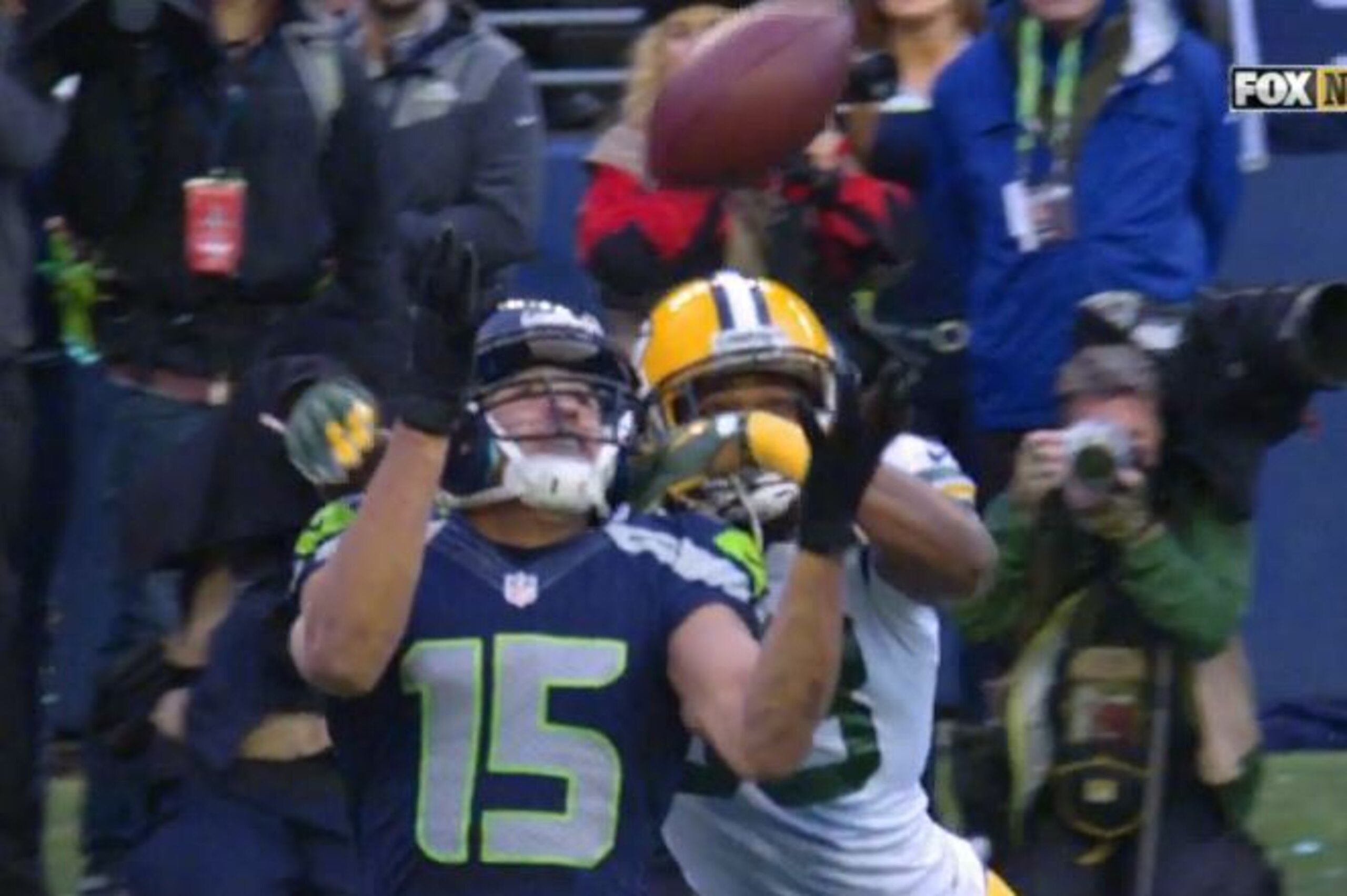
That play was the ultimate barometer of separation. Over a 35-yard sprint with no safety help, Kearse gained about a half-step, which was then nearly erased as the ball descended.
During the regular season, Wilson finished just outside of the top 10 in completions traveling at least 20 yards through the air. He collected 21 of them (12th), per PFF, a respectable final tally considering he attempted only 52 such passes (21st). For much of those connections, cramped spaces were a regular occurrence.
In Week 15, he fit another ball through a wormhole for a 47-yard completion to Kearse.

But as common as those narrow gaps between receiver and defender were in recent weeks, spacious throwing windows haven't been completely absent.
Prime example: The much wider, buffer Baldwin put space between himself and Packers cornerback Casey Hayward on his own 35-yard reception, which set up Kearse’s game-winner.

That catch came on a corner route from the slot. Baldwin released with a stutter step at the line of scrimmage to freeze Hayward. Then, with Hayward firmly committed to press coverage and sealed to the inside, he planted with his left foot and accelerated deep downfield toward the sideline, where Wilson’s lob eventually fell.
Quick movement off the snap with abrupt cutting is how Seahawks receivers win battles. Doing that against Revis and Brandon Browner during the Super Bowl presents an all new challenge.
Revis is among the most positionally sound cornerbacks in football, and he has allowed an opposing passer rating of only 70.5 in coverage this season, per PFF. Meanwhile, Browner is one of the league’s largest cornerbacks at 6’4” and weighing 221 pounds. He's not beaten often with grappling physical play at the line.
The Seahawks can still get separation, and there will likely be opportunities for significant yardage downfield. But it’ll mostly come through standard Seahawks football: running to set up play action and then suddenly striking.
.jpg?w=2560 "Broncos Eagles Football")
.jpg?w=2560 "Saints Lions Football")


.jpg?w=2560 "Report: Baker May Miss Up to 6 Weeks")