Russell Wilson's Decision-Making Is a Concern Heading into Super Bowl
Russell Wilson is many things to many people as the polarizing quarterback of the Seattle Seahawks.
To those who lean more toward a curmudgeon life, he’s unorthodox and dangerous, always flirting with disaster and skittish in the pocket. To the progressive thinkers among us he’s balanced, and enters Super Bowl XLIX against the New England Patriots as more playmaker than quarterback, and more innovator than standard passer.
During the 2015 playoffs, both warring sides have been right. Which leaves us with an unfamiliar feeling about Wilson as the Seahawks prepare to defend their title: confusion, and then concern.
TOP NEWS
.jpg?w=2560 "Titans Giants Football")
OBJ Calls Out Giants After Release
Lamar Jackson Day-to-Day

Live Live: Updates from every NFL game
If Wilson’s decision-making and accuracy don't reverse course swiftly, the Seahawks could have a repeat performance of the NFC Championship Game, just without the ending.
The contrast between the two Wilsons during Seattle’s current playoff run is jarring.
During a divisional-round win over the Carolina Panthers, he was nearly perfect, completing 68.2 percent of his throws while averaging 12.2 yards per attempt with three touchdown passes. Even more remarkably, he finished that game with a passer rating of 149.2, the fifth highest in NFL postseason history.
His ball placement was superb, and as the Seahawks advanced we were left with the image of a quarterback who’s brimming with confidence, knowing he can complete even the most difficult low-percentage throws.
He was calm in critical moments, completing all eight of his pass attempts on third down. Nearly 75 percent of Wilson’s overall passing yardage (199 yards) came on third down, along with three touchdowns.
Following that win there was an air of invincibility about Wilson heading into the NFC Championship Game. At the time he held the best postseason passer rating in league history, which then sat at 109.6.
But then an inferior Wilson appeared when he was faced with a greater challenge from the Packers and their 10th-ranked pass defense during the regular season. The Wilson who surfaced on that Sunday afternoon was the one you would meet after following the darkest timeline to its conclusion.
He didn’t throw a completion until the 3:58 mark of the second quarter. Shortly after that throw mercifully found its desired destination he threw his third interception of the first half. He later chucked another turnover in the fourth quarter after finishing the regular season with only seven interceptions.
Wilson had plunged to the rockiest bottom when that fourth pick was snatched by Packers safety Morgan Burnett.
Instead of being masterful on third down, he was woeful this time, throwing two of this interceptions with a completion percentage of 36.3.
The human mind falls victim to recency bias far too easily, so foremost in our memories right now are Wilson’s two overtime throws that sealed an improbable comeback. It’s convenient to forget that until the 3:52 mark of the fourth quarter Wilson had eight completions, and he was the reason a series of miraculous events were needed to resuscitate title defense hopes.
That’s where the contrast lies, and where the confusion around Wilson in recent weeks begins. As he prepares for a Super Bowl matchup against a Patriots defensive backfield featuring cornerback Darrelle Revis and safety Devin McCourty (both with an opposing passer rating under 75.0 in coverage, and McCourty is well under at 62.6 per Pro Football Focus), it’s fair to wonder which Wilson will arrive in Arizona.
There will be more cringing and face-palming if the quarterback who unloaded a ball deep after seeing this is the one on the field against New England.
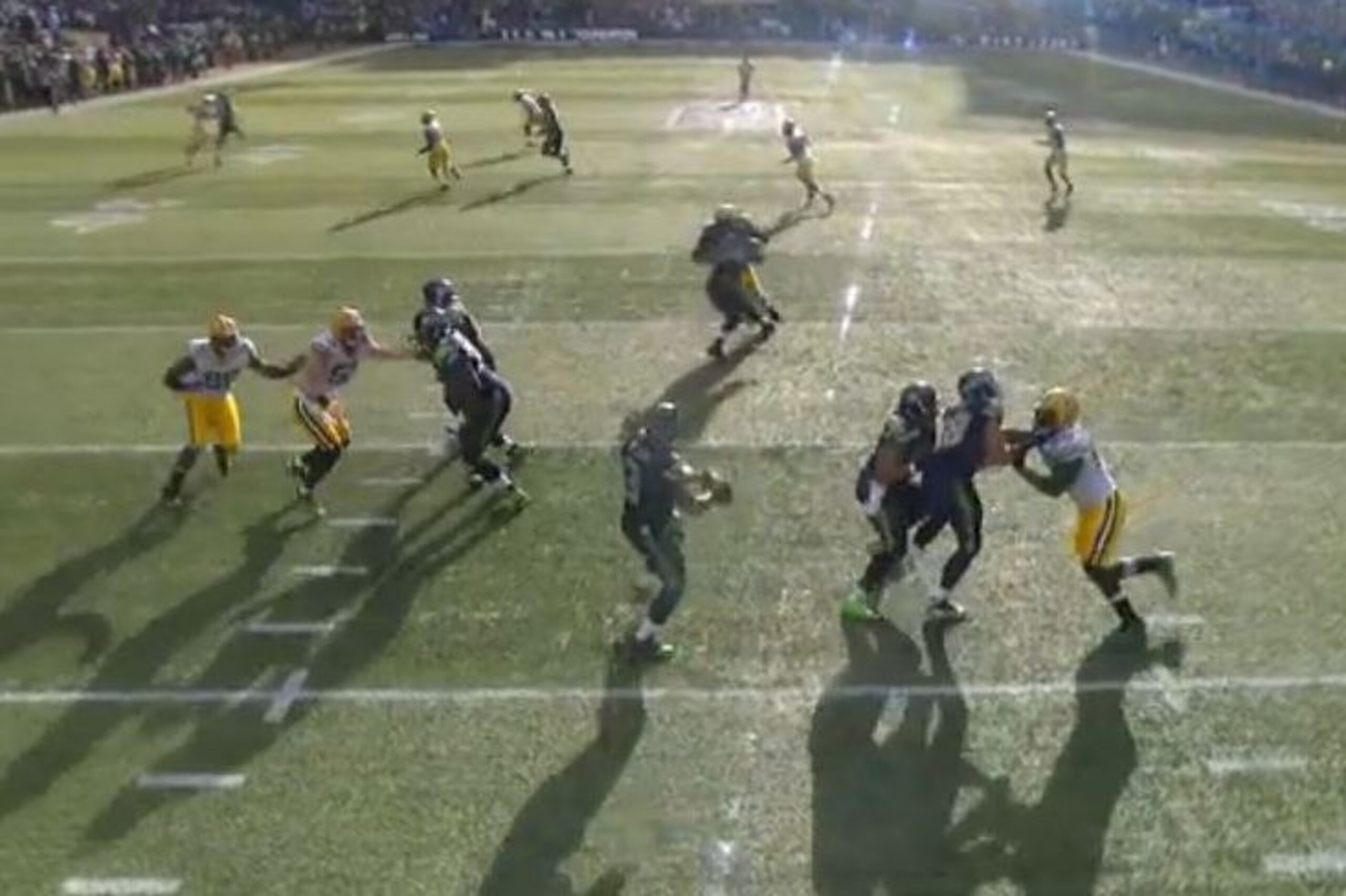
That’s what Wilson saw just before launching a throw to his left in the direction of wide receiver Jermaine Kearse. At best there was a low-percentage completion possibility if he led Kearse far enough and his receiver made a diving catch.
But throwing into double coverage demands flawless ball placement, and it invites trouble. A ball that’s even slightly inaccurate or underthrown often finishes its flight in the wrong set of hands. The better play with the stakes high is any other play, particularly when your name is Russell Wilson and you just rushed for 849 yards this season.
Instead, Wilson shunned caution and foolishly embraced danger. Then he promptly exited for what was becoming a warm bench seat. There's rarely a happy ending when a receiver is sandwiched between two defenders waiting for a lofted ball.

That was the second interception by Packers safety Ha Ha Clinton-Dix. It was completely avoidable and a product of poor decision-making, the sort of error rarely seen from Wilson this season prior to the NFC Championship Game.
His ability to scan the field and properly go through his reads is what led to Wilson’s minimal number of regular-season interceptions. Combine that with typically pinpoint accuracy, and you have a dual-threat quarterback who can beat a defense with multiple weapons.
But the wayward version of Wilson is a quarterback who crumbles mentally. Later that was evident on another throw in Kearse’s direction when the receiver was blanketed throughout his route, leaving little opportunity for a completion.

Even when Wilson’s throws reach a friendly target, his receivers often crank the difficulty level a few more notches by leaving a narrow window. They gain little separation, which makes clawing back from a deficit of any significance a steeper challenge.
That still doesn’t provide an invitation to jam balls through impossible holes, and cross the line separating a dangerous throw from the death of a drive.
It also doesn’t explain inaccuracy, and why Kearse had to reach so far on a simple slant.

The larger sample size of Wilson in the playoffs tells us we should try to look past the NFC Championship Game. Even with that insult to quarterbacking he’s still completed a fine if not spectacular 61.3 percent of his playoff attempts, and prior to the near flame-out against Green Bay, he had thrown nine touchdowns with only one interception.
But good luck with that after Wilson fell from his playoff pedestal to around Ryan Lindley’s level after posting the third-worst postseason passing performance by a winning quarterback, according to Football Perspective’s Chase Stuart.
The Seahawks are driven by the run offensively, and by the power of running back Marshawn Lynch along with the added element of Wilson escaping the pocket. However, some degree of passing comfort still needs to be established early against the Patriots through quick, easy looks.
Without that, it’s difficult to determine which Wilson will show up.
.jpg?w=2560 "Broncos Eagles Football")
.jpg?w=2560 "Saints Lions Football")


.jpg?w=2560 "Report: Baker May Miss Up to 6 Weeks")