
Power Ranking Every Super Bowl MVP
It’s almost here.
We are finally a few days from Super Bowl XLIX, when the New England Patriots will face the Seattle Seahawks to determine the 2014-15 NFL champion.
For nearly two weeks, most of the talk surrounding this game has been about air—be it the apparent lack of it in the Patriots’ footballs or too much of it in many ways from the Seahawks’ starting running back.
Let’s not digress. It’s time to talk about the game and who will win. More specifically here, who will emerge as the Super Bowl’s Most Valuable Player?
Here we have taken the time (and enjoyed every moment of it) power ranking the previous 48 Super Bowl MVPs. How did we determine No. 48 to No. 1? We took into account the player’s statistics and actual impact on the game. In some instances, another performer may have been more worthy than the one who took home MVP honors, and we have a suggestion or two along the way.
Agree or disagree with our rankings? Feel free. But also enjoy the nostalgic journey along the way.
48. S Dexter Jackson, Tampa Bay Buccaneers (Super Bowl XXXVII)
1 of 48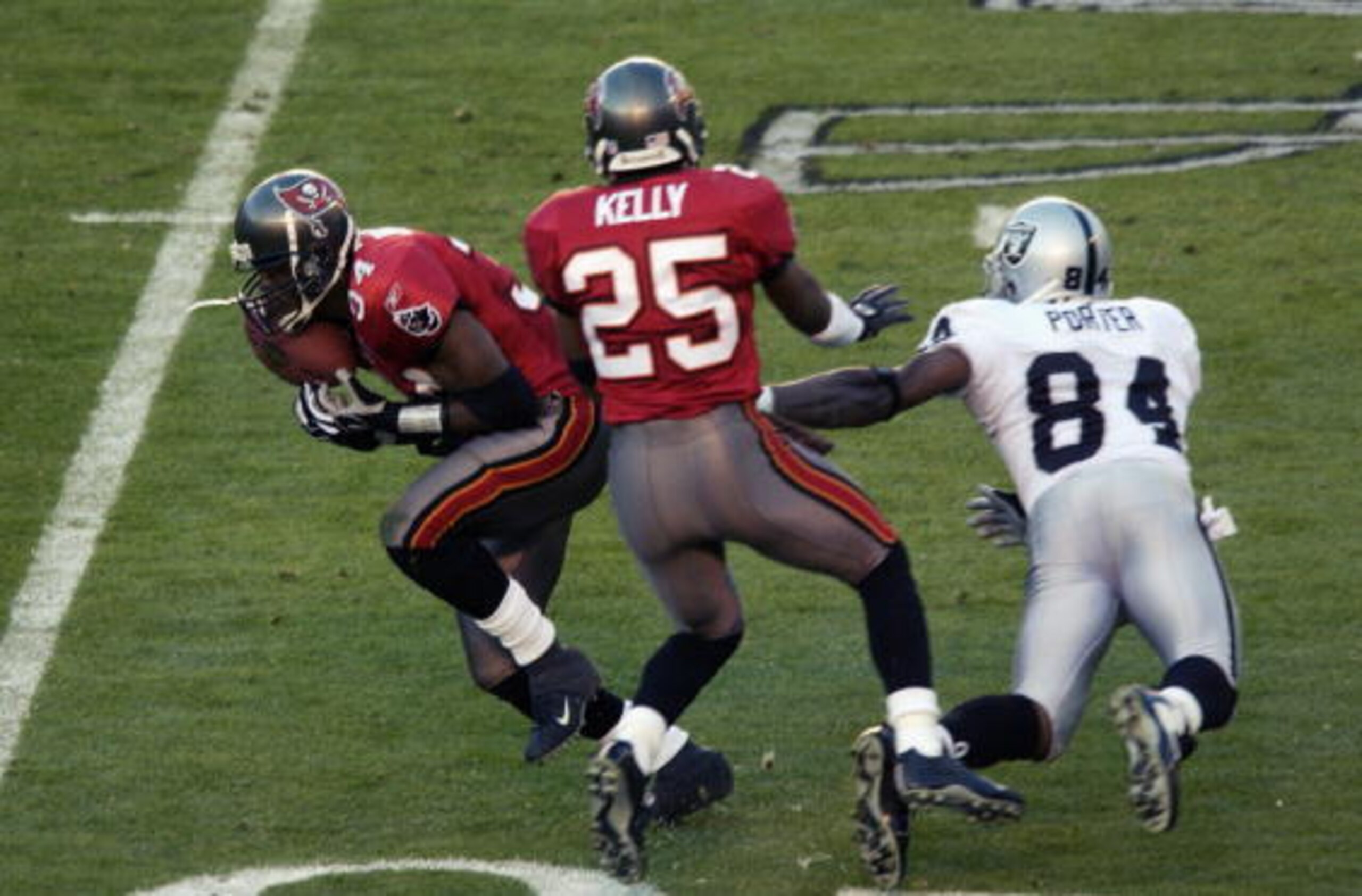
Super Bowl XXXVII: Tampa Bay Buccaneers 48, Oakland Raiders 21
It took 37 tries, but Super Bowl XXXVII finally featured the top-ranked offense (Raiders) in terms of yards gained versus the top-ranked defense (Buccaneers) in terms of yards allowed.
And since defense wins championships, was the result somewhat predictable?
A unit that featured Pro Football Hall of Famers Warren Sapp and Derrick Brooks could have earned 11 or so Most Valuable Player trophies. But the choice was Buccaneers free safety Dexter Jackson, who picked off 2002 NFL MVP Rich Gannon twice in the first half of his team’s 48-21 conquest of the silver and black.
All told, the Bucs intercepted Gannon five times, with the other three thefts being returned for scores by Dwight Smith (two) and Brooks (one). Jackson also had one tackle while knocking down two passes.
Was Smith more deserving of MVP honors? Along with his pair of pick-sixes, he finished with four tackles and a pair of passes defensed.
47. RB Ottis Anderson, New York Giants (Super Bowl XXV)
2 of 48
Super Bowl XXV: New York Giants 20, Buffalo Bills 19
It remains the only Super Bowl decided by a single point.
The New York Giants held the football for 40-plus minutes and scored 20 points. The Buffalo Bills had the pigskin 19-plus minutes and scored 19 points.
Bill Parcells’ game plan worked to perfection. And thanks to a veteran running back named Ottis Anderson, the Giants surprised the favored Bills.
Anderson ran 21 times for 102 yards and a score. New York rushed for 172 yards on 39 carries, which meant New York owned the line of scrimmage. So why no MVP love for the five members of the Giants offensive line?
46. CB Larry Brown, Dallas Cowboys (Super Bowl XXX)
3 of 48
Super Bowl XXX: Dallas Cowboys 27, Pittsburgh Steelers 17
The last time the Dallas Cowboys won a Super Bowl was 1995. It was the team’s third title in four years and came against a franchise the team had faced (and lost to) in two previous and epic Super Bowls.
This time around, the Cowboys were in their dynasty years. The Hall of Fame triplets of Troy Aikman, Emmitt Smith and Michael Irvin were the catalysts on offense. Both Aikman (XXVII) and Smith (XXVIII) were prior Super Bowl MVPs.
But in the 10-point win over the Steelers, it was unheralded cornerback Larry Brown, who picked off Pittsburgh quarterback Neil O’Donnell twice. If there is such a thing as fate, Brown was in the right place at the right time, as documented by Vito Stellino of The Baltimore Sun nearly two decades ago.
.jpg?w=2560 "Commanders Eagles Football")
45. QB Len Dawson, Kansas City Chiefs (Super Bowl IV)
4 of 48
Super Bowl IV: Kansas City Chiefs 23, Minnesota Vikings 7
It’s ingrained in our football memories.
The play is 65 Toss Power Trap. It was the first touchdown scored in Super Bowl IV by the Kansas City Chiefs, who were on their way to a 23-7 win that afternoon at New Orleans.
The head coach was Hall of Famer Hank Stram. Mic'd for the game by NFL Films, he was entertaining, fascinating and enlightening, as the late Steve Sabol tells us.
He had a quarterback named Len Dawson, who's also a member of the Pro Football Hall of Fame. That day, he completed 12 of his 17 throws for just 142 yards and a touchdown while throwing an interception. He seemed like an afterthought when you consider how the Chiefs defense took apart the Vikings. Middle linebacker Willie Lanier and his cohorts limited Minnesota to 239 total yards while forcing five turnovers.
Far from spectacular, Dawson still garnered MVP honors. Perhaps Stram would have been the better choice. He should've gotten an Emmy for his performance.
44. WR Fred Biletnikoff, Oakland Raiders (Super Bowl XI)
5 of 48
Super Bowl XI: Oakland Raiders 32, Minnesota Vikings 14
The Oakland Raiders were back in the Super Bowl for the first time in nine years, when the franchise lost the final game of the Vince Lombardi Era in Green Bay (Super Bowl II).
They were facing the Minnesota Vikings, who had already come up short three times on Super Sunday, including two of the previous three years (Super Bowls VIII and IX).
Oakland Raiders wide receiver Fred Biletnikoff caught four passes for 79 yards in this rout of the Purple Gang. He didn’t score a touchdown in the game, but his receptions set up the team’s numerous scoring opportunities as the Silver and Black finally reigned supreme.
43. DE Richard Dent, Chicago Bears (Super Bowl XX)
6 of 48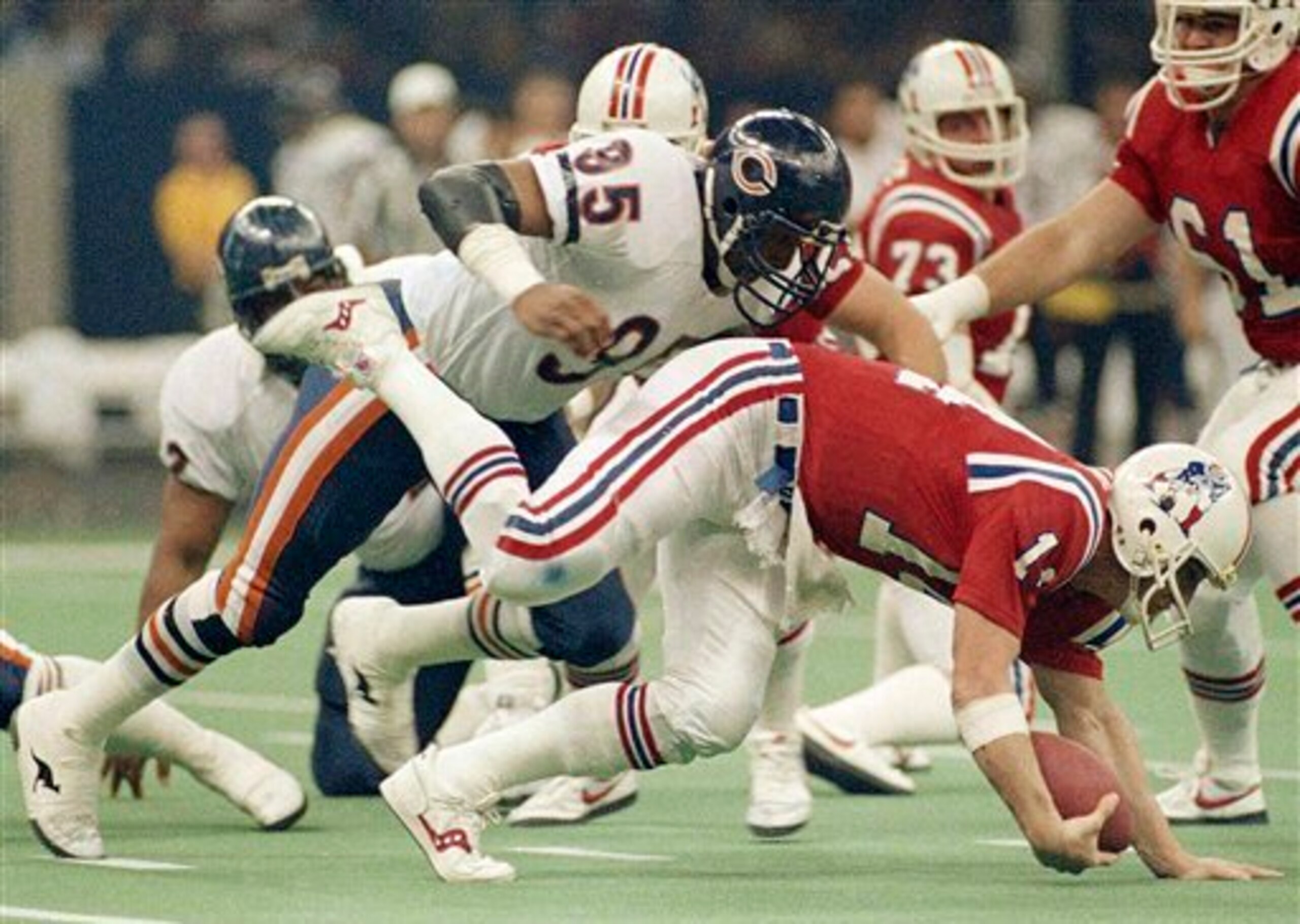
Super Bowl XX: Chicago Bears 46, New England Patriots 10
It remains one of the great defensive performances in the history of the Super Bowl.
Mike Ditka’s Chicago Bears limited Raymond Berry’s New England Patriots to 123 total yards, sacked quarterbacks Tony Eason and Steve Grogan a combined seven times and forced six turnovers in a mauling 36-point win.
Pro Football Hall of Fame defensive end Richard Dent made an impression early. He totaled three tackles, 1.5 sacks and forced a pair of fumbles in the easy victory. His relentless play symbolized the Bears’ impressive effort at the Louisiana Superdome.
Too bad there wasn’t a group award.
42. QB Roger Staubach, Dallas Cowboys (Super Bowl VI)
7 of 48
Super Bowl VI: Dallas Cowboys 24, Miami Dolphins 3
Once upon a time in our current galaxy, the Dallas Cowboys couldn’t win the big one.
They finally got it done with a convincing 24-3 win over the Miami Dolphins.
Obviously, Pro Football Hall of Fame quarterback Roger Staubach was the game’s MVP, but with very modest stats. He completed 12 of 19 passes for 119 yards and a pair of touchdowns in the victory.
However, why no love for a defensive unit that held Miami to 185 total yards? To this day, these Dolphins are the only team not to score a touchdown in a Super Bowl.
There were a few worthy MVP candidates in regard to Staubach’s teammates. Safety Cliff Harris totaled 10 tackles. Defensive tackle Bob Lilly amassed six stops and added a Super Bowl record sack of Dolphins quarterback Bob Griese that amounted to a 29-yard loss.
41. QB Tom Brady, New England Patriots (Super Bowl XXXVI)
8 of 48
Super Bowl XXXVI: New England Patriots 20, St. Louis Rams 17
Can you imagine today’s New England Patriots only scoring a total of three offensive touchdowns in three games?
That is sometimes one quarter’s work when it comes to Tom Brady and the always-dangerous New England attack.
But that was the case during the Patriots’ first championship run.
Brady and the offense managed only one trip to the end zone in the 20-17 win over the heavily favored St. Louis Rams. The then-second-year quarterback threw for a mere 145 yards and one score that day in New Orleans.
However, Brady saved his best for last, and perhaps that was enough to capture MVP honors. He led the team on a nine-play, 53-yard drive with less than two minutes remaining. Then Adam Vinatieri booted the game-winning 48-yard field goal on the final play of the game.
Was the kicker worthy of the MVP award? Vinatieri would have been an intriguing selection.
40. QB Terry Bradshaw, Pittsburgh Steelers (Super Bowl XIV)
9 of 48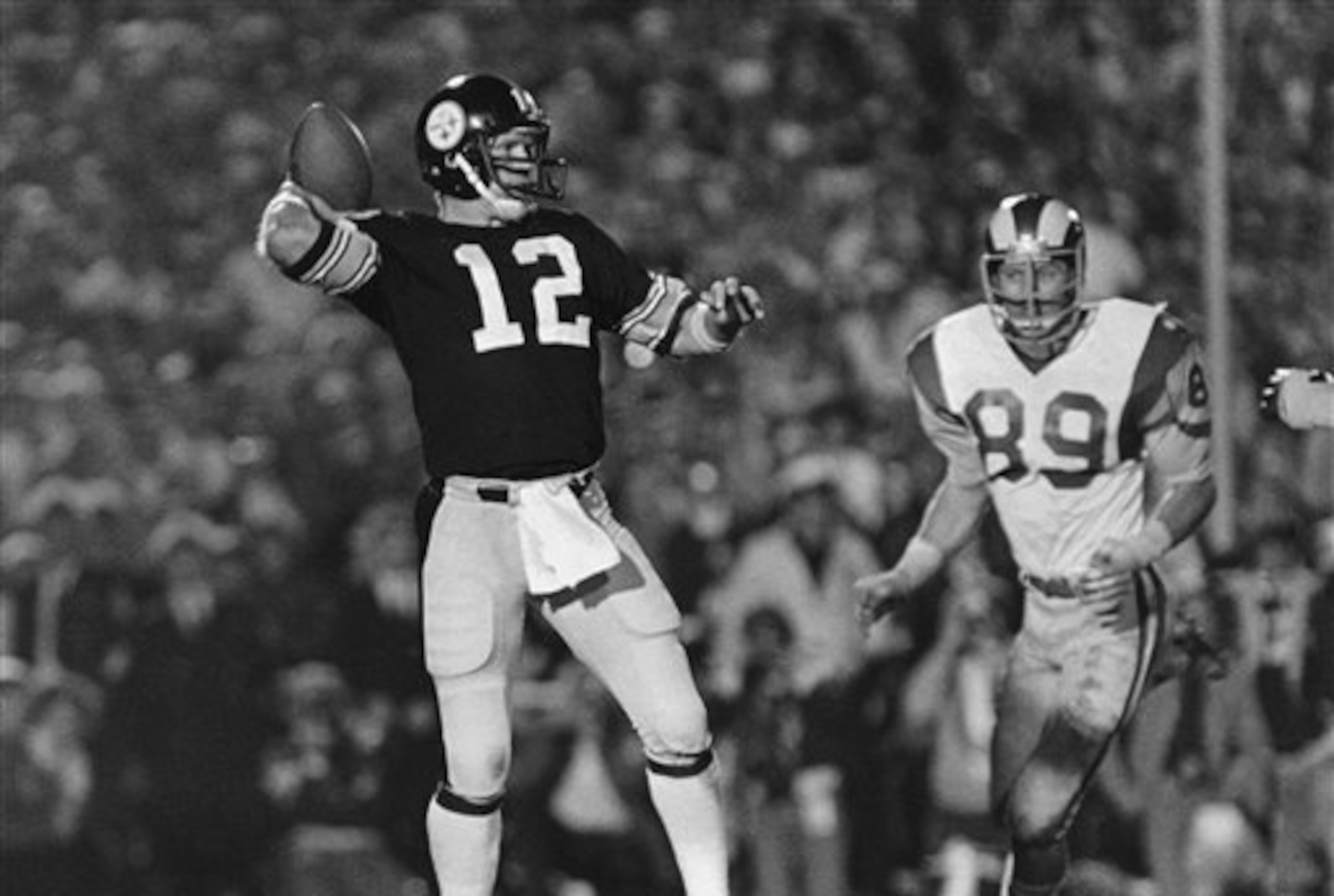
Super Bowl XIV: Pittsburgh Steelers 31, Los Angeles Rams 19
There's only been three occasions when a team has committed more turnovers in a Super Bowl and still managed to win the game.
One of those three contests was Super Bowl XIV, when Pittsburgh Steelers quarterback Terry Bradshaw threw three interceptions, yet his team still managed to outlast the Los Angeles Rams.
The Hall of Fame signal-caller connected with Lynn Swann (47 yards) and John Stallworth (73 yards) for long scores in the second half. Bradshaw threw for 309 yards by game’s end and captured MVP honors for the second consecutive year.
39. QB Peyton Manning, Indianapolis Colts (Super Bowl XLI)
10 of 48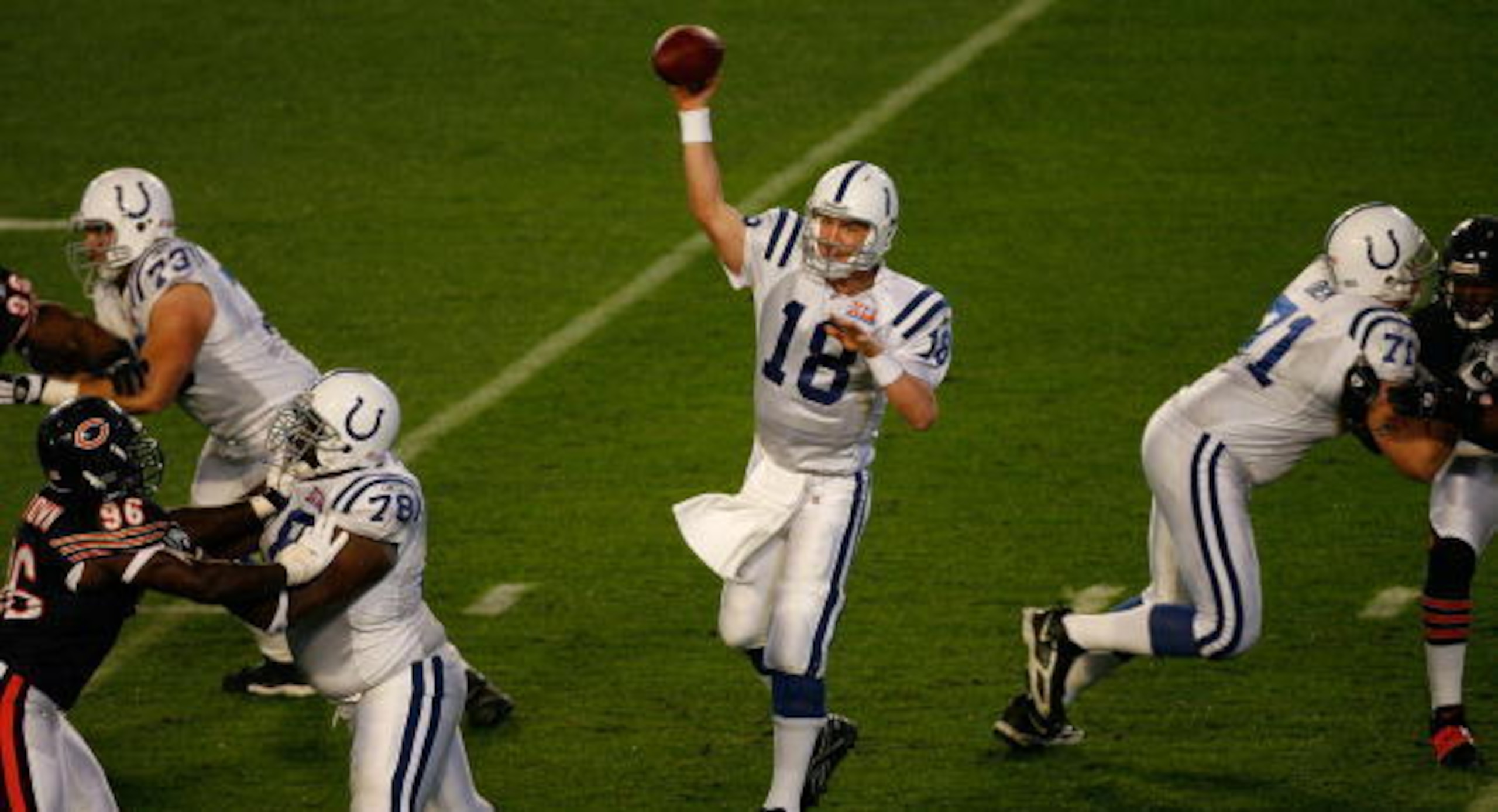
Super Bowl XLI: Indianapolis Colts 29, Chicago Bears 17
In his ninth NFL season, quarterback Peyton Manning won his first and only Super Bowl to date.
It came during a playoff run that was far from his best.
In four postseason games, Manning threw more than twice as many interceptions (seven) as touchdown passes (three), and you can add in a lost fumble as well. Still, the Indianapolis Colts claimed their second Super Bowl victory in 36 years via a 29-17 conquest of the Chicago Bears.
Manning completed 25 of 38 passes for 247 yards and one score. But he was sacked once and also committed a pair of turnovers.
So how about co-MVPs? Colts running backs Dominic Rhodes (113 yards, one touchdown) and Joseph Addai (143 yards) combined for 256 yards from scrimmage in the rain at Miami.
38. DE Harvey Martin and DT Randy White, Dallas Cowboys (Super Bowl XII)
11 of 48Super Bowl XII: Dallas Cowboys 27, Denver Broncos 10
For the first and only time in Super Bowl history, we saw co-MVPs emerge from the game.
Defensive end Harvey Martin and Hall of Fame defensive tackle Randy White were a big part of a Dallas Cowboys “Doomsday” defense that smothered the Denver Broncos at the Louisiana Superdome in the first Super Bowl played indoors.
The Cowboys crushed the Broncos. Dallas limited Denver to 156 total yards, sacked quarterbacks Craig Morton and Norris Weese a combined four times and forced eight turnovers—six in the first half.
White totaled five stops and one sack. Martin added two tackles and a pair of sacks and knocked down a pass.
It was a thorough destruction.
37. QB Joe Montana, San Francisco 49ers (Super Bowl XVI)
12 of 48
Super Bowl XVI: San Francisco 49ers 26, Cincinnati Bengals 21
In the team’s very first Super Bowl appearance, the San Francisco 49ers saw Joe Montana earn the first of his three Super Bowl MVP awards.
But did the future Hall of Fame quarterback deserve those accolades in a 26-21 victory over the Cincinnati Bengals? He led an offense that managed only 275 total yards and scored a pair of touchdowns.
Granted, Montana had his hands in both of those trips to the end zone. He threw for 157 yards and a score (to fullback Earl Cooper), and his one-yard touchdown plunge in the first quarter gave the Niners a 7-0 lead.
What about Ray Wersching, who was successful on all four field-goal attempts and squib-kicked the Bengals all day? How about cornerback Eric Wright, who totaled five tackles, knocked down a pass, forced a fumble and had one of the team’s two interceptions of Cincinnati quarterback Ken Anderson?
Still, the nod went to Montana. And we’re “cool” with that.
36. WR Deion Branch, New England Patriots (Super Bowl XXXIX)
13 of 48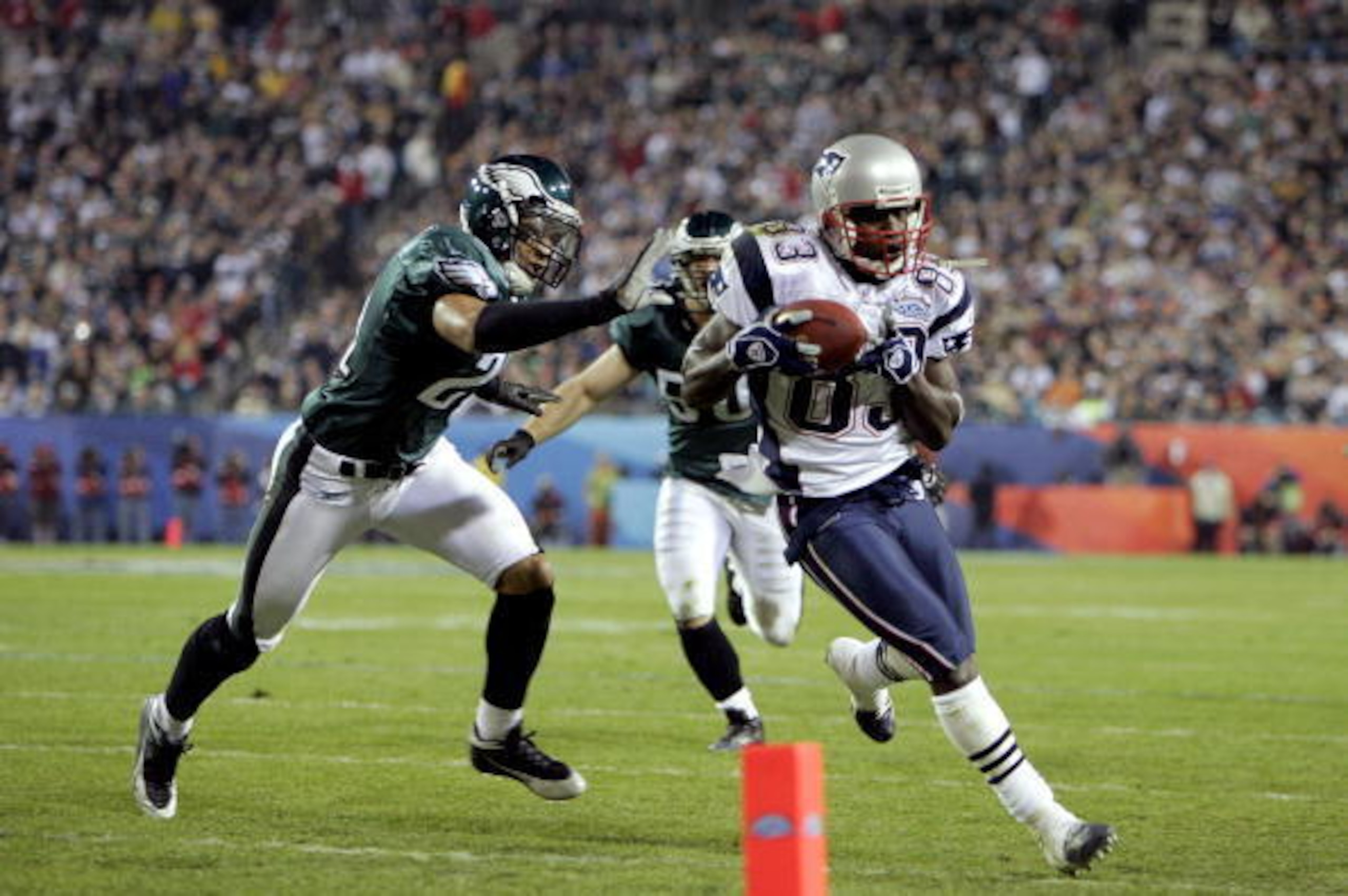
Super Bowl XXXIX: New England Patriots 24, Philadelphia Eagles 21
It’s somewhat hard to catch 11 passes in a game and not score a touchdown.
No matter. New England Patriots wide receiver Deion Branch did just that in Super Bowl XXXIX against the Philadelphia Eagles. While he never crossed the goal line, he did earn a Super Bowl ring and game MVP accolades in the process.
Branch was quarterback Tom Brady’s favorite receiver against the Birds. His 11 receptions totaled 133 yards, which was not bad considering the Patriots quarterback threw for 236 yards that day in Jacksonville, Florida. Branch’s 11 grabs was also nearly half of Brady’s completion total (23) in the game.
The spoils in terms of touchdown passes went to David Givens and Mike Vrabel. The game’s top honor went to Branch.
35. QB John Elway, Denver Broncos (Super Bowl XXXIII)
14 of 48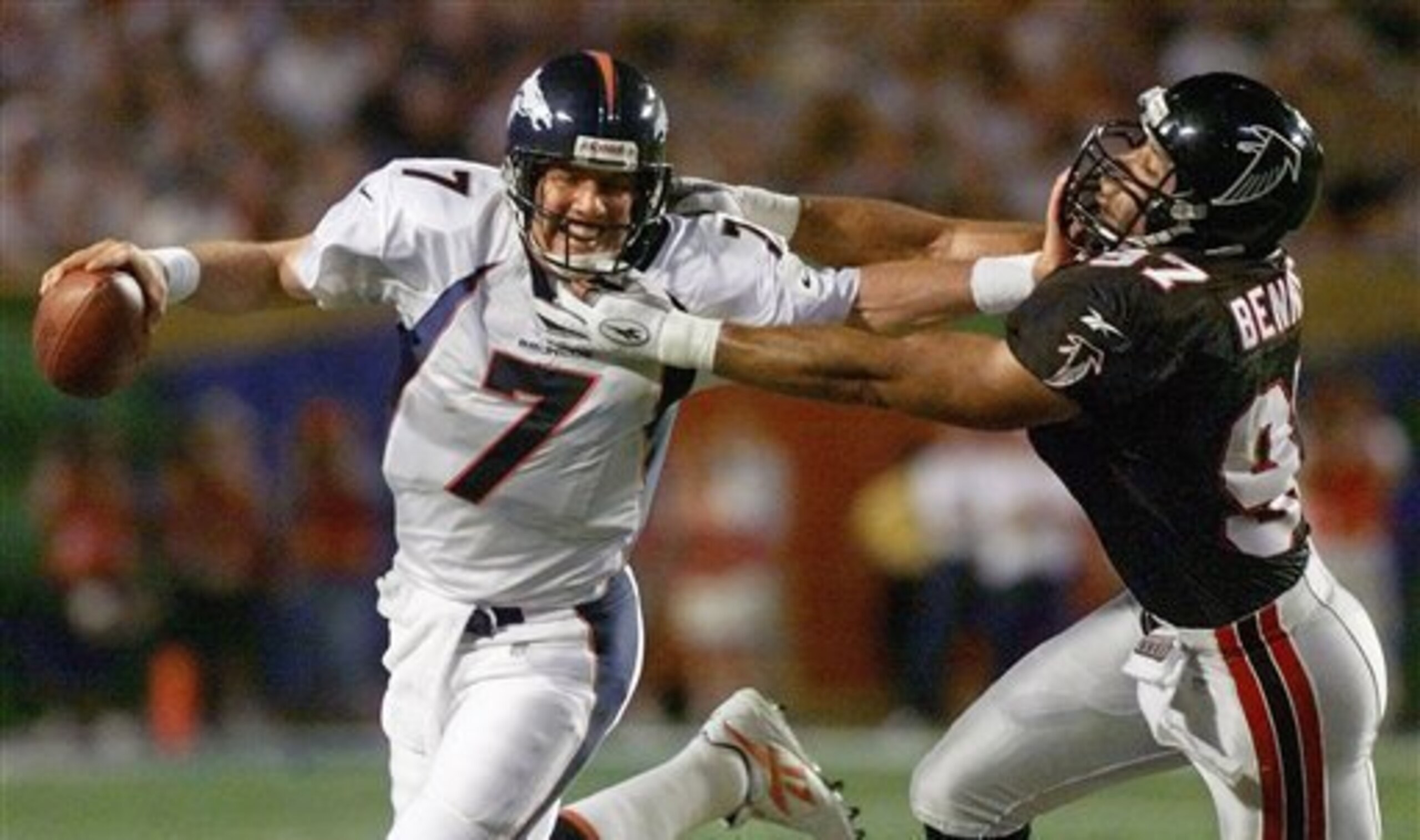
Super Bowl XXXIII: Denver Broncos 34, Atlanta Falcons 19
During his magnificent career, Denver Broncos quarterback John Elway never had great numbers in any of his Super Bowl appearances...until the very last contest. It proved to be the final game of his 16-year NFL career.
But what’s wrong with going out on top? The talented signal-caller completed 18 of 29 passes for 336 yards and a touchdown (one interception) and added a three-yard run for a score in the Broncos' 34-19 win over the upstart Atlanta Falcons.
The win saw Denver’s potent offense roll up 457 total yards against a Falcons team led by head coach Dan Reeves, Elway’s sideline leader in the Mile High City for 10 years from 1983 to 1992. The duo had been to three previous Super Bowls together with zero success.
It was somehow fitting that Reeves was there to witness Elway’s shining moment.
34. FS Jake Scott, Miami Dolphins (Super Bowl VII)
15 of 48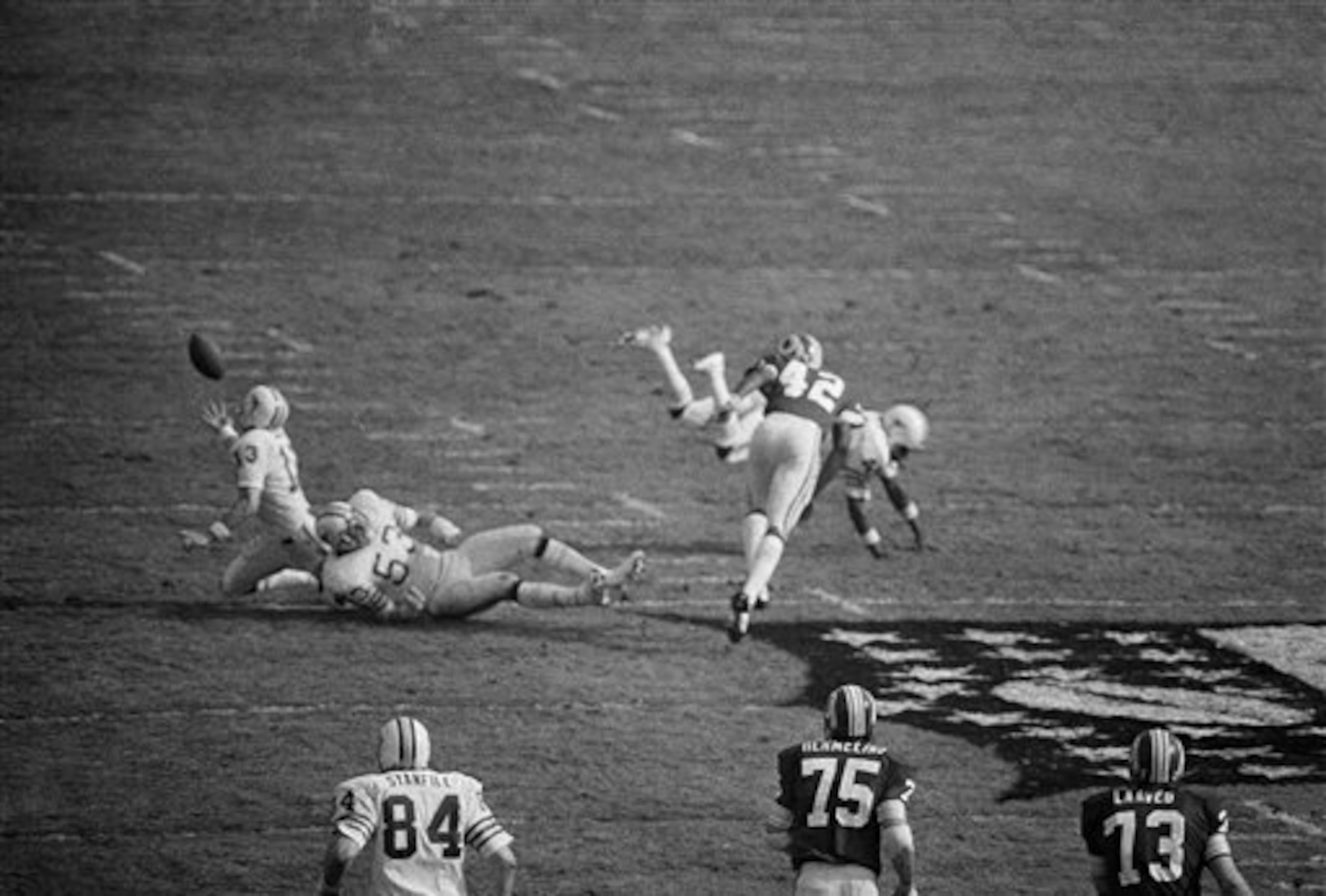
Super Bowl VII: Miami Dolphins 14, Washington Redskins 7
As you can clearly see here, it’s the most glorious of photos. Then again, it wasn’t the most glorious of games.
However, the end result was indeed historic. The Miami Dolphins completed a perfect 17-0 season with a 14-7 victory over George Allen’s “Over the Hill Gang.”
The Dolphins, born in the AFL out of expansion in 1966, took less than 10 seasons to capture an NFL title. They outslugged the Redskins in a defensive duel that saw Miami (253) and Washington (228) combine for only 481 total yards.
Free safety Jake Scott (No. 13) was a big part of keeping Allen’s offense out of the end zone. He totaled a pair of tackles and two of the three interceptions of Redskins quarterback Billy Kilmer.
So how did the Redskins score their only touchdown? It was courtesy of Dolphins kicker Garo Yepremian, who turned a block field goal into an adventure, his bobble and fumble returned by Mike Bass for a score.
33. QB Eli Manning, New York Giants (Super Bowl XLII)
16 of 48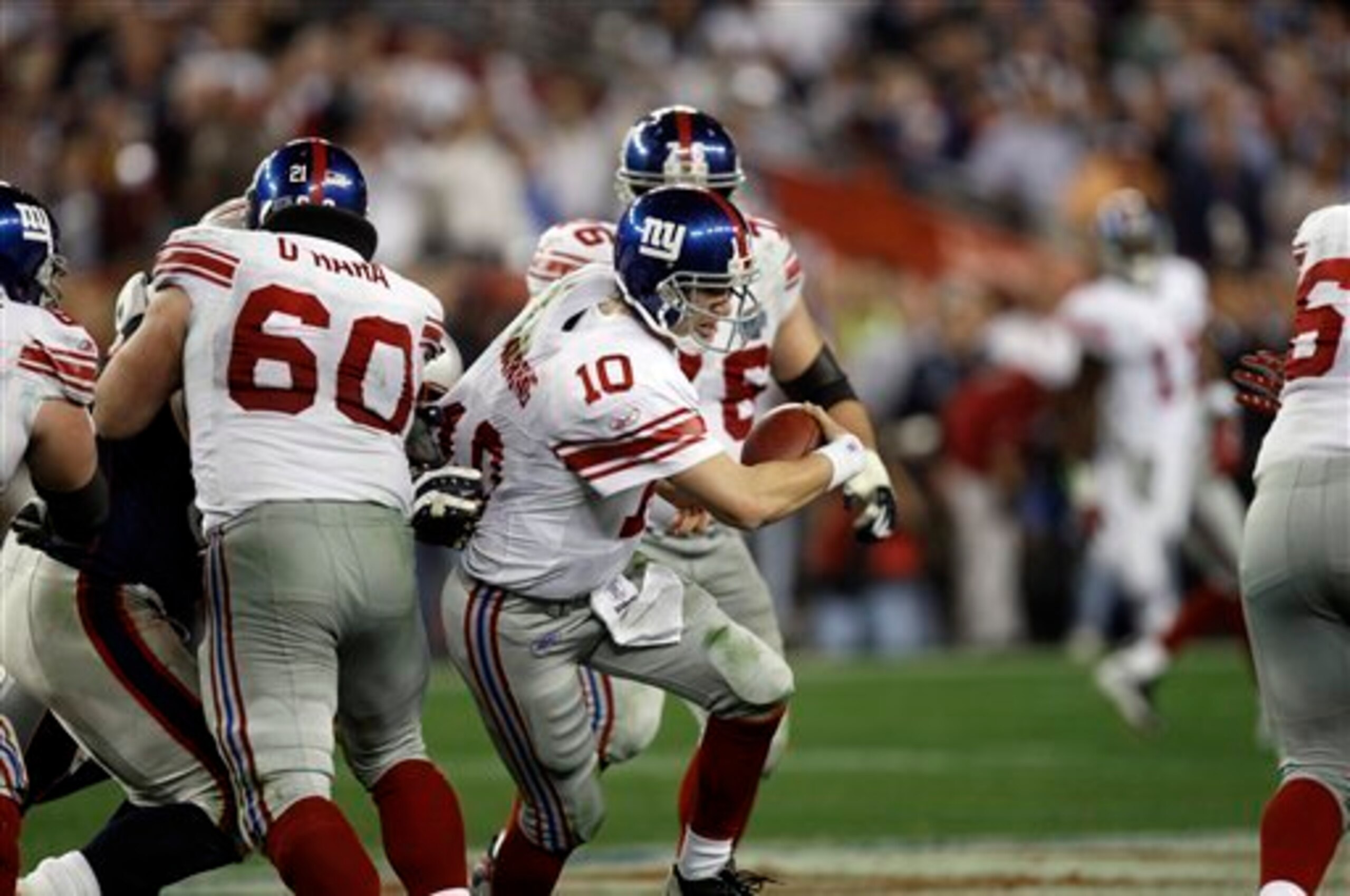
Super Bowl XLII: New York Giants 17, New England Patriots 14
The New England Patriots entered Super Bowl XLII riding an 18-game overall winning streak. Bill Belichick’s explosive squad had an opportunity to not only become just the second team in NFL history to go unbeaten and untied, but could do the 17-0 Miami Dolphins of 1972 two better by finishing 19-0.
That’s a lot of numbers. Unfortunately, the Pats did not put up a lot of numbers that day in Glendale, Arizona, as the New York Giants pulled off a stunning 17-14 win.
Obviously, Big Blue wasn’t overwhelming on the scoreboard. But quarterback Eli Manning led a pair of touchdown drives late in the second half that resulted in a pair of fourth-quarter touchdowns. He threw for 255 yards and was picked off once, but his 13-yard score to wide receiver Plaxico Burress with 35 seconds to play proved to be just perfect.
Of course, Burress’ touchdown would have never occurred if some guy named David Tyree (who scored New York’s first touchdown of the game) hadn’t used his head...literally.
32. LB Malcolm Smith (Super Bowl XLVIII)
17 of 48Super Bowl XLVIII: Seattle Seahawks 43, Denver Broncos 8
It was a complete annihilation of the highest-scoring team in NFL history.
The Seattle Seahawks abused the Denver Broncos 43-8, limiting quarterback Peyton Manning and his cohorts to one touchdown. This after Manning and co. had totaled a record 606 points during the regular season.
Pete Carroll’s squad beat the Broncos in every phase: offense, defense and special teams. But the biggest standout of them all was outside linebacker Malcolm Smith, who not only returned an interception 69 yards for a touchdown but totaled nine tackles and a fumble recovery. All told, the Seahawks forced four turnovers in the convincing 35-point victory.
Could we see another Seattle defender walk away with MVP honors this Sunday in Super Bowl XLIX? The defending champions square off with the New England Patriots at University of Phoenix Stadium this weekend.
31. QB Bart Starr, Green Bay Packers (Super Bowl II)
18 of 48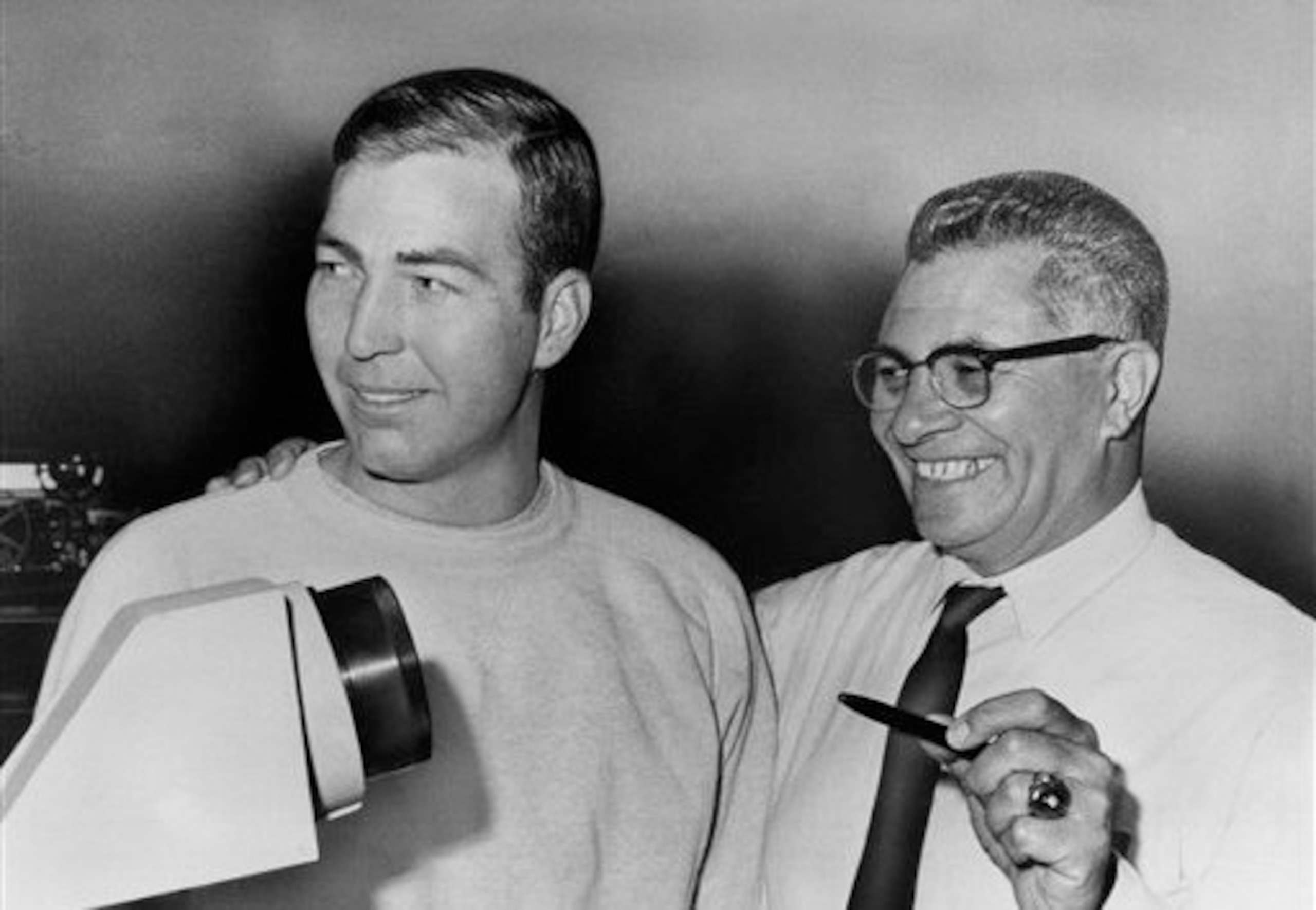
Super Bowl II: Green Bay Packers 33, Oakland Raiders 14
It was hard to find a real standout in Green Bay’s 33-14 victory over the Raiders at Miami’s Orange Bowl, which resulted in the third consecutive NFL title for Vince Lombardi’s Packers. Of course, it was also the last game for the legendary head coach.
For the second time in as many years, quarterback Bart Starr was named the game’s MVP. But his statistical performance was hardly thrilling. He completed 13 of 24 passes for 202 yards and a touchdown, plus he rushed for 14 yards. While Starr was sacked four times, the Packers did not commit a turnover.
Meanwhile, kicker Don Chandler accounted for nearly half (15) of the team’s 33 points thanks to four field goals and three PATs.
30. QB Tom Brady, New England Patriots (Super Bowl XXXVIII)
19 of 48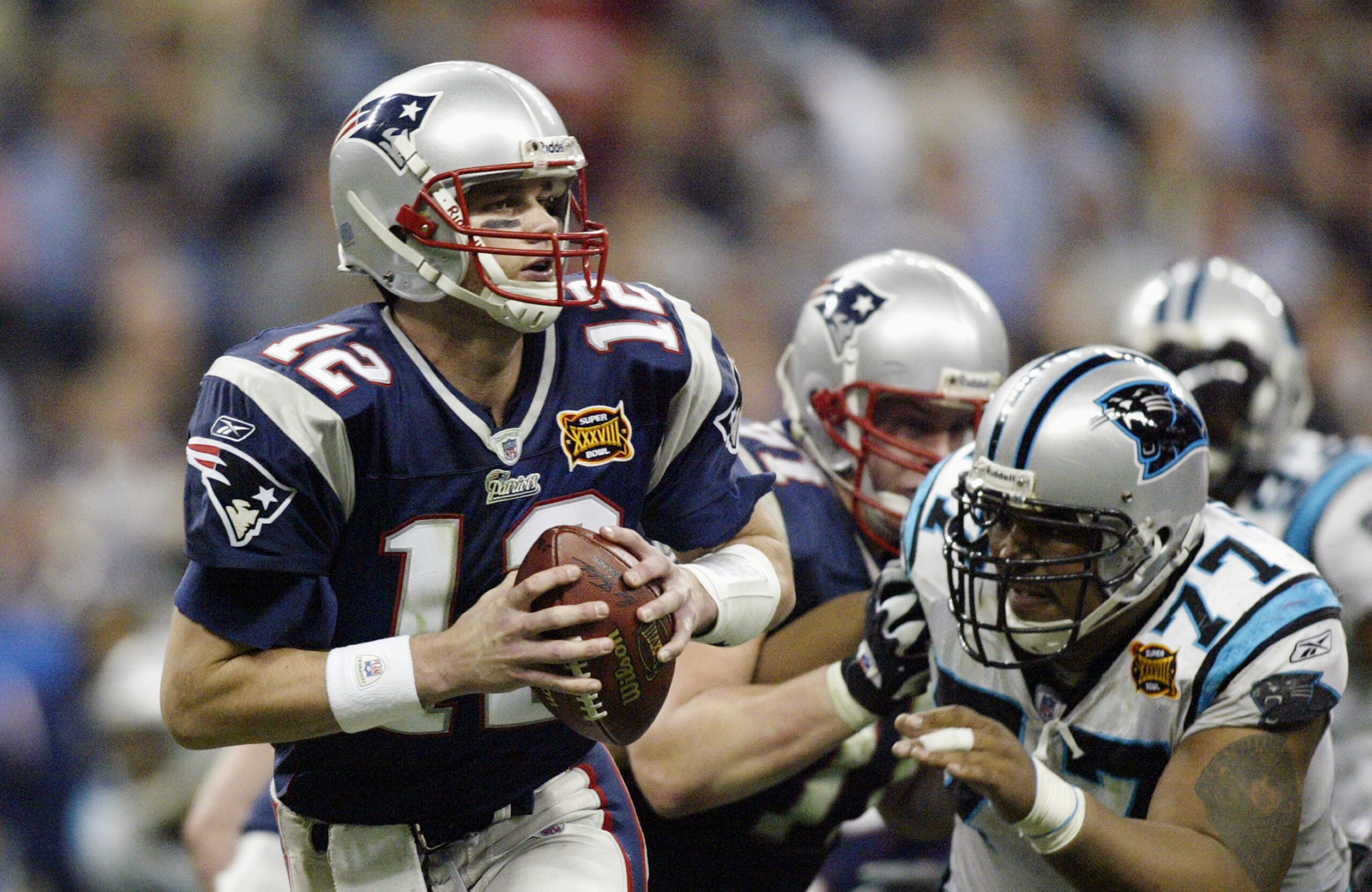
Super Bowl XXXVIII: New England Patriots 32, Carolina Panthers 29
In one of the more underrated Super Bowls, Patriots quarterback Tom Brady garnered MVP honors for the second time as New England captured its second Lombardi Trophy in three years.
The young signal-caller, in just his fourth NFL season, completed 32 of his 48 throws for 354 yards (the sixth-highest single game total in Super Bowl history) and three touchdowns (one interception). He also orchestrated the game-winning drive in the closing moments, resulting in Adam Vinatieri’s 41-yard field goal with four seconds to play.
Brady and the Pats offense rolled up 481 yards that day—further proof the team was not malfunctioning that Super Sunday.
29. QB Joe Namath, New York Jets (Super Bowl III)
20 of 48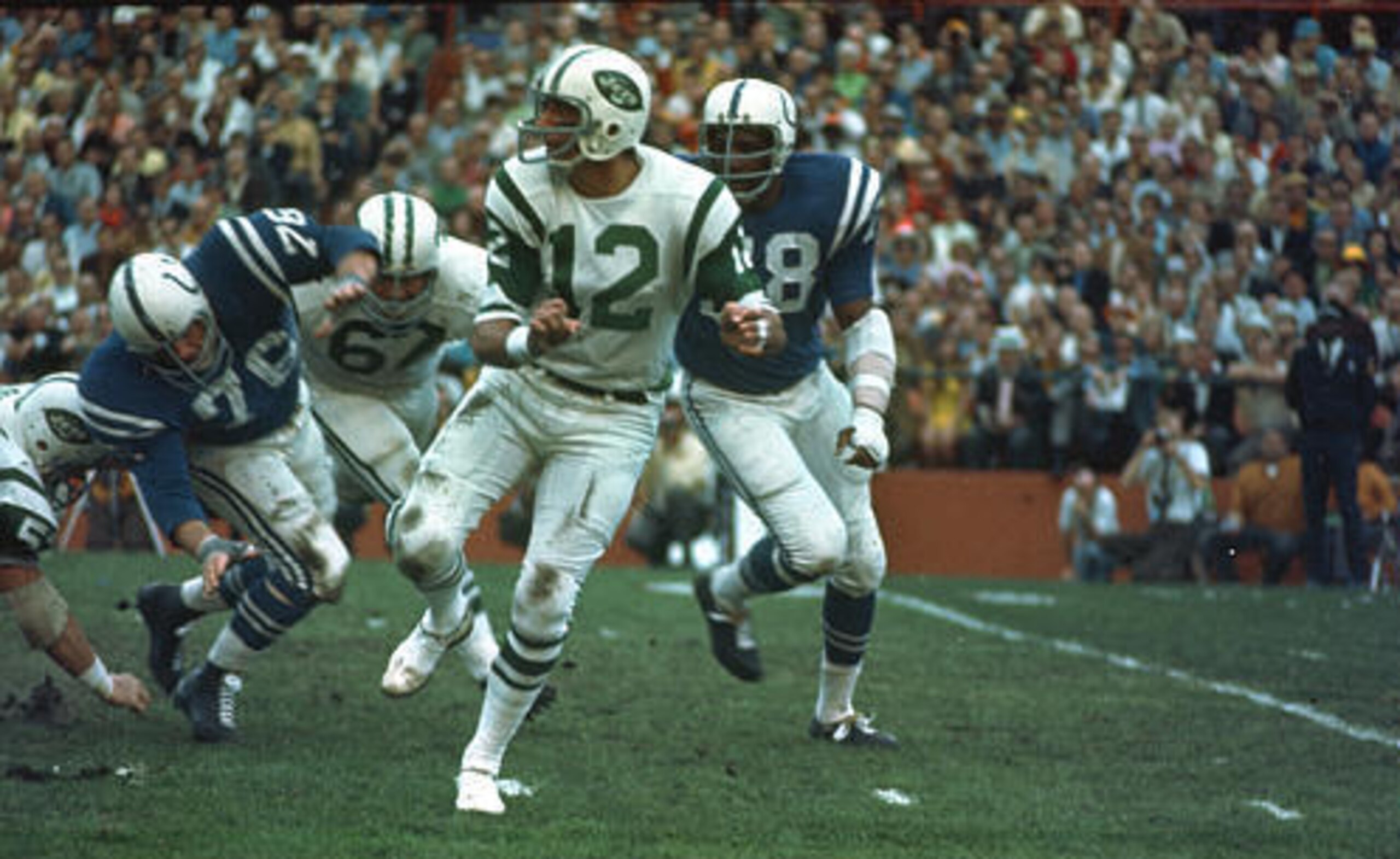
Super Bowl III: New York Jets 16, Baltimore Colts 7
I guarantee some football pundits didn’t necessarily agree with New York Jets quarterback Joe Namath earning MVP honors for his play in Super Bowl III.
The popular signal-caller completed 17 of his 28 throws for 206 yards in the team’s 16-7 upset of the Baltimore Colts. But was he the best player on the Orange Bowl field that Sunday afternoon?
Running back Matt Snell totaled 34 touches from scrimmage, gained 161 yards (121 rushing, 40 receiving) and scored New York’s only touchdown against the highly regarded Baltimore defense.
Perhaps Namath’s earlier guarantee of a win left an unforgettable impression. In any case, Snell’s performance was the assurance the Jets really needed.
28. LB Chuck Howley, Dallas Cowboys (Super Bowl V)
21 of 48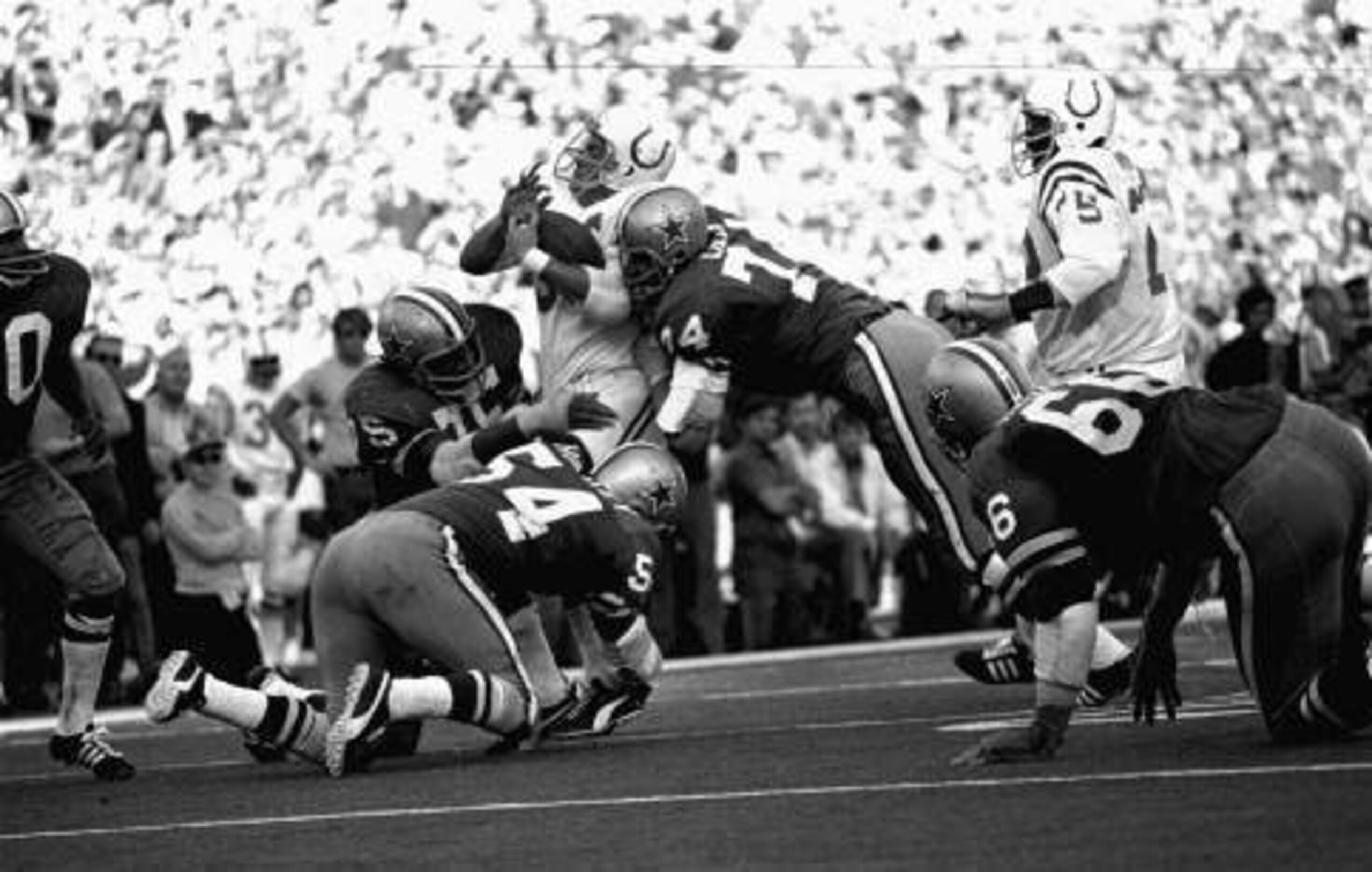
Super Bowl V: Baltimore Colts 16, Dallas Cowboys 13
Here’s a pretty remarkable statistic if you think about it: There have been 48 Super Bowl champions, and those winners have committed a combined 52 turnovers.
But take away what the Baltimore Colts managed to do (or not do) in Super Bowl V, and that number becomes even more amazing.
Led by head coach Don McCafferty, the Colts squared off against the Dallas Cowboys and turned the football over seven times...but they still managed to win the game.
It helped that Dallas contributed with four turnovers of its own. One of those led to Jim O’Brien’s 32-yard field goal with five seconds to play, which gave Baltimore a 16-13 win.
So it is little wonder in this low-scoring affair a defensive player would capture MVP honors. But the award went to Cowboys linebacker Chuck Howley, who totaled four tackles and a pair of interceptions in a losing effort. He not only became the first defensive player to be named Super Bowl MVP, but he remains the only performer on a losing team to earn the award.
27. QB Joe Flacco, Baltimore Ravens (Super Bowl XLVII)
22 of 48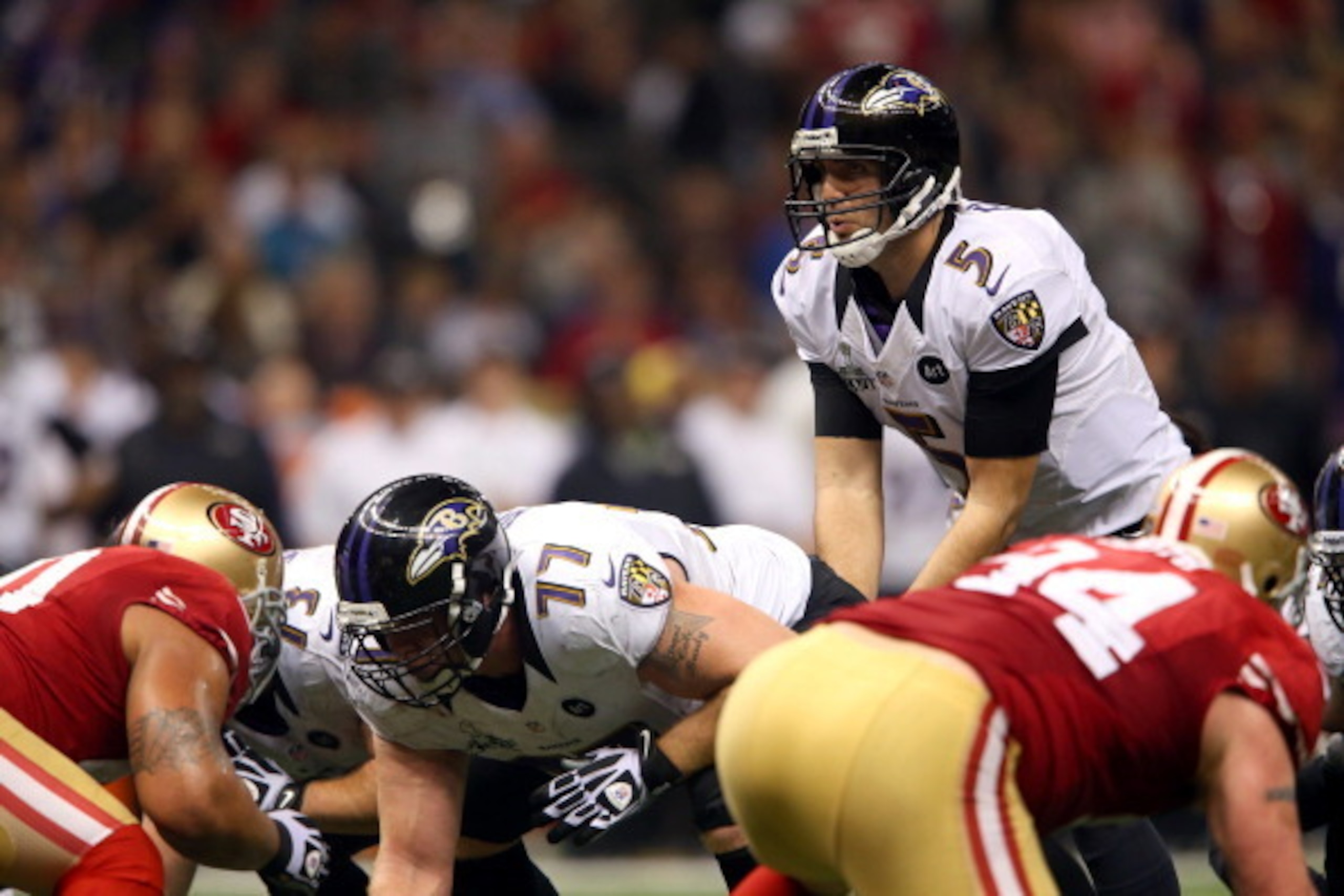
Super Bowl XLVII: Baltimore Ravens 34, San Francisco 49ers 31
Much-maligned Baltimore Ravens quarterback Joe Flacco was having a postseason for the ages. And it would culminate in Super Bowl XLVII with a victory and his best performance of the 2012 playoffs.
The club had disposed of the Indianapolis Colts, Denver Broncos and New England Patriots on its way to a meeting with the San Francisco 49ers at the Louisiana Superdome.
Flacco connected on 22 of his 33 throws for 287 yards and three touchdowns in the thrilling 34-31 win. Some would call it a lights-out performance. As we all know, a third-quarter power outage at the Dome almost wrecked John Harbaugh’s plans of defeating his brother Jim in the NFL’s biggest game of the season.
The Ravens would build a 28-6 lead and hold on for the victory, with all three of Flacco’s scoring passes coming in the first half.
26. RB Franco Harris, Pittsburgh Steelers (Super Bowl IX)
23 of 48
Super Bowl IX: Pittsburgh Steelers 16, Minnesota Vikings 6
We were about to see an NFL dynasty launched in the Big Easy in Super Bowl IX—only no one knew it at the time.
The Pittsburgh Steelers defeated the Minnesota Vikings 16-6 at Tulane Stadium, and in the process, held the NFC champions to a Super Bowl record-low 119 total yards.
The Vikings offense was completely stifled and never reached the end zone. It didn’t help Minnesota’s cause that the Steelers held the football for 38 minutes, 47 seconds. The Vikings also had five costly turnovers.
But the “Purple People Eaters” defense featuring Hall of Famers in defensive tackle Alan Page, defensive end Carl Eller and safety Paul Krause had its hands full with Steelers’ third-year running back Franco Harris. Pittsburgh’s workhorse totaled 34 carries for 158 yards rushing in the win, and the Steelers set a Super Bowl record with 57 rushing attempts.
It was the Steelers' first of four Super Bowl wins in six years, an accomplishment that has yet to be matched.
25. QB Mark Rypien, Washington Redskins (Super Bowl XXVI)
24 of 48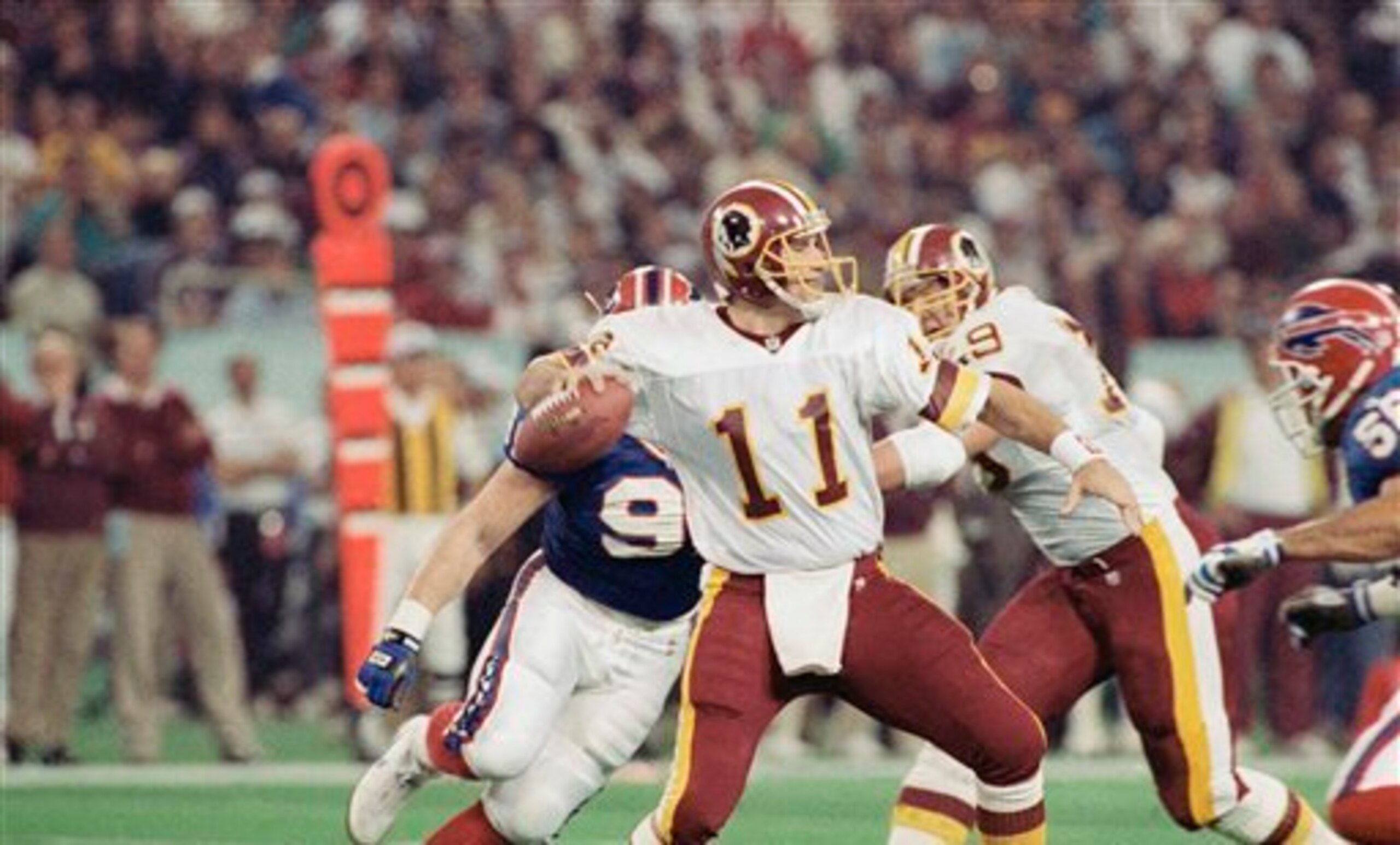
Super Bowl XXVI: Washington Redskins 37, Buffalo Bills 24
It turned out to be a game more known for what the Buffalo Bills didn’t do than what Joe Gibbs’ Washington Redskins actually accomplished.
Led by quarterback Mark Rypien, the ‘Skins rolled to a 37-24 victory over the Bills in a game that wasn’t nearly as close as the final score indicated. The explosive Buffalo offense was limited to 283 total yards and managed to make the result respectable thanks to a pair of touchdowns with less than six minutes to play.
Rypien connected on 18 of his 33 pass attempts for 292 yards and touchdown passes to running back Earnest Byner and wide receiver Gary Clark. The game’s MVP threw one interception, but Washington’s offensive front did not allow a sack in the contest.
It was Rypien’s finest moment as an NFL quarterback and also remains the last time the Redskins reached the Super Bowl.
24. QB Eli Manning, New York Giants (Super Bowl XLVI)
25 of 48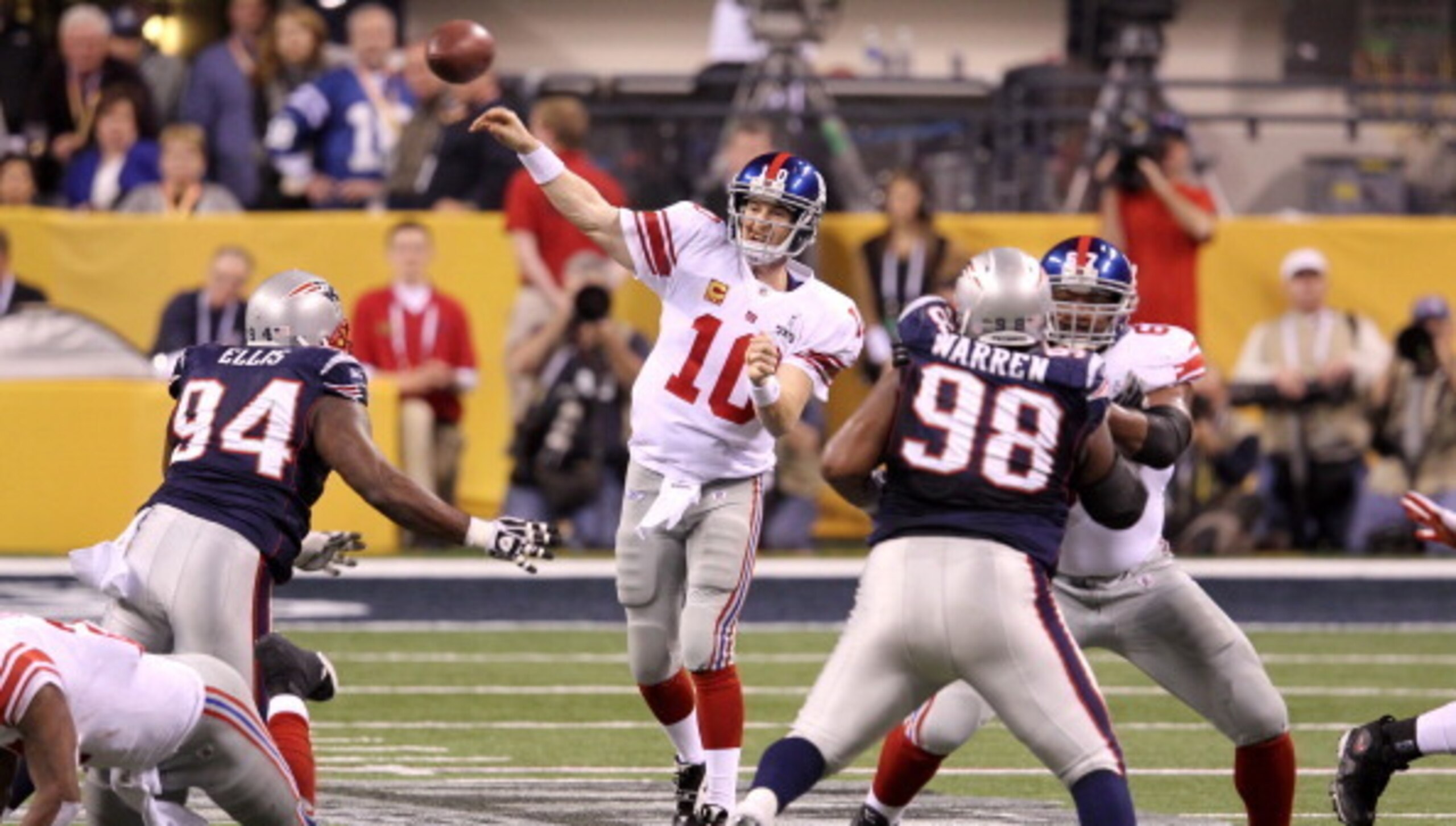
Super Bowl XLVI: New York Giants 21, New England Patriots 17
You think the New York Giants had the New England Patriots’ number?
Four years after Big Blue prevented Bill Belichick and his team from achieving perfection, the Giants proved they had the perfect game plan in beating Tom Brady and co.
In Week 9 of 2011, Eli Manning and his team went to Foxborough and snapped the Pats’ 20-game home regular-season winning streak courtesy of a 24-20 victory.
New England didn't lose another game entering Super Bowl XLVI—racking up 10 straight wins, including playoffs—but it ran into the Giants again. And New York jumped out to a 9-0 lead, fell behind 17-9 and then rally for a 21-17 win.
For the second time in five years, Manning was Super Bowl MVP. He completed 75 percent of his passes (30-of-40) for 296 yards and a score. But his best throw (or was it just a great catch by Mario Manningham?) came in the team’s fourth-quarter game-winning drive.
23. LB Ray Lewis, Baltimore Ravens (Super Bowl XXXV)
26 of 48
Super Bowl XXXV: Baltimore Ravens 34, New York Giants 7
In some ways, you almost had to feel sorry for head coach Jim Fassel, quarterback Kerry Collins and the New York Giants offense.
They never had a chance.
The Giants ran 59 plays and gained 152 total yards. Collins was sacked four times and threw four interceptions. New York’s offense never saw the end zone, with the team’s lone touchdown coming on a Ron Dixon 97-yard kickoff return in the third quarter after the Ravens had built a 17-0 lead.
Let’s not bury the lead. The Baltimore defense was amazing, and had been all season, limiting a total of 20 opponents (including playoffs) to a mere 188 points.
The unit had its stars, but none shined brighter than middle linebacker Ray Lewis, who knocked down four passes and a few Giants, totaling five tackles in the win.
22. WR Santonio Holmes, Pittsburgh Steelers (Super Bowl XLIII)
27 of 48Super Bowl XLIII: Pittsburgh Steelers 27, Arizona Cardinals 23
The catch is spectacular.
Most people remember Pittsburgh Steelers wide receiver Santonio Holmes and his Cris Carter-like footwork in the end zone in the closing minute of Super Bowl XLIII.
The six-yard touchdown reception with 35 seconds to play would prove to be the difference in the Steelers’ sixth Super Bowl win, a thrilling 27-23 conquest of the Arizona Cardinals at Raymond James Stadium in Tampa, Florida.
Holmes earned MVP honors, but it wasn’t just because of his Fred Astaire imitation in front of the Cardinals secondary. The third-year wideout caught nine passes for 131 yards by game’s end, with four of those catches (for 73 yards) coming on Pittsburgh’s game-winning drive.
21. QB Kurt Warner, St. Louis Rams (Super Bowl XXXIV)
28 of 48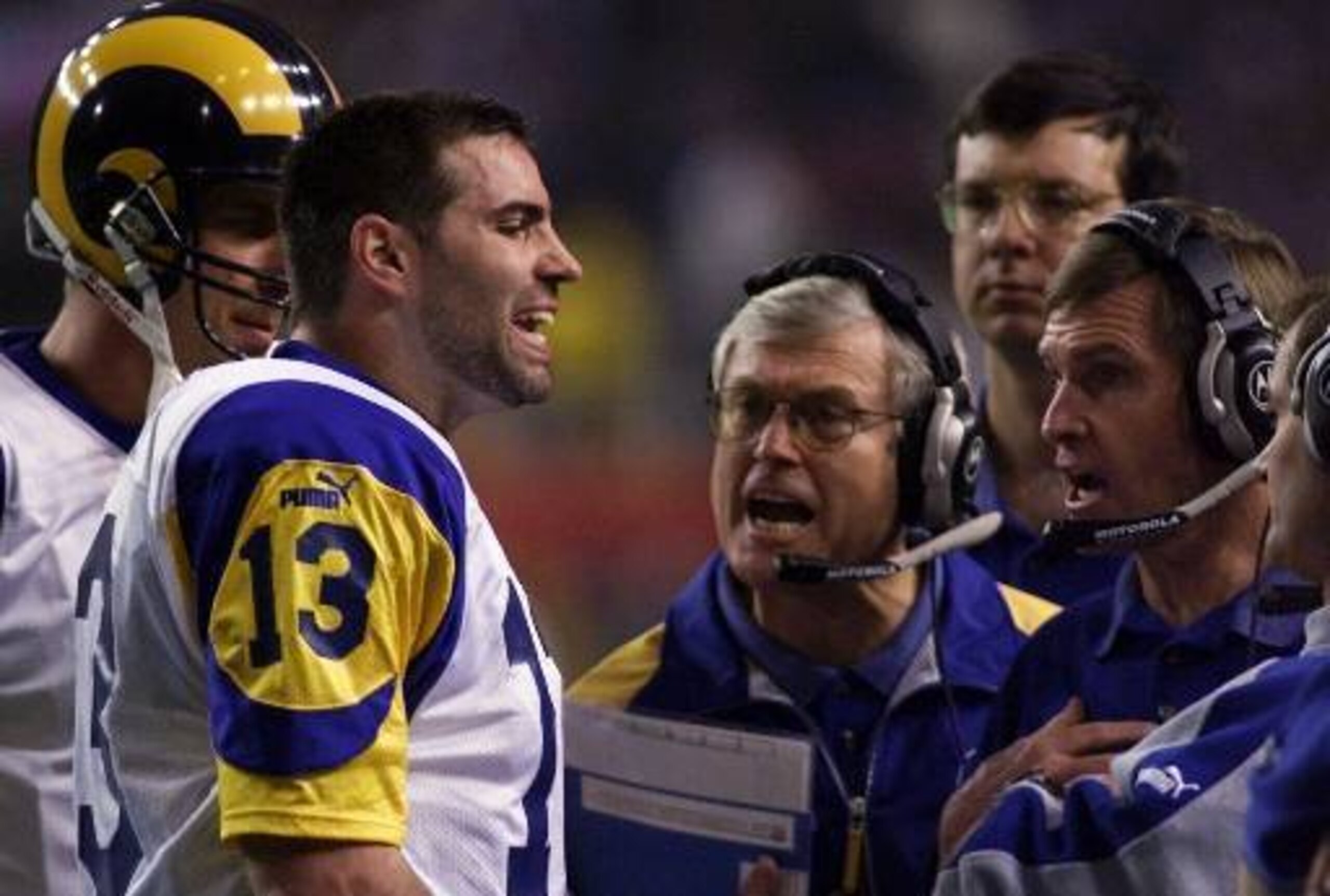
Super Bowl XXXIV: St. Louis Rams 23, Tennessee Titans 16
Quarterback Kurt Warner is a finalist for the Pro Football Hall of Fame Class of 2015.
He is one of three quarterbacks in NFL history (Craig Morton and Peyton Manning are the others) to start a Super Bowl with two different franchises.
Warner owns the three highest passing totals by yards in Super Bowl history. His 414-yard performance against the Tennessee Titans in Super Bowl XXXIV remains the standard. He completed 24 of 45 passes in the game, throwing touchdowns to wide receivers Torry Holt and Isaac Bruce. That last score came with 1:54 to play and broke a 16-all tie in the game.
Warner’s other two Super Bowl performances were not nearly as successful. In fact, he had interceptions returned for scores in each of the games. But in Super Bowl XXXIV, he completed one of football's greatest stories of determination and perseverance.
20. QB Jim Plunkett, Oakland Raiders (Super Bowl XV)
29 of 48Super Bowl XV: Oakland Raiders 27, Philadelphia Eagles 10
From No. 1 to looking like No. 2. And from No. 2 to becoming No. 1.
Stanford University quarterback Jim Plunkett was the top pick in the 1971 NFL draft by the Patriots.
Nine years later, after stints in New England and San Francisco, he was a backup to Dan Pastorini with the Oakland Raiders.
Suddenly, the veteran signal-caller was a starter once again when Pastorini broke his leg five games into the 1980 season. Plunkett led the Silver and Black into the playoffs as a wild-card team.
After disposing of the Houston Oilers, Cleveland Browns and San Diego Chargers in the AFC, Plunkett threw for 261 yards and three touchdowns (two to wide receiver Cliff Branch) in a 27-10 rout of the Philadelphia Eagles in New Orleans.
It was a great way for Plunkett to wrap up a storybook season.
19. KR Desmond Howard, Green Bay Packers (Super Bowl XXXI)
30 of 48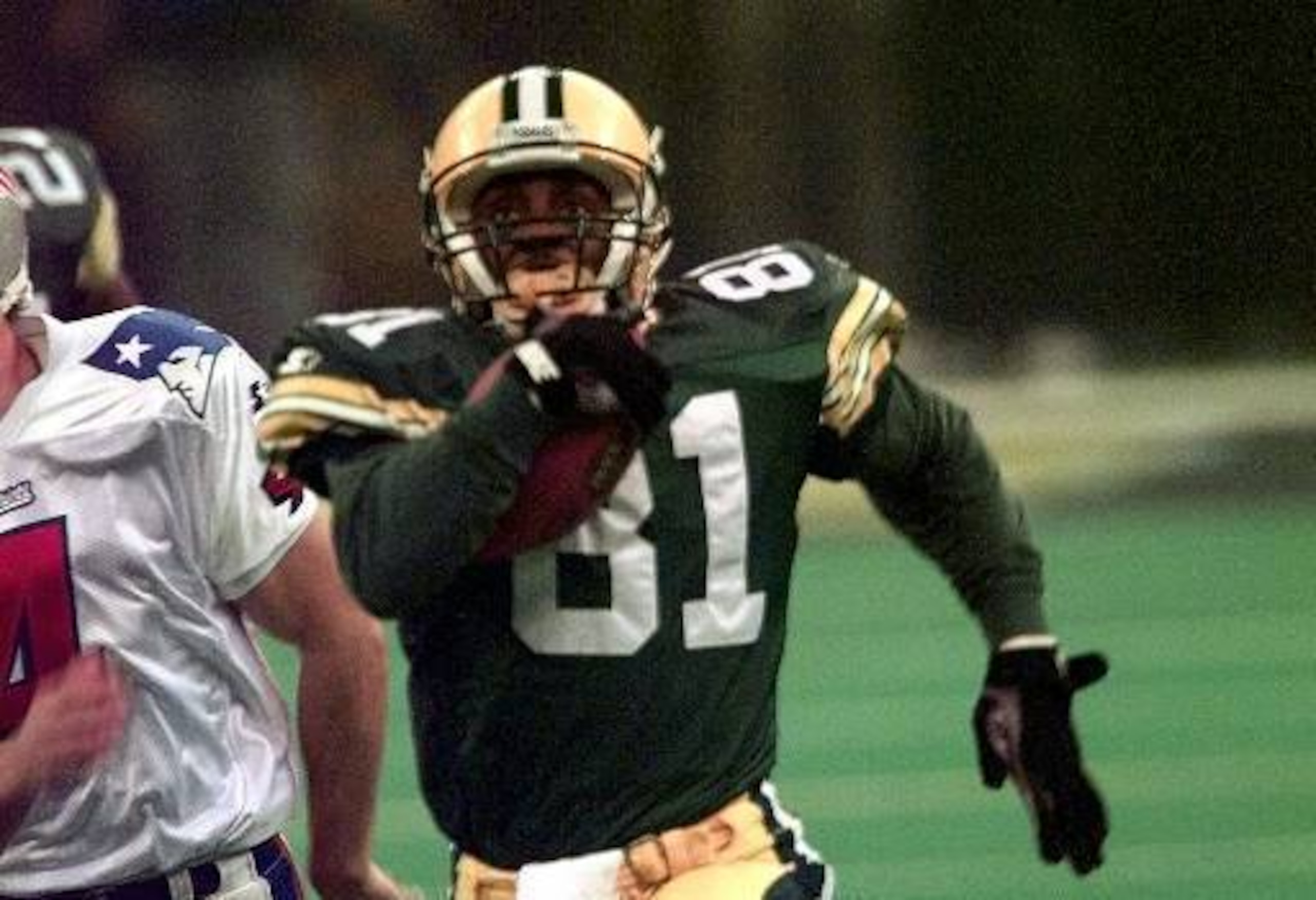
Super Bowl XXXI: Green Bay Packers 35, New England Patriots 21
In each of the last two Super Bowls, we have seen the second-half kickoff returned for a touchdown—first by the Baltimore Ravens’ Jacoby Jones (XLVII) and last year by the Seattle Seahawks’ Percy Harvin (XLVIII).
But in 48 Super Bowls, we have only once seen one kick-return artist earn Super Bowl MVP honors. And against the New England Patriots in Super Bowl XXXI, one-time Heisman Trophy winner Desmond Howard earned an NFL championship and a place in history.
The fourth overall pick in the 1992 NFL draft by the Washington Redskins, Howard proved to be a disappointment in D.C. After three seasons with the team, he wound up with the expansion Jacksonville Jaguars in 1995. One year later he was a member of the Green Bay Packers, just in time to help the team win its first NFL title since Super Bowl II.
Against the Patriots, Howard totaled 244 yards on punt (90 yards) and kickoff returns (154 yards), including a 99-yard kickoff for a touchdown in Green Bay’s victory.
Five years after striking that Heisman pose while with the Wolverines, Howard was being fitted for a Super Bowl ring.
18. QB Bart Starr, Green Bay Packers (Super Bowl I)
31 of 48Super Bowl I: Green Bay Packers 35, Kansas City Chiefs 10
It would be dubbed the AFL-NFL World Championship Game.
It would eventually be named Super Bowl I.
The NFL’s Green Bay Packers bested the AFL’s Kansas City Chiefs 35-10 in front of less than a sellout crowd at the Los Angeles Coliseum. A 14-10 halftime lead by Vince Lombardi’s club eventually turned into a lopsided final as the Packers scored 21 unanswered points in the final 30 minutes.
Green Bay was led by a staunch defense, limiting the Chiefs to 239 total yards. The Packers offense was orchestrated by quarterback Bart Starr, who was picked off once but still managed to throw for 250 yards and two touchdowns—both to wide receiver Max McGee.
It was the second of three straight titles for the Packers and the first of Starr's two Super Bowl MVPs.
17. QB Troy Aikman, Dallas Cowboys (Super Bowl XXVII)
32 of 48Super Bowl XXVII: Dallas Cowboys 52, Buffalo Bills 17
When you put 52 points on the board, there’s plenty of credit to go around.
The Dallas Cowboys were about to win their first of three Super Bowls in a four-year span in the early 1990s. And Jimmy Johnson’s young and talented club dominated the Buffalo Bills (who actually owned a 7-0 first-quarter lead) with an amazing performance.
Dallas forced a Super Bowl record nine turnovers and returned two of them for scores. Running back Emmitt Smith amassed 135 yards from scrimmage and made one trip to the end zone. The Cowboys also rolled up 408 total yards at the Rose Bowl in Pasadena.
It would prove to be one of quarterback Troy Aikman’s best performances, and it earned him Super Bowl MVP honors. The first overall pick in the 1989 NFL draft looked the part against the Bills, completing 22 of 30 passes for 273 yards and four touchdowns—two of those scores to fellow Hall of Famer Michael Irvin.
16. WR Hines Ward, Pittsburgh Steelers (Super Bowl XL)
33 of 48Super Bowl XL: Pittsburgh Steelers 21, Seattle Seahawks 10
As the Seattle Seahawks prepare for their third Super Bowl appearance, we'll look back at their first trip to the Big Game.
It proved to be a less-than-memorable afternoon in the Motor City for the ‘Hawks, who lost to the wild card Pittsburgh Steelers, 21-10, in a contest more known for its officiating than the teams’ play.
In a game that had more questionable calls than that cell phone in your back pocket, the Steelers managed a few more big plays than quarterback Matt Hasselbeck and a Seattle team that led the NFL in scoring in 2005.
The best player on the field that day in Detroit proved to be Pittsburgh wide receiver Hines Ward, who totaled five receptions for 123 yards and one touchdown—that coming on a 43-yard strike from fellow wide receiver Antwaan Randle El in the fourth quarter.
In a game where Ben Roethlisberger was simply dreadful, the veteran wideout saved his quarterback and his team by game’s end.
15. QB Aaron Rodgers, Green Bay Packers (Super Bowl XLV)
34 of 48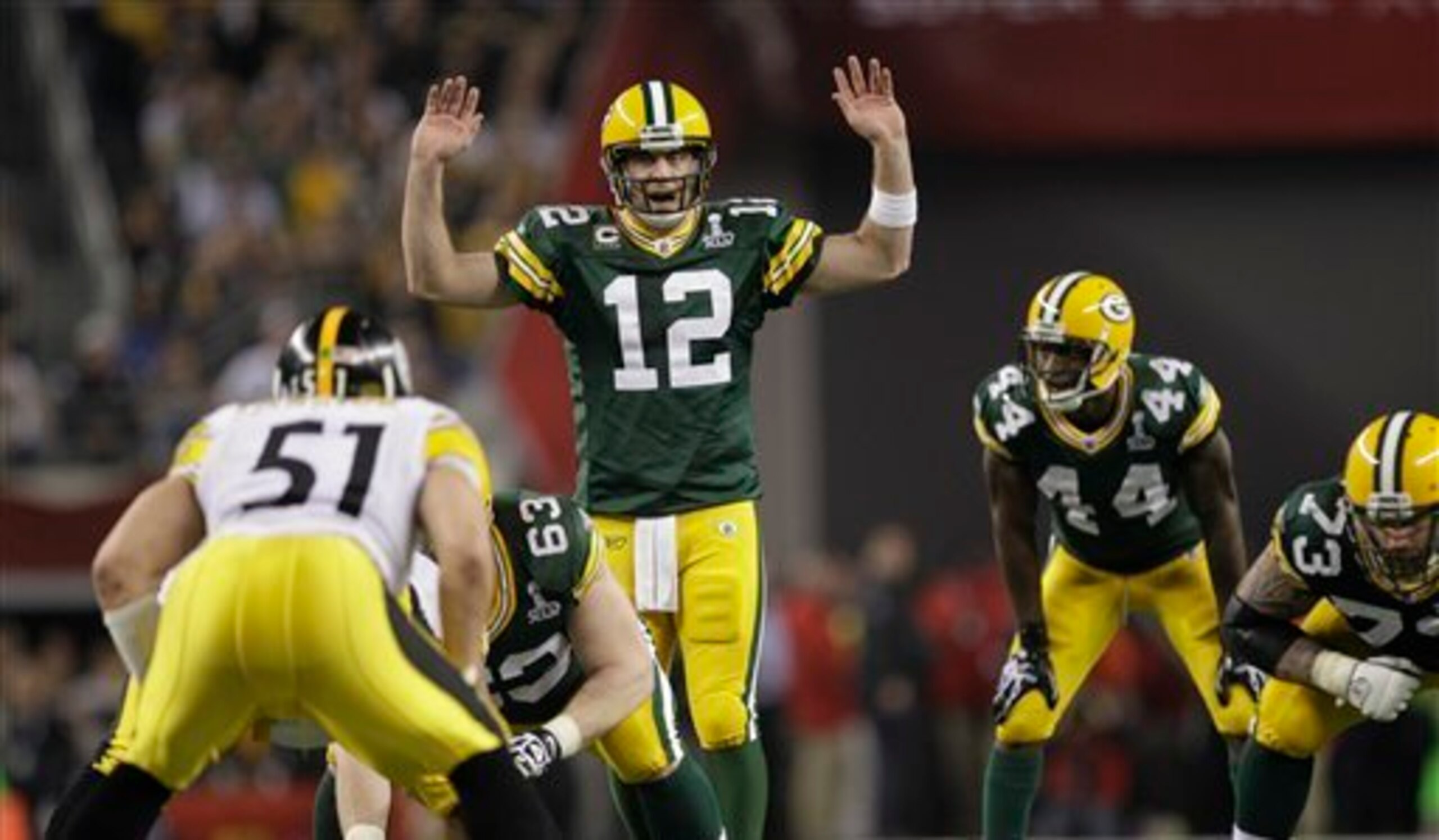
Super Bowl XLV: Green Bay Packers 31, Pittsburgh Steelers 25
This past season, Green Bay Packers quarterback Aaron Rodgers enjoyed a MVP-type season with his 38 touchdown passes compared to only five interceptions. We’ll find out this weekend if he is indeed the Most Valuable Player of the 2014 NFL season.
On this Super Sunday at Arlington, the talented signal-caller made somewhat easy work of a proud Pittsburgh defense. Rodgers connected on 24 of his 39 pass attempts for 304 yards and three touchdowns—two of those scores to wide receiver Greg Jennings.
This was a team effort, as the Packers defense forced three turnovers. But Rodgers’ pinpoint accuracy was the difference when the Steelers looked like they might pull off a big comeback. In the fourth quarter, he completed nine of his 13 throws for 125 yards, and Green Bay was successful on three out of four third-down conversions.
14. RB Larry Csonka, Miami Dolphins (Super Bowl VIII)
35 of 48
Super Bowl VIII: Miami Dolphins 24, Minnesota Vikings 7
Some would make a strong case that the 1973 Miami Dolphins were better than their perfect ’72 predecessors.
One thing is for sure: Few teams would have beaten Don Shula’s defending champions that day at Rice Stadium, thanks mainly to a well-schooled offensive line and fullback Larry Csonka's power running.
The workhorse performer carried 33 times for a then-Super Bowl record 145 yards rushing and two touchdowns against the celebrated Minnesota Vikings defense. Csonka ran 16 times for 78 yards and a score in the first half and then added 17 carries for 67 yards and a touchdown after intermission.
All told, Miami amassed 196 yards on the ground on 53 attempts.
Yes, it’s a very different game these days.
13. WR Lynn Swann, Pittsburgh Steelers (Super Bowl X)
36 of 48
Super Bowl X: Pittsburgh Steelers 21, Dallas Cowboys 17
It was the first of three Super Bowl encounters between the Dallas Cowboys and Pittsburgh Steelers. All of them had their entertaining and memorable moments.
In this contest, the defending champion Steelers took on a Dallas squad that was the first-wild card team to reach a Super Bowl.
But second-year wide receiver Lynn Swann went wild against Tom Landry’s secondary—and in particular, cornerback Mark Washington.
The former USC Trojans standout caught passes of 32, 53, 12 and 64 yards, with the final reception proving to be the eventual game-winning touchdown. His four catches totaled 161 yards.
However, catch No. 2 ranks as one of the most scintillating plays in the game’s history.
12. RB Marcus Allen, Los Angeles Raiders (Super Bowl XVIII)
37 of 48Super Bowl XVIII: Los Angeles Raiders 38, Washington Redskins 9
Talk about Super deja vu?
We all saw the Seattle Seahawks take apart the Denver Broncos 43-8 in Super Bowl XXXVIII a year ago. The champs scored on offense, defense and special teams and held off a Denver team that had scored a record 606 points during the regular season.
Thirty years earlier, we saw a nearly identical scenario and result. The Washington Redskins had scored a then-league record 541 points. The Raiders (in their second season in Los Angeles) pummeled the then-depending Super Bowl champions in Tampa, also scoring on offense, defense and special teams.
Raiders running back Marcus Allen ran for 191 yards and two touchdowns in the victory. His amazing 74-yard scoring run has to be seen to be enjoyed.
So...enjoy.
11. QB Drew Brees, New Orleans Saints (Super Bowl XLIV)
38 of 48
Super Bowl XLIV: New Orleans Saints 31, Indianapolis Colts 17
For the second straight year and the third time in six seasons, we will see the top seeds in the AFC (New England Patriots) and NFC (Seattle Seahawks) square off in the Super Bowl.
Back in 2009, the Indianapolis Colts and New Orleans Saints marked the start of the recent trend. Both clubs made a run at an undefeated season, and in early February, they squared off in South Florida.
The Colts jumped out to a 10-0 first-quarter lead. But it was mostly New Orleans after that, as the Saints outscored Indianapolis a combined 31-7 the rest of the way and captured the franchise’s first NFL title.
While there were many heroes, including head coach Sean Payton’s decision to try an onside kick after intermission, quarterback Drew Brees won the game’s MVP. The prolific passer completed 32 of his 39 throws for 288 yards and a pair of short touchdown passes.
Cornerback Tracy Porter’s 74-yard interception return of a Peyton Manning pass for a touchdown was the signature moment of the game. But Brees’ performance, especially in the second half, proved to be the key to victory.
10. WR Jerry Rice, San Francisco 49ers (Super Bowl XXIII)
39 of 48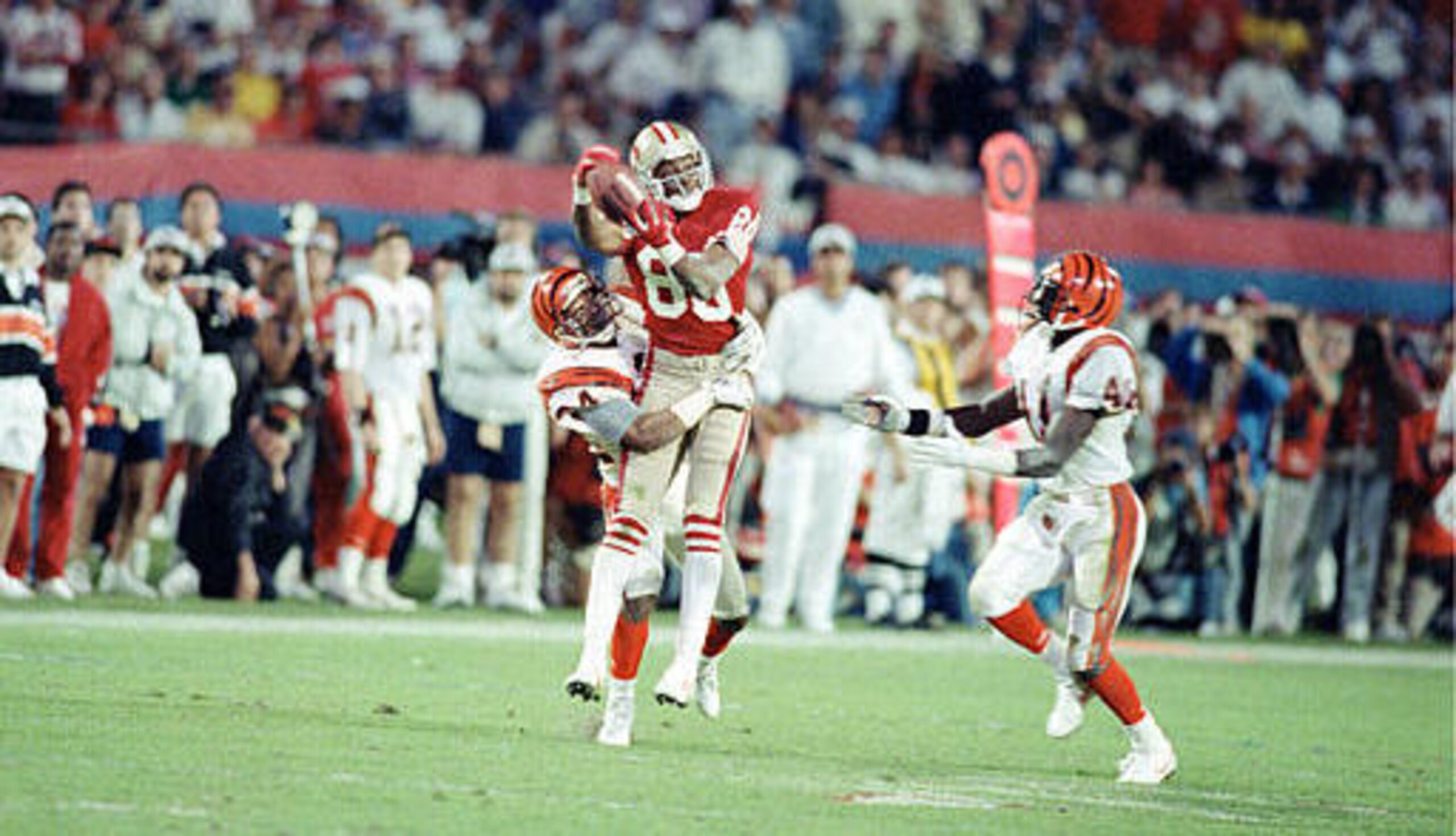
Super Bowl XXIII: San Francisco 49ers 20, Cincinnati Bengals 16
Pro Football Hall of Fame wide receiver Jerry Rice owns nearly every significant NFL record when it comes to catching the football and putting in the end zone—be it the regular season or postseason.
We said "nearly." Last year at MetLife Stadium, Denver’s Demaryius Thomas totaled a Super Bowl record 13 receptions in the Broncos’ 43-8 loss to the Seattle Seahawks.
However, Rice still owns the Super Bowl record for receiving yards in a game, totaling 215 yards and a touchdown on 11 catches versus the Cincinnati Bengals in Super Bowl XXIII.
San Francisco 49ers quarterback Joe Montana connected with John Taylor on a 10-yard score with 34 seconds to play to help give Bill Walsh’s team a 20-16 win.
But Rice set the tone for the entire game with a Niners attack that stalled most of the game. On Montana’s fabled game-winning 92-yard drive in the closing minutes, Rice accounted for more than half of those yards (51) on three crucial receptions.
9. QB Terry Bradshaw, Pittsburgh Steelers (Super Bowl XIII)
40 of 48Super Bowl XIII: Pittsburgh Steelers 35, Dallas Cowboys 31
Some would argue that this was the best of the 48 Super Bowls to date. It is certainly in the conversation.
In the first-ever rematch in Super Bowl history and a contest that featured numerous Hall of Famers for both the Pittsburgh Steelers and Dallas Cowboys, Terry Bradshaw came up big when it mattered most.
While the strong-armed quarterback was far from perfect, throwing one interception and having a fumble returned for a touchdown, he also set what was, at the time, a career high for passing yards in a game. The first overall pick in the 1970 NFL draft hit on 17 of his 30 attempts for 318 yards and four touchdowns and kept the Dallas defense off-balance with his play-calling.
Of course, it didn't hurt that he had a pair of fellow Hall of Famers to throw the football to. That day at the Orange Bowl, Lynn Swann (124) and John Stallworth (115) became the first teammates in Super Bowl history to each have 100-plus yards receiving in the game.
The Steelers were the first team to win three Super Bowls. As we all know, there would be more to come.
8. RB Terrell Davis, Denver Broncos (Super Bowl XXXII)
41 of 48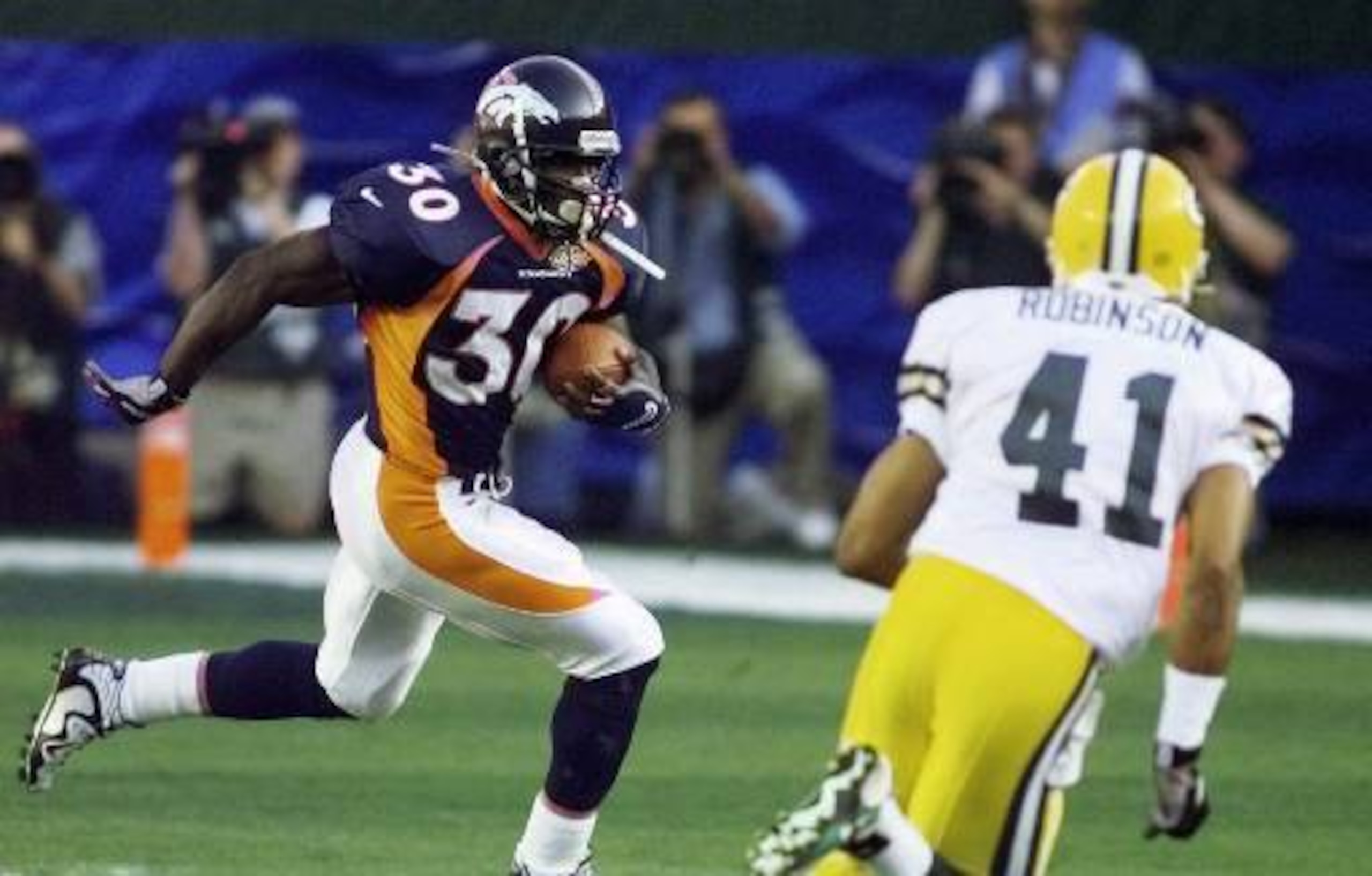
Super Bowl XXXII: Denver Broncos 31, Green Bay Packers 24
These days, John Elway is the general manager of the Denver Broncos.
Some 17 years ago this week, he was the team's quarterback and getting ready to start his fourth Super Bowl.
Obviously, things had not gone so well in his first three tries, as the Broncos were pushed around by the New York Giants (39-20), Washington Redskins (42-10) and San Francisco 49ers (55-10).
This time would prove to be the charm, as the wild-card Broncos surprised the defending Super Bowl champion Green Bay Packers in San Diego 31-24. Not only did they claim the franchise’s first NFL title, but they snapped the NFC’s 13-game Super Bowl winning streak in the process.
While no one player can win a title alone, Elway would not be by his lonesome. Third-year running back Terrell Davis captured MVP honors, and his one-yard touchdown run with 1:45 remaining proved to be the difference in the game. It should be noted that Packers head coach Mike Holmgren allowed Davis to score so his team could get the ball back.
Of course, that wasn’t the plan for most of the game. Denver rushed for 179 yards on 39 attempts, and Davis led the way with 30 carries for 157 yards. He also scored touchdowns in both the first and third quarters (again, both one-yard runs) as the Broncos won one for Elway.
7. QB Phil Simms, New York Giants (Super Bowl XXI)
42 of 48
Super Bowl XXI: New York Giants 39, Denver Broncos 20
When it comes to passing accuracy and the Super Bowl, no one has done it better than New York Giants quarterback Phil Simms—at least not yet.
The franchise was making its very first Super Bowl appearance and had not won an NFL title since 1956. And it appeared the Giants may come up short again in Pasadena, California, when they fell behind the Denver Broncos 10-9 at halftime in Super Bowl XXI.
That’s when Simms really turned it on. He did not throw an incompletion in the second half (thanks to a little assist from tight end Mark Bavaro and wide receiver Phil McConkey). He finished the game with 22 completions on 25 attempts, a tidy Super Bowl record of 88 percent. Simms also threw for 268 yards and three scores in the 19-point victory.
So whatever happened to Simms following that performance? He was busy setting another Super Bowl standard.
6. QB Joe Montana, San Francisco 49ers (Super Bowl XXIV)
43 of 48
Super Bowl XXIV: San Francisco 49ers 55, Denver Broncos 10
You could make a strong case that this was San Francisco 49ers quarterback Joe Montana’s best performance of his four Super Bowl victories.
We beg to differ; hence we will be revisiting the topic in a slide to be named later.’
On the way to the biggest blowout in Super Bowl history, Montana was extremely sharp. The Niners scored a record 55 points, which added up to a pair of touchdowns in each quarter. “Joe Cool” was red hot, completing 22 of 29 passes for 297 yards and five touchdowns, with three of those scoring strikes going to wide receiver Jerry Rice.
Montana captured his third Super Bowl MVP award, which remains a record, although Patriots quarterback Tom Brady could equal that should he capture such honors this weekend in Super Bowl XLIX.
Meanwhile, the Niners legend finished his career with four Super Bowl victories and numbers that added up to 11 touchdown passes and zero interceptions in those wins.
5. QB Doug Williams, Washington Redskins (Super Bowl XXII)
44 of 48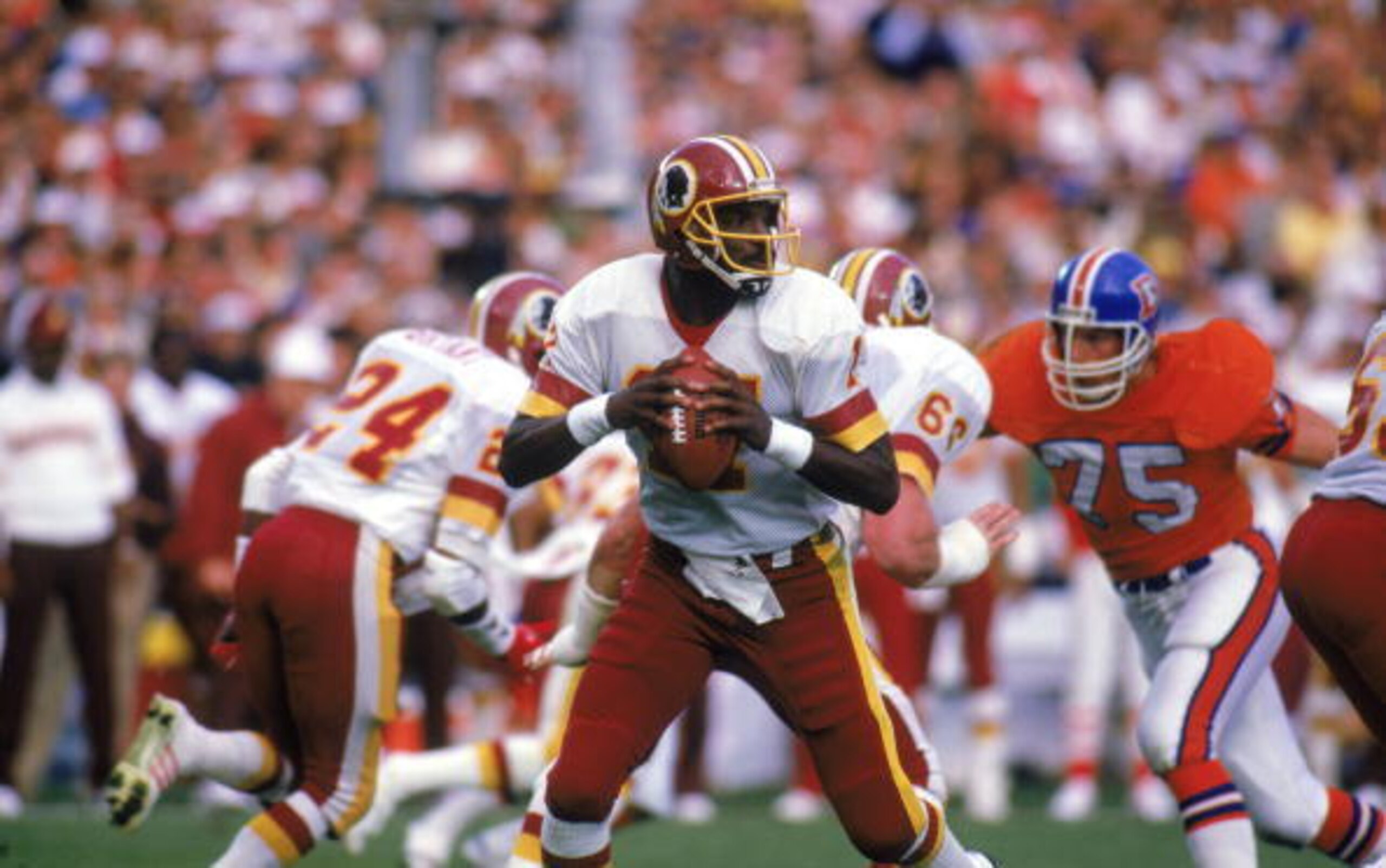
Super Bowl XXII: Washington Redskins 42, Denver Broncos 10
It may be the most amazing football game played at any level.
Down 10-0 after 15 minutes, the Washington Redskins rolled up 35 points and 356 total yards in the second quarter against the Denver Broncos and eventually coasted to a 42-10 victory.
One catalyst for the offensive explosion was rookie running back Timmy Smith, who finished the game with 204 yards and two touchdowns on the ground. Can you say “counter trey"?
However, the ringleader was veteran quarterback Doug Williams, who picked apart the Denver defense for 340 yards and four touchdowns in capturing MVP honors. His scores covered 80, 27, 50 and eight yards, and all came in the second quarter.
Washington set Super Bowl records for total yards (602) and rushing yards (280) at the expense of the stunned Broncos. Amazing indeed.
4. RB Emmitt Smith, Dallas Cowboys (Super Bowl XXVIII)
45 of 48
Super Bowl XXVIII: Dallas Cowboys 30, Buffalo Bills 13
Everything came full circle for the Dallas Cowboys in the 1992 season, including running back Emmitt Smith.
The defending Super Bowl champions began 1993 at 0-2, mainly because Smith was unhappy with his current contract and was a no-show.
The eventual all-time leading rusher in NFL history returned in Week 3, and despite missing those first two contests, Smith won the league rushing title with 1,486 yards.
He also led the Cowboys to a second consecutive NFL title thanks to 132 yards rushing and two touchdowns on 30 carries in a win over the Buffalo Bills. Smith added Super Bowl XXVIII MVP to a resume that included the NFL’s Most Valuable Player, awarded a few weeks earlier.
3. QB Steve Young, San Francisco 49ers (Super Bowl XXIX)
46 of 48
Super Bowl XXIX: San Francisco 49ers 49, San Diego Chargers 26
As we all know, the New England Patriots and Seattle Seahawks are preparing to battle in Super Bowl XLIX.
Twenty years earlier, it was the San Francisco 49ers who brought football numerology to new heights.
The Niners became the first NFL franchise to win five Super Bowls thanks to a 49-26 conquest of the upstart San Diego Chargers. If you thought the irony of the final score and the team that managed that point total was interesting, keep in mind that quarterback Steve Young also ran for 49 yards in the win.
The versatile signal-caller also had his way with the Chargers pass defense. He completed two-thirds of his pass attempts (24-of-36) for 325 yards and a Super Bowl-record six touchdown passes in the rout.
By the way, as Patriots quarterback Tom Brady prepares for the league’s 49th Super Sunday, know that he has thrown an NFL-record 49 postseason touchdown passes.
2. QB Joe Montana, San Francisco 49ers (Super Bowl XIX)
47 of 48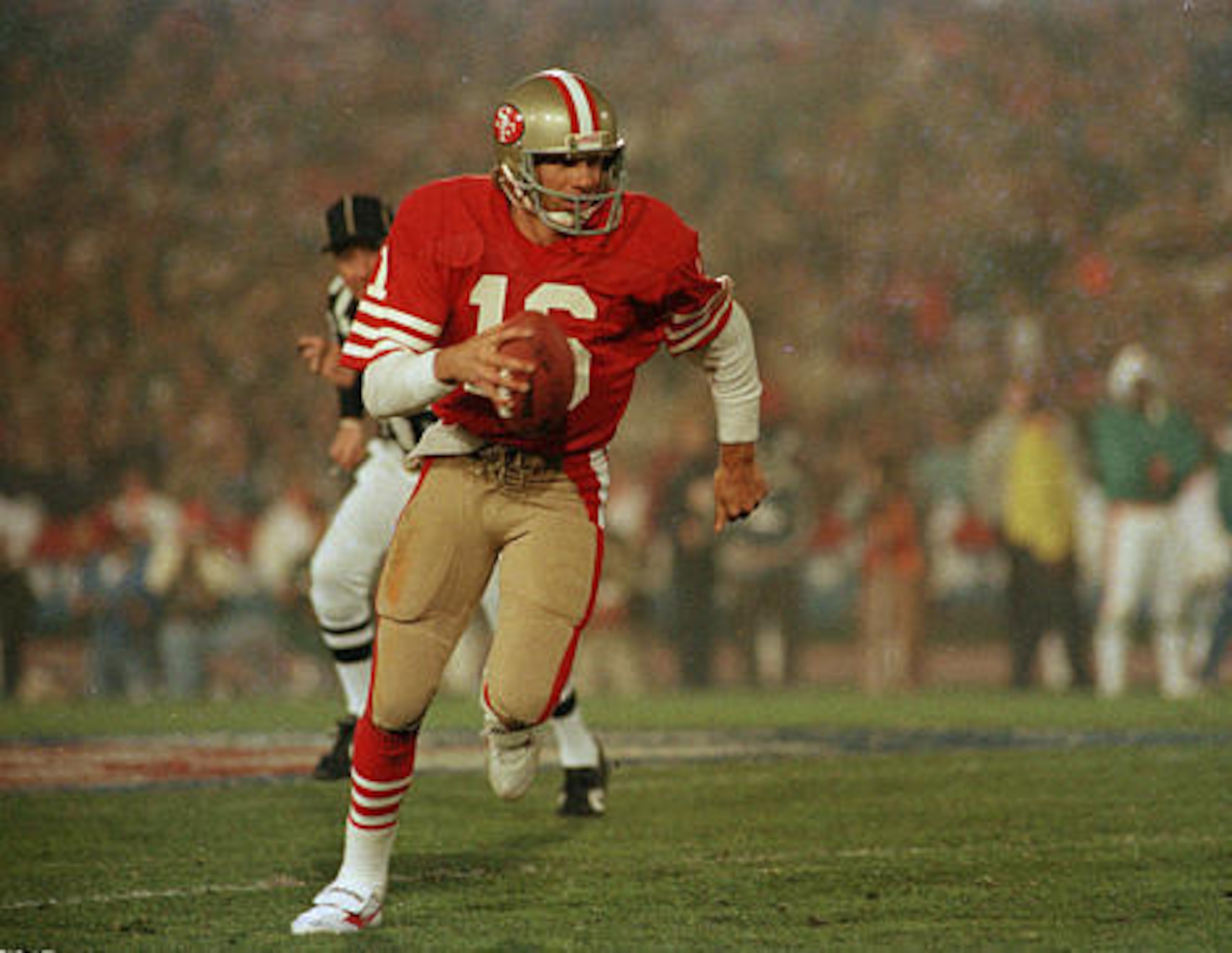
Super Bowl XIX: San Francisco 49ers 38, Miami Dolphins 16
The Super Bowl record for rushing yards by a quarterback in a game is owned by the late and great Steve McNair, who rambled 64 yards in the Tennessee Titans’ 23-16 loss to the St. Louis Rams in Super Bowl XXXIV.
Two years ago at the Superdome (Super Bowl XLVII), San Francisco 49ers quarterback Colin Kaepernick ran for 62 yards in a 34-31 loss to the Baltimore Ravens.
Guess whose performance ranks third on the list? A mere 30 years ago in Palo Alto, California, San Francisco’s Joe Montana ran five times for 59 yards and a touchdown in his team’s 38-16 conquest of the Miami Dolphins.
By the way, the Hall of Fame quarterback also threw for 331 yards and three scores. His team rolled up 537 total yards (second-most by a team in Super Bowl history) in the surprisingly easy win over a Dolphins team that finished 14-2 in the regular season.
Unfortunately for Miami, there was nothing regular about Montana, who always seemed to save his best for Super Bowls.
1. RB John Riggins, Washington Redskins (Super Bowl XVII)
48 of 48Super Bowl XVII: Washington Redskins 27, Miami Dolphins 17
Somehow, Washington Redskins running back John Riggins made us all forget that the 1982 strike-shortened season lasted only nine games.
That’s because the veteran performer put on a show during the entire Super Bowl tournament. That year, 16 teams qualified for the playoffs, and it took four wins to capture the Lombardi Trophy.
In his second season as the Redskins head coach, Joe Gibbs turned Riggins loose on the rest of the league, and he responded in a big way. When it was all said and done, the Pro Football Hall of Famer totaled 136 carries for 610 yards and four touchdowns in four postseason contests, an NFL record for rushing yards in one playoff year.
As for this matchup with the Miami Dolphins, Riggins set a Super Bowl record with 38 carries. His 166 rushing yards remains the third-highest total in a Super Bowl. And his 43-yard scoring run in the fourth quarter remains one of the series’ signature moments.
.jpg?w=2560 "Bills Texans Football")
.jpg?w=2560 "WWE x AAA Triplemanía Night 2 📝")