San Francisco 49ers: How Will Colin Kaepernick Develop in 2015?
Colin Kaepernick finds himself at something of a crossroads as 2015 begins.
The quarterback, who received a $126 million contract last offseason, saw his play regress last season. He threw fewer touchdowns and more interceptions than he did the year before. His quarterback rating dropped to 86.4, his lowest as a regular starter. His yards-per-attempt figure fell from 7.69 to 7.05, and his sacks skyrocketed from 39 to 52.
He finished the year with a grade of minus-10.2 from Pro Football Focus (subscription required), 12th-worst in the league and by far the worst grade of his career.
TOP NEWS

New NFL contenders starting to emerge after Week 4
.jpg?w=2560 "Cardinals Giants Football")
NFL investigating 2 referees for separate viral exchanges
.jpg?w=2560 "Hill Injury Update Football")
Report: Chiefs Contact Hill's Agent
It wasn’t all bad, however. While this year was worse than last, there were signs of improvement, especially in the first half of the year.
Kaepernick’s completion percentage rose, as did his accuracy, per PFF. There were times, especially in the first game of the season against Dallas and the last game of the season against Arizona, when Kaepernick put all his amazing physical tools together and had great games. It was really more of an inconsistent season than a total step backwards.

Kaepernick’s contract makes it economically feasible to release or trade him after the 2015 season, per Spotrac.com, meaning Kaepernick has one year to try to return to his 2012 and 2013 forms. He needs to show the new coach that 2014 was an aberration—an off-year that won’t impact his career arc.
His decision to work with Kurt Warner this offseason, as first reported by Matt Barrows of The Sacramento Bee, can only help. This is the first offseason in which Kaepernick’s been in a structured program like this. Hopefully, working on his mechanics and pocket presence will see an increase in his statistical output in 2015.
How can we try to estimate Kaepernick’s improvement in 2015? Lacking a crystal ball, what we can do is try to compare Kaepernick to similar quarterbacks from the past and see how they did in future seasons. I ran this exercise last season and came up with a projected stat line that was a bit optimistic, but still reasonably close to Kaepernick’s actual 2014 numbers:
| Projection | 260 | 420 | 61.9% | 3,400 | 26 | 7 | 85 | 420 | 2 |
| Actual | 289 | 478 | 60.5% | 3,369 | 19 | 10 | 104 | 639 | 1 |
| Difference | +29 | +58 | -1.4% | -31 | -7 | +3 | +19 | +219 | -1 |
The major differences were the significant increases in pass plays called, and of course the raw number of touchdowns and interceptions. I guessed he would have more yards per pass attempt and fewer yards per rushing attempt. It wasn’t a bad ballpark figure, however.
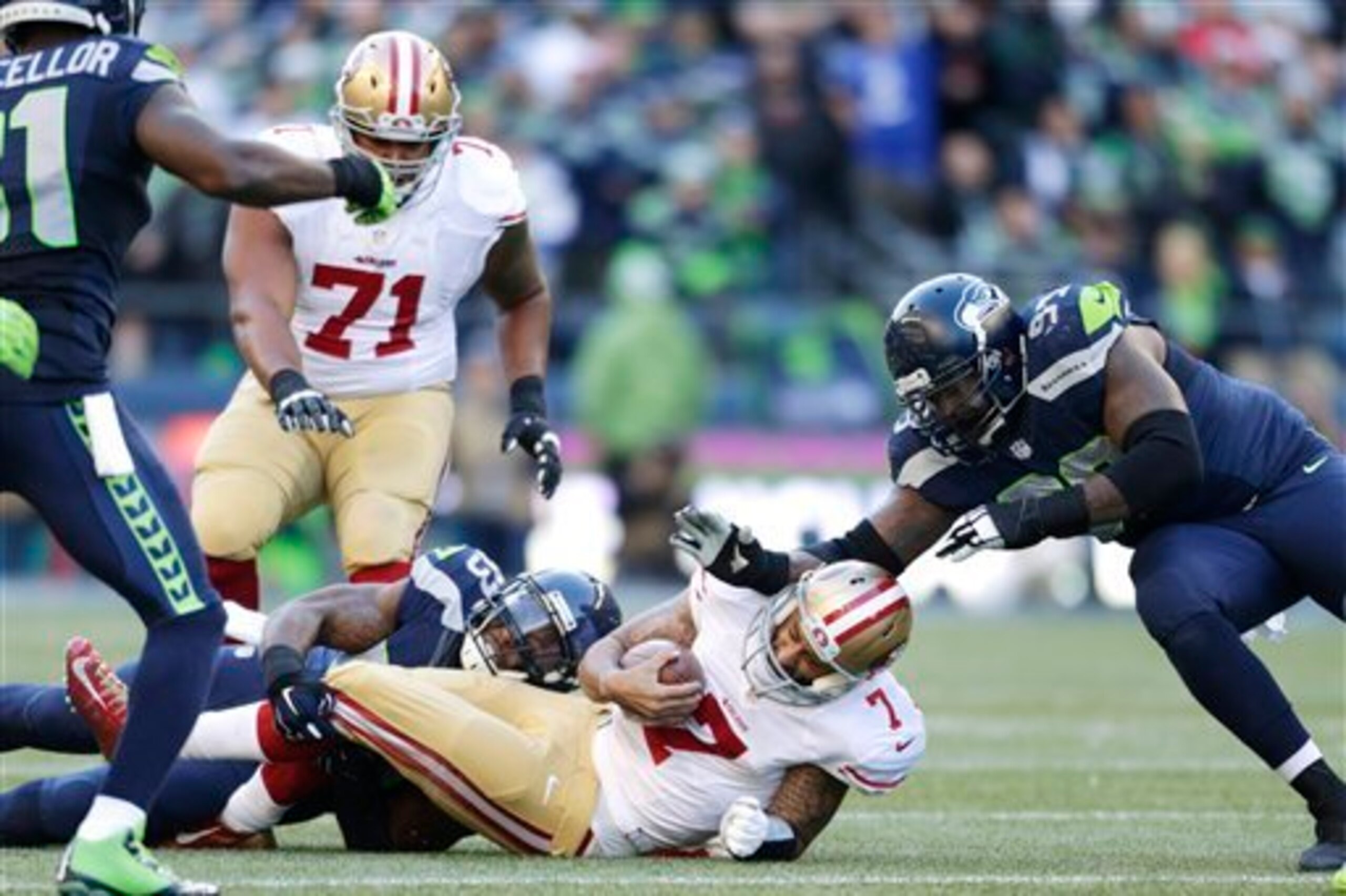
We can repeat the same experiment this year, now adding Kaepernick’s 2014 data to the mix.
Perhaps the most significant change from 2013 to 2014 was the number of sacks Kaepernick absorbed. Kaepernick took 52 sacks in 2014, second-most in the league last season and one of the top 30 totals of all time, according to Pro-Football-Reference.com.
Taking 40 or more sacks in a season can seriously depress a quarterback’s numbers, and possibly even damage his future potential—see Derek Carr with the Houston Texans for an example of that.
To try to find out how quarterbacks with similar career arcs to Kaepernick have fared, I went back and looked at every quarterback’s passing numbers between the ages of 24 and 29. I then used a modified version of Football Outsiders’ similarity scores to find which quarterbacks had the most similar two-year stretches compared to Kaepernick’s last two seasons, adjusting somewhat for Kaepernick’s particular play style.
This gives us a list of reasonable comparisons; a baseline for judging how quarterbacks like Kaepernick progress from year to year.
I’ll get to the list of the most comparable quarterbacks in a moment, but first I’d like to focus on the most similar quarterback in the data set: Ben Roethlisberger.
| Kaepernick | 2013 | 243 | 416 | 58.4% | 3,197 | 21 | 8 | 39 | 92 | 524 | 4 |
| Roethlisberger | 2007 | 264 | 404 | 65.3% | 3,154 | 32 | 11 | 47 | 35 | 204 | 2 |
| Kaepernick | 2014 | 289 | 478 | 60.5% | 3,369 | 19 | 10 | 52 | 104 | 639 | 1 |
| Roethlisberger | 2008 | 281 | 469 | 59.5% | 3,301 | 17 | 15 | 46 | 34 | 101 | 2 |

Roethlisberger was a year younger than Kaepernick in this sample and had nearly two years more starting experience than Kaepernick, but the raw numbers are very similar. Both players saw their interception rates dramatically increase along with an added workload in the passing game, and both responded by completing about 60 percent of their passes for 3,300 yards or so.
The Pittsburgh Steelers won the Super Bowl in 2008, but it was probably Roethlisberger’s worst year to that point in his career. His quarterback rating of 80.1 is still the worst number in his career. He was described here on Bleacher Report as “plodding yet solid” by Michael Wong and “not [yet] an elite quarterback” by Robert A., though some of the criticism was blamed on his offensive line. His Pro Football Focus grade that year was minus-4.7 (subscription required).
Sound familiar?
Since then, of course, Roethlisberger’s numbers have improved dramatically, averaging over 4,000 yards passing a season, completing 64.5 percent of those passes and having an average touchdown-to-interception ratio of 25-to-10. He still gets sacked a lot but has overcome poor offensive line play to be one of the top passers in the NFL today.
If 49ers fans knew Kaepernick would morph into Ben Roethlisberger, they’d be more than satisfied.
The top comparables offer room for optimism even beyond Roethlisberger. The top 25, for example, include a Hall of Famer in John Elway, two more All-Pro players and 13 more Pro Bowlers, as well as 11 Super Bowl rings.
I’ve put the top 350 comparable quarterback years in a Google Document for ease of display, but here are the top 15, complete with the stats in the season that corresponds to Kaepernick’s 2014:
| Roethlisberger | 2008 | 281 | 469 | 59.91% | 3,301 | 17 | 15 | 46 | 34 | 101 | 2 |
| Steve McNair | 2002 | 301 | 492 | 61.18% | 3,387 | 22 | 15 | 21 | 82 | 440 | 3 |
| Jim Zorn | 1980 | 276 | 448 | 56.56% | 3,346 | 17 | 20 | 44 | 44 | 214 | 1 |
| Cunningham | 1990 | 271 | 465 | 58.28% | 3,466 | 30 | 13 | 49 | 118 | 942 | 5 |
| Russell Wilson | 2014 | 285 | 452 | 63.05% | 3,475 | 20 | 7 | 42 | 118 | 849 | 6 |
| Philip Rivers | 2007 | 277 | 460 | 60.22% | 3,152 | 21 | 15 | 22 | 29 | 33 | 1 |
| Aaron Brooks | 2003 | 306 | 518 | 59.07% | 3,546 | 24 | 8 | 34 | 54 | 175 | 2 |
| Cam Newton | 2014 | 262 | 448 | 58.48% | 3,127 | 18 | 12 | 38 | 103 | 539 | 5 |
| Eli Manning | 2008 | 289 | 479 | 60.33% | 3,238 | 21 | 10 | 27 | 20 | 10 | 1 |
| Jim Zorn | 1979 | 285 | 505 | 56.44% | 3,661 | 20 | 18 | 23 | 46 | 279 | 2 |
| Steve McNair | 2001 | 264 | 431 | 61.25% | 3,350 | 21 | 12 | 37 | 75 | 414 | 5 |
| Dave Krieg | 1985 | 285 | 532 | 53.57% | 3,602 | 27 | 20 | 52 | 35 | 121 | 1 |
| Jay Cutler | 2010 | 261 | 432 | 60.42% | 3,274 | 23 | 16 | 52 | 50 | 232 | 1 |
| J. Campbell | 2009 | 327 | 507 | 64.50% | 3,618 | 20 | 15 | 43 | 46 | 236 | 1 |
| Joe Flacco | 2012 | 317 | 531 | 59.7% | 3,817 | 22 | 10 | 35 | 32 | 22 | 3 |
| Top 25 | AVG | 287 | 484 | 59.46% | 3,446 | 21 | 14 | 36 | 53 | 263 | 2 |
| C. Kaepernick | 2014 | 289 | 478 | 60.46% | 3,369 | 19 | 10 | 52 | 104 | 639 | 1 |
That’s a lot of raw numbers. It might be best to look at the top 25 QBs in groups to get a better idea of the range of outcomes Kaepernick might expect going forward. I’ll split them into four groups, career-wise: the below-average starters, the above-average starters, the very good players and the all-time elites.
Here’s how many of the top 25 fall into each category, in my opinion:
| Elite | 6 | John Elway, Drew Brees, Randall Cunningham, Philip Rivers, Steve McNair (x2) |
| Good | 14 | Russell Wilson (x2), Cam Newton, Jay Cutler, Eli Manning, Ben Roethlisberger, Matt Hasselbeck, Mark Brunell, Jim Everett, Dave Krieg, Joe Flacco (x2), Jim Zorn (x2) |
| Above Average | 3 | Aaron Brooks (x2), Richard Todd |
| Below Average | 2 | Kyle Orton, Jason Campbell |
The worst-case scenario is Kaepernick's turning out like Orton or Campbell. Campbell had some promising starts for some bad Washington teams but was traded to Oakland and never recovered. Orton spent most of his career after this comparison point as a backup to either Tim Tebow or Tony Romo, only to have one poor season in Buffalo this last season before retiring. These are not good names to have on your comparison list.
On the flip side, John Elway is enshrined in Canton, and Drew Brees will likely join him there in five or so years.
Steve McNair might be the most interesting name on the list, as he shows up twice. McNair never put up huge numbers, but he was co-league MVP in 2003 and is one of only three players in NFL history to have 30,000 passing yards and 3,500 rushing yards. The most optimistic comparison you can hope for is for Kaepernick to turn into the second coming of Steve McNair—which most teams would take.

The preponderance of evidence, however, says that quarterbacks like Kaepernick are a rung below McNair’s level.
That’s still a very good list. Matt Hasselbeck, for example, was a starting quarterback for a decade in Seattle and Tennessee, bringing the Seahawks to their first Super Bowl. Mark Brunell also started for over a decade in Jacksonville and Washington, gradually declining from a Pro Bowl-caliber quarterback to a solid starter to a savvy backup.
Even the likes of Jim Zorn, Dave Krieg and Jim Everett had solid if unspectacular careers, with each starting over 100 games in the NFL.
All the quarterbacks on this list started their careers out strong but had a dip somewhere around their age-27 season, just like Colin Kaepernick did. Almost all of them were able to recover in the next year or two and continue to play at high levels in the NFL.
To predict what Kaepernick might look like in 2015, we can look at the next season for each of these comparables, with three exceptions. Two of the quarterbacks, Russell Wilson and Cam Newton, are comparable through 2014, but we can’t use their 2015 seasons because they haven’t occurred yet.
The other exception is Randall Cunningham, who tore his ACL in the first game of the 1991 season. We’ll use his 1992 season for comparison purposes on the flawed presumption that the injury didn’t slow his progression down.
Here are the best and worst five N+1 seasons, as well as the average, for players in Kaepernick’s top-25 comparables:
| Philip Rivers | 2008 | 312 | 478 | 65.27% | 4,009 | 34 | 11 | 25 | 31 | 84 | 0 |
| Steve McNair | 2003 | 250 | 400 | 62.50% | 3,215 | 24 | 7 | 19 | 38 | 138 | 4 |
| Drew Brees | 2006 | 356 | 554 | 64.26% | 4,418 | 26 | 11 | 18 | 42 | 32 | 0 |
| M. Hasselbeck | 2005 | 294 | 449 | 65.48% | 3,382 | 24 | 9 | 24 | 36 | 124 | 1 |
| Roethlisberger | 2009 | 337 | 506 | 66.60% | 4,328 | 26 | 12 | 50 | 40 | 82 | 2 |
| Cunningham | 1992 | 233 | 384 | 60.68% | 2,775 | 19 | 11 | 60 | 87 | 549 | 5 |
| Aaron Brooks | 2005 | 240 | 431 | 55.68% | 2,882 | 13 | 17 | 33 | 45 | 281 | 2 |
| Jim Zorn | 1980 | 276 | 488 | 56.56% | 3,912 | 19 | 22 | 48 | 27 | 131 | 1 |
| Joe Flacco | 2013 | 362 | 614 | 58.96% | 3,912 | 19 | 22 | 48 | 27 | 131 | 1 |
| Jim Everett | 1993 | 135 | 274 | 49.27% | 1,652 | 8 | 12 | 18 | 19 | 38 | 2 |
| TOP 25 | AVG | 293 | 489 | 59.70% | 3,582 | 22 | 13 | 36 | 47 | 208 | 2 |

It’s a good sign for Kaepernick that his closest comparison also shows up as one of the best year N+1 seasons with Roethlisberger. You also have McNair’s MVP season and Super Bowl runs for both Brees and Matt Hasselbeck on the list, as well as Rivers’ first of four straight 4,000 yard seasons. Add in the possibility of a year like Wilson’s 2014, and you have a very solid list of names at the top.
On the other side, some of the bottom five come with asterisks.
Cunningham, as addressed, had missed the entire previous season with an ACL tear and was never the same player afterwards. Kaepernick’s ACL, from all accounts, is still intact, so it’s not a very useful data point. Aaron Brooks’ 2005 numbers are also depressed by the effects of Hurricane Katrina, which saw the Saints travel on the road all year. Neither seem like very fair projections for Kaepernick’s 2015.

The absolute bottom point is Everett, whose regression in 1992 turned out to be not a fluke, as he was benched midyear for T.J. Rubley. Joe Flacco lost his top receiver in Anquan Boldin and had a nasty season, which might be a warning for what would happen if the 49ers lost Michael Crabtree this offseason. Jim Zorn’s another possible comparison, as a promising 9-7 team absolutely collapsed to 4-12, losing their last nine games.
Prorating everything to 16 games for the averages (to ignore the effects of injuries and the like), you see slight improvements across the board from one season to the next. Perhaps most notable are the interceptions—15 of the 23 players saw significant drops in their interception rate. That bodes well for Kaepernick, who threw double-digit interceptions for only the first time in his career.
The average quarterback rating jumped too, from the mid-80s to the mid-90s.
The one takeaway you want to have from all these statistics is that talented quarterbacks have off seasons. Brees had a dip in his second full season as a starter, and he’s headed to the Hall of Fame. Roethlisberger played horrible in his first Super Bowl appearance and now is one of the top quarterbacks in the game. McNair fought through an injury-plagued season and bounced back.
One poor season does not mean Kaepernick is history.
At the same time, sometimes early career success doesn’t translate over the long term. Zorn looked like he was on his way to NFL superstardom in the late ‘70s but never turned it around after a poor 1980 season, lasting just two more years before being sent to the bench. Aaron Brooks was always exciting in New Orleans but could never put all the pieces together.
A couple very good seasons early in the career does not necessarily mean that the rest of a player’s career will be great.
Considering that Kaepernick is putting in extra work this offseason with Warner, as well as the large number of players with similar numbers who went on to have success later in their careers, I remain optimistic about Kaepernick’s long-term development. I’m not as confident as I was leading up the 2014 season, but overall, I think the signs still point to Kaepernick having a productive NFL career from this point on.

As for my predictions for 2015? That’s incredibly difficult to put together thanks to the uncertainty in the 49ers’ coaching situation.
We have no idea if the new offensive coordinator will try to mold Kaepernick into a pocket passer or let him run the read option all the time. Without that key piece of information, a true prediction is almost impossible.
What I will predict, however, is more consistency. I don’t think we’ll see anything like the five games in which Kaepernick had less than 200 passing yards moving forward. I think Kaepernick will go back to playing more like he was in the first half of the season rather than the second, somewhat more disastrous half. That consistency alone will see his numbers go up.
| 2014 Total | 289 | 478 | 60.5% | 3,369 | 19 | 10 | 104 | 639 | 1 |
| Prediction | 330 | 510 | 64.7% | 3,900 | 24 | 10 | 110 | 550 | 0 |
Kaepernick’s not going to develop into a 4,000-yard passer overnight, no matter what system is put into place. I do think that, when we look back at the 2014 season five years from now, we’ll see that Kaepernick’s year is an outlier but rather a small step back in an otherwise solid career.
Bryan Knowles is a featured columnist for Bleacher Report, covering the San Francisco 49ers. Follow him @BryKno on Twitter.
.jpg?w=2560 "Titans Giants Football")
.jpg?w=2560 "Dolphins Bills Football")