

Redskins Can't Pin All of Their Problems on the Offensive Line
It's become almost impossible to criticize the Washington Redskins nowadays, especially at the quarterback position, because there appears to be a perception that the offensive line is the worst position unit in the history of professional sports.
The problem is that's a misconception. I know this isn't a sole authority when it comes to gauging football success, but many of you would probably be surprised to learn that Pro Football Focus (subscription required) ranks the Washington offensive line 11th in football when it comes to pass-blocking efficiency.
TOP NEWS
.jpg?w=2560)
Deshaun slams Browns fans after blowout loss
.jpg?w=2560 "Steelers Football")
Steelers To Keep Allar, Howard

Live Live: NFL Preseason Week 2 🏈
| PBE rating | 80.3 | 11th |
| Pressures allowed | 137 | 10th |
| Sacks allowed | 26 | 27th |
Again, it would be unfair to view PFF as omnipotent in this regard. And I know what you're going to say. You're gonna say, "Brad, you're an idiot." And then you're going to tell me that you've seen with your own two eyes that the line sucks. And you won't necessarily be wrong.
The problem is that our eyes aren't trustworthy either. In fact, they're less reliable. And oftentimes, they're biased. Redskins fans primarily watch Redskins games. They don't always notice when other offenses have pass-protection meltdowns, especially when those teams aren't playing against the Redskins.
So while it become become plainly and painfully obvious at times that the Redskins line sucks, the reality is that it's all relative. It's possible most lines suck.
Did 'Skins fans watch what their defense did to the St. Louis Rams (Shaun Hill was pressured on 35 percent of his dropbacks and sacked four times), the Dallas Cowboys (Tony Romo was pressured on 35 percent of his dropbacks and sacked five times) or the Jacksonville Jaguars (Chad Henne was pressured on 58 percent of his dropbacks and saved 10 times)?
The Redskins pass rush isn't particularly good, yet they've roughed up lines from St. Louis, Dallas, Jacksonville, Seattle, Philadelphia, Tennessee and San Francisco this season. Indianapolis, New Orleans, San Diego and Miami have all given up pressure at least 25 percent more often than Washington has, according to PFF.
The PFF advantage is they watch every game—not just your team's game—and without bias. And they've determined that, even in a down year, Trent Williams has been an above-average left tackle and the eighth-best pass-blocker in the league at that position.
Consider how much worse off you'd be with the majority of the rest of the league's blindside starters:
| Andrew Whitworth | 8 |
| Joe Thomas | 12 |
| Jason Peters | 18 |
| Kelvin Beachum | 19 |
| Trent Williams | 20 |
| Russell Okung | 21 |
| Duane Brown | 22 |
| Jared Veldheer | 22 |
| Tyron Smith | 23 |
| Terron Armstead | 25 |
| Ryan Clady | 26 |
| David Bakhtiari | 26 |
| Joe Staley | 27 |
| William Beatty | 28 |
| Nate Solder | 28 |
| Cordy Glenn | 30 |
| Riley Reiff | 30 |
| Anthony Castonzo | 31 |
| Eric Fisher | 33 |
| D'Brickashaw Ferguson | 33 |
| Donald Penn | 34 |
| Luke Joeckel | 36 |
| Jermon Bushrod | 39 |
| King Dunlap | 41 |
| Jake Matthews | 43 |
| Matt Kalil | 48 |
| Byron Bell | 49 |
Veteran interior offensive linemen Chris Chester and Kory Lichtensteiger both have positive PFF grades, overall and as pass-blockers. Lichtensteiger is the only center in football who hasn't been charged with a single sack on over 700 snaps.
Left guard Shawn Lauvao has struggled, and preseason right tackle Tyler Polumbus, who was never good to begin with, has been replaced by the equally ineffective Tom Compton. But can you really call this line terrible based on two weak links?
There aren't many lines in this league that don't have problem spots. The Dallas line has been lauded, but left guard Ronald Leary has surrendered 25 quarterback pressures in 13 games, and it's not as though right tackle Doug Free is an asset.
The Seattle Seahawks won the Super Bowl last year despite poor pass-blocking grades from starting linemen Paul McQuistan, James Carpenter, Max Unger and Russell Okung. On paper, that line was worse than Washington's.
The Redskins do give up a lot of sacks—53 on the season now, which is the second-highest total in the NFL—but the line has been responsible for giving up only 26 of those. PFF pins seven of them squarely on the quarterbacks and seven on the running backs and tight ends. The other 13 were coverage sacks.
Williams has been playing through injuries much of the year, making the entire line more vulnerable. He's missed significant portions of two of the last four games, a time frame during which Washington has surrendered a ridiculous 25 sacks. Prior to that, the 'Skins ranked only a touch below the middle of the pack in terms of sacks allowed.
Going back to that somewhat skewed perception that this line is somehow much worse than average, let's consider that the lion's share of the analysis and/or criticism regarding the line and the offense in general has been related to how they've performed with supposed franchise quarterback Robert Griffin III in the lineup.
Due to injuries and a benching, Griffin's only been on the field for 35.4 percent of Washington's offensive snaps this year. And yet he's taken 53 percent of the sacks.
| Robert Griffin III | 190 | 28 | 14.7 | 48.4 |
| NFL average | 422 | 24 | 5.7 | 33.4 |
| Colt McCoy | 150 | 17 | 11.3 | 33.3 |
| Kirk Cousins | 213 | 8 | 3.8 | 24.9 |
Unless we're to assume that the line is trying less hard for Griffin, that's no coincidence. Backups Kirk Cousins and Colt McCoy are pocket passers who have made quicker decisions, while the truth is RG3 has made the line look a lot worse than it actually is.
Based on raw timing numbers from PFF, we know that Griffin hangs out in the pocket 7.9 percent longer than the average NFL quarterback. That's only 0.2 seconds, but it makes a huge difference in the world of sacks and pressure.
Among 38 qualifying quarterbacks, only four have held onto the ball longer than Griffin on a per-dropback basis. He very rarely gets rid of the ball in 2.5 seconds or less, which is sort of a golden rule.
| Robert Griffin III | 2.74 | 5th |
| NFL average | 2.54 | 18th |
| Colt McCoy | 2.49 | 24th |
| Kirk Cousins | 2.37 | 35th |
The offensive line has become a scapegoat for those who are still clinging to the idea that Griffin is the savior. There have simply been too many instances in which the 2012 No. 2 overall pick has screwed up despite fine blocking from his teammates.
Just from the last few weeks, let's play a game called Clean Pocket, Bad Play.


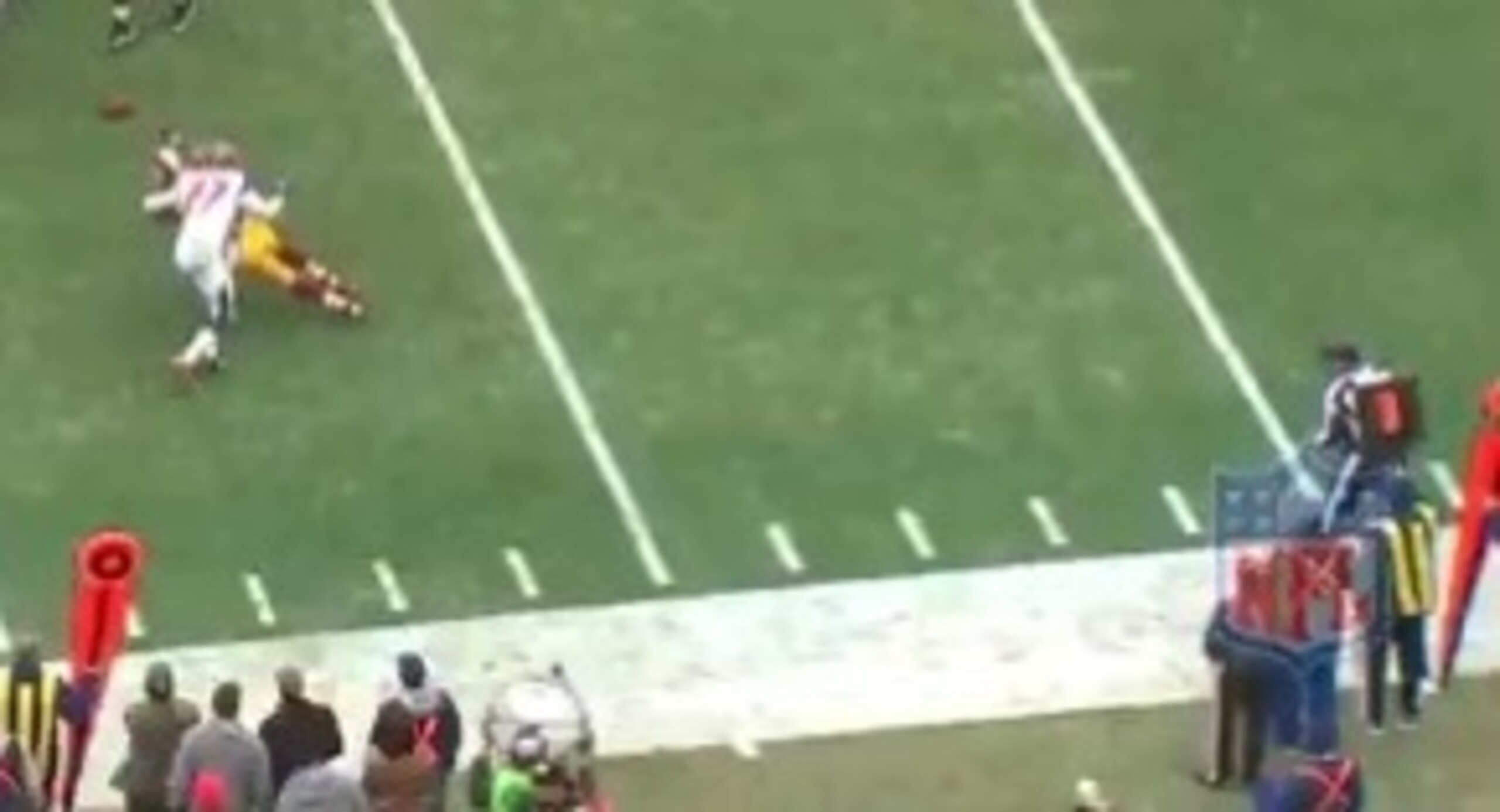


A lot of the best quarterbacks in the game have excelled with lines as bad as, if not worse than, Washington's. Few of those quarterbacks have had the luxury of being protected on the blind side by a player as talented as Williams.
The reality is that the game's best active quarterbacks—the Manning brothers, Drew Brees, Aaron Rodgers, Tom Brady—are good regardless of who is (or isn't) blocking for them.
PFF ranked the 2011 New York Giants line dead last in terms of pass-blocking efficiency, but that didn't stop Eli Manning from leading New York to the Super Bowl.
In 2007, 2008 and 2010, Peyton Manning's line in Indianapolis allowed more pressure than all but a handful of other units, yet Manning was MVP in '08 and a Pro Bowler the other two years. In that 2010 season, Charlie Johnson, who was graded by PFF as the fourth-worst pass-blocking left tackle in the league (min. 12 games), manned Peyton's blind side.
In fact, during his entire 13-year run with the Colts, Peyton only ever had two offensive linemen—Jeff Saturday and Tarik Glenn—make the Pro Bowl. Glenn, who was the only strong tackle he ever played with, was gone by 2007.
The only Pro Bowl tackle Brady ever had was Matt Light, but Light isn't around now, and he wasn't a Pro Bowler until after New England's glory years.
Charles Brown was an absolute disaster on Brees' left side in 2013, grading out at PFF as the seventh-worst tackle among 77 qualifiers. Yet Brees went over 5,000 yards with a 104.7 passer rating in an All-Pro-caliber season.
And in six seasons, Aaron Rodgers has never worked with an All-Pro lineman in Green Bay.
These guys are good enough to succeed without studs along the offensive line, and their teams have usually known that. That explains why the Colts drafted only one first-round offensive lineman during Manning's time there and why the Patriots have done so only once during Brady's reign. Since Brees arrived in New Orleans, the Saints have drafted just one offensive lineman ahead of the third round.
The point is that when you have an elite quarterback, you don't have to worry a whole lot about your line. And Griffin is supposed to be elite, just like his 2012 top-of-the-draft compadre, Andrew Luck, who leads the league in passing yards and touchdowns despite the fact the first-place Colts have surrendered more pressure than any other team in football.
It's time to face a key fact: Even when accounting for pass protection (or lack thereof), Robert Griffin III has been a mediocre quarterback for two years running, and the Redskins have been a bad time for that duration.
That doesn't mean that the line can't be improved upon, because it certainly isn't a strength. Just don't be fooled into believing that fixing that unit will somehow fix this franchise.
Brad Gagnon has covered the NFC East for Bleacher Report since 2012.
.jpg?w=2560 "Rams Chiefs Football")
.jpg?w=2560 "Eagles Patriots Football")


.png?w=2560 "Vrabel Calls Out Pats Defense 🤷♂️")