Breaking Down Alfred Morris' Return to Form for Washington Redskins
It seems Alfred Morris' revival won't mean much for Robert Griffin III after all. Washington Redskins head coach Jay Gruden has made the probably necessary decision to ditch Griffin a little sooner than expected, per ESPN reporter Adam Schefter.
But while Griffin languishes in a Gruden-built limbo, the man ticketed to replace him, Colt McCoy, will certainly benefit from Morris' return to form. That return was heralded by the third-year running back thundering for 125 yards and a touchdown on 21 carries in Week 12.
Morris' efforts weren't good enough to beat the San Francisco 49ers, who topped Washington and its one-dimensional offense 17-13. But the runner will still be his team's main man this week on the road against the Indianapolis Colts and their soft run defense.
TOP NEWS
.jpg?w=2560 "Seahawks Camp Football")
NFL Rookies Who Could Earn Starting Jobs 🌟
Former NFL Star Rips Jake Paul

Latest from NFL training camp
What was so impressive about Morris' performance in the Bay Area was how the Redskins schemed ways for him to produce big plays. Simply put, Gruden and offensive coordinator Sean McVay packaged principles of the team's familiar zone scheme around power-based fronts and looks.
That proved to be a lethal combination. Here's how it worked.
Facing 2nd-and-10 in the first quarter, Washington balanced its line against San Fran's 3-4 base front. To do it, wide receiver Andre Roberts (12) flexed onto the line, tacking a tighter split next to left tackle Morgan Moses:
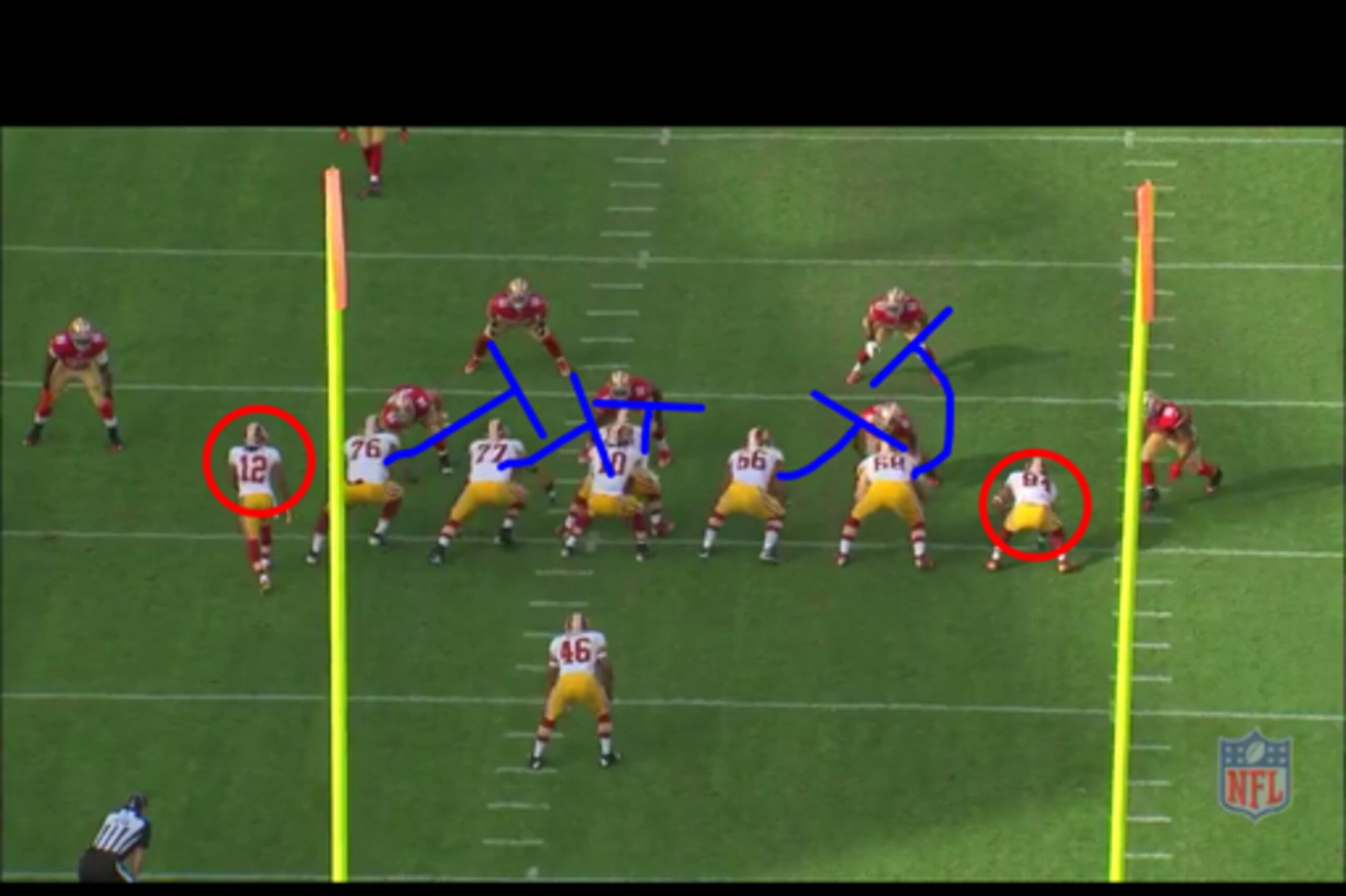
With tight end Niles Paul on the other side, next to right tackle Tom Compton, the Redskins were perfectly balanced. This gave them the chance to create double-teams on the edges, as well as eliminate backside pursuit, depending on which way the play was run.
In this instance, Washington ran its staple zone-stretch play to the right behind Compton. As a core characteristic of zone-style blocking, linemen shifted one way and set up double-teams before peeling off to absorb linebackers.
Notice how center Kory Lichtensteiger and left guard Shawn Lauvao worked a double-team on nose tackle Quinton Dial. Lauvao allowed Lichtensteiger (78), to quickly move off Dial and block middle linebacker Chris Borland:
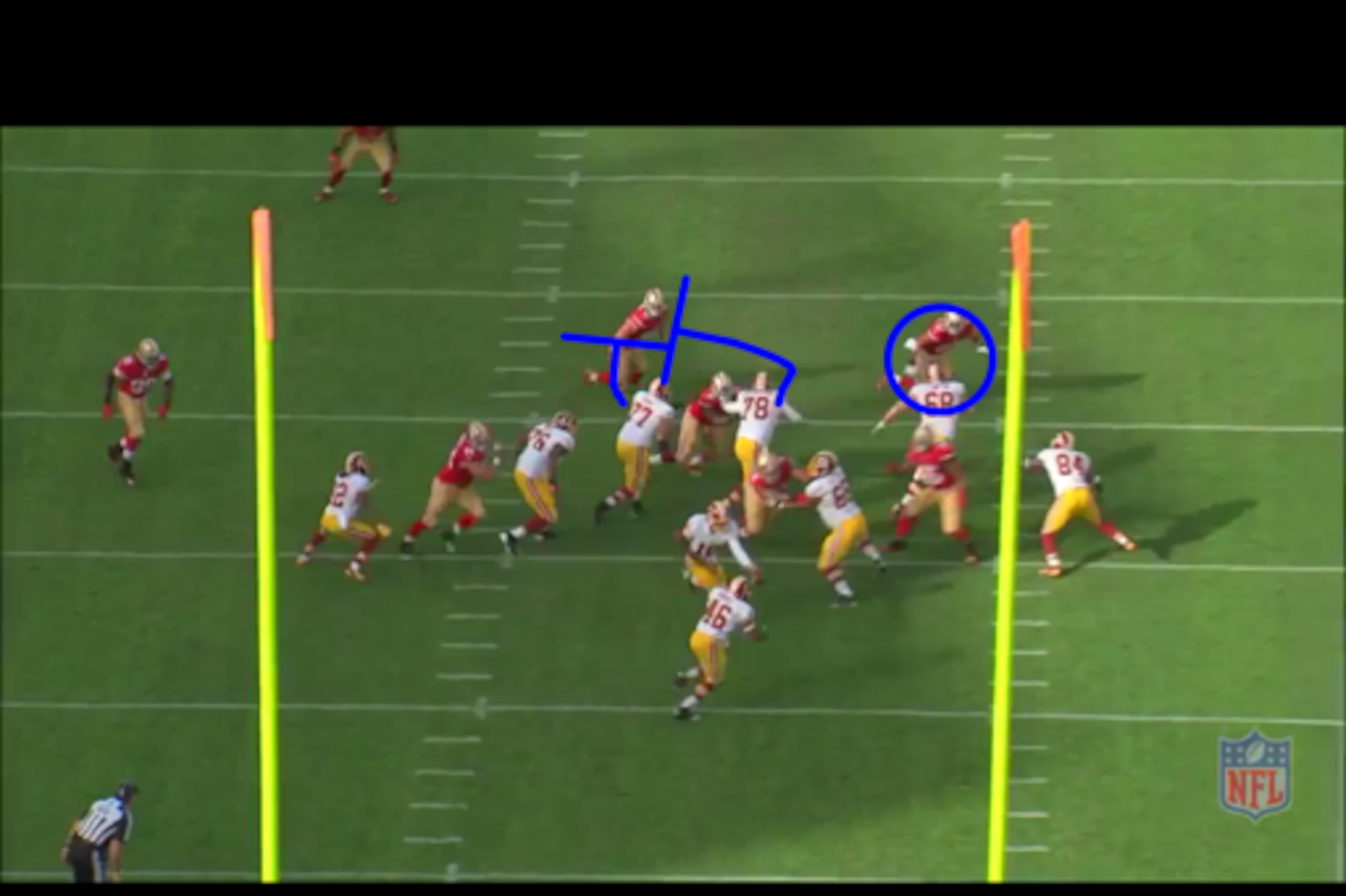
At the same time, Compton and Paul moved up to block Borland's fellow inside 'backer, Michael Wilhoite. The Redskins had now taken care of San Fran's main run-stuffers:

That gave Morris, who deftly made outside linebacker Ahmad Brooks miss in the backfield, a natural cutback lane to exploit:
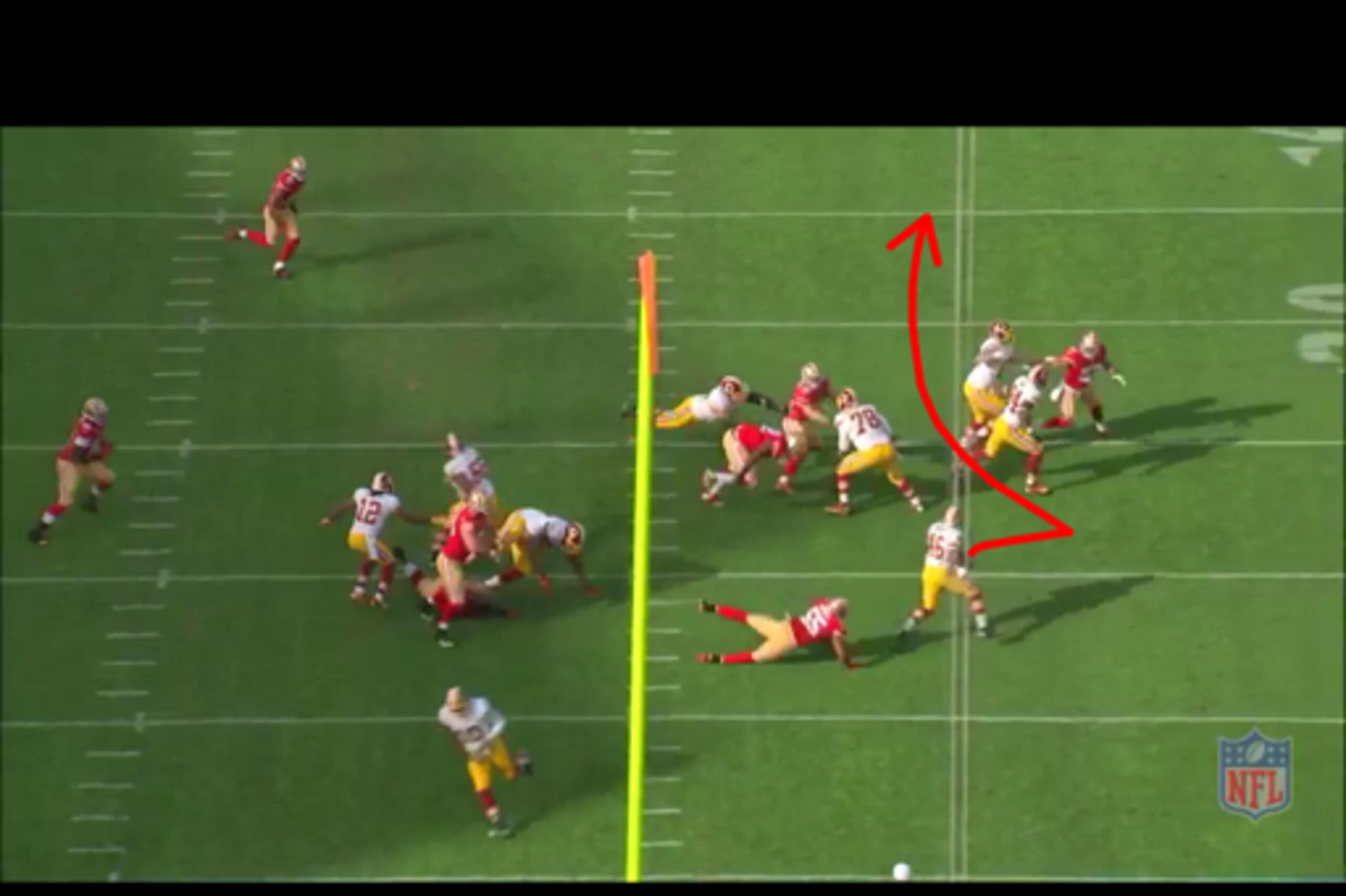
Creating this kind of lane is the key to manufacturing big plays in a zone-based scheme. Washington continually succeeded in creating lanes and creases for Morris to barrel his way through for significant yards. In this case, he gained 22.
After bookending the offensive front to combat the 3-4, Gruden and McVay went with an overloaded line to create an even bigger gain in the third quarter.
The play began with fullback Darrel Young shifting across in motion:
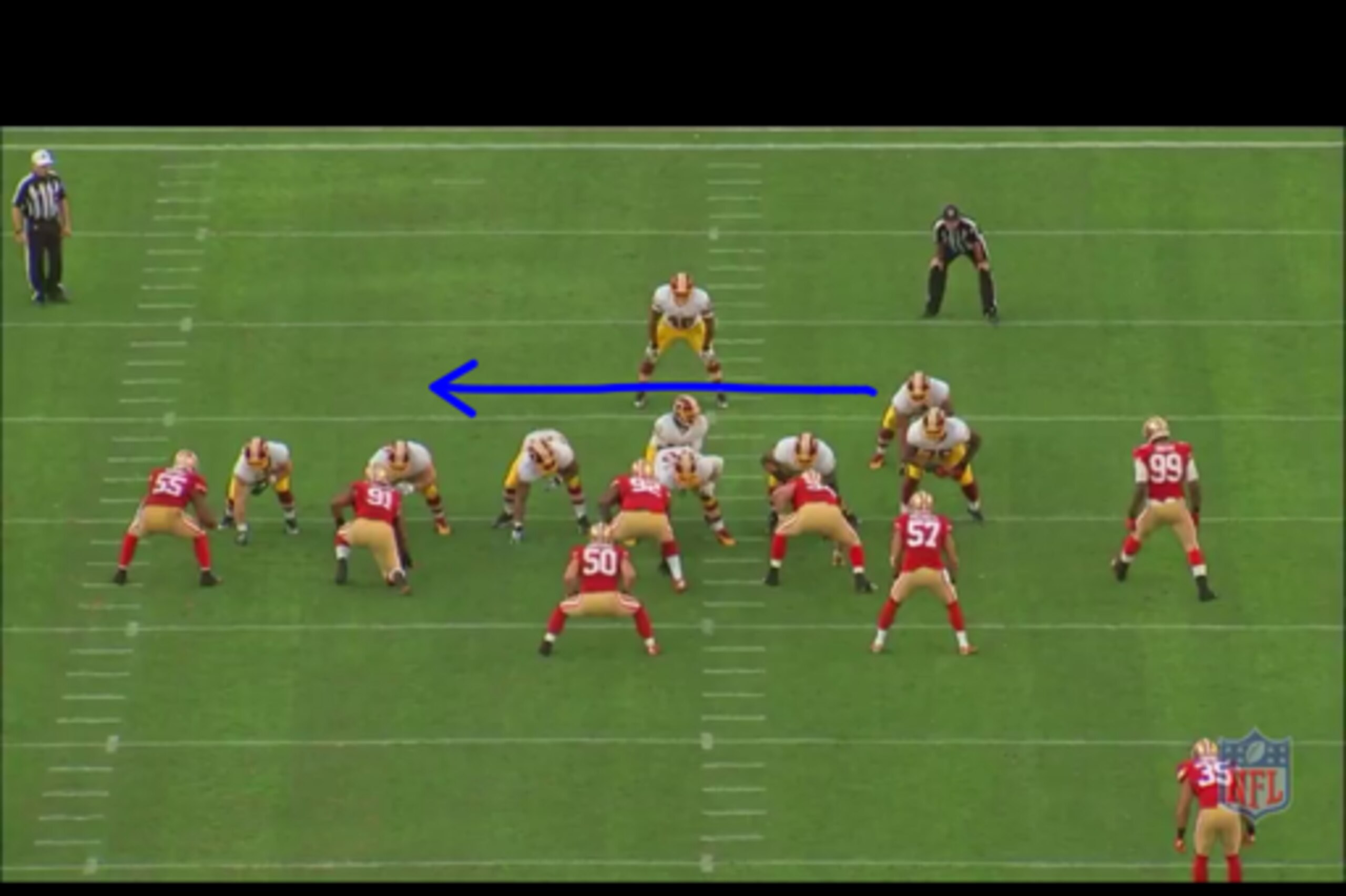
He joined the same side of the line where tight end Logan Paulsen was positioned. This gave Washington an overload on that side. The Redskins now had a four-on-three advantage:
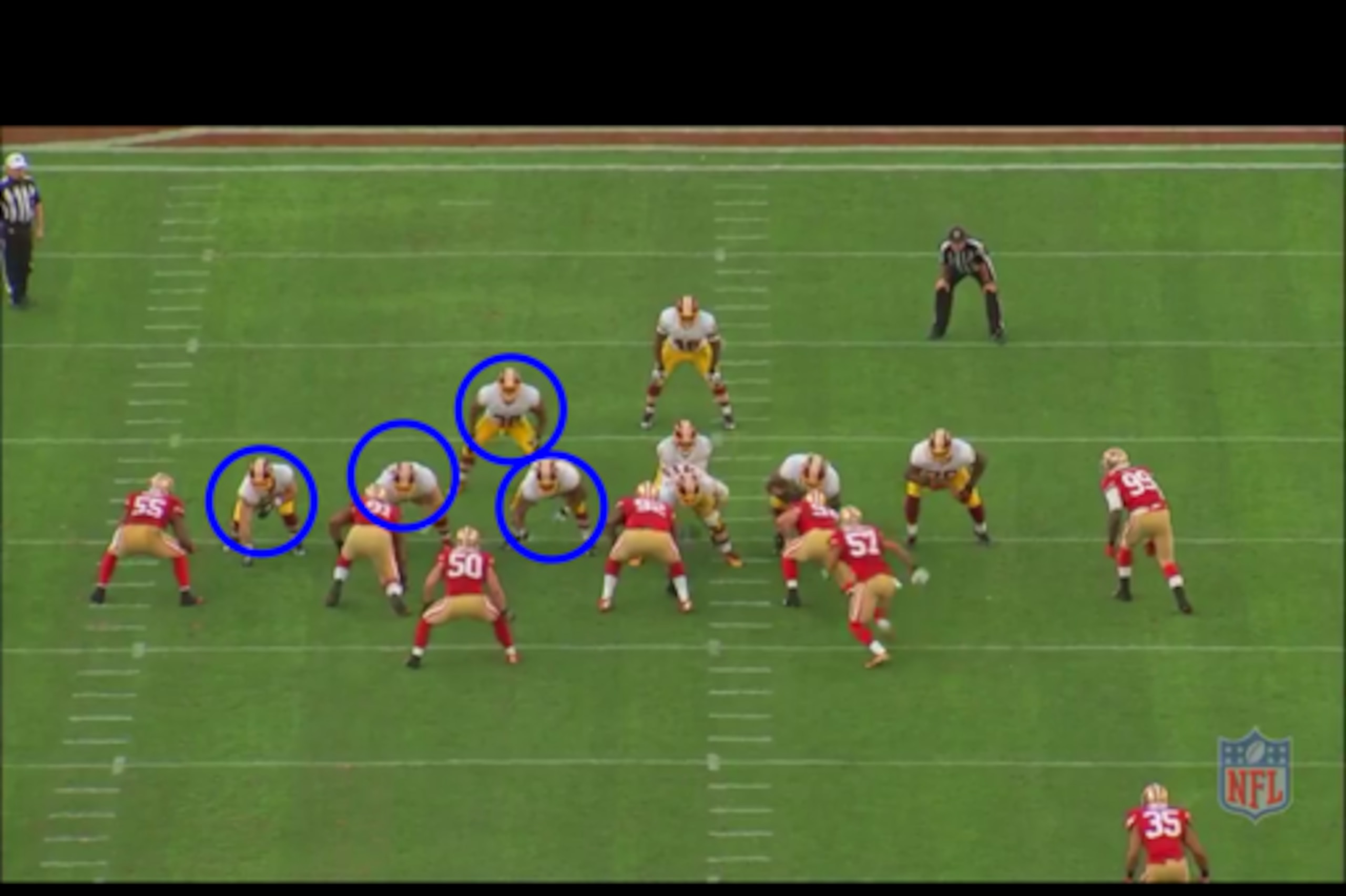
The stretch play was again run to the right. Morris' blockers shifted that way and the key double-team came from Compton and right guard Chris Chester against defensive end Ray McDonald:
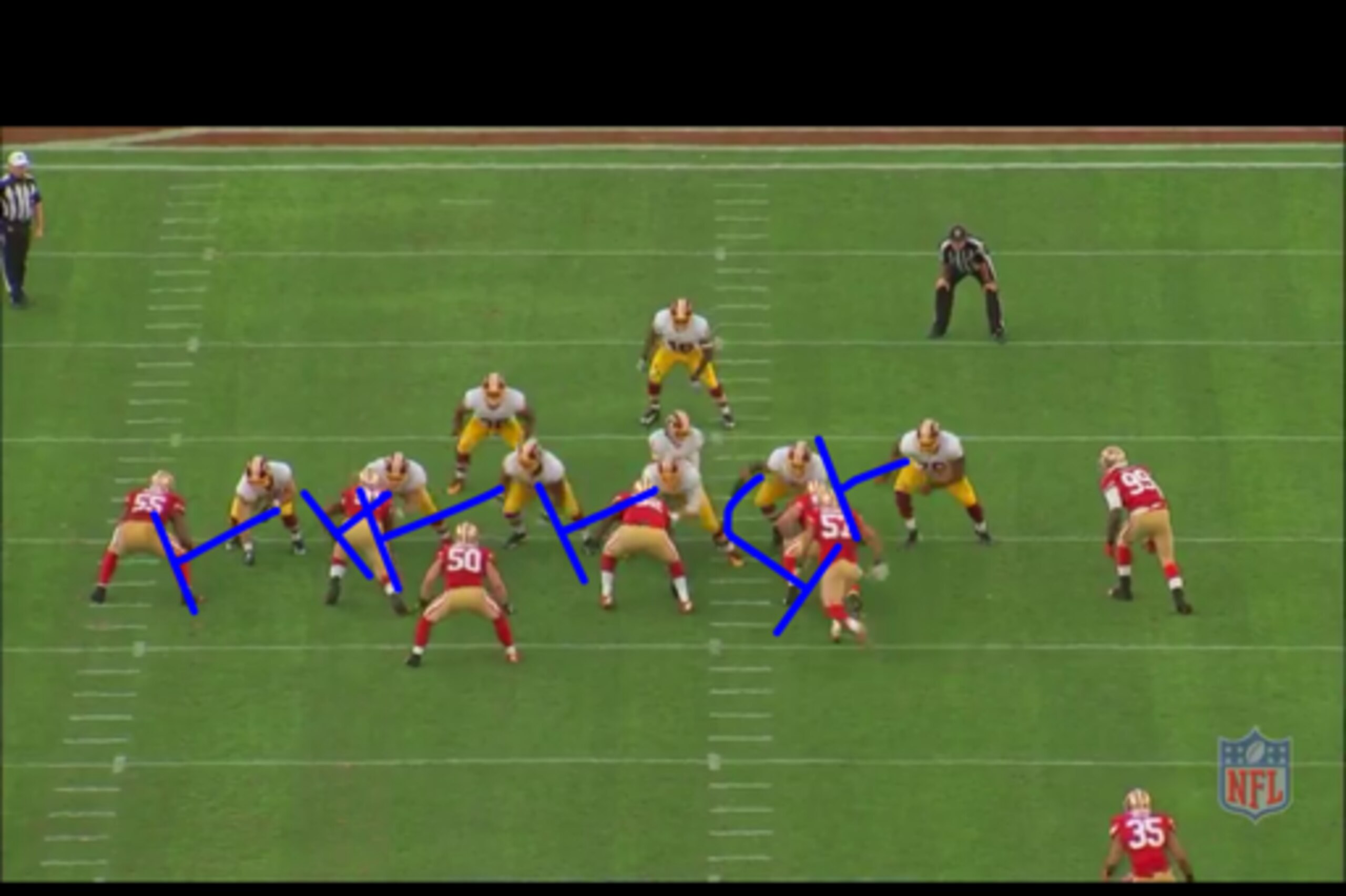
With McDonald neutralized, Compton soon released to the linebacker level to absorb Borland. At the same time, wideout Pierre Garcon came inside to block safety Antoine Bethea, who was the force player for runs to that side:
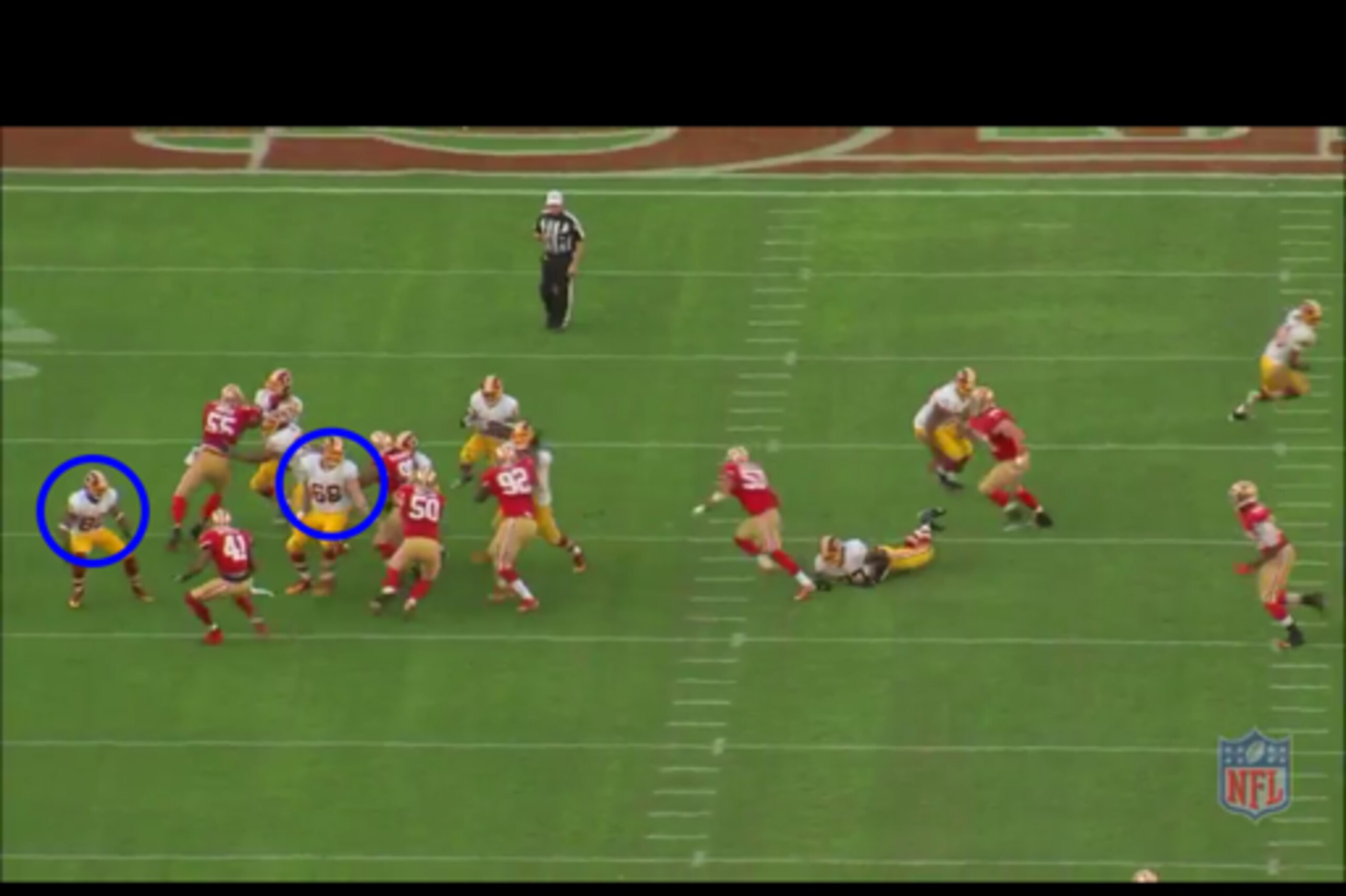
With Compton and Garcon making their key blocks and Young leading the way, Morris had a clear alley to attack:
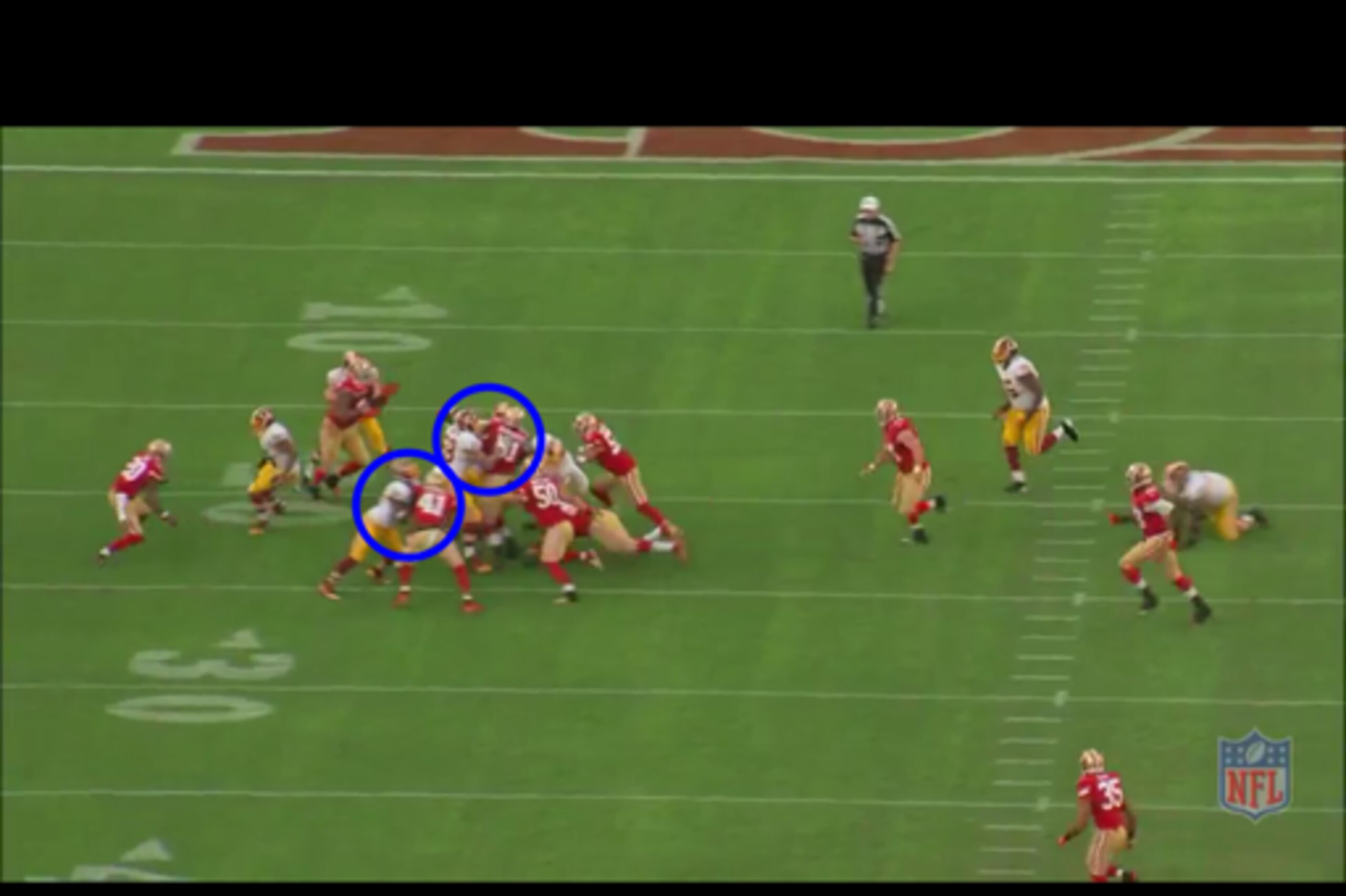
He promptly burst through the gap and rumbled his way for 30 yards:
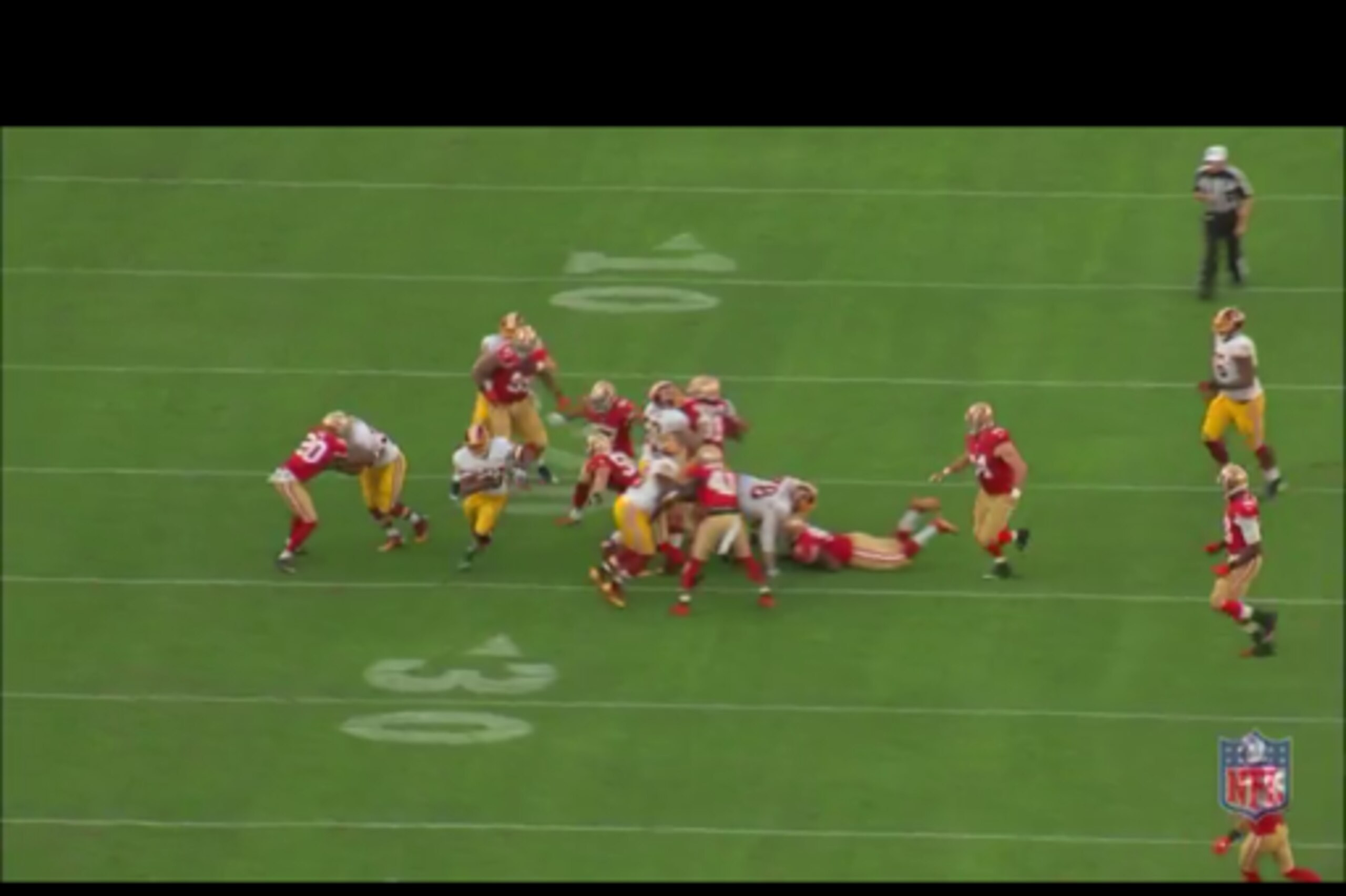
Young's block on cornerback Perrish Cox (20) was a vital factor in the success of this play. It was also a vivid illustration of the fullback's ample skill and genuine value.
Young is one of the more underrated players at his position in the NFL. He's certainly a positive influence on the production Washington gets from its running game, something noted by 106.7 The Fan host Grant Paulsen after another solid run from Morris:
Young will be a factor in Indy, but the play designs of these outside runs will be more significant. One of the best things the Redskins did with Morris in San Francisco was to run him laterally.
That meant he avoided downhill tackling machine Borland. The tenacious rookie has impressed many with his enthusiasm and willingness to hit.
But while he's been productive, Borland is still limited. He's not particularly quick and is better plugging the the gaps in the guard-center-guard box.
Washington exploited Borland's weakness chasing plays sideline-to-sideline and his numbers suffered as a result. Borland entered Week 12 having made 17 and 13 tackles, respectively, in his previous two games. He managed just eight combined stops against Washington.
Why is this important this week? Because the Colts have their own downhill pluggers who can be exploited laterally. D'Qwell Jackson and Jerrell Freeman will struggle to chase down plays run toward the sideline.
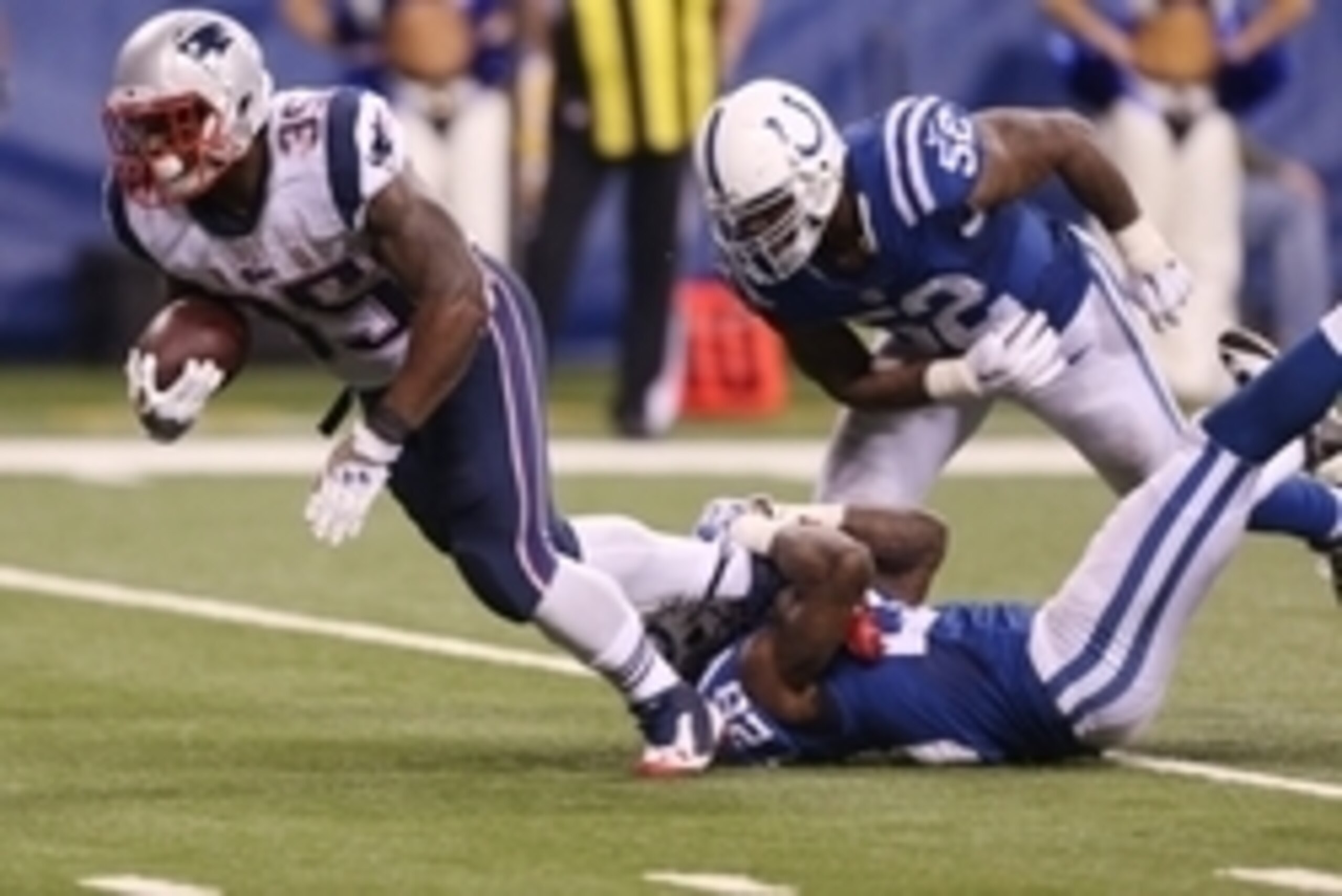
The pair can also find it tough to work through traffic and avoid blockers at the second level. The New England Patriots proved that when they freed Jonas Gray for 201 yards and four scores in Week 11.
ESPN.com Patriots reporter Mike Reiss noted how it was power-based concepts, such as overloaded fronts, that really overwhelmed the Colts:
"Gray agreed that was a tone-setter, and a big part of the plan was having rookie offensive tackle Cameron Fleming on the field as a tight end/sixth offensive lineman -- his 6-foot-6, 325-pound frame contributing to the beatdown the Patriots delivered. Fleming played 37 snaps in that role, which was similar to how the Patriots attacked the Minnesota Vikings in Week 2.
"
With Morris back in form, Washington can use a similar game plan to test out Jackson and Freeman.
Of course, one of the major benefits of having Morris back to his best is what he can mean for the passing game. Against the 49ers, the passing attack stalled while Griffin floundered.
He threw for a mere 106 yards, but 54 of those yards came on two play-action passes set up by Morris' strong running. The first of those passes went to Garcon and showed exactly how this running game messes with coverage.
The plan was to again manipulate Borland and Wilhoite's tendency to pursue the run like dogs chasing tennis balls. The play began with Paulsen coming across the formation in motion:
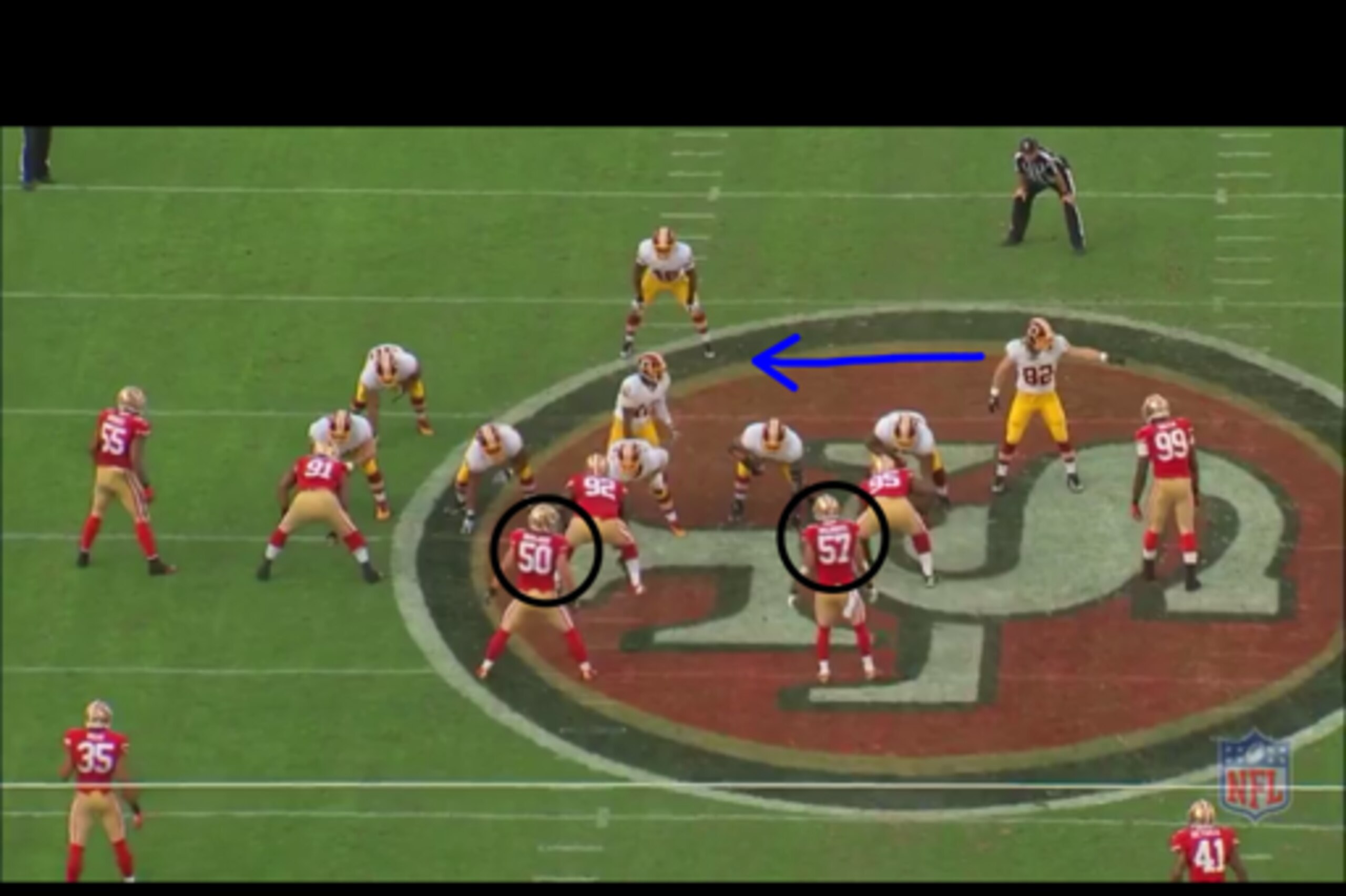
This again created an overload on one side of the front, something that certainly sold the idea of a run:
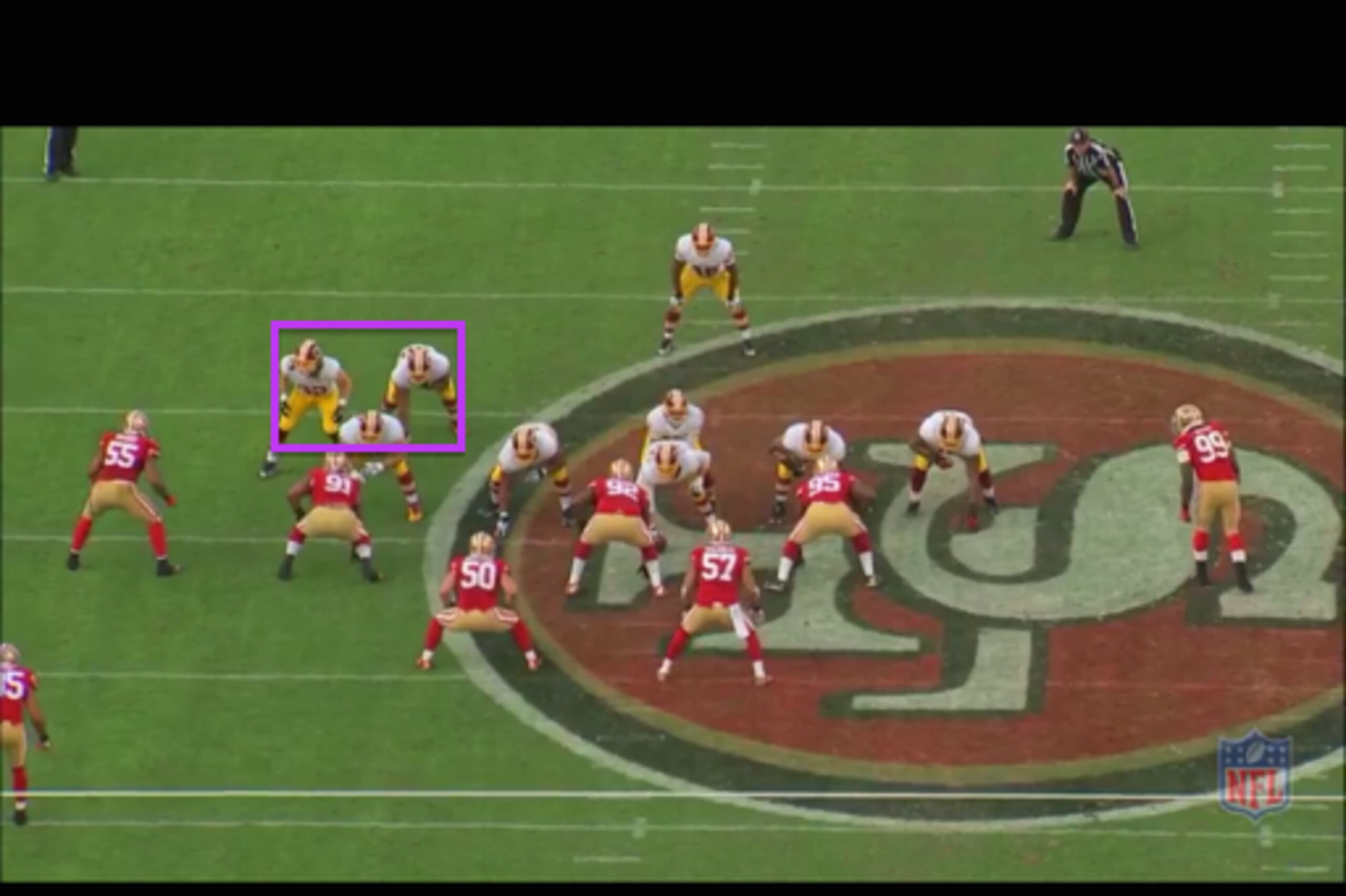
As soon as Griffin faked the ball to Morris, both Borland and Wilhoite lurched toward the backfield. At the same time, Garcon crept behind them on a slant pattern:

From the overview, you can see the gap in the second level of the defense. The middle is wide-open because the inside 'backers bought the run action. With the safeties deep, the coverage was split, leaving the middle free:
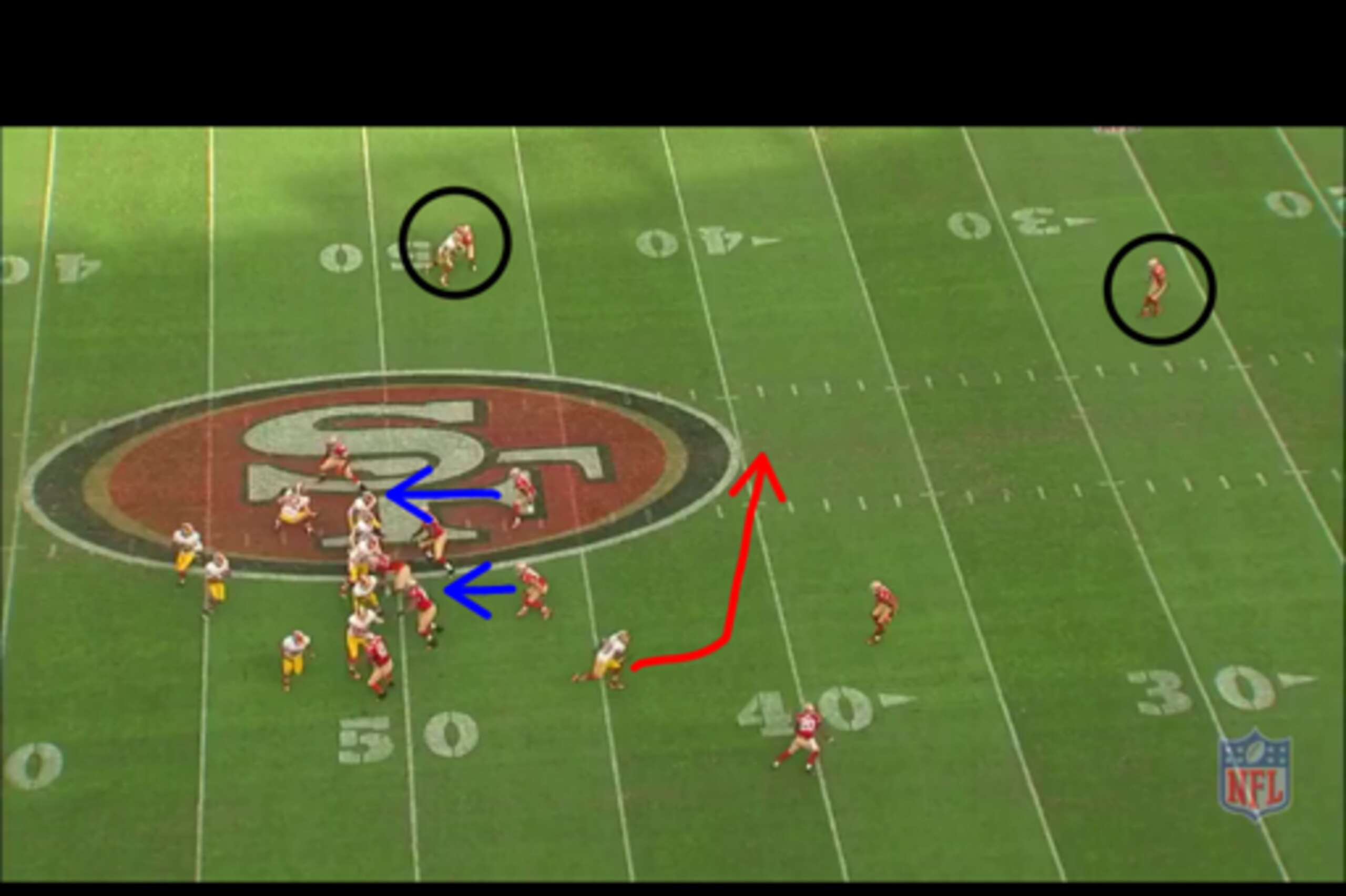
Notice the Niners' decision to play press coverage with a safety over the top against DeSean Jackson on the other side of the field. That took away a safety who might act as a robber and pounce on any underneath crossing patterns like the one Garcon ran.
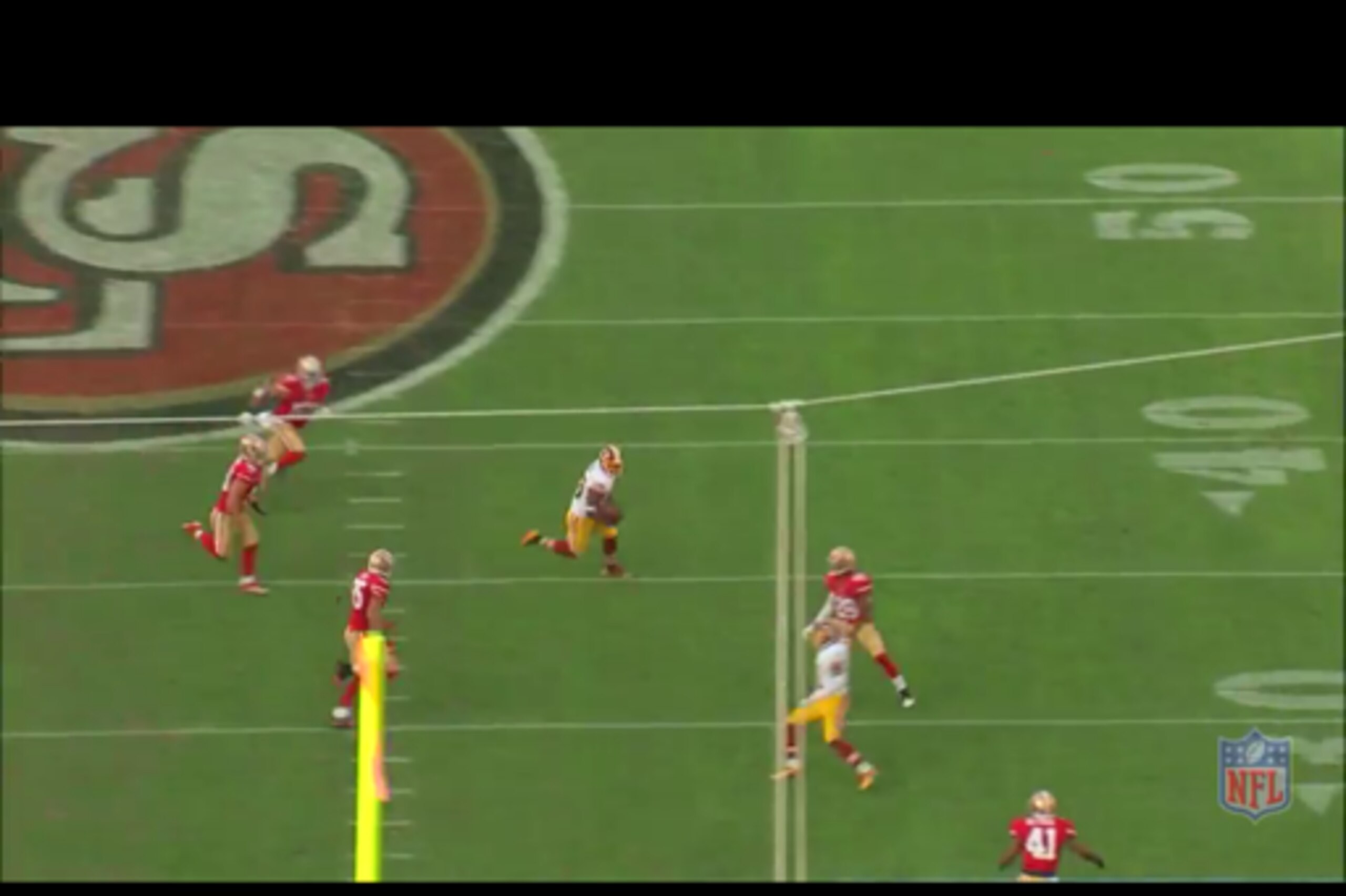
The receiver snagged the ball and had all the room he needed to register double-digit yards after the catch. Garcon soon completed a 24-yard gain:
This is a concept that can work just as well with McCoy under center. A trip back to Week 8's season-highlight victory over the Dallas Cowboys offers ample proof of that.
Setting up any successful play-action pass demands a strong run preceding it. Morris delivered that in the third quarter.
The Redskins showed an I-formation look from a Pro-set. Notice how McCoy is calling an audible pre-snap:

This shows the value of Morris. When he's running well, Washington's quarterback, whomever that may be, has a safety net. If the man under center sees something he doesn't like, he can simply audible to the zone-stretch run. That's the go-to call in times of trouble. Every offense has to have one of those.
In this instance, McCoy handed to Morris as stretch blocking was executed toward the right. Compton and Paulsen secured the all-important double-team on the edge:

You all know the formula by now. Paulsen's blocking allowed Compton to release and nullify a linebacker. That gave Morris a lane to cut into and gain 29 yards:
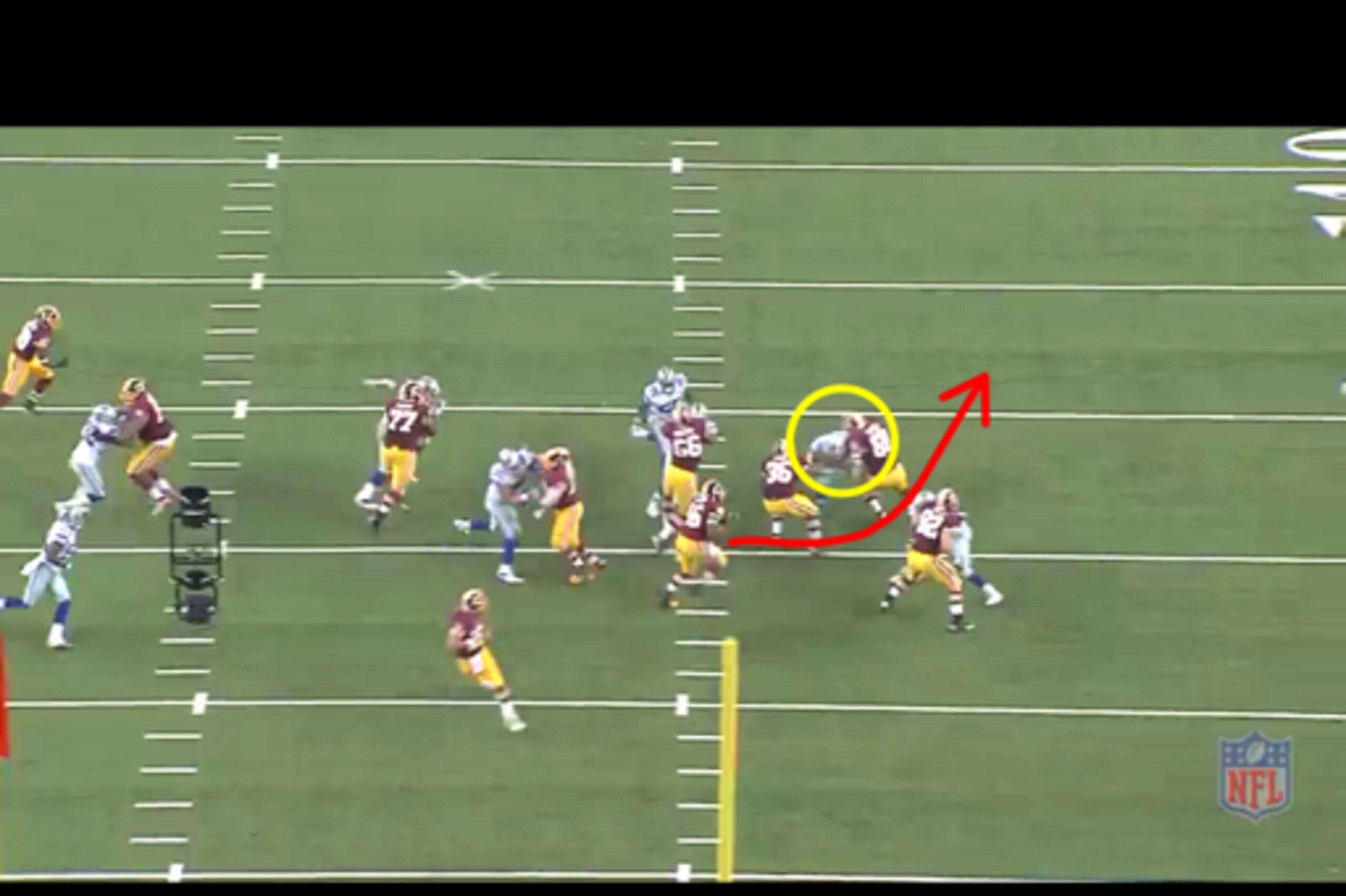
Any gain like this is going to create opportunities for yards off play action. A few plays later, McCoy put that theory into practice.
This time, Washington showed a read-option look with McCoy in the pistol and Paul in the backfield with Morris:
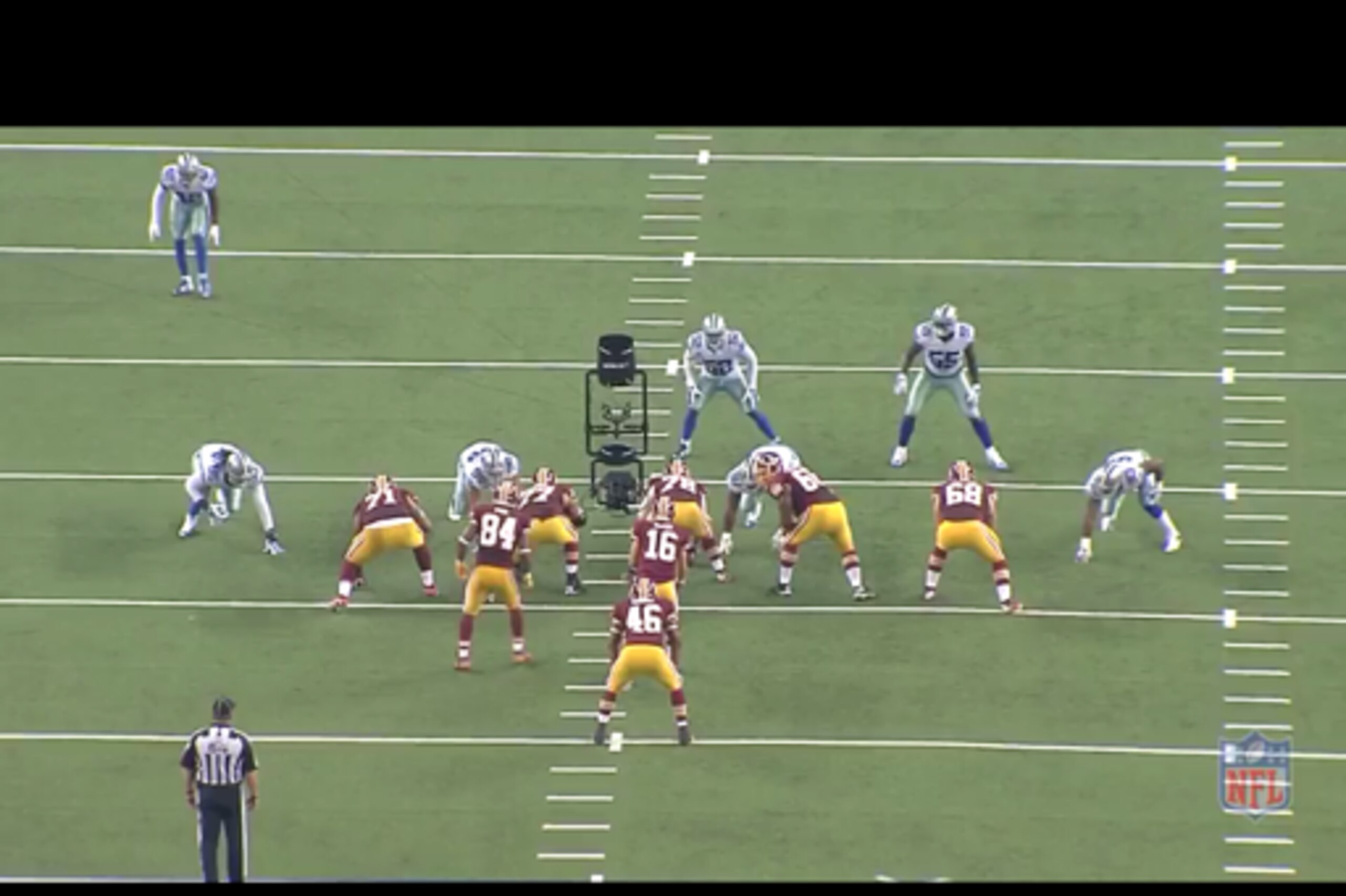
The fake froze not only the inside linebackers, but also the play-side defensive end, Anthony Spencer:
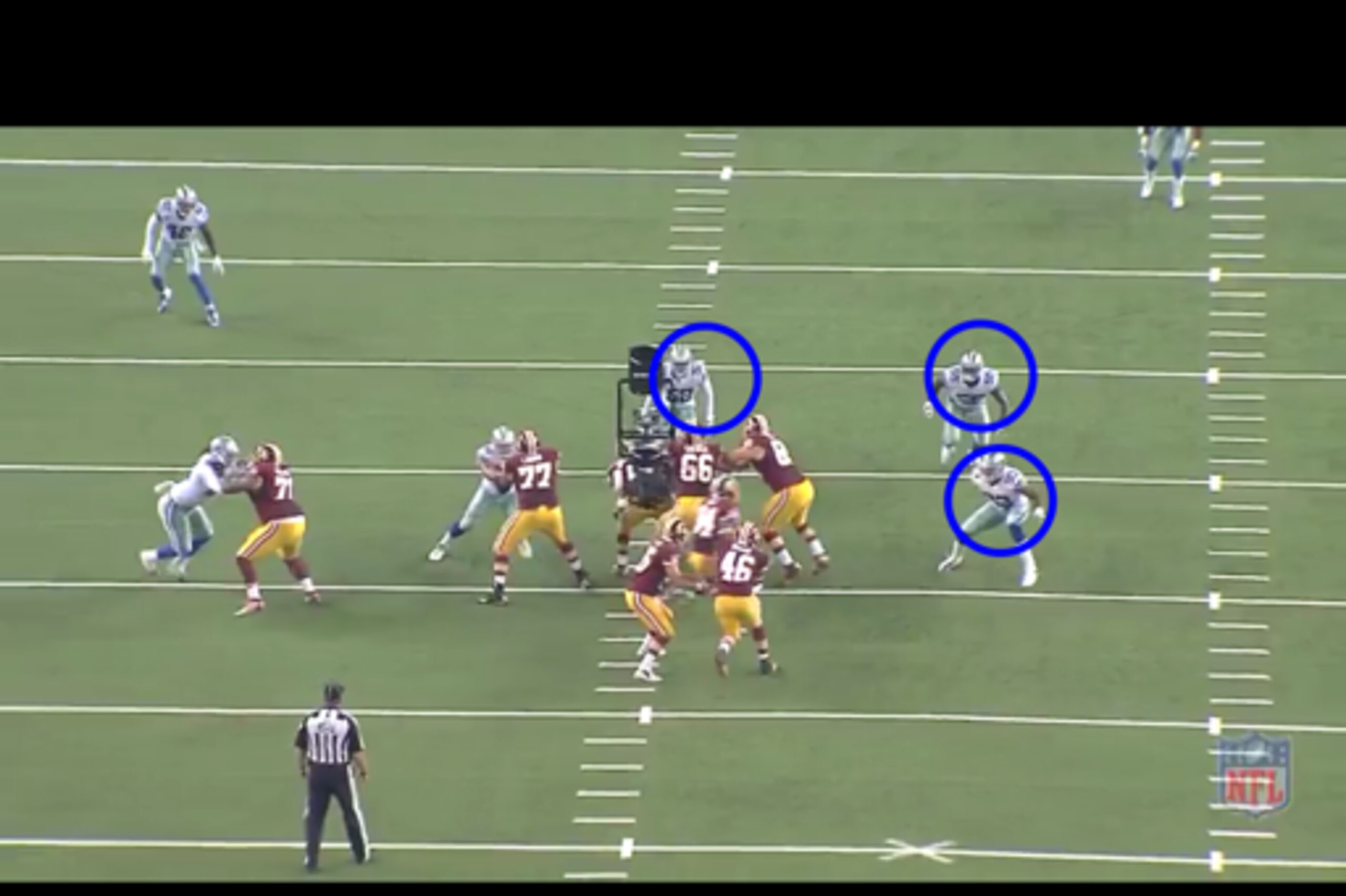
Notice how Spencer was in a sort of no man's land. He was neither rushing the passer nor slanting inside for the run. That's because he was more concerned with setting the edge in case McCoy kept the ball and ran.
This is the type of threat Washington's offense always hopes to pose with Griffin under center. At least, that's the theory.
But the same approach can apply, perhaps to a lesser extent, with McCoy. The veteran is mobile and not afraid to make plays with his legs.
From the eye in the sky, see how the fake drew the linebackers down, creating that void in the middle. Andre Roberts looked to exploit it with a slant route:
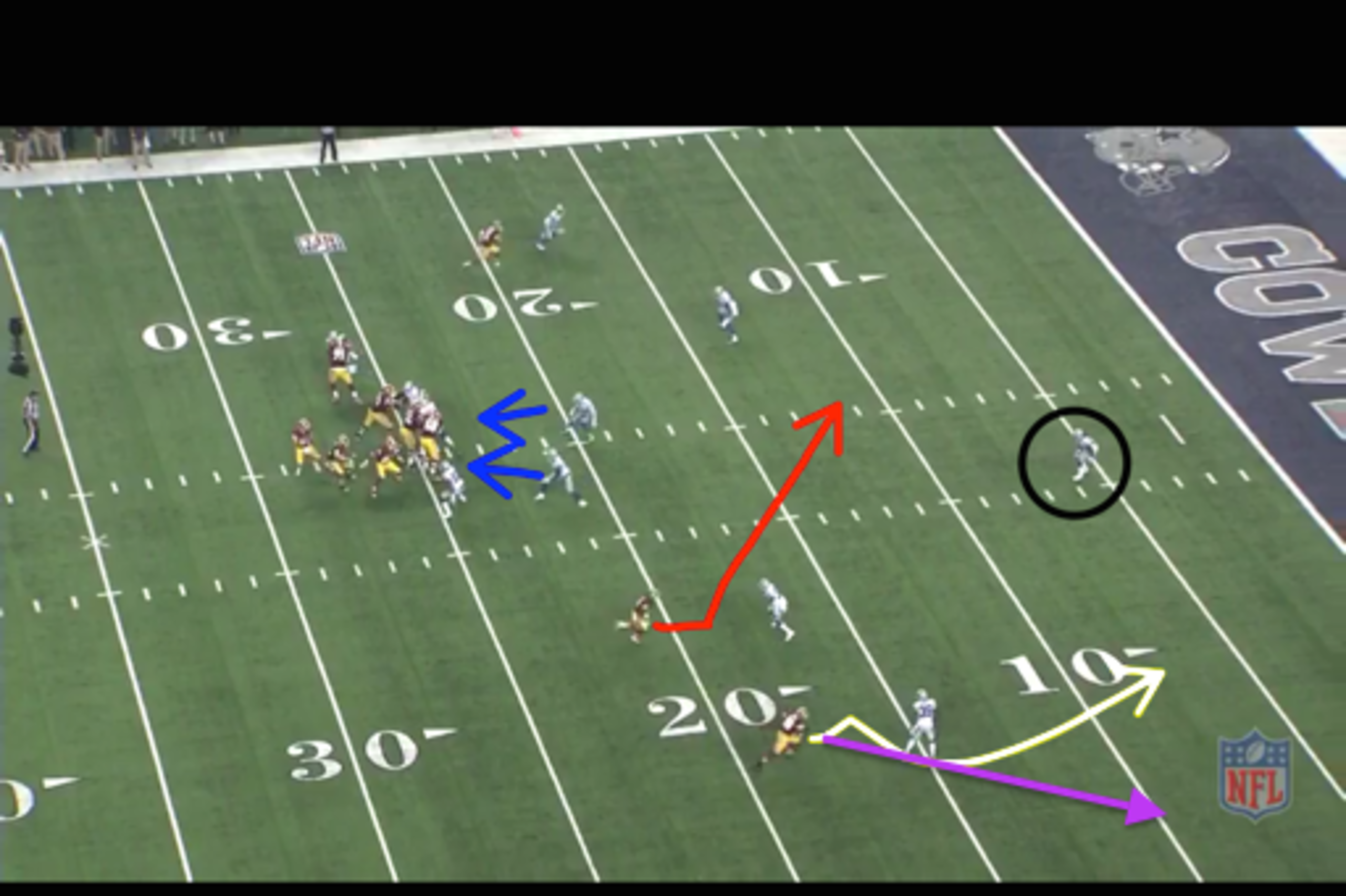
Meanwhile, Garcon worked the outside. He faked a vertical pattern, but soon used a stop-and-go move to complete a comeback route.
With the deep safety choosing to cover Roberts' inside release to the vacated middle, Garcon was left free on the outside after his clever route beat single coverage:
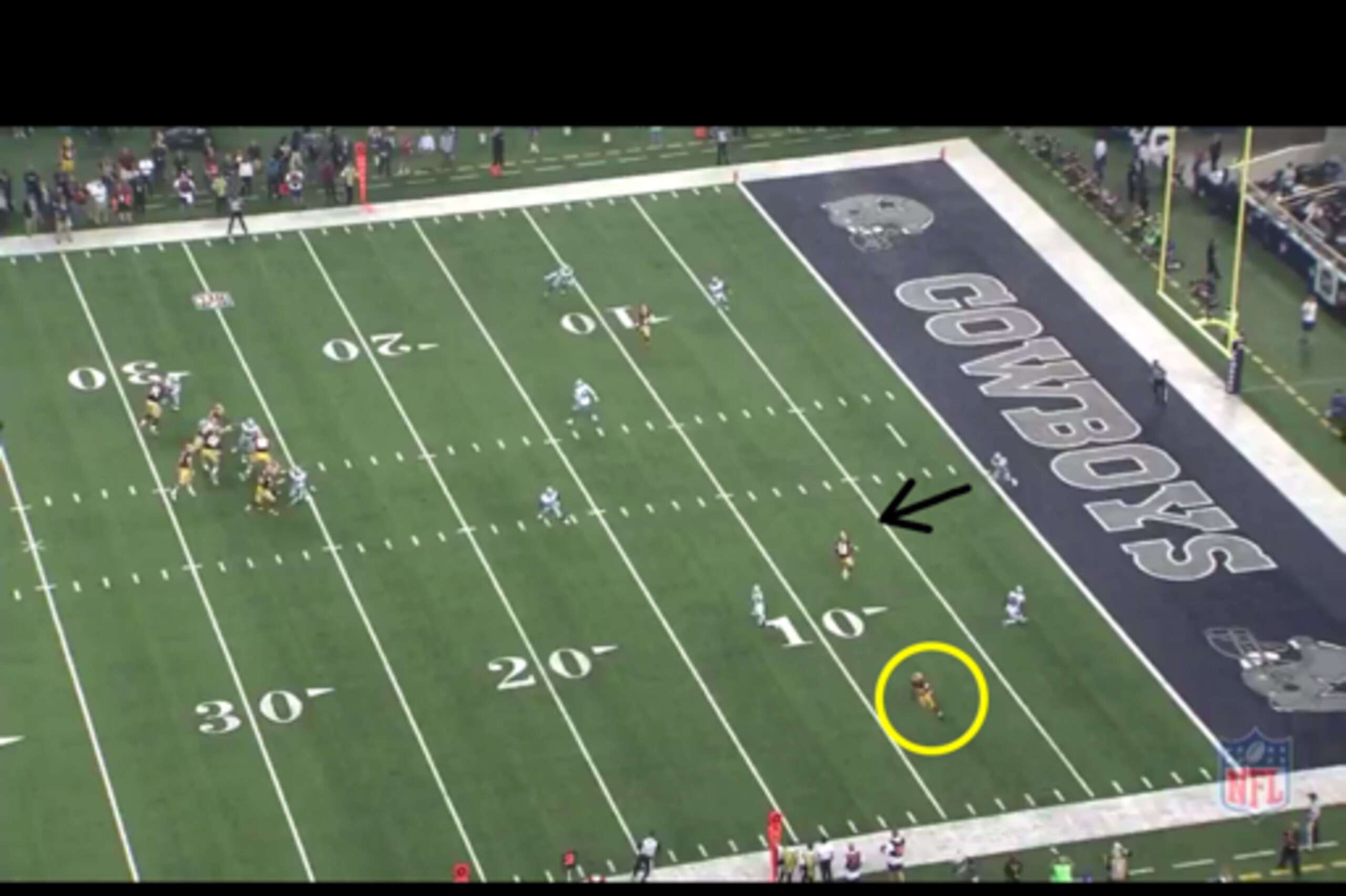
McCoy soon saw the mismatch and connected with Garcon for 18 yards on a drive the Redskins soon turned into a touchdown:
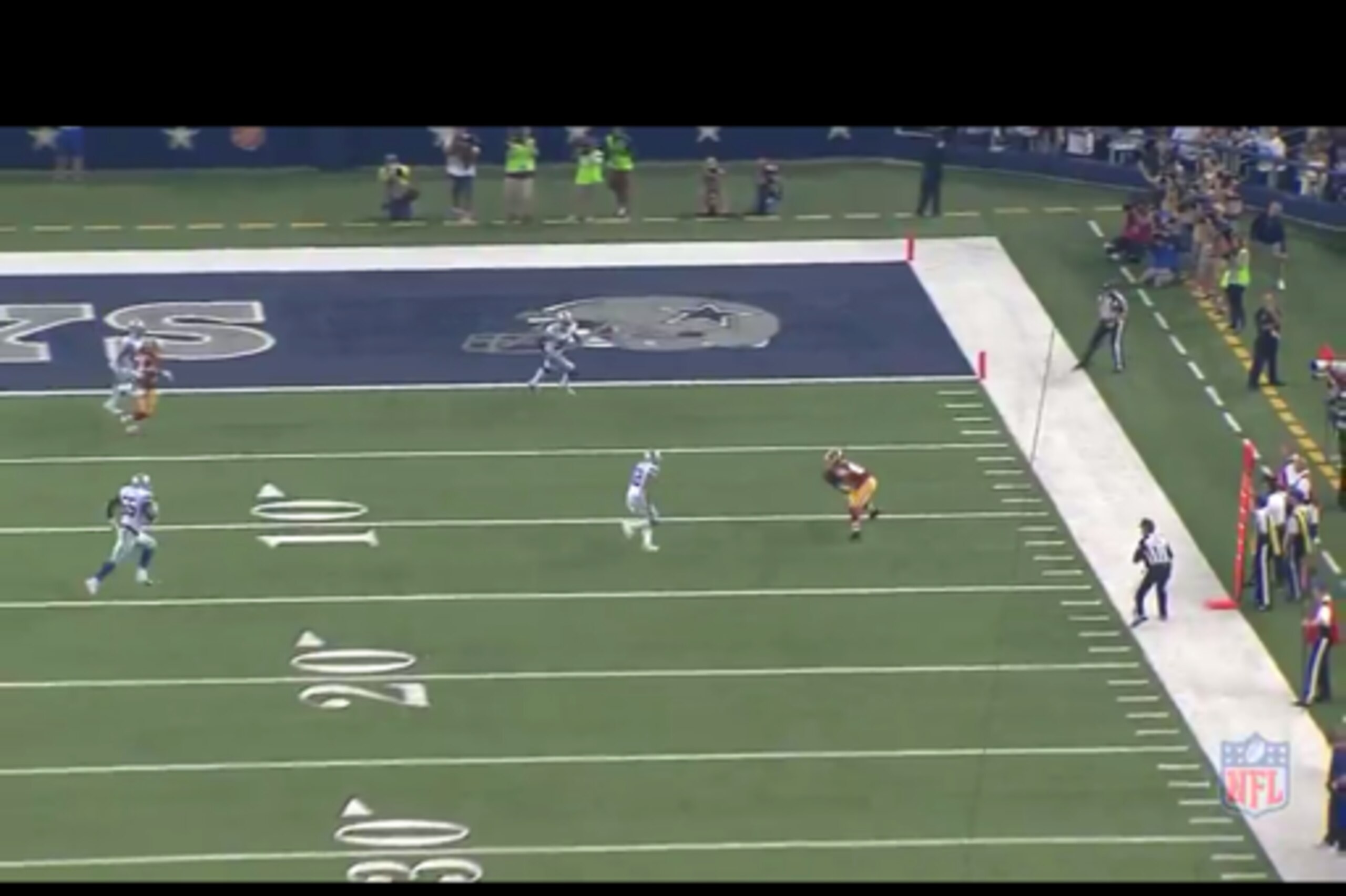
McCoy made a nice read here, even if the throw was below average. Garcon practically had to scoop the ball off his laces to complete the catch.
However, the real debt is owed to Morris. His threat created the play-action opportunity and put the Cowboys D in passive, guess mode.
That same formula can work for McCoy in Indianapolis. He won there as quarterback of the Cleveland Browns in Week 2 of the 2011 season. On that day, 94 rushing yards from Peyton Hillis gave him the balance he needed.
McCoy will probably need Morris to exceed those numbers this week. The Redskins need the two-time 1,000-yard rusher at his best for the rest of this season.
Fortunately, he seems to be back to his best already.
All statistics via NFL.com.
All screen shots courtesy of CBS Sports, ESPN and NFL.com Game Pass.
.jpg?w=2560 "Buccaneers Mayfield’s Future Football")
.jpg?w=2560 "Rams Camp Football")