

What's Behind Teddy Bridgewater's Struggles in the Deep-Passing Game?
Despite early success as an NFL quarterback, Minnesota Vikings rookie Teddy Bridgewater has failed to throw accurately in the deep passing game, limiting the offense's capabilities. The frustration with his downfield passing came to a head on Sunday, when he missed multiple deep throws to receivers in an area code’s worth of space, leaving at least two touchdowns on the field.
Correcting the issues is necessary for Bridgewater and the Vikings offense to reach their full potential. So where do the issues come from?
When Minnesota made the move of drafting Bridgewater back in May, in effect hitching to him as the quarterback of the future, the team's decision-makers surely acknowledged his propensity for misfires in the deep passing game in their deliberations.
TOP NEWS

🚨 Jalen Hurts Out for Year
.jpg?w=2560 "Texans Jaguars Football")
Hunter's Wife Calls Out Sharpe
Hurts Stayed Awake 36 Hours Before Jags Game
Through my own charting, Bridgewater only completed 51 percent of throws (counting drops as completions) beyond 20 yards during his final season at Louisville. While above average for the 18 prospects included, the No. 7 ranking falls well below the standards he set for himself when it came to completing passes as a college quarterback.
Glaring misses occurred at Louisville too; it wasn’t just contested passes that receivers failed to reel in. As far as weaknesses went for Bridgewater as a prospect, inaccuracy down the field stood near the top of the list.
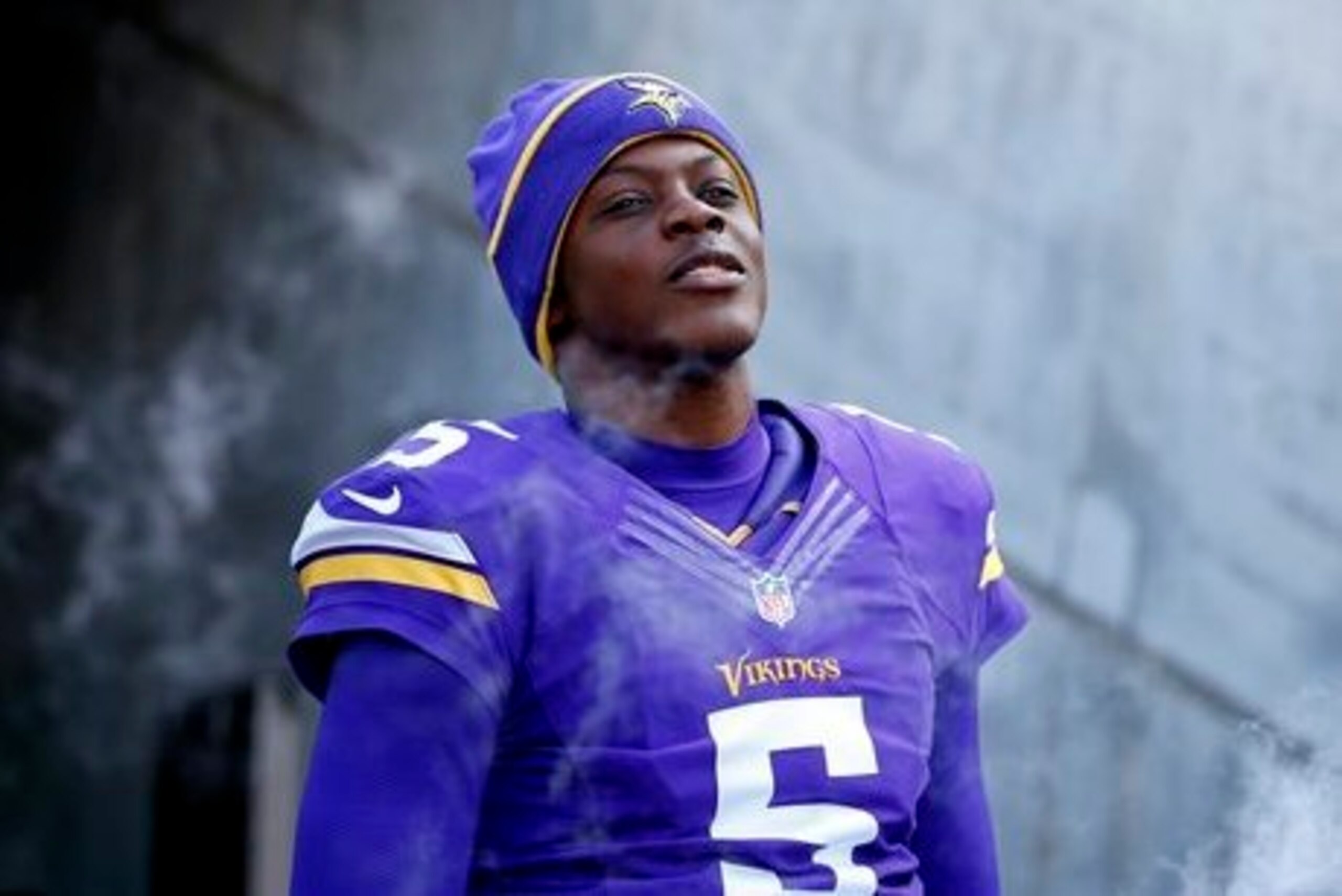
Size was his other big concern. Despite adequate height and weight, Bridgewater's frame is quite thin. He also lacks an outright cannon for downfield throws at high velocity. He ran a West Coast offense efficiently at Louisville, one that featured short to intermediate passes and moved him from the pocket frequently.
Then the Vikings raised some eyebrows by drafting the slender quarterback and pairing him with an offensive coordinator whose system is synonymous with downfield passing from the pocket in Norv Turner. Turner’s system often utilizes deep to short progressions, requiring the QB to make accurate throws to downfield route-runners as option No. 1.
Few exceptions are made for Bridgewater. He can either sink or swim.
On the whole, the rookie is treading water quite comfortably and improving weekly. The one thing still pulling him downward is inaccuracy down the field, specifically on the deepest of routes.
Not all downfield passing has been inaccurate from Bridgewater. Per Football Focus premium statistics (subscription required), he has thrown accurately on 38.5 percent of throws 20 or more yards down the yield. Out of 34 qualifiers, he ranks No. 20, just below average. Tom Brady, Matthew Stafford, Andrew Luck and Ben Roethlisberger all had deep-accuracy percentages between 40 and 35 in 2013.
On throws between 20 and 30, Bridgewater has been able to deliver with accuracy, especially to the sidelines. It’s the go routes and the deepest of passes that have him missing big chances. His statistics from Sunday’s game follow that conclusion, as told by ESPN.com’s Ben Goessling:
"Teddy Bridgewater threw a season-high 18 passes of 10 yards or more, per @ESPNStatsInfo. Hit 9 for 153 yards. Could've had a lot more.
— Ben Goessling (@GoesslingESPN) November 3, 2014"
Three throws in particular stand out as massive misses by Bridgewater from the Washington game, all occurring in the first half.
The first two examples go back to the routes he struggled with the most at Louisville. They are north and south routes all the way, having no discernible landmark where the receiver breaks inside, outside or back to the QB.
On the first play, Minnesota was given the perfect coverage for the offensive call. As Greg Jennings ran straight down the seam in his vertical route from the slot, the inside linebacker had to carry him all the way down the field in man coverage. An obvious mismatch, Bridgewater had a touchdown waiting for him.

The ball was a flat-out overthrow, giving Jennings no chance to run underneath it. Overthrowing is the theme for Bridgewater on these deep routes, putting far too much mustard on the throws.
The same was true when he overthrew Cordarrelle Patterson, the most glaring miss to this point in his NFL career. It was a blown coverage by Washington. Bridgewater could have underthrown his receiver by 10 yards and still had a touchdown. He just couldn’t help himself.
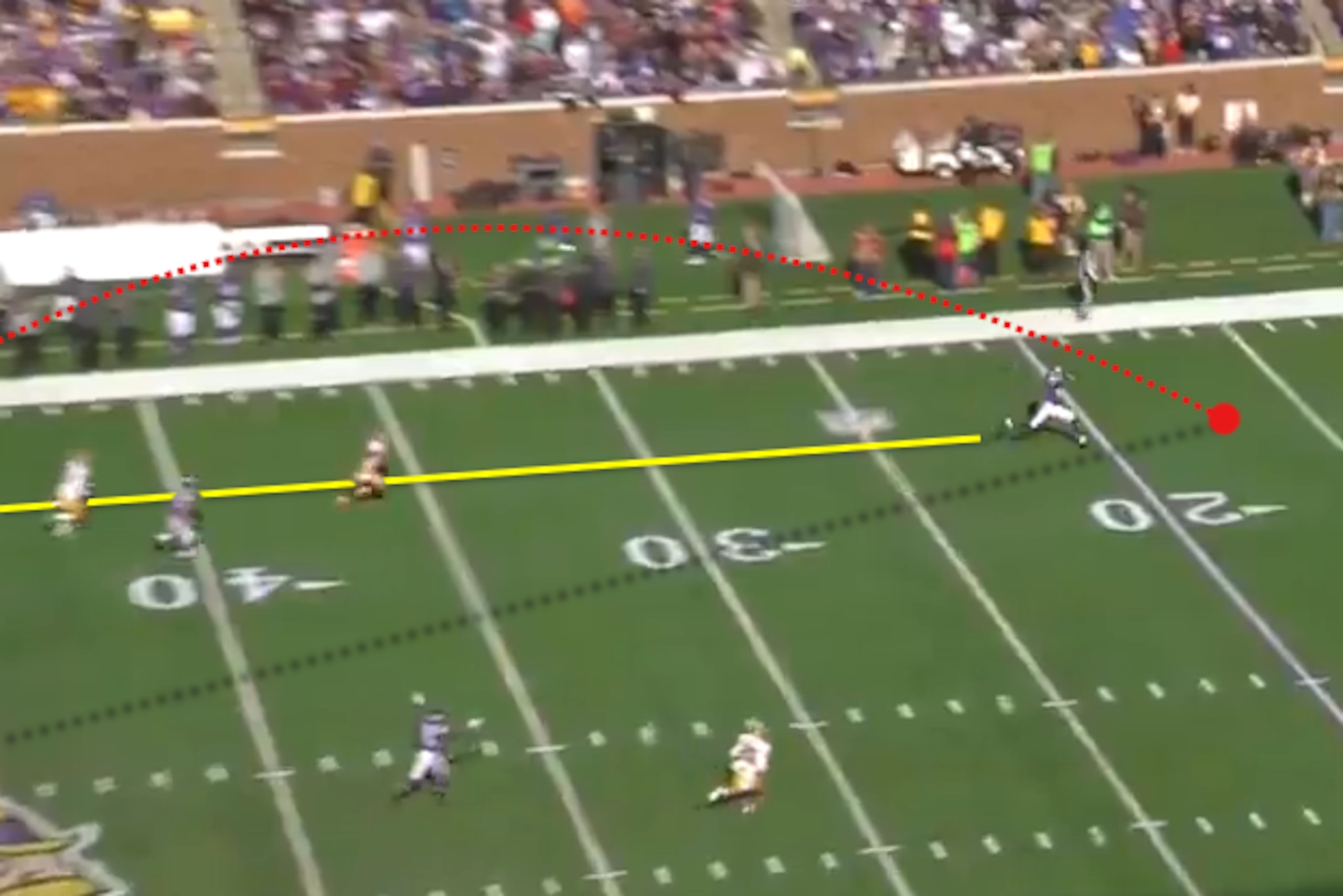
Whether Patterson could have actually caught this ball is debatable. With such an open receiver, though, it should not come down to that.
A few culprits could be behind these inaccurate deep passes. Throwing go routes, a QB must have an innate feel for where his receiver is going to be when the ball arrives and what kind of power goes into making that throw. Then mechanics come into play. Consistent mechanics of the throwing motion and consistent generation of power is necessary.
With Bridgewater, that last point leads to problems. On a typical short or intermediate throw, Bridgewater steps and throws to drive the football like a quarterback should. On deep throws, he seems to account for the fact that he lacks a cannon, exaggerating his forward step and following through on the throw with extra rotation.
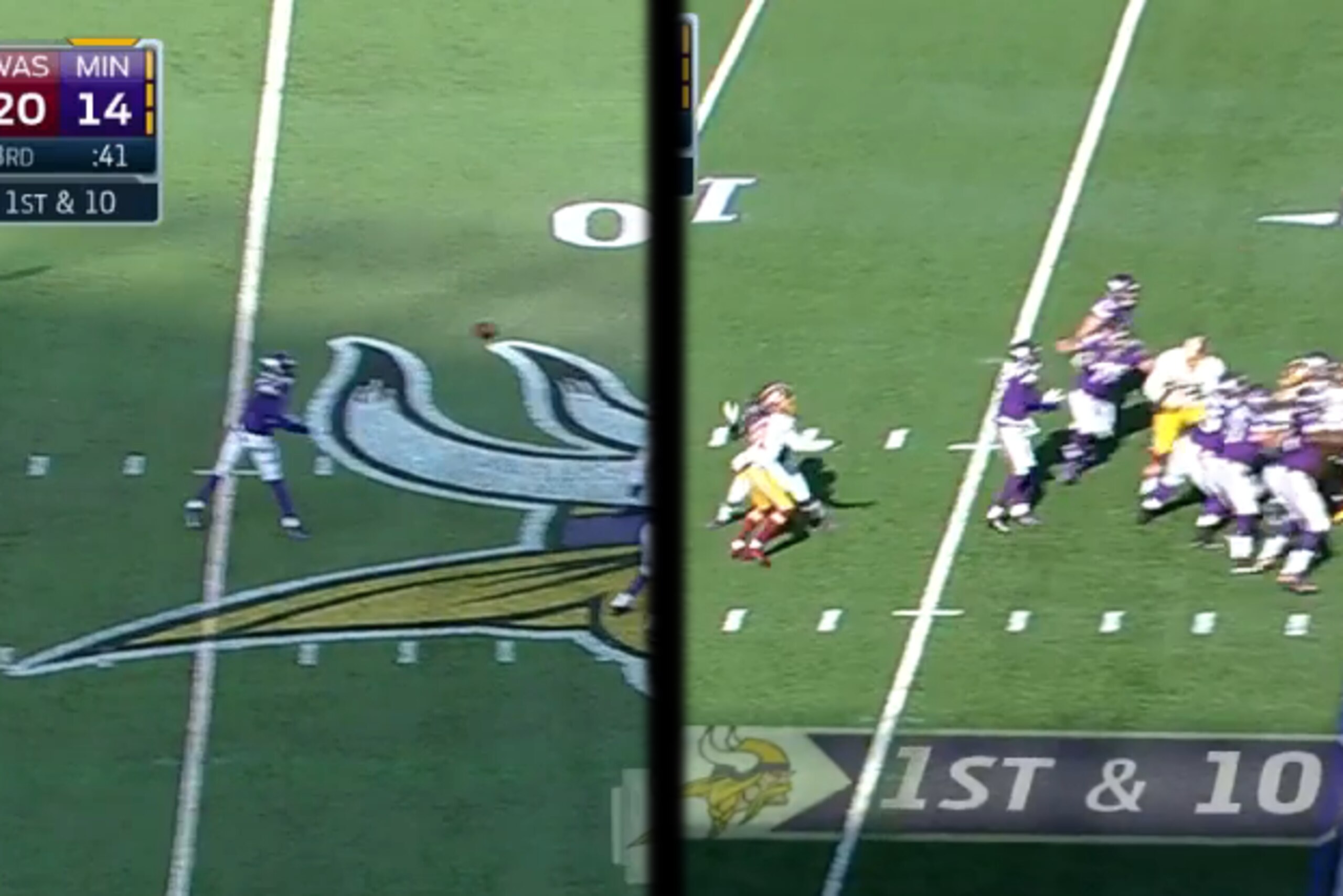
The first shot is from a 13-yard throw completed at the sideline. Bridgewater steps and throws, but his back foot does not come through. The second is from the missed deep ball to Jennings. He generates extra power by rotating as he throws, which brings his back foot all the way through to the point he even takes a forward step after releasing.
All quarterbacks make tweaks to generate the power needed for different throws. Having drastically different footwork for each is problematic.
Bridgewater also gets himself into trouble by taking multiple hitch steps, forward steps that allow coverage to clear and sync up the timing with routes. Climbing the pocket is productive, but those extra steps are generating power that Bridgewater doesn’t seem to account for in the way he dials up the deep ball.
The final issue is one Bridgewater pointed to after Sunday’s game, via Matt Vensel of the Star Tribune:
"Teddy said the issues on the deep ball were the result of aiming at the player instead of throwing it to an area and letting WR run into it.
— Matt Vensel (@mattvensel) November 2, 2014"
This was especially true on his third miss, a deep post.

Patterson ran a crisp route, spinning the cornerback like a top at the break of his route and running into acres of space. Washington had no single-high safety to provide help, so Bridgewater had another big chunk of the field to work with.
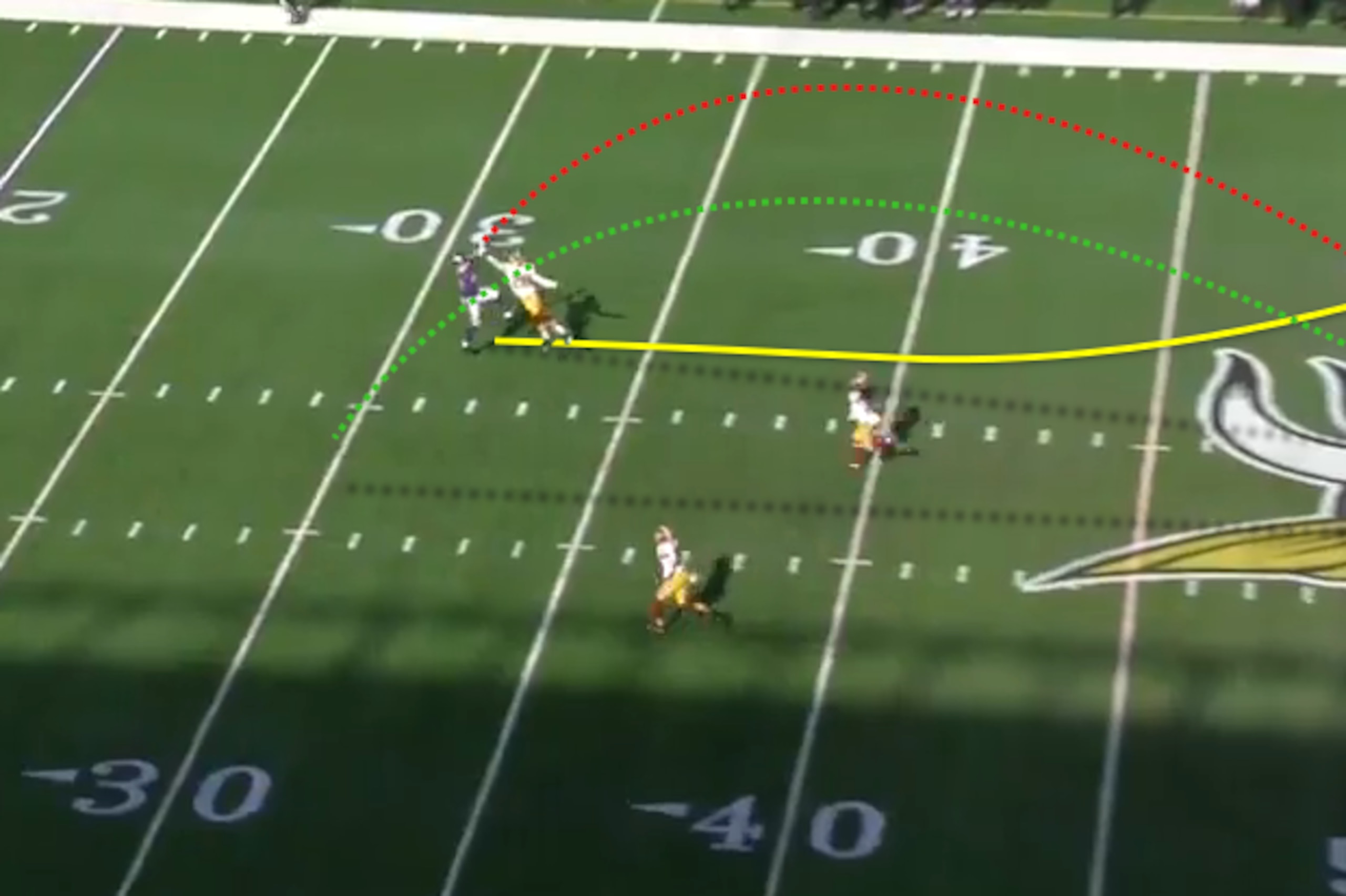
Instead of throwing to the open area, Bridgewater has his sights on Patterson and inadvertently leads him up the hash mark, bringing the CB back into the play. If he throws it to the middle of the field, Patterson runs under it, and he would be still be running a few days later.
When it comes to fixes, this is the first and most correctable issue. Quarterbacks are taught to identify the soft spots in a defense and throw to them, trusting that their route-runners will get to the right places. Bridgewater typically does this well. But in throwing deep passes, he tends to steer the ball and throw to his receivers, not to the open areas of the field.
The next step is simple repetition. Drilling these downfield routes over and over will help Bridgewater’s feel for the timing on downfield throws and his feel for where his receivers will be.
Throwing in rhythm will help the consistency of his downfield passing. He showed on numerous occasions at Louisville that when he throws after planting his back foot or with a single hitch step, he can be very accurate down the field.

This throw is the definition of that. Bridgewater plants his back foot, takes a hitch step forward and delivers in rhythm, dropping a dime over the outside shoulder of his receiver on a go route.
The footwork and timing aspect comes from quicker diagnosis of coverage and quicker decisions. Expect those parts of his game to be fine-tuned as his experience in Turner’s offense keeps building.
Finally, the Vikings need to make lemonade out of lemons. Bridgewater will never be a QB who fires 60-yard rockets or who threads the needle 30 yards down the field. Those are not his strengths.
Turner will continue to stress downfield passing, and the offense can be successful doing so. Bridgewater has already shown his accuracy throwing deep out, corner, post and dig routes. Each of these has a clearly defined break that gets a receiver moving east and west across the field. Bridgewater thrives throwing to these routes, even at significant depths.
With five starts under his belt, Bridgewater has shown the type of traits that indicate he can be a franchise quarterback in Minnesota. His steady improvement over the last few weeks is promising too.
The next hill to climb is the deep ball. With a more consistent approach and a more timely decision-making process, it can get there.
.jpg?w=2560 "Falcons Colts Football")
.jpg?w=2560 "Jaguars Broncos Football")

.jpg?w=2560 "Report: Dalton Signing with Falcons")
