


As soon as he came, there he went.
That could be the final narrative of Yoenis Cespedes' time with the Boston Red Sox. And given the various parameters in play, it really should be.
Cespedes, as you know, arrived in Boston via a deadline-day trade that sent ace left-hander Jon Lester to the Oakland A's. Though the move signaled that the Red Sox were punting on a 2014 season they eventually finished 71-91, it also signaled that they aimed to return to contention in 2015 with Cespedes as part of a much-improved offense.
.jpg?w=2560)
But now? Maybe not.
Roughly two weeks ago, Nick Cafardo of The Boston Globe reported that "word [was] spreading" that the Red Sox could make Cespedes available on the winter trade market. Then came a report from Bill Madden of the New York Daily News that Cespedes' agency switch to Jay Z's Roc Nation outfit "is said to increase the likelihood the Red Sox will trade the Cuban slugger this winter."
This is where we get into the arguments for and against trading Cespedes, and there are indeed compelling cases to be made either way.
The case for the Red Sox to keep Cespedes is all about practicality. He's still only 29 and is coming off a season that saw him hit 22 homers with a .751 OPS and, according to FanGraphs, a career-best 3.4 WAR. Beyond that, he possesses a rare talent and has a tangible sort of value on the Red Sox.
The rare talent Cespedes possesses is power from the right side. He has yet to finish a season with fewer than 22 home runs or an isolated slugging rate (slugging percentage minus singles) below .190. These are pretty good numbers for an age in which, as Grantland's Joe Lemire noted, right-handed power is in perilously short supply.
Cespedes' defense in left field, meanwhile, was never better than in 2014, if you buy into the advanced metrics. He saved double-digit runs above average, whether you consult Defensive Runs Saved or Ultimate Zone Rating.
As for Cespedes' tangible value, that has everything to do with the other outfielders around him on Boston's roster. The list includes Mookie Betts, Rusney Castillo, Shane Victorino, Daniel Nava, Allen Craig and Jackie Bradley Jr. Or, if you prefer:
- Betts: A 22-year-old who's new to the outfield and only has 52 major league games under his belt.
- Castillo: A 27-year-old Cuban import with all of 10 major league games under his belt.
- Victorino: A soon-to-be 34-year-old coming off an injury-wrecked 2014 season.
- Nava: A 31-year-old switch-hitter who's only useful from the left side.
- Craig: A 30-year-old who managed only a .594 OPS in 2014 and who might be damaged goods.
- Bradley: A 24-year-old center fielder who can field like crazy but can't hit a lick.
Behold the Red Sox outfield. It's Cespedes, and then a handful of unknowns.
And that's the case for keeping Cespedes. As I said, it's a compelling case.
The case for trading him, however, is even more compelling.
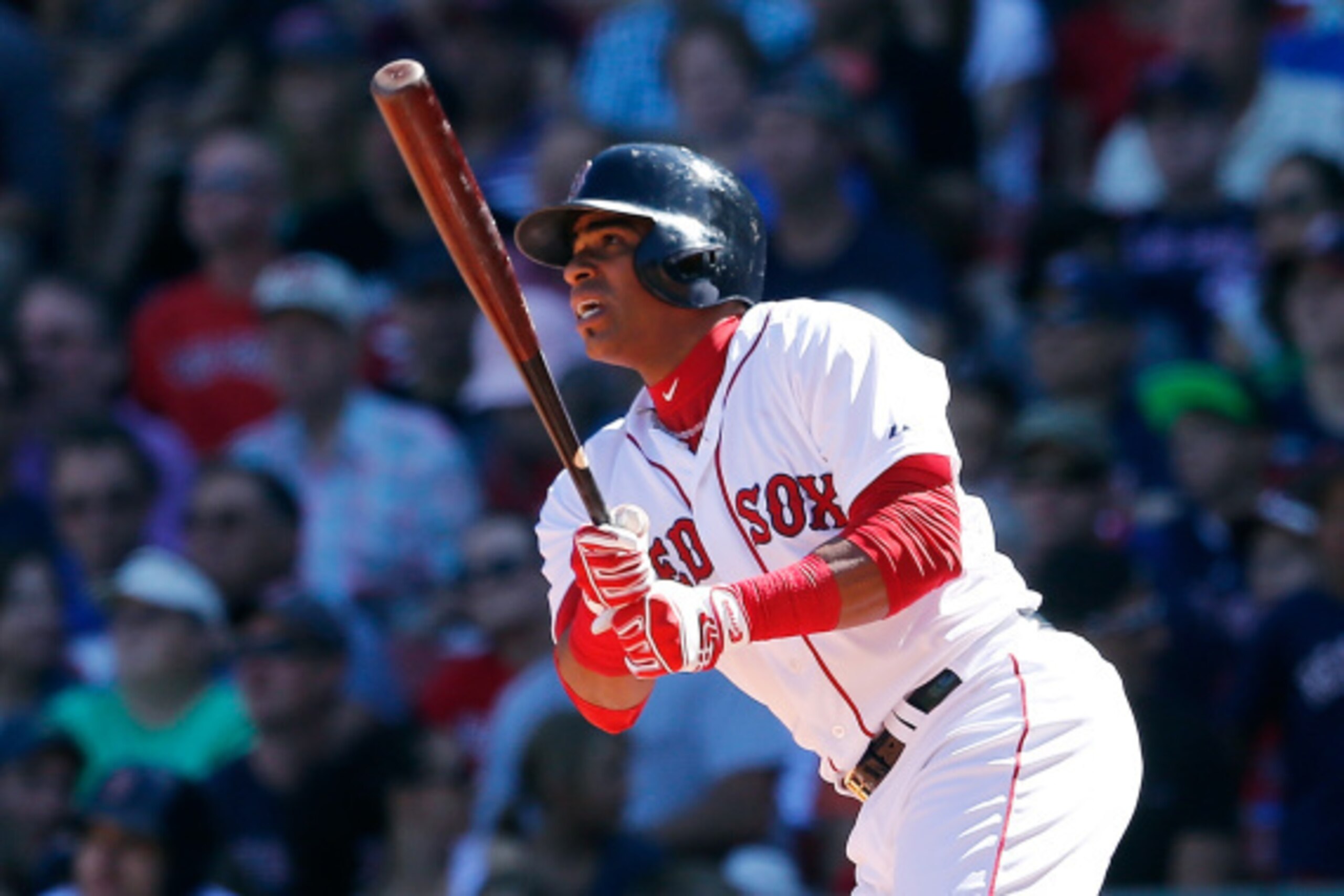
You know that right-handed power we were talking about?
Yeah, that. By all rights, Cespedes' move from O.co Coliseum to Fenway Park should have made it even better. What actually happened, though, is it got worse.
Cespedes went from .208 isolated slugging in Oakland to .154 isolated slugging in Boston, and his five homers in 51 games would have put him on pace for just 16 over a full season.
A fluke? Perhaps, but it's also a possible warning sign.
For as much as Cespedes looks like the perfect guy to take aim at the Green Monster due to his extreme pull-power split, FanGraphs can vouch that he's traditionally more of a line-drive and ground-ball hitter to left field than the kind of pull fly-ball hitter that works best with the Green Monster:
| Pull | 20.5% | 56.3% | 23.3% |
| Center | 17.4% | 28.9% | 53.7% |
| Opposite | 15.3% | 14.3% | 70.4% |
If you're talking raw power, Cespedes certainly has tons of it. If you're talking actual in-game power, he might not actually be able to give the Red Sox as much as they'd prefer.
If so, then he doesn't have much else to offer on offense. Cespedes isn't a burner on the basepaths, and his .298 OBP over the last two seasons makes him a poor fit for a Red Sox offense that, as general manager Ben Cherington confirmed in an interview with FanGraphs' David Laurila, is still going to be based largely on patience going forward.
Then there's Cespedes' defense. Though he rated highly in 2014, it was thanks almost entirely to his lethal right arm. He's otherwise hardly Alex Gordon's equal in left field, as he doesn't have an abundance of range to go with his arm strength.
Also, Rob Bradford of WEEI.com has details on how Cespedes' defense was something of a sticking point with the Red Sox. While Bradford was quick to dispel a quote given to Madden by a "Red Sox insider" that all Boston's coaches hate Cespedes, there were some issues.
Cespedes only spent a couple of days working out in right field trying to accommodate the Red Sox's wishes that he move there before abandoning the workouts altogether. He also displayed "a reluctance to spend time improving" some other fielding issues he was having.
So, in a nutshell: Maybe Cespedes really isn't as much of a sure thing as he appears on the surface.
This doesn't mean he doesn't have any appeal as a possible trade target, however.
Cespedes' defensive dilemma in Boston is a non-issue for any clubs that view him as a left fielder, and his raw right-handed power is still tantalizing even despite the nitpicking that can be done with it. And with $10.5 million coming his way in his last year before free agency in 2015, he's reasonably affordable.
As such, it's possible that the Red Sox could flip one year of Cespedes for one year of a top-of-the-rotation type for a starting rotation that could use some help. If not, he could probably be used as a centerpiece in a larger package for a younger star pitcher with more controllability.
Whatever the case, the Red Sox certainly can get something significant for Cespedes in a trade. And realistically, that's the only way they're going to get anything for him.
When Tim Britton of The Providence Journal asked Cespedes toward the end of the season about the possibility of signing an extension with Boston, he was noncommittal.
“I’m still not sure if I want to sign an extension or if I want to be a free agent,” Cespedes said through an interpreter. “It’s still too soon.”
Frankly, Cespedes darn well should be noncommittal. He has to know that talent like his would be a hot commodity on the open market, and he'll also have the added bonus of having no strings attached.
Here's this from FanGraphs' Dave Cameron:
This is huge. Since he's free from having to worry about the qualifying offer, Cespedes doesn't have to worry about having ties to draft-pick compensation holding down his market—a la Nelson Cruz last year—if and when he gets to free agency.
And from the Red Sox's perspective, that means they wouldn't be entitled to a draft pick if Cespedes were to leave and sign elsewhere. The only way they're going to get something in return if he leaves town is by trading him. And the sooner they trade him, the more valuable he'll be.
That leaves just one really good reason for the Red Sox to hold on to Cespedes: the desire for some stability in the outfield. Take him away, and there are only question marks.
But there is a flip side to this perspective, of course. We can easily turn those question marks into exclamation marks by doing this:
- Betts: A wunderkind who showed off a remarkably advanced plate approach on his way to an impressive .291/.368/.444 slash line as a rookie.
- Castillo: A guy the Red Sox thought was worth $72.5 million, a payout that both the scouting world and the early returns (.928 OPS in 40 plate appearances) say was a good idea.
- Victorino: After being arguably Boston's best player in 2013, perhaps he can be that again with good health.
- Nava: At the least, he's a dangerous platoon hitter against righties.
- Craig: At the least, his track record says he can be a dangerous platoon hitter against lefties.
- Bradley: He may only be proven as a defensive game-changer, but he's also a guy who was a consensus top-50 prospect as recently as last season.
With Cespedes in the mix, Boston's outfield has a tremendous amount of upside for 2015. Without him in the mix, that upside really doesn't take much of a hit.
So as good and solid as the case for keeping Cespedes is, the case for trading him is the following: He may have more value on the trade market than he does in Boston, the Red Sox might as well get something for him if he's ticketed to leave Boston anyway, and their outfield will still have plenty of upside even if he does leave.
If Cherington is operating on the same wavelength, then it won't be long before the narrative of Cespedes' time in Boston is written.
As soon as he came, there he went.
Note: Stats courtesy of Baseball-Reference.com unless otherwise noted/linked.
If you want to talk baseball, hit me up on Twitter.

.jpg?w=2560 "Skattebo Has 0 Touch Game 😬")
.jpg?w=2560 "Jameis Benched by Giants")
.jpg?w=2560 "49ers FB Slams CJGJ 😳")

.jpeg?w=2560 "Colts DT's Harsh Quote 😨")
.jpg?w=2560 "Travis Hunter Makes Rare History")
.jpg?w=2560 "Chargers Fall to 0-6")