If J.J. Watt Isn't NFL MVP Material, What Does the Award Even Mean?
On Monday Night Football, with the whole world watching, Houston Texans defensive end J.J. Watt had a subpar game.
His team, sitting at .500 after six games, desperately needed a win to keep up with the streaking Indianapolis Colts in the AFC South. Fighting off chips and double-teams all night, Watt only mustered one sack, two quarterback hurries, two quarterback hits and three tackles, as charted by Pro Football Focus (subscription required)—oh, and a fumble recovery.
Yes, that's a down game for Watt.
.png?w=2560)
.jpg?w=2560 "Saints Football")
.jpg?w=2560 "Steelers Chargers Football")
The seven-point loss to the Pittsburgh Steelers followed a five-point loss to the Colts, which followed a three-point overtime loss to the red-hot Dallas Cowboys. No matter how much Watt does—and it's far more than any 3-4 defensive end ought to be able to—it's not enough to lift his Texans any higher than the middle of the NFL pack.
Because of that, his chances of winning The Associated Press' Most Valuable Player award look grim.
Isn't that backward? Shouldn't a player who's clearly vital to his team's competitiveness be more valuable, not less? Shouldn't a player who's playing far better at his position than anyone else is at his be the MVP front-runner? Just what does MVP mean, anyway?
It's a debate sportswriters have had for years on end. The Baseball Writers' Association of America defines a few things "MVP" doesn't mean on its ballot—but as ESPN.com's Anna McDonald wrote in 2011, many voters ignore those guidelines as they see fit.
Dan Pompei, former Bleacher Report columnist and longtime MVP voter, said that to his recollection "the AP never has told the voters how we should define most valuable."
Player
Watt's certainly a player.
After three seasons in the NFL, he was a two-time Pro Bowler and two-time first-team All-Pro, per Pro-Football-Reference.com. From the 3-4 defensive end spot, a position usually tasked with occupying blockers, plugging run lanes and generally taking up space, Watt's racked up a monstrous 41.5 sacks, 201 solo tackles and 45 assists in 55 career starts.
"J.J. Watt has 27 combined sacks and hits this year. For reference only 9 defenders had more the entire 2013 season (one of whom was Watt)
— Pro Football Focus (@PFF) October 21, 2014"
He's forced eight fumbles and recovered nine, intercepted a pass (returned 80 yards for a touchdown) and swatted down 33 others. This season, he even reported as a goal-line tight end and caught a touchdown pass.
Of course, he's not the only player in the NFL.
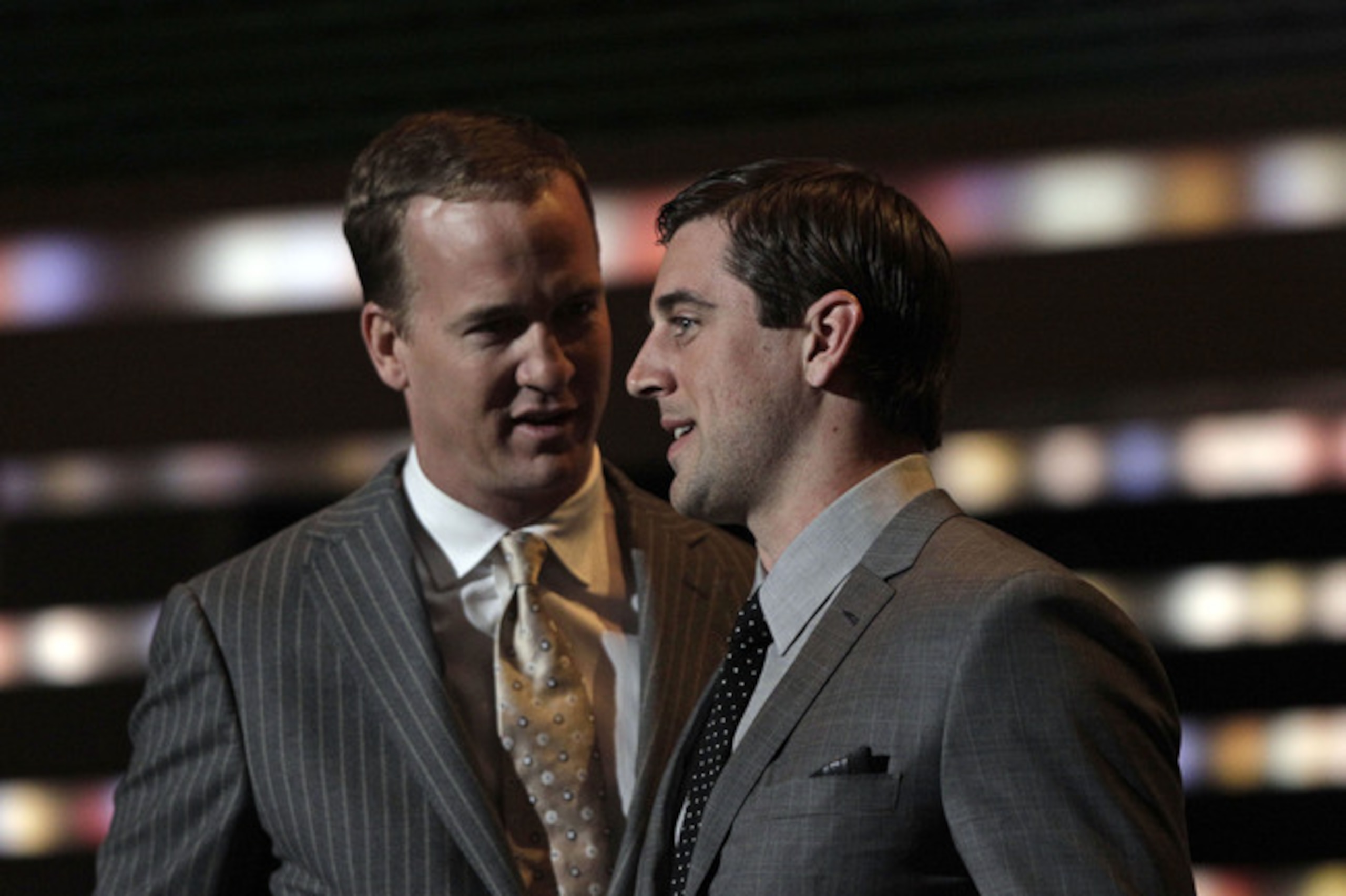
Denver Broncos quarterback Peyton Manning set the league on fire in 2013 and burned down the record books in the process. He won last season's MVP award in a landslide 49-1 vote. Incredibly, he's arguably playing better this season: His completion rate, touchdown rate, interception rate, NFL passer efficiency rating and ESPN Total QBR are all better so far in 2014 than they were in 2013, per Pro-Football-Reference.com.
Hot on Manning's heels, though, are San Diego Chargers quarterback Philip Rivers and Green Bay Packers quarterback Aaron Rodgers. Both are putting up stats comparable to Manning's gonzo numbers; there's no guarantee Manning even ends up leading the NFL in any major passing categories this year.
Further, Rodgers is arguably playing with a less talented roster than Manning, and Rivers definitely is. As vital as Manning has been to the Broncos' success, a Packers team without Rodgers or a Chargers team without Rivers would likely struggle more than the Broncos would without Manning.
Watt isn't even the only non-quarterback in the discussion. Dallas Cowboys tailback DeMarco Murray is on pace for 2,086 rushing yards, which would be the third-highest total in NFL history. More than just a number, though, Murray's consistent explosion and high workload has completely changed the Cowboys' competitiveness.
A Cowboys team that's finished 8-8 for the last three seasons—and whose talent level is at best no better than any of those seasons—currently sits at 6-1 and is arguably the best team in football. That's impact.
Most
The "most?" Oh yes, J.J. Watt is the most.
His season overall Pro Football Focus grade so far, plus-38.2, is nearly twice that of the second-best 3-4 defensive end, Muhammad Wilkerson, and his plus-19.2. No other player has anywhere near that high of a PFF grade, and no PFF-grade leader at any position currently sits as far ahead of No. 2.
Watt's five sacks don't lead the league, but he currently ranks 12th in the NFL despite fending off constant double-teams from a position where it's almost impossible to generate huge sacks.
Even so, PFF credits Watt with 22 quarterback hits and 19 quarterback hurries, both figures tops among 3-4 defensive ends (PFF gives Washington's Jason Hatcher credit for five sacks, two more than his official three, thereby tying him with Watt for the 3-4 end sack lead).
In terms of tools, Watt's one of the most impressive athletes, especially for his size, in football today. He certainly had one of the most outstanding combine performances we've ever seen. Here's the 6'5", 289-pound Watt completing a 59.5" box jump:
When it came time for Bleacher Report NFL Draft Lead Writer Matt Miller to grade out the NFL's best 1,000 players, Watt wasn't just the No. 1 3-4 defensive end, and he didn't just grade out at a 95/100.
"You could make a legitimate case," Miller wrote, "for Watt being the best player in the NFL regardless of position."
If he's the best player in the NFL, isn't he the most valuable?
Valuable
Well, that depends on what you mean by "valuable."
There are a few statistics out there that attempt to measure a player's value to his team, regardless of position. One, Pro-Football-Reference.com's Approximate Value, is only calculated at the end of the season and so is useless for 2014.
Considering that in 2012, when Watt led the NFL with 20.5 sacks, he was locked in a seven-player tie for eighth-highest AV, this stat is not likely to reveal Watt as the "most valuable" in 2014 either. Who was above him? Six quarterbacks and running back Adrian Peterson—in the season Peterson rushed for just a few more yards than for what Murray's currently on pace to reach this year.
Watt leads all defenders in AdvancedFootballAnalytics.com's plus-WPA and plus-EPA metrics. Plus-WPA measures how much the plays a defender has made have contributed to improving his team's likelihood of winning games; plus-EPA does the same for his team's expected points (the former is highly situation-dependent, the latter not).
| Aaron Rodgers | 2.60 | 76.1 |
| Philip Rivers | 2.48 | 86.9 |
| Peyton Manning | 2.42 | 85.0 |
| J.J. Watt | 1.59 | 47.4 |
| DeMarco Murray | 0.21 | 0.6 |
However, Watt's 1.59 plus-WPA and 47.4 plus-EPA pale in comparison to the other contenders.
No matter how much Watt produces, he's never going to affect the game like a quarterback or running back* who touches the ball dozens of times a game, every game.
Disqualified or Dissed?
Whenever MVP awards are debated, the postseason is brought up. If a player didn't at least lead his team to the playoffs, the logic seems to go, how valuable can he be?
"Personally," Pompei said, "I never would omit a player from consideration for Most Valuable Player because his team missed the playoffs, or his team wasn’t as good as others. The Most Valuable Player award, in my opinion, should recognize individual excellence and impact on a team."
It's hard to argue that Watt hasn't single-handedly dragged the Texans (who, remember, had the worst record in the NFL last season) to the respectable 3-4 record they possess. In the wake of the Colts loss—during which he recorded two sacks, three passes defensed and that pick-six—Watt still put pressure on himself.
"Big play, but at the end of the day, not enough," Watt told ESPN.com's Tania Ganguli. "Gotta find a way to do more."
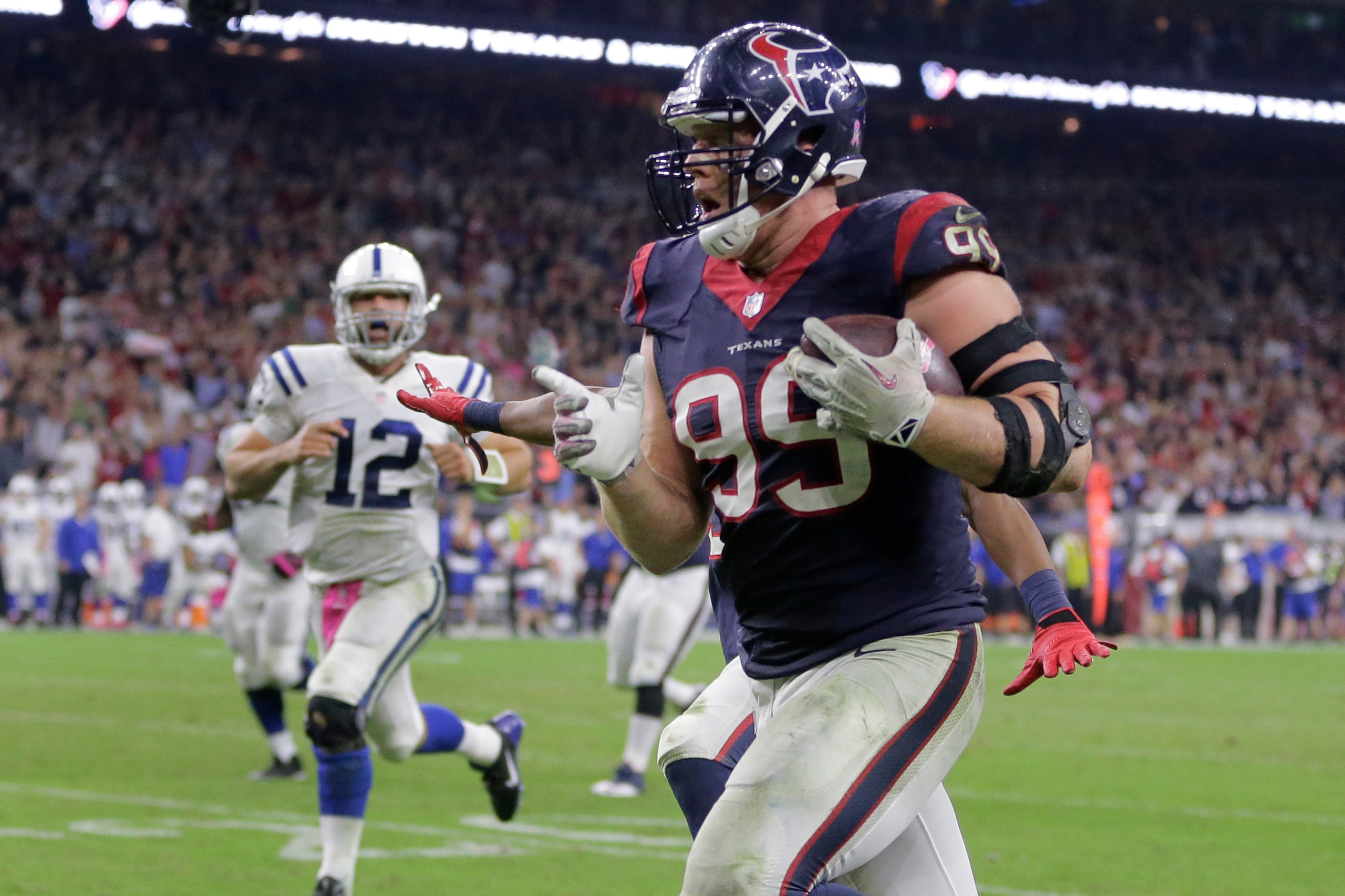
Watt's currently doing as much to help his team win as any defensive end ever has. If he can't single-handedly elevate his team to the playoffs, though, can he really be disqualified as an MVP candidate? This, Pompei said, is one of the benefits of the AP leaving the award's qualifications open to interpretation.
"They do give the voters some flexibility to define the awards based on every unique circumstance," he said.
Watt, by nearly any measure, is the best player in the NFL, and without him the Texans would be sunk. Those circumstances are pretty unique and should give AP voters cause to be a little bit more flexible than usual.
*Murray, despite leading the NFL in rushing yards, is ranked 18th and 25th among running backs in WPA and EPA respectively.
Ty Schalter is a National NFL Lead Writer for Bleacher Report. All quotes were obtained firsthand unless otherwise noted.
.jpg?w=2560 "Titans 49ers Football")
.jpg?w=2560 "Rams Chiefs Football")
.jpg?w=2560 "Grading Monday Night Raw 🔠")