How Kevin Durant Injury Shakes Up Western Conference Power Structure
When a player is so great and so durable for so long, it can be easy to take their omnipresence for granted.
Case in point: Kevin Durant, who over seven increasingly incendiary NBA seasons has missed a total of 16 games for the Oklahoma City Thunder.
Sadly, Sunday arrived with word that the five-time All-Star and reigning MVP could be out longer than that after suffering a fracture in his right foot.
TOP NEWS

Ranking top NBA free agents after Harden signs

Teams That Blew The Offseason 😮💨
Players Ready To Make The Leap 📈
“After practice yesterday, Kevin made us aware of discomfort in his right foot,” Thunder general manager Sam Presti told The Oklahoman’s Darnell Mayberry. “We proceeded to perform the necessary imaging studies to determine the cause of his discomfort. At this stage, Kevin has been diagnosed with a Jones fracture.”
Questions and concerns abound, of course. And while talk of timetables is sure to dominate the headlines, one question in particular looms larger than most: How, exactly, will Durant's injury shake up the Western Conference power structure?
Numbers Game

For the sake of argument, let’s assume Durant is held out for seven weeks. That would put his prospective return at or around Dec. 2, a full 18 games into the regular season.
It’s a significant stretch to be sure. But enough to make or break a season? Hardly.
For reassurance, one need look no further than LeBron James, Dwyane Wade, Chris Bosh and the 2010-11 Miami Heat, who sputtered to a 9-8 start before going on a 49-16 tear to finish with a 58-24 clip.
Can OKC manage a .500 record in Durant’s absence? It’s certainly possible, even in an unforgiving Western Conference that featured nine teams with 48 or more wins a season ago.
The good news: Nine of the Thunder’s first 17 games will be held in the friendly confines of Chesapeake Energy Arena, giving Scott Brooks and Co. ample opportunity to hold down the fort in KD’s absence.
Even if Durant remains out until mid-December, OKC’s relatively soft slate—just two of its first seven December games are against teams that were above .500 a season ago (the Phoenix Suns and the revamped Cleveland Cavaliers), both of them at home—gives it something of a margin for error.
Still, the West behemoth being what it is, the Thunder have their work cut out for them when it comes to capturing the conference’s top playoff seed. From Pro Basketball Talk’s Sean Highkin:
"The west is at least 10 deep with playoff teams, but the general pecking order has been understood to be the Thunder, Spurs and Clippers at the top, and then everyone else. That changes now. With Westbrook, Jackson, and Serge Ibaka, the Thunder still have enough talent to make the playoffs, but depending on how much time Durant misses, they can probably take themselves out of the conversation for the No. 1 seed. They may even lose home-court advantage if his recovery drags out. The door is open for another team to move into that upper tier — if everyone stays healthy, the Grizzlies and the Warriors are the best bets.
"
And that’s before we get to the inevitable learning curve to be scaled once Durant is back in the fold: the recalibration of chemistry and dusting off of rust part and parcel with any return from injury. But so long as the timetable holds true, the Thunder should have plenty of time to work out whatever kinks KD’s absence may have wrought.
Real as those kinks may be, however, the fringe benefits of Durant’s absence are ones that could pay significant long-term dividends.
More Than Making Do
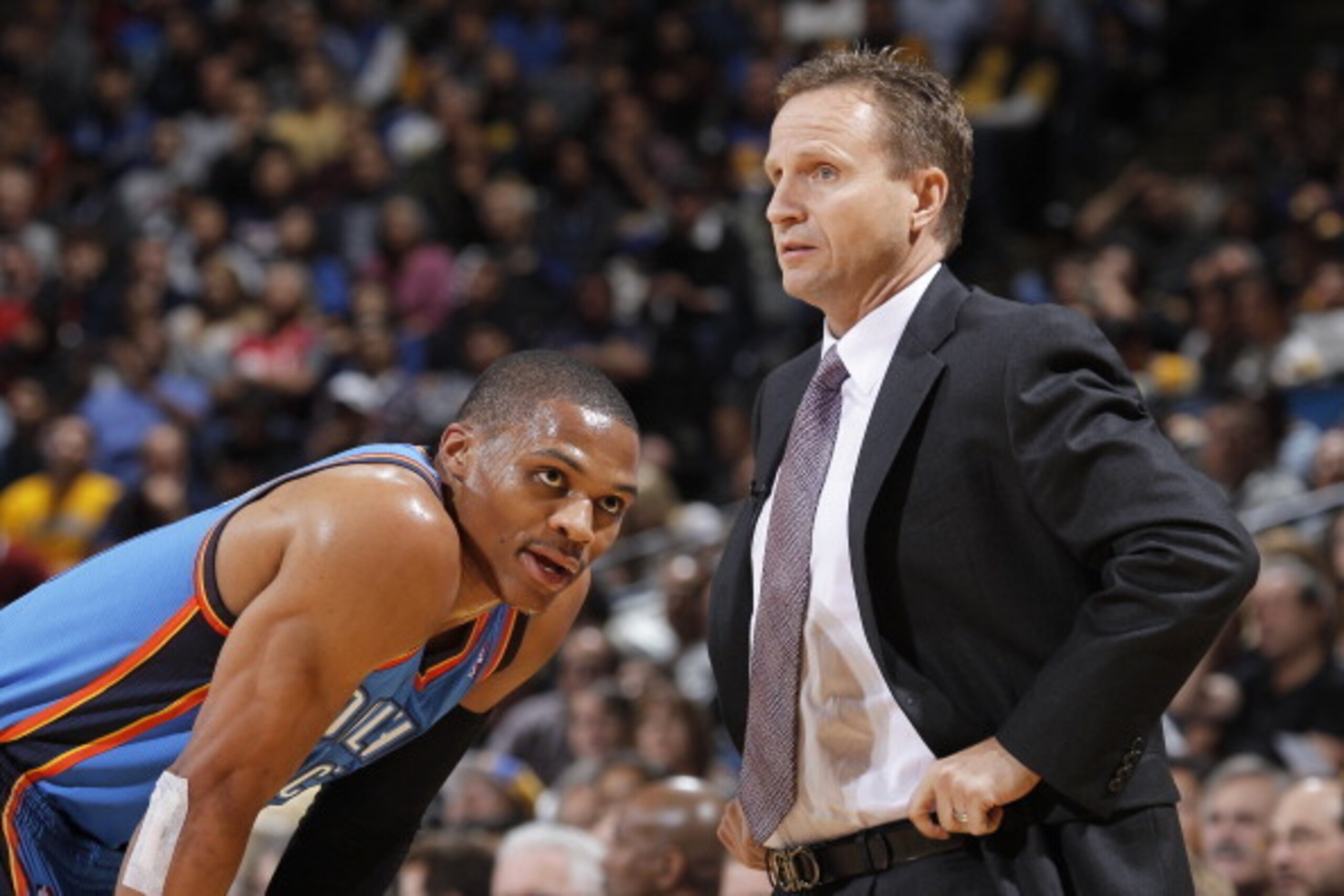
Speaking at a press conference late Sunday morning, Thunder general manager Sam Presti underscored how important it would be for OKC to grow from, rather than surrender to, the resulting tumult:
"We’ve been encountered with a lot of different scenarios, and one of the things we have to do as an organization—one of the things we have to do as a team—is you have to be able to deal with uncertainty and ambiguity. If you can only operate when the wind’s blowing out for you, I don’t think that’s the mark of an elite organization.
"
All great teams must, at some point or another, learn to handle adversity. Indeed, tales abound of teams using their best player’s absence as motivational fuel. Be the learning curve long, as it was with the Chicago Bulls in 1994 and ’95, or instantaneous, a la Magic Johnson’s intrepid performance at center in place of Kareem Abdul-Jabbar in the 1980 Finals.
That teams will look to exploit the Thunder’s inevitable strategic holes goes without saying. Particularly on offense, where Russell Westbrook stands to receive the lion’s share of attention from opposing defenses.

Just how large does Durant’s loss loom? According to NBA.com (subscription required), OKC fielded only two lineups sans Durant for more than 50 minutes a season ago.
The more productive of the two: a unit of Derek Fisher, Jeremy Lamb, Nick Collison, Steven Adams and Reggie Jackson that registered a net rating of minus-4.2 over 112 minutes.
That, to put it mildly, isn’t very encouraging.
Another factor worth considering is how Durant’s injury might compel Gregg Popovich and the San Antonio Spurs—the conference’s other perennial power—to either rest players, knowing that the Thunder won’t be able to separate themselves atop the standings, or go full tilt in hopes of sprinting out of the gate to an early lead.
In the end, OKC’s near-future fortunes stand to rest heavily on whether the West will prove a loss-laden gauntlet for all involved, or whether one team—be it the Spurs, Los Angeles Clippers, Golden State Warriors or another conference upstart—can separate itself from the pack immediately and decisively.
A Dream Deferred?

At this point, much of the hand-wringing over OKC’s devastating loss concerns not the specifics of Durant’s return, so much as what lingering effects—if any—might be expected.
From Bill Walton to Yao Ming, NBA history is rife with sad stories of chronic foot injuries prematurely derailing otherwise sensational careers. And while advancements in treatment and prevention—to say nothing of KD’s steadfast durability—should put our collective minds at ease, Durant’s setback nonetheless forces us to face yet again the cruel scourge of sports mortality.
Whatever the subsequent specifics, Durant’s absence is sure to send shock waves through the conference standings. Whether those tremors will be chaotic and seismic or merely marginal, however, only time will tell.
One storyline that’s sure to gain instant and lasting traction is how Westbrook, free of the burden of having to defer to Durant, will operate as the Thunder’s unquestioned No. 1 option. Small sample size aside, the evidence is nothing if not jarring:
OKC can’t survive on its fiery floor general’s heroics alone. Instead, look for Brooks to place a heavier emphasis on pick-and-rolls featuring Jackson and Westbrook at the point of attack, with Serge Ibaka and blossoming big men Steven Adams and Mitch McGary as the principal recipients.
Slimmest of silver linings though it may be, Brooks has a real opportunity to develop his team’s young talent. The hope being that, if and when Durant returns, his oft-criticized supporting cast will be prepared to finally silence the doubters.
.jpg?w=2560)
.jpg?w=2560 "B/R Experts Week 1 NFL Power Rankings")
.jpg?w=2560 "Grading SNME in Atlanta 🔠")

.jpg?w=2560 "Top 10 2027 Free Agents ✍️")
.jpg?w=2560 "Giants Extend Jameis Winston")
.png?w=2560 "B/R NFL Scouting Dept's 2027 NFL Mock Draft Before 2026 Season")