St. Louis Rams Could Be Ruined by Their Run Defense in 2014
The 2014 version of the St. Louis Rams is a team that's, well, a little confusing so far. At root of the confusion has been an early—though swift—regression by the team's run defense.
There are some peachy Rams thoughts to keep in mind while we wonder what’s gone wrong with the run defense in St. Louis and if this bumpy ride downhill will continue. Mostly, just think about Brian Quick.
It’s early, which is simple knowledge you can obtain by consulting a calendar. But Week 4 kicks off on Thursday, meaning “it’s early” is about to die an annual death.
.jpg?w=2560 "Green Bay Steelers Football")
.jpg?w=2560 "Chargers Mack")
.jpg?w=2560 "Giants Football")
After three weeks, this is how the Rams have performed on the ground defensively after they had the ninth-ranked unit against the run in 2013.
| Yards Allowed | Yds/carry | 100-yard rusher? | 20-plus-yard carries | |
| Week 1 (vs. Vikings) | 185 | 5.8 | Yes | 2 |
| Week 2 (@ Bucs) | 157 | 5.2 | Yes | 2 |
| Week 3 (vs. Cowboys) | 123 | 4.2 | Yes | 2 |
That’s an average of 155.0 yards per game at a pace of 5.1 per attempt, two ratios up significantly from where the Rams finished last year (102.9 YPG, 3.2 YPA).
You may be thinking “it’s early” to put a lot of emphasis on per-game averages. You’re not wrong, so let’s look at the total math from those numbers. It adds up to 465 rushing yards allowed over three games.
What your calendar tells you quickly becomes irrelevant because any three-game stretch with that sort of gashing has a strong, dizzying stench. What’s even more troubling is those rushing yards are mostly coming in chunk form.
The Rams have given up two carries for 20-plus yards in each game of the season. That means the opponent is covering at minimum one-fifth of the field without risking an interception or sack.
The risk of a sack is like oxygen to the Rams defense, with its front four that can turn most quarterbacks into dust—and fast.
A few of those long, pleasant Sunday jogs have been broken off for far more than 20 yards. That includes Cordarrelle Patterson’s 67-yard touchdown in Week 1, the third-longest run surrendered this season. There have also been Bobby Rainey’s 31-yarder and DeMarco Murray’s 44-yard trot.
Looking at even chunkier yardage then, the Rams are one of only three teams to have given up multiple 40-yard runs.
We’ll generously give them a pass on all the lengthy carries they allowed to Cordarrelle Patterson—who had runs of 12, 23 and 67 yards—because stopping him in full stride usually requires a device made by Wile E. Coyote.
Nevertheless, it’s easy to see why those runs happened. The Rams have bitten easily on misdirection plays.
Murray’s 44-yarder in Week 3 is a prime example, and the victim was James Laurinaitis, who bit hard on a fake reverse to Dez Bryant.
Like Patterson, Bryant is a generally fast and athletic individual, and his speed needs to be respected. But as a linebacker who has split seconds to read the backfield and react to a developing play, there’s a fine line between respect and overcommitment.
Bryant doesn’t present nearly the dual-running threat that Patterson does. The same could apply to Tavon Austin, someone the Rams defense is rather familiar with. His speed has presumably given the team's front seven a regular education on how to deal with misdirection.
In this case, Laurinaitis needs to react to Bryant, and even leaning in his direction was fine. Most of all, he needs to respect the threat Bryant presents:
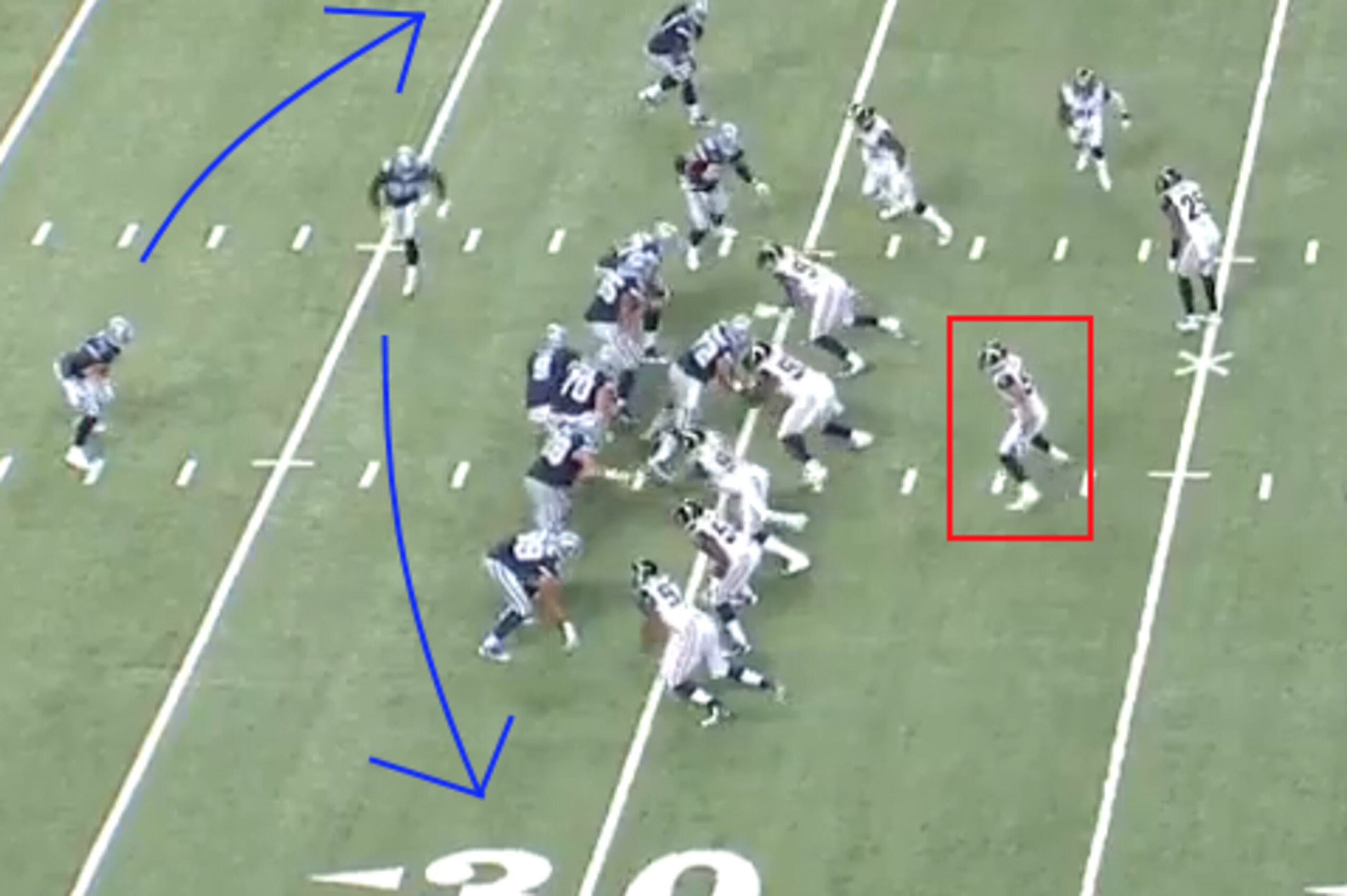
He does that but also far too much more. Laurinaitis bounces a full stride toward Bryant. It may not look like much when the game tape is replayed at full speed, but that step is plenty.
Laurinaitis’ momentum is now moving in the complete opposite direction of the play:
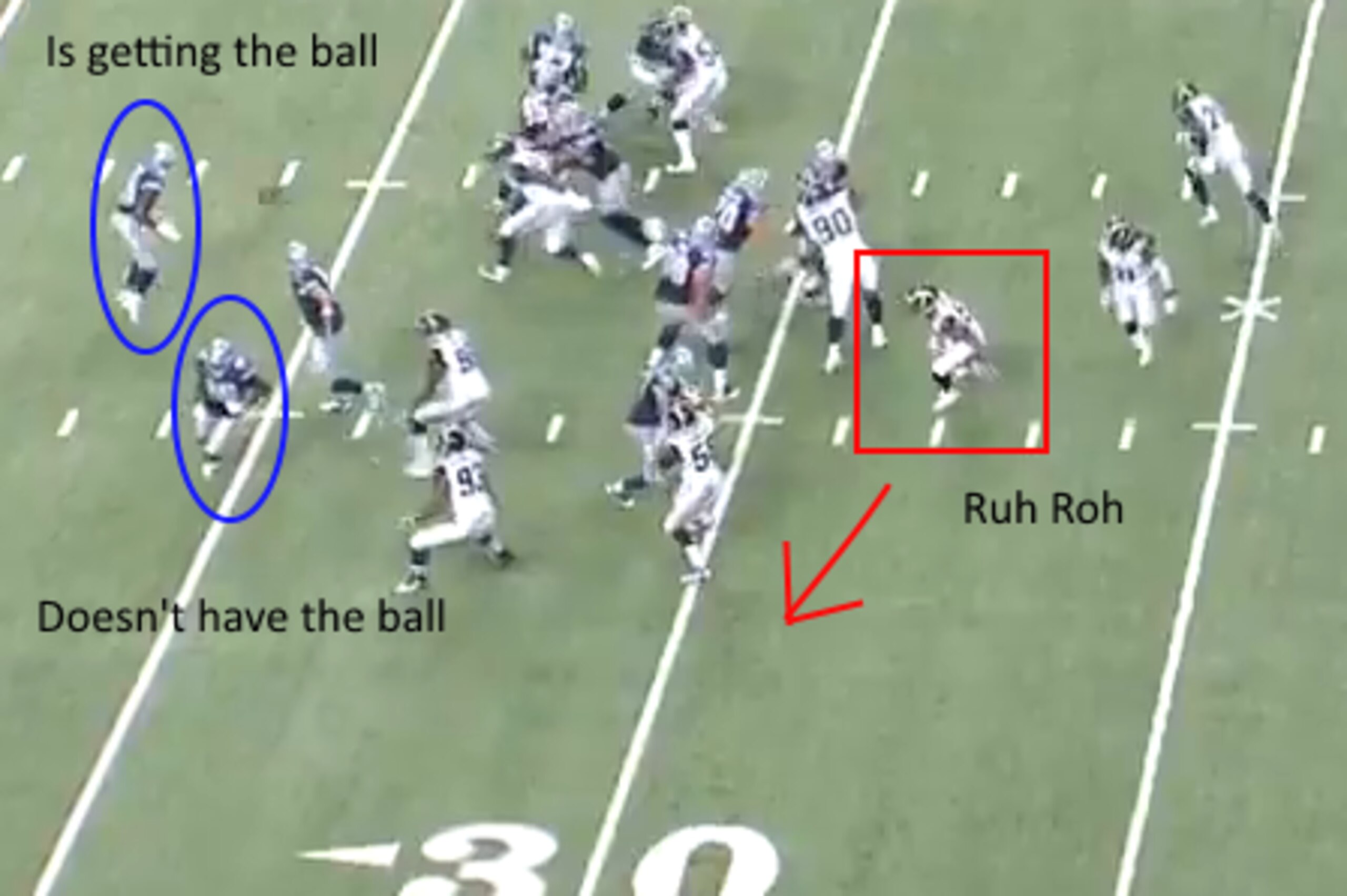
By the time he plants, resets himself and begins moving to correct his mistake, Murray is gone. He's rounding the corner on the other side and the Cowboys have numbers, with two pulling linemen ready to take on defensive backs. That doesn’t usually end well.
Laurinaitis and fellow linebacker Alec Ogletree led the team in tackles this past Sunday with 14 apiece, which shows how utterly meaningless that stat can be at times.
Laurinaitis has been an effective and reliable tackler throughout much of his Rams tenure, and he’s had two seasons with over 140 tackles. But to add more context to his 17 tackles—also tied for the overall team lead this season, and also with Ogletree—we turn to a metric which carries more weight: run stops.
It comes to us by way of the fine observational and statistical minds at Pro Football Focus (subscription required).
For the uninitiated, here’s how it defines and measures a run stop: “Stops are what we judge to be tackles that prevent an offensive success (defined as gaining 40 percent of required yardage on first down, 60 percent on second down, and the entire required yardage on third or fourth)”
It’s a simple yet vital concept, and to simplify it even further, focus on these words: tackles that prevent offensive success.
If a linebacker diagnoses the direction of a run quickly—and correctly—before shooting a gap and holding the offense to a gain of only two or three yards on first down, the play is a failure.
Game-breaking runs are swell, but the basic goal of a runner in that scenario is to pick up half of the needed yardage on first down, leaving his offense to gain only five more yards on the following two plays.
Laurinaitis hasn’t done much stopping.
| Rank | Run Snaps | Stops | Stop % | |
| Curtis Lofton | 1 | 70 | 12 | 17.1 |
| Nate Irving | 2 | 64 | 9 | 14.1 |
| Luke Kuechly | 3 | 60 | 8 | 13.3 |
| Lawrence Timmons | 4 | 68 | 9 | 13.2 |
| Brian Cushing | 5 | 66 | 8 | 12.1 |
| James Laurinaitis | 32 | 88 | 3 | 3.2 |
Among his inside linebacker peers, Laurinaitis is significantly behind in both run stops and the percentage of his snaps against the run that has resulted in a stop.
Sure, he’s had to defend far more runs than most. If you’ll allow me to walk out onto a limb here, though, that may be tied to a 34-6 Week 1 trouncing and the Vikings wanting to kill the clock—they finished with 32 run attempts.
Oh, and opposing offenses gnawing on a delicious weakness might also be a factor. Overall, the Rams have faced 91 runs so far, the league’s fourth-highest total.
There’s early woe elsewhere, with Jo-Lonn Dunbar tied for the league lead among outside linebackers with four missed tackles per PFF. Combined, all three Rams linebackers have registered only 19 stops so far, nine of which have come from the still-impressive and growing Ogletree, a first-round pick in 2013.
Looking forward, the gushing holes in the Rams’ run defense need to be plugged fast.
If they persist, the gauntlet starting in Week 5 after St. Louis' bye won’t be a fun time. It begins with LeSean McCoy, then the Frank Gore/Carlos Hyde tandem, followed by Marshawn Lynch and Jamaal Charles. Two of those running backs (Charles and McCoy) were among the top three in rushing yards last year.
With a passing offense that will be inconsistent at best while led by an inexperienced Austin Davis or the journeyman Shaun Hill, the Rams can’t afford to keep giving up easy chunks of field position on the ground and letting precious seconds tick away.
Whatever hope they have this season with that quarterback combination will slip away fast, and they’ll sink far below the always-violent NFC West waters.
.jpg?w=2560 "Commanders Cowboys Football")
.jpg?w=2560 "Texans Patriots Football")