Derek Carr's Growing Pains Highlight Challenge Ahead for the Oakland Raiders
Derek Carr became the first rookie quarterback to start Week 1 for the Oakland Raiders on Sunday. The start of the Carr era renewed Raider Nation's hope that the team will soon get on the winning track after more than a decade without a playoff berth.
Expectations for Carr were unrealistically high coming into a Week 1 road start against Rex Ryan's defense. Deep down, everyone expected growing pains, but they were a little more painful and plentiful than anyone would like to admit.
Carr was neither bad nor good Sunday, but his growing pains highlight the challenges ahead for both him and the Raiders. Carr must learn quickly, and if the Raiders don't give him more help soon, that's going to be harder and harder for him to do.
TOP NEWS
.jpg?w=2560 "Saints Lions Football")
Rap: Lions, LaPorta End Contract Talks
.jpg?w=2560 "Commanders Eagles Football")
Commanders May Change Logo 👀
.jpg?w=2560)
Live EVERY Fantasy Football Update
The Raiders failed to protect Carr with a competent running game, the defense was fortunate to allow 19 points, and Oakland's receivers struggled to get much separation from a thin Jets secondary. Carr proved too green to put the team on his back against a well-coached defense on the road.
The primary criticism of Carr coming out of college was that he struggled with pressure, which continued to be the case in his first start as a pro. Derek's older brother set an NFL record his rookie year with 76 sacks, but Derek's struggles Sunday were of a different variety.
Carr did a good job of getting the ball out of his hand to avoid sacks, but it was at the expense of looking down the field for open receivers. He finished 20-of-32 with two touchdowns and no interceptions—which would have been a huge success if he had more than 151 yards passing.
The underlying problem was that Carr was too slow to pull the trigger on passes over 10 yards even though he was only reading half of the field. When Ryan forced Carr to make quicker decisions by blitzing, he struggled to find his hot read and forced the ball into coverage. Carr was lucky he didn't throw two or three interceptions.
These struggles weren't unexpected, but they should temper some of the expectations for Carr. As he gets more comfortable as the starter, Carr will make plays on talent alone, but if he's going to put the franchise on his back, he'll need to work on a few things.
Reading the Field
The NFL can be weird because a bad play can look like a good play and a good play can look like a bad play. Then there are plays that are good plays but could have been better had the quarterback done something different.

One of Carr's best plays of the day was a 17-yard back-shoulder throw to Rod Streater from his own goal line in the second quarter. Carr threw the ball accurately and before Streater even looked back for the ball. It was an impressive play by Carr, but Denarius Moore was also wide open on the right side with room to run after the catch and no safety help over the top.
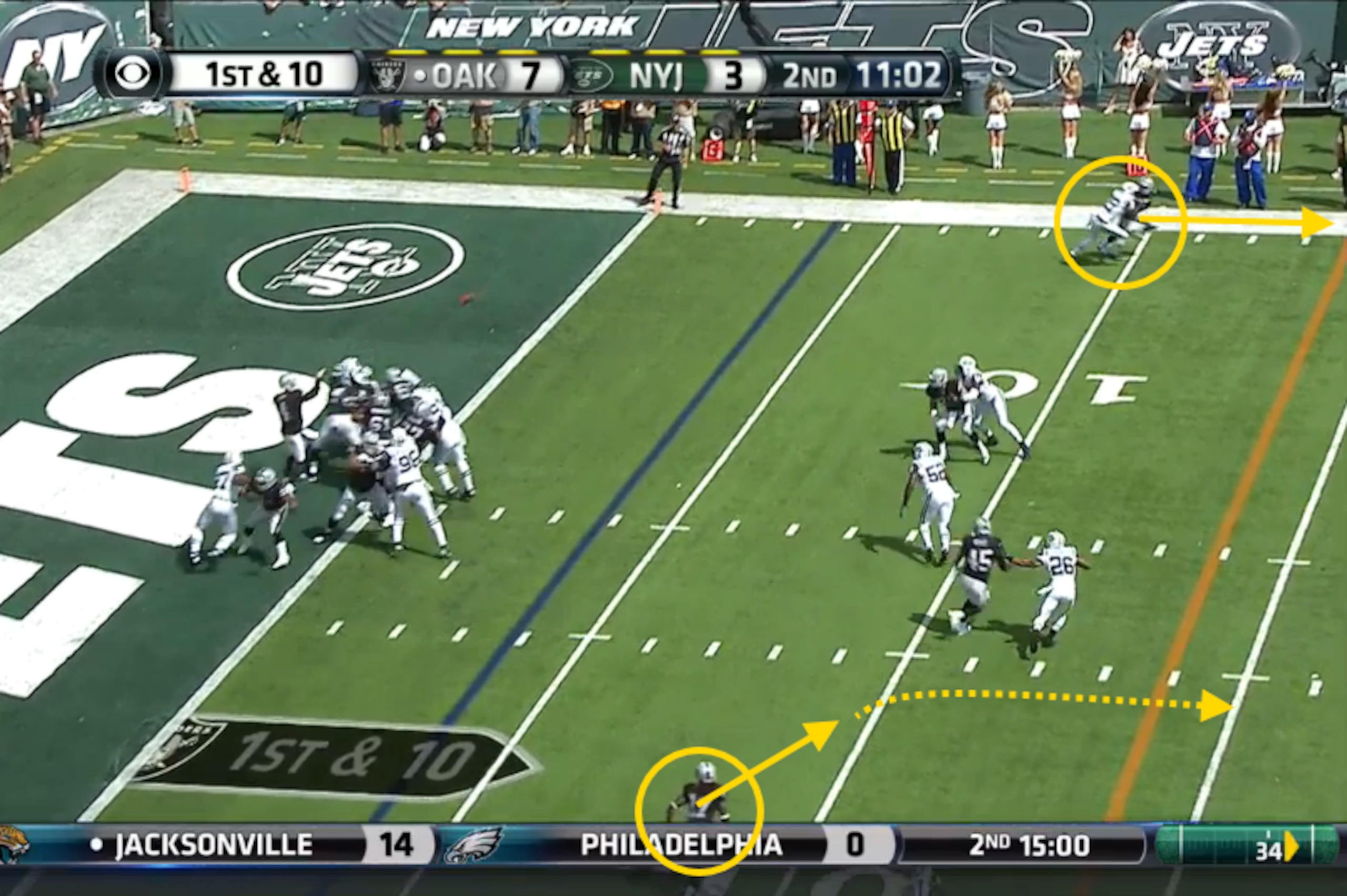
Had Carr recognized the blitzing linebacker from his right, he would have also realized he had two receivers in man-to-man coverage with no safety help on that side. Hitting Streater should have been the second option, but either Carr or offensive coordinator Greg Olson predefined his read, and he never even looked to his right.
This is a good example of a play the Raiders called trying to protect their rookie quarterback. Carr was able to make the play, but that's not always going to be the case. Carr's talent can only take him and the team so far.
Two plays later, the Raiders used another technique to protect Carr—a hard play-action reverse bootleg that effectively cut the field in half. If one of three different defenders bit on the play action, Carr would have an open receiver.

One of the linebackers did bite, and that left tight end Brian Leonhardt wide open. The backside defensive end didn't scrape down the line of scrimmage, but fullback Marcel Reece ran across his face and slowed him down just enough to buy Carr the time he needed to flick the ball to Leonhardt for a gain of 12 yards.

Simplifying reads for a rookie quarterback isn't groundbreaking stuff, but it's usually not necessary if he can read the whole field. This is where the coaching staff's conservative game plan manifested itself, not in the inability of the Raiders to throw the ball farther than 10 yards down the field.
As the Raiders got away from scripted plays, it was far too easy for the Jets to figure out what the Raiders were trying to do. The Jets dominated both sides of the ball, and it was only close because of a couple turnovers and penalties.
Carr locked onto receivers, so he was only able to read half of the field before he had to hit the checkdown. It not only affected his ability to hit receivers down the field but also the production the Raiders got out of all of Carr's checkdown passes. It's better than forcing passes into coverage but still something he'll need to learn to do this season.
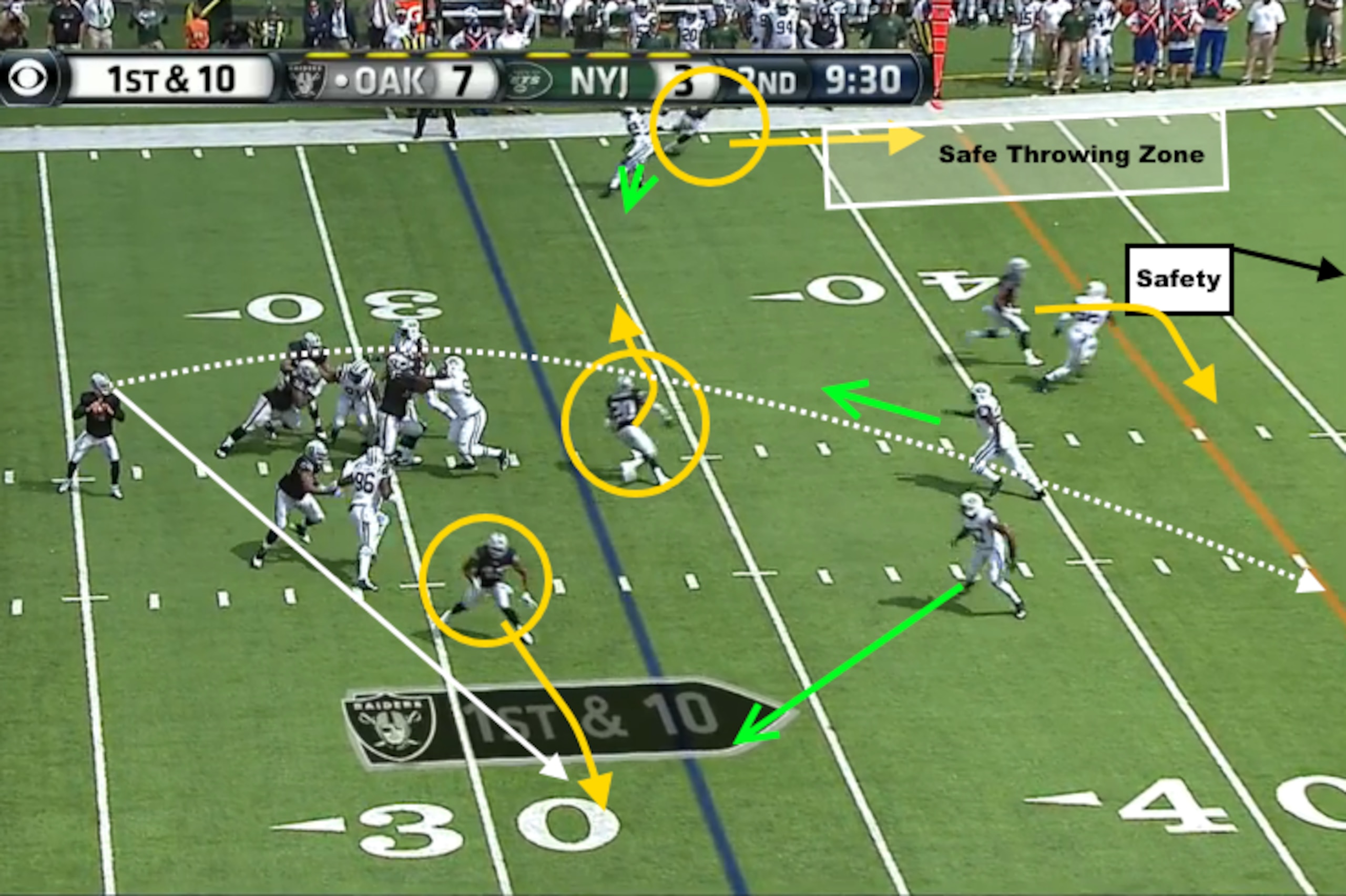
In the middle of the second quarter, Carr stared down his receiver deep right and ended up checking it down to Reece in the flat for no gain. Had he simply glanced to his left, he would have seen a wide-open Streater as well as a large, safe throwing zone, as Mychal Rivera was holding the safety in the middle of the field.
Had Carr even glanced left, he would have also seen a better checkdown in Darren McFadden, who would have been able to gain a few yards with a chance for more after the catch if he could slip a tackle. Carr's inability to read the whole field was a big reason why the Raiders couldn't get much going offensively.
This also wasn't the only example of Carr not seeing the whole field. On the next drive, the Jets pressured Carr from the right edge, and he hit running back Maurice Jones-Drew in the right flat for a short gain.


Carr was looking deep right but stepped up in the pocket just in time to evade the rush. Had Carr stepped up earlier, he would have seen Reece running free in the flat to the left. Carr didn't have time on this play to scan the entire field even though he gave little indication he would have looked left at all. Carr's failure to step up into the pocket and away from pressure before it arrived killed what could have still been a productive play.
Finding Hot Reads
Everyone knew the Jets were going to throw a bunch of different blitzes at Carr to see how he handled them. Carr didn't crumble under pressure, but he did make many poor decisions and rarely was able to find a hot read.

Ryan smartly brought blitzes from the third level, and Carr wasn't able to adjust. On this 3rd-and-7 in the third quarter, it's easy to see the safety creeping up to blitz. This should have given Carr the indication that Streater was either going to be covered by a linebacker or wide open.
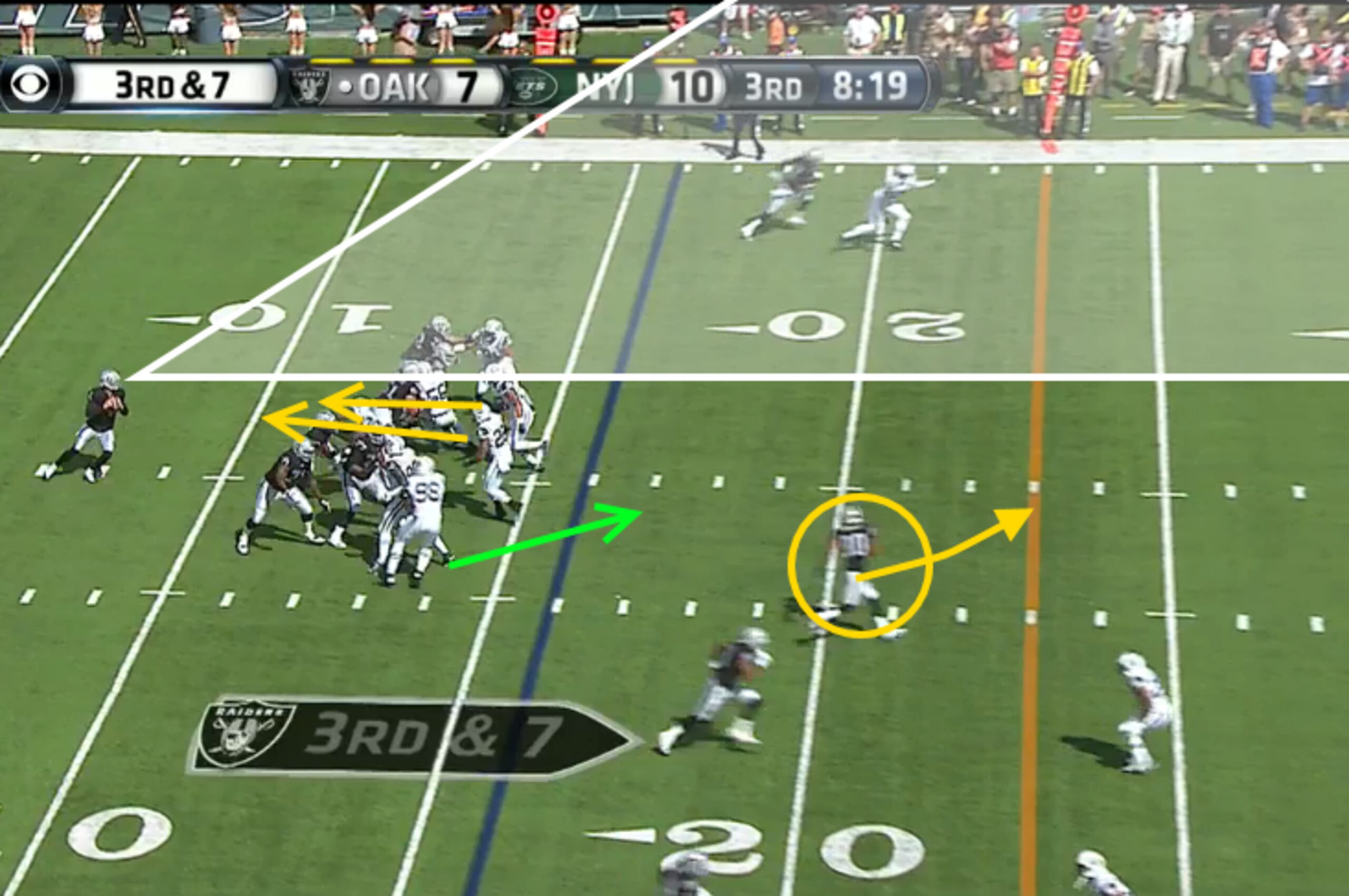
Carr locked onto Moore wide left and quickly ran out of time as the blitz arrived. Even if Carr had time to work back to his right, the linebacker would have cut off the short route.
This is an instance where Carr has to instantly recognize the blitz and get the ball the Streater for a first down. Until Carr figures out how to find hot reads, he's going to see a heavy dose of blitzes from opposing defenses.

In the fourth quarter, the Jets fooled Carr with another blitz, and he threw incomplete into double coverage as a result. The Jets brought two blitzers off the right edge and dropped the linebacker to Carr's left into coverage.
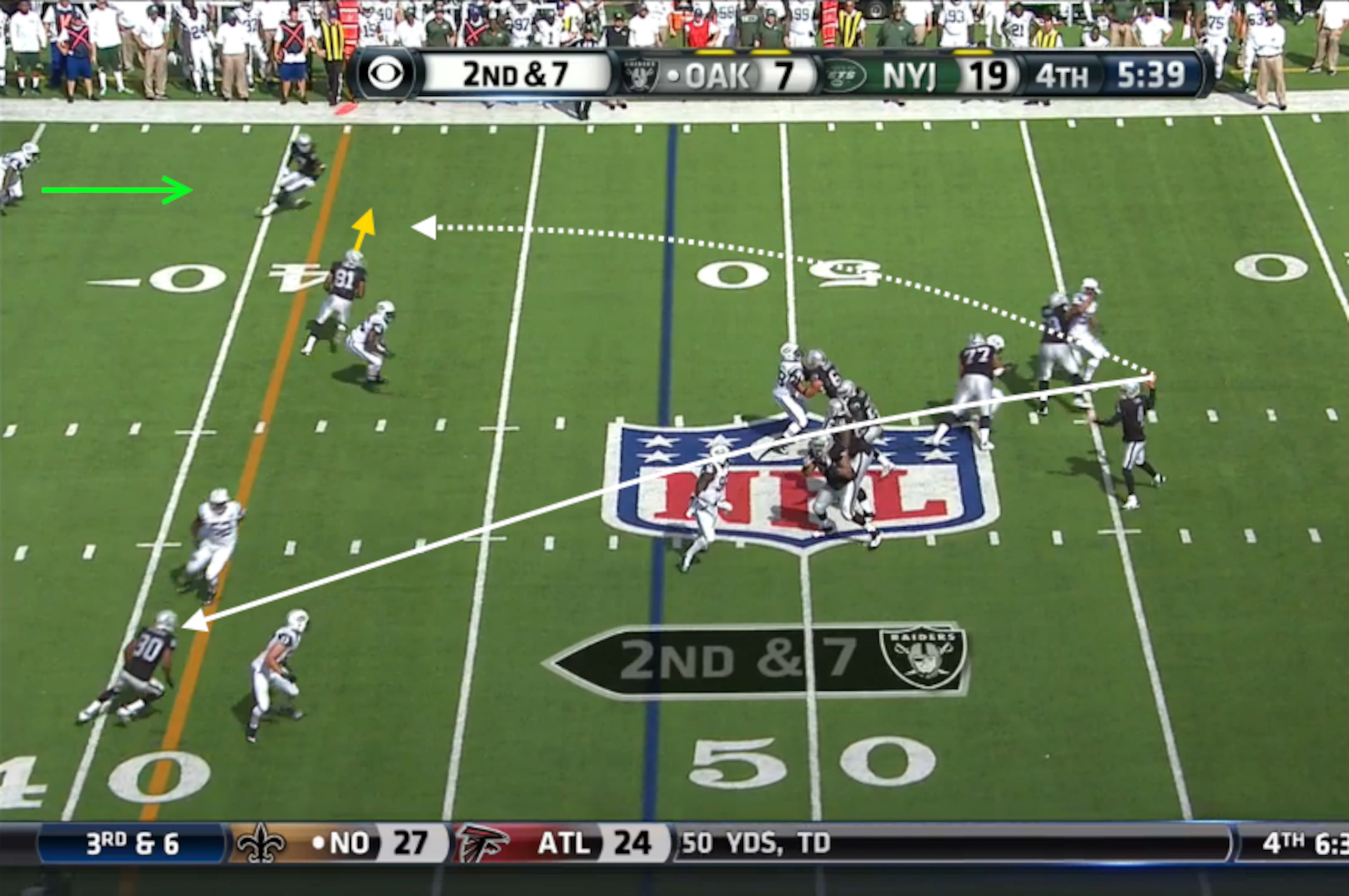
Carr should have known immediately that Rivera out left would be open on the out route if both edge defenders came on the blitz. Instead, Carr looked left to Streater and couldn't fit the ball into a very tight window.
Making Progress
The good news is that Ryan threw a lot at Carr in his first career start, but the bad news is that he failed to adjust on the fly to what the Jets were doing to him. Carr will have to try to learn from his rookie mistakes on film and make corrections when the Houston Texans visit Oakland on Sunday.
Most of Carr's mistakes should be correctable as he gains more experience, which is why it was smart for the Raiders to make him the Week 1 starter. Carr should make enough plays with his athleticism to keep the boo-birds at bay, but he still has a long way to go before he's ready to put the offense on his back.
Until Carr develops, the Raiders will need to give him a lot more help. Running the ball effectively will take some of the pressure off the rookie, but they should let him know that it's okay to make mistakes.
Carr played conservatively to a fault against the Jets, and it minimized his strengths. The Raiders didn't make Carr the starter so he could play like now-backup quarterback Matt Schaub. The Raiders may not have great receivers, but all of them are capable of high-pointing passes down the field.
.jpg?w=2560 "Vikings Buccaneers Football")
.jpg?w=2560 "Chargers Mack")
_0.png?w=2560 "Week 5 Winners & Losers 📊")