

How Washington Wizards Can Seamlessly Integrate Paul Pierce
The Washington Wizards made a few key tweaks to their roster this offseason, but none will change what the team looks like on the court more than the move to replace Trevor Ariza on the wing with Paul Pierce.
For the last two seasons, Ariza plied his trade as a catch-and-shoot specialist in Washington, topping out with a 40.7 percent finish from beyond the arc last season.
According to SportVU data released by the NBA and STATS LLC, Ariza's 63.6 effective field-goal percentage ranked eighth-best among the 113 players who attempted at least 3.0 catch-and-shoot field goals per game, and he actually finished the season ninth in the league in total catch-and-shoot points. Nearly half of his shot attempts (5.3 of 11.1 per game) came courtesy of the catch-and-shoot.
TOP NEWS
Jokić Pops Out at CU Game 🦬
Watch: LeBron's 1st 76ers highlights

NBA Power Rankings Entering Preseason 🔢
He also did almost all of his damage through shots created for him by others. According to NBA.com, Ariza was assisted on 76.1 percent of his baskets, with John Wall alone accounting for 165 of 389 makes.
It is also apparent when looking at his shot chart from last season (courtesy of Nylon Calculus) that Ariza did almost all of his work from three-point range, much of it from the corners.

In fact, 442 of Ariza's 853 shot attempts last season were threes, and 180 of those attempts came from the corner, according to NBA.com. He didn't discriminate, either, knocking down 47 of 103 (45.6 percent) from the right corner and 34 of 77 (44.2 percent) from the left side.
Note: The only place along the arc Ariza didn't shoot well from is the right wing, where he made only 33.6 percent of his attempts. This is somewhat unsurprising because, as I detailed in this space last season, the Wizards loved to put point guard John Wall in pick-and-rolls moving toward the right side of the floor, and he loved to attack the area near the right elbow. Attacking that spot on the floor draws defenders to the area, making it both a difficult pass to find Ariza behind the arc and a difficult shot if the ball found him there.
Now let's take a look at Pierce's shot chart, again via Nylon Calculus.
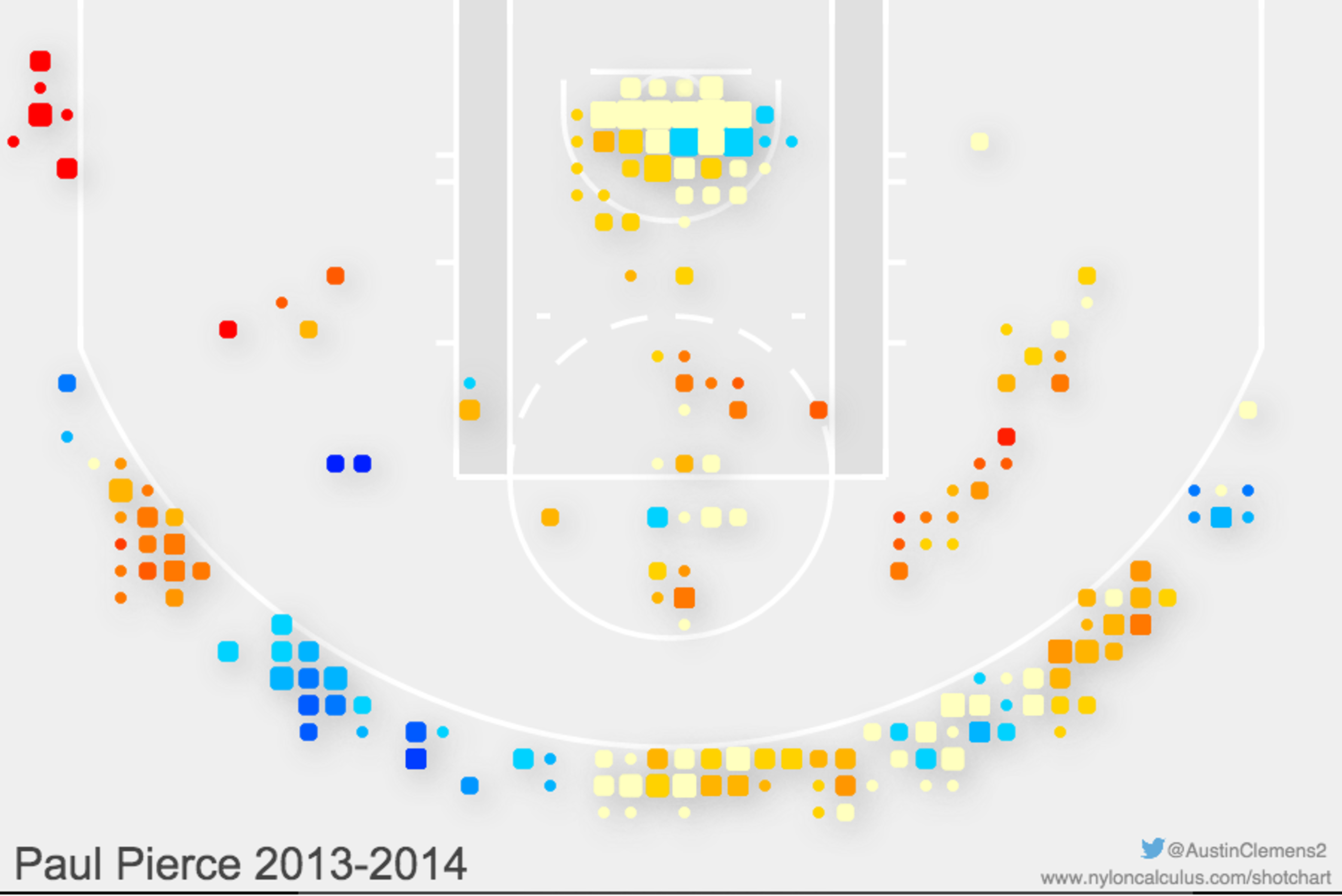
You'll notice the heavy volume behind the three-point line yet again, but it should be noted that last season was the first ever in which at least 40 percent of Pierce's shots came from behind the line, according to Basketball-Reference. It's all part of a four-years-in-the-making move away from the basket for Pierce.

But you'll also notice that Pierce is still active in the mid-range area (particularly that right-elbow area Wall loves), certainly far more so than Ariza. The Wizards, presumably, did not bring Pierce in to just do his best Ariza impression; they want to see that herky-jerky off-the-bounce game that has made Pierce a future Hall of Famer as well.
Even while attempting fewer mid-range shots as his career winds down, Pierce still ranked in the top third of the league in conversion rate among those who took as many or more mid-range attempts, per NBA.com.
These days, Pierce gets most of his mid-range attempts through pick-and-rolls, isolations and post-ups. According to Synergy Sports (subscription required), Pierce made just over 40 percent of his attempts on those three play types combined, a solid but unspectacular number that is more than 3.0 percent worse than his average over the previous four seasons.
It's worth asking if that difference signifies that Pierce is just done as a player who can create for himself, but only looking at that number alone wouldn't tell the whole story.
Pierce spent a lot of his time playing as a small-ball power forward in the Nets' new "long-ball" look last season. This meant he spent more time playing against stout post defenders than in years past, which undoubtedly contributed to his poor performance (37.8 percent) on post-up shots. Posting up against Draymond Green, Kenneth Faried or Paul Millsap is a whole lot different than posting up Iman Shumpert or DeMar DeRozan.
The Nets, in fairness, tried to matchup hunt on a bunch of Pierce post-ups as well, but spending a lot of time playing next to Shaun Livingston and Andray Blatche tends to cramp spacing a bit when Pierce isn't hanging out outside the three-point line himself.
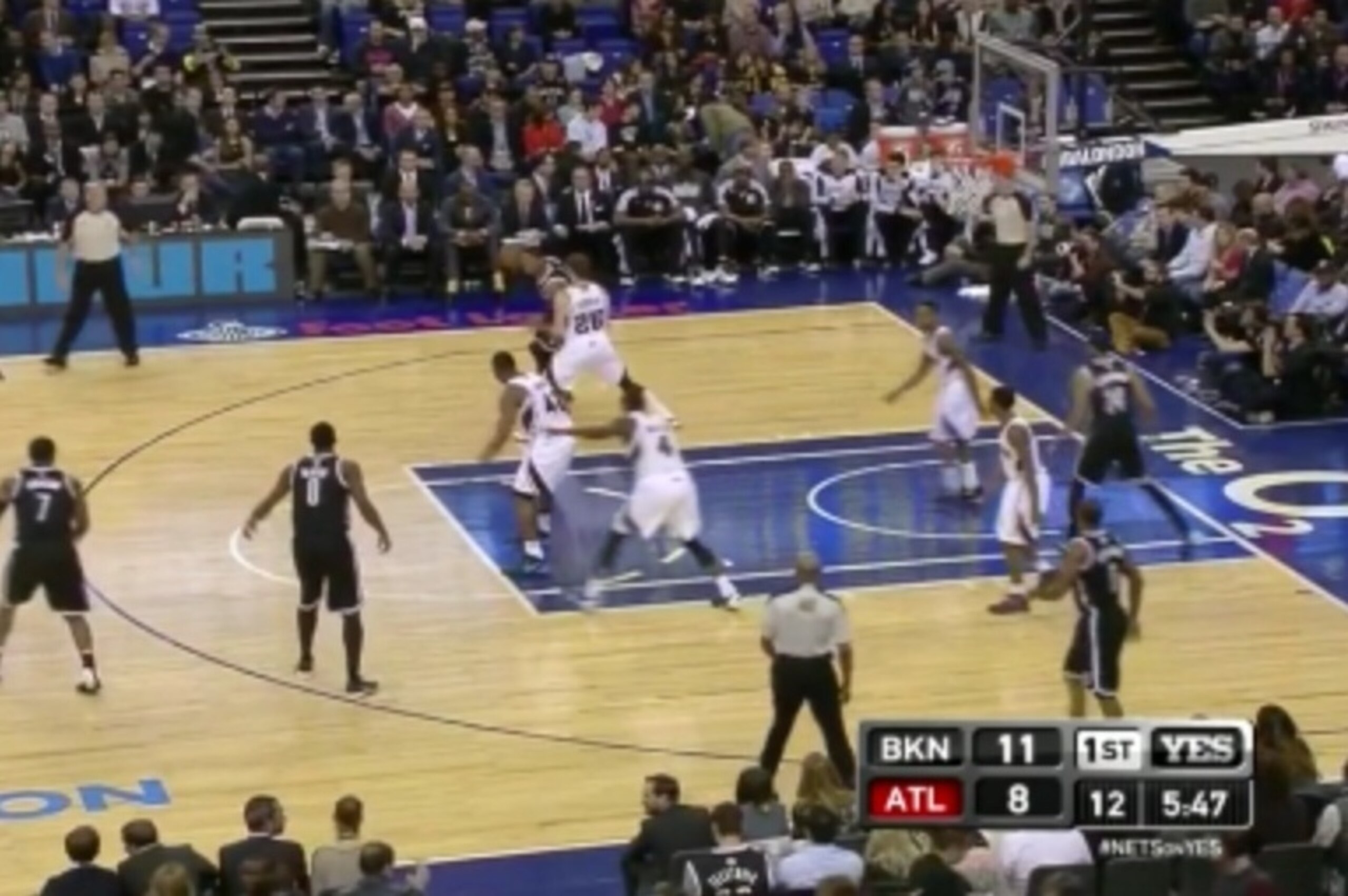
You'll notice all five bodies of the Hawks in the paint here as Pierce attempts to back down Kyle Korver on the left block. That's not ideal.
Nene and Marcin Gortat aren't the greatest outside shooters in the world, but they are stretchier than Blatche or Mason Plumlee, or even last season's version of Kevin Garnett.
It also helps having Bradley Beal or Martell Webster (who will eventually make it back from his injury) on the floor to draw defenders away from the post. And though John Wall is not yet a league-average outside marksman, he's improving, and he is deathly dangerous when attacking on-the-move defenders after receiving a pass from the perimeter, so it's dangerous to stray too far away from him on the perimeter as well.
Wall, for his part, is extremely enthused about what the acquisition of Pierce might mean in that respect, noting in an interview with Monumental Sports at a Baltimore Orioles game that "He gives us another versatile guy who can put the ball on the floor and attack the basket, and also knock down shots."
Last season, the Wizards really only had two guys who could create their own shot: Wall and Beal. Even Beal required some help, often being run through a maze of screens or receiving a handoff near the elbow to help generate space.
Adding another player who can create separation allows for more diversity in the offense. Specifically, it provides another backup option if things break down in the initial action for Wall or Beal.
When the ball was kicked out to Ariza or Webster last season, it was either going up for a shot or else being passed back to one of the two primary ball-handlers. Pierce provides the additional skill of being able to create for himself off the bounce, or even to make a dribble-drive and dish to a teammate.
The real challenge for Randy Wittman in integrating Pierce will come on the other end, where Pierce has the tall task of replacing one of the NBA's stoutest defenders. Ariza's combination of height and length makes him extremely bothersome to all of the top wings in the league, whether they be of the bigger variety like LeBron James, Kevin Durant or Carmelo Anthony, or the smaller, quicker types like James Harden or Monta Ellis.
Pierce has the bulk to deal with bigger players on the wing, but he no longer possesses the foot speed or lateral mobility to handle quicker players off the dribble in space. He also developed a bad habit of straying a bit too far from shooters who were a bit too dangerous when off the ball last season, something he'll have to clean up if he wants to pick up Ariza's slack.
Luckily, he has some excellent defenders on hand to help with any mistakes he might make. Wall, Nene and Gortat formed the core of a very strong defensive unit last season.

According to NBA.com, Washington allowed a defensive efficiency of only 95.7 in the 947 minutes that trio shared the floor last season, a mark that would have led the NBA over the full season. Add in Beal and the number dropped to 94.9 in 588 minutes, which, again, would have led the league. Pierce will have plenty of cover.
With Ariza out of town, Webster injured and a host of traditional bigs on the roster, Pierce will be returning to his natural position of small forward for most of the season. While his shift to the 4 was crucial for the Nets in creating spacing around their post-up guards who lacked range last season, it may not have been the best thing for Pierce as an individual player.
He took advantage of some slower forwards guarding him at times, but when he tried to go to his bread-and-butter post moves and dribble-drives, it at times left the spacing too cramped. That will be less of a problem this season as he plays with some better shooters and is able to generate more favorable post matchups against wing players.
If he can hold his own on defense, and if the Wizards can patch up whatever deficiencies he has in speed and quickness relative to Ariza, the Wizards could be a dark-horse challenger for the conference finals.

.jpg?w=2560 "Rap: Lions, LaPorta End Contract Talks")
.jpg?w=2560 "Commanders May Change Logo 👀")
_0.png?w=2560 "Week 5 Winners & Losers 📊")

.jpg?w=2560 "EVERY Fantasy Football Update")