Chip Kelly's Offense Presents Biggest Challenge to NFL Defensive Coordinators
Breaking down Chip Kelly’s offense in Philadelphia (with a focus on the core concepts), I have no problem calling this a West Coast-spread system in both the run and pass game.
However, given the amount of formation disguise, pre-snap movement and “read” schemes that show up on the film, the Eagles can dictate the flow of the game with their uptempo style while creating matchups (and stress) for the opposing defense.
Today, let’s discuss how Kelly’s playbook impacts the game prep from a defensive perspective using some examples from the Eagles’ All-22 tape.
.jpg?w=2560 "Panthers Saints Football")
.jpg?w=2560 "Raiders Football")
Dressing Up the Base West Coast Concepts
Defensive coaching staffs put together “hit charts” in the weekly game plan that show the core concepts based on formation, alignment and personnel.
Whether that is the quick game out of Posse/11 (3WR-1TE-1RB) in a Doubles Slot formation (3x1) or the closed (strong) versus open (weak) side runs in Regular/21 (2WR-1TE-2RB), these graphs highlight tendencies that defensive players can key on in their game prep.
The “hit charts” also include pre-snap movement such as shifts, motions (divide, yogi, fly) and “hops” (tight end moves to opposite side of the formation to reset) to give the defense an opportunity to study (and eventually play) these specific tendencies come game day.
However, when you study the Eagles on tape, the amount of formation disguise (and movement) Kelly uses to dress up the base West Coast concepts will put stress on defensive-game prep.
Remember, these are the same passing concepts we see from Andy Reid in Kansas City or Marc Trestman in Chicago along with the various “air raid” systems in the college game.
These aren’t routes drawn up in the dirt.
Here’s an example of the curl-flat concept (run at every level of the game) from the Eagles-Packers matchup this past season with some added window dressing before the snap out of Posse/11 personnel.

Instead of aligning in a 2x2 formation (standard curl-flat alignment), the Eagles move DeSean Jackson to the backfield and motion the receiver to the closed side (“fly” motion) while showing the mesh point “read” (QB/RB exchange) to create a curl-flat combination versus Cover 2.
From a defensive perspective, that’s a lot of moving parts to account for in a basic passing combination that is run on Friday nights in high school ball.
Plus, with the “read” look in the backfield, don’t be surprised to see linebackers (and safeties) step to the line of scrimmage (poor eye discipline).
Let’s take a look at another West Coast staple in the Hi-Lo series from the Eagles' Wild Card matchup versus the New Orleans Saints.
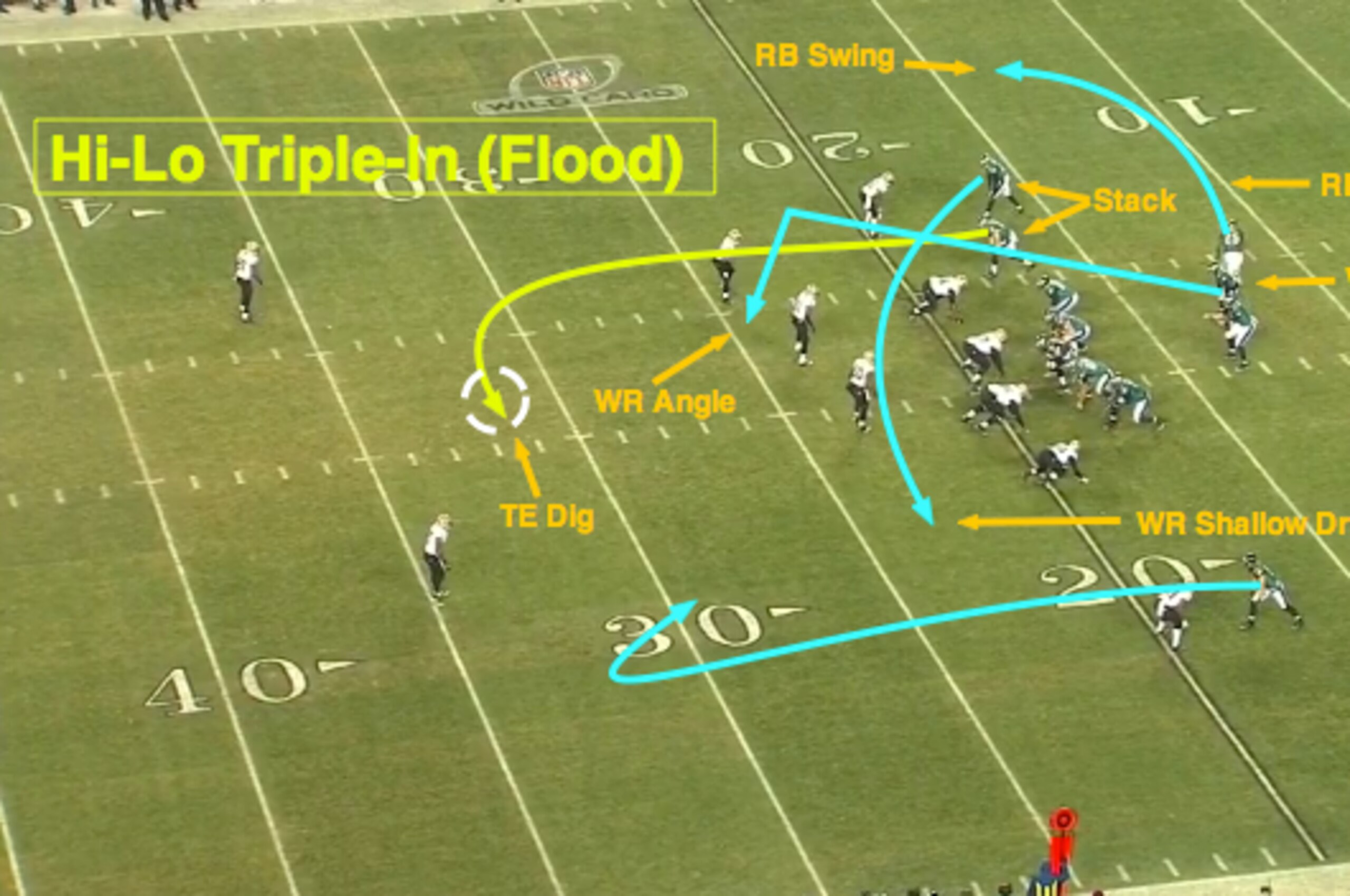
This is called the “Hi-Lo Triple-In Flood.” A concept Reid and the Chiefs will usually run from a Strong I formation with the Z receiver in nasty/reduced split (close to the core of the formation) to create a bunch alignment.
But Kelly dresses it up with Jackson aligned in the backfield to the closed side of the formation and running back LeSean McCoy on the pre-snap “fly” motion to widen the defense.
To the inside of the formation, this is no different than the scheme I played against with the tight end on the intermediate dig paired with the shallow drive route and the angle (triple-in).
These are just a couple of examples. But as I see it, the Eagles do an excellent job of taking base concepts to another level by using multiple looks and disguise.
And the key is the way they are presented when paired with an uptempo style that tests the conditioning level/technique of the defense. That’s tough when you have to concentrate, identify the concept and execute versus a team that spreads the field.
“Read” Schemes
As one coach told me, the Eagles force the defense to be wrong (and take advantage of the numbers) to create positive execution through packaged plays and “read” schemes out of the shotgun.
I focused on the basics of packaged plays last week, and to be honest, I could have used Eagles tape for the entire piece because of the amount of “read” schemes they show under Kelly.
Again, think uptempo here with a focus on making the defense choose by alignment and technique to limit the multiple options within the scheme.
Here’s one packaged play we looked at from the Eagles' matchup versus the Oakland Raiders with Nick Foles throwing the bubble screen off the mesh-point read.
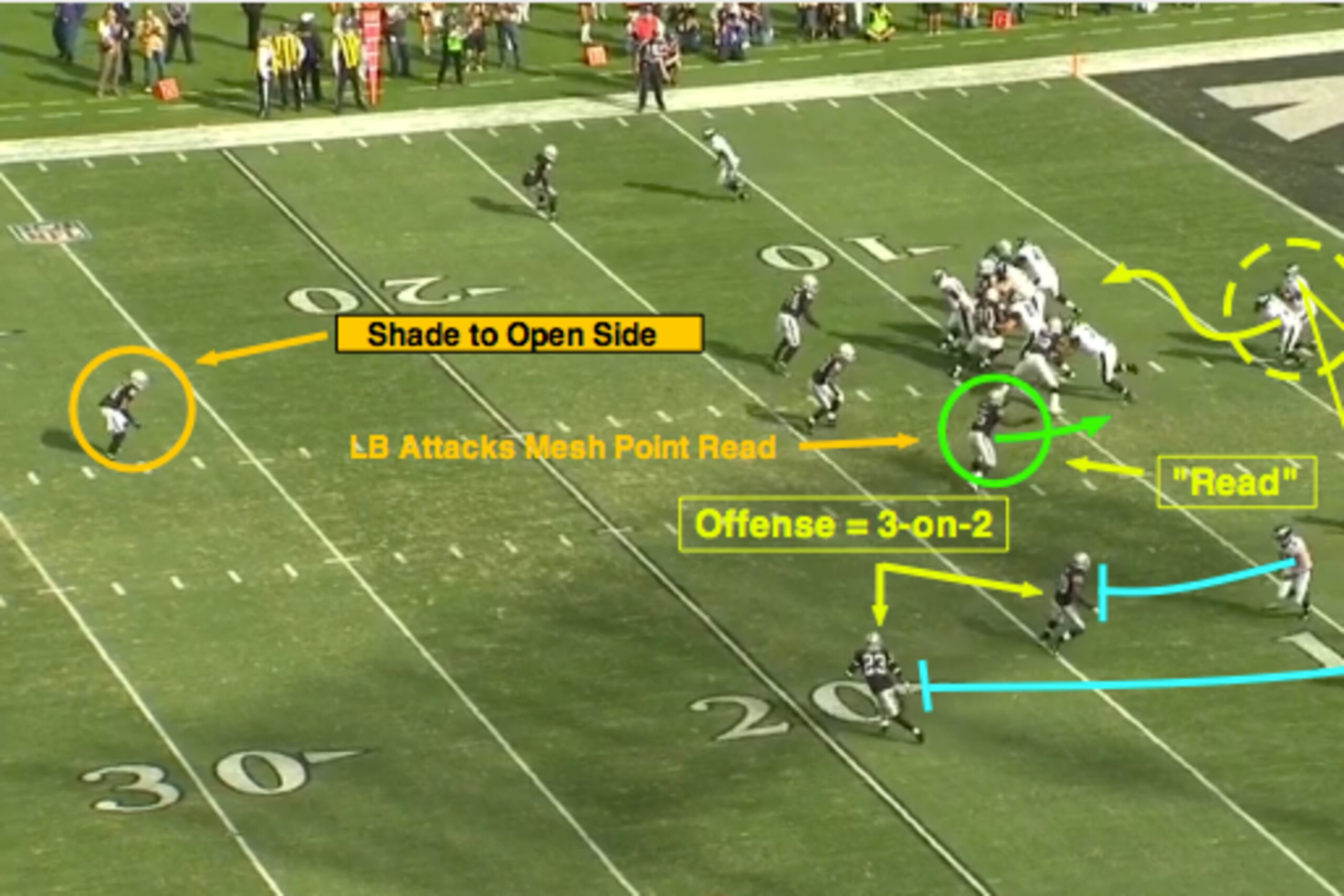
The Raiders are trying to account for the quarterback keep and the bubble screen with the linebacker removed versus the slot look.
However, all it takes is one step to the formation, and the Eagles have the numbers (three-on-two) to produce an explosive gain (plus 40 yards) on a simple read for the quarterback to throw the screen.
Let’s look at another example on the inside zone versus the Packers.
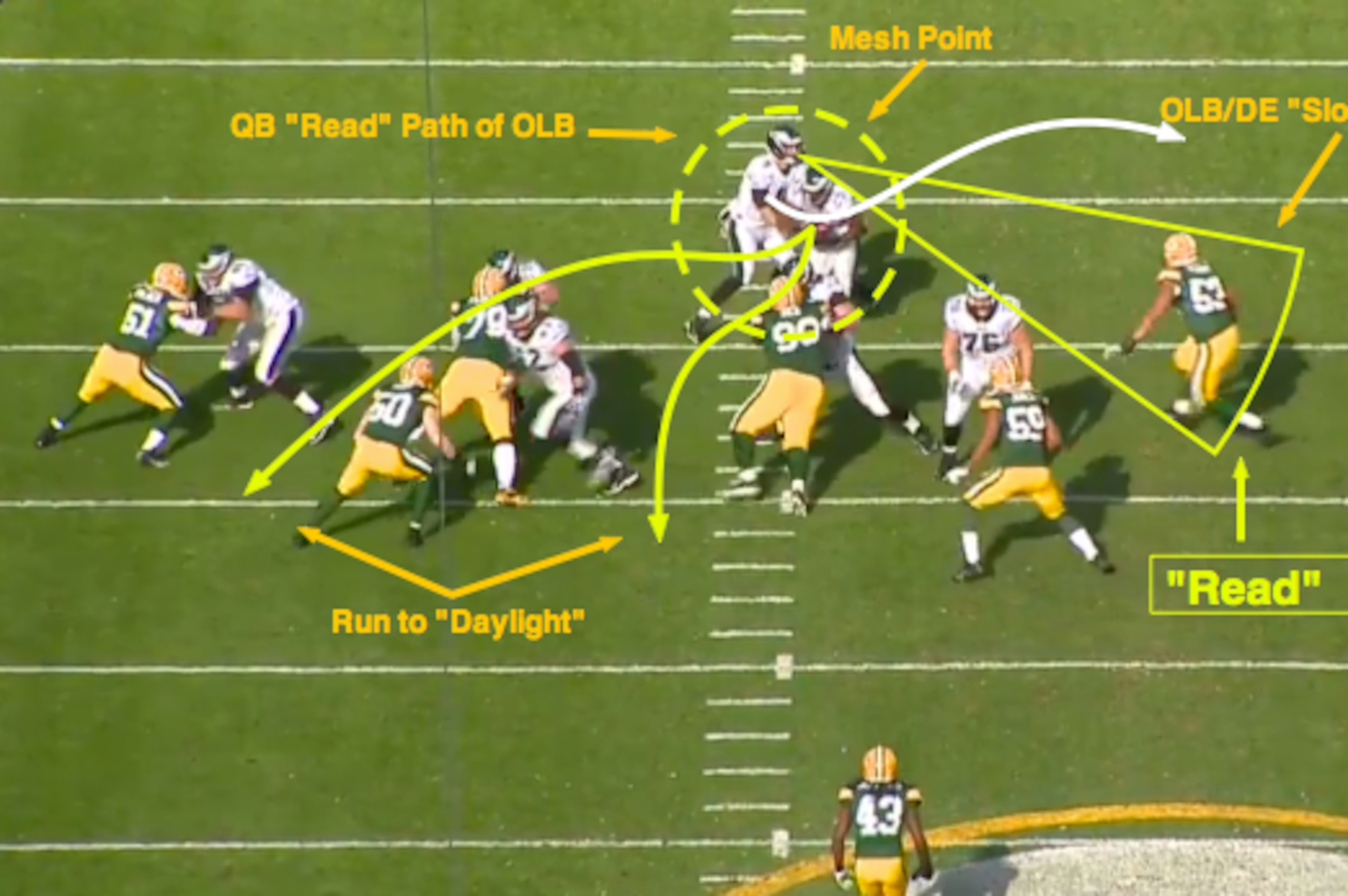
Foles “reads” the path of the edge defender here through the mesh point versus the outside linebacker.
If the linebacker crashes inside (dive), the Eagles quarterback will pull the ball. If he stays up the field (or “slow plays”), Foles gives to LeSean McCoy on the inside give.
Check out another example of the “read” scheme the Eagles used off the Buck Sweep action versus the Chicago Bears.
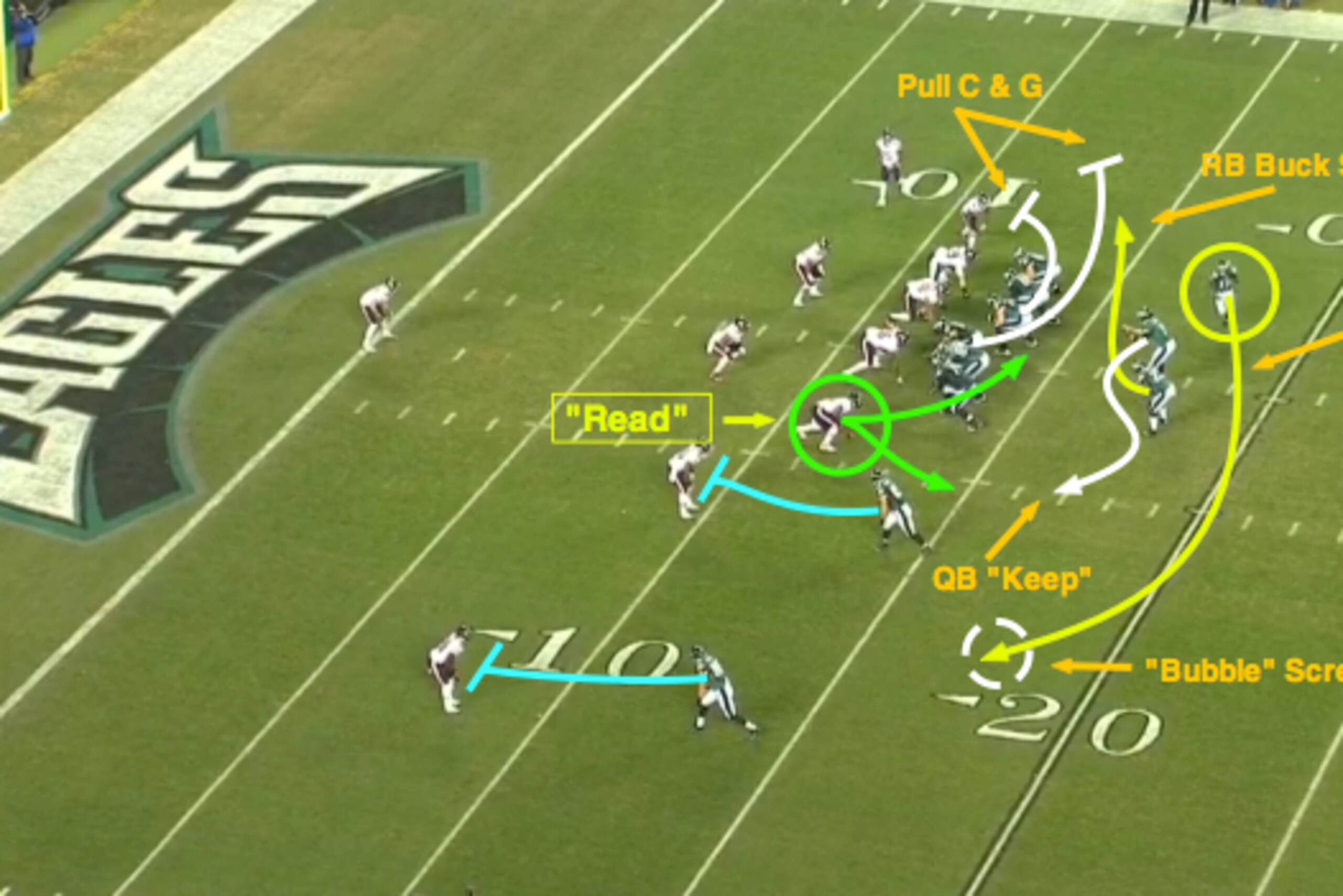
This gives Kelly’s offense the option of running the power game to the closed side of the formation or “reading” the open-side edge defender (with a bubble screen built in).
The Eagles will run their base zone schemes out of Ace/12 personnel (2WR-2TE-1RB) with the running back in the “dot” (aligned directly behind quarterback under center) to maximize McCoy’s ability in the inside zone, outside stretch or split zone.
And that’s a big part of the game plan in Philadelphia.
However, these “read” schemes within the Eagles' packaged plays present major issues for defenses in their run/pass keys and discipline.
And that creates options for the quarterback to target defenses based on the numbers they show before the snap and the technique of the edge defender.
Man-Coverage Beaters
If you play man coverage (Cover 1) versus the Eagles, this offense under Kelly is going to beat you up using Hi-Lo concepts, mesh schemes and the boot game to create positive matchups with misdirection and crossing routes.
Think of “pick” plays and inside traffic that forces defenders to “bubble” over each other (run over the top) to match (find) their coverage.
And it isn’t often that the Eagles slow the game down with a static formation (no pre-snap movement) to give you that extra time as a defensive player to identify a stack, a running back in a “chowed” alignment (outside leg of the tackle) or a player aligned out of position.
Instead, the back seven is forced to trail and lose leverage while fighting through traffic that resembles rush hour in Chicago’s Loop on a Friday afternoon.
That’s brutal as a defensive player.
This is a look at the Hi-Lo mesh concept (with the running back on the wheel route) that the Eagles used often this past season to exploit man-coverage defenses.

As you can see here, the Eagles motion Jackson across the formation with the “Z” receiver in a nasty split and the running back offset (“chowed”) to the closed side versus the Cowboys Cover 1 scheme.
Before the ball is even snapped, the Cowboys middle linebacker is beat. Why? Look at the inside crossing routes (or “picks”) that will force the linebacker to either duck under or bubble over to find the back.
And the result is an explosive gain when the running back stems the wheel route to the numbers with the linebacker chasing from behind (trail position) and the free safety late to react over the top.
If you study the Eagles on tape, you will see this same concept run from a variety of looks with the wide receiver in the backfield, McCoy removed from the formation and “fly” motion to create those specific matchups.
The boot game? That’s going to show up inside of the red zone with the Eagles using the “swap” action (receiver under the line of scrimmage) to give the quarterback a clean read to the flat.
Here’s an example from that same matchup with the Cowboys.
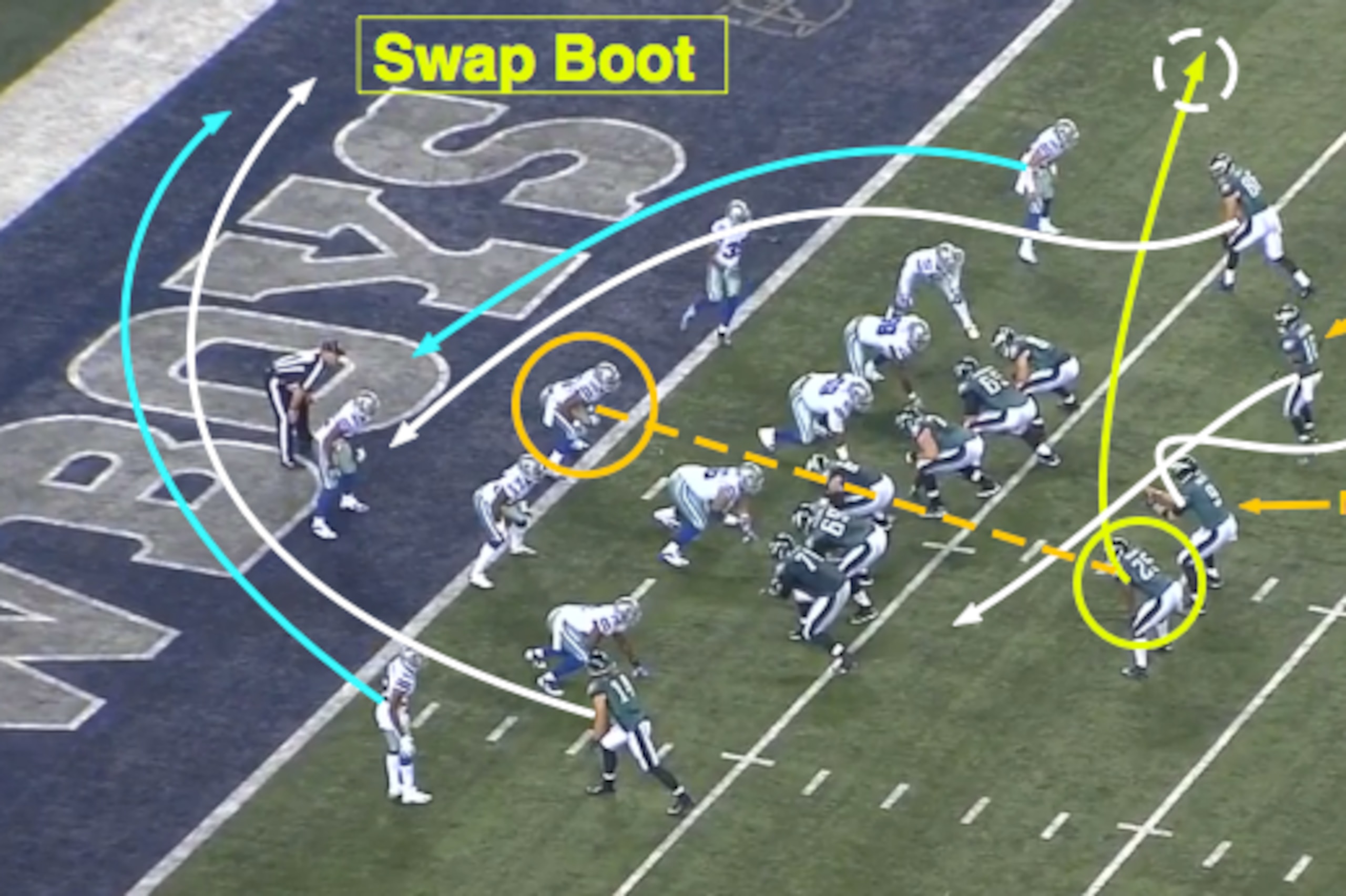
What does Kelly do here? Check out Jackson motioning into the backfield with McCoy on the “swap” action.
This allows Foles to ride Jackson through the mesh point (forcing the linebacker in coverage to settle his feet) while McCoy sneaks out to the closed side of the formation with a Hi-Lo concept over the top.
And again the Eagles produce in this situation by taking advantage of the defense with their personnel, alignment and scheme.
Tight End Matchups
The final thing I want to look at is the use of the tight end position after the Eagles drafted Zach Ertz out of Stanford last season to give Kelly the personnel who can win with size/leverage at the point of attack.
Along with Brent Celek, the Eagles can utilize their Ace/12 personnel to run pro-style concepts with the formation flexibility of the tight end position to create matchups versus both man and zone schemes.
Here’s a quick look at the Eagles removing both tight ends to the closed side of the formation to run the base three-step slant with a smash-7 (corner) to the open side.

This isn’t complex or exotic, but with both tight ends removed (and running inside breaking concepts), the stress falls on the defense to play with technique in its coverage to win at the point of attack (break point).
Both Ertz and Celek can box out the defenders and create leverage back to the ball on a route that is run in little league games.
But the point here is simple: The tight end position forces the defense to scheme coverages (based on game situation) to take away those inside-breaking concepts.
And it gives Kelly another outlet to target the secondary with pro-style concepts versus base and nickel packages.
How Does Kelly’s Offense Compare to the Rest of the NFL?
We can look at Peyton Manning and the Denver Broncos, Trestman’s playbook in Chicago, the Green Bay Packers, Saints or New England Patriots when discussing some of the top offenses in the NFL right now from a scheme perspective.

But I do believe Kelly’s system should be in the discussion because of the multiple looks (and personnel) that cause stress to opposing defenses when they set their game plans.
And if I’m a defensive coordinator preparing to play the Eagles, it’s going to be a long week of work to get my players ready to identify specific concepts while playing through the “read” schemes and matching up to the tight end position.
Seven-year NFL veteran Matt Bowen is an NFL National Lead Writer for Bleacher Report.