Taxes Will Undoubtedly Force the Oklahoma City Thunder to Part Ways with Melo
The Indiana Pacers appeared to be the initial losers in the 2017 Paul George trade with the Oklahoma City Thunder, giving up an All-Star for role players in Victor Oladipo and Domantas Sabonis.
The Thunder were the second team giving up on Oladipo, who was originally drafted second overall by the Orlando Magic in 2013. He, with Sabonis, didn't seem like fair compensation for George.
As the season progressed, Oladipo proved to be flat-out sensational for the Pacers. Meanwhile, George and the Thunder faced their share of struggles in the Western Conference.
TOP NEWS

Amtrak Recruiting LeBron
Teams That Quietly Crushed Offseason 🤫
.png?w=2560 "Oklahoma City Thunder v Los Angeles Lakers - Game Four")
Dillon Brooks Wants to Box Jimmy 🥊
In addition to acquiring George, the Thunder traded for Carmelo Anthony from the New York Knicks. The moves impressed Russell Westbrook enough for him to sign a long-term extension before the season.
The results on the court were less impressive. Anthony fell to career lows at 16.2 points per game on 40.4 percent shooting. Eventually, Oklahoma City lost in the first round of the playoffs to the Utah Jazz.
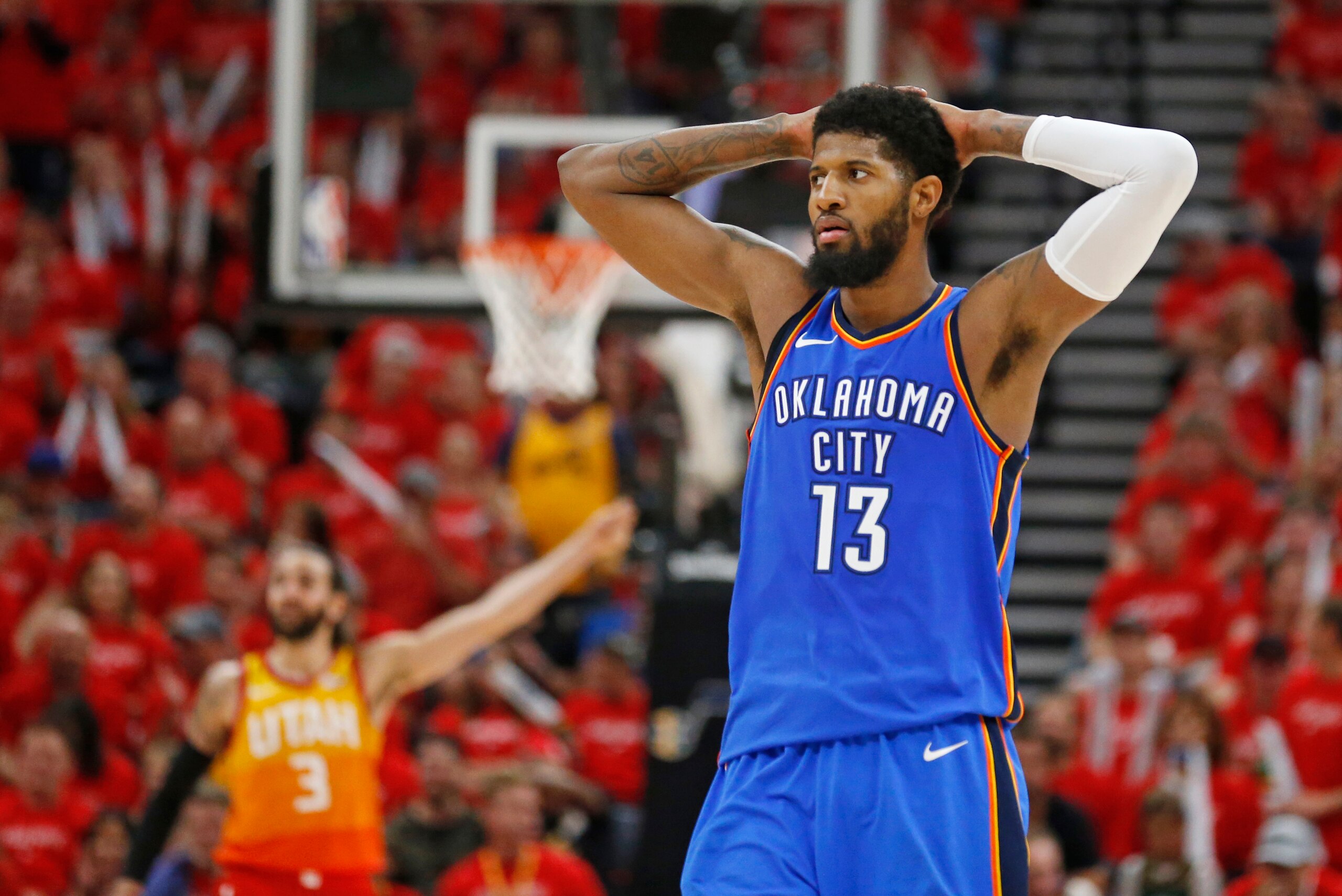
The verdict seemed obvious: Gambles on Anthony and George had failed. Anthony was overpaid. George was headed home to play for the Los Angeles Lakers as a free agent. He wouldn't be able to say no to Earvin "Magic" Johnson. No chance.
Instead, when July 1 arrived, the Lakers didn't even get a meeting. George committed to sign a four-year deal with Oklahoma City, and just like that, the swap with the Pacers proved to be a win for both sides.
Now, the Thunder face an entirely different and complex issue: the largest luxury-tax bill in NBA history.
With George expected to earn $30.6 million in the first year of his $136.9 million contract, along with the team's commitment to re-sign Jerami Grant and Raymond Felton, Oklahoma City is looking at a payroll just shy of $160 million.
Because the Thunder paid luxury taxes for the 2014-15, 2015-16 and 2017-18 seasons, they are considered repeat offenders. With the current tax threshold at $123.7 million, Oklahoma City will pay a dollar-for-dollar penalty of about $36 million—on top of the team's progressive tax bill of $115 million!
In total, the Thunder are looking at $151 million in luxury taxes, almost doubling their payroll expense to $311 million.
That's a significant price for a team that won 48 games last season, 17 fewer than the first-place Houston Rockets.
To put that in perspective, the Cleveland Cavaliers paid almost $187 million last season (including $50.7 million in taxes), while the champion Golden State Warriors spent $167.6 million (including $32.3 million in taxes).
It seems untenable for a small-market team in Oklahoma City to foot such a massive bill for even a single season. The Thunder need to trim sizable salary, and the obvious and perhaps only answer appears to be getting out of the final $27.9 million owed on Anthony's contract.
The solution may be simple: They can waive the veteran forward and stretch his salary out over three seasons at $9.3 million a year. Perhaps Anthony would accept a buyout worth the veteran's minimum of $2.4 million, which he would be able to find elsewhere with a contending team looking for scoring (maybe to join LeBron James in Los Angeles).
If so, that stretched number would dip to $8.5 million a season, and its impact on the Thunder's 2018-19 payroll would be massive.
In addition to the $19.4 million dip in what they would pay Anthony over the next year, Oklahoma City would save nearly the equivalent amount in repeater taxes. The team's total payroll would drop to about $140 million. More significantly, the progressive tax would fall to just $33 million.
In total, the Thunder would be paying only $49 million in tax, with a total payroll of $189 million.
That's still huge, but it's $122 million cheaper than it would be to pay Anthony to stay. Is any player worth that much for one season?
By stretching Anthony, the Thunder could face taxes on that extra $8.5 million for the next two years, but the NBA projects the threshold to climb to $132 million for 2019-20 and $141 million for 2020-21. The immediate savings in stretching Anthony won't significantly bite Oklahoma City in the future.
If the Thunder could find a team to take Anthony in a trade—without taking significant salary in return—they'd be able to clear some of that financial burden outright. But few franchises have that kind of cap space.
Teams such as the Atlanta Hawks and Chicago Bulls are likely to ask for significant draft considerations for their trouble. Oklahoma City still owes the Magic a first-round pick (originally dealt to the Philadelphia 76ers for Grant), limiting their ability to send out future selections.
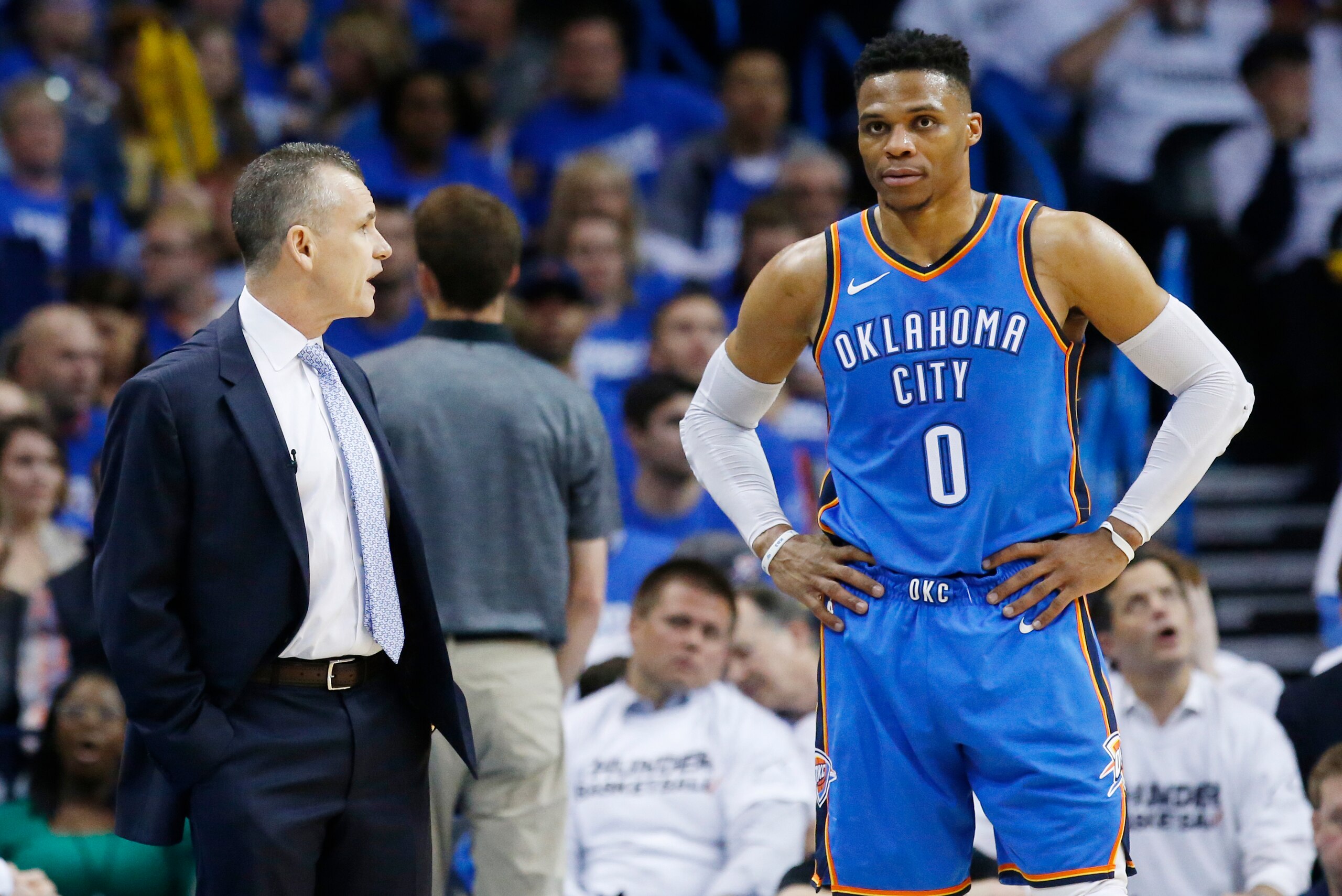
Additionally, Anthony has a no-trade clause that arrived with him from New York. He can block any trade he doesn't like.
The Thunder can avoid any complex trade negotiations by taking matters into their own hands via stretch.
The team doesn't have to stop with Anthony. It can look to move off the contracts of Alex Abrines, Patrick Patterson and/or Kyle Singler (each in the $5 million-to-$5.5 million range). They would bring tax relief, but nowhere close to what shedding Anthony's number would do.
Anthony has had a tremendous career, but the Thunder will survive and perhaps even flourish without him and the financial burden his contract brings. At 34 years old, he's not the same player he used to be. Even if he were, the Thunder need financial relief more than they need an isolation scorer.
The franchise needed to bring in Anthony and George last summer to woo Westbrook. His extension was the big win for the small-market Thunder. It's a boon that George will be a part of the team's future, but Anthony has served his purpose.
The decision needs to be made by the Aug. 31 deadline, and the numbers suggest stretching Anthony is the only play the Thunder have.
Update: According to Adrian Wojnarowski and Royce Young of ESPN.com, the Thunder "front office is working through scenarios that will culminate in the inevitable this summer: an ending to the brief Carmelo Anthony partnership."
Email Eric Pincus at eric.pincus@gmail.com, and follow him on Twitter @EricPincus.
.jpg?w=2560 "NFL Rookies Who Could Earn Starting Jobs 🌟")
.jpg?w=2560 "🚨 Pearsall Out for Season")
.png?w=2560 "D-Hop Not Retired from NFL 🤔")
.jpg?w=2560 "Teams That Should Eye Baker Mayfield")