
NFL Playoffs 2017: Takeaways from Seahawks vs. Falcons and Texans vs. Patriots
We now know the first half of the NFL's final four.
The divisional round of the 2017 NFL playoffs got underway Saturday, and in at least one respect it followed the same script as Wild Card Weekend.
There wasn't much nail-biting or suspense.
Just as happened a week ago, the higher-seeded teams emerged with victories.
And just like a week ago, those wins came in emphatic fashion.
It didn't appear things would be that way when the Seattle Seahawks took the opening kickoff and drove 89 yards for a touchdown. But the rest of the day belonged to the Atlanta Falcons, as a surgically precise offense and hard-hitting defense paved the way for a 36-20 win.
The nightcap was a game everyone expected to be a rout—a 14-win New England Patriots team taking on a Houston Texans squad they blasted 27-0 at Gillette Stadium earlier this season. For a half at least, Houston's defense kept things close, but the Texans faded in the second half and fell 34-16.
Now that Saturday's NFL playoff action has drawn to a close, let's take a look at what we learned from the beatdowns in Atlanta and Boston.
The Atlanta Offense Is an Absolute Buzz Saw
1 of 6
OK, so this isn't exactly a revelation. The Atlanta Falcons finished the 2016 season second in the NFL in total offense, third in passing offense and fifth in rushing offense.
Still, it isn't often that you see Seattle's vaunted Legion of Boom defense get cut to pieces. Utterly dominated. Embarrassed, even.
That's what happened Saturday at the Georgia Dome.
Leading up to the game, Seattle cornerback Richard Sherman told ESPN's Sheil Kapadia that the Seahawks were well aware of the success Matt Ryan and the Atlanta offense has had in 2016.
"The worst thing you want to do in football is overthink," Sherman said. "They know this, they know that, but we know them too. It's sort of the idea where we just have to go out there, align and execute."
The only execution that happened Saturday was Seattle's.
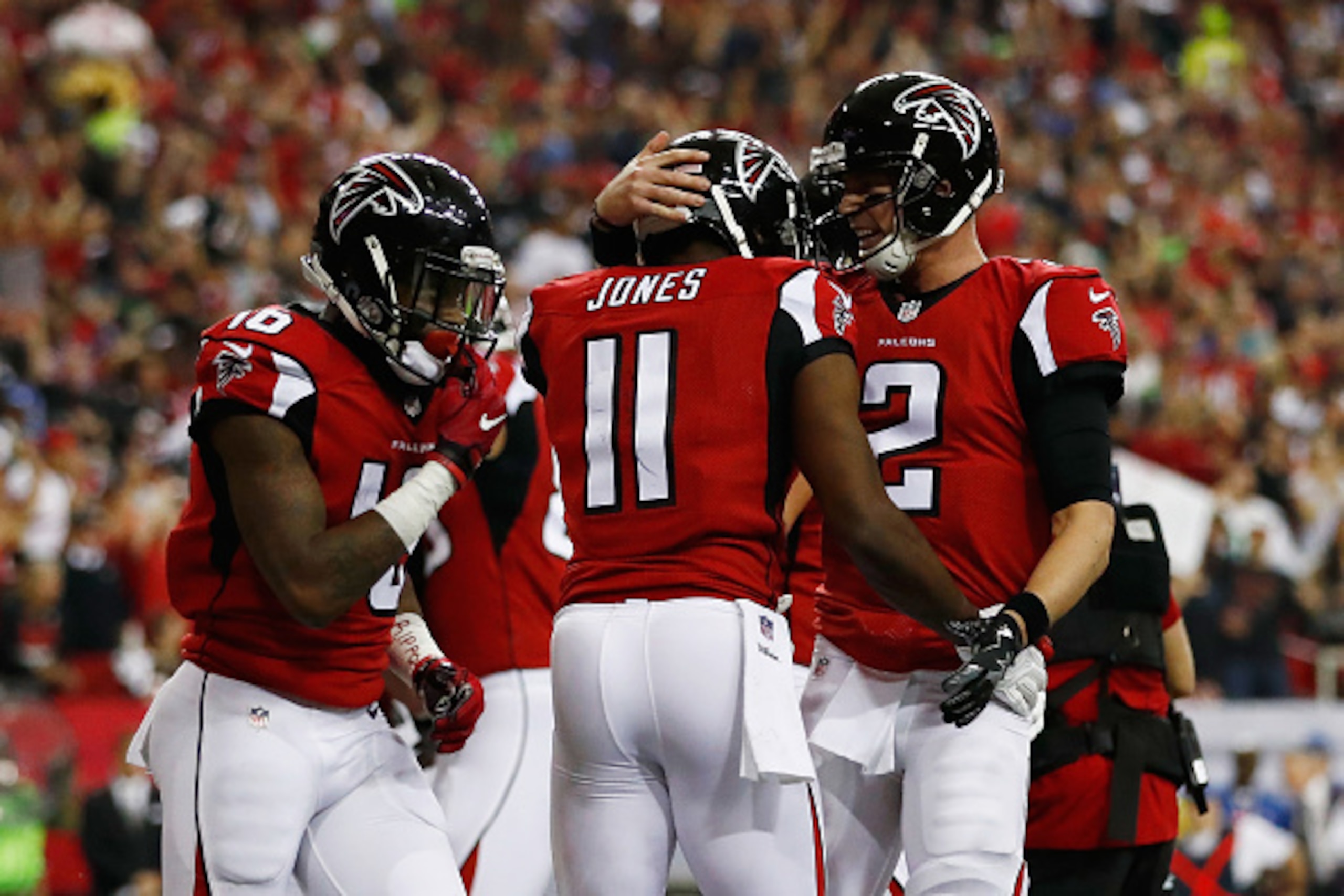
Ryan was brutally effective against the Seahawks, completing 26 of 37 pass attempts to eight different receivers. The MVP candidate piled up 338 passing yards, tossed three touchdowns and posted a passer rating of 125.7.
Ryan wasn't the only player on the Falcons offense to have a big day. Tailback Devonta Freeman garnered 125 total yards and scored. Backfield batterymate Tevin Coleman had 5.2 yards per carry and found the end zone.
Despite a relatively "down" day (six catches, 67 yards, one touchdown) for Julio Jones (who left late with a foot injury that head coach Dan Quinn called "no concern," per ESPN.com's Vaughn McClure), the Atlanta offense moved the ball at will.
Ryan entered Saturday trying to exorcise the demons of his 1-4 career playoff record.
Mission most certainly accomplished.
Without Earl Thomas, Seattle's Legion Is Boom-Less
2 of 6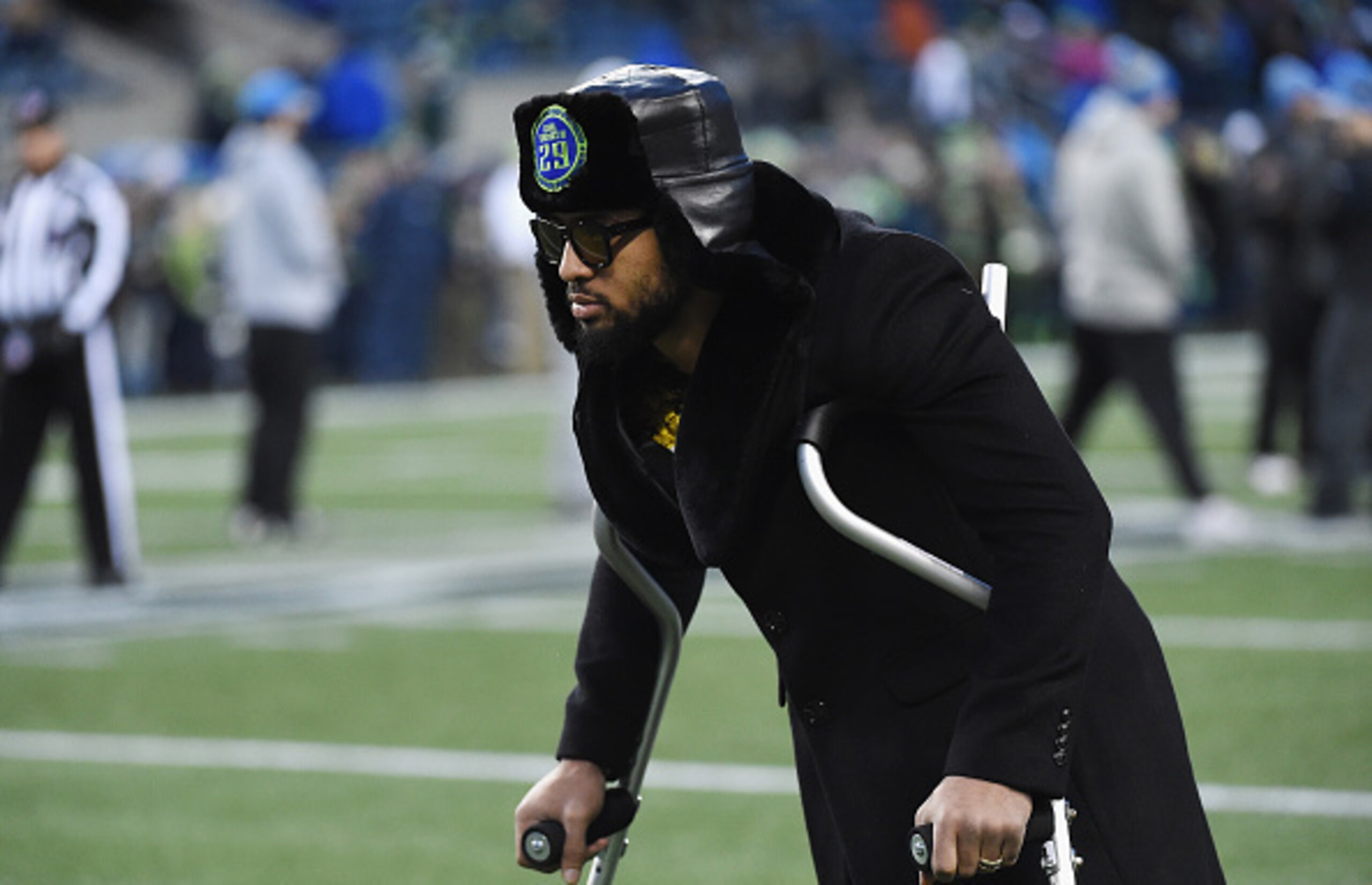
There's been a lot written this year about Seattle's problems on the offensive line.
I should know. I wrote a fair amount of it.
That line didn't play well against Atlanta. OK, that's being kind—the Seahawks' besieged line allowed three sacks and a staggering 22 hurries, per Pro Football Focus, never mind that it stepped on Russell Wilson's foot and caused the safety that started the scoring deluge that blew open the game.
But that wasn't the most glaring problem the Seahawks had Saturday.
As Jim Sannes of NumberFire wrote, the Seattle defense has struggled in a big way since losing safety Earl Thomas to a broken leg in Week 13.
"When you adjust for opponents," Sannes wrote, "the Seahawks have had one of the worst pass defenses in the entire league since Thomas' injury, besting only teams who scraped the bottom of the barrel. These struggles were even more defined on deep passes, an area where [Matt] Ryan figures to test them this week."
That statement was so prophetic that even Nostradamus was like "Whoa. Dude."
Or at least he would have been had he not died in 1566.
For the sixth straight game since Thomas went down, the Seahawks failed to record an interception. Ryan had his way with the short-handed Seahawks all afternoon. And Thomas' replacement, Steven Terrell, whiffed on three tackles in the game, per Pro Football Focus.
Two of those missed tackles led to long gains.
The fact is, this year's iteration of the Seahawks wasn't nearly as good as the team that won Super Bowl XLVIII. Or the team that lost Super Bowl XLIX. Or maybe even the team the Carolina Panthers bounced a year ago.
But among the lessons learned about the Seahawks this season, one looms largest: The glue that holds the Legion of Boom together isn't Richard Sherman. Or Bobby Wagner. Or Michael Bennett, Cliff Avril or Kam Chancellor.
It's Thomas. Because without him the whole thing fell apart.
Don't Sleep on the Atlanta Defense
3 of 6
The Atlanta offense gets a ton of attention. And with good reason: It has the Falcons one win away from Super Bowl LI.
But at the beginning of this week, a writer as sage as he is handsome opined here at Bleacher Report that the Atlanta defense would be the key to a deep playoff run.
"For their season to continue," that wise and talented author said, "that young defense needs to grow up in a hurry. If it can pull that off—if Atlanta's defense can make a couple of big plays and get a few timely stops—the Falcons could be headed somewhere they haven't been in nearly two decades."
Let's just take a moment and bask in how right he was.
Didn't that feel good? I know it did for me.
Kidding and self-congratulation aside, head coach Dan Quinn has to be over the moon about the way his young defense played against the Seahawks. It was exactly the sort of effort the Falcons needed to secure the sort of win that sent a message to the their prospective NFC title-game opponents, the Cowboys and Packers.
As I mentioned earlier, the Atlanta pass rush was consistently up in Russell Wilson's business Saturday, logging three sacks and innumerable knockdowns and hurries—without a big night from 2016 sack king Vic Beasley.
The run defense did its part too. A week ago, Seattle running back Thomas Rawls gashed the Detroit Lions for 161 yards on the ground. Against the Falcons, Rawls failed to get a quarter of that amount, averaging 3.1 yards a pop on his 11 totes for 34 yards.
In fact, Wilson led the team with 49 yards on the ground, and most of those came with Seattle in desperation mode.
Add in a pair of interceptions and a gift-wrapped safety, and in its totality, Saturday's defensive effort was one of the Falcons' best of the season.
If Atlanta can produce similar results on that side of the ball a week from now, then Matt Ryan, Julio Jones and the other Atlanta stars who were named to the NFC's Pro Bowl squad will to have to beg off.
They'll have other plans.


Another Postseason Record for Tom Brady
4 of 6
Tom Brady garnered another postseason record, but it's one he'd just as soon not have.
In the regular season, the New England quarterback attempted 432 passes. He completed 28 of those for touchdowns. Only two were picked off.
That 14-to-1 touchdown-to-interception ratio was an NFL record, a performance that has the likes of Boston.com's Paul Swydan banging the drum for Brady as the NFL's MVP despite his four-game suspension to open the season:
"Tom Brady and Matt Ryan both played excellently this season, and both are deserving of the league's MVP award. Ryan was slightly better than Brady in several offensive categories, but given the fact that Ryan is eight years younger and had a better rushing attack at his disposal, his degree of difficulty wasn't quite as high as Brady's. Furthermore, Brady put together a historically efficient season in terms of interceptions, limiting interceptions better than anyone in the game has ever done.
"
Brady matched that interception total against the Texans in 394 fewer attempts.
The pair of miscues gave the Golden Boy 30 interceptions in the playoffs over his career, tying Brett Favre for the most in NFL history.
All in all, it wasn't the best of games for Mr. Bundchen, and not just because Brady's interceptions (and the points that emanated from them) were just about the only thing that kept Houston in the game for three quarters.
The Texans took a page out of the Denver Broncos' playbook from last year's AFC title tilt, coming at Brady early and often.
The result was two sacks, more than a few knockdowns and at one point an unhappy superstar quarterback.
It wasn't enough to get the Texans a win. Heck, it wasn't enough to get the Texans anywhere close to a win, if only because 30 percent of Brady is better than 130 percent of anyone the Texans have on the roster at the quarterback position.
But in some respects, as odd as it sounds to write it, the Patriots didn't win because of Brady.
They won in spite of him.
Brock Osweiler Is an Anchor Around the Texans' Necks
5 of 6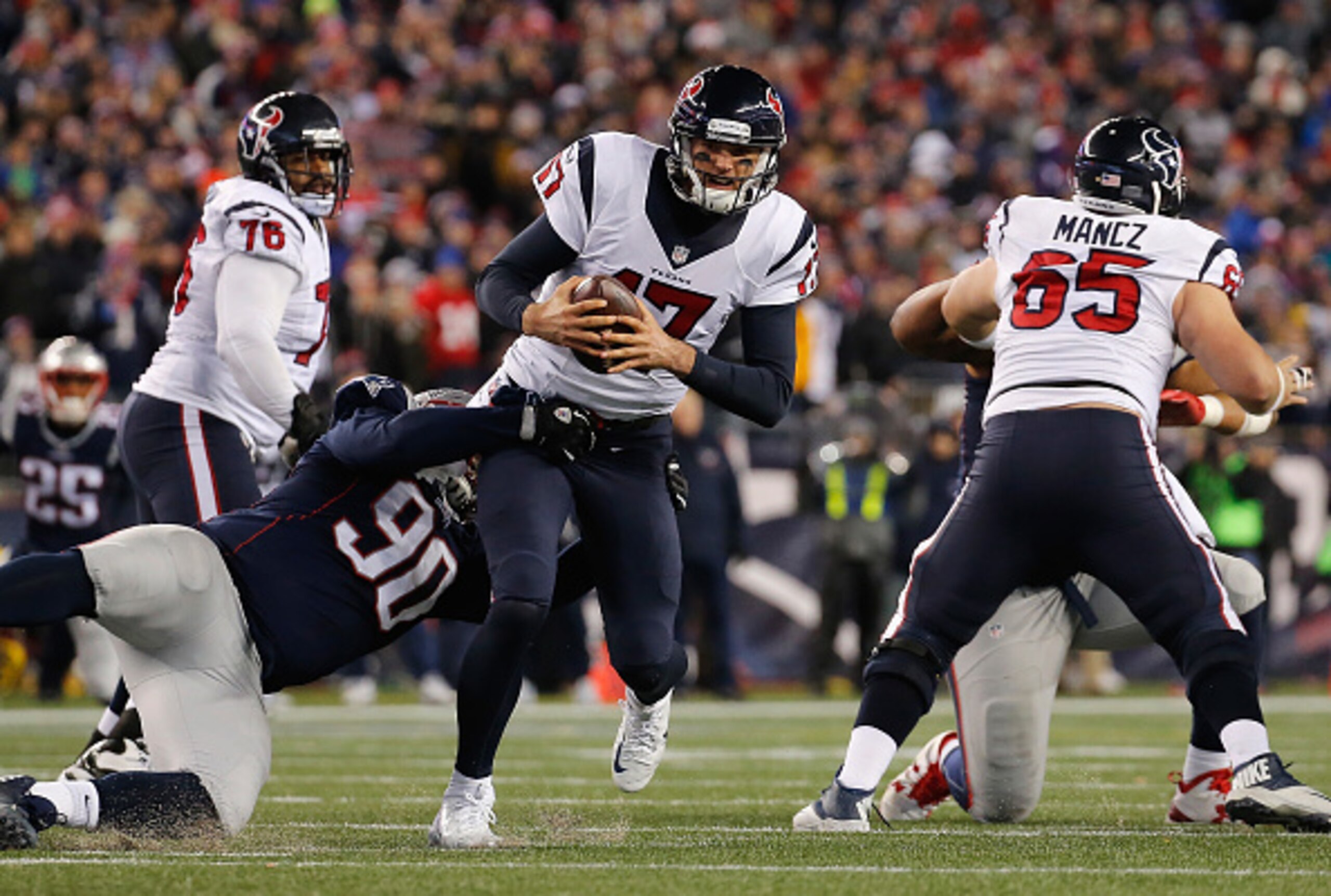
There are those who will call the 2016 season a success for the Houston Texans. The team won the AFC South for the second straight year, made the playoffs for the fourth time in six seasons and won the third playoff game in franchise history.
There were other bright spots. The Texans finished 2016 with the NFL's No. 1 defense despite not having reigning Defensive Player of the Year J.J. Watt for most of the season. They did so thanks to the contributions of young stars in the making, such as Whitney Mercilus and Jadeveon Clowney. Tailback Lamar Miller ran for 1,073 yards on the ground in his first year with the team.
None of that matters. The Texans don't matter. And as long as Brock "the $37 million bandit" Osweiler is Houston's starting quarterback, the Texans aren't going to matter.
I'm sorry if that sounds harsh, but Saturday night was an object lesson in the truth of that harshness.
Despite a phenomenal effort from Houston's front seven and a less than stellar performance from the Patriots, there was never a point where anyone outside the most fervent Texans fans thought they had a chance.
The reason for that is Osweiler.
After the Texans downed the Oakland Raiders last week, Osweiler sounded like a quarterback ready to put his regular-season struggles behind him while speaking to Lorenzo Reyes of USA Today.
"When we all came together in April, for (organized team activities), when we all came together again in July for training camp, this is what we all had envisioned," he said. "We envisioned a great season. We envisioned an AFC South championship, and we envisioned making some noise in the playoffs. This is exactly what we expected out of this football team and to be able to get the job done today means a lot."
The problem is that against the Patriots he still played like Brock Osweiler.
On the night, he attempted 40 passes, completing 23 for 198 yards. For those who aren't big on arithmetic, that's a sterling 4.95 yards per attempt. I lost count of the passes chucked over heads and under feet.
In Osweiler's defense, Will Fuller dropped a sure touchdown in the third quarter, which didn't help. But neither did the quarterback's three interceptions.
The Texans are a decent team. And given how much coin they have invested in Osweiler, odds are he'll open 2017 as their starting quarterback.
As long as that's the case, they have zero chance of getting better.
The Patriots Are Going to the Super Bowl
6 of 6
This will probably make everyone angry. There will be those who will accuse me of being a Patriots homer/shill/fanboy or some equally endearing term. Others will wonder how I could write such a thing after criticizing Tom Brady's play.
Hey, Brady didn't play especially well, at least by his standards. The Patriots also didn't run the ball all that well (98 yards) or consistently pressure Brock Osweiler—not that they needed to.
Have I mentioned how bad he is?
It was far from New England's best effort of the season.
And yet the game was never in question.
Most NFL teams, even the good ones, have one or two things they do well. Whether or not those squads win in a given week depends on how well they succeed at doing those things.
The Patriots can change what they do on a dime. They change from game to game, depending on their opponent. Then they change again during the game, depending on how that game is progressing.
When New England met Houston back in September, with Jacoby Brissett under center, LeGarrette Blount carried the ball 24 times for 105 yards and two touchdowns. The Texans took that power run game away Saturday, but that meant leaving their cornerbacks in man coverage against wideouts Julian Edelman and Chris Hogan.
Twelve catches and 232 yards later, they were just as beaten as before.
Most NFL teams, even good ones, have one or two stars. If they're going to win a playoff contest, it's because those stars had a big game.
Well, the Patriots have Tom Brady, who as I already mentioned didn't exactly play like a superstar Saturday. Instead it was tailback Dion Lewis who shined, scoring touchdowns on a run, a reception and a 98-yard kickoff return—a first in postseason history.
He didn't even play in the first meeting in Houston.
The schemes change. The personnel changes, and yet one thing remains constant in the kingdom of Darth Hoodie: winning.
Oh, and the Patriots lead the NFL in scoring defense and are the best team in the NFL at taking away what an opponent does best.
It isn't hard to see why so many people dislike the Patriots so intensely. It's the same reason they are playing in their sixth consecutive AFC Championship Game next week—at home—in a stadium where they've never lost a game they led at the half.
They're really, really good. Annoyingly so.
Like it or not, the Patriots aren't going to play two straight bad games.
And that's bad news for the Chiefs or Steelers.


.jpg?w=2560 "🚨 FALCONS GIVING BIJAN $75M")