Grit-'N'-Grind 2.0: How the Memphis Grizzlies Finally Joined the Modern NBA
LOS ANGELES — The Memphis Grizzlies don't own a Larry O'Brien Trophy. They've never won a game during the conference finals, let alone appeared in the NBA Finals during their 21 years in the league (the first six of which were in Vancouver).
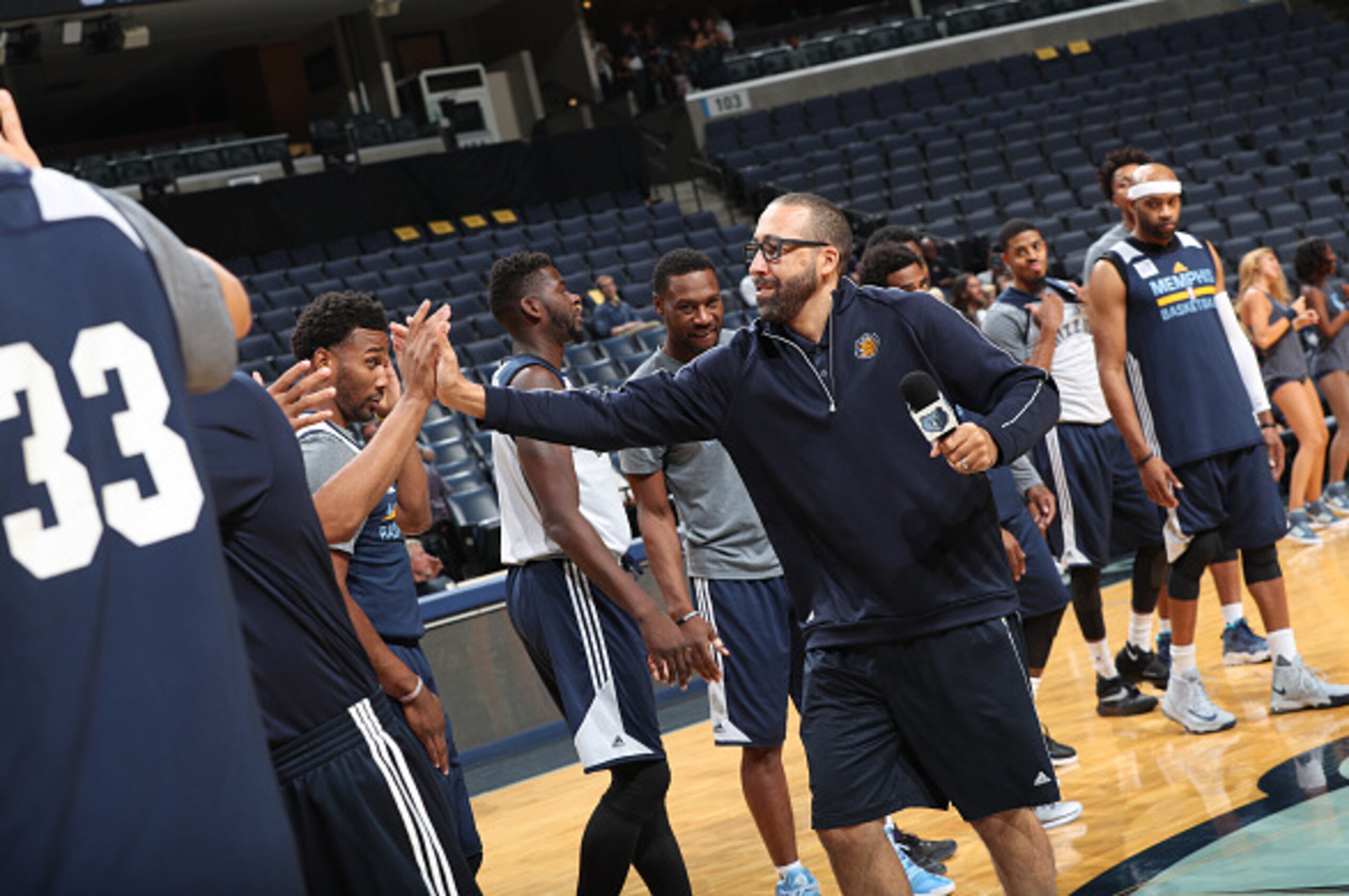
But they do have pictures of the trophy prominently displayed in the hallway leading from their locker room to the court at FedExForum. It's one of head coach David Fizdale's many personal touches and another not-so-subtle nod to the Grizzlies' grander plan of upgrading the organization from perennial Western Conference pest to legitimate title contender.
"I think sometimes when new coaches take over, it's always, 'Let's change everything,'" Fizdale explained. "That wasn't my attitude when I came to this team. They had a lot of stuff in place that was working for them.
TOP NEWS
KAT Frustrated with Contract Talks

Surprise Dubs Trade Idea 💡

Projecting New-Look Lakers Rotation 🧐
"What we had to do was take that and adapt it to the league that we play in today—being able to defend the three-point line, being able to get up enough threes to equalize the three-point line—but with the same exact toughness and grind-and-grit attitude that they've always had."
This past May, the Grizzlies hired Fizdale away from the Miami Heat, where attention to detail and chain of command have long been imperatives under Pat Riley and Erik Spoelstra. For eight years—four with the trio of LeBron James, Dwyane Wade and Chris Bosh—Fizdale saw firsthand what could be accomplished when everyone was held accountable and pushed beyond their comfort zones. Player development was part of the process for the entire roster, not just for the young guys trying to find their way in the NBA.
"I had never heard anybody put it that way before," Grizzlies general manager Chris Wallace said.
In Miami, that meant getting James cozy in the post, coaxing Wade into a secondary role and stretching Bosh's shot beyond the arc. In Memphis, Fizdale has encouraged everyone to expand their shooting range.
Nobody has made a bigger leap there than Marc Gasol. His all-around skill set didn't need much tinkering, but Fizdale and his staff saw enough room for Gasol to take another step back like Bosh did. When they got to work, they found a willing pupil.
"He's taken to it like a fish to water, and he's really used it as a weapon for us," Fizdale said.
Through the first 36 games of the 2016-17 season, Gasol took nearly twice as many threes and made more than four times as many as he had during his previous eight NBA seasons combined. At 41.1 percent from deep, Gasol boasts the best three-point mark among centers and ranks among the top 25 in the league overall.
"The more tools you have offensively and defensively, the better," Gasol said. "I'm obviously not the most gifted guy athletically, so I have to do different stuff for me to be a difference-maker out there."
Gasol's move out has brought the big man a new set of challenges. Getting to the rim requires an extra dribble or two—no easy feat for "Big Spain" and his 7'1", 255-pound frame. Offensive rebounding has never been Gasol's forte but is now an even tougher task farther from the hoop. And where once he might've shied away from jacking up shots after a brick or two, he's now expected to keep launching even if the misfires pile up.
"That's a different mindset for me," Gasol explained. "I always, when something isn't working for me, I go and flip it and try to go somewhere else and try to attack in a different way and let the other thing develop and let it come more organically."
Gasol, though, plays the same 33-34 minutes a night as a starter that he always has and still ranks among the top 10 in post and elbow touches, per NBA.com.
Zach Randolph, on the other hand, has had to adapt to life on the bench—in his 16th pro season, no less.
"There was no debate about it," Fizdale said. "He said, 'Coach, whatever you need.'"
The Grizzlies see the switch as a boon for Randolph: They can more readily modulate the 35-year-old's playing time to preserve his body and keep him productive. Z-Bo is logging his lightest nightly load since his sophomore season with the Portland Trail Blazers, but he's scoring (21.1 points) and rebounding (12.1 boards) on a per-36-minute basis better than he did during either of his All-Star seasons.
The move has worked well for Memphis as a whole. The Randolph-Gasol pairing, once a staple of Grit-'n'-Grind, stalled out last season. By splitting up the hulking duo, the Grizzlies have afforded themselves a potent frontcourt at all times.
| Both | minus-3.7 | 8.6 |
| Randolph, No Gasol | plus-0.7 | 14.8 |
| Gasol, No Randolph | plus-3.0 | 26.9 |
| Neither | minus-10.1 | 5.0 |
It helps that the Grizzlies had an able replacement waiting in the wings. JaMychal Green isn't anything close to the low-post brute Randolph has long been. What he can do—and didn't do much of prior to this season—is shoot from outside.
He took Fizdale's directive to heart and spent his summer hoisting threes. Through 37 games, he's drained a sturdy 36.1 percent of his 1.9 attempts per night.
Green admitted to battling nerves at the outset, even after starting 15 times while leading the injury-riddled Grizzlies with 78 appearances last season. He's also taken better care of the ball as he's acclimated to his new role, averaging 0.6 turnovers per game since mid-December—less than half what he had up to that point.
"You just don't want to make too many mistakes and make the coach look bad and make the team look bad," Green said. "You don't want to let down your teammates. But I'm past that to the point where I'm comfortable out there on the floor now. I'm not second-guessing myself."
Green's shooting and cutting, along with Gasol's extended range, have helped open up the floor for Mike Conley. No longer are his forays into the paint cut short by his own bigs.
Instead, as Gasol draws out the opposing shot-blocker and Green proves a modicum of gravity on the wing, Conley has found more space to create than ever before.
"It's definitely opened up a whole new world for Mike," Fizdale said.
Before he went down with a back injury in late November, Conley was setting the Association on fire. Through his first 17 games, he shot 46.7 percent from three on 5.3 attempts while pouring in a career-high 19.2 points and dishing 5.7 assists. His shot has been spotty upon return (41.9 percent overall, 34.0 percent from three in nine games), but Memphis isn't fretting the rust that's built up.
Tony Allen has thrived in that space too. Instead of standing around unnoticed on the perimeter as a liability from long range, he’s been turned loose as a cutter and cleanup guy around the rim.
"It's a little unpredictable," Gasol said, "but he does a great job."
Allen has turned his manic activity into 10.2 points per game—the second-most of his career—and a personal-best 2.4 offensive rebounds. He's done it at an age (34) when most wings who lean so heavily on quickness and athleticism are already deep into decline.
In time, Chandler Parsons could both boost and benefit from Memphis' newfound offensive freedom, assuming he's ever healthy enough to be fully unleashed.
The Grizzlies have been careful with the biggest (and most expensive) non-incumbent free-agent signee in franchise history. He missed the first six games of the season while recovering from knee surgery, sat out another 18 in a row in November and December with a bone bruise in the same knee and has rested during the second half of back-to-backs since returning to the lineup Dec. 21.
Memphis has managed to make tangible progress toward modernizing its offense without Parsons' help. The Grizzlies have climbed into the middle of the pack in three-point makes and attempts and are on pace to shatter the team's single-season bests in both. They've already set a new single-game mark with 17 makes against the Sacramento Kings on New Year's Eve.
| 2010-11 | 3.8 (30th) | 11.3 (30th) | 33.4% (27th) |
| 2011-12 | 4.2 (27th) | 12.9 (28th) | 32.6% (25th) |
| 2012-13 | 4.7 (30th) | 13.5 (30th) | 34.5% (24th) |
| 2013-14 | 4.9 (30th) | 14.0 (30th) | 35.3% (19th) |
| 2014-15 | 5.2 (29th) | 15.2 (29th) | 33.9% (22nd) |
| 2015-16 | 6.1 (27th) | 18.5 (25th) | 33.1% (29th) |
| 2016-17 | 8.9 (18th) | 25.7 (18th) | 34.6% (22nd) |
It's not as though the Grizzlies are putting lipstick on a pig. They're 9-3 when hitting 40 percent or more of their threes and a ho-hum 13-13 when they haven't.
But they remain among the bottom 10 in points per 100 possessions and are next-to-last in effective field-goal percentage, ahead of only the Chicago Bulls, per NBA.com. So there is plenty of evolving left to do.
On paper, Parsons' presence could push Memphis' offense further in the right direction.
"He's a player that we've never really had," Wallace said, "someone of that size that can stretch the floor, that can handle the ball, play in pick-and-rolls, that gives us another playmaker too on the floor. Which in today's NBA, it's so helpful to have multiple playmakers that you can go to rather than just one guy with the ball that's got to be in his hands all the time."
The Grizzlies are never going to be the Golden State Warriors, but if they can shoot well enough to hang with the West's best, they don't need to be. They haven't forsaken their identity as a team intent on grinding its opponents to death.
"Clearly, it's an important thing for them," Los Angeles Clippers head coach Doc Rivers said, "but at the end of the day, the ball's going to go to Gasol and it's going to go to Randolph and it's going to go to Conley, and they're going to play off of those three guys."
Chances are they're going to play at a snail's pace; the Grizzlies sit 28th in possessions per game, per NBA.com.
Defense still matters most to Memphis' identity and its championship aspirations. On that end, the Grizzlies are as physical and effective as ever. They still foul a ton—and yield the highest opponent free-throw rate in the league as a result—while remaining among the elites in points allowed per 100 possessions, opponent effective field-goal percentage, turnovers forced, defensive caroms collected and scores surrendered in the paint.
| 101.5 (2nd) | 49.5% (3rd) | 15.5% (5th) | 78.6% (4th) | 36.5 (1st) |
But there's evolution here too: Memphis has adjusted its approach to account for the NBA's three-point craze. In the pick-and-roll, it drops back less and plays up more. Overall, the Grizzlies have taken to switching rather than sticking squarely with their assignments.
The team's recent infusion of longer arms and younger legs has helped. Amid a historic rash of injuries last season, the Grizzlies got long looks at the defensive versatility of guys like Green, James Ennis and Jarell Martin. This season, they've added Troy Daniels and a slew of promising rookies (Andrew Harrison, Troy Williams, Wade Baldwin IV, Deyonta Davis) to the mix.
With so many new faces and big changes for familiar ones, everyone has wound up in the same boat.
"In reality, we're all rookies to this," Conley said. "We're trying to help our young guys as much as we can, to hurry them along, but we're trying to figure ourselves out as well."
Youngsters like Harrison and Williams have helped Memphis paper over injuries to core players, but those setbacks have taken their toll on the Grizzlies' search for consistency on both ends of the floor.
"It's rocky," Fizdale said of his team's chemistry. "Obviously with guys coming in and out of the lineup and all of the injuries, it's been difficult to build a rhythm with this group."
To that end, Memphis has also played catch-up with the rest of the league. Over the past couple of years, owner Robert Pera has empowered the front office to hire more physical therapists, expand and update the rest of the medical training staff and bring the team's best practices in line with those set by the San Antonio Spurs, among other franchises.
Those investments could prove all the more crucial given how much money Memphis has poured into injury-prone players. Gasol, 31, fractured his foot during the first season of a five-year, $110 million deal last season. This past summer, Conley, 29, signed for a league-record $153 million over five years following a campaign marred by Achilles issues. Parsons, 28, nabbed his max (four years, $94 million) despite hobbling through the two previous seasons with the Dallas Mavericks.
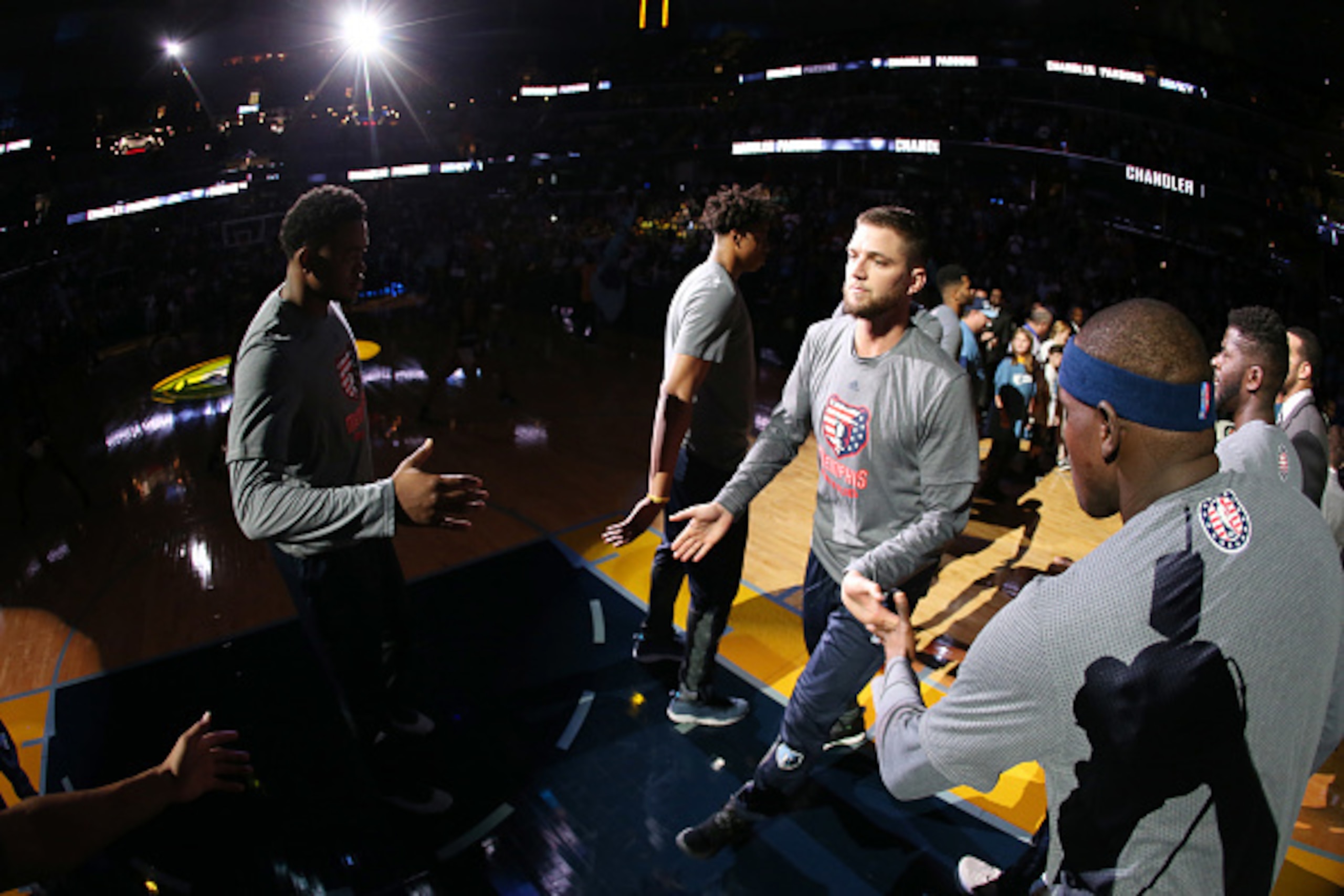
If the Grizzlies are going to compete at the highest level with that trio—along with impending free agents like Randolph, Allen and Green—they'll need all the help they can get to keep everyone healthy.
"You can have the greatest roster assembled in the history of the game," Wallace said, "but if they're not healthy and not playing for a long period of time, you don't get any value."
A more experienced backup point guard might help. So could another shooter.
Those are narrower needs for the Grizzlies to address. They believe this team—with its ability to cover more ground in different ways on both ends of the floor—can compete with the elites. They've already beaten the Warriors in Memphis without Conley and the Clippers in L.A. with a more complete outfit.
However, the Grizzlies have played one of the NBA's softest schedules; their remaining slate through mid-April looks like a grueling gauntlet. If the going gets tough, their core group (now the league's longest-serving) could feel the tug of Grit-'n'-Grind as it was.
They'll need to resist the temptation to fall back into familiar patterns that, while crucial to a franchise-record six straight postseason appearances, haven't yielded much more than aspirational posters of the ultimate prize.
"We've all been uncomfortable along the season," Gasol said, "and it's all for the greater good."
All quotes obtained firsthand. All stats via NBA.com and Basketball-Reference.com unless otherwise noted.
Josh Martin covers the NBA for Bleacher Report. Follow him on Twitter, Instagram and Facebook, and listen to his Hollywood Hoops podcast with B/R Lakers lead writer Eric Pincus.


.jpg?w=2560 "Love's Body Already 'Tired'")

.jpg?w=2560 "Tyreek Deal May Come Soon")
.jpg?w=2560 "Ward Nearly Walks Out of Presser ▶️")
.jpg?w=2560 "NFL investigating 2 referees for separate viral exchanges")