Revamped Defensive Line a Major Disappointment for Washington Redskins
What do you get when you add Ricky Jean Francois, Stephen Paea and Terrance Knighton alongside talented holdovers Jason Hatcher and Chris Baker? If you guessed a dominating defensive line, it's understandable, but you're still wrong.
Through seven games, the Washington Redskins are a lowly 30th against the run and 19th in sacks. And it's the fault of the men up front.
When general manager Scot McCloughan opened his checkbook this offseason he thought he was purchasing a defensive front stout enough to accelerate the Redskins' rebuild. He knew how a formidable D-line can quickly inspire an attitude change for a franchise he's determined to shape into a more blue-collar and physical beast.
TOP NEWS
.jpg?w=2560 "Commanders Football")
Commanders' Tunsil Tore Triceps
.jpg?w=2560 "Browns Football")
Scuffle at Browns Training Camp
.jpg?w=2560 "Texans Bears Football")
Active Players Destined for HOF 🤩
After all, McCloughan had already seen it work. As general manager of the San Francisco 49ers, he was responsible for putting together a trio of front-line monsters. Ends Justin Smith and Isaac Sopoaga, along with nose tackle Aubrayo Franklin, instantly transformed the finesse 49ers into a smashmouth ball club few teams looked forward to facing.

McCloughan was clearly reading from the same script when he brought three burly D-tackles to Redskins Park. But beasts these ain't.
So far, the impact of the new boys is mostly of the unseen variety. All three are tough old pros capable of altering the mindset in a locker room too often fractured by egos in recent seasons.
But ultimately, any position group must be judged a success or failure based on its performances between the hash marks. By that criteria, McCloughan's investments just aren't passing muster.
It starts with those failures up front. Make no mistake, the blame for that 30th ranking on the ground lies firmly with Washington's so-called trench warriors.
In a bye-week breakdown of Knighton's struggles, ESPN.com's John Keim spells out some depressing numbers:
"It’s tough to say he’s made the necessary impact because the run defense has been bad -- the Redskins allow 4.91 yards per carry and it’s 4.38 with Knighton in the game. The disappointing part is that the Redskins allow 4.82 yards per carry with Knighton and fellow linemen Chris Baker and Jason Hatcher in the game.
"
Those numbers just shouldn't happen with one of the league's supposed premier run-stuffers clogging the middle.
As the lone two-gap lineman up front, Knighton is occasionally doing his job. Namely, he's sometimes tying up double-teams, something Keim gives him credit for. Yet, as the focal point of the run defense, Knighton has to do more than merely act as a magnet for blockers.
Even the best house-sized 0-techniques will still get into the backfield and wreck plays at their source. But Knighton isn't splitting gaps the way he often did with the Denver Broncos. Of his 16 tackles, just half are solo stops. ESPN.Go.com credits the mammoth malcontent with just one "stuff" and half a sack all year.
Knighton has to offer more. Based on his meager stats, it's easy to ask if the 6'3", 354-pounder is the ideal fit for a defensive scheme more geared to single-gap techniques this season.
During the offseason, the members of Washington's D-line couldn't wait to tell anyone who'd listen about how the change in techniques would let them be more of an attacking force. Back in late-May, Hatcher emphasized the difference more one-gap principles would make for him.
"You can make more plays in the backfield, make a lot of tackles, as long as you’re in your gap and do what you’re supposed to do it’ll be fun," Hatcher said, according to Keim. "Just attack. You ain’t holding up blocks no more. You can make a play here and there."
But single-gap lines are supposed to be swarming groups that live in offensive backfields. It's a method of defense that is reliant on quickness and downhill instincts. As a player who has spent his career filling space rather than exploiting it, Knighton may not be the best fit.
Of course, many teams now mix up one- and two-gap techniques along their D-lines. If Knighton is two-gapping, it's up to players such as Hatcher and Co. to take full advantage. But it just isn't happening.
In his brilliantly detailed and incisive look at Washington's dreadful run defense, Scout.com and Breaking Burgundy's Paul Conner identified a familiar trend. Specifically, he noted how new coordinator Joe Barry has his edge players, the outside linebackers, crashing inside against the run while the middle 'backers scrape to the outside.
Ideally, Washington's edge-rushers should be setting the edge to either force backs toward the sideline or funnel them back inside to marauding linemen, depending on the design of the play being run at them.
While it's easy to criticize Barry's teaching and scheme, derision that's certainly merited, another core reason might be behind this trend. Perhaps Barry is crashing Ryan Kerrigan and others inside to compensate for the lack of penetration from the front three.
But the Burgundy and Gold's limitations up front aren't merely about struggles stopping the run. Washington's D-line isn't making life tough enough for opposing quarterbacks.
The Redskins have just 13 sacks this season, with the line accounting for 6.5 of them. Head coach Jay Gruden has pinpointed an inability to complete sacks as the root of the problem, according to Stephen Czarda of the team's official site:
"I think we missed three or four sack opportunities [vs. the Buccaneers]. Again, when we get back there we’ve got to wrap the quarterback up. I think Ricky Jean [Francois] missed a couple, Trent [Murphy] missed one. We missed a couple the week before. [Jason] Hatcher missed one the week before. These guys are rushing hard. I think we have the people in here that can rush, we’ve just got to do a better job of finishing plays with a sack or the forced fumble.
"
Even though linemen in most 3-4 fronts are supposed to act more as complementary pieces rather than primary playmakers, this line still isn't doing its bit.
Pressure from any front seven is supposed to be a symbiotic effort from linebackers and linemen.
When there's pressure from the edges, quarterbacks must step up, right into interior linemen ready to make them pay. Alternatively, a strong push in the middle can force hapless passers out of the pocket and into the arms of grateful edge-rushers.
Sadly, neither of those things have happened often for the Redskins this season. Guys like Hatcher and Paea are most culpable. The latter has been a real letdown since leaving the Chicago Bears and signing a four-year, $21 million contract during free agency.

Paea, who enjoyed a career year as a pass-rusher in the Windy City during 2014, has been such a disappointment his playing time has even been reduced, as noted by Keim:
"He was expected to be the starting left end, but he did not play great and was then outplayed by Chris Baker, who is off to an excellent start. So Paea now is just a guy in the rotation rather than a starter. He showed quite a bit as a pass rusher last season with Chicago that he’s not showing this season. Occasionally he’ll flash. Paea has the skills, but he hasn’t yet made the desired impact.
"
As for Hatcher, he didn't live up to his billing last season, so just one sack in 2015 is hardly proof of a player responding well to a new system and making up for lost time.
The Redskins have linemen who can rush and are employing techniques that are supposed to favor those talents. But too many quarterbacks are getting a free ride. One-gap lines make it easier to run stunts and games, some wrinkles Barry must introduce for the rest of the season.
It'll be a tough second half of the campaign for Washington if its supposedly revamped D-line doesn't start delivering. The style, tactics and effectiveness of a defense are all determined by the success of the men up front.
If the Redskins need proof, they should just consult Week 9's opponent, the unbeaten New England Patriots. Depending on the offense they face, the Pats can gear their defense to stop different strengths based on their vast array of linemen.
For instance, during a close game against the run-heavy New York Jets in Week 7, big-bodied D-tackles Malcom Brown and Alan Branch combined for 65 defensive snaps, as noted by ESPN.com's Mike Reiss. In a game plan drawn up to shut bruising back Chris Ivory down, the Pats went big.
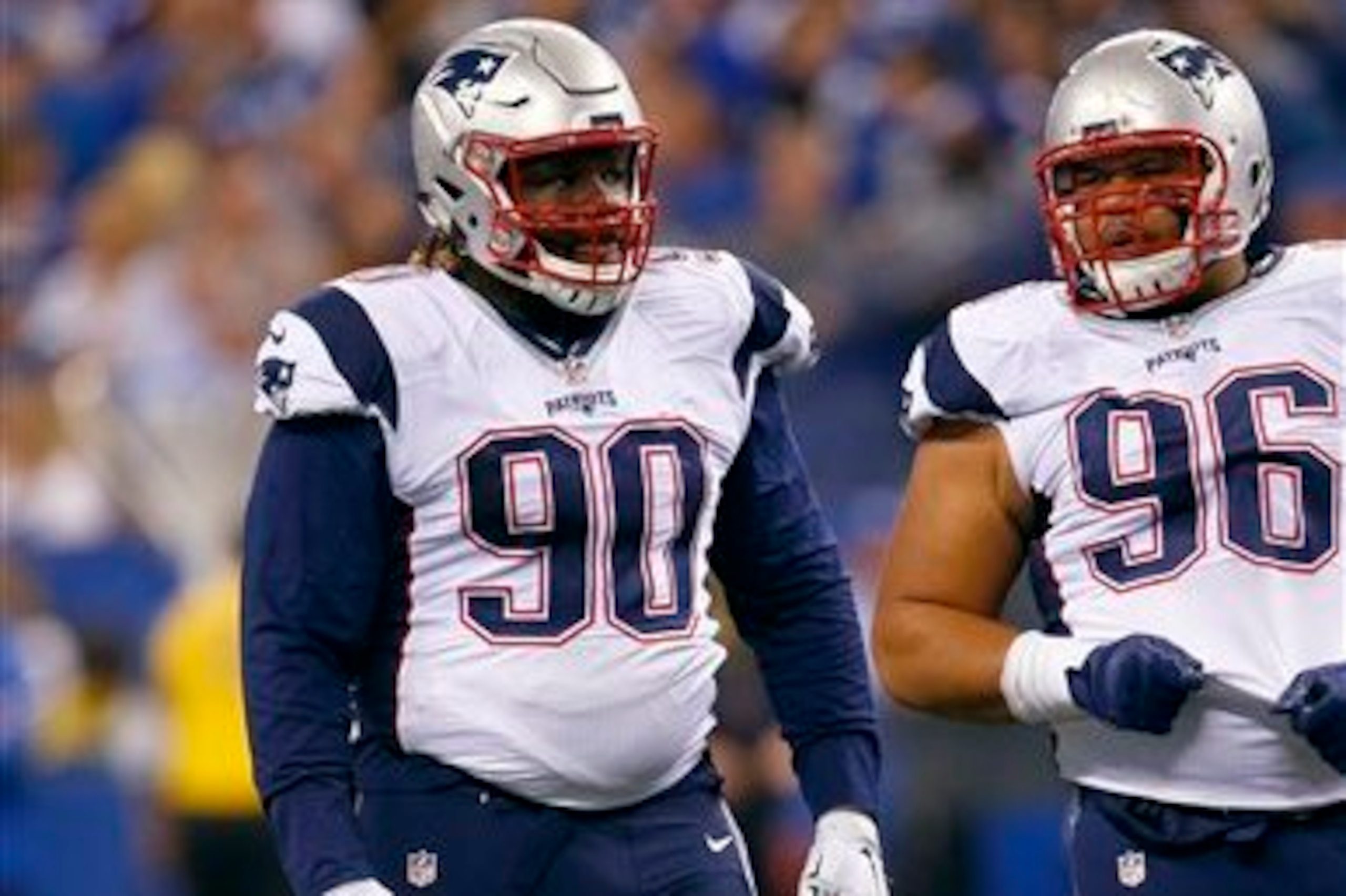
Yet, one week earlier against an Indianapolis Colts team led by star quarterback Andrew Luck, New England played interior pass-rusher Dominique Easley more often, according to Reiss.
This is the kind of flexibility and production the Redskins need from their defensive line rotation.
Knighton called the group "Capital Punishment" this offseason, during an interview on ESPN Sports Nation (h/t Scott Allen of the Washington Post). Gruden expected the new-look line to "set the tone" for a formidable defense, as noted by the Post's Mike Jones.
So far this season, though, there's been too much talk and not enough action from Washington's revamped D-line.
Statistics and player information via NFL.com, unless otherwise stated.
.jpg?w=2560 "Hall of Fame Football")