How Blake Bortles Can Become Jaguars' Franchise Quarterback
The light at the end of the tunnel didn't move closer for the Jacksonville Jaguars last season.
Entering the second year of Gus Bradley and Dave Caldwell's reign in Florida, the Jaguars were hoping to be a more competitive team. Combining proven veterans and young talent was supposed to infuse the roster with a greater competitive edge, even though they were still some distance from contending.
Instead of taking a step forward, the Jaguars dropped further behind in the win-loss column. Bradley's team won just three games after winning four during his first season.
.jpg?w=2560 "49ers Football")
Wins are important, but the idea that they are reflective of growth from season to season is unfounded. It would have been encouraging for the franchise if they could have won five games or more for the first time since 2011, but it wouldn't have offered anything tangible for the team moving forward.
Teams fluctuate from winning to losing in the NFL with great regularity. What is more stable, when measured annually, is individuals' growth and development. For rebuilding teams, individual performances from foundation pieces can be more meaningful moving forward.
For the Jaguars, that shines the spotlight on quarterback Blake Bortles.
Bortles was the third overall pick of the 2014 draft. The first quarterback taken, ahead of Johnny Manziel, Teddy Bridgewater and Derek Carr. Bortles played college football at Central Florida, where he accumulated 3,581 yards, with 25 touchdowns and nine interceptions, during his final season.
It came as a surprise when the Jaguars selected Bortles. They hadn't been noticeably linked with the quarterback leading up to the draft, and he wasn't widely considered the top quarterback option or even a consensus top-10 pick.
The Jaguars drafted Bortles because of what he could become rather than what he was at the time, though. His large frame, athleticism and arm strength were appealing for obvious reasons. Those traits came with inconsistent mechanics and decision-making, though, so his new franchise wasn't rushing to start him.
In fact, Caldwell, the team's general manager, told ESPN's Mike & Mike radio show (via Mike Wilkening of Pro Football Talk) that their goal was to sit Bortles behind Chad Henne until 2015.
"To be honest with you, probably 2015 [is when we'd like Blake Bortles to start]. We’d like to give Chad this whole year. [Bortles] has some development to do. [Our goal is to] really kind of get [Bortles] ready so come 2015, he’s ready to compete for that spot.”
Not once during the offseason did any of the Jaguars' major decision-makers waver from that stance publicly. They even resisted the urge to open a competition between Bortles and Henne during the preseason, when the rookie was clearly outperforming his new teammate.
Once the real games began, the temptation to break out Bortles became too strong.
Henne started the first two games of the season. The Jaguars lost both. He was handicapping the offense, while the defense was being overwhelmed, giving up a total of 75 points. When Bortles was inserted into the Week 3 matchup with the Indianapolis Colts, he flashed signs of his potential.
They were signs that eventually pushed the resolve of the Jaguars coaching staff past its breaking point. Whether Bortles should or shouldn't have stayed on the sidelines is unclear. There is no actual method to measure which approach works better for each individual player.
With that in mind, it's tough to blame the Jaguars for scrapping their original plan. In hindsight, though, it was clear that Bortles wasn't ready to be an NFL starter.
He had flashes of positive play. He made precision-touch throws through tight coverage windows that required timing and anticipation. He showed awareness in the pocket to alter his footwork and sense pressure while keeping his eyes downfield. He had outstanding physical attributes.
Yet, most of those positives were drowned in a sea of negatives. Bortles' only truly consistent positives for Bortles were his athleticism and eye level.
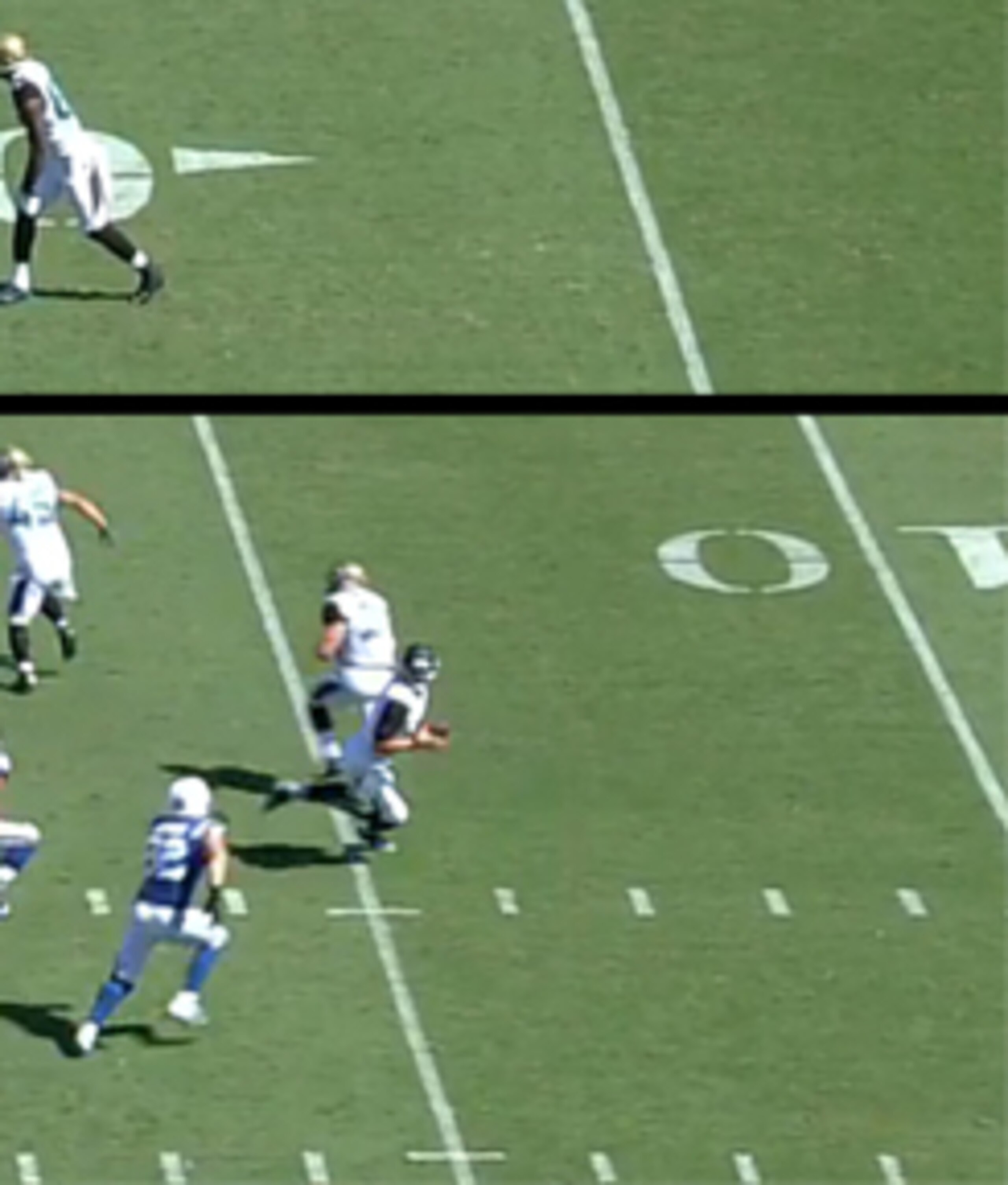
Arguably the most impressive play from his entire rookie season came during that debut performance against the Colts. The Colts defense blitzes off the backside of this play. That is the worst possible defensive call for the Jaguars because they are running a hard play action to that side of the field.
Once Bortles turns around after the play fake, he is confronted by two unblocked defenders.

Neither of the Colts defenders closing on Bortles are great athletes, but both have favorable positions on the quarterback. The rookie passer is able to quickly recognize this and pivot so that he can accelerate back across the field.
Once he has turned his head back toward the line of scrimmage, he is able to survey the coverage downfield to locate an open receiver. Most quarterbacks drop their eyes in this situation.
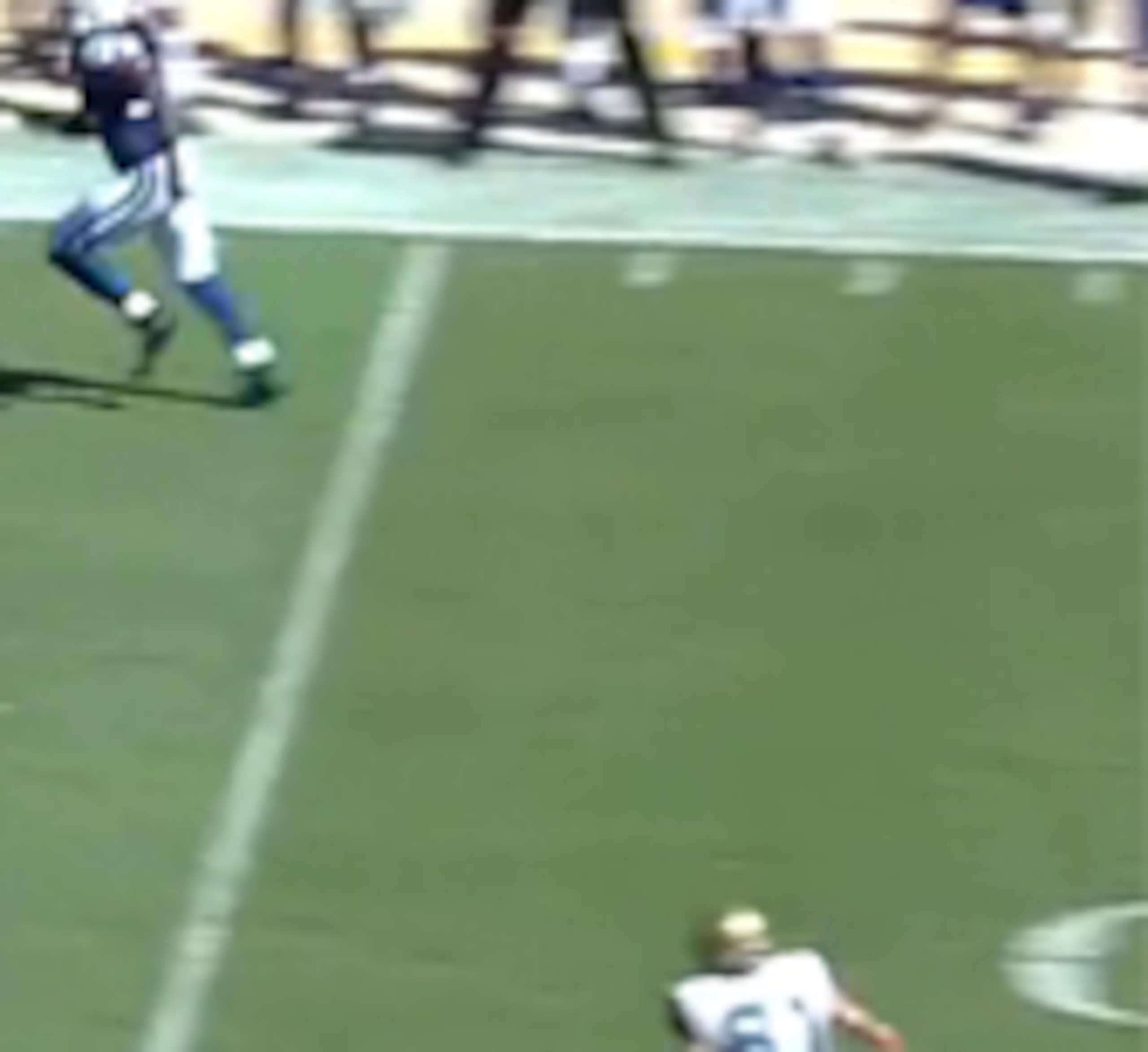
Because the play was designed to work to the other side of the field with its receivers, the coverage has been drawn away from where Bortles is looking. His only option downfield is a fullback, but that fullback is wide-open.
Bortles steadies himself, even though he doesn't come to a complete stop. He throws with his feet and shoulders square to his target, so he delivers an accurate ball downfield.
This play was about instinct and athleticism more than anything else. There are different ways of using athleticism to extend plays. Sometimes it's about adjusting quickly as everything around you breaks down, but other times it's about showing poise and patience, understanding what time you do have.

On this play against the Dallas Cowboys later in the year, Bortles runs a similar play-action pass design to the one that failed to work against the Colts. This time Bortles is able to get outside comfortably, but one unblocked edge defender is in immediate pursuit.
The defender doesn't have an angle to disrupt Bortles, but the quarterback needs to accelerate if he wants to throw from a completely comfortable position.
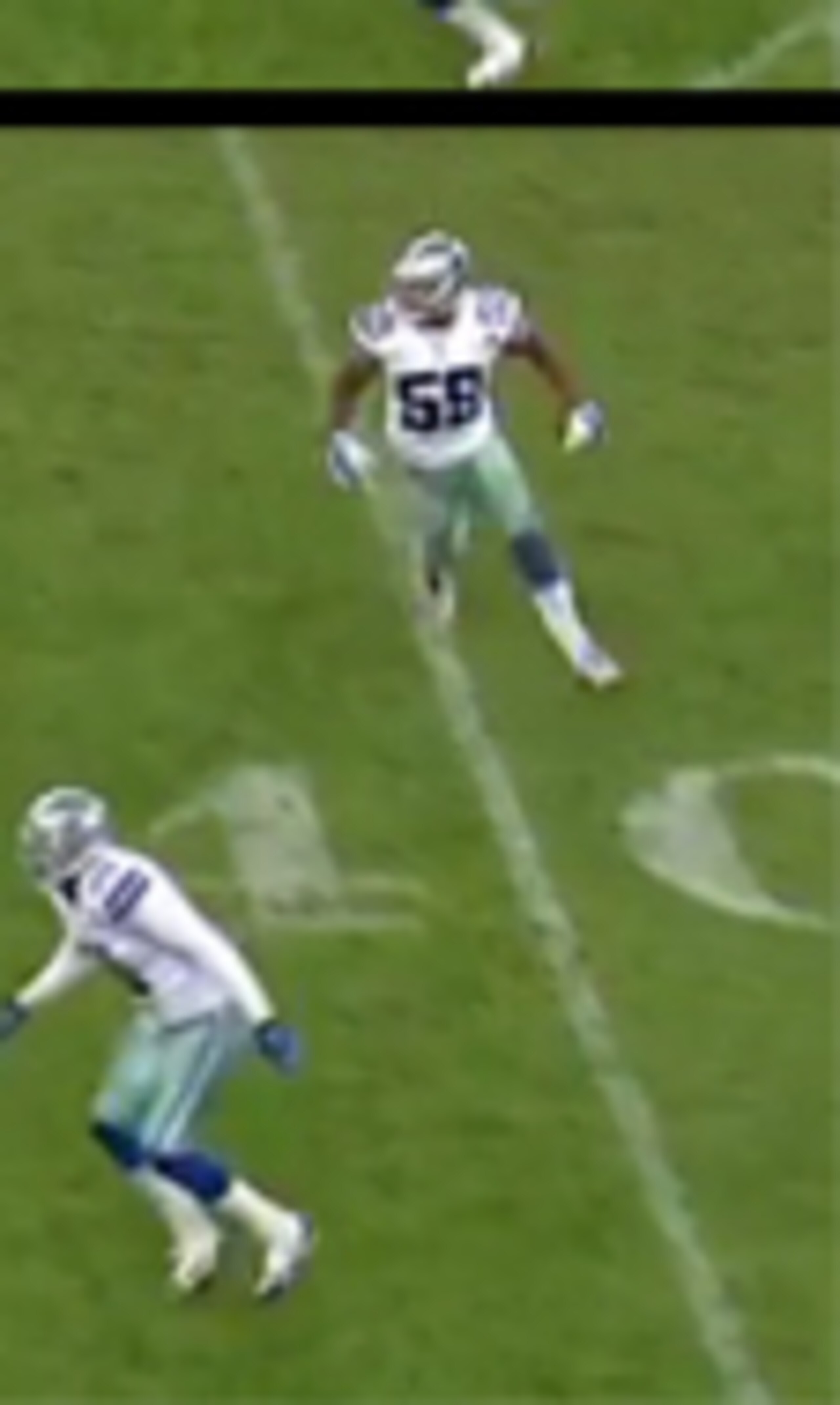
Accelerating initially allowed Bortles to get to a spot where he could slow down to a trot while surveying the coverage downfield. He has an immediate option available underneath, but with two defenders closing on the receiver, the play is unlikely to gain more than a one- or two-yard gain.
Bortles didn't rush to get rid of the ball, even though he had a pursuing defender and a safe completion underneath.

Instead he showed patience and a willingness to advance closer to the sideline before looking back infield to a receiver who adjusted his route as the play was extended. Bortles makes an accurate, safe throw back across his body for a first down and a big gain.
Although that patience and eye level is understated, it's vitally important for creating big plays downfield. It buys his receivers time and punishes defensive backs who can't sustain their discipline further than what is typical for passing plays.
These kinds of plays are attractive to any quarterback. They further the Ben Roethlisberger comparisons that are inevitable for a player of Bortles' physical stature and appearance. However, they are not plays that you can build an offense around.
Roethlisberger could survive playing this way because he has often played with a great defense, and he has been consistently competent from the pocket.
His big-play ability outside of the pocket has always stood out, but it's largely on complementary plays, plays that would occur no more than three or four times per game. In recent years, Roethlisberger's accuracy, intelligence and awareness in the pocket has improved, but he has always been a well-rounded quarterback.
Bortles' willingness to set his feet and square his shoulders consistently outside of the pocket is frustrating because those are habits he abandons within the pocket, whether there is pressure or not.
Focusing on a quarterback's minor mechanical issues can lead to poor analysis because it focuses on the smaller details instead of the whole package. A quarterback such as Philip Rivers doesn't have perfect mechanics, but that doesn't affect how he plays. Bortles' mechanics definitely affect how he plays.
This chart tracks Bortles' accuracy during his rookie season.

The chart doesn't include throwaways, spikes or passes batted down at the line of scrimmage. Whether passes were completed or not was irrelevant; this chart focused purely on accuracy so ball placement was prioritized over the play's result.
Of Bortles' qualifying throws, 306 were considered accurate, while 140 were considered inaccurate. That is an accuracy percentage of 68.6 percent.
However, when you consider where those passes were going, that percentage's perception should be negatively affected. Despite his obvious arm talent, Bortles couldn't throw the ball downfield as a rookie. This wasn't a case of his receivers being incapable of separating either.
Mechanics have a greater impact on throws the further the ball has to travel. Without the balance that comes with set feet or the control that comes with a compact motion, minor inaccuracies become major inaccuracies.
For as impressive as Bortles looks when he completes passes downfield, his efficiency is so bad that it hinders the whole offense's effectiveness. Arm strength is a desirable trait, but it's worthless if it goes unharnessed.
Bortles has reportedly been working on his throwing motion this offseason.
Working on your throwing motion during the offseason is obviously a positive, but it can often be meaningless. It will be meaningless if Bortles' instincts lead him back to throwing the ball recklessly when faced with pressure. Pressure spooked him too often in 2014.

On this play against the Cleveland Browns, the defense is threatening to blitz at the snap, with double A-gap pressure, three defensive linemen with their hands on the ground and one approaching edge defender. Bortles doesn't have a running back in the backfield to threaten a run or act as an extra blocker.
Ultimately, it didn't matter that Bortles didn't have an extra blocker. The Browns were trying to confuse the rookie quarterback with their pre-snap alignment. As it often did last year, that worked.
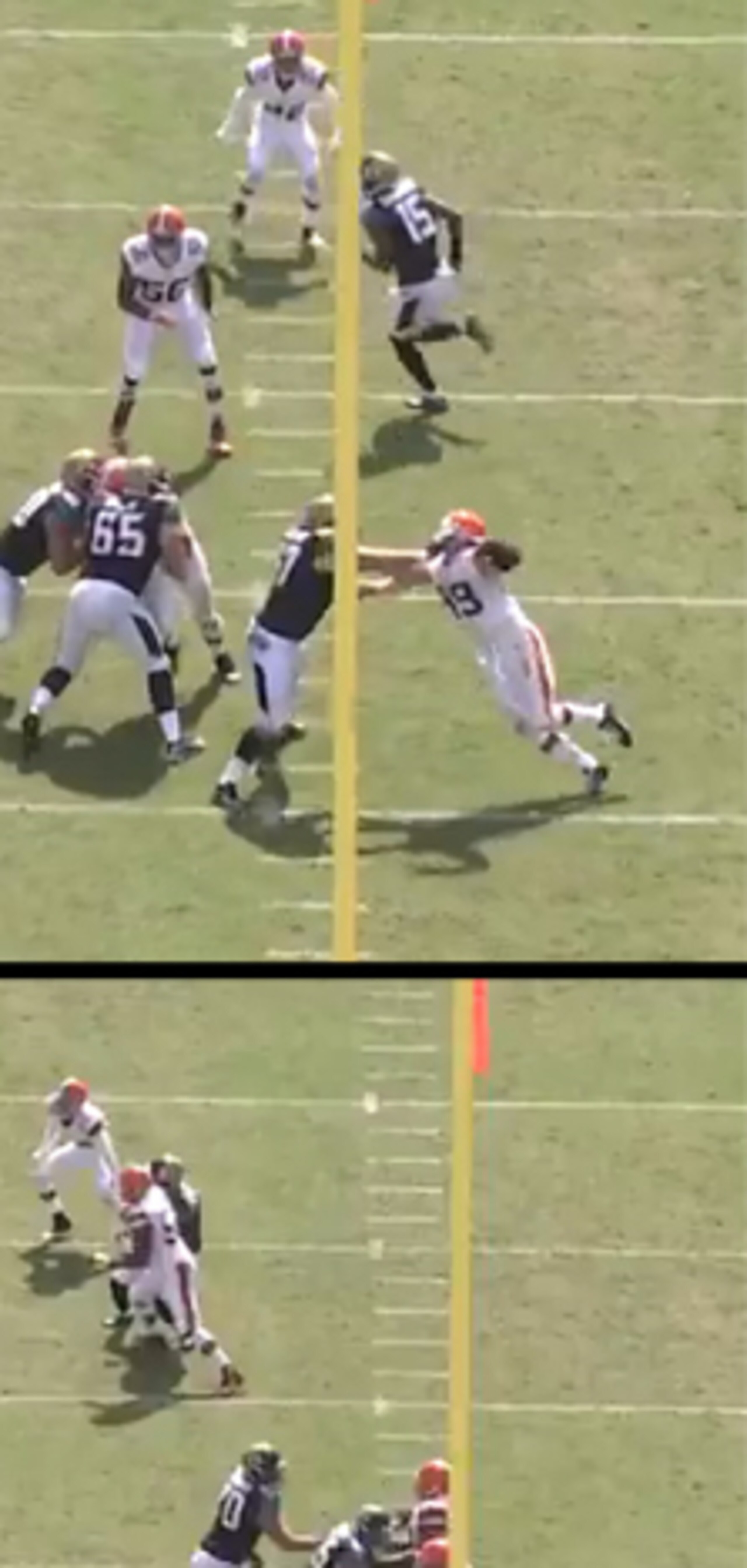
The Browns only rushed four defenders, and Bortles locked into his first read to force the ball out quicker than he needed to. Denard Robinson was running a route from the slot that safety Tashaun Gipson jumped from off coverage.
Bortles never had a chance of getting this ball to Robinson by throwing the ball ahead of him. He needed to fire it to the running back's back shoulder if he was fully committed to this route.
Even though the Browns didn't rush, Bortles put himself under pressure by forcing a quick throw. He threw the ball flat-footed, while his momentum was pulling him backward. His front arm was pushed away from his body in some sort of desperate move to maintain his balance.
Instead of forcing a throw from the worst possible body position he could have thrown the ball, Bortles ideally would have slid to his right where there was a clean pocket.
Throwing over the middle of the field is something that former offensive coordinator Jedd Fisch made a concentrated effort to avoid. His offense focused on simpler, safer outside throws that Bortles was more likely to diagnose correctly at this stage of his career.
When he tried to throw over the middle of the field, defensive backs were able to break on the ball more easily because of his mechanics. His poor footwork caused his passes to flutter off course, while his elongated throwing motion invites pressure and makes it easier for defensive linemen to knock down his pass attempts.
It's safe to assume that Bortles' athleticism and eye level will remain consistent moving forward. It's likely that he will become a smarter quarterback who isn't so easily manipulated by opposing defenders.
Whether he corrects his throwing motion and becomes an accurate passer is less clear. It's something that must happen if he is to ever become the team's franchise quarterback. Inaccurate passers in the NFL struggle to earn backup roles, never-mind becoming long-term starters.
At this stage of his career, Bortles is a relative unknown.
Reading too much into his rookie displays can lead to too strong of a dismissal, but they also highlight just how far away he is from competence and why the Jaguars likely regret forcing him into the starting lineup.
.jpg?w=2560 "Grading WWE Raw 🔠")