What to Expect from New England Patriots Pass Rush and Pass Defense in 2015
Although there's certainly more than one way to build a great NFL defense, every unit needs an ace in the hole to lean on in a game plan.
For the New England Patriots, that responsibility will fall on the front seven in 2015, as Bill Belichick has attempted to offset personnel losses in the secondary by beefing up the trenches this offseason.
However, that switch isn't the byproduct of a single offseason but rather multiple years of quietly heavy investment.
.jpg?w=2560 "Cowboys Rams Camp Football")
.jpg?w=2560 "Patriots Moves Football")

Since 2012, the Patriots have spent 13 draft picks on defensive linemen or linebackers, including four first-rounders and seven in the first three rounds. It's not hard to see where New England has chosen to build its foundation, and without the likes of Darrelle Revis and Brandon Browner to support them on the back end, it is also time for that talent to mature.
Right now, it's impossible to judge how the unit will coalesce as a whole, especially when considering the importance of unknown commodities like Dominique Easley and Malcom Brown. And that's to say nothing of the secondary, whose starting cornerbacks are a mystery at this time.
But based on how the Pats have schemed and performed under similar circumstances in the past, we can begin to see an outline of how New England might approach its pass defense in 2015.
Biggest Strengths
Technique Versatility

Interchangeability is huge for any Belichick defense. That applies doubly to the front seven, which has morphed from a power-oriented 3-4 two-gap scheme into a hybrid scheme that incorporates one- and two-gapping principles on the majority of plays.
For such a scheme to work, a defensive line needs a wide range of skill sets and athletic players capable of handling multiple roles, often within a single drive. The Patriots have accumulated lots of "in-and-out" edge defenders, players capable of rushing the passer from either an inside or outside defensive technique, providing them with a drool-worthy plethora of possibilities in sub-packages.
One wrinkle I'll be tracking is the possibility of Chandler Jones' receiving more rush opportunities against interior offensive linemen. As discussed before, Jones' 35.5-inch arms are tough enough for tackles to deal with, let alone smaller guards. That combination of length and explosiveness has made Jones dangerous in the limited opportunities he's received at the 3-technique.
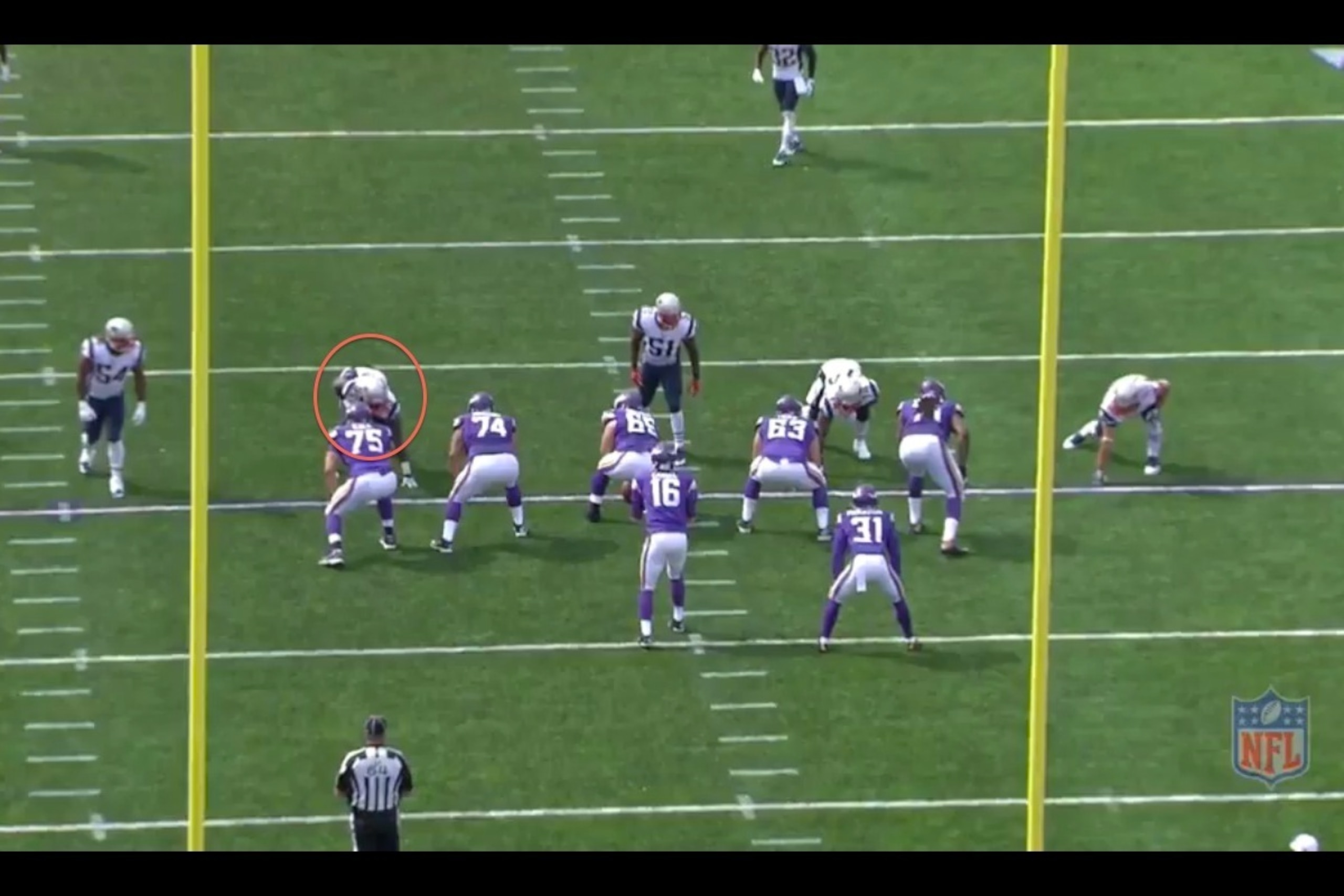

Jones demands double-teams in such situations, as a late shove in the above screenshot from Matt Kalil barely helped to prevent a sack. More importantly, shifting Jones inside more might let free-agent acquisition Jabaal Sheard return to his roots as a 4-3 defensive end, where he compiled 15.5 sacks over his first two seasons in Cleveland.
Sheard's pass-rushing potential has many Patriots fans excited, but in reality he brought plenty of value as a run-stuffer as well, as evidenced by his 19 total Approximate Value units in his first two seasons, according to Pro-Football-Reference.com. Since 2000, only eight players have compiled at least 15.5 sacks and 19 AV in their first two seasons:
| Clay Matthews | 23.5 | 30 |
| J.J. Watt | 26 | 30 |
| Von Miller | 30 | 29 |
| Shawne Merriman | 27 | 19 |
| Brian Orakpo | 19.5 | 19 |
| Jabaal Sheard | 15.5 | 19 |
| Corey Simon | 17 | 19 |
| DeMarcus Ware | 19.5 | 19 |
Needless to say, that's an extremely impressive list, with a combined 25 Pro Bowl appearances and 13 All-Pro selections between them.
Sheard has not blossomed into that type of player, but with his signing, the Pats now boast three edge defenders with three-down capabilities (Sheard, Jones, Rob Ninkovich). That's a rare haul which should not only keep each player fresh but also provide Belichick with more versatility in how he likes to deploy his defensive linemen.
That trio should represent the cornerstone of New England's pass-rushing efforts, but one more player to keep an eye on might be second-year player Zach Moore. The former Division II standout was drafted as a defensive end, but having bulked up to 275 pounds, there have been reports of the Patriots' moving the sixth-round selection to more of an interior role:
Moore doesn't possess nearly the length of Jones (33.75"), but still presents an athletic mismatch against most interior linemen. If the Patriots rotate more liberally along the line and cap their starters at roughly 70 percent snaps, that could open the door for Moore to carve out a much more substantial role than what he played last season.
Keep an eye on the Roy Hibbert lookalike this training camp to see if he sticks at defensive tackle, as he should have the size to play the 5-technique and the explosiveness to play the more glamorous 3-tech.
Blitz Schemes
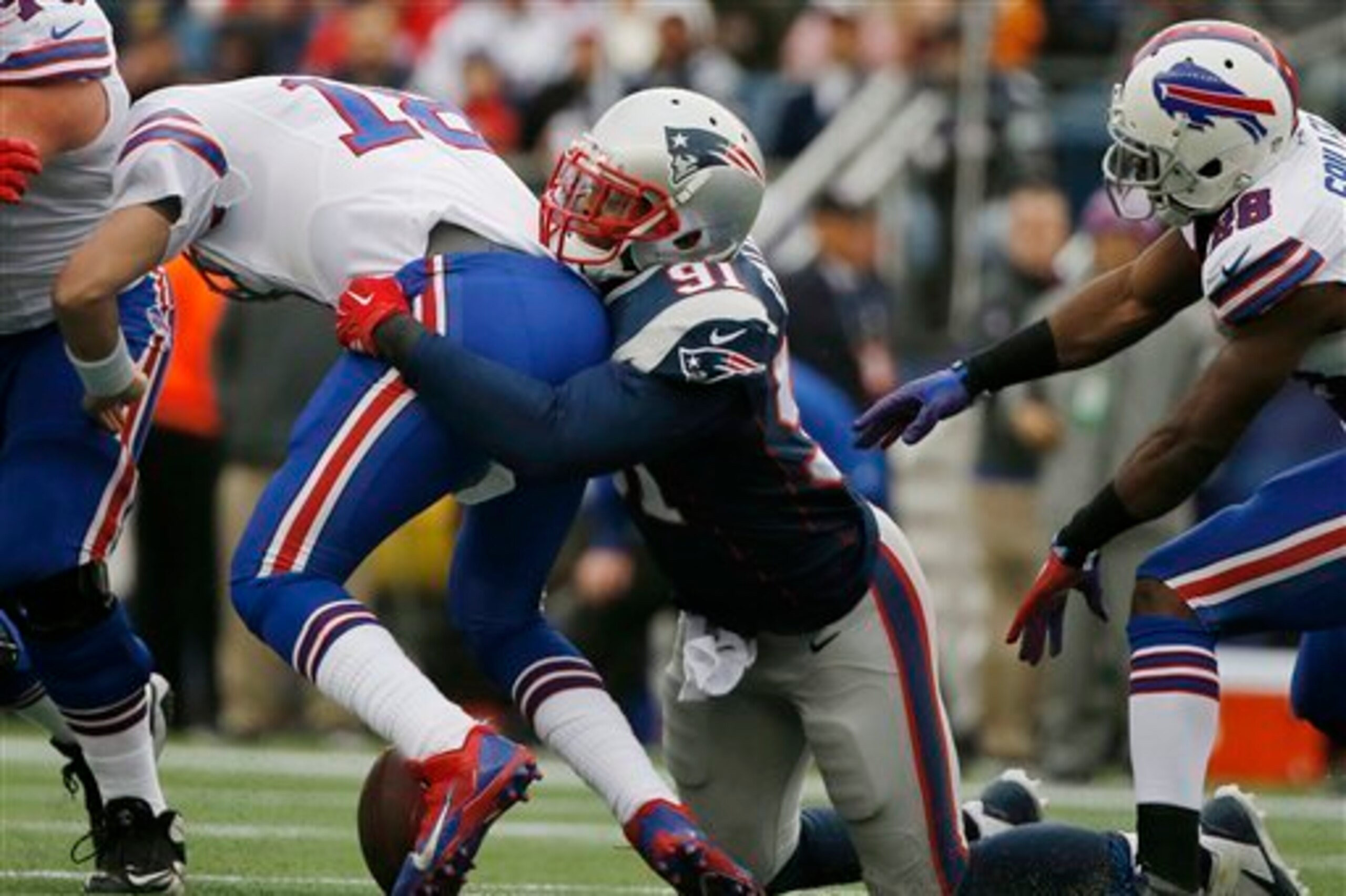
The Patriots weren't a particularly heavy blitzing team, but when they did send extra rushers, the results were typically effective. Jamie Collins and Dont'a Hightower emerged as significant double-A-gap blitz threats, a pre-snap look that the Patriots grew to rely upon by the latter half of the season.
Before the Super Bowl, Grantland and Smart Football film savant Chris Brown illustrated a read concept Belichick uses as a staple of his defense. Blitzing is all about creating an unanticipated numbers advantage on one side of the formation, and New England has one particular blitz look that prevents offenses from sliding extra blockers toward the rush:
"Today’s offenses are nimble enough to redirect their pass protection schemes toward the most likely blitzers at the line. Belichick, however, enables his defenders to regain the advantage by teaching them to read the offense, specifically the center. For example, Belichick frequently calls blitzes with potential rushers lined up to the offense’s left and right, with each reading the center’s movement. If the center slides toward the keyed defender, he drops into coverage, and if the center slides away from the keyed defender, he turns kamikaze and blitzes the quarterback.
"
Brown uses an example from the Patriots' Week 16 win over the New York Jets, a Hightower sack that helped preserve a one-point fourth-quarter lead. However, there were numerous examples of the Patriots' disguising double-A-gap pressure to scramble protection calls:
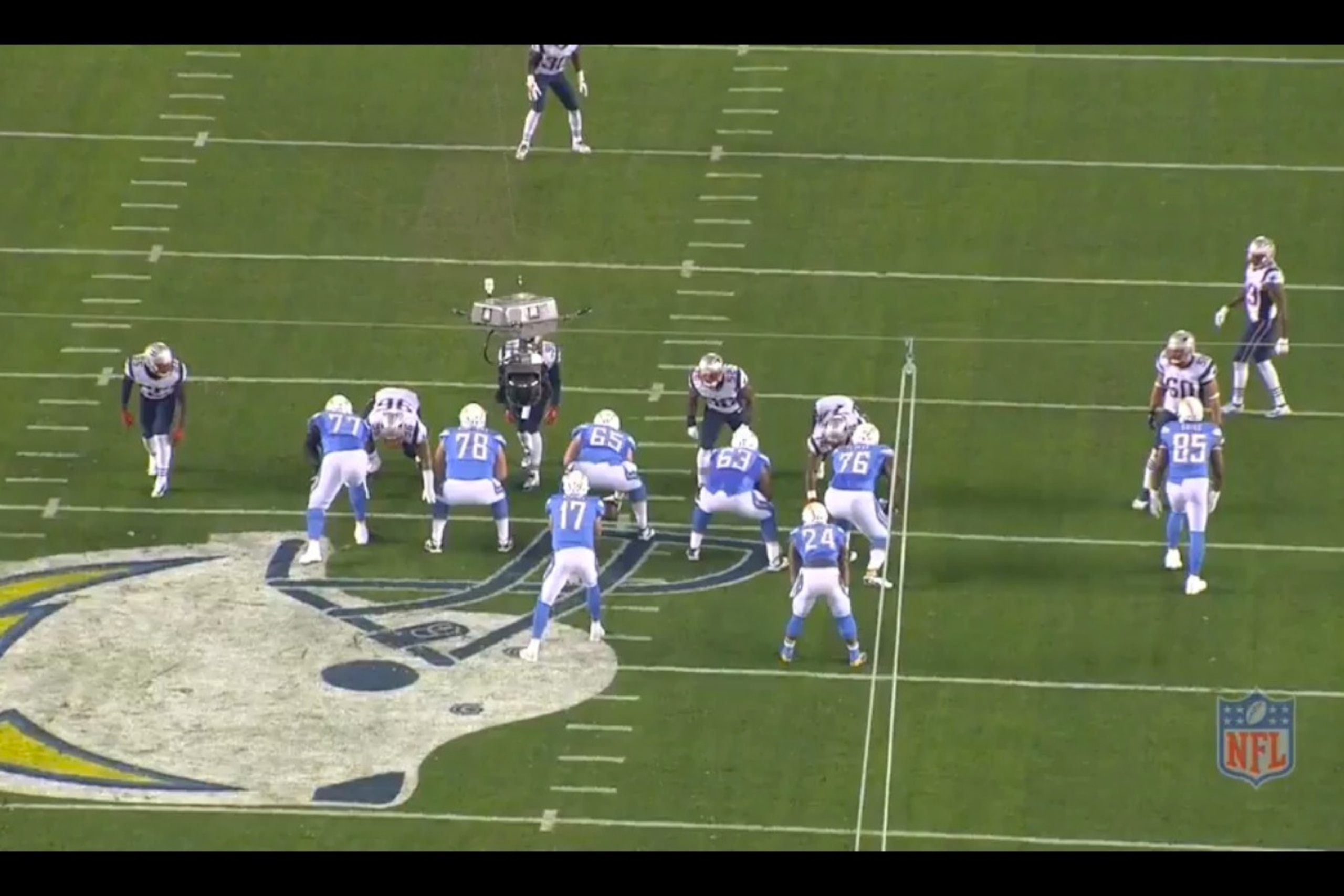
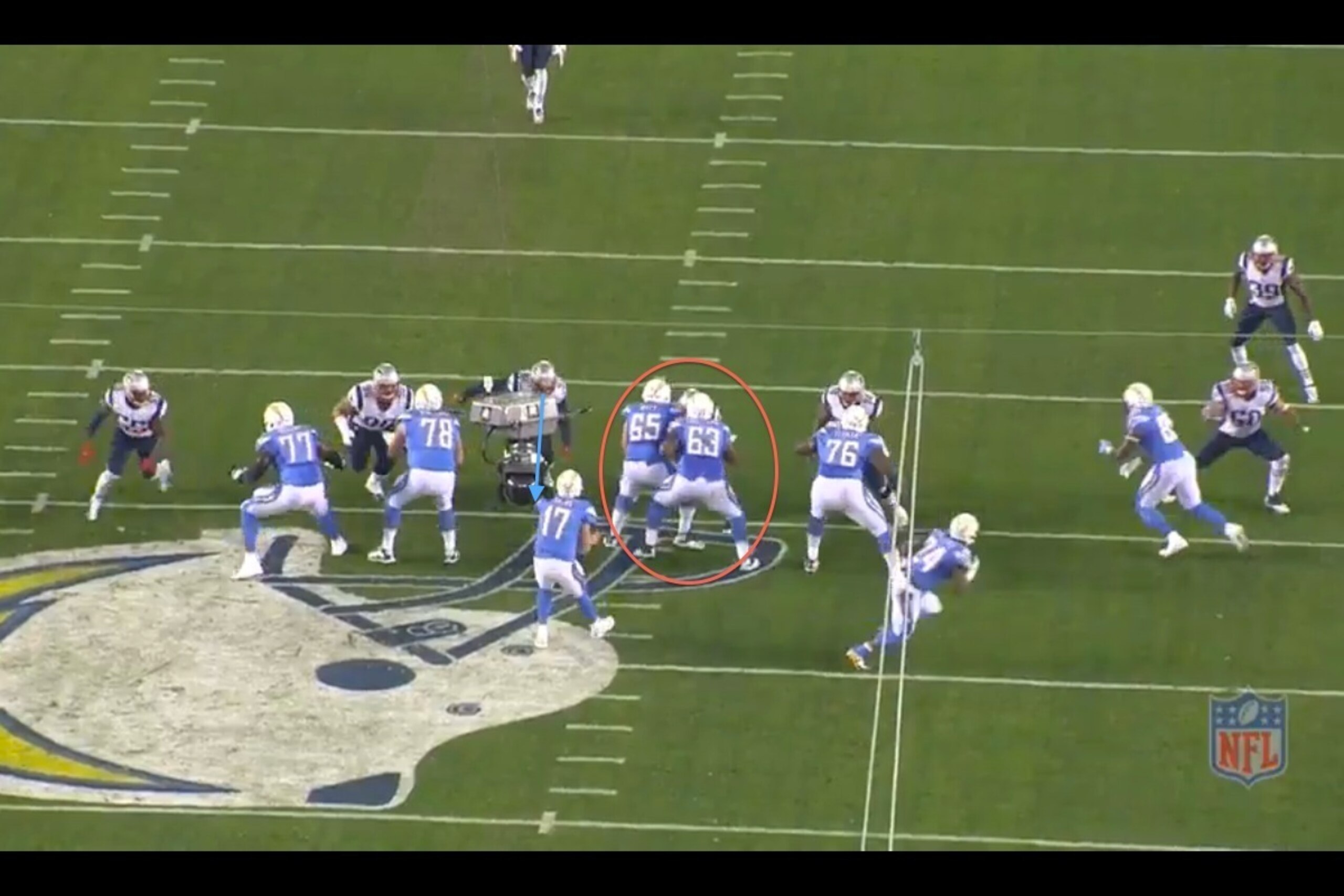
The San Diego Chargers' miscommunication is probably more to blame here, as five linemen shouldn't have issues picking up five rushers. But when centers face stress from both sides, the guards on either side also need to check the linebackers before setting into their protection.
That kind of doubt can create positive domino effects for the pass defense as a whole, whether it's an edge defender getting a one-on-one opportunity or a running back getting audibled in to block and thereby removing a receiver from the equation.
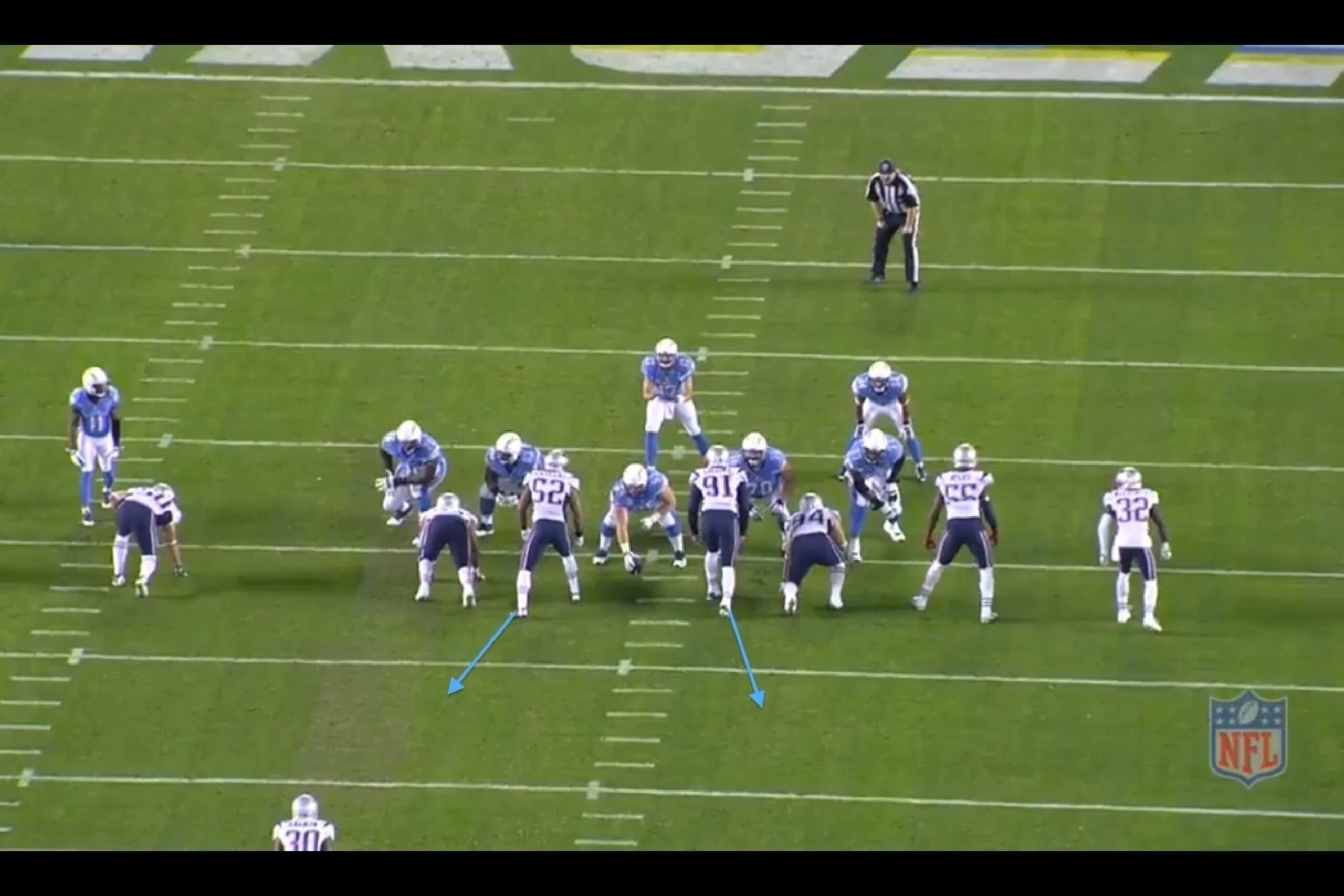
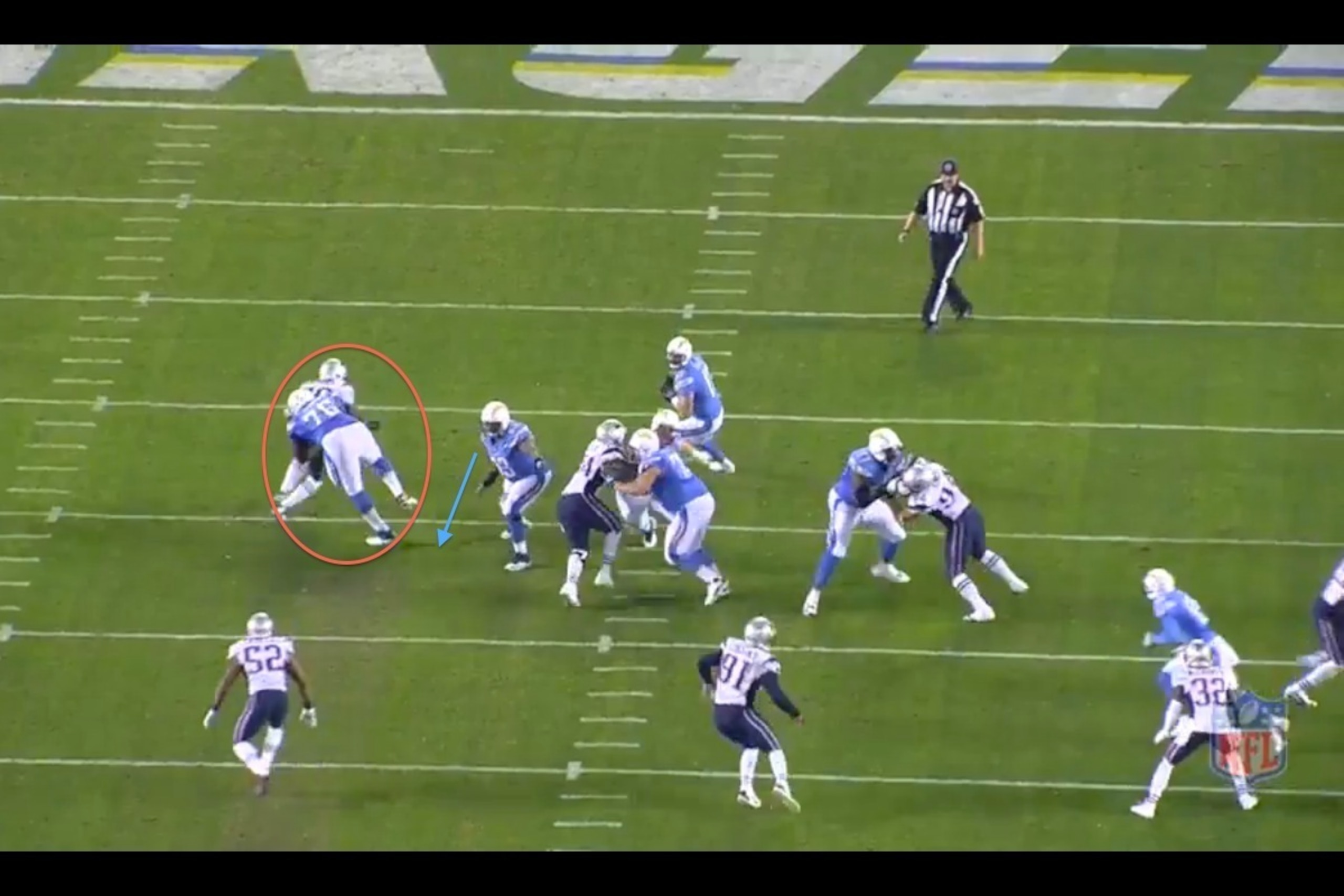

The above example is from a later drive in the same Week 14 contest. Instead of blitzing, both linebackers drop back into coverage, leaving the Pats with a meager three-man rush. However, because the guards are occupied by the threat of the A-gap blitz, San Diego essentially has three blockers on defensive tackle Dominique Easley.
Consequently, the right guard is unable to check Rob Ninkovich when he beats D.J. Fluker around the corner, allowing Ninkovich to take down Philip Rivers short of the markers on third down.
The Patriots' newfound depth and versatility, as discussed in the previous section, should only augment these blitz calls to produce similarly productive pressure results in 2015.
More blitz calls might also complement off-coverage from the defensive backs, if the Patriots do indeed move away from press concepts. The expectation of immediate pressure can allow corners to play with a "flat foot read," keeping routes in front of them and allowing them to drive downhill rather than try to mirror receivers and read route concepts.
That's only a theory, of course, and Belichick has never been a big disguise-and-blitz guy, a la Rob Ryan or Todd Bowles. However, it's also arguable that he's never had a Patriots defense with this large a talent disparity between the pass-rushers and defensive backs.
Blitzing by its nature is more of a changeup call, but with more talent at his disposal, perhaps Belichick will be more inclined to give opposing offensive lines different looks to protect his secondary.
Biggest Weaknesses
Perimeter Defense
One advantage this defense holds over the dreadful units from 2009-11 is its coverage strength between the hash marks. Jamie Collins and Devin McCourty should provide no worse than above-average coverage up the middle of the field, as both possess plus instincts and range.
On the perimeter, however, the 2015 Pats could bear an unwelcome resemblance to those beleaguered units.
According to ESPN Boston's Mike Reiss, Logan Ryan and Bradley Fletcher have received the majority of the first-team OTA reps on the outside. Second-year pro Malcolm Butler could still displace one of those starters, but having sat out OTAs thus far, Butler is losing valuable reps in what figures to be a different coverage scheme.
Football Outsiders' Andrew Healy recently penned an analysis on the site's cornerback charting stats from 2014, and Ryan and Fletcher were each among the worst corners when factoring adjusted yards per pass and adjusted success rate into a formula called "corner index."
Based on Healy's corner index, Fletcher finished 25th of 32 corners who primarily covered No. 1 receivers, while Ryan finished 33rd of 45 corners who primarily covered other receivers.
That doesn't necessarily have to translate to 2015, and if you click on the link, you'll see that both Ryan and Fletcher fared better in adjusted success rate than adjusted yards per attempt. This would suggest that some of the completions they conceded led to junk yardage that didn't necessarily result in a successful play for the offense.
We shouldn't stretch that assertion too far since neither was great in 2014, but both have shown more promising flashes of capable No. 2 cornerback play in the past. However, offenses can also target Ryan, Fletcher or any other perimeter corner the Patriots have through isolation concepts outside the numbers.
We saw this at times over the first six weeks last season, when Brandon Browner was on the sidelines due to suspension and injury. No amount of support can cover up a player who simply doesn't consistently win one-on-one situations:


When faced with subpar corners in the past, Belchick has typically erred on the conservative side, giving up these types of intermediate curls and comebacks in favor of eliminating the huge chunk plays.
Considering New England's strength at safety, it looks like the Patriots could be prepared to play plenty of Quarters and Cover 2 schemes that allow the corners to gain depth and receive help over the top from their safeties.
Such coverage could also allow patient offenses to take high-percentage throws underneath without much resistance.
It's obviously speculation to assume what specific type of coverage the Patriots will lean on, but it's also safe to assert that they won't suffocate receivers in one-on-ones outside the numbers like they did with Revis and Browner last year.
Fourth Quarters
Unlike cornerback, this is more of a "show me" weakness than an expectation that the Patriots will struggle here.
New England's plus-106 fourth-quarter point differential last season did rank 11th-best in the league during the regular season, according to Pro-Football-Reference. In recent seasons, however, the pass rush has dried up near the end of games, which has had a deleterious effect on the pass defense as a whole.
It might seem strange to single out the rush after raving about New England's defensive line versatility, and perhaps the additional depth gooses overall productivity. However, strength in numbers doesn't change the fact that Jones and Ninkovich have sacrificed pass-rushing productivity to play grueling three-down roles.
Including those two, defensive ends accounted for only 14.5 of New England's 40 sacks last season, a reflection of how the primary rushers have worn down in fourth quarters.
Since 2012, when Jones and Ninkovich became starters on the edge, the Patriots have been a poor pass-rushing team in the fourth quarter. Interestingly, New England has been even worse in terms of sack percentage in the second quarter, suggesting a potential fatigue-at-end-of-halves hypothesis, in effect:
| 1st Quarter | 6.84% | 11th |
| 2nd Quarter | 5.58% | 25th |
| 3rd Quarter | 7.73% | 8th |
| 4th Quarter/OT | 6.45% | 22nd |
That's not necessarily unique to the Patriots; sack percentages as a whole are down at the end of halves across the league. However, New England's splits are a fairly telling pattern considering the large three-season sample size.
Until we actually see a definitive rotation that keeps the snap counts down for Jones and Ninkovich, this remains a legitimate concern with a solution that exists only in theory.
The more troubling trend is New England's tendency to also give up longer completions in the second half. The yards per completion don't necessarily correlate with the sack rate, but they do illustrate how the secondary hasn't been able to compensate whenever the pass rush has dried up.
Whether you want to pin the blame on the rush or secondary (or more accurately, a combination of both), the second-half decline has been a legitimate concern the past three seasons:
| 1st Quarter | 12.38 | 30th |
| 2nd Quarter | 11.12 | 10th |
| 3rd Quarter | 13.32 | 30th |
| 4th Quarter/OT | 12.24 | 25th |
Given the secondary downgrades, we should expect a stronger correlation between pass rush and overall defensive performance 2015. It can be dangerous for a team to rely so heavily on even the most potent pass rushes. After all, an important factor in New England's Super Bowl win was the Cliff Avril injury, which robbed the Seattle Seahawks of a crucial pass-rusher and allowed Tom Brady more time to pick apart an injury-riddled secondary.
The Patriots have been an unusually great team in one-score games, but that's been more the result of Tom Brady's brilliance and some fortunate situational breaks than the pass defense specifically.
For all the depth and high-ceiling potential littered throughout this defense, the unit's ability to close out games is a deceptively underrated issue to watch for when the regular season begins.
Sterling Xie is a Patriots Featured Columnist whose work has also appeared on Football Outsiders and Advanced Football Analytics. Sterling is a co-author of the Football Outsiders Almanac 2015, coming out mid-July.
.jpg?w=2560 "Vikings Camp Football")
.jpg?w=2560 "Browns Camp Football")