Chasing 1,000: The NBA's 3-Point Revolution Has Only Just Begun
The Houston Rockets set an NBA record by making 933 three-point shots this season, a mark that, for now, represents the pinnacle of NBA long-range prowess.
But as the league-wide reliance on the three-point shot continues to skyrocket, that mark will someday be nothing more than a signpost—blown by at 100 miles per hour on the road to a total three-point takeover.
With the way things have gone in the last decade, and more notably in the last five years, there's no reason to believe the Rockets' record will survive past the 2015-16 season.
TOP NEWS

Duren Calls Out 'False' Rumors

Pic of LeBron's Helicopter Commute 🚁

NBA Power Rankings Entering Preseason 🔢
Some team will drill 1,000 treys next year.
And that'll be wildly impressive, even surreal...until some team makes 1,200 or 1,500 or 2,000 in the coming seasons.
The three-point revolution is real, and the Rockets' record is just the start.
Trending Up
The best way to illustrate the league's upward trend in treys is to throw all the data into a chart:
As you can see, triple tries increased steadily from 2004 to 2007 before leveling off for three straight years. In 2011-12, we saw a pronounced spike.
It's hard to know what precipitated the most recent surge (maybe the lockout gave everyone more time to think about optimal scoring strategies), but the rise in three-point attempts since that shortened season has been striking.
If you go all the way back to the beginning, when the NBA instituted the three-point line in 1979-80, the extent of the game's metamorphosis is even more incredible. That year, the average team attempted 2.8 threes per game.
In 2014-15, 107 individual players attempted at least 2.8 threes per game.
If you isolate the 30 highest single-season team totals for three-point attempts, something remarkable jumps out of the data set: A whopping 17 of those were reached in the last two years, meaning more than half of the NBA's most three-happy seasons have come since 2013-14.
And if we turn our focus back to Houston, we've never seen a team devote a percentage of its total offense to the three-point shot like it did this past year, when 39.2 percent of its shots came from beyond the arc, per SportingCharts.com.
Seven other teams took at least 30 percent of their shots from deep in 2014-15, which has never happened before.
We don't have to focus on the Rockets, or any specific team, to show threes are the future.
All we have to do is look at the league's likely MVP.
Stephen Curry broke his own record for makes in a season this year. His new mark stands at 286 made threes, and he now owns three of the top five single-season figures. Granted, Curry is an evolutionary basketball first: a point guard whose threat as an off-the-dribble gunner makes virtually any shot a statistically good one.
"I've been in the league 25 years, and I can't go back and say that anyone can shoot the ball off the dribble like Steph can," Golden State Warriors assistant coach Alvin Gentry told Ben Golliver of Sports Illustrated.
Not everybody has the ability (or unlimited leash from his coach) Curry does, but the notion that a three-point shot—almost any three-point shot, really—has a higher expected value than anything but a layup is gradually gaining acceptance.
Doing the Math
It's hard to argue the logic of a three-heavy approach. If we take this year's numbers and incorporate a quick and dirty expected-value analysis, we see that this year's league-wide average of 35 percent from long range yielded a rough expected value of 1.05 points per shot.
To get 1.05 points per shot on two-point attempts, a team would have to convert at a 52.5 percent rate. The league averaged only 48.5 percent on twos this past season.
The most basic math says threes are the way to go.
Here's a more thorough breakdown that shows how threes are easily the most sensible shots outside of point-blank looks. (Note: We're not factoring in offensive rebound frequency or any other follow-up variables like that. This is just an illustration of the value of individual shots, used as a way to emphasize the logic behind shooting as many threes as possible.)
| Average FG% | 62.8 | 38.3 | 40.3 | 39.4 | 35.0 |
| Points per Shot | 1.26 | .77 | .81 | .79 | 1.05 |
Basically, if you can't get a point-blank look, threes are the best option. Settling for in-between shots is an increasingly obvious mathematical blunder.
Of course, personnel matters. If you don't have the shooters to connect at league-average rates or better, it's probably a mistake to wildly fire away from deep. And to be fair, we've seen recent examples of teams finding ways to win without the three.
The Memphis Grizzlies closed out the Portland Trail Blazers in Game 5 of their first-round series by making just one three-pointer.
Seeing that counterexample, maybe you're dissuaded from believing the Rockets' strategy is effective enough to represent the way teams will play in the future. After all, Houston's analytics-driven model, the one that prizes threes and attempts at the rim above all else, resulted in an underwhelming No. 12 offensive rating this season, according to NBA.com.
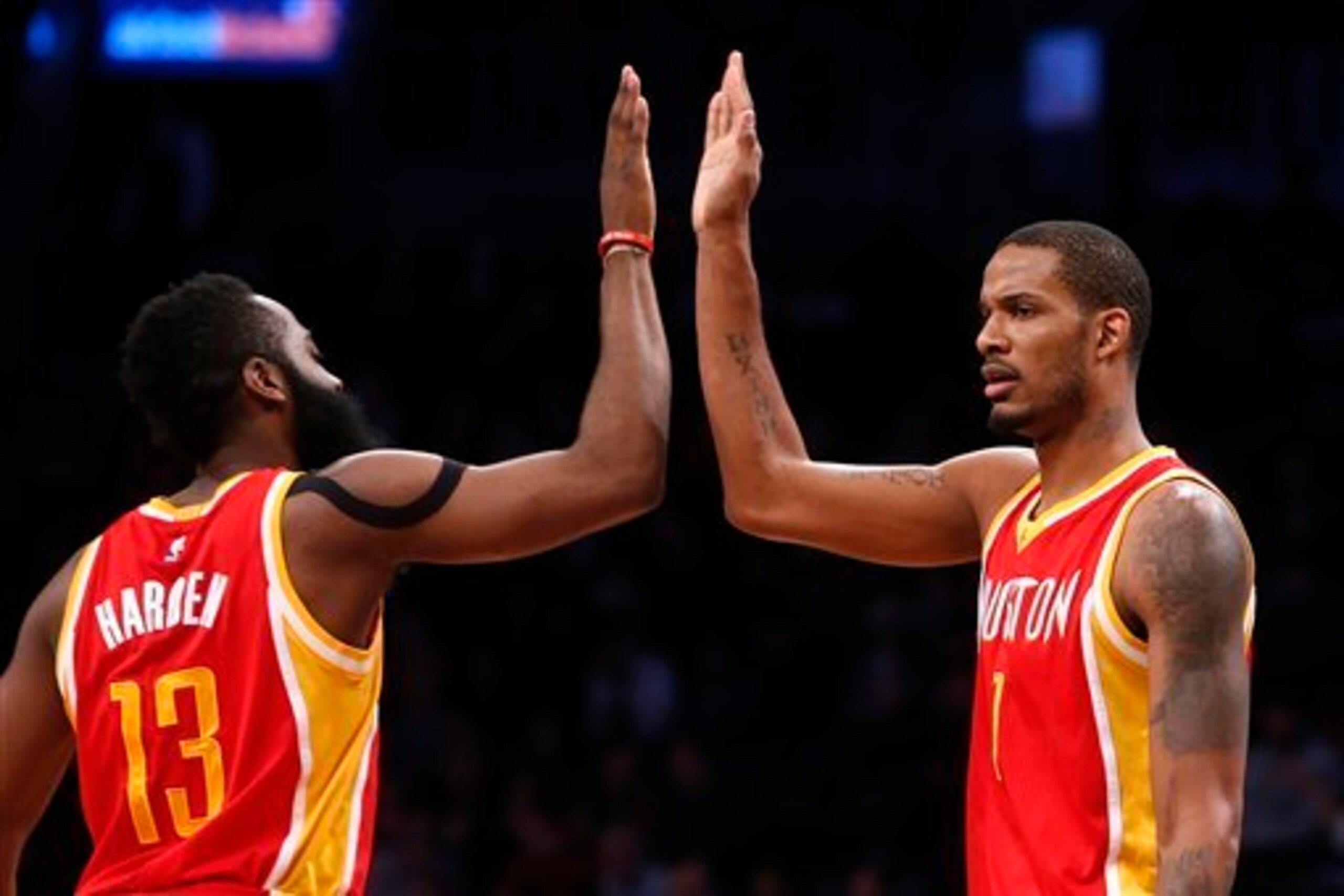
But Houston struggled with plenty of injuries this year, losing starters Dwight Howard, Terrence Jones and Patrick Beverley for significant chunks of the season. And it ranked in the top six using a similar offensive strategy in each of the two previous seasons.
Still, maybe looking at the Rockets and Curry is misleading. Maybe teams won't fully embrace the three-point revolution until we can tie high-volume threes to wins.
As it turns out, we can already do the reverse; teams that didn't shoot threes this past season generally lost. A lot.
There were 10 teams whose three-point attempts per game didn't increase from 2013-14 to 2014-15, per NBA.com. Of those 10 off-trend trey-decliners, seven wound up in the lottery. So if you're looking to tank, holstering the three is a good way to go.
What's Next

In light of the obvious league-wide trend toward high-volume threes, it's no wonder so many records have already fallen.
There'll be plenty more to come in short order—in both the team and individual realms.
"Never before has the NBA seen anything like [Curry]," Sports Illustrated's Rob Mahoney wrote. "The Nash comparisons may be apt, but Curry isn't checked by the same altruistic inhibitions. He'll shoot and score and shatter every one of the league's three-point shooting records by the time he's done."
Houston won't have to change much to shatter its own record, either.
The Rockets attempted 2,680 threes at a 34.8 percent clip this past year. To get to 1,000 makes at that rate, all they'd have to do next season is increase their total attempts to 2,873. That's just 2.4 extra attempts per game.
Between 2013-14 and 2014-15, they increased their attempts by 6.1 attempts per game, so adding another couple of threes hardly seems like a challenge.
We're bound to hit a point of diminishing returns eventually. There'll come a time when NBA defenses so totally change their tactics in an effort to stop three-point shots that it will no longer make sense for offenses to keep increasing their emphasis on treys.
But from the looks of it, we're nowhere near that pivotal juncture yet.
And before we reach it, teams and players across the league will continue to demolish records and push the limits of long-range potency.
The age of the trey is upon us.
Stats courtesy of Basketball-Reference.com, unless otherwise indicated.
.jpg?w=2560 "NFL investigating 2 referees for separate viral exchanges")
.jpg?w=2560 "Report: Chiefs Contact Hill's Agent")
.jpg?w=2560 "OBJ Calls Out Giants After Release")

.jpg?w=2560 "Tyreek makes another cryptic post amid Chiefs rumors")