

Why Dominique Easley Is New England Patriots' Most Overlooked 2015 Starter
In the Bill Belichick era, the New England Patriots have never really had a player like Dominique Easley. Since evolving out of his 3-4 background to employ a faster and lighter hybrid front against today's spacing-oriented passing games, Belichick has yet to find that disruptive 3-technique, the Warren Sapp type who can wreak havoc on the interior of a line.
When considering how the Patriots might keep their defense afloat after the free-agency defections of three former Pro Bowlers, Easley is easy to overlook. Recurring right knee soreness sabotaged the 2014 first-rounder's rookie campaign and landed him on injured reserve, an ominous sign after he tore both ACLs at Florida.
TOP NEWS

New NFL contenders starting to emerge after Week 4
.jpg?w=2560 "Cardinals Giants Football")
NFL investigating 2 referees for separate viral exchanges
Buzz: Chiefs Reached Out to Tyreek
At the time, the hope was that shutting down Easley might help him avoid offseason surgery and allow him to enter 2015 completely healthy.
The Boston Globe's Ben Volin (h/t Josh Alper of Pro Football Talk) reported that Easley would hopefully be ready for OTAs this spring, and if all goes well, he'll essentially play a starter's workload of snaps, given that the Patriots spend roughly three-quarters of their defensive snaps in sub-package personnel.
Rather than pouring resources into the depleted secondary, New England appears ready to retool its defense around the front seven, putting Easley's unique skill set in an extremely important spotlight. Reviewing his limited rookie year film and examining recent historical precedence, let's take a look at what we can reasonably expect from arguably the biggest X-factor along the Patriots' front seven.
Rookie Year in Review
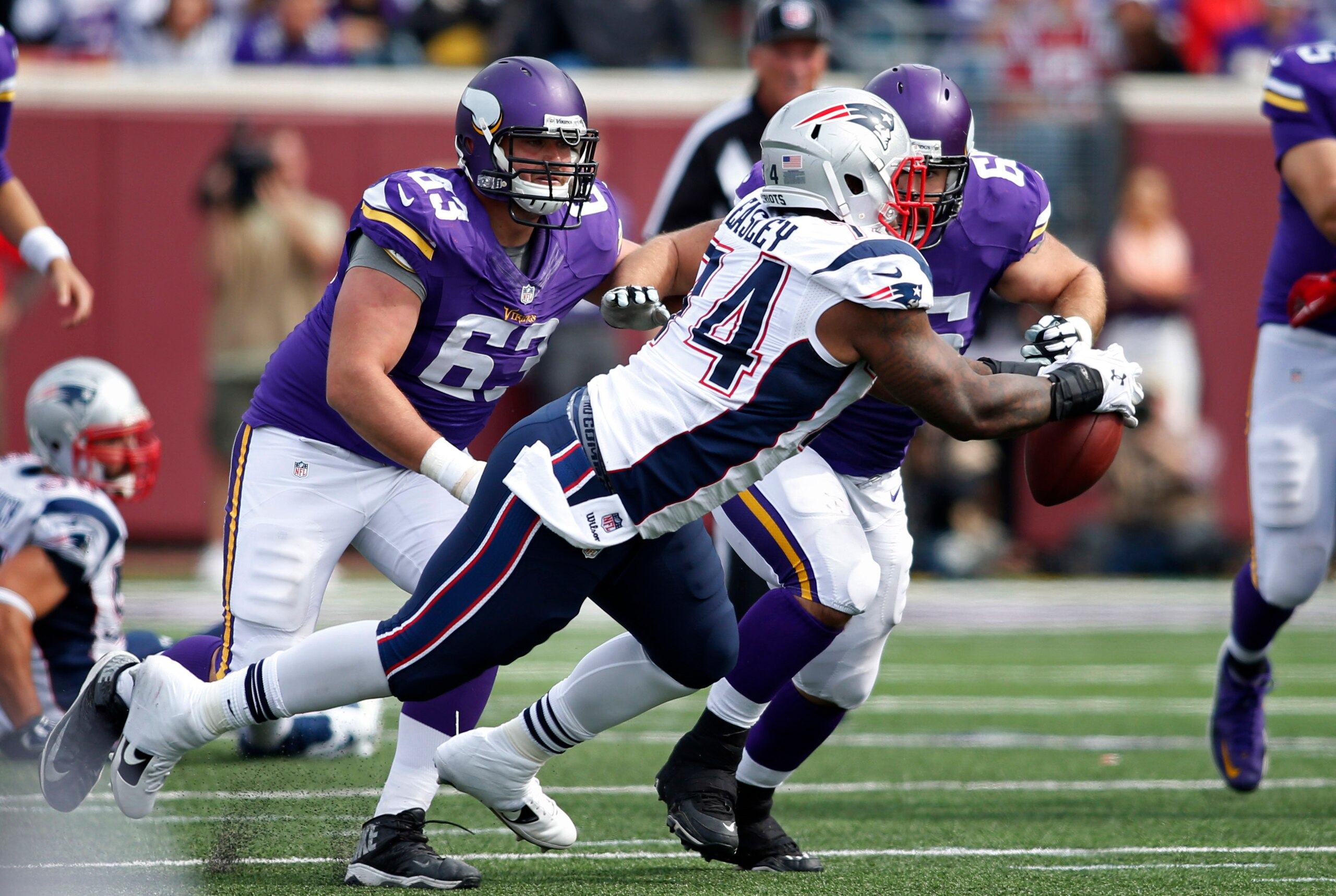
A Rough Start
Easley missed nearly the entire offseason program leading up to his rookie campaign, putting him behind the eight-ball before the year had even started. Consequently, Easley would play just 270 defensive snaps scattered over 11 games, playing over half the snaps in a single game only once, per Pro Football Focus.
Given his lack of reps in the preseason, it was hardly surprising to see him struggle in his debut against the Miami Dolphins in Week 1. Recall that the Patriots bizarrely employed a 3-4 front for nearly the entire game that day, which forced Easley into unnatural alignments at the 5-technique (head up over tackle) and 0-technique (head up over center).
I won't include stills of Easley attempting to two-gap; as you can imagine, it didn't go well for the 290-pound tackle. He was routinely floored on guard-center double-teams, rarely demonstrating the Vince Wilforkian strength to anchor the middle of the line. Of course, that's not his role, and unsurprisingly, we rarely saw Easley in these alignments again the rest of the season.
However, the most distressing part of Easley's early rookie campaign was his slow get-off from the line. When studying his tape at Florida, I noted how Easley's explosiveness off the line was his greatest asset, the type of burst that made him a total mismatch against lead-footed interior linemen.
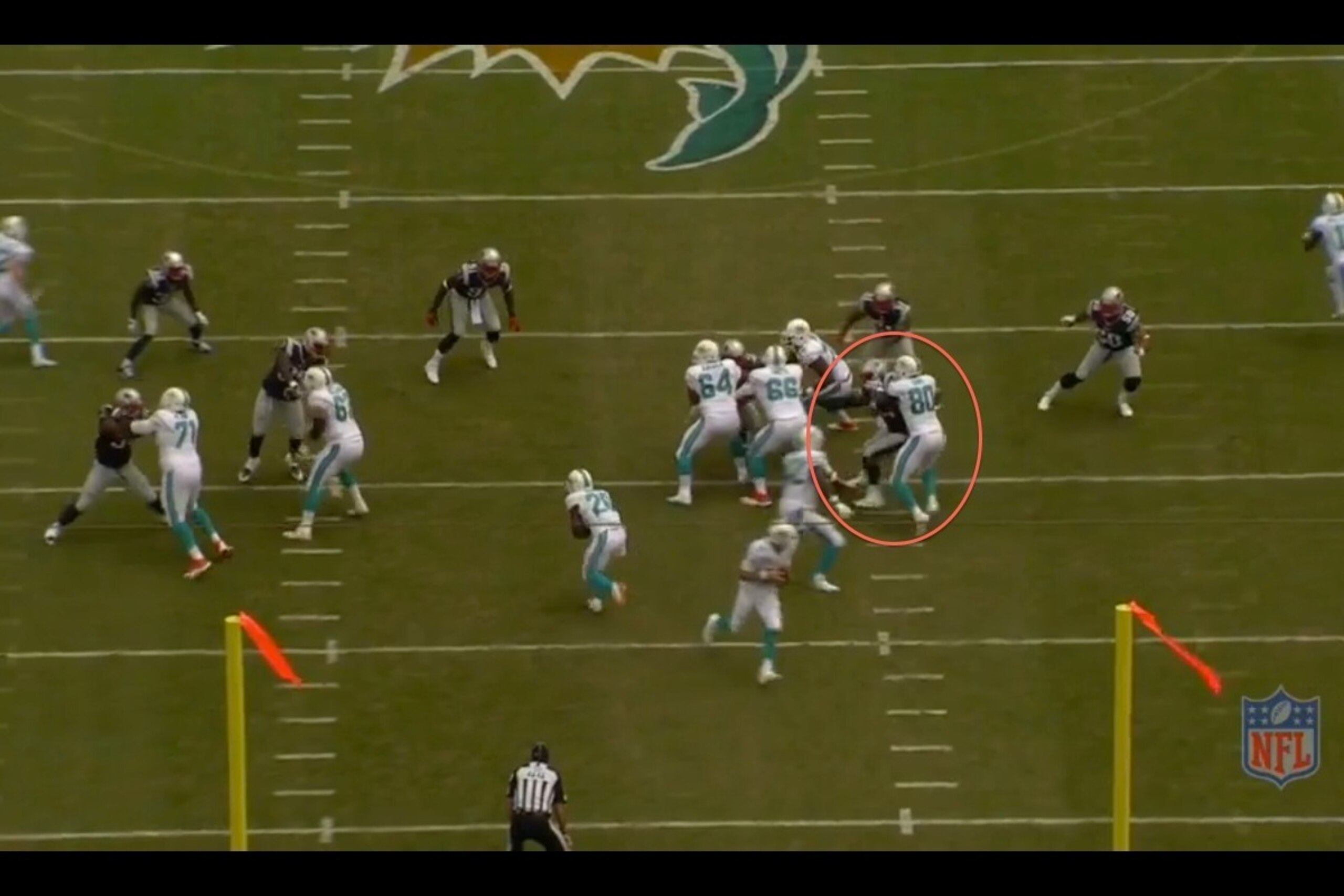
But in the two first-half games I reviewed against the Dolphins and Cincinnati Bengals, Easley rarely won with his first step off the line. There were multiple instances against Miami in which tight end Dion Sims handled Easley off the edge, including this play, where he crossed his face to stonewall the rookie at the line:
Compare this to a couple of his college rushes, where he often shot out of a cannon into the backfield:

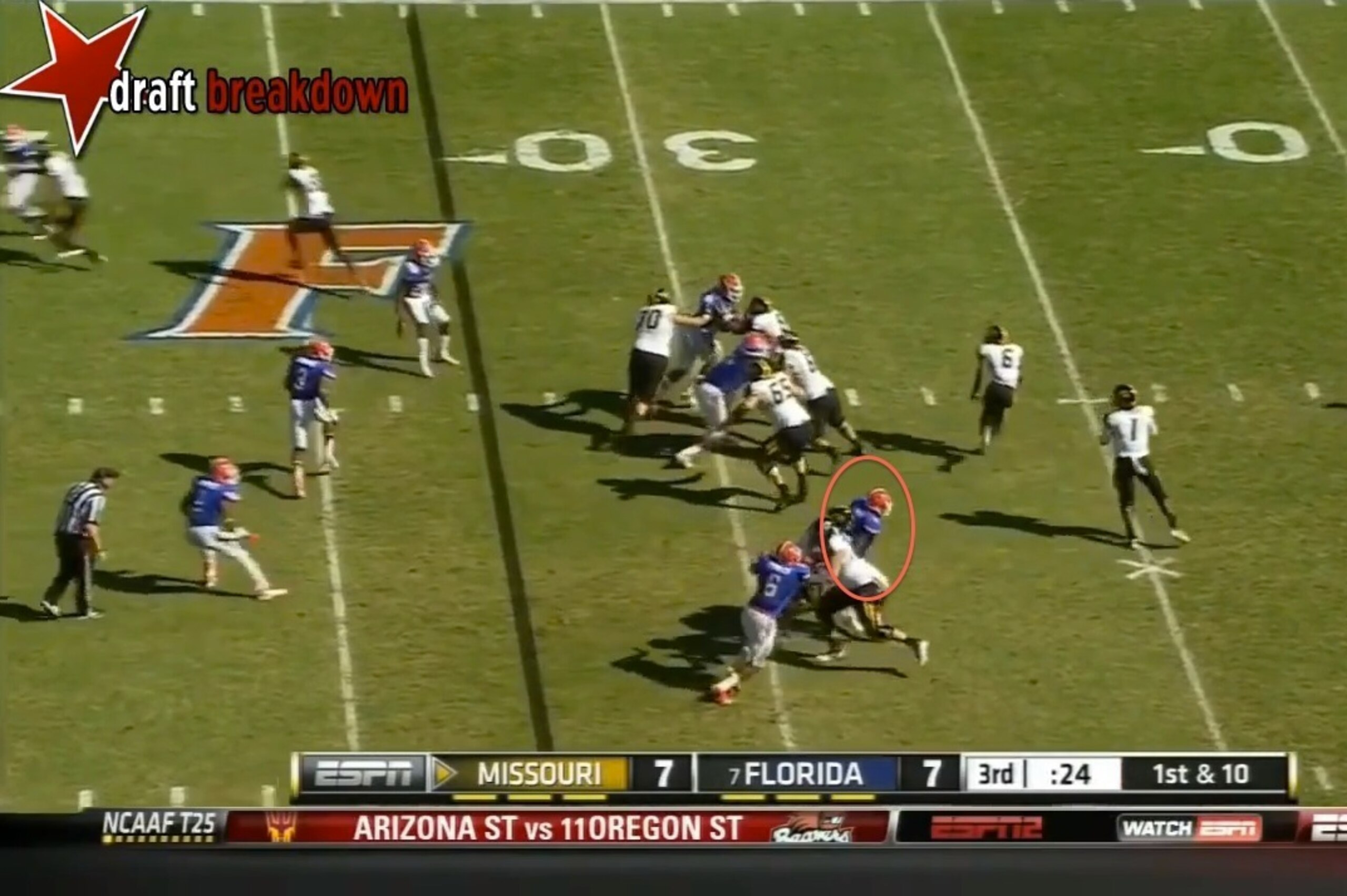
Again, it's important to remember that Easley was 12 months removed from a torn ACL, so it was hardly fair to expect an immediate return of his collegiate explosiveness.
Physical limitations aside, pad level was the most consistent issue I saw with Easley's rushes, and that's a technical component unrelated to his injury. For someone who's already undersized, engaging without any leverage against an O-lineman essentially ends the play. There were multiple instances in which Easley's rush never got off the ground.
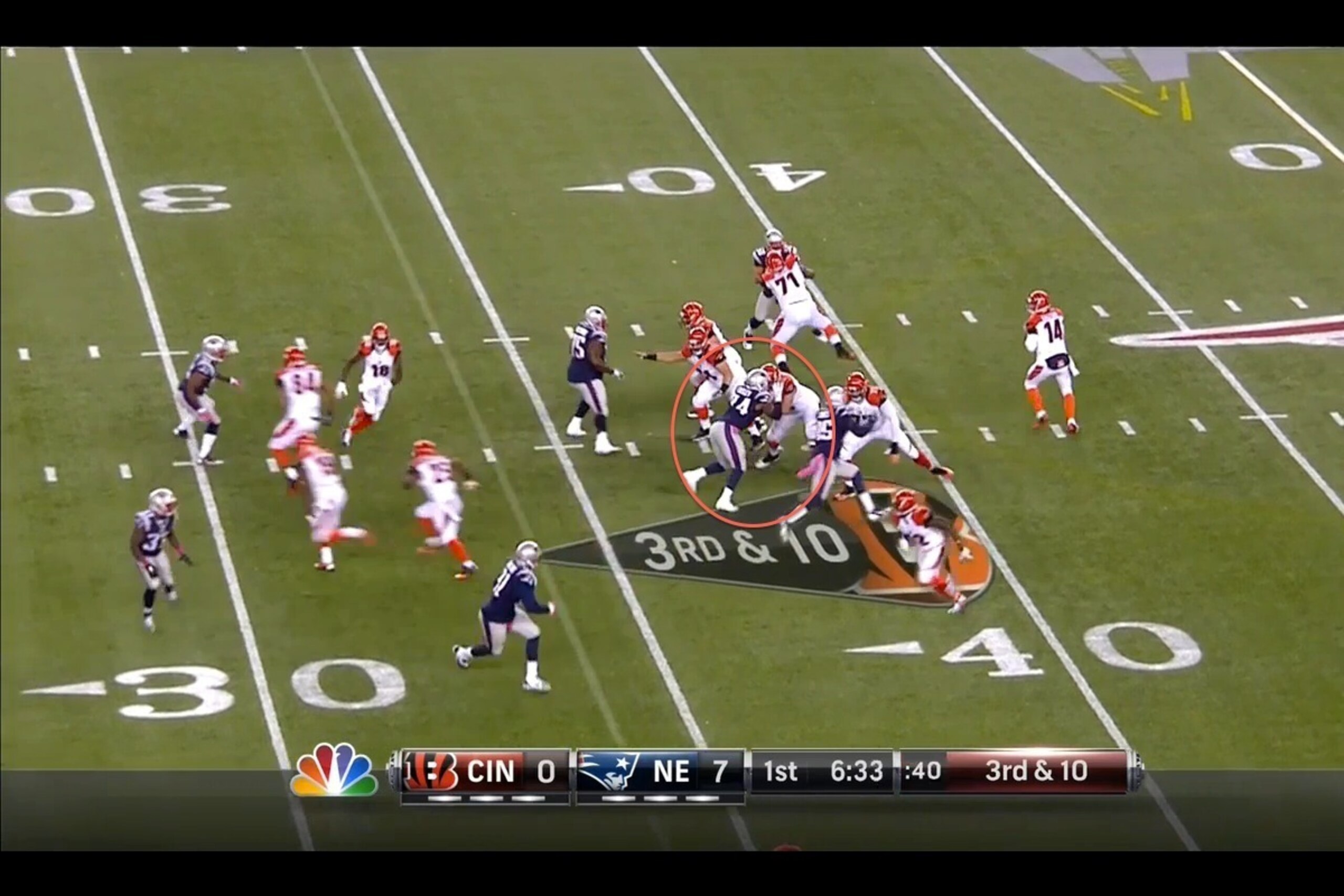
When he did get low, however, he demonstrated a surprisingly effective bull rush. Here, he walked Cincy left guard Clint Boling back into Andy Dalton, who had to dump off a one-yard pass on 3rd-and-10:
Still, through the first five weeks, Easley accumulated a grand total of two quarterback pressures over 95 pass-rushing snaps. The combination of playing all over the line and a lack of offseason work probably put the first-rounder in an unfair position to start his career.
Once he did settle into a consistent one-gapping role, though, Easley showed some of the glimpses that had analysts gushing over his selection in the first place.
Promising Flashes
Easley's largest workload of the year came in Week 8 against the Chicago Bears, as he started and played 42 out of the Patriots' 70 defensive snaps. This was the first game after Chandler Jones went down for seven weeks with a hip injury, so Easley slid into Jones' customary spot as a 4-3 right defensive end.
On the afternoon, Easley had his first career sack and three total pressures, more than he had accumulated the entire season. Despite his short arms (32½" when the average defensive end's are 34"), Easley had some success lining up from an edge-rushing 7-technique (outside the tackle) and 9-tech (outside the tight end), in addition to his customary 3-tech spot.
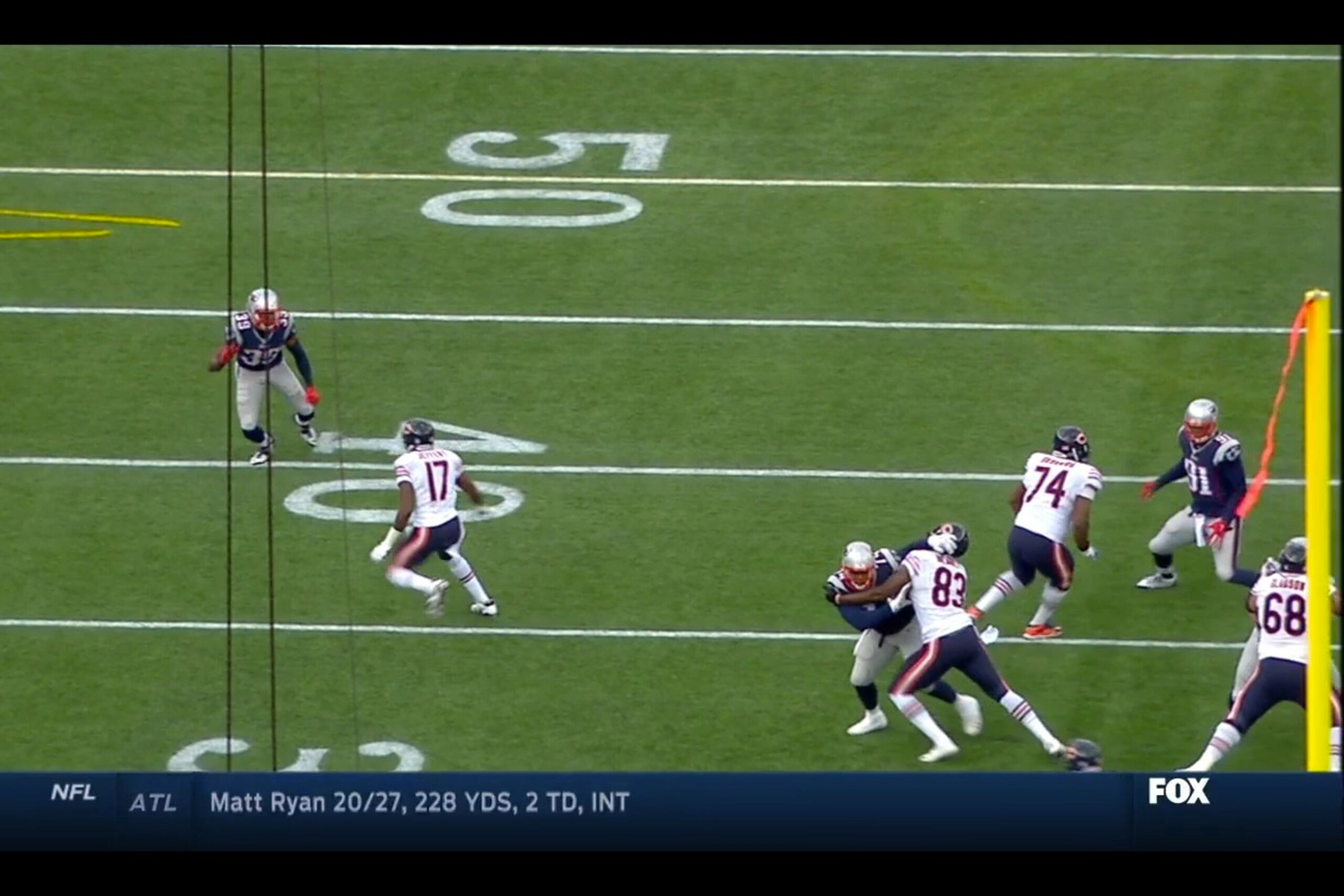
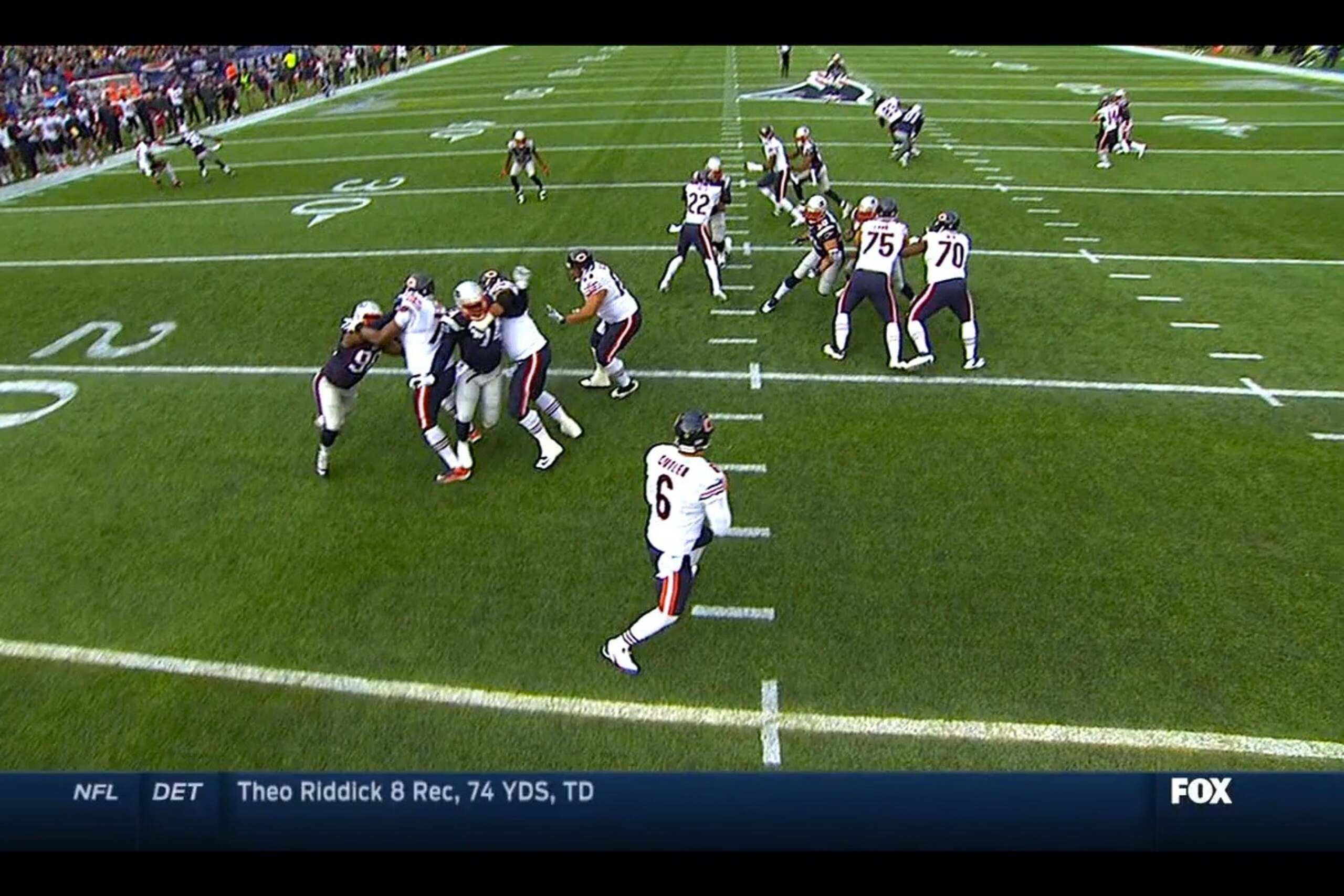
Indeed, there were multiple instances where Easley changed the play's complexion without registering on the stat sheet. Here are a pair of examples where Easley drew a holding call on Martellus Bennett from the wide-9 alignment and where he forced Jay Cutler to scramble out of the pocket (and probably drew a hold on left guard Matt Slauson that went uncalled):
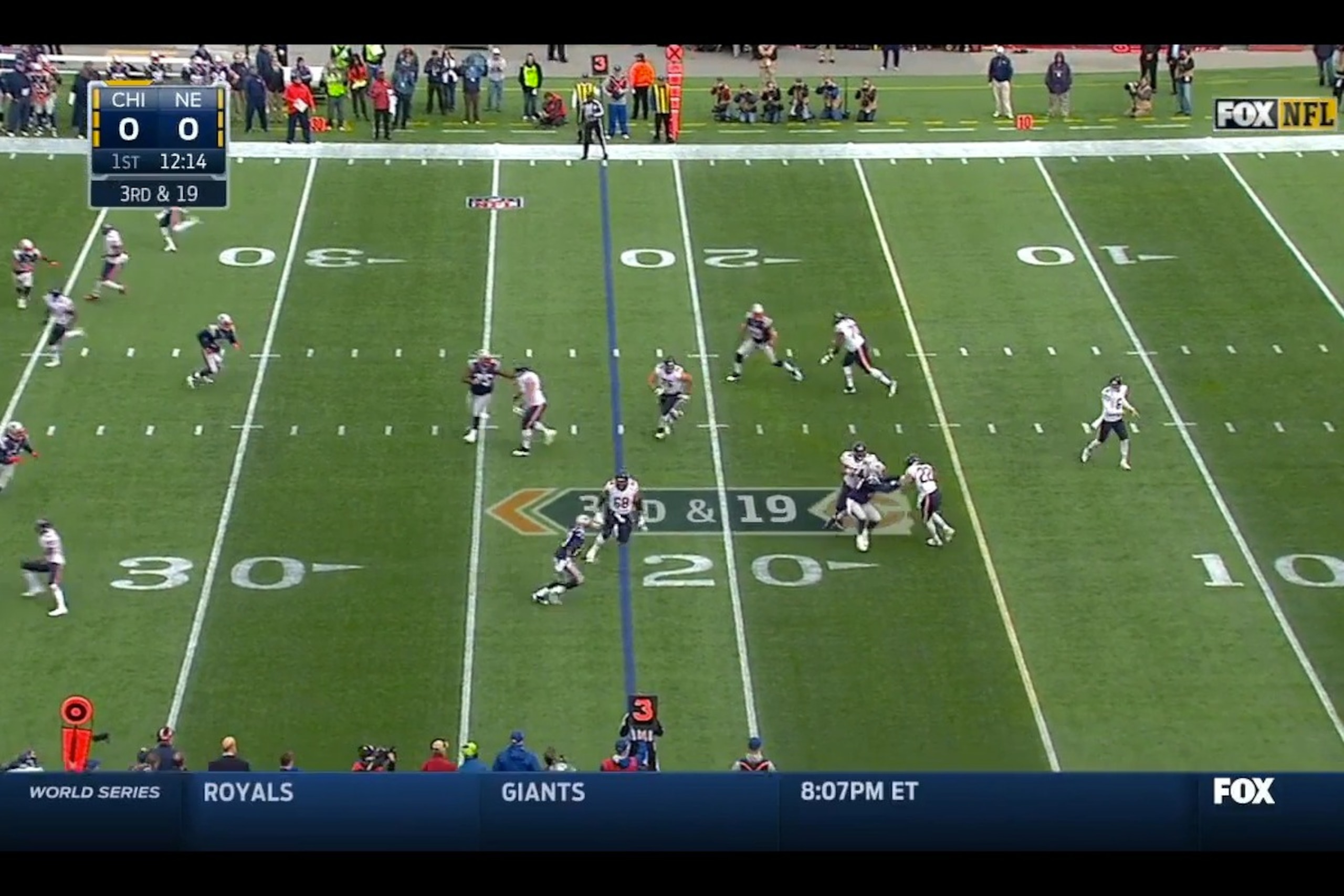
I was also impressed with his instincts against the Bears, one of his greatest weaknesses coming out of Gainesville. This was the clearest area the Patriots coaches had developed, as Easley was generally successful in tracking ball-carriers and shedding his man to pursue. Defensive ends are usually the ones who get baited upfield on running back screens, but Easley's play recognition sabotaged this Matt Forte screen:
This was the only week where Easley filled this role, however, as the Pats traded for Akeem Ayers before their next game against the Denver Broncos. Easley would go on to play between one-third and one-half of the snaps as a pure sub-package interior rusher against the Broncos and Indianapolis Colts before lingering knee soreness eventually forced his shutdown.
Though he was largely ineffective against Denver's Pro Bowl guard tandem of Louis Vasquez and Orlando Franklin, Easley showed some promising diversity in his pass-rushing arsenal against Indy.
Like most rookies, Easley's secondary pass-rushing moves are relatively unrefined. Perhaps realizing that speed alone won't win for him in the NFL, Easley unveiled a "hump" move (speed-to-power) that absolutely rocked right guard Hugh Thornton back on his feet:

Easley rarely won with his hands in the games I reviewed, as his swim and rip moves appeared to be in their nascent stages. But he certainly had more success keeping linemen's arms off his chest than he did in the first quarter of the season, even though this facet of his game still clearly needs improvement.
Given that Easley's knee limited the efficacy of his fastball, though, it was encouraging to see him utilize some secondary pitches in games.
To clarify, Easley's bottom-line production was still rather abysmal if you hold him by the standards of a first-round pick. Among 3-4 defensive ends (technically his official position on PFF), Easley ranked 32nd out of 45 qualifiers (min. 25 percent snaps played) in pass-rushing productivity.
While no one could have reasonably expected a season like that of Aaron Donald's, it's not encouraging to see Easley finish with a worse PRP than two-gapping tackles like Stephon Tuitt, Justin Ellis and Ego Ferguson.
With a full offseason to develop his game, it's anyone's guess as to what kind of sophomore leap Easley will make. Looking at recent numbers with similar players, however, might clue us into the type of impact Pats fans should expect.
Fair Expectations?
To quantify Easley's potential 2015 impact, I decided to comb through PFF and Pro-Football-Reference.com for defensive players with similar backgrounds. Obviously, this is an imperfect exercise—heck, not all of the players below are even defensive tackles—but their career paths do share some overlap with Easley's, so perhaps we can learn something from how these players have developed.
First, I looked at defenders taken in the first round between 2000 and 2013 whose rookie years were essentially washes, whether because of injury, ineffectiveness or a crowded depth chart. All these players played 11 games or less (Easley's total), and many also ended up on injured reserve.
Using PFR's Approximate Value (AV) metric, here's how these players performed their second season, as well as how many games they played:
| 2013 | D.J. Hayden, CB, OAK | 10 | 3 |
| 2012 | Dre Kirkpatrick, CB, CIN | 14 | 4 |
| 2012 | Nick Perry, OLB, GB | 11 | 3 |
| 2011 | Nick Fairley, DT, DET | 13 | 4 |
| 2011 | Prince Amukamura, CB, NYG | 13 | 4 |
| 2010 | Derrick Morgan, DE, TEN | 15 | 5 |
| 2010 | Jared Odrick, DT, MIA | 16 | 4 |
| 2010 | Patrick Robinson, CB, NO | 15 | 4 |
| 2009 | Peria Jerry, DT, ATL | 16 | 1 |
| 2007 | Justin Harrell, DT, GB | 6 | 1 |
| 2007 | Jarvis Moss, DT, DEN | 12 | 1 |
| 2006 | John McCargo, DT, BUF | 16 | 2 |
| 2005 | Antrel Rolle, S, ARI | 16 | 5 |
| 2004 | DeAngelo Hall, CB, ATL | 15 | 10 |
| 2004 | Marcus Tubbs, DT, SEA | 13 | 7 |
| 2003 | Jerome McDougle, DE, PHI | 11 | 1 |
| 2003 | Andre Woolfolk, CB, TEN | 10 | 1 |
| 2002 | Ryan Sims, DT, KC | 16 | 7 |
| 2002 | Roy Williams, S, DAL | 16 | 15 |
| 2002 | Phillip Buchanon, CB, OAK | 16 | 8 |
| 2001 | Jamal Reynolds, DE, GB | 7 | 1 |
| 2001 | Damione Lewis, DL, STL | 16 | 3 |
| 2001 | Willie Middlebrooks, CB, DEN | 15 | 1 |
| 2000 | Reggie McGrew, DT, SF | 12 | 1 |
As you can see, there are lots of busts here, particularly between 2000 and 2009, but also a scattering of Pro Bowl-level talents like Roy Williams, Antrel Rolle and DeAngelo Hall. The jury is still out on the likes of D.J. Hayden, Nick Perry and Dre' Kirkpatrick, but most of the first-rounders since 2010 appear to have settled into a niche.
The average AV of these players was four; for reference, here's a list of defenders who posted that mark last season. It's mostly situational but useful role players like Patriots' free-agent signee Jabaal Sheard.
I'm a little more hesitant to take away anything from the games played average, but it's encouraging to see that this group played over three-quarters of their sophomore years, with just two suiting up for fewer than 10 games. But again, not all of these players were injury risks headed into the NFL like Easley.
To get a little more granular, I also turned to PFF to see the success rate of second-year defensive tackles.
Going back to 2007 (the first year that PFF has data for), I looked at sophomore defensive tackles who had played at least 25 percent of their team's defensive snaps and tabulated how many had positive overall grades, positive grades against the run and positive grades rushing the passer. Note that just because a player has a plus overall grade doesn't mean he graded positive against both the run and pass:
| 2014 | 13 | 6 | 7 | 7 |
| 2013 | 5 | 3 | 3 | 2 |
| 2012 | 9 | 4 | 2 | 4 |
| 2011 | 14 | 2 | 2 | 5 |
| 2010 | 11 | 3 | 2 | 3 |
| 2009 | 10 | 2 | 1 | 1 |
| 2008 | 10 | 2 | 1 | 4 |
| 2007 | 14 | 5 | 0 | 9 |
Besides the relatively low number of success stories, what jumps out is how much easier it is for a pass-rushing defensive tackle to have a positive impact. This is partially due to sample bias—there are more passing plays in an NFL game, so there are typically more opportunities for 3-techniques to make an impact than nose tackles—but if we're just thinking about Easley, this bodes well for him.
Again, these are unique individual cases, and all this information goes kaput if Easley's knee soreness is actually a chronic issue rather than just a couple of freak ACL tears. However, while all those pre-draft Geno Atkins comps probably won't result in Easley playing at that kind of level next year, anything less than a roughly four AV season with a plus impact as a pass-rusher should be seen as a disappointment.
Bottom Line
Ultimately, a lot of this boils down to the cartilage structure in Easley's knees, something we can't really know ahead of time. Per The Associated Press (h/t Pro Football Talk), previous studies have suggested that playing on FieldTurf, the artificial surface the Patriots have used since 2006, results in more ACL injuries, though other studies have since disputed that claim.
That's out of everyone's control, so it's more useful to focus our energy into the technique of Easley's game to analyze what kind of player he might become.
Despite the subpar numbers, I was largely encouraged by the development of secondary moves and the relentless motor that Easley demonstrated throughout the season. And though he'll never be a gap-clogging anchor, Easley also exhibited more upper-body strength than I expected when playing from a one-gap technique.
However, a lot of his future will depend on if he can reclaim that quick explosiveness off the line. Every game-changer has one asset he can rely on to produce consistently positive results, and for Easley, beating linemen off the snap was his bread and butter.
Those countermoves could eventually be deadly against guards lunging to make contact, but no one will respect those until Easley shows he can beat linemen with his first move.
The Pats do probably need to add another defensive tackle to beef up their base-package depth, but it's hard to imagine them investing a premium draft pick in another 3-tech one year after selecting Easley. If New England really does plan to rely on its front seven to carry the secondary this season, a sophomore surge from Easley is absolutely essential.
.jpg?w=2560 "Titans Giants Football")
.jpg?w=2560 "Dolphins Bills Football")




.jpg?w=2560 "Ward Nearly Walks Out of Presser 😳")