How Will the Seattle Seahawks Contain Rob Gronkowski?
The Seattle Seahawks defense doesn’t play nice with anyone. Collectively, it's the kid who takes all the best sandbox toys and then takes ownership over every other neighborhood sandbox.
But one position has stolen a dump truck or two: tight end.
Overall, the Seahawks were solid against tight ends throughout the regular season, allowing an average of only 41.4 receiving yards per game to the NFL’s tree trunks with arms. That was the league’s fifth-best mark, according to Football Outsiders, which looks favorable as a matchup with the New England Patriots and Rob Gronkowski in Super Bowl XLIX looms.
TOP NEWS
.jpg?w=2560 "Titans Giants Football")
OBJ Calls Out Giants After Release
.jpg?w=2560 "Saints Lions Football")
Rap: Lions, LaPorta End Contract Talks

Live Live: Updates from every NFL game
But peering only a layer below the surface, we see that of the 17 passing touchdowns Seattle allowed this season, 11 went to tight ends, the third-highest total in the league. That’s less encouraging as the Gronkowski preparation rolls along. He’s caught 54 touchdowns over only 65 career regular-season games, including 12 this season.
Gronkowski led all tight ends in 2014 with 1,124 receiving yards, a total reached while averaging 13.7 yards per catch. The Seahawks faced a top-10 tight end (by receiving yardage) five times this season and gave up an average of 13.6 yards per reception to those tight ends.
The Seahawks’ tight end weakness isn’t glaring, but it is present. And it was low-lighted when Seattle gave up 96 yards and three touchdowns to San Diego Chargers tight end Antonio Gates back in Week 2.
Gates is quite Gronk-like with his body type and sense for positioning to block out defenders. What have the Seahawks learned since then? And how will they defend the great Gronk of the Northeast?
Let’s answer that question by how not to defend Gronkowski. The Seahawks won’t (or shouldn’t) rely heavily on linebackers.
The Seahawks will certainly bring linebackers into play with zone coverage—likely Cover 3 with K.J. Wright, Bobby Wagner and Bruce Irvin asked to eliminate the middle of the field.
But when linebackers assume responsibility for Gronkowski in coverage, it can end badly. That’s especially true in man coverage, and although the damage is minimized in zone, even Wright and Wagner often can’t close space quickly enough when faced with a tight end of Gronkowski’s caliber.
That was evident against tight ends who are a rung or three below the league’s leader in kitten cuddling.
Overall, the Seahawks allowed a league-low 32 receptions of 20-plus yards during the 2014 regular season. But of those few chunky yardage receptions the Seahawks surrendered, eight went to tight ends. That included a 31-yard catch by San Francisco 49ers tight end Garrett Celek, the same Garrett Celek who finished with 53 receiving yards total this season.
There was an opportunity for opposing tight ends to gain significant yards with either the right matchup or the right physical tools. And in Week 14, the right matchup came against Wright, a linebacker who was left huffing, chasing and trailing far behind the Eagles’ Zach Ertz.
In the third quarter of that game, the Eagles lined up with three receivers spread out, quarterback Mark Sanchez in shotgun and Ertz in-line on the left side. With safety Kam Chancellor playing short up the middle and Earl Thomas deep on the right hash, Ertz was left one-on-one with Wright, who had to be mindful of the natural pick coming off the outside slant.
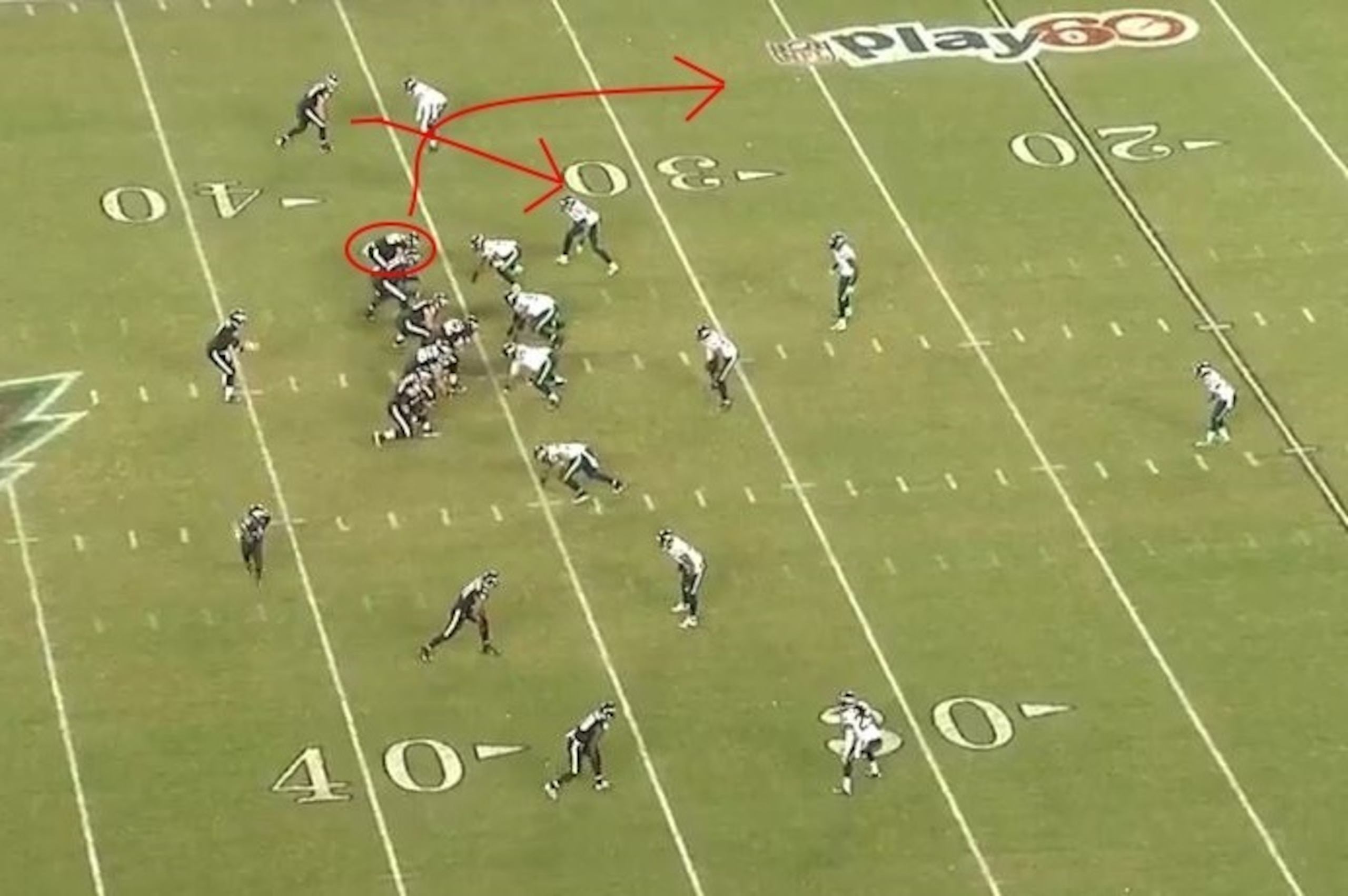
Anticipating and reacting to that rub is challenging for any defender. Ideally, Wright would like to drop back first to give himself an angle and then turn to run with Ertz.
But in hindsight, this play now functions as a sort of experiment. The question: What happens when Wright needs to rely solely on speed (and less so on positioning) to keep up with an opposing tight end who has Ertz's quickness?
The answer: a 35-yard touchdown.
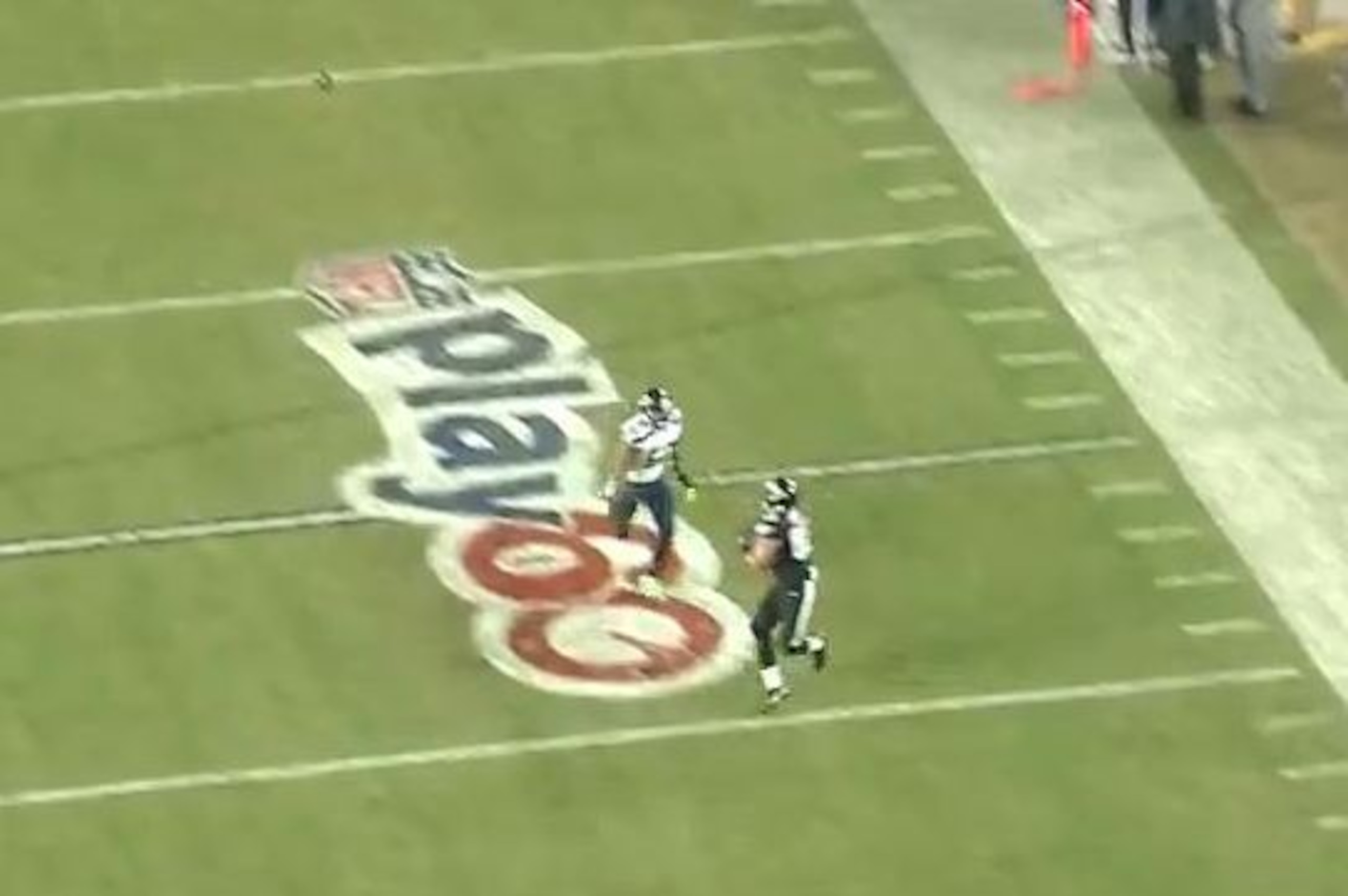
Wright was beaten almost immediately at the line of scrimmage, and then the gap separating tight end and linebacker grew. As Sanchez released the ball, Ertz was ahead by over two full strides.
Ertz had plenty of room to adjust and do a complete spin while hauling in a poor throw that was well short. It was the sort of throw Wright would have had an opportunity to disrupt had he maintained even a reasonable distance.
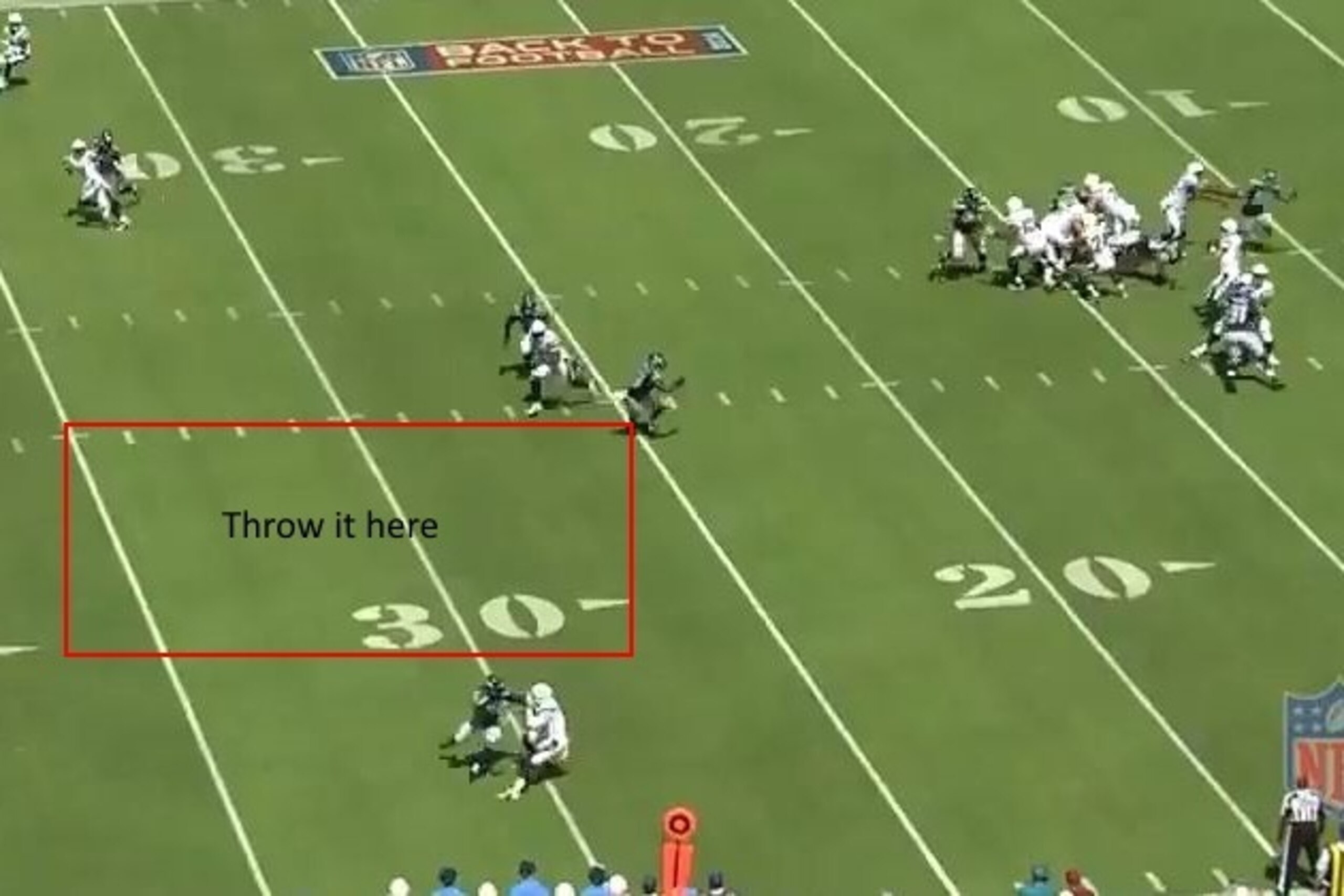
There was a similar outcome back in Week 2 when Gates matched Wagner's muscle on a post route and then easily galloped by to haul in a 20-yard reception.
When Wagner’s attempt to impose himself physically on Gates failed, he gave an All-Pro access to plenty of green space. Gates used that space to haul in a big catch, and Gronkowski will likely do the same if given the same opportunity Sunday.
This is when I remind you that Wright was one of the best 4-3 outside linebackers in coverage during the regular season, allowing a reception only once every 10.8 cover snaps, according to Pro Football Focus. And Wagner allowed the fourth-fewest yards in coverage among inside linebackers who played at least 50 percent of their team’s defensive snaps (also per PFF).
Gronkowski is 16 pounds heavier than Ertz, yet leading up to their respective drafts, Gronkowski posted a faster 40-yard dash time (4.68 to Ertz's 4.76). Over the years, whenever he’s been healthy, we’ve grown to expect brilliance from Gronkowski. But even though you see it often, you’re still allowed to be in awe of what he’s able to do athletically at his size.
That combination of speed and power means the Seahawks’ deep-ball problem against tight ends becomes an even greater concern.
| Coby Fleener | 18 | 9 |
| Zach Ertz | 16 | 7 |
| Delanie Walker | 14 | 4 |
| Jared Cook | 13 | 5 |
| Rob Gronkowski | 13 | 5 |
Gronkowski was targeted 124 times, and a sizable slice came beyond that 20-yard mark (10.5 percent, per PFF). To neutralize Gronkowski as much as possible, the Seahawks need to isolate him in coverage against a safety who also has a body of bricks.
Which brings us to Chancellor, one of the few safeties capable of matching Gronkowski’s physicality. Chancellor has allowed only 278 yards in coverage this season (including playoffs) with an opposing passer rating of 72.2, all per PFF.
Though he’s known for hits that make his targets lose their baby teeth all over again, Chancellor diagnoses a play in coverage quickly and reacts just as fast. That’s what led to his game-clinching interception against the Carolina Panthers in the divisional round.
Against Gronkowski, he’ll need both of those attributes—and he’ll need them often.
The Patriots and Seahawks last met in 2012, a strange time when Thomas had long hair and Russell Wilson still hadn’t quite yet earned full job security. Much has changed since for both teams, as is the nature of the NFL with its various offseason carousels.
But the core of the current Seattle defense was still featured in that game (and specifically the secondary), albeit a more youthful version. Gronkowski finished with a productive, though not explosive, six receptions for 61 yards.
His longest catch of the day came against Chancellor, and the play provides a perfect illustration of the larger problem presented by the Gronkowski-Tom Brady tandem. They’ve developed such a strong connection that intricate timing between route and throw is almost always present.
Gronkowski ran a post route that he broke off to the inside about 10 yards downfield. At this point, Chancellor had maintained a five-yard gap, which allowed him to react and spring to disrupt any route. He was positionally sound while giving himself a play on both his man and the ball.

Gronkowski gave Chancellor a head fake to freeze the safety for just an instant. Chancellor had to multitask and respect Gronkowski’s ability to box out defenders, along with his deep explosiveness.
Then it was all over once Gronkowski planted his right foot to turn inside. Chancellor was still in fine position, and only a three-yard buffer now sat between him and his assignment. But all Gronkowski needed was that brief flinch to get Chancellor leaning on his back foot.
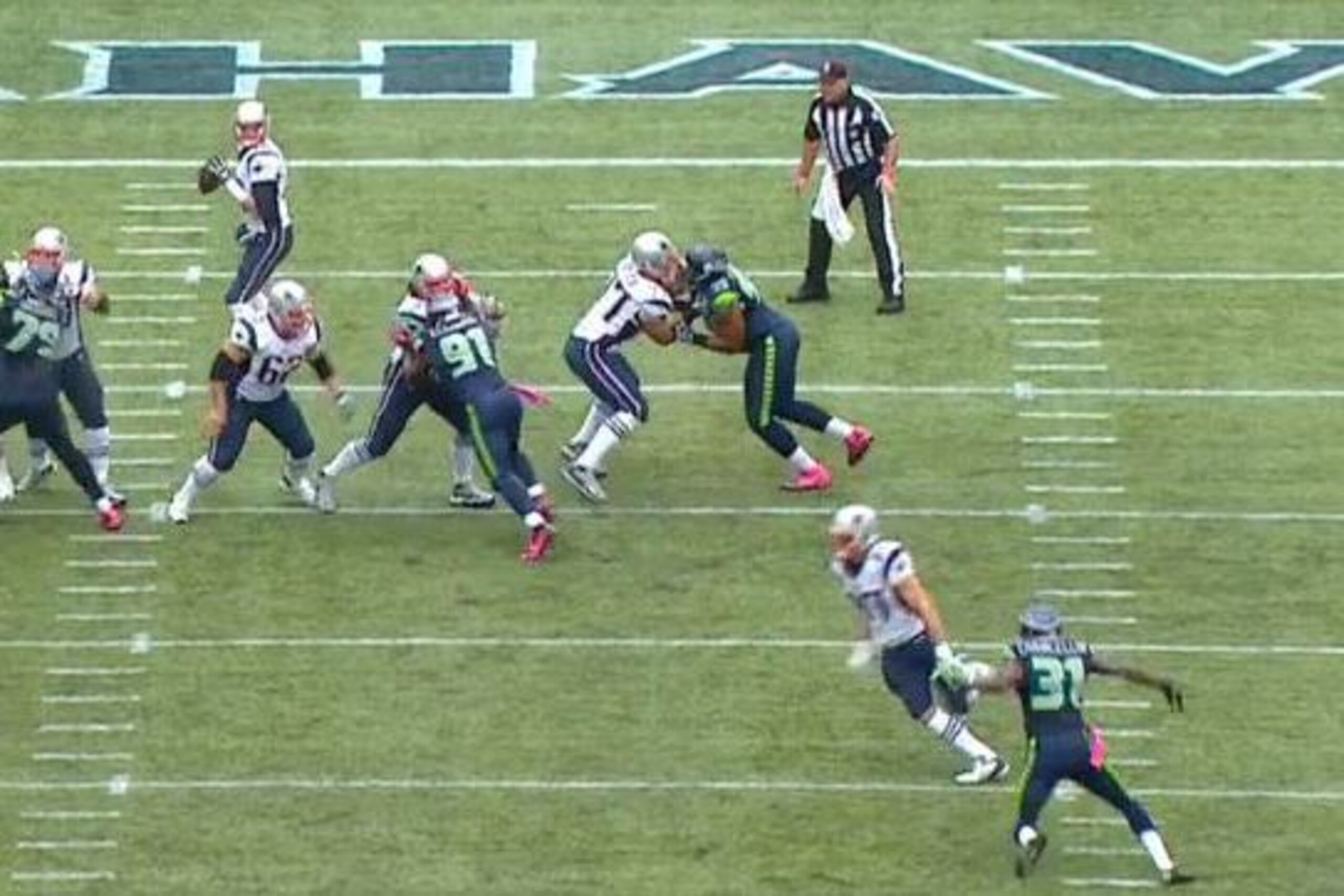
A window was created, and despite fundamental positioning, Chancellor couldn’t close it fast enough. For Brady, the rest was muscle memory—a quick release and an accurate throw. Then the play ended 20 yards later.
The battle between Gronkowski and Chancellor will be won or lost within that minutiae, and physical play will be the ultimate equalizer. Chancellor swings a mighty hammer at 6’3” and 232 pounds. With that strength, he can disrupt Gronkowski’s release at the line of scrimmage, which will by extension mangle the delicate timing that forms the foundation of New England’s passing offense.
The aforementioned Seahawks linebacker K.J. Wright said of Chancellor versus Gronk, via NFL.com's Chris Wesseling, "Our best against their best. Of course I've got my money on Kam. He's an All-Pro, he's the captain of our defense. I expect him to win every battle."
It’s critical to limit Gronkowski's free releases so he doesn't march downfield uninterrupted. That’s when he wins physically and those windows for Brady become even larger. The primary task at hand for Seattle will be minimizing the number of chances Gronkowski has to open up as a large target.
Everything with Gronkowski comes back to grappling and timing, while everything about Chancellor revolves around dictating the game physically. Chancellor has the body and instincts to contain Gronkowski, and now it just may be a matter of execution.
.jpg?w=2560 "Vikings Buccaneers Football")