

Hassan Whiteside Has Gone from Novelty to Necessity for Miami Heat
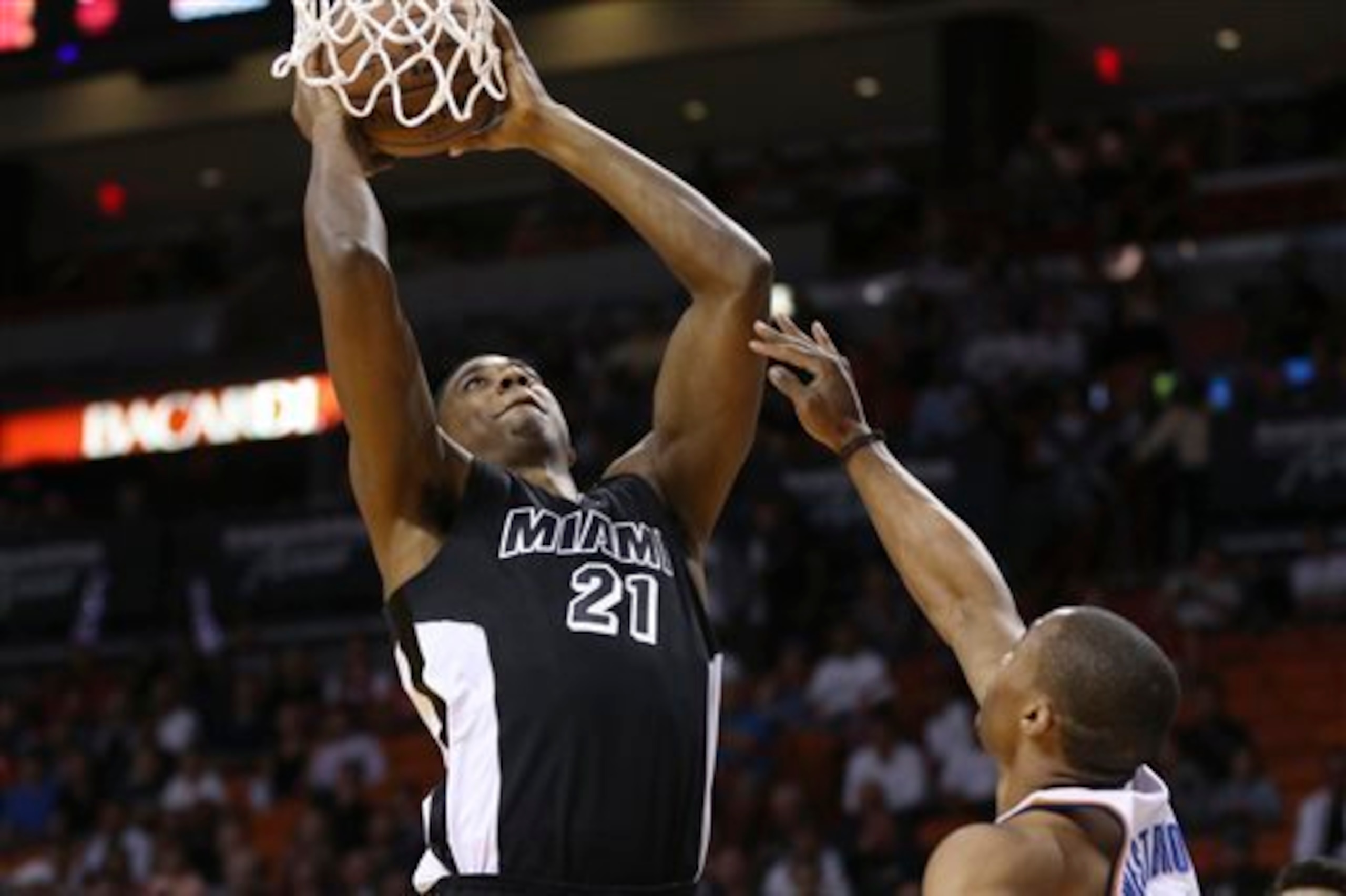
MIAMI — Every time Hassan Whiteside appears on the floor now, there's an assumption his output will be astonishing. There's an expectation the NBA's unforeseen emerging force will stamp the stat sheet with some more say-what-wait-what(?!) numbers.
That's precisely what was happening here again Friday against the contending Mavericks and formidable center Tyson Chandler. The shorthanded Heat rode his ridiculous rebounding, 14 in the first seven minutes, into a sizable lead.
But that's not how this night will be remembered, not if the Heat wish to remember it at all. They allowed a 37-2 second-half run to the Mavericks, including 21-0 with Whiteside watching. It rendered his rebound total (24), tied for the second-highest mark in franchise history, just a trampled footnote in a 93-72 defeat.
TOP NEWS
Buzz: Knicks' KAT Offer Revealed

Buzz: Bron Chopper Part of Deal 🚁

MJ Makes Record-Setting Donation 🙌
This was the night when Hassan-ity officially went from novelty to necessity.
That's where the Heat are this season, 20-26 and desperate for any positives in their first post-LeBron James campaign. That's the level Whiteside has reached this month. He's risen as fast as, and from even further away than, Jeremy Lin did in 2012.
Yes, the Heat were without Dwyane Wade and Luol Deng on Friday, but they did have five core members of recent championship teams available, with four combining to play 104 minutes.
Yet they were entirely incapable of competing without a guy who played 19 games in his first two NBA seasons. Whiteside spent the next two years bouncing between three D-League teams, plus two Chinese squads (he learned some Mandarin) and two Lebanese teams (he learned something even more useful).
"Hummus is really good," Whiteside said. "Y'all need to try that."
He's really good, too.
Legitimately good.
Good enough to follow 14 points, 13 rebounds and 12 blocks in 25 minutes against Chicago with 16 points and 16 rebounds during an off night against Milwaukee and then 16 points and 24 rebounds in 29 minutes against Dallas.
Good enough that after Dirk Nowitzki joked "the 10 offensive rebounds he had, I gave him all of them," the future Hall of Famer called him "really active" and "stronger than you think."

"He gets so close to the basket, and his reach is next to none," Nowitzki said. "He's so long out there, it's incredible. When he's so close to the basket, he just tips it to himself or tips it in. And then he started to make some jump shots today. So, yeah, that's a nice find for sure for Miami."
Good enough that Chandler acknowledged Whiteside reminded him of himself "with his length and activity," and that "if he starts to understand the game, he can be very impactful."
Good enough that Erik Spoelstra admitted he'd erred by keeping Whiteside on the bench so long, after taking him out late in the third quarter due to some fatigue.
Good enough that Whiteside had to take questions from a crowd of reporters on this topic, reporters who, just a season ago, would only crowd LeBron James and Dwyane Wade and Chris Bosh like this.
Good enough that he's looking, rather remarkably, like the Heat's last best hope to save this season.
By now, you may have heard some of the reasons this took so long. The concerns about attitude and aptitude after Whiteside left Marshall University early. The lack of development in Sacramento (which waived him two years after drafting him in the second round). The circuitous route he took to the workout and interview that wowed Miami.
You probably have heard some of his more colorful, carefree quotes, too. Whether about how he was just trying to "get my NBA2K rating up" while demolishing the Bulls. How those who sent him away from Sacramento weren't very smart ("they're not there anymore"). Or how he blocks some shots out of bounds, "just because the crowd likes it."
So, yes, there's still an innocence about him. It's an innocence that does seem somewhat out of step with the culture-conscious Heat organization, led by a man, Pat Riley, who has always worried about young players getting ahead of themselves.
By the time Bleacher Report sat down with Whiteside on Thursday, the Heat had chosen to shut down interviews with assistants about him, preferring to limit voices as the hype machine was already humming on overdrive.
In that conversation, Whiteside spoke humbly at times, about how he was grateful the Heat had even considered him, about how it's "amazing" and "crazy" Heat fans are buying his jersey. He said his greatest growth as a player has come with his patience on offense, since "the shot-blocking had been there for a long time."
"I just learned it from repetition overseas," Whiteside said. "When you're the main option on a team, you see a lot of double-teams. I just kind of got used to it."
By then, he had gotten used to needing to prove himself, over and over.
"I wish everything went perfect, you know, Whiteside said. "Everybody wants to be the No. 1 pick, go to the NBA and just kill that rookie year on. But I didn't have that path. I had a lot tougher path. Who knows if it would have come out better or not. I just know it's turning out to be good."
Did he ever think about giving up?
"No," Whiteside said. "I had too much confidence in myself. I had too much confidence in my dream. My Mom always told me I was made for something special. Since I was little. I was hit by a car when I was 10 years old. And I just had multiple injuries that would take me to the hospital. And she always said I was made for something special."
His mother Debbie worked two jobs to care for his five brothers and his sister. His oldest brother, Anthony, watches every game from Gastonia, North Carolina, texting him encouragement before every one. Anthony is the one who told Hassan to quit wrestling in high school and go out for basketball, even if going out for basketball often meant trying to play point guard.
"He's had a chance to go through some things and mature," Anthony said. "I think he really appreciates it now. I came down there for his home game against OKC, and just his whole demeanor, I told my Mom, just his whole personality, you can tell he's mature by the way he acts. He's not like a big kid anymore. We were talking about he would have just been graduating college last year, if he would have stayed in college. So I think it was that age and having a chance to mature a little more."
"He takes a challenge well," Anthony said. "Anytime you can challenge him to do something, he goes all-in at it. Now he's getting a chance to play through his mistakes. That's the best opportunity for him to learn and grow."
So how much can he grow?
What can he be, after averaging 13 points, 10.6 rebounds and 3.4 blocks in 23.6 minutes in January?
"I don't know," Whiteside said. "I really can't tell you the future. I couldn't have called this year, though. I don't know, man. I'm just going to try to keep building, just try to win every game. I'm going to try to do my best to put us in a winning situation."
It's a most unlikely obligation.
The Heat were the winningest situation in the NBA the past four seasons, reaching four NBA Finals. That put their reclamation projects on the periphery.
Eddy Curry, Greg Oden and the second coming of Michael Beasley weren't successes in any form or fashion, but it hardly mattered as long as the Big Three were pulling the majority of the load. Nor did it doom them that the once-deep development well was running increasingly dry, with no real discoveries since Udonis Haslem in 2003 and Joel Anthony in 2007.
That latter name remained meaningful to Spoelstra, even after Anthony was traded to Boston last season. Two of the Heat's top people on the scouting side, Chet Kammerer and Adam Simon, had kept Riley and others in the organization abreast of Whiteside's whereabouts and development.
And, after Whiteside was waived by the Memphis Grizzlies for a second time in a month, ended up with the D-League's Iowa Energy and was summoned by the Heat, Spoelstra made Anthony an answer of an impromptu quiz.

"I met with Hassan. I asked if he knew who I started my first year coaching, and who I started the majority of the first year of the Big Three," Spoelstra said. "He had to look it up. I said, once you find that answer, you'll understand the type of player I like and we sign."
A player with energy and athleticism, like Joel Anthony.
This one, though, clearly has quite a bit more potential, with his taller frame and better hands.
Spoelstra was impressed with the workout and felt the hour-long interview was much improved from their many prior interactions over the years. There was much better eye contact and conversational flow, as Whiteside shared some of his worldly experience.
The real aha occurrence?
"The first practice we had, we were doing four-on-four defensive drills," Spoelstra said. "And he dominated that practice. We couldn't defend anything that he was involved in. One less player, four-on-four, and he totally dominated. Both ends. He had 10 blocks that practice. Nobody knew who he was, so they were just challenging them. And he would just catch in the paint and dunk on somebody or shoot it over whoever was on him."
Spoelstra has tried to keep it simple since then, enlisting Alonzo Mourning to work on his mindset while Juwan Howard spends hours working with him on his game.
"We're not trying to add 10 moves," Spoelstra said. "It's an ability to catch high-low, chest it, find the rim, one bounce, over the top either way. ...We don't want him to be [Hakeem] Olajuwon with a myriad offensive moves down there. He's good enough right now with a move and a counter."
The most impressive move thus far?
That came Tuesday against Milwaukee, when he spun baseline past John Henson, then punctuated it by flexing his biceps. That wasn't his best overall performance, as Kenyon Martin used some veteran tricks, staying low, to keep him from doing more damage. But it teased at his capability, that he can do more than jump and dunk.
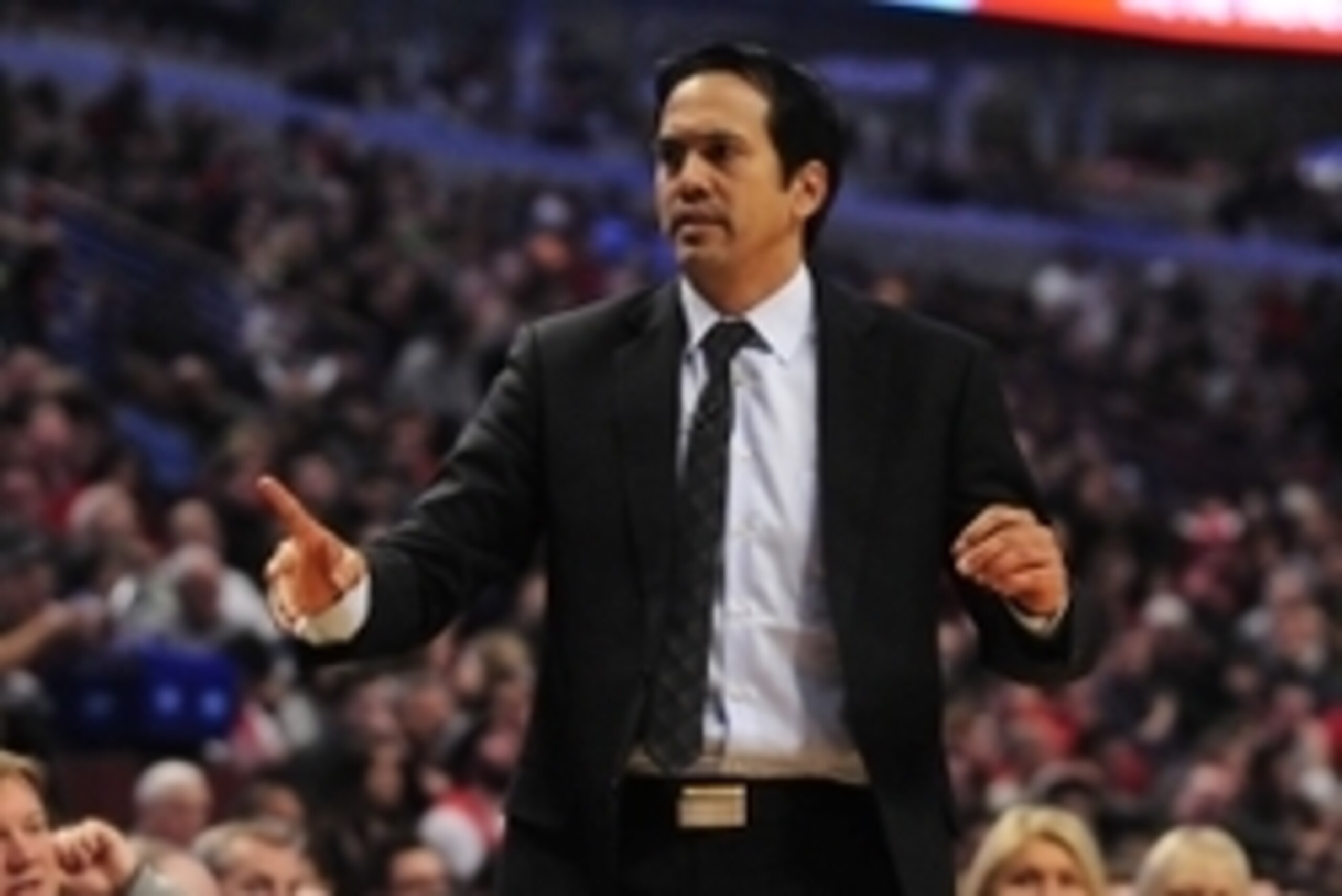
"Strong balance, being able to control it without it being taken away," Spoelstra said. "That's the residual of hours and hours and hours of work."
Whiteside has been willing to put that in, following years of frustration. He's also been willing to take counsel from teammates, such as Bosh, who is helping him deal with the sudden success by "telling him what he's doing wrong. I never want him to really get comfortable, because this is not a comfortable game, if you want to be successful. It's comfy if you just want to lose and just go home in mid-April.
"But I don't want him to get complacent. I want him to continue to strive for something, so I'm going to point out his mistakes, and what I want him to improve on. I know how things can change. The storm has come up on him fairly quickly."
Bosh wants Whiteside to be ready for teams game-planning against him and not allowing him to do what he wants to do. Whiteside still did what he wanted Friday, posting a statline that no Heat player had approached since Shaquille O'Neal in 2004.
The postgame questions seemed to present more problems than any of the Mavericks did. He took great care not to create any issues, even after a nine-point lead became a 12-point deficit while he sat. He said that he was "just blessed to be here," and that any questions about his minutes should be addressed to "Coach Spo," since he didn't know what to say but that, naturally, "everybody wants to play."
Otherwise, he characterized himself as "speechless."
Which is what we all have been while watching him.
Ethan Skolnick covers the NBA for Bleacher Report.




.jpg?w=2560 "Love's Body Already 'Tired'")
.jpg?w=2560 "Tyreek Deal May Come Soon")

.jpg?w=2560 "Mahomes' Wife Trolls Kubiak 💀")